Category Archives: Education

This is education score

Why STEM Education Is Important in Schools Today

Why STEM Education Is Important in Schools

Modern classrooms face a fast-changing world driven by technology. Consequently, understanding why STEM education is important in schools has become crucial for all educators. Science, Technology, Engineering, and Mathematics (STEM) learning goes beyond simple memorization. Instead, it provides a hands-on approach that teaches students to solve complex problems. For example, according to insights from the National Science Foundation, fostering early interest in science and math builds essential skills. Ultimately, these skills prepare young learners for a technical global economy.

Furthermore, STEM education does not treat academic subjects as separate units. Rather, it connects them through real-world applications. Therefore, by introducing these concepts early, schools help students build logic and curiosity. In addition, beyond improving test scores, this training equips children to adapt to shifting job markets. In this guide, we will explain why STEM education is important in schools, how it transforms classrooms, and why these core skills matter for every student.

Why Is STEM Education Necessary Today?

STEM education is necessary today because the global economy increasingly depends on people who can adapt, innovate, and solve complex problems. Traditional rote memorization alone no longer prepares students for success in a technology-driven world. Employers now value individuals who can analyze information, think critically, collaborate effectively, and apply knowledge across multiple disciplines.

By combining science, technology, engineering, and mathematics into a unified learning approach, STEM education bridges the gap between classroom theory and practical application. Students learn to view challenges as interconnected problems that require creative and evidence-based solutions. This approach strengthens resilience, adaptability, and technical literacy from an early age.

As industries continue evolving through automation, artificial intelligence, and digital transformation, students need skills that remain relevant in changing workplaces. STEM education encourages innovation while preparing learners to become creators of technology instead of passive consumers. It also builds confidence, improves decision-making, and promotes lifelong learning.

Ultimately, investing in STEM education helps students prepare for rewarding careers while enabling societies to remain competitive in a rapidly evolving global economy.

Preparing Students for Modern Workforce Demands

Today’s industries increasingly rely on automation, artificial intelligence, robotics, and data analytics. Schools must adapt their curriculum to reflect these changes and reduce future skills gaps. Students who participate in hands-on STEM projects gain practical experience that closely resembles real workplace environments.

Project-based learning also improves communication, teamwork, and problem-solving abilities. These transferable skills are valuable across industries, including healthcare, manufacturing, finance, education, and information technology. Early exposure to STEM careers helps students explore future opportunities with greater confidence and purpose.


Why Is STEM Important in the Classroom?

STEM plays a vital role in modern classrooms because it transforms students from passive learners into active investigators and problem-solvers. Rather than simply reading about scientific concepts, students conduct experiments, build prototypes, write code, and test ideas through practical activities. This hands-on approach makes learning more engaging while improving understanding and long-term knowledge retention.

Teachers become facilitators who guide inquiry instead of simply delivering information. Students ask meaningful questions, test hypotheses, evaluate evidence, and refine their ideas through continuous exploration. This learning model develops curiosity while encouraging independent thinking and creativity.

STEM classrooms also emphasize collaboration. Students work together to solve problems, communicate ideas clearly, and respect different viewpoints. These experiences mirror real workplace environments where teamwork is essential. As a result, learners develop both technical knowledge and valuable interpersonal skills.

By making lessons relevant to everyday life, STEM education creates a classroom environment where students stay motivated, actively participate, and better understand how their education connects to the world around them.

Fostering Inquiry-Based Learning and Curiosity

Inquiry-based learning encourages students to take ownership of their education. Instead of providing immediate answers, teachers present real-world challenges that require investigation and experimentation.

Students learn to ask questions, gather evidence, test solutions, and improve their ideas through trial and error. They also discover that mistakes are valuable learning opportunities. This process builds critical thinking, confidence, curiosity, and the ability to learn independently throughout life.


What Is STEM Education and Why Does It Matter?

STEM education is an interdisciplinary approach that integrates science, technology, engineering, and mathematics into connected, real-world learning experiences. Instead of teaching these subjects separately, educators combine them through practical projects that demonstrate how different disciplines work together to solve everyday problems.

This approach matters because it helps students understand how scientific discoveries influence engineering, how mathematics supports programming, and how technology improves modern life. Rather than memorizing isolated facts, learners develop a deeper understanding of concepts by applying them in meaningful situations.

STEM education also prepares students to address global challenges such as climate change, cybersecurity, healthcare innovation, renewable energy, and sustainable resource management. These issues require individuals who can think across multiple disciplines and develop creative, evidence-based solutions.

By promoting collaboration, innovation, and analytical thinking, STEM education prepares students for future careers while helping them become informed citizens capable of contributing to technological and scientific progress.

Connecting Academic Theory to Real-World Applications

Connecting classroom lessons with real-life applications makes difficult concepts easier to understand. When students design a bridge, build a robot, or create a simple computer program, abstract theories become practical experiences.

This hands-on learning improves comprehension, strengthens memory, increases motivation, and helps students appreciate the real-world value of science, technology, engineering, and mathematics.


What Are the Three Importance of STEM?

The three major benefits of STEM education are fostering innovation, strengthening critical thinking, and supporting long-term economic growth. Together, these pillars prepare students for personal success while helping communities remain competitive in an increasingly technology-focused world.

First, STEM promotes innovation by combining technical knowledge with creativity. Students learn how to develop new ideas, improve existing solutions, and contribute to scientific and technological advancement.

Second, STEM strengthens critical thinking by teaching learners to evaluate evidence, question assumptions, analyze information, and make informed decisions. These skills are essential in an age of rapid technological change and widespread digital information.

Third, STEM supports economic growth by preparing a skilled workforce for high-demand careers. Countries with strong STEM education systems are better positioned to attract investment, encourage entrepreneurship, and remain globally competitive.

By focusing on these three areas, educational institutions equip students with practical skills that benefit both their careers and society as a whole.

Driving Economic Growth and Global Competitiveness

Countries with strong STEM talent attract investment, encourage innovation, and support thriving industries. A skilled workforce enables businesses to develop advanced technologies, expand research, and compete internationally.

Prioritizing STEM education also creates high-paying career opportunities, strengthens startup ecosystems, and improves long-term economic resilience. Investing in technical education today helps build a more competitive and prosperous future.


FAQ

How does STEM education differ from traditional learning?

Understanding why STEM education is important in schools starts with how it differs from traditional learning. STEM education integrates science, technology, engineering, and mathematics into project-based learning instead of teaching each subject separately. Traditional learning often emphasizes memorization and isolated concepts.

In contrast, STEM focuses on hands-on activities, teamwork, experimentation, and solving real-world problems. Students actively apply classroom knowledge, helping them develop practical skills that prepare them for future careers and everyday decision-making. This practical approach is one of the main reasons why STEM education is important in schools, as it encourages critical thinking, creativity, and innovation.

At What Age Should Children Start Learning STEM Concepts?

Children can begin exploring basic STEM concepts during preschool through play-based activities such as building blocks, puzzles, nature observation, and simple experiments. Early exposure encourages curiosity and helps children understand how the world works.

Age-appropriate STEM experiences build confidence in mathematics and science while reducing anxiety toward technical subjects later in school. Introducing these concepts early also supports problem-solving, creativity, and logical thinking that benefit learning throughout life.

Do Students Need to Pursue Engineering Careers to Benefit from STEM?

No. Students do not need to become engineers, programmers, or scientists to benefit from STEM education. The skills developed through STEM—including critical thinking, collaboration, communication, creativity, and digital literacy—are valuable in nearly every profession.

Whether students choose careers in healthcare, business, education, law, finance, or the arts, STEM helps them analyze information, solve problems efficiently, and make better decisions in both professional and personal settings.

How Can Parents Support STEM Learning at Home?

Parents can encourage STEM learning by creating opportunities for curiosity and exploration during everyday activities. Cooking, gardening, building projects, puzzles, and simple science experiments all help children develop logical thinking and problem-solving skills.

Parents can also ask open-ended questions, encourage children to test ideas, and promote creative play instead of excessive passive screen time. Supporting curiosity at home helps children build confidence, enjoy learning, and develop habits that contribute to lifelong academic and personal success.


CONCLUSION

In summary, understanding why STEM education is important in schools is essential for creating a forward-thinking educational system. Broadly speaking, understanding why education is important in our life helps us see how foundational learning shapes individual growth and long-term societal progress. By integrating science, technology, engineering, and mathematics into daily instruction, school districts provide young learners with vital tools. Specifically, they cultivate intellectual resilience, systematic problem-solving skills, creative adaptability, and cooperative habits that benefit students across all areas of life.

Ultimately, these core competencies prepare students to succeed in high-growth technical careers. In addition, they equip them to navigate an increasingly digital world safely and effectively. Therefore, investing in early, equitable, and engaging technical education ensures that every child has the opportunity to discover their true potential. Above all, school administrators, teachers, parents, and local communities must work together. Together, they must make hands-on, interdisciplinary learning a standard feature in every modern classroom.

Education Systems Around the World: Top Countries Compared

Education Systems Around the World: Top Countries Compared

Parents, policymakers, and educators constantly debate how to properly prepare students for the future. When we analyze education systems around the world, massive differences in student performance, teacher training, and overall equity become immediately apparent. To truly understand these international variations, experts frequently rely on benchmark data from the Organisation for Economic Co-operation and Development (OECD). Certain nations consistently produce top-tier graduates, while other regions continually struggle to close the achievement gap.

This global assessment evaluates 15-year-old students in mathematics, reading, and science. The detailed results give us a very clear picture of which countries excel and exactly why they succeed.

So, what makes a country truly great at educating its youth? Is it heavy financial funding, less daily homework, or highly respected teachers? The actual answers might surprise you. In some progressive nations, students spend fewer hours in the classroom but achieve significantly higher test scores. Alternatively, rigorous standardized testing remains the absolute cornerstone of academic success in other regions.

In this article, we will compare the top countries for learning. We will break down their primary teaching methods, cultural attitudes toward education, and specific policies that drive student success. Whether you are an educator looking for new strategies or a parent curious about global academic standards, this comprehensive guide provides valuable insights. Let us dive into what makes these global learning models so successful.

Which Country Has the Highest Ranked Education System?

When comparing education systems around the world, Finland and Singapore consistently rank among the global leaders. Both countries perform exceptionally well in international education rankings because they invest heavily in quality teaching, student success, and long-term learning outcomes. Although their approaches differ, each system demonstrates that strong educational policies produce excellent academic results.

Finland focuses on educational equity, teacher autonomy, and student well-being. Children experience less academic pressure during their early years, allowing them to develop strong problem-solving and critical-thinking skills. Teachers enjoy significant professional independence and adapt lessons to meet students’ individual needs.

Singapore follows a more structured model with high academic expectations. Its curriculum emphasizes mathematics, science, and analytical thinking. The government also invests substantially in teacher development, curriculum research, and classroom innovation. These strategies help students consistently achieve top scores in international assessments.

Rather than relying only on standardized testing, both countries emphasize high-quality teaching and continuous improvement. Their success shows that professional teacher training, balanced learning environments, and strong government support create lasting educational excellence across all grade levels.

The Role of Teacher Training

One of the defining characteristics of top-performing education systems around the world is their investment in teacher quality. Countries with outstanding academic performance treat teaching as a highly respected profession and maintain rigorous standards for entering the field. This approach strengthens classroom instruction and improves student outcomes across subjects.

Many leading nations require teachers to complete advanced education, often including master’s degrees, before entering the profession. They also provide competitive salaries, ongoing professional development, and mentoring throughout a teacher’s career. Continuous training helps educators stay current with modern teaching methods and educational research.

Well-prepared teachers can adapt lessons to different learning styles, encourage critical thinking, and create engaging classroom environments. These investments lead to better academic achievement, stronger student confidence, and improved long-term educational success. High-quality teaching remains one of the most important factors behind consistently successful education systems.

Which Rank Is India in Education?

India operates one of the world’s largest and most diverse education systems, serving hundreds of millions of students through public and private institutions. Because ranking methods vary across international organizations, India’s position differs depending on the indicators being measured. Assessments may consider literacy rates, higher education quality, learning outcomes, workforce skills, or student performance in global studies.

India generally falls within the middle tier of global education rankings. Major cities are home to internationally recognized universities, engineering colleges, and research institutions. However, many rural areas continue to face challenges related to infrastructure, teacher availability, funding, and student retention.

The National Education Policy (NEP) seeks to address these issues through curriculum modernization, stronger foundational literacy, vocational education, digital learning, and flexible learning pathways. As implementation expands, these reforms aim to improve educational quality while reducing regional disparities and preparing students for future employment opportunities.

Addressing Rural Educational Gaps

Reducing the educational gap between urban and rural communities remains one of India’s highest priorities. Equal access to quality education helps improve literacy, employment opportunities, and long-term economic development. Continued investment in underserved regions is essential for creating a stronger national education system.

Governments and educational organizations are expanding digital classrooms, internet connectivity, teacher training, and school infrastructure across rural districts. Better transportation, updated facilities, and improved access to learning materials also help increase student participation and retention.

These improvements create more equitable learning opportunities for children regardless of where they live. As technology adoption grows and infrastructure continues to improve, rural students gain greater access to modern educational resources, helping narrow achievement gaps across the country.

Which Are the Top 10 Educated Countries in the World?

The top educated countries in the world are typically identified using indicators such as literacy rates, higher education participation, average years of schooling, and academic performance. Although rankings vary by organization and methodology, several nations consistently appear among the global leaders because of their strong educational investments and learning outcomes.

Countries frequently included in the top ten are Singapore, Finland, Japan, South Korea, Canada, the United Kingdom, Switzerland, the Netherlands, Norway, and Denmark. These nations prioritize public investment in schools, high-quality teacher preparation, accessible higher education, and continuous curriculum improvement.

Many also encourage lifelong learning through adult education, vocational training, and research opportunities. Their commitment to innovation and educational excellence supports economic growth while preparing citizens with the knowledge and skills needed in a rapidly changing global economy.

Higher Education Access

Affordable higher education plays a major role in the success of leading education systems. Many top-performing countries reduce financial barriers through government funding, scholarships, or subsidized university tuition. This approach allows more students to pursue advanced education regardless of their economic background.

Strong public investment helps universities maintain high academic standards while expanding research opportunities and professional training. Students benefit from better facilities, experienced faculty, and greater access to specialized programs that match workforce needs.

When higher education remains accessible, countries develop a more skilled workforce, encourage innovation, and improve long-term economic competitiveness. Expanding educational opportunities also supports social mobility by giving students from diverse backgrounds a fair chance to succeed.

Which Education System Is Best in the World?

Determining the best education system in the world depends on the goals a country values most. Different education models emphasize different strengths, making it difficult to identify a single universal standard. Some prioritize academic excellence, while others focus on creativity, student well-being, or practical life skills.

Finland is widely recognized for its student-centered approach, limited standardized testing, and emphasis on mental well-being. Singapore stands out for outstanding academic achievement, particularly in mathematics and science, supported by a structured curriculum and highly trained teachers. South Korea also performs exceptionally well through strong academic discipline and high educational expectations.

The most effective education systems around the world combine academic rigor with creativity, critical thinking, collaboration, and emotional support. This balanced approach prepares students not only for examinations but also for higher education, careers, and lifelong learning in an evolving global economy.

Balancing Rigor and Well-Being

Successful education systems recognize that academic achievement and student well-being should complement each other. Strong learning outcomes become more sustainable when students feel supported, motivated, and engaged throughout their education.

Leading countries increasingly combine challenging academic standards with counseling services, extracurricular activities, and flexible teaching methods. These strategies help reduce excessive stress while encouraging curiosity, creativity, and independent thinking.

Maintaining this balance allows students to build strong foundational knowledge without sacrificing their mental health. As education continues to evolve, integrating academic excellence with emotional well-being remains a defining characteristic of high-performing school systems worldwide.

What is the 5 3 3 4 system of education?

The 5 3 3 4 system of education is a progressive schooling framework designed to align learning stages with a child’s cognitive development. Introduced as part of modern educational reforms, such as India’s National Education Policy, this structure replaces older models to ensure continuous growth. It divides formal schooling into four distinct stages: foundational, preparatory, middle, and secondary. By categorizing education this way, schools can tailor teaching methods to specific age groups. This approach emphasizes activity-based learning in early years and gradual transitions toward critical thinking and multidisciplinary subjects later on. Ultimately, it aims to reduce heavy exam burdens while fostering holistic skill development for every student.

The Stages of the Framework

This structured model breaks down a student’s academic journey into clear, manageable blocks. The foundational stage covers ages three to eight, focusing on play-based learning. Subsequent stages gradually introduce formal subjects, scientific inquiry, and vocational training options. This phased progression ensures children build a strong cognitive foundation before tackling advanced concepts in high school.


Frequently Asked Questions

What role do standardized tests play in top education systems?

Standardized tests serve different purposes across education systems around the world. Singapore uses structured assessments to measure progress and maintain high academic standards. Finland, however, places less emphasis on high-stakes examinations and relies more on classroom assessments, teacher evaluations, and continuous feedback. Both approaches aim to improve learning, but they reflect different educational philosophies.

How does public funding impact school quality globally?

Public funding strongly influences school quality by supporting teacher salaries, classroom resources, infrastructure, technology, and student services. Countries that invest consistently in education often achieve better academic performance, lower student-to-teacher ratios, and improved learning environments. Sustainable funding also helps schools adapt to changing educational needs and maintain long-term quality.

Why do Scandinavian countries perform so well academically?

Scandinavian countries emphasize educational equity, highly qualified teachers, student well-being, and equal access to quality schools. Students benefit from comprehensive social support, including healthcare and school meals, which reduces socioeconomic barriers to learning. This balanced approach contributes to consistently strong academic outcomes and lifelong educational success.

Can developing nations replicate top-performing education models?

Developing nations can adopt many successful practices from leading education systems, including improved teacher training, stronger foundational literacy, curriculum modernization, and gradual infrastructure improvements. Complete replication is rarely practical because economic, cultural, and policy environments differ. However, carefully planned reforms and sustained investment can significantly improve educational quality over time.


CONCLUSION

Understanding how different nations educate their youth offers valuable lessons for the future. By analyzing education systems around the world, we clearly see that there is no single magical formula for success. However, exploring classroom differences based on countries reveals that the best nations for learning share common priorities. They respect their teachers, prioritize student well-being, and ensure equitable access to educational resources across all communities.

Whether we look at the high-performing mastery model in Singapore or the progressive classrooms of Finland, the ultimate goal remains exactly the same. These forward-thinking nations purposefully prepare their students to navigate a complex, rapidly changing global economy. Leaders in these countries understand that a strong educational foundation is the greatest economic asset a nation can build.

Policymakers, parents, and educators everywhere must take extensive notes from these global leaders. We cannot simply copy and paste another country’s system, but we can intelligently adapt their best practices. Investing equitably in public schools will inevitably yield much better outcomes for everyone.

Student Loan Guidelines 2026: Everything You Need to Know

A Complete Guide to Student Loan Guidelines in 2026

Figuring out how to pay for college can feel overwhelming. With rising tuition costs, most families eventually need to explore borrowing options. If you are preparing for higher education, understanding the latest student loan guidelines is absolutely essential. These rules dictate everything from how much money you can borrow to how you will eventually pay it back. By familiarizing yourself with the official Federal Student Aid requirements provided by the U.S. Department of Education, you can make smarter financial decisions that protect your future.

Education debt is a serious commitment, but it does not have to be a lifelong burden. Knowing the right steps to take before you sign a promissory note gives you total control over your finances. Today, borrowing parameters frequently change. New repayment plans emerge, interest rates fluctuate, and forgiveness programs face legislative updates. Therefore, you need accurate, up-to-date information to navigate this complex landscape.

In this comprehensive article, we will explore the core rules you must know before borrowing. We will break down current borrowing limits, explain the crucial differences between federal and private lenders, and highlight the best repayment strategies available today. Whether you are an incoming freshman, a graduate student, or a parent supporting your child, this guide will provide the absolute clarity you need to succeed.

Understanding Basic Student Loan Guidelines

Before you borrow a single dollar, you must grasp the foundational rules of college financing. The government sets specific parameters to protect both the borrower and the lender. These foundational student loan guidelines determine who qualifies for aid, how interest accrues, and what responsibilities you hold after graduation.

You must complete the Free Application for Federal Student Aid (FAFSA) every year to access government funding. The information you provide dictates your financial need. Consequently, your school uses this data to build a custom financial aid package.

Federal vs. Private Education Funding

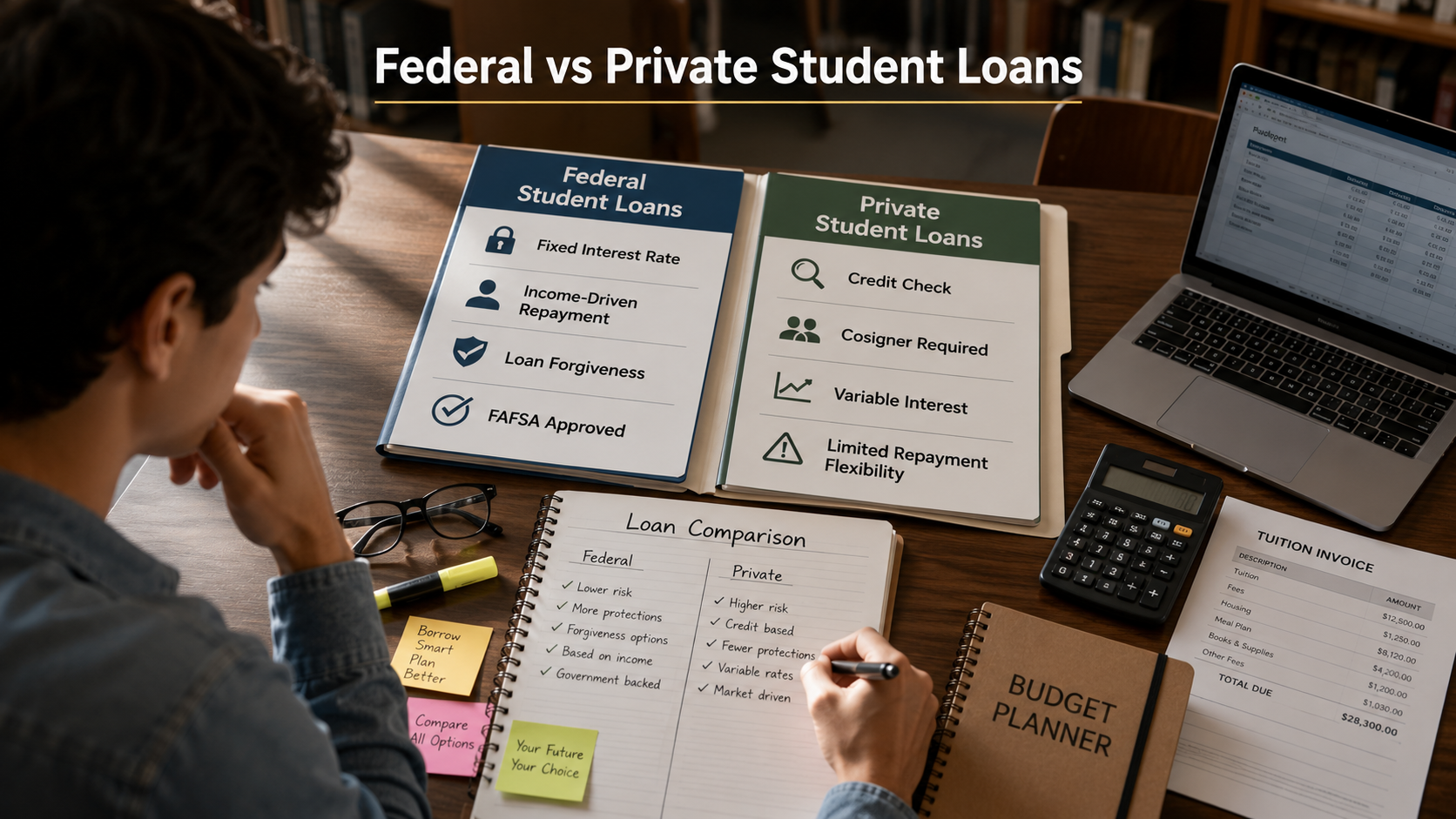
Borrowers generally choose between two main types of debt: federal and private.

  • Federal funding: The government funds these options. They offer fixed interest rates, income-driven repayment plans, and forgiveness programs. Federal loans almost never require a credit check or a cosigner.

  • Private funding: Banks, credit unions, and online lenders provide these options. They require a credit check and usually demand a cosigner. Private lenders set their own rules, which means they rarely offer flexible repayment options.

Always exhaust your federal options before turning to private lenders. Federal loans offer built-in safety nets that private lenders simply do not match.

What Is the New Student Loan Plan for 2026?

The new student loan plan for 2026 introduces streamlined income-driven repayment (IDR) options designed to reduce monthly payments for many undergraduate borrowers. Under the updated framework, the government aims to cap discretionary income at more affordable levels, helping low- and middle-income graduates manage repayment without excessive financial strain. The application process has also become simpler through integrated digital portals, reducing paperwork and administrative delays. In addition, revised interest subsidy rules help prevent qualifying borrowers from seeing their balances grow because of unpaid interest. These changes are intended to make repayment more predictable and financially sustainable. Financial experts recommend reviewing the updated repayment options before selecting a plan. Comparing your expected income, career path, and long-term financial goals can help you choose the repayment strategy that offers the greatest savings over the life of your student loan.

Impact on Monthly Discretionary Income Caps

One of the most significant changes in the 2026 student loan plan is the adjustment to monthly discretionary income caps. The updated formula lowers the percentage of discretionary income used to calculate monthly payments for many eligible borrowers. As a result, recent graduates can keep more of their income during the early stages of their careers, when salaries are often lower and living expenses can be challenging. Lower monthly payments improve cash flow and make it easier to cover essentials such as housing, transportation, and savings. These changes also reduce the likelihood of missed payments caused by financial pressure. Borrowers should review their income annually and update their repayment information when required. Staying enrolled in the appropriate income-driven repayment plan ensures they continue receiving the maximum benefit while keeping their student loan payments affordable over time.

What Is the Minimum Student Loan for 2026–2027?

The minimum student loan amount for the 2026–2027 academic year depends primarily on your school’s Cost of Attendance (COA), federal borrowing limits, and lender requirements. Federal Direct Loans generally do not impose a nationwide minimum borrowing amount. However, colleges and private lenders may require students to borrow a minimum amount, often around $1,000, before approving a loan. This flexibility allows students to borrow only what they truly need for tuition, mandatory fees, books, and essential living expenses. Borrowing responsibly helps reduce future repayment costs and minimizes unnecessary interest charges. Before accepting a loan offer, calculate your education expenses carefully and explore scholarships, grants, and savings first. Your school’s financial aid office can explain any institution-specific borrowing requirements and help you determine the most appropriate loan amount.

Navigating Private Lender Minimums Successfully

Private lenders often establish minimum loan amounts to offset administrative and processing costs. These requirements vary by lender, making it important to compare multiple loan providers before applying. Some lenders may require higher minimum borrowing amounts than others, while eligibility criteria can also differ based on credit history or a co-signer. Planning your semester budget in advance helps you borrow only what you need while still meeting lender requirements. Avoid taking extra funds simply because they are available. Every additional dollar borrowed may increase the total interest paid over the life of the loan. Comparing interest rates, repayment terms, fees, and borrower benefits can help you select the most cost-effective financing option while keeping future debt manageable.

What Are the New Guidelines for Student Loans?

The new student loan guidelines for 2026 focus on greater transparency, stronger borrower protections, and increased accountability across federal and private lending programs. Lenders must provide clearer disclosures showing the estimated total repayment cost before borrowers sign loan agreements. Updated policies also strengthen default prevention by requiring loan servicers to offer counseling and alternative repayment solutions before accounts enter serious delinquency. These measures help students make informed financial decisions while reducing the risk of unexpected repayment challenges. Educational institutions are also expected to provide more comprehensive financial literacy resources before students accept federal or private loans. Together, these improvements encourage responsible borrowing and help students better understand their financial obligations throughout the borrowing and repayment process.

Enhanced Consumer Protection and Fee Transparency

Recent policy updates place a stronger emphasis on consumer protection and transparent loan terms. Borrowers now receive clearer explanations of interest calculations, repayment schedules, and any applicable fees before accepting a loan. Many updated regulations also reduce or eliminate hidden charges that previously increased borrowing costs unexpectedly. Simple, easy-to-understand loan documentation allows students to make informed decisions without navigating complex financial language. Better transparency also helps borrowers understand when interest begins accruing, how repayment options work, and what happens if payments are missed. These protections support more responsible borrowing and reduce the likelihood of unpleasant financial surprises. Reading all loan documents carefully remains essential, even with stronger disclosure requirements.

What Is the Education Loan in 2026?

An education loan in 2026 reflects a more modern approach to financing higher education. Today’s loan products are designed to match rising tuition costs while offering greater convenience through digital banking technology. Many lenders now provide flexible disbursement schedules that align with semester or quarterly billing cycles, ensuring students receive funds when they are needed most. Borrowers can also manage their accounts through secure online dashboards that allow them to monitor balances, submit documents, request deferments, and review repayment progress. Education loans now support a wider range of academic pathways, including university degrees, vocational programs, technical certifications, and online learning. These innovations make student financing more accessible and improve the overall borrowing experience for students pursuing traditional and non-traditional educational opportunities.

Digital Integration and Smart Repayment Tracking

Modern student loan platforms include advanced digital tools that simplify account management throughout the repayment journey. Mobile apps and online dashboards allow borrowers to monitor balances, receive payment reminders, download statements, and update personal information from anywhere. Many lenders also encourage automatic payments by offering small interest rate discounts to eligible borrowers. Automated billing helps reduce missed payments while supporting consistent repayment habits. Digital account management also makes it easier to request deferment, review repayment history, or switch eligible repayment plans when financial circumstances change. These technology-driven features improve convenience, increase payment accuracy, and encourage long-term financial responsibility, making student loan management significantly easier than in previous years.

How much student loan can I get in 2026?

Determining your borrowing capacity depends on several vital factors governed by lenders and institutional policies. Under current guidelines, the exact amount you can secure varies based on your chosen course, university reputation, and total cost of attendance. Undergraduate students typically face different borrowing limits compared to graduate or professional degree seekers. Private lenders and financial institutions evaluate your credit history, co-signer strength, and future earning potential before approving large sums. Furthermore, universities calculate your financial need by subtracting your expected family contribution from the total cost. This ensures that you only borrow what is necessary to cover tuition, housing, and essential study materials. Proper budget planning keeps your post-graduation debt manageable and prevents unnecessary financial strain.

Assessing Your Total Cost of Attendance

Lenders carefully evaluate the complete cost of attendance provided by your academic institution. This calculation encompasses tuition fees, accommodation, textbooks, transportation, and daily living expenses. Providing accurate estimates ensures your approved loan amount closely matches your actual financial requirements during the academic year.

Can I get a 100% student loan?

Securing full coverage for your academic expenses is a common goal for many aspiring scholars worldwide. While 100 percent financing is possible, it largely depends on the lender, your academic profile, and collateral availability. Public lenders often impose caps that cover a significant portion of tuition, leaving students to arrange margin money for living costs. However, specialized financial institutions and premium banks sometimes offer complete coverage for top-tier universities or high-demand professional programs. Achieving full funding usually requires a strong co-signer with an excellent credit score or valuable tangible collateral like property. Students must carefully weigh the long-term interest implications of borrowing the entire cost upfront before committing to a massive debt burden.

Role of Collateral in Full Financing

Providing secure collateral significantly increases your chances of obtaining complete educational funding from traditional lenders. Real estate, fixed deposits, or government bonds act as strong security guarantees for banks. This security minimizes lender risk, allowing them to disburse the entire cost of your education smoothly.

Education loan by Government

Government-backed financial assistance remains one of the most reliable and affordable ways to fund higher studies. These programs are designed to support deserving students by offering lower interest rates and flexible moratorium periods. Most government schemes do not require immediate repayment while you are studying, giving you peace of mind. Additionally, many nationalized initiatives waive processing fees and provide special subsidies for economically weaker sections or female students. Applicants must complete thorough verification processes and submit academic admission proofs to qualify for these beneficial public funds. Checking official state or federal education portals ensures you never miss crucial deadlines for application submissions.

Benefits of Moratorium Periods

Government loans typically feature a helpful moratorium period that lasts throughout your course duration plus a grace period. During this window, you are not obligated to make principal or interest repayments. This crucial breather allows you to focus entirely on your academics without immediate financial pressure.

Education loan debt calculator

Managing your future finances effectively requires a clear understanding of your monthly repayment obligations before signing any agreement. An education loan EMI calculator is a digital tool that instantly computes your Equated Monthly Installments based on specific variables. By inputting your desired loan amount, applicable interest rate, and repayment tenure, you instantly see your monthly breakdown. This transparency helps you choose a tenure that aligns with your projected post-graduation salary expectations. Experimenting with different numbers allows you to find a comfortable balance between affordable monthly payments and total interest outgo. Utilizing this tool prevents unpleasant surprises and builds financial discipline long before your repayment phase officially begins.

Impact of Tenure on Total Interest

Choosing a longer repayment tenure reduces your monthly EMI amount, making payments feel manageable right after graduation. However, extending the timeline significantly increases the total cumulative interest paid over the life of the loan. Shorter tenures save money overall but demand higher monthly installments from your starting salary.


Frequently Asked Questions

How do I apply for the updated federal student loan programs?

Applying for updated federal student loan programs begins with completing the Free Application for Federal Student Aid (FAFSA) through the official government website. Review the latest student loan guidelines before submitting your application so you understand the current eligibility requirements and repayment options. Submit your FAFSA as early as possible to meet your school’s priority deadlines and maximize your financial aid eligibility. After processing, your college or university will provide a financial aid offer outlining available grants, scholarships, work-study opportunities, and federal student loans. Carefully review the award letter before accepting any loan. Compare repayment plans, estimated monthly payments, and long-term borrowing costs. If you have questions, contact your institution’s financial aid office for guidance before finalizing your borrowing decisions.

Can I refinance my existing loans under the 2026 guidelines?

Refinancing existing student loans remains an option in 2026, but borrowers should evaluate the benefits and potential drawbacks carefully. The latest student loan guidelines continue to encourage borrowers to compare all available options before refinancing federal loans with a private lender. While refinancing may reduce your interest rate if you have strong credit and stable income, it often means giving up federal benefits such as income-driven repayment, deferment, and certain loan forgiveness programs. Compare offers from multiple lenders, including interest rates, repayment terms, fees, and borrower protections. Calculate your long-term savings instead of focusing only on a lower monthly payment. A careful comparison helps determine whether refinancing supports your financial goals.

What happens if I miss a student loan payment under the new rules?

Missing a student loan payment does not automatically place your loan in default. Under the updated student loan guidelines, your loan servicer typically sends reminders and contacts you to discuss available assistance before the situation becomes more serious. Depending on your eligibility, you may qualify for forbearance, deferment, or an alternative income-driven repayment plan. Responding quickly to your loan servicer is essential because early communication often prevents additional fees and protects your credit history. Ignoring missed payments can eventually lead to delinquency and more severe financial consequences. Staying proactive and seeking assistance at the first sign of financial hardship gives you the best opportunity to keep your student loans in good standing.

Are graduate students eligible for the new 2026 repayment structures?

Graduate and professional students may qualify for portions of the updated 2026 repayment framework, although eligibility rules differ from those for undergraduate borrowers. The latest student loan guidelines outline separate borrowing limits, repayment options, and eligibility requirements for many graduate-level federal loan programs. Many graduate students rely on specialized borrowing options, such as Grad PLUS Loans, which have unique repayment terms. Before borrowing, review available repayment plans, projected monthly payments, and long-term borrowing costs. Graduate students with higher loan balances may benefit from selecting an income-driven repayment strategy that matches their expected earnings. Consulting financial aid professionals or trusted financial advisors can help determine the most suitable repayment approach.


Conclusion

Managing your education debt successfully comes down to preparation, organization, and knowledge. The world of college financing often seems complicated, but you can master it by paying close attention to the rules. Understanding the specific student loan guidelines that govern your borrowing gives you a significant advantage. You will know exactly how much you can safely borrow, how to secure the lowest interest rates, and which repayment plans fit your future budget.

Always remember to prioritize federal funding over private options. Federal programs offer unmatched flexibility, including income-driven repayment and powerful forgiveness options like PSLF. Keep your loan servicer informed of any changes to your address or income. If you ever face financial hardship, contact them immediately instead of ignoring your payments. They provide deferment and forbearance options designed to help you avoid default.

If you’re also exploring ways to reduce your overall education costs, consider applying for financial aid programs alongside student loans. You can discover several funding opportunities in our guide on Top Scholarships for Indian Students, which can help minimize borrowing and lower your long-term debt burden.

Ultimately, your education is a valuable investment in your future earning potential. Treat your debt responsibly, review your loan documents carefully, and stay informed about policy changes. By applying the strategies outlined in this guide while taking advantage of scholarship opportunities, you can confidently manage your finances and pay off your student loans faster.

What Is The Heat Island Effect? (Why It Affects Cities)

What Is The ‘Heat Island’ Effect, And Why Does It Only Affect Cities?

Have you ever noticed that a busy downtown area feels much hotter than a quiet country road? This temperature difference is not just your imagination. It is a proven scientific phenomenon known as the heat island effect. According to the United States Environmental Protection Agency (EPA), urban structures absorb and re-emit the sun’s heat much more intensely than natural landscapes. When summer temperatures spike, this effect quickly turns concrete jungles into literal ovens.

But why does this extreme heat specifically target urban areas? We will explore exactly why modern cities trap so much warmth. You will discover the science behind rising urban temperatures and why rural areas stay naturally cooler. We will also look at the real-world health, energy, and environmental consequences of living in hot cities.

Cities often experience drastically higher temperatures during the day. However, they struggle even more to cool down at night. Buildings and roads hold onto thermal energy for hours. After the sun sets, they slowly release this stored heat back into the surrounding air. This continuous cycle prevents the local environment from finding any meaningful relief.

Understanding the heat island effect matters now more than ever. As global temperatures continue to rise, urban populations face increasing risks. Let’s dive into the core causes of this urban phenomenon and learn how we can build cooler, safer, and greener neighborhoods.

What Causes the Heat Island Effect in Cities?

The urban heat island effect occurs because cities absorb, store, and generate far more heat than surrounding rural areas. Natural landscapes with trees, grass, and soil are replaced by buildings, roads, and parking lots made from concrete, asphalt, and other dense materials. These surfaces absorb large amounts of solar radiation during the day instead of reflecting it or cooling through natural evaporation.

After sunset, the stored heat is released slowly into the surrounding air, keeping cities warmer throughout the night. Human activities add even more heat to the urban environment. Air conditioners, vehicles, industrial facilities, and electrical equipment constantly release waste heat into the atmosphere. In addition, tall buildings reduce airflow by blocking natural wind patterns. Limited vegetation also reduces shade and evapotranspiration, making it harder for cities to cool naturally. Together, these factors create higher temperatures that define the urban heat island effect.

Human Activities and Energy Consumption

Human activity is one of the biggest contributors to the urban heat island effect. Every vehicle engine, factory, and air conditioning system produces waste heat that warms nearby air. As cities grow, energy consumption rises, increasing the amount of heat released into the environment.

Dense neighborhoods with heavy traffic and large commercial buildings generate heat throughout the day and night. Air conditioning systems create a cycle by cooling indoor spaces while releasing hot air outdoors. Industrial operations and public transportation also contribute to higher urban temperatures. Since this waste heat never fully disappears, cities remain significantly warmer than nearby rural areas, especially after sunset. Reducing energy use, improving building efficiency, and adopting cleaner technologies can help lower this additional heat.

What Cities Are Most Affected by Heat Islands?

Cities with dense development, extensive concrete surfaces, and limited green space experience the strongest urban heat island effect. Large metropolitan areas in warm climates often record temperatures several degrees higher than nearby rural regions. Urban expansion replaces natural vegetation with roads, buildings, and parking lots that absorb and retain solar heat throughout the day.

Cities such as Phoenix, Houston, and New York frequently experience significant urban warming because of their size, population density, and built environments. Heavy traffic, tall buildings, and limited tree cover further increase heat retention. Coastal cities face additional challenges because high humidity reduces the body’s ability to cool through sweating. During prolonged heatwaves, these combined factors increase health risks, energy demand, and pressure on local infrastructure. Expanding green spaces and improving urban design remain essential for reducing excessive heat.

The Role of Urban Density and Concrete Sprawl

Urban density strongly influences how much heat a city retains. Closely packed buildings, wide highways, and large parking areas create vast surfaces that absorb solar radiation. Concrete and asphalt release this stored heat slowly, keeping temperatures elevated long after sunset.

Limited tree canopy and shrinking green spaces reduce natural cooling through shade and evapotranspiration. Tall buildings also restrict airflow, preventing cooler air from circulating effectively. As cities continue expanding, these conditions intensify the urban heat island effect. Increasing tree cover, preserving parks, and using reflective building materials can significantly reduce heat buildup across densely developed neighborhoods.

How to reduce heat island effect?

Mitigating urban warming requires intentional design choices that cool down built environments. Urban planners and property owners can implement several strategies to lower surface and air temperatures effectively. Planting trees and creating expansive green spaces provide natural shade and cooling through evapotranspiration. Installing green roofs on commercial and residential buildings absorbs less solar radiation than traditional dark roofs. Cool pavements made from reflective materials also prevent surfaces from retaining excessive solar heat. Additionally, expanding community gardens and utilizing light-colored paint on exterior walls helps deflect sunlight away from neighborhoods. These combined interventions successfully lower ambient temperatures, improve neighborhood comfort, and reduce overall municipal energy demands during peak summer cooling seasons.

Implementing Cool Roofs and Reflective Pavements

Reflective roofing materials and cool pavements play a critical role in lowering urban surface temperatures. Traditional building materials absorb up to ninety percent of sunlight, converting it into thermal energy. By retrofitting structures with high-albedo coatings and laying down permeable, light-colored asphalt, cities reflect solar radiation back into the atmosphere. This simple technological shift prevents heat absorption, significantly decreasing the intensity of local microclimates and improving neighborhood climate resilience.

How do heat islands affect people?

Elevated urban temperatures create serious health and economic challenges for city residents. Vulnerable populations, including older adults, children, and outdoor workers, face heightened risks during prolonged heatwaves. High ambient temperatures increase the frequency of heat-related illnesses such as heat exhaustion and heatstroke, which can lead to emergency hospitalizations. Furthermore, soaring temperatures drive up residential electricity bills as air conditioning units work overtime to maintain indoor comfort. This financial strain disproportionately affects low-income households that may lack efficient cooling systems. Additionally, trapped heat worsens mental well-being and disrupts normal sleep patterns, lowering overall community productivity and standard of living during peak summer months.

Public Health Risks and Heat-Related Illnesses

Extended exposure to extreme urban heat triggers severe physiological stress on the human body. When nighttime temperatures remain unusually high due to thermal mass retention, the body fails to recover from daytime heat. This continuous thermal stress exacerbates pre-existing cardiovascular and respiratory conditions. Public health officials emphasize that proactive warning systems and accessible cooling centers are crucial interventions to protect vulnerable urban communities from dangerous medical emergencies.

What is meant by the heat island effect?

The heat island effect refers to metropolitan areas that become significantly warmer than their surrounding rural peripheries. This temperature disparity occurs because human construction materials replace natural vegetation and soil. Concrete, brick, asphalt, and dark roofing materials readily absorb and store solar radiation throughout the day. After sunset, these dense materials slowly release the accumulated heat into the surrounding air, keeping urban night temperatures elevated. Anthropogenic heat generated by vehicles, air conditioning units, and industrial facilities further intensifies this microclimatic anomaly. Consequently, cities develop distinct thermal domes that set them apart climatologically from adjacent undeveloped countryside landscapes and agricultural fields.

Urban Geometry and Thermal Mass Retention

The physical layout of a city significantly contributes to local temperature retention. Narrow streets flanked by tall buildings create urban canyons that trap solar radiation and restrict airflow. This dense geometry prevents efficient wind cooling and reduces surface heat loss through thermal radiation at night. As buildings absorb and store massive amounts of energy, the collective thermal mass sustains high ambient temperatures, making the urban core noticeably warmer than open rural areas.

What is the heat island effect on the environment?

Urban warming exerts profound pressures on surrounding ecosystems, local weather patterns, and natural resource availability. Higher temperatures accelerate the chemical reactions that form ground-level ozone, degrading air quality and harming regional flora. Elevated stormwater runoff from hot impervious surfaces flows into nearby streams and rivers, raising water temperatures and threatening aquatic life. These thermal shifts disrupt local wildlife habitats, altering migration and blooming patterns for various plant and animal species. Furthermore, urban heat islands can modify local precipitation patterns, occasionally triggering heavier downpours and severe thunderstorms downwind of major metropolitan centers as warm air plumes rise into the atmosphere.

Impacts on Water Quality and Aquatic Ecosystems

Stormwater flowing over scorching city surfaces picks up thermal energy before draining into local aquatic ecosystems. Elevated water temperatures in rivers and lakes reduce dissolved oxygen levels, stressing native fish populations and encouraging harmful algal blooms. This ecological imbalance threatens biodiversity within urban waterways, highlighting the urgent need for sustainable stormwater management practices that incorporate natural filtration, bioswales, and shaded retention ponds to protect delicate aquatic habitats.

What Is the Urban Heat Island Effect or Affect?

The correct term is urban heat island effect, not “urban heat island affect.” The confusion comes from the similar spelling of the words, but they serve different grammatical purposes. Effect is a noun that describes the result or outcome of something, while affect is usually a verb that means to influence or change something.

In climate science, the urban heat island effect refers to the measurable increase in temperatures within cities compared to surrounding rural areas. It describes the physical result of replacing natural landscapes with heat-absorbing buildings and pavement. Using the correct term improves scientific accuracy and avoids confusion in discussions about urban planning, climate adaptation, and environmental policy. Understanding this distinction also helps readers communicate clearly when learning about urban climatology and sustainable city development.

Linguistic Accuracy in Climate Science

Using precise terminology improves communication among researchers, policymakers, and the public. Referring to the urban heat island effect correctly shows an accurate understanding of environmental science concepts and climate-related discussions.

Incorrect word choices can create unnecessary confusion, especially in educational materials and policy documents. Clear language helps communities better understand scientific findings and supports informed decision-making. Whether discussing climate adaptation, sustainable cities, or environmental planning, using effect instead of affect ensures consistency and improves the credibility of the information being shared.

Is the Urban Heat Island Effect Getting Worse?

Research shows that the urban heat island effect is becoming more intense in many parts of the world. Rapid urbanization continues to replace forests, farmland, and open spaces with roads, buildings, and other heat-absorbing infrastructure. At the same time, global climate change is increasing average temperatures, creating a combined effect that makes cities even hotter.

Nighttime temperatures are rising faster than before because urban materials continue releasing stored heat after sunset. This lack of overnight cooling increases heat stress for residents and raises demand for air conditioning, which produces even more waste heat. Without effective mitigation measures, urban temperatures are expected to continue increasing. Expanding tree cover, installing cool roofs, improving energy efficiency, and using reflective building materials can help reduce future warming and make cities more resilient to extreme heat.

Climate Change and Rapid Urban Expansion

Climate change and rapid urban growth reinforce each other, increasing the severity of the urban heat island effect. Rising global temperatures create warmer baseline conditions, while expanding cities add more concrete, asphalt, and buildings that trap additional heat.

As natural landscapes disappear, cities lose important cooling mechanisms such as shade and evapotranspiration. Growing populations also increase energy use, transportation, and industrial activity, all of which release additional heat into the environment. Addressing this challenge requires coordinated urban planning, expanded green infrastructure, sustainable architecture, and long-term climate adaptation strategies that reduce heat while improving the quality of urban life.


FAQ

How does vegetation reduce urban heat?

Trees and plants reduce urban temperatures through evapotranspiration, a natural process where plants release water vapor into the air. This cools the surrounding environment much like natural air conditioning.

Vegetation also provides shade for roads, sidewalks, and buildings, preventing them from absorbing excessive solar heat. Increasing tree canopy is one of the most effective ways to reduce the urban heat island effect.

What are cool roofs and how do they help?

Cool roofs use highly reflective materials that bounce more sunlight away than traditional dark roofing. They absorb less heat and help keep buildings cooler during hot weather.

Lower indoor temperatures reduce air conditioning demand, saving energy and decreasing the amount of waste heat released outdoors. Widespread use of cool roofs can lower neighborhood temperatures and improve urban comfort.

Can individuals do anything to reduce heat islands?

Yes. Homeowners can plant shade trees, install cool roofs, and replace traditional pavement with permeable materials. These changes reduce heat absorption and improve natural cooling.

People can also lower electricity use during peak hours, support local tree-planting initiatives, and create rain gardens. Small actions across many households can collectively reduce the urban heat island effect.

How does urban heat impact public health?

Extreme urban heat increases the risk of heat exhaustion, dehydration, and heatstroke, especially for older adults, children, and people with existing medical conditions.

Because cities stay warmer overnight, residents often receive little relief after hot days. Continuous heat exposure places additional strain on the cardiovascular system, worsens air quality, and increases the likelihood of heat-related illnesses during prolonged heatwaves.


Conclusion

The heat island effect remains one of the most pressing challenges facing modern urban development. As we replace natural landscapes with concrete, asphalt, and steel, we unintentionally create massive heat traps that absorb solar radiation during the day and release it slowly at night.

The consequences extend far beyond physical discomfort. Rising urban temperatures increase energy consumption, place greater strain on power grids, worsen air and water quality, and create serious health risks during extreme summer heat.

Fortunately, effective solutions already exist. Planting more trees, installing reflective cool roofs, using permeable and light-colored paving materials, and embracing sustainable building practices can significantly reduce urban heat. If you’re planning a new construction or renovation, choosing an eco-friendly roofing system is another impactful step. Learn more about how to select a sustainable roof system to improve energy efficiency and help combat the urban heat island effect.

Every community can contribute to cooler, healthier cities. Whether you support local tree-planting initiatives, advocate for green infrastructure, or encourage sustainable construction, your actions matter. By understanding the heat island effect and adopting climate-conscious solutions, we can build more resilient urban environments for future generations.

Student Performance Tracking Made Easy for Modern Schools

Student Performance Tracking Made Easy for Schools

Modern schools often face big challenges when managing academic data. Fortunately, implementing effective student performance tracking helps teachers move past slow paper spreadsheets. It gives clear insights into daily classroom progress. By using full platforms like Google for Education, schools can easily organize student assessments. Additionally, educators can monitor growth and build great learning environments.

Tracking student performance goes beyond logging test scores at the end of a term. Indeed, it gives a complete view of a student’s learning journey. This process highlights individual strengths. Furthermore, it quickly points out specific topics that need extra help. When teachers have instant access to clear data, they adapt their daily lessons fast. Consequently, they meet diverse student needs without wasting class time.

Streamlining student performance tracking empowers leaders, teachers, parents, and students alike. As a result, schools build better routines by using clear metrics and simple digital tools. They create an environment focused on steady growth and academic success. This guide shares practical strategies, useful software tools, and easy steps. Ultimately, these ideas make tracking student performance simpler and more valuable for your whole school community.

What Is the School Performance Tracking System?

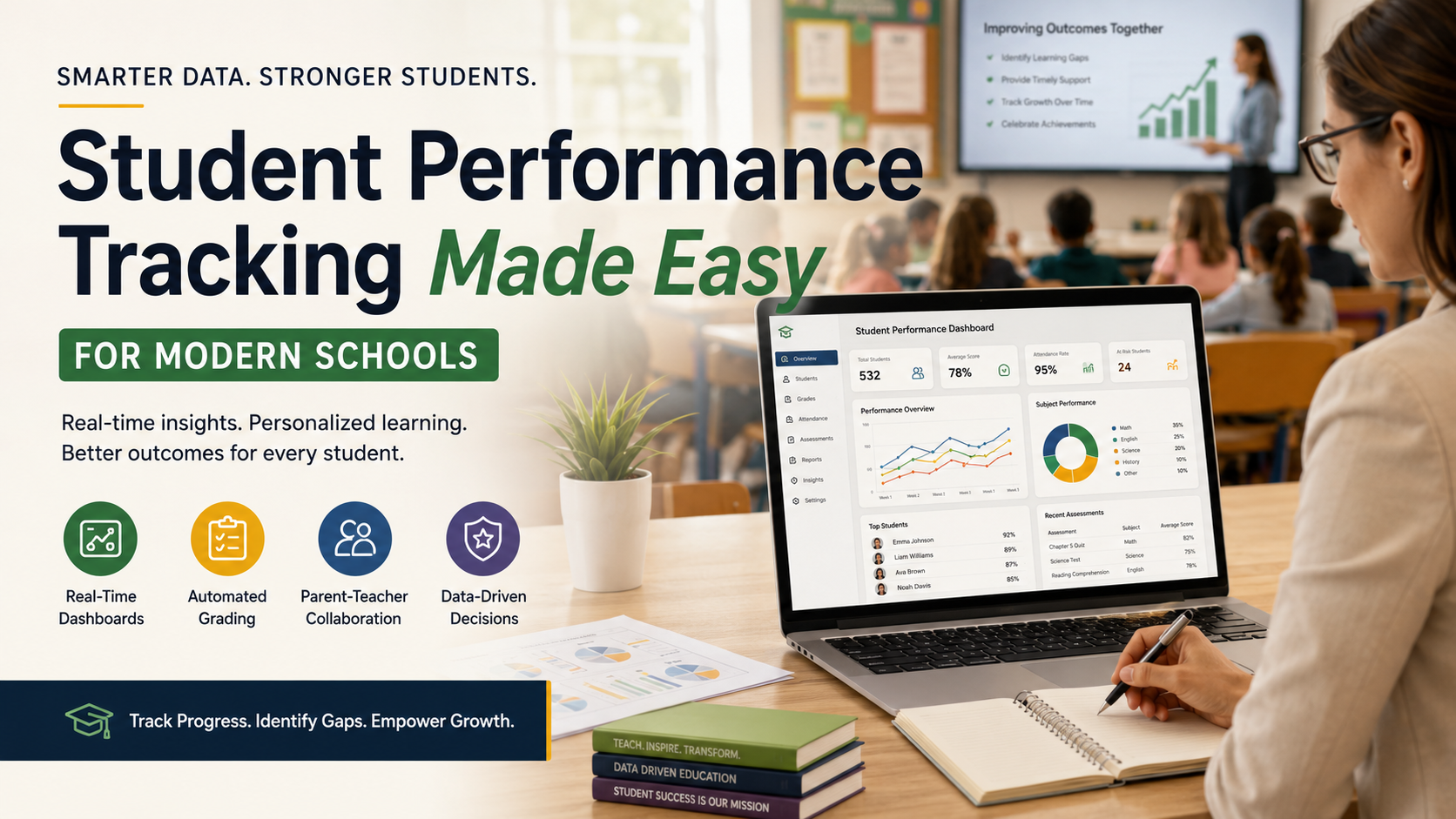
A school performance tracking system is a digital platform that collects, analyzes, and reports student academic data in one centralized location. These systems replace scattered paper records and spreadsheets with interactive dashboards that display grades, attendance, behavior, and academic progress in real time. Teachers use these insights to monitor daily performance, while administrators evaluate school-wide trends and curriculum effectiveness. Parents also receive secure access, allowing them to stay informed and support learning from home. By automating routine data collection and reporting, schools reduce administrative workloads and minimize manual errors. As a result, educators spend less time on paperwork and more time delivering quality instruction, identifying learning gaps early, and providing personalized support. A well-designed student performance tracking system creates a more transparent, efficient, and data-driven learning environment that benefits students, teachers, parents, and school leaders alike.

Centralized Data Hubs for Better Insights

A centralized database brings together grades, attendance, behavior records, assessments, and teacher observations into one complete student profile. This shared information gives teachers, counselors, and administrators a consistent view of every learner’s progress.

Historical data also reveals performance trends over time. Educators can identify learning gaps early, monitor improvements, and provide timely interventions before small challenges become larger academic problems.

How to Improve Performance in School as a Student?

Improving academic performance requires consistent study habits, effective time management, and active participation in learning. Students should create a realistic study schedule and break large assignments into smaller tasks. This approach reduces stress and prevents last-minute cramming before exams. Participating in classroom discussions, asking thoughtful questions, and reviewing lessons regularly strengthen understanding and long-term memory. Maintaining a healthy routine also plays an essential role. Adequate sleep, balanced nutrition, and regular physical activity improve concentration and cognitive performance. Students should seek help as soon as they encounter difficulties instead of waiting until grades decline. Teachers, tutors, and classmates can provide valuable guidance that prevents small misunderstandings from becoming larger obstacles. Over time, these daily habits build confidence, improve academic results, and create a strong foundation for lifelong learning and personal success.

The Power of Active Recall and Review

Active recall is one of the most effective learning techniques. Instead of repeatedly reading notes, students should test themselves using flashcards, quizzes, or practice questions. Retrieving information strengthens memory and improves long-term retention.

Regular review sessions also reinforce learning and reduce forgetting. Combining active recall with spaced repetition helps students prepare more effectively for quizzes and final examinations.

Best Practices to Simplify Student Performance Tracking

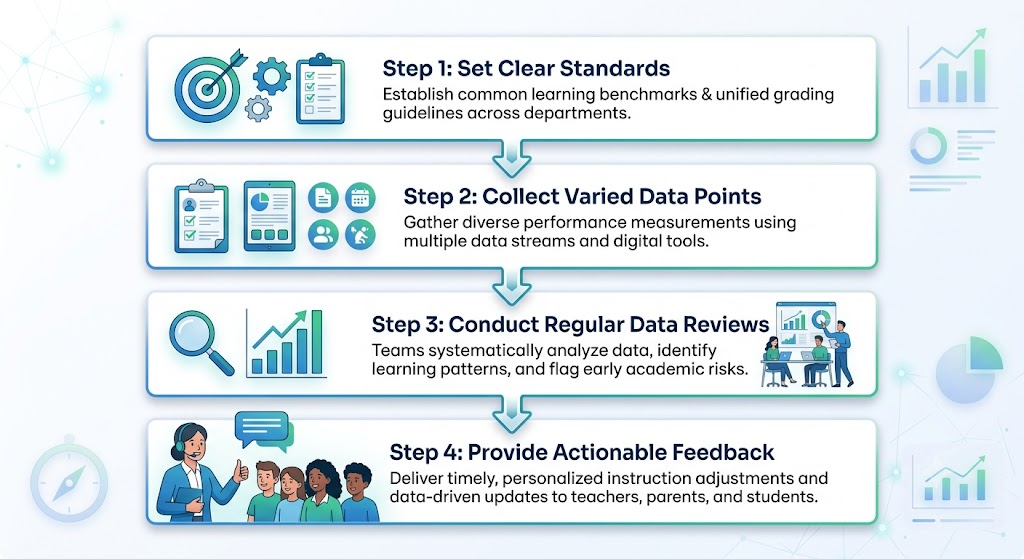
Buying good software is only the first step. School leaders must set clear, consistent assessment rules across all classrooms to get full value.

Inconsistent grading across rooms makes comparing progress hard. Therefore, leaders must create simple grading rules, clear learning goals, and regular data review meetings for teams.

Moreover, schools need a supportive culture where data helps people grow. When teachers share progress data openly, they swap good lesson plans. Consequently, they solve learning problems together as a team.

Why Is It Important to Track Student Progress?

Tracking student progress gives educators continuous insight into academic strengths, learning challenges, and overall development. Rather than waiting until final examinations reveal problems, teachers can identify struggling students early and adjust instruction immediately. Regular progress monitoring also helps schools evaluate whether teaching strategies, interventions, and curriculum changes are producing meaningful results. Students benefit because clear reports and visual progress charts make improvement easier to understand. Seeing measurable growth often increases motivation and encourages greater responsibility for learning. Parents also gain timely updates, allowing them to support their children’s education more effectively at home. Schools use long-term performance data to allocate academic resources, plan targeted interventions, and improve educational outcomes across different grade levels. Overall, a school performance tracking system promotes informed decision-making and creates a collaborative environment focused on continuous student achievement and long-term academic success.

Fostering Collaborative Support Networks

Regular progress monitoring strengthens communication between teachers, parents, and students. Instead of relying on occasional report cards, everyone receives timely updates about academic performance and attendance.

Shared information creates more productive parent-teacher discussions. Together, families and educators can develop targeted strategies that address specific learning challenges and celebrate student achievements.

What Are the 5 Key Performance Indicators in School?

Schools measure several key performance indicators (KPIs) to evaluate both student achievement and institutional success. These metrics provide valuable insights into academic performance, student engagement, and overall educational quality. The first KPI is academic achievement, which includes examination scores, classroom assessments, quizzes, and assignment results. The second is attendance, as regular school participation strongly influences learning outcomes. The third measures student behavior, including classroom participation, discipline records, and positive conduct. The fourth focuses on course completion and graduation progress, ensuring students remain on track to meet academic requirements. The fifth indicator is extracurricular participation, which reflects leadership skills, teamwork, and social-emotional development. Monitoring these indicators together gives educators a balanced understanding of student growth and helps schools identify areas that require additional support, resources, or instructional improvements while promoting long-term academic and personal success.

Balancing Academic and Social Metrics

Evaluating only test scores provides an incomplete picture of student development. Academic performance should be considered alongside behavior, attendance, and classroom engagement.

A balanced approach helps educators identify students who may be experiencing stress, disengagement, or other challenges. This broader perspective supports both academic success and overall well-being.

What are the 4 C’s of student engagement?

The 4 C’s of student engagement consist of connection, conceptual clarity, competence, and challenge, which together drive academic motivation. These four pillars create a balanced framework that ensures learners remain mentally stimulated, emotionally supported, and academically challenged. Educators utilize this model during student performance tracking to diagnose disengagement before grades begin to drop. When students feel a strong personal connection to their teachers, they participate more actively in classroom discussions. Furthermore, clear concepts prevent cognitive overload, while proper challenges foster resilience and grit. Integrating these elements transforms passive classrooms into dynamic hubs of active learning.

The Role of Connection in Daily Learning

Establishing a deep sense of connection helps learners feel safe, valued, and understood within their school environment. Teachers build this trust by actively listening to student concerns and validating their academic efforts consistently. Consequently, motivated learners take intellectual risks because they know their instructors support them through mistakes.


FAQ

How often should schools update their student tracking data?

Schools should update student performance tracking data continuously or at least once each week. Frequent updates allow teachers and parents to identify sudden declines in grades, attendance, or classroom participation before they become serious concerns. Real-time reporting also supports faster academic interventions and more informed decision-making.

Can parents access these student performance tracking systems?

Yes. Most modern school performance tracking systems include secure parent portals. Parents can view attendance records, assignment deadlines, assessment results, and teacher feedback. This transparency strengthens communication between home and school while encouraging students to remain accountable for their progress.

Do tracking systems help students with special learning needs?

Yes. These systems support students with special learning needs by tracking Individualized Education Program (IEP) goals, accommodations, intervention outcomes, and academic milestones. Teachers use this information to adjust instructional strategies, monitor progress, and provide personalized support based on each student’s unique learning requirements.

Are student data and performance metrics secure?

Reputable educational platforms prioritize student data security. Most systems comply with privacy regulations such as FERPA and GDPR. They also use encryption, secure authentication, and role-based access controls to protect sensitive information and prevent unauthorized access to student records.


CONCLUSION

Streamlining student performance tracking changes how schools monitor, evaluate, and nurture student growth. Moving past old paper books to modern digital platforms gives teachers instant view of classroom learning. Furthermore, this clear data lets teachers adapt daily lessons, offer quick help, and celebrate student milestones with complete confidence.

Digital student performance tracking also connects teachers, leaders, parents, and students in one supportive space. Open digital portals keep families updated on daily work, while adopting the best productivity systems for students helps learners stay organized and manage their personal goals effectively. Consequently, this turns standard parent meetings into helpful, goal-focused planning sessions. When everyone shares clear data, students get steady support that encourages continuous growth.

Using efficient student performance tracking shows a strong commitment to educational quality and fairness. By setting clear rubrics, balancing daily and final test data, and protecting private records, schools build a system focused on long-term success. Therefore, school leaders should review their current evaluation tools today. Taking practical steps toward smart tracking tools empowers teachers and inspires every student to succeed.

Online Learning Pros and Cons: A Complete Guide to Success

Online Learning: Pros, Cons, and Success Tips

Education has changed rapidly in recent years. Traditional classrooms are giving way to flexible digital spaces. Understanding the online learning pros and cons is vital today. This knowledge helps working adults, busy parents, and degree seekers alike. Organizations like the U.S. Department of Education regularly track these educational trends. They highlight both the great career opportunities and the instructional challenges of virtual platforms.

Distance education gives you access to top-tier academic resources. However, it requires strong self-discipline and time management skills. Virtual classrooms force students to use complex software independently. You must also process dense information without daily face-to-face supervision. Consequently, simply enrolling in a virtual course does not guarantee success. You need a clear plan, structured study habits, and realistic goals to succeed.

This guide breaks down the primary advantages and drawbacks of distance education. Furthermore, we will share simple, proven tips to help you stay focused. These steps will help you manage study time and achieve your long-term goals.


What Are the Advantages and Disadvantages of Online Learning?

Online learning has transformed modern education by making knowledge more accessible than ever before. Students can attend classes from almost anywhere with an internet connection. This flexibility makes it easier to balance education with work, family, or other personal responsibilities. As a result, digital education continues to grow across schools, colleges, universities, and professional training programs.

However, online learning is not without challenges. Success often depends on strong time management, reliable technology, and consistent self-motivation. Internet disruptions, limited face-to-face interaction, and home distractions can affect the overall learning experience. Understanding both the benefits and limitations helps students choose the learning method that best fits their goals and circumstances.

Flexibility and Self-Discipline in Virtual Classrooms

One of the biggest advantages of online learning is its flexibility. Students can study at convenient times instead of following a fixed classroom schedule. This makes online education ideal for working professionals, parents, and learners with busy lifestyles. Many courses also allow students to replay recorded lessons, helping them review difficult topics until they fully understand them.

At the same time, flexibility brings greater responsibility. Without daily classroom supervision, students must stay organized and meet deadlines independently. Poor time management can quickly lead to missed assignments and lower performance.

Creating a dedicated study space improves concentration and reduces distractions. Maintaining a consistent study routine also supports long-term success. Students who develop strong self-discipline often gain valuable skills that benefit both academic and professional life.

What Are the 10 Disadvantages of E-Learning?

Understanding the online learning pros and cons requires examining the common challenges students face in digital classrooms. Although e-learning offers convenience, it may not suit every learner or subject. Practical courses often require hands-on experience that virtual platforms cannot fully provide. In addition, technical problems and limited social interaction can reduce engagement throughout the learning process.

The ten major disadvantages of e-learning include:

  • Limited face-to-face interaction, which can increase feelings of isolation.
  • Dependence on technology, making learning vulnerable to hardware or internet failures.
  • Screen fatigue from spending long hours on digital devices.
  • Limited practical experience for laboratory, medical, or trade-based subjects.
  • Challenges in maintaining assessment integrity during remote examinations.
  • Home distractions that reduce concentration and productivity.
  • Delayed personalized feedback compared to traditional classrooms.
  • Additional technology costs, including software and hardware upgrades.
  • Greater dependence on self-motivation and personal discipline.
  • Reduced peer collaboration and fewer networking opportunities.

Recognizing these limitations allows students to prepare better and develop strategies that improve their online learning experience.

Technical Hurdles and Screen Fatigue Challenges

Technology is the foundation of virtual learning, but it can also become one of its greatest obstacles. Slow internet connections, unexpected software updates, or device failures may interrupt lessons and reduce productivity. Even brief technical issues can affect concentration during live classes or online assessments.

Extended screen time creates additional challenges. Many students experience eye strain, headaches, mental fatigue, and reduced focus after several hours of studying on digital devices. These issues may lower information retention and overall learning efficiency.

Taking regular breaks, following the 20-20-20 eye rule, and using ergonomic workstations can reduce discomfort. Reliable internet access, updated software, and properly maintained devices also help create a smoother and more productive online learning environment.

What is the biggest problem with online school?

The biggest problem with online school is often considered to be a profound lack of self-motivation and discipline among students. Without the physical structure of a traditional classroom, fixed schedules, and face-to-face accountability from teachers, many learners struggle to stay on track. Procrastination easily creeps in when distractions are just a click away, leading to missed assignments and overwhelming stress. Furthermore, isolation plays a major role, as the absence of daily social interaction can diminish enthusiasm for learning. Students miss out on spontaneous discussions, collaborative projects, and the emotional support that physical peers provide. Consequently, academic burnout becomes a frequent risk for those who fail to establish strict personal routines and boundaries at home.

Overcoming Isolation and Distractions

Combating isolation and digital distractions requires intentional habit-building and active engagement strategies. Students should designate a dedicated study workspace separate from leisure areas to trigger focus. Additionally, joining virtual study groups helps restore a sense of community, accountability, and shared academic purpose.

What is the 70 30 rule in teaching?

The 70 30 rule in teaching is an instructional guideline suggesting that students should do roughly 70 percent of the active work, thinking, and practicing, while teachers speak or lecture for only 30 percent of the time. This learner-centric approach shifts the classroom dynamic away from passive listening toward active participation. In digital environments, this principle prevents online fatigue by replacing lengthy video lectures with interactive discussions, problem-solving tasks, and peer-to-peer collaboration. By taking the lead in their learning process, students build deeper comprehension and critical thinking skills. Teachers act more as facilitators or guides, supporting learners as they explore concepts independently rather than simply delivering static information.

Applying the Rule Online

Implementing this framework digitally involves leveraging breakout rooms, collaborative documents, and interactive quizzes during live sessions. Instructors can assign short exploratory tasks before discussions, ensuring students arrive prepared to contribute actively. This method transforms passive screen time into meaningful, highly engaging educational experiences.

What Are 10 Advantages and Disadvantages of the Internet?

When discussing online learning pros and cons, internet access plays a central role in the learning experience. A reliable internet connection gives students access to educational resources, virtual classrooms, and global learning communities. At the same time, internet-related risks can affect safety, privacy, and productivity. Understanding these benefits and challenges is essential when evaluating online learning pros and cons, as it helps students use digital technology more responsibly and effectively.

Advantages of the Internet

  • Instant global communication
  • Access to vast educational resources
  • Remote work and learning opportunities
  • Convenient online shopping
  • Easy entertainment access
  • Fast information sharing
  • Automation of everyday tasks
  • Global networking opportunities
  • Cloud storage and file sharing
  • Continuous technological innovation

Disadvantages of the Internet

  • Cybersecurity threats
  • Privacy concerns
  • Spread of misinformation
  • Digital addiction
  • Social isolation
  • Online distractions that reduce productivity
  • Internet service costs
  • Cyberbullying
  • Data security vulnerabilities
  • Digital inequality between regions

Reliable, secure, and high-speed internet remains essential for successful online learning. Without dependable connectivity, students may struggle to participate in live classes, complete assignments, or collaborate effectively with classmates.

Security Risks and Information Overload Online

The internet provides unlimited educational content, but not every source is accurate or trustworthy. Students must learn to evaluate information carefully before using it for assignments or research. Developing strong digital literacy skills has become an essential part of modern education.

Online security also deserves equal attention. Phishing attacks, malware, identity theft, and privacy breaches continue to affect internet users worldwide. Protecting personal information through strong passwords, secure networks, and updated software reduces these risks.

Information overload presents another challenge. Thousands of search results can make it difficult to identify reliable sources. Learning how to verify facts and prioritize credible information improves both academic performance and digital safety.

What Are 5 Advantages of Online Learning?

When discussing online learning advantages, five benefits consistently stand out. These advantages explain why millions of students and professionals continue choosing digital education to build new skills and advance their careers. Online learning offers greater flexibility while making quality education available to people regardless of location.

The five major advantages include:

  • Study from anywhere without relocating.
  • Learn at your own pace by reviewing lessons whenever needed.
  • Lower education costs by reducing travel, housing, and commuting expenses.
  • Interactive multimedia learning through videos, quizzes, podcasts, and simulations.
  • Career development opportunities that allow professionals to upgrade skills while working.

These benefits make online education an attractive option for lifelong learners. Whether pursuing a degree, certification, or personal development, students can customize their learning experience according to individual goals and schedules.

Customized Learning Styles and Multimedia Integration

Modern e-learning platforms support different learning preferences through interactive digital tools. Instead of relying only on textbooks, students can access videos, animations, podcasts, quizzes, discussion forums, and virtual demonstrations. These resources make complex topics easier to understand and more engaging.

Visual learners often benefit from diagrams and instructional videos, while auditory learners prefer recorded lectures or podcasts. Interactive quizzes reinforce key concepts through immediate feedback. This variety helps students stay engaged and improves long-term knowledge retention.

Multimedia learning also encourages active participation rather than passive reading. As educational technology continues to evolve, personalized learning experiences are becoming increasingly effective for students with different backgrounds and learning styles.


Frequently Asked Questions

How does online learning impact student motivation?

Online learning places greater responsibility on students to stay motivated and organized. Without daily classroom routines, learners must set goals, manage their time, and remain consistent. Students with strong self-discipline often perform well, while those who struggle with organization may need additional structure and support.

Are online degrees respected by employers today?

Yes. Employers increasingly recognize online degrees from accredited institutions. Many organizations value the time management, digital communication, and self-discipline required to complete online programs. The institution’s accreditation remains the most important factor when evaluating degree credibility.

What equipment is necessary for successful e-learning?

A successful online learning setup typically includes:

  • A reliable computer or laptop
  • A stable high-speed internet connection
  • An updated web browser
  • A webcam and microphone for live classes
  • Headphones for better audio quality
  • Any course-specific software or applications

Having dependable equipment minimizes technical disruptions and supports a more productive learning experience.

Can online learning replace traditional classroom education?

Online learning cannot fully replace traditional classroom education in every situation. Subjects requiring laboratories, clinical practice, or hands-on training still benefit from in-person instruction. However, digital education provides a flexible and effective alternative for many academic and professional courses. In many cases, a blended learning approach combines the strengths of both online and classroom-based education.


CONCLUSION

Navigating online learning pros and cons reveals incredible opportunities for career growth and skill building. The benefits—such as flexible schedules, lower transit costs, and access to global schools—are compelling. However, you must balance these advantages against real challenges. Screen fatigue, tech issues, and the demand for self-motivation require real effort. Additionally, learning independently means you must learn how to avoid misinformation studying online when researching subjects on the web. Understanding the full picture of online learning pros and cons helps you set realistic expectations.

Long-term success in virtual classrooms depends on your daily study habits. You can easily overcome common drawbacks with the right approach. Set up a dedicated workspace and follow a structured study schedule every week. Furthermore, communicate actively with your professors and classmates to stay connected. Embrace these practical habits to master your coursework, build skills, and achieve your educational goals.

FOMO Marketing: The Psychology of Consumer Hype

FOMO Marketing: The Psychology Behind Consumer Hype

Have you ever bought an item simply because a timer was ticking down? Or maybe you booked a room because a pop-up warned that only two spaces remained? If so, you have experienced FOMO marketing firsthand. This strategy relies on the fear of missing out. It is a deep psychological driver that urges people to take quick action before an opportunity vanishes. According to insights shared by the American Psychological Association, social connection and the anxiety of exclusion heavily influence daily decisions.

Marketing teams rely on these psychological triggers to turn casual browsers into active buyers. When consumers feel a loss risk, their choices shift rapidly. They move from logical evaluation to emotional action. Consequently, brands using FOMO marketing effectively can build high-converting campaigns without losing customer trust.

In this guide, we will examine the psychological drivers behind consumer hype. We will explore loss aversion, social proof, and practical urgency triggers. Furthermore, we will analyze ethical ways to implement FOMO marketing tactics. You will learn how to apply these persuasion strategies to grow your business while serving your audience well.

What Is an Example of FOMO Marketing?

A classic example of FOMO marketing is a flash sale that features a prominent countdown timer on an e-commerce website. When shoppers see that a significant discount expires within two hours, they often shift from careful consideration to immediate action. The limited timeframe creates urgency and reduces the likelihood of delaying a purchase.

Travel booking websites also use this strategy effectively. They display real-time messages such as “Three other people are viewing this hotel right now” or “Only one room left at this price.” These notifications encourage users to act before the opportunity disappears. As a result, many consumers complete their purchases more quickly than they normally would. By combining scarcity, urgency, and social proof, brands increase conversions without reducing the perceived value of their products. When used honestly, these techniques create excitement while helping customers make timely decisions.

Live Inventory Alerts in Retail

Live inventory alerts display messages such as “Only two items left in stock” to highlight limited availability. This information creates a sense of urgency because shoppers know the product may soon sell out.

Instead of postponing the purchase, many customers decide to buy immediately to avoid disappointment. This tactic works because people naturally dislike losing opportunities. When inventory levels are genuine and accurately displayed, live stock alerts can increase conversions while maintaining customer trust. Retailers should avoid creating false scarcity, as transparency is essential for long-term credibility.

What Is the FOMO Marketing Technique?

The FOMO marketing technique is a strategy that combines scarcity, urgency, and social proof to encourage people to take immediate action. Brands use this approach across websites, email campaigns, social media, and digital advertising to shorten the buying journey. Limited-time offers, exclusive product launches, and members-only promotions make consumers feel that valuable opportunities may disappear if they wait too long.

This technique is based on a simple psychological principle. People often place greater value on products or experiences that appear difficult to obtain. Businesses reinforce this perception through countdown timers, limited stock messages, exclusive access, and real customer activity. When applied ethically, FOMO marketing increases engagement and sales while preserving customer trust. The key is ensuring that every urgency trigger reflects a genuine offer rather than artificial pressure.

Leveraging Exclusive Social Proof

Brands strengthen social proof by showcasing customer reviews, user-generated content, and influencer experiences. Seeing others enjoy a product increases confidence and creates a stronger desire to participate.

Live testimonials, trending purchases, and community engagement also encourage faster decisions. Consumers often want the same benefits or recognition that others receive. Authentic social proof builds credibility while naturally reinforcing the fear of missing out.

What Is FOMO vs. JOMO?

FOMO (Fear of Missing Out) describes the anxiety people experience when they believe others are enjoying opportunities that they are missing. It often leads to constant social media checking, impulse buying, and quick purchasing decisions. In contrast, JOMO (Joy of Missing Out) represents the conscious choice to disconnect, slow down, and appreciate the present moment without feeling pressured to participate.

For marketers, understanding this difference is increasingly important. Traditional FOMO marketing relies on urgency and scarcity to drive action. However, many consumers now prefer brands that respect their time and decision-making process. Successful businesses balance promotional urgency with transparency and authenticity. Rather than creating unnecessary pressure, they focus on genuine value, allowing customers to make confident purchasing decisions while still benefiting from limited-time opportunities.

The Shift Toward Mindful Consumption

Many consumers are moving away from anxiety-driven purchasing and embracing mindful consumption. They research products carefully and prioritize long-term value over impulsive decisions.

This shift encourages businesses to rethink aggressive marketing tactics. Brands that combine honest urgency with transparent communication build stronger customer relationships. Respecting consumer boundaries helps create trust, loyalty, and sustainable business growth.

What is the psychology of FOMO marketing?

The psychology of FOMO marketing is built on loss aversion, social comparison, and the human desire to belong. People naturally dislike missing valuable opportunities more than they enjoy gaining similar benefits. Marketers use this behavior by creating limited-time offers, exclusive deals, and low-stock alerts that make opportunities seem temporary. When consumers believe they may lose access to a product or experience, they often make faster decisions. Instead of carefully evaluating the purchase, they react emotionally. This shift increases the likelihood of impulse buying because acting immediately feels safer than risking regret later. Effective FOMO marketing works because it taps into emotions rather than logic. However, the most successful campaigns combine urgency with genuine value instead of relying only on pressure. When used responsibly, this strategy can increase engagement while still maintaining customer trust and long-term brand loyalty.

The Role of Social Proof

Social proof strengthens the psychology behind FOMO marketing by showing that other people have already made the same decision. Positive reviews, customer testimonials, trending products, and high purchase counts reassure potential buyers that the product is worth considering. Seeing others participate reduces uncertainty and creates a stronger desire to join in. Social media also amplifies this effect by making popular products and experiences more visible. When combined with authentic urgency, social proof encourages quicker purchasing decisions without relying entirely on artificial pressure.

Is FOMO marketing unethical?

FOMO marketing becomes unethical when businesses rely on deception instead of genuine urgency. Creating legitimate scarcity because inventory is limited or a promotion has a real deadline is a common and acceptable marketing practice. Problems arise when brands display fake countdown timers, misleading stock levels, or false claims that products are almost sold out. These tactics manipulate consumer emotions rather than helping people make informed decisions. Over time, deceptive strategies damage customer trust and weaken brand credibility. Ethical FOMO marketing focuses on transparency, ensuring that every limited-time offer or exclusive promotion reflects actual business conditions. Honest communication helps customers feel confident about their purchases while protecting the company’s reputation. Brands that balance urgency with integrity are more likely to build long-term loyalty, encourage repeat purchases, and maintain positive relationships in today’s competitive digital marketplace.

Drawing the Line on Deception

Businesses should establish clear guidelines that separate authentic urgency from misleading sales tactics. Customers deserve accurate information about inventory, availability, and promotional deadlines. Honest messaging allows marketers to encourage action without compromising consumer trust. This balanced approach supports stronger customer relationships and sustainable business growth over the long term.

What is FOMO in marketing?

FOMO in marketing is a strategy that encourages people to take immediate action because they fear missing a valuable opportunity. Brands create this sense of urgency through flash sales, exclusive product launches, limited-edition collections, early-access events, or time-sensitive discounts. The goal is to reduce hesitation and motivate faster purchasing decisions. Instead of allowing customers to delay their choices, marketers emphasize that waiting could mean losing access forever. This approach also increases excitement around product releases and encourages people to share offers with friends through social media. As more consumers engage, visibility grows, creating additional momentum for the campaign. When supported by genuine value and honest messaging, FOMO marketing can increase conversions, improve customer engagement, and generate stronger brand awareness without relying on misleading promotional techniques.

Creating High-Impact Urgency

Successful FOMO marketing requires the right message at the right moment. Brands should promote genuine scarcity, exclusive access, or limited availability across websites, email campaigns, and social media. Clear calls to action encourage customers to respond quickly while maintaining transparency. Authentic urgency delivers better long-term results than exaggerated or misleading claims.

What is the psychology behind FOMO?

The psychology behind FOMO comes from humanity’s long history of seeking social acceptance and avoiding exclusion. Throughout evolution, belonging to a group improved survival by providing protection, resources, and shared knowledge. Today, those instincts remain active, even though they appear in different forms. Social media constantly exposes people to carefully selected highlights of others’ lives, making comparisons almost unavoidable. As individuals see friends enjoying experiences, buying new products, or joining trends, they may worry about being left behind. This emotional response creates anxiety and increases the desire to participate immediately. Marketers understand these psychological patterns and often design campaigns that promise inclusion, exclusivity, or limited opportunities. Recognizing these triggers helps consumers slow down, evaluate purchases carefully, and make decisions based on personal needs rather than emotional pressure.

Navigating Digital Anxiety

Constant online connectivity can intensify feelings of comparison and urgency. Recognizing how digital platforms influence emotions helps consumers respond more thoughtfully to marketing messages. Taking time to evaluate whether a purchase meets a genuine need reduces impulsive decisions and supports healthier spending habits.

Frequently Asked Questions

How does social media amplify consumer hype?

Social media amplifies consumer hype by giving people instant visibility into trending products, experiences, and recommendations. Users regularly see influencers, creators, and friends sharing purchases, reviews, and limited-time offers. This continuous exposure creates the impression that many people are participating, increasing the desire to join before the opportunity disappears.

Brands strengthen this effect through viral campaigns, influencer partnerships, live shopping events, and user-generated content. As conversations spread across digital platforms, demand appears stronger and more immediate. This combination of social proof and visibility makes social media one of the most effective channels for FOMO marketing.

Can small businesses successfully use scarcity tactics?

Yes. Small businesses can use scarcity marketing without large advertising budgets. Boutique stores, local retailers, and independent creators often offer limited product runs, seasonal collections, exclusive workshops, or weekend-only promotions. These genuine limitations naturally create exclusivity.

Customers often appreciate unique products that are unavailable everywhere. When businesses communicate honestly about limited availability, they create excitement while strengthening customer trust. Authentic scarcity can be just as effective for small businesses as it is for global brands.

What are the ethical risks of using urgency triggers?

Urgency triggers become unethical when businesses create fake countdown timers, false inventory shortages, or misleading claims about demand. These tactics may generate short-term sales, but they often reduce customer trust and increase buyer’s remorse.

Ethical FOMO marketing relies on accurate information. Brands should only promote genuine stock limitations, authentic deadlines, and real promotional periods. Transparent marketing protects brand reputation while encouraging long-term customer loyalty.

How do modern consumers resist psychological sales tactics?

Today’s consumers are becoming more aware of psychological marketing techniques. Many compare prices, read reviews, check product history, and delay purchases before making decisions. Digital literacy has made shoppers more cautious about artificial urgency.

As awareness grows, successful brands increasingly focus on providing real value instead of relying solely on pressure-based marketing. Honest communication, quality products, and strong customer relationships now play a greater role in influencing purchase decisions than manufactured scarcity alone.

CONCLUSION

Understanding the psychology behind FOMO marketing reveals why hype drives consumer behavior so effectively across modern digital marketplaces. By tapping into fundamental human motivations such as loss aversion, social validation, and time sensitivity, businesses can systematically eliminate buyer hesitation. This streamlines decision-making and accelerates conversion rates. When consumers encounter real-time inventory alerts, authentic customer testimonials, or visible countdown timers, their mental focus shifts instantly. They move from delaying a purchase to securing the item before the opportunity disappears.

However, achieving sustainable success requires maintaining a balance between persuasive tactics and true brand authenticity. Deceptive practices like fake stock warnings, endless timers, or fabricated social proof erode consumer trust over time. They degrade your brand reputation and lead to high churn rates. Smart marketers realize that true urgency must always be grounded in real value, transparent communication, and authentic limitations that respect consumer intelligence. When evaluating campaign strategies, striking the right balance of hype vs. value ensures that short-term conversions never come at the expense of brand integrity.

By aligning honest urgency with exceptional product quality and transparent messaging, you can create compelling campaigns. These campaigns generate immediate sales while cultivating deep, long-term customer loyalty. Implement these psychological principles thoughtfully within your broader marketing strategy. This will turn emerging buyer trends into predictable, sustainable business growth for years to come.

Wind vs Solar Efficiency: Which Energy Source Is Better?

Wind vs Solar Efficiency: Which Energy Source Is Better?

The debate over wind vs solar efficiency is heating up rapidly. Global energy markets urgently need cleaner power grids today. Homeowners and governments want the absolute best return on investment. You must deeply understand how each mechanical system works perfectly. Both systems convert raw natural resources into reliable everyday electricity. The U.S. Department of Energy (DOE) heavily researches both expanding sectors. Officials state that optimizing these renewable power systems remains critical. Constant optimization actively ensures a truly sustainable global future.

But how do field experts strictly measure this crucial performance? For solar panels, efficiency means precisely calculating sunlight conversion rates. Engineers measure exactly how much light turns into electrical current. For wind turbines, the complex testing process requires another approach. Technicians must evaluate the kinetic energy safely captured from air. Both green technologies offer consumers distinct operational strengths and benefits. Buyers also face specific physical drawbacks that require careful consideration.

You might discover that solar panels work perfectly for homes. Suburban houses fit incredibly well in sunny, dense urban climates. Meanwhile, massive industrial wind farms heavily dominate open rural areas. Vast flat plains and windy offshore ocean environments prove ideal. This comprehensive article breaks down everything you need to know. We explore exactly how both advanced energy systems operate daily. Our guide thoroughly compares their specific energy conversion rates accurately. We also evaluate long-term financial maintenance costs for future buyers. Let us finally settle this vital renewable energy debate today.


Is Solar More Efficient Than Wind?

Comparing the conversion rates of solar panels and wind turbines reveals clear differences in how each technology generates electricity. Traditional photovoltaic (PV) panels typically convert 17% to 22% of sunlight into usable electricity. Premium models can exceed this range under ideal conditions. In comparison, modern wind turbines can convert up to 50% of the wind’s kinetic energy into mechanical power, approaching the theoretical Betz limit.

Although wind turbines achieve a higher conversion efficiency, actual energy production depends heavily on local weather conditions. Wind speeds fluctuate throughout the day and across seasons, which directly affects electricity generation. Solar panels, on the other hand, produce more predictable output in regions with consistent sunlight.

When comparing solar vs. wind efficiency, conversion rates alone do not tell the whole story. Real-world performance depends on climate, installation location, maintenance requirements, and annual energy production. In sunny regions, solar systems often deliver more reliable daily generation. Meanwhile, wind power performs exceptionally well in areas with steady, strong winds. Choosing the most efficient renewable energy source ultimately depends on local environmental conditions rather than efficiency percentages alone.

Conversion Rates and Practical Power Generation

While wind turbines offer a higher theoretical conversion ceiling, solar photovoltaic systems provide dependable performance for residential and commercial installations. Solar panels use semiconductor materials to convert sunlight directly into electricity through the photovoltaic effect. This process contains no moving parts, reducing maintenance requirements and improving long-term reliability.

Wind turbines generate electricity by using aerodynamic blades to capture kinetic energy from moving air. The rotating blades drive a generator that produces electrical power. However, wind conditions change frequently, causing energy output to vary throughout the day.

Because of these differences, practical performance should be measured by annual electricity generation instead of laboratory efficiency ratings alone. Solar systems often produce consistent energy in sunny climates, while wind turbines can outperform solar where strong, sustained winds are common. Evaluating local weather patterns, available space, and long-term energy needs provides a far more accurate comparison than conversion efficiency alone.


What Is the 20% Rule for Solar?

The 20% rule for solar generally refers to the long-standing benchmark that commercial photovoltaic panels convert about one-fifth of incoming sunlight into usable electricity. For many years, standard silicon solar panels achieved efficiencies between 15% and 20%, making this figure an important industry reference point. It reflects how much solar energy can realistically be converted into electrical power under standard testing conditions.

Modern manufacturing has significantly improved panel performance. Many residential and commercial solar panels now reach efficiencies between 21% and 23%, while premium products perform even better. Although the 20% rule originated as a historical benchmark, it continues to help consumers understand how solar panel efficiency has evolved. Higher efficiency means greater electricity production from the same roof area, making modern solar installations more productive and cost-effective than earlier generations.

Historical Benchmarks and Modern Panel Efficiency

Silicon-based solar technology has advanced steadily since its commercial introduction. Continuous improvements in manufacturing, materials, and cell design have pushed panel efficiencies beyond the traditional 20% benchmark.

Researchers are also developing advanced technologies such as perovskite solar cells and tandem solar cells. These innovations aim to capture a broader range of the light spectrum and significantly improve electricity generation. Although many remain in development, they represent the next generation of high-efficiency solar technology.

As production methods become more efficient, higher-performing panels continue to become more affordable. Today’s homeowners and businesses can generate substantially more electricity per square foot than they could just a decade ago. This ongoing progress allows both rooftop and utility-scale solar installations to deliver greater energy output while making better use of available installation space.


What Did Elon Musk Say About Solar Energy?

Elon Musk has consistently promoted solar energy as one of the world’s most important long-term renewable energy solutions. He often explains that Earth receives an enormous amount of energy from the Sun every day, describing it as a giant fusion reactor in the sky. Musk has also suggested that covering only a relatively small desert area with solar panels could generate enough electricity to power the United States.

Beyond solar generation, Musk frequently emphasizes the importance of combining photovoltaic systems with battery storage. He believes decentralized energy systems that pair rooftop solar with home batteries can improve grid reliability and reduce dependence on fossil fuels. According to this vision, renewable electricity can be generated locally, stored during the day, and used whenever needed, creating a cleaner and more resilient energy infrastructure.

The Future of Solar Integration and Storage

Musk’s vision extends beyond installing more solar panels. He regularly highlights the value of integrating photovoltaic systems with advanced battery storage technologies, such as residential energy storage systems. Without batteries, surplus daytime electricity may be exported to the grid or remain underutilized, while nighttime demand still depends on other energy sources.

Smart battery systems allow homeowners and businesses to store excess solar electricity for later use. This improves energy independence and reduces reliance on conventional power grids during peak demand periods or outages.

As battery technology continues to improve, solar power becomes increasingly practical as a reliable, all-day energy solution. Combining renewable generation with energy storage creates a more flexible electricity network capable of supporting households, businesses, and large-scale infrastructure while reducing greenhouse gas emissions.


Is wind more efficient than solar?

Evaluating whether wind is more efficient than solar comes down to capacity factor and physical conversion limits. Wind turbines typically boast a higher capacity factor, often operating between 35% and 50% in optimal locations, meaning they generate electricity for a larger portion of the day. In contrast, standard commercial solar panels generally achieve a capacity factor of 15% to 25%, heavily constrained by nightfall and changing weather conditions. Furthermore, wind turbines can capture energy 24 hours a day as long as air currents remain strong enough to spin the blades. This continuous generation capability often gives wind an operational edge in utility-scale deployments. However, solar technology excels in predictability and flexibility, making it vastly superior for decentralized, rooftop installations where massive wind towers cannot be built.

Conversion Limits and Theoretical Maximums

The fundamental physics governing wind vs solar efficiency highlights distinct technical constraints. Wind turbines are bounded by the Betz Limit, which dictates that no turbine can capture more than 59.3 percent of the kinetic energy in wind. Modern commercial turbines successfully capture about 45 percent of that theoretical maximum. Meanwhile, traditional silicon solar panels convert roughly 20 percent of sunlight into usable electricity, though advanced multi-junction laboratory cells can exceed 40 percent. While wind converts its available energy resource at a higher percentage, solar benefits from an overwhelmingly abundant and direct fuel source.


How many solar panels equal one windmill?

Determining how many solar panels equal one windmill requires comparing the massive generating capacity of utility-scale turbines to typical residential solar arrays. A modern utility-scale wind turbine typically generates between 2 to 3 megawatts of electricity, with some offshore behemoths reaching up to 15 megawatts. Assuming a standard residential solar panel produces roughly 400 watts of power under optimal peak sunlight conditions, bridging that output gap requires a staggering quantity. A single 3-megawatt wind turbine can equal the power output of approximately 7,500 individual 400-watt rooftop solar panels. This massive discrepancy explains why commercial wind farms require vast open acreage, whereas solar installations can scale incrementally from small rooftops to expansive solar farms.

Calculating Real-World Output Differences

Comparing the physical footprint and actual output of these systems reveals practical deployment challenges. Wind turbines capture energy from much larger sweeping areas, allowing them to harness high-altitude winds that blow consistently and forcefully. Solar panels are limited by their two-dimensional surface area exposed directly to sunlight during daytime hours. Because solar generation fluctuates significantly with cloud cover and seasonal changes, matching the steady output of a single large turbine demands extensive battery storage or vast arrays of photovoltaic panels working in unison.


Wind power vs solar power cost

Analyzing wind power vs solar power cost involves examining upfront capital expenditures, ongoing maintenance requirements, and overall levelized cost of energy. Historically, utility-scale wind projects offered a lower levelized cost of electricity due to massive economies of scale and high individual turbine capacity. However, solar technology has experienced dramatic price drops over the past decade, making photovoltaic installations exceptionally competitive for both residential and commercial buyers. Installation costs for solar panels have plummeted, allowing homeowners to install rooftop systems with predictable payback periods. Wind energy systems, conversely, involve heavy logistical expenses, specialized heavy machinery for transport, and complex zoning regulations that raise initial project costs.

Maintenance and Long-Term Operating Expenses

Long-term financial viability depends heavily on routine upkeep and structural resilience over decades of operation. Wind turbines feature complex mechanical moving parts, gearboxes, and large blades that experience intense mechanical stress, requiring frequent inspections and costly maintenance interventions. Solar panels contain no moving parts, which drastically reduces ongoing mechanical wear and tear, lowering routine operation expenses significantly. While inverters in solar setups eventually need replacement after ten to fifteen years, the overall structural maintenance for solar arrays remains much lower than the upkeep demanded by towering industrial wind turbines.


Wind vs solar efficiency pros and cons

Weighing wind vs solar efficiency pros and cons shows that neither technology is universally superior without considering context. Wind energy offers a high capacity factor and generates power day and night. However, wind brings severe intermittency, setup hurdles, aesthetic concerns, and ecological impacts on local birds. Solar energy shines through its scalability, silent operation, zero moving parts, and easy urban integration. Solar disadvantages involve dependence on daylight, weather disruptions, and heavy reliance on battery storage for grid reliability.

Geographical Limitations and Environmental Factors

Choosing the right renewable resource depends entirely on local climate, topography, and regional weather patterns. Coastal regions, open plains, and high-altitude mountain passes offer exceptional wind resources that maximize turbine efficiency. Conversely, desert regions and sun-drenched tropical or temperate zones provide optimal conditions for maximizing photovoltaic energy yield. Understanding these regional distinctions ensures that energy planners deploy the most effective technology for maximum generation capacity and environmental harmony.


Which Is Best, Solar or Wind?

Choosing between solar power and wind power depends on location, climate, available space, and individual energy requirements. Solar energy generally performs best in sunny regions and urban environments where rooftop installations are practical. Wind energy delivers stronger results across coastal areas, open plains, and offshore locations with consistent wind speeds.

Rather than treating these renewable technologies as direct competitors, many modern energy systems combine both. Hybrid renewable systems help balance electricity production because weather conditions affecting one resource may not impact the other. This complementary approach improves energy reliability throughout the year while reducing dependence on traditional fossil fuels. Evaluating local environmental conditions, installation costs, and long-term energy goals is the most effective way to determine which renewable solution offers the greatest value.

Choosing the Right Renewable Energy Solution

Selecting the best renewable energy system starts with evaluating your local climate, property size, and electricity usage. Properties located in consistently windy areas may benefit from small-scale or utility-grade wind turbines. However, these installations require sufficient open space and compliance with local zoning regulations.

For most homeowners and businesses, solar panels remain the simpler and more affordable option. They require relatively little maintenance and commonly provide reliable performance for 25 to 30 years.

Comparing installation costs, expected electricity production, maintenance needs, and available incentives helps maximize long-term savings. In many regions, combining solar panels with battery storage provides an excellent balance between affordability, energy security, and environmental sustainability.


Frequently Asked Questions

How does weather affect solar and wind efficiency?

Weather directly influences the performance of both renewable energy systems. Heavy clouds, rain, fog, and snow reduce the amount of sunlight reaching solar panels, lowering electricity production. Seasonal daylight variations also affect daily output.

Wind turbines depend entirely on moving air. Calm conditions stop electricity generation, while extremely strong winds may require turbines to shut down temporarily to protect mechanical components.

Combining solar and wind provides consistent energy because each technology responds differently to changing weather.

Can I use both solar and wind power together?


Yes. A hybrid renewable energy system combines solar panels with wind turbines to improve overall reliability. Solar panels usually generate the most electricity during sunny daytime hours, while wind speeds often increase during evenings, storms, or cloudy weather.

Using both technologies together helps smooth fluctuations in electricity production. This reduces dependence on the utility grid and improves energy availability throughout different seasons. Hybrid systems are particularly useful in remote locations where maintaining a consistent power supply is essential.

How long do solar panels and wind turbines last?

High-quality solar panels typically last 25 to 30 years while experiencing only gradual performance loss over time. Most manufacturers also provide long-term performance warranties.

Wind turbines generally operate for 20 to 25 years, although they require more regular maintenance because they contain moving mechanical components. Routine inspections and timely replacement of worn parts help maximize efficiency, extend service life, and maintain safe operation throughout the system’s lifespan.

Which renewable source is cheaper to install?

For most homeowners, solar power is the more affordable renewable energy option. Declining manufacturing costs, modular system designs, and simpler installation have made residential solar increasingly accessible.

Wind turbines usually involve higher upfront costs. They require larger installation areas, specialized equipment, structural engineering, and local permitting. These additional expenses make wind energy more suitable for farms, commercial properties, and utility-scale projects than for typical residential installations.


Conclusion

The debate over wind vs solar efficiency shows that each technology has distinct advantages. Commercial wind turbines convert a higher percentage of wind energy into electricity, operate around the clock when conditions are favorable, and generate far more power than individual solar panels. As a result, wind energy remains the preferred choice for large-scale electricity generation.

However, technical efficiency is only one factor. For homeowners, solar energy is often the more practical option because rooftop panels are easier to install, require minimal maintenance, and provide long-term savings. If you’re interested in making informed sustainability decisions beyond renewable energy, it’s also worth exploring other important subjects that affect everyday life. Check out our guide on topics you should educate yourself on.

Ultimately, wind vs solar efficiency is not about choosing a single winner but understanding how each technology performs in different conditions. Large wind farms can supply cities with renewable electricity, while residential solar systems help households reduce their dependence on the grid. Comparing wind vs solar efficiency shows that their strengths complement each other, making a combined approach more reliable than relying on either source alone. As renewable energy adoption grows, wind vs solar efficiency will remain an important factor in energy planning, helping governments, businesses, and homeowners make informed decisions. By combining wind and solar power, we can build a cleaner, more reliable, and more sustainable energy future while maximizing wind vs solar efficiency across diverse energy systems.

Essential Emergency Tools Every Home Needs in 2026

Essential Emergency Tools Every Home Needs in 2026

Natural disasters happen without warning. Because of this, building a reliable preparedness kit is vital. If you want to protect your family, you need the right gear on hand. Having the essential emergency tools readily available can make a life-saving difference during a sudden blackout or severe storm.

To get started, you can review the official disaster preparedness guidelines at Ready.gov. However, we are taking those basic concepts a step further in this guide. We have updated our recommendations for 2026.

Why does this topic matter so much today? The global climate changes rapidly. Weather patterns remain unpredictable. A basic flashlight simply will not cut it anymore. Today, you need smart power solutions, advanced water filtration, and reliable communication devices. Evaluating your essential emergency tools ensures true household security.

In this comprehensive guide, we will break down exactly what you need. We will cover power backups, critical first aid necessities, and modern communication gear. You will learn how to build a kit that actually works when you need it most.

What Are 10 Items in an Emergency?

When an unexpected crisis occurs, you need a reliable set of supplies to protect yourself and your family. Having a well-prepared emergency kit ensures you are ready for power outages, severe weather, or other disasters. The right supplies help you meet your basic needs during the critical first 72 hours, when emergency services may be delayed.

Start with water, which is the highest priority. Store at least one gallon per person per day for drinking and basic hygiene. Pack non-perishable food that requires little or no preparation, along with a manual can opener for canned goods. Include a fully stocked first aid kit to treat minor injuries until medical help is available.

You should also carry a flashlight with extra batteries or a rechargeable option. A battery-powered or hand-crank radio keeps you updated with weather alerts and emergency instructions if phone service fails. Add personal hygiene items, including soap, hand sanitizer, tissues, and sanitary products, to maintain cleanliness.

A multi-tool is useful for simple repairs, cutting materials, and opening packages. Emergency blankets help retain body heat during cold weather or unexpected outdoor conditions. Finally, keep copies of important documents, such as identification, insurance information, and emergency contacts, in a waterproof bag. Together, these ten essentials provide a strong foundation for effective disaster preparedness.

Essential Gear Organization and Storage Best Practices

Owning emergency supplies is only part of being prepared. Organizing and storing them properly ensures you can find everything quickly when every second matters. Place your emergency preparedness kit in a durable, waterproof container or backpack that is easy to carry during an evacuation.

Store your kit in a cool, dry location that every household member can access. Review your supplies at least twice a year. Replace expired food, rotate stored water, and test flashlights and radios regularly. Change batteries annually unless you use rechargeable alternatives.

Keep similar items together to avoid wasting time searching for equipment. Store medical supplies in clearly labeled pouches and protect important documents in waterproof sleeves. If your household has children, older adults, or pets, include supplies that meet their specific needs. Good organization makes your emergency kit more reliable and ensures it is ready whenever an unexpected disaster occurs.

What Are Emergency Tools?

Emergency tools are specialized items designed to help you solve problems, stay safe, and respond effectively during disasters. They support tasks such as clearing debris, making temporary repairs, accessing blocked areas, and handling basic survival challenges when professional assistance is unavailable.

One of the most valuable tools is a heavy-duty multi-tool, which combines several functions in one compact device. A crowbar helps open jammed doors or move heavy debris after storms or structural damage. Heavy work gloves protect your hands from broken glass, sharp metal, and splintered wood while working in hazardous conditions.

Other useful tools include duct tape for temporary repairs, a utility knife for cutting ropes and materials, and a compact hand saw for clearing fallen branches. A bright LED headlamp provides hands-free lighting, making repairs safer in dark environments. Finally, carry waterproof matches or fire starters to create heat and light when needed. Together, these emergency tools improve your ability to respond safely and effectively during unexpected situations.

Selecting Durable and Reliable Survival Hardware

The quality of your emergency tools matters just as much as the tools themselves. Durable equipment is more likely to perform when you need it most. Choose products made from hardened stainless steel, reinforced plastics, or other materials designed to withstand heavy use and harsh weather.

Avoid purchasing the cheapest options if reliability is a priority. Read reviews, inspect build quality, and select tools with comfortable grips and secure locking mechanisms. Store your equipment in a dry location to prevent rust and damage over time.

Regular maintenance is equally important. Clean tools after use, sharpen cutting edges when necessary, and replace damaged equipment immediately. Investing in dependable survival hardware helps reduce the risk of equipment failure during an emergency and gives you greater confidence in your preparedness.

What to Buy in Case of War?

Preparing for war, civil unrest, or other major emergencies starts with securing the essentials that help you stay safe and self-reliant. The right emergency preparedness supplies can reduce the impact of supply chain disruptions, power outages, and limited access to basic services.

Focus on long-lasting food, clean water, medical supplies, lighting, and backup power first. Shelf-stable food, heavy-duty water filtration systems, high-quality flashlights, and comprehensive trauma kits should be among your first purchases. Backup generators, hand-crank radios, and emergency communication devices also become valuable when electricity and mobile networks are unavailable.

Keep a supply of cash in small denominations in case digital payment systems stop working temporarily. You should also store heavy-duty duct tape, plastic sheeting, and suitable personal protective equipment for environmental hazards where appropriate. Prioritize practical, widely useful supplies instead of buying specialized gear that you may never need.

Securing Long-Term Water and Medical Supplies

Reliable access to clean water and medical care is the foundation of every emergency preparedness plan. Water systems can become disrupted or contaminated during disasters. Because of this, every household should have multiple ways to produce safe drinking water.

Store enough bottled water for several days and keep a high-quality gravity water filter with water purification tablets as a backup. These options provide flexibility if your primary water source becomes unavailable.

Medical supplies deserve equal attention. A well-stocked first aid kit should contain bandages, antiseptic, pain relievers, prescription medications, burn dressings, and trauma supplies such as tourniquets and hemostatic gauze if you know how to use them. Regularly inspect expiration dates and replace used or outdated items.

Learning basic first aid is just as important as owning medical equipment. Proper training helps you respond more effectively during emergencies while waiting for professional assistance.

What Are 20 Items in an Emergency Kit?

A well-prepared emergency kit should include essential items that support hydration, nutrition, communication, warmth, hygiene, and basic medical care. Rather than packing unnecessary equipment, focus on versatile supplies that are useful during many different emergency situations.

A complete emergency kit should include:

  • Bottled water
  • Non-perishable food
  • Manual can opener
  • Battery-powered or hand-crank radio
  • Bright flashlight
  • Extra batteries
  • First aid kit
  • Multi-tool
  • Whistle
  • Dust masks
  • Moist towelettes
  • Plastic sheeting
  • Duct tape
  • Local paper map
  • Pocket knife
  • Emergency thermal blankets
  • Waterproof matches
  • Change of clothes
  • Sturdy work gloves
  • Prescription medications

These items cover many of the most common needs during natural disasters, extended power outages, and evacuation scenarios.

Balancing Practicality and Portability in Storage

An emergency kit is only useful if you can access it quickly. Store your supplies inside durable waterproof backpacks or heavy-duty storage containers that are easy to carry during an evacuation.

Place kits in locations that every family member can reach without difficulty. Consider keeping one at home, one in your vehicle, and a smaller version at your workplace if practical.

Review your emergency supplies every six to twelve months. Replace expired food, batteries, medications, and damaged equipment. Keeping your kit current ensures everything works when you need it most.

What Should I Have in My House for Emergencies?

Preparing your home for emergencies means storing supplies that support shelter-in-place situations lasting several days or even weeks. Build your inventory gradually by focusing on necessities instead of buying everything at once.

Store several gallons of drinking water per person, along with canned food, dry grains, protein bars, and other shelf-stable groceries. Keep fire extinguishers on every level of your home and regularly test smoke and carbon monoxide detectors.

Maintain cleaning supplies such as household bleach for sanitation, heavy-duty trash bags for waste disposal, and extra blankets for warmth. A portable camping stove with appropriate fuel allows you to prepare meals safely during power outages. Don’t forget spare phone chargers, batteries, and essential personal hygiene products.

Review your household supplies regularly and rotate stored food before it expires to reduce waste.

Home Hardening and Power Backup Solutions

Strengthening your home improves safety during severe weather, extended power failures, and other emergencies. Portable solar generators or inverter generators can provide electricity for lighting, refrigeration, communication devices, and essential medical equipment.

Secure heavy furniture, bookshelves, and large appliances to wall studs to reduce injury risks during earthquakes or structural movement. Install surge protectors for valuable electronics and keep emergency lighting in frequently used areas.

Simple improvements such as weatherproofing doors, maintaining roofing, trimming hazardous trees, and storing emergency tools can also improve your home’s resilience without requiring major renovations.

What Are the 7 Essential Survival Items?

The seven essential survival items cover the basic human needs required during almost any emergency. These supplies provide the greatest benefit when resources become limited and outside assistance is delayed.

The seven essentials are:

  • Clean drinking water
  • Non-perishable food
  • First aid supplies
  • Emergency thermal protection
  • Reliable flashlight or lighting
  • Multi-purpose cutting tool
  • Communication device or emergency radio

Together, these items help maintain hydration, nutrition, warmth, medical care, visibility, and communication. While additional equipment may be helpful, these essentials should always receive the highest priority when building an emergency preparedness kit.

Prioritizing Water and First Aid in Crisis

Among all emergency supplies, water and first aid remain the highest priorities. People can survive only a few days without safe drinking water, and severe injuries require immediate treatment to reduce complications.

Store at least one gallon of water per person per day for several days, with additional supplies for hot climates, children, and pets. Keep multiple methods of water purification in case stored supplies run out.

Your first aid kit should include supplies for treating cuts, burns, sprains, and more serious injuries. Review your kit regularly, replace expired items, and ensure family members know where it is stored. Combining quality medical supplies with basic first aid knowledge significantly improves your ability to respond safely during an emergency.


FAQ

How often should I check my emergency supplies?

You should inspect your emergency supplies, including your essential emergency tools, at least twice a year. Check food expiration dates, replace expired items, rotate stored water, and test flashlights and radios. Replace worn batteries, inspect your essential emergency tools for damage or rust, and confirm that medical supplies remain usable. Many people schedule these inspections during daylight saving time changes to make the routine easier to remember.

Where is the best place to store an emergency kit?

Store your emergency kit in a cool, dry, and easily accessible location that everyone in your household knows. Hallway closets, garage shelves, and mudrooms are common choices. Avoid damp basements and extremely hot attics because moisture and temperature changes can damage food, batteries, medications, and other emergency supplies.

Do I need cash in an emergency situation?

Yes. Keeping a small amount of cash in small denominations is recommended for emergency preparedness. During widespread power outages, ATMs, card readers, and electronic payment systems may stop working. Having cash allows you to purchase fuel, food, medications, or other essential supplies when digital payment options are unavailable.

How much water should I store per person?

Store at least one gallon of water per person per day for a minimum of three days. Approximately half should be reserved for drinking, while the remaining water supports cooking, hygiene, and basic sanitation. If you live in a hot climate, have young children, or expect higher activity levels, consider storing additional water to meet increased daily needs.


Conclusion

Building a truly resilient home requires proactive planning and purchasing the right equipment in advance. You simply cannot wait until dark storm clouds gather to start shopping.

By actively acquiring the essential emergency tools we discussed today, you protect your family. You transform your standard house into a highly prepared, safe haven against unpredictable disasters.

Remember to prioritize absolute universal human needs first. Secure reliable lithium power stations to keep your lights on. Invest in advanced medical gear to handle unexpected physical injuries. Long emergencies can also be stressful, making comfort items like noise-cancelling headphones valuable for reducing distractions, improving focus, and helping family members stay calm during extended power outages or shelter-in-place situations.

Purchase durable off-grid communication devices to stay informed when local cell towers drop offline. Finally, ensure you have robust gravity water filtration systems to maintain daily hydration.

Disaster preparedness simply requires highly logical, step-by-step action. Identify the gaps in your primary survival kit today. Then, purchase high-quality, durable essential emergency tools to fill those critical voids immediately.

Common Saving Mistakes to Avoid for Financial Freedom

Common Saving Mistakes to Avoid: 7 Pitfalls to Financial Freedom

Building a robust financial foundation is essential for a stress-free life, yet many people struggle to grow their wealth effectively because they do not know which common saving mistakes to avoid. Even if you earn a substantial income, poor money management habits can severely limit your long-term economic security. Understanding the nuances of personal finance helps you protect your hard-earned cash from inflation and unexpected expenses.

If you want to achieve true independence, you must learn which common saving mistakes to avoid at all costs. According to the Consumer Financial Protection Bureau (CFPB), establishing a dedicated, consistent savings habit is a critical component of lifelong economic well-being and stability. However, simply placing cash in a standard bank account is no longer enough to build real wealth.

You need a comprehensive, proactive strategy that maximizes your returns and minimizes unnecessary losses. Without a definitive plan, you risk falling behind your retirement targets and struggling during unforeseen emergencies. By recognizing these widespread financial errors, you can immediately shift your approach, optimize your budgeting techniques, and put your money to work for your future. Let us explore the fundamental rules of effective wealth generation.

What Are the Biggest Savings Mistakes?

Many people struggle to save money because they start without a clear financial goal. Saving becomes much easier when you know exactly what you are working toward, whether it is an emergency fund, a home down payment, or retirement. Without a specific target, it is tempting to dip into your savings for impulse purchases or lifestyle upgrades that provide only short-term satisfaction.

Another common mistake is keeping all your emergency savings in a low-interest checking account. Over time, inflation reduces your money’s purchasing power, meaning your savings lose value even if the balance stays the same. A high-yield savings account is often a better choice because it provides easy access while earning more interest.

Many people also overlook their monthly spending habits. Small subscription fees, daily coffee purchases, and forgotten recurring charges can quietly consume hundreds of dollars each year. Reviewing your expenses regularly helps you identify unnecessary costs before they become long-term financial drains.

Avoiding these common savings mistakes creates a stronger financial foundation. Setting measurable goals, choosing the right savings account, and tracking your spending consistently will help you build a reliable financial safety net for unexpected expenses and long-term financial success.

Failing to Automate Your Monthly Savings Transfers

One of the easiest ways to build savings is through automation. Scheduling an automatic transfer on payday ensures you save before you have the opportunity to spend. This simple strategy removes emotion from the process and keeps your financial goals on track.

Automatic savings also create consistency. Even small monthly contributions add up over time through regular deposits and compound growth. Because the transfers happen automatically, you rely less on motivation or willpower.

Treat your savings transfer like any other recurring bill. Prioritizing your future first makes it easier to build wealth steadily while reducing the temptation to spend money on unnecessary purchases.


What Is the 7 7 7 Rule for Money?

The 7 7 7 rule for money is a simple decision-making strategy that encourages thoughtful spending instead of impulse buying. Although different versions exist, the most common approach asks you to consider how a purchase will affect your finances over seven days, seven months, and seven years. Looking at expenses through multiple time horizons helps separate temporary wants from meaningful long-term needs.

This pause gives you time to evaluate whether a purchase truly adds value to your life or simply satisfies a short-lived desire. Many impulse purchases lose their appeal after a few days, making it easier to avoid unnecessary spending.

The money you choose not to spend can instead support more important financial goals. Redirecting those funds toward an emergency fund, retirement savings, debt repayment, or a high-yield savings account strengthens your long-term financial position. Consistently applying the 7 7 7 rule encourages mindful spending habits that improve both financial discipline and overall savings.

Applying the Time Horizon Strategy to Major Purchases

Before making a major purchase, pause and evaluate its value across different timeframes. Ask yourself whether the item will still matter in seven days, seven months, or seven years. If the answer is no, reconsider the purchase.

This simple habit reduces buyer’s remorse and prevents emotional spending. Instead of buying something with little lasting value, transfer that money directly into your savings account or investment fund.

Using a time horizon strategy consistently helps you make smarter financial decisions while keeping your long-term goals on track.


How to Avoid Common Financial Mistakes

Avoiding common financial mistakes starts with creating a realistic monthly budget and tracking every expense. Knowing exactly where your money goes helps you identify unnecessary spending before it becomes a habit. Even small recurring purchases can have a significant impact on your long-term financial health.

Another effective strategy is to automate your savings. Set up automatic transfers that move money into a separate savings account as soon as you receive your paycheck. Paying yourself first reduces the temptation to spend money on impulse purchases and helps you build wealth consistently.

Finally, establish an emergency fund that covers three to six months of living expenses. This financial cushion helps you handle unexpected events, such as medical bills or job loss, without relying on high-interest credit cards or personal loans. Developing these habits creates a stronger financial foundation and supports long-term financial stability.

Automating Your Savings for Long-Term Success

Automating your savings is one of the simplest ways to improve your financial future. Instead of relying on willpower each month, let technology handle the process automatically. Scheduling transfers on payday ensures saving becomes a regular habit rather than an occasional decision.

Direct deposits into a dedicated savings account help you live comfortably on the income that remains. Over time, this approach reduces overspending and limits the effects of lifestyle inflation. As your income grows, you can increase your automatic contributions without changing your daily routine.

Automation also keeps your financial goals moving forward during busy periods. Whether you’re saving for a home, vacation, education, or retirement, consistent contributions create steady progress. Even modest deposits can grow significantly over time through discipline and consistency.


What Are the Five Biggest Financial Mistakes?

Many people struggle financially because they repeat the same avoidable mistakes. Recognizing these habits early allows you to make better decisions and improve your long-term financial health.

The five biggest financial mistakes include:

  • Not following a monthly budget
  • Failing to build an emergency fund
  • Carrying high-interest credit card debt
  • Allowing lifestyle inflation to consume income increases
  • Delaying retirement planning and investing

Each of these mistakes can reduce your ability to save and build wealth. Poor budgeting limits financial awareness, while credit card debt adds expensive interest charges. Ignoring retirement planning also means losing valuable years of compound growth. Addressing these issues early improves cash flow, strengthens financial security, and makes it easier to reach future financial goals.

The Hidden Danger of Lifestyle Inflation

Lifestyle inflation happens when your spending rises every time your income increases. Instead of saving or investing extra earnings, you gradually spend more on housing, vehicles, dining, entertainment, or luxury purchases.

While occasional upgrades are reasonable, constantly matching spending to income leaves little room for saving. Many people earn more over time but still struggle financially because their expenses grow at the same pace.

A practical solution is to direct part of every raise into savings or investments before adjusting your lifestyle. This strategy lets you enjoy higher earnings while steadily building long-term wealth. Small decisions made consistently often produce better financial results than dramatic changes.


What Should You Avoid When Saving Money?

Understanding the common saving mistakes to avoid is just as important as developing good financial habits. Saving money is about more than setting cash aside. It also requires avoiding decisions that can slow your financial progress over time. One of the most common saving mistakes to avoid is keeping all your money in a standard checking account that earns little or no interest. As inflation rises, your purchasing power gradually declines.

Another of the common saving mistakes to avoid is withdrawing money from your savings for non-essential purchases such as luxury items, entertainment, or spontaneous vacations. Treat your savings as money reserved for genuine emergencies or carefully planned financial goals. Staying disciplined helps your savings grow consistently.

Finally, one of the most costly common saving mistakes to avoid is chasing unrealistic investment opportunities that promise guaranteed high returns. These schemes often carry significant risk and can lead to major financial losses. By recognizing these common saving mistakes to avoid and practicing consistent saving, careful investing, and patience, you can build stronger long-term financial security.

Choosing the Right Accounts for Growth

Selecting the right savings account helps your money work harder without increasing risk. High-yield savings accounts generally offer much better interest rates than traditional checking accounts, making them a suitable place for emergency funds and short-term savings.

Although inflation still affects purchasing power, earning competitive interest helps reduce its impact. Compare interest rates, account fees, withdrawal limits, and accessibility before opening an account. Choosing the right financial institution can improve your overall savings strategy.

For longer-term goals, consider combining a high-yield savings account with diversified investment options that match your risk tolerance and financial objectives. Using the right mix of accounts allows your savings to remain accessible while supporting steady financial growth over time.


What Are 7 Ways to Save Money?

Saving money does not require a high income. It requires consistent habits and smart financial decisions. Small changes made regularly can have a significant impact over time. By reducing unnecessary spending and prioritizing savings, you can steadily build financial security without feeling deprived.

Here are seven practical ways to save money:

  • Review recurring subscriptions and cancel services you rarely use.
  • Plan meals and shop with a grocery list to reduce food waste and restaurant spending.
  • Use the 24-hour rule before making non-essential purchases to prevent impulse buying.
  • Negotiate recurring bills, including insurance, internet, and utility services, each year.
  • Reduce energy consumption by turning off unused electronics and using energy-efficient appliances.
  • Deposit unexpected income, such as tax refunds or work bonuses, directly into savings.
  • Handle simple DIY home and vehicle maintenance when it is safe and practical instead of paying for minor repairs.

These strategies become even more effective when practiced consistently. Over time, small savings accumulate into meaningful financial progress and help you achieve both short-term and long-term financial goals.

Implementing Automated Budgeting and Expense Tracking Tools

Budgeting apps make managing your money easier by automatically tracking income and expenses. They categorize purchases, identify spending patterns, and highlight areas where you can save more.

Regularly reviewing your financial data helps you catch unnecessary expenses before they become recurring habits. Many apps also allow you to set savings goals and monitor your progress in real time.

Combining automated budgeting with automatic savings transfers creates a simple system that supports consistent financial growth while reducing the effort required to manage your money.


Frequently Asked Questions

What is the ideal amount to keep in an emergency fund?

Most financial experts recommend saving three to six months of essential living expenses. This emergency fund provides financial protection during job loss, medical emergencies, or unexpected home and vehicle repairs.

Keep these funds in a high-yield savings account where the money remains accessible while earning competitive interest. Review your emergency fund regularly and adjust it as your monthly expenses change.

How can I stop spending money impulsively?

Reducing impulse spending starts by creating small barriers before making purchases. Remove saved payment information from shopping websites, avoid one-click checkout, and follow a mandatory waiting period before buying non-essential items.

Shopping with a list and setting spending limits also helps reduce unnecessary purchases. If emotional spending is a challenge, find healthier alternatives for managing stress, such as exercise, reading, or spending time with friends.

Is it better to save money or pay off debt first?

For most people, the best approach is to build a small emergency fund first, then focus on paying off high-interest debt, especially credit card balances. This strategy protects you from unexpected expenses while reducing costly interest payments.

After eliminating expensive debt, increase your emergency savings to cover three to six months of living expenses. The right balance depends on your interest rates, financial goals, and overall financial situation.

How often should I review my monthly budget?

Review your budget at least once each month. Monthly check-ins allow you to compare your actual spending with your planned budget, identify unnecessary expenses, and adjust savings goals as needed.

Regular reviews also help you catch subscription price increases, monitor progress toward financial goals, and maintain healthy financial habits. Consistent budgeting is one of the most effective ways to achieve long-term financial stability.


Conclusion: Avoiding Common Saving Mistakes to Avoid for Good

Securing your ultimate financial future is a completely attainable goal that remains entirely within your personal, day-to-day control. Building massive, lasting wealth absolutely does not require a highly lucrative executive salary or a sudden, incredibly lucky lottery win. Instead, it relies heavily on unwavering consistency, intense daily discipline, and knowing exactly which common saving mistakes to avoid. By properly identifying and proactively correcting these extremely frequent money mistakes to avoid today, you immediately set yourself up for lifelong economic success.

We comprehensively explored exactly why establishing a robust, fully funded emergency reserve actively protects you from life’s unexpected, expensive turns. We also deeply discussed the absolute vital importance of setting clear, highly actionable monetary goals to keep your daily motivation consistently elevated. You must always remember to heavily leverage the significantly better interest rates of modern online high-yield banking accounts. Furthermore, you must never allow toxic, high-interest consumer debt to silently destroy your hard-earned financial progress over the coming decades.

Most importantly, you must confidently start right now, regardless of how incredibly small your initial monthly financial contributions might currently seem. Time and the mathematical magic of compound interest are unequivocally your absolute greatest allies in this lifelong wealth-building journey. Take highly intentional, immediate action today by deeply reviewing your current digital bank statements and your household monthly budget. Automate your financial systems comprehensively so you never have to actively think about transferring your money ever again.

Understanding Assets and Liabilities for Beginners

Understanding Assets and Liabilities: A Complete Guide

Mastering your finances starts with a fundamental step: understanding assets and liabilities. Whether you are managing a household budget or running a growing business, these two concepts dictate your financial health. Knowing what you own versus what you owe is the absolute foundation of building lasting wealth and financial independence.

If you want to make smart money moves, you need clear definitions and practical strategies. According to the U.S. Securities and Exchange Commission’s Investor.gov, financial literacy is crucial for long-term stability and protecting your family’s future. This means knowing exactly how your money flows in and out every single month.

Assets put money in your pocket, while liabilities take money out. It really is that simple at its core. However, navigating the details can sometimes feel overwhelming. In this guide, we will break down everything you need to know. We will define both financial terms clearly and explore everyday examples to secure your financial future.

What Are the 4 Types of Assets?

Financial experts classify assets into four main categories based on how they create future economic value. Understanding the types of assets and liabilities helps individuals and businesses make informed financial decisions. Each asset category serves a different purpose, whether it supports daily operations, generates income, or increases long-term wealth. Learning these classifications also makes it easier to read financial statements and calculate net worth accurately. The four primary asset types are current assets, long-term investments, fixed assets, and intangible assets. Together, they represent everything a person or organization owns that provides present or future financial benefits. Understanding how each category works improves financial planning, investment decisions, and overall money management.

  • Current assets: Cash, checking accounts, inventory, and accounts receivable expected to convert into cash within one year.
  • Long-term investments: Stocks, bonds, and mutual funds held to generate future growth.
  • Fixed assets: Physical property such as real estate, machinery, vehicles, and office furniture used in daily operations.
  • Intangible assets: Non-physical resources including patents, trademarks, copyrights, proprietary software, and brand recognition.

Why Intangible Assets Matter Most Today

In today’s digital economy, intangible assets often contribute more to a company’s value than physical property. Intellectual property, software, customer relationships, and brand reputation can create lasting competitive advantages. Unlike machinery, these assets can continue generating value without significant physical maintenance.

Many of the world’s largest companies derive much of their market value from patents, technology, and recognizable brands. Understanding the importance of intangible assets provides a more accurate view of a business’s financial strength. It also helps investors and business owners make better long-term decisions when evaluating growth opportunities.


What Are the 4 Types of Liabilities?

Liabilities are financial obligations that require future payment or settlement. Understanding the types of liabilities is just as important as understanding assets because both determine financial health. Liabilities are grouped according to repayment timing and the nature of the obligation. The four main categories are current liabilities, long-term liabilities, contingent liabilities, and accrued liabilities. Each category affects cash flow, financial planning, and balance sheet analysis differently. Knowing these classifications helps businesses prioritize repayments while allowing individuals to manage debt more effectively. A balanced approach to assets and liabilities leads to stronger financial stability and more informed financial decisions.

  • Current liabilities: Debts due within one year, including utility bills, accounts payable, and short-term bank loans.
  • Long-term liabilities: Financial obligations extending beyond one year, such as commercial loans, bonds, and deferred tax liabilities.
  • Contingent liabilities: Potential obligations that depend on uncertain future events, including lawsuits and product warranties.
  • Accrued liabilities: Expenses incurred but not yet paid, such as unpaid wages and accumulated interest.

Managing Long-Term Liabilities Wisely

Long-term liabilities require careful planning because they affect future cash flow for several years. While borrowing can support growth, excessive long-term debt may reduce financial flexibility. Maintaining manageable debt levels helps businesses and individuals avoid unnecessary financial pressure.

Keeping interest rates low whenever possible and following a consistent repayment schedule reduces borrowing costs over time. Regularly reviewing outstanding obligations also helps identify refinancing opportunities. Responsible debt management supports sustainable financial growth and improves overall financial stability.


What Are 20 Examples of Assets and Liabilities?

Reviewing practical examples is one of the easiest ways to understand assets and liabilities. Assets represent valuable resources that can generate future economic benefits, while liabilities represent debts or financial obligations. Comparing both categories provides a clearer picture of financial health and helps calculate net worth. These examples cover many of the items commonly found on personal and business balance sheets. Recognizing where each item belongs also improves budgeting, financial planning, and investment decisions. The following examples illustrate ten common assets and ten common liabilities that people frequently encounter.

Examples of assets:

  • Cash
  • Checking accounts
  • Savings accounts
  • Residential real estate
  • Commercial property
  • Publicly traded stocks
  • Corporate bonds
  • Mutual funds
  • Personal vehicles
  • Valuable jewelry

Examples of liabilities:

  • Credit card balances
  • Personal bank loans
  • Mortgage loans
  • Student loans
  • Auto loans
  • Medical debt
  • Accounts payable
  • Unpaid taxes
  • Short-term notes payable
  • Accrued payroll expenses

Calculating Net Worth Using Real Examples

Your net worth equals your total assets minus your total liabilities. This simple calculation provides an accurate snapshot of your financial position at a specific point in time. A positive and growing net worth generally indicates improving financial health.

Reviewing your assets and liabilities regularly makes it easier to track financial progress. Monitoring net worth each month can highlight positive trends and identify areas where debt reduction or increased savings may be beneficial.


What Are the 5 Current Assets and Liabilities?

Effective short-term financial management depends on understanding current assets and current liabilities. These items are expected to be used, collected, or settled within one operating cycle or one year. Current assets provide the liquidity needed for daily expenses, while current liabilities represent obligations requiring near-term payment. Maintaining the right balance between these categories helps businesses operate efficiently and allows individuals to manage everyday finances with confidence. Strong liquidity reduces financial risk and improves the ability to respond to unexpected expenses. The following examples highlight the most common current assets and current liabilities.

Five current assets:

  • Cash on hand
  • Marketable securities
  • Accounts receivable
  • Prepaid expenses
  • Inventory

Five current liabilities:

  • Accounts payable
  • Short-term bank notes
  • Accrued wages
  • Current tax liabilities
  • Unearned revenue

Maintaining Healthy Working Capital

Working capital is the difference between current assets and current liabilities. A positive working capital balance indicates that short-term obligations can be paid without financial strain. This measure is widely used to evaluate liquidity and day-to-day financial stability.

Regularly monitoring working capital helps identify potential cash flow issues before they become serious problems. Maintaining adequate liquidity supports smooth operations, improves financial flexibility, and prepares individuals or businesses for unexpected expenses.


What Are 7 Current Assets?

Current assets are short-term resources that a business or individual expects to convert into cash, sell, or use within one operating cycle or one year. These assets play a vital role in maintaining daily operations and meeting short-term financial obligations. Businesses rely on current assets to manage cash flow, pay suppliers, and cover operating expenses without financial strain.

The seven common current assets include:

  • Cash and cash equivalents
  • Marketable securities
  • Accounts receivable
  • Inventory
  • Prepaid expenses
  • Short-term loans receivable
  • Office supplies and other consumable assets

Together, these assets provide financial flexibility and improve liquidity. Regularly monitoring current assets helps businesses maintain healthy working capital, make informed financial decisions, and respond quickly to changing market conditions.

Why Liquidity Matters for Short-Term Assets

Liquidity measures how quickly an asset can be converted into cash without significantly reducing its value. Businesses with highly liquid current assets can pay suppliers, employees, and other short-term obligations more easily. Strong liquidity also helps companies respond to unexpected expenses without disrupting daily operations.

Cash and cash equivalents are the most liquid assets because they are immediately available. Marketable securities can also be converted into cash relatively quickly under normal market conditions. Less liquid assets, such as inventory, may take longer to sell before generating cash.

Monitoring liquidity ratios and reviewing current assets regularly helps businesses identify potential cash flow problems early. Maintaining an appropriate balance between liquid and non-liquid current assets supports financial stability and reduces the risk of operational disruptions during slower business periods.


What Are the 5 Types of Financial Assets?

Financial assets are intangible assets that derive their value from contractual rights or ownership claims. Individuals and businesses use these assets to preserve wealth, generate income, and diversify investment portfolios. Understanding the different types of financial assets helps investors make informed decisions based on their financial goals and risk tolerance.

The five main types of financial assets are:

  • Cash and cash equivalents
  • Equity securities (stocks)
  • Debt securities (bonds and notes)
  • Derivatives
  • Mutual funds and exchange-traded funds (ETFs)

Each category serves a different purpose. Cash offers maximum liquidity, while stocks provide growth potential. Bonds generate regular income, derivatives are commonly used for hedging or speculation, and mutual funds and ETFs offer diversification by combining multiple investments into a single portfolio.

The Role of Equity and Debt Securities

Equity securities represent ownership in a company. Investors may benefit through long-term capital appreciation and dividend payments. While stocks can deliver higher returns, they also experience greater price fluctuations and market risk.

Debt securities, including government and corporate bonds, represent loans made to issuers. In return, investors receive scheduled interest payments and repayment of the principal at maturity. These investments generally provide more predictable income and lower volatility than stocks.

Combining equity and debt securities creates a more balanced investment portfolio. Diversification across both asset classes helps manage risk while supporting long-term financial growth. The right allocation depends on an investor’s financial objectives, investment timeline, and tolerance for market fluctuations.


FAQ SECTION

How often should I update my personal balance sheet?

You should update your personal balance sheet at least once every quarter. Regular reviews help you track changes in your net worth, monitor debt reduction progress, and adjust your savings or investment strategies effectively.

Can an asset suddenly turn into a liability?

Yes, an asset can become a liability if it starts costing more to maintain than the income or value it generates. For instance, a depreciating luxury car with high maintenance and insurance costs often acts as a financial drain.

Why is distinguishing between current and long-term debts important?

Separating current debts from long-term obligations helps you manage cash flow and prioritize payments. Current debts require immediate liquidity, whereas long-term debts allow for structured, multi-year repayment planning.

What is the simplest formula for calculating net worth?

The simplest formula for calculating net worth is subtracting total liabilities from total assets. If your assets exceed your debts, you have a positive net worth, which indicates strong financial stability.


Conclusion: Mastering the Basics of Understanding Assets and Liabilities

Achieving true financial freedom does not happen by accident or pure luck. It requires deliberate planning, highly disciplined spending habits, and a crystal-clear grasp of foundational financial concepts. Understanding assets and liabilities is absolutely the critical first step on your lifelong journey to consistent wealth building and financial security.

When you finally know the distinct difference between what you own and what you owe, you can begin making significantly smarter financial decisions. You will naturally stop wasting your hard-earned money on depreciating items that constantly drain your monthly cash flow. Instead, you will strategically focus your time and energy on acquiring powerful investments, real estate properties, and robust businesses that put money directly back into your pocket.

Remember, the ultimate financial goal is to grow your personal net worth steadily over time. Protecting your assets is just as important as acquiring them. For instance, securing proper coverage is crucial, and you can explore the advantages of car insurance to see how it shields your net worth from unexpected liabilities. Take a few minutes today to sit down, calculate your current net worth, and build a roadmap to a prosperous future.

Best Budgeting Apps for Students: Track & Save Money

Best Budgeting Apps for Students: Ultimate Guide to Managing College Finances

Finding the best budgeting apps for students is essential for managing money during college. Managing money during college can feel overwhelming. Balancing tuition, textbooks, rent, and social activities on a tight income is difficult. According to financial literacy guidelines from the Consumer Financial Protection Bureau, building early money management habits sets the foundation for lifelong economic stability. However, traditional spreadsheets and manual notebook tracking often fall short for busy students who are constantly on the move. Fortunately, modern financial technology offers a smarter solution. Choosing the right digital tools can transform how you handle cash, eliminate overspending, and reduce financial stress. This article explores top-rated tools, key features to look for, and actionable strategies to help you pick the right mobile tool for your unique lifestyle.

What is the best budgeting app for students?

Choosing the ideal financial tool depends heavily on your specific spending habits and comfort level with technology. PocketGuard often emerges as a top recommendation because it calculates your precise spendable cash after accounting for bills.

As a result, this eliminates guesswork by showing a single, clear number on your screen every single day. Students frequently struggle with accidental overspending on non-essentials like dining out or streaming services. By linking directly to bank accounts, this tool automatically categorizes transactions and flags recurring subscription charges. Thus, you gain instant clarity without needing a degree in finance or spending hours updating spreadsheets manually. Financial experts recommend selecting tools that reduce friction rather than adding complex hurdles to your daily routine. Ultimately, the right platform keeps your financial goals front and center while fitting seamlessly into a busy academic schedule, meaning you can easily find the best budgeting apps for students for your daily needs.

Understanding Automated Bank Syncing Features

Automated bank syncing takes the manual labor out of tracking daily purchases by pulling transaction data directly into your phone. Therefore, this feature ensures you never miss a hidden fee or an unexpected subscription renewal. However, you must always prioritize security by using platforms with robust, bank-level encryption.

What are the top 5 budgeting apps?

Navigating the crowded digital marketplace can feel overwhelming when you need reliable financial software. The top five choices dominating the market include PocketGuard, You Need a Budget (YNAB), Goodbudget, Spendee, and Fudget. Each platform offers a unique philosophy tailored to different user preferences. PocketGuard excels at preventing overspending, while YNAB uses a zero-based approach where every dollar gets assigned a specific job. Goodbudget revives the classic envelope method digitally, making it ideal for sharing expenses with roommates. Spendee provides gorgeous visual analytics and multi-wallet tracking, and Fudget offers minimalist lists for absolute simplicity. Reviewing these distinct options helps you match your personal workflow to the software that keeps your college bank account secure, which ultimately highlights why these platforms rank among the best budgeting apps for students today.

Comparing Automated Tracking Versus Manual Entry

Deciding between automated bank syncing and manual entry depends on your desire for active engagement. Automated apps save time by recording every swipe instantly. Conversely, manual apps require you to type in purchases, which builds psychological awareness and mindfulness around every single dollar spent.

How do I budget as a student?

Building a reliable financial plan starts with mapping out your exact monthly income sources. This baseline includes financial aid disbursements, campus job earnings, parental support, and occasional freelance money. Next, subtract your fixed monthly expenses like rent, utilities, insurance, and mandatory textbook fees. Whatever money remains becomes your flexible spending pool for groceries, entertainment, and personal items. Sticking to this structure requires regular check-ins using your chosen app to monitor category limits. Consistency matters far more than perfection during your college years. Therefore, you should adjust your allocations slightly each month as your academic schedule or work hours shift to keep your financial foundation stable and secure while using the best budgeting apps for students.

Setting Realistic Spending Limits by Category

Breaking your flexible income into distinct categories prevents accidental overspending in high-risk areas like dining out. Experts recommend allocating conservative limits for non-essentials so you always protect enough funds for absolute necessities like nutritious food and transport.

What is the best budget friendly app?

The best budget friendly app depends on your personal financial style, but options like YNAB and PocketGuard stand out for college users. These platforms sync securely with your bank accounts to automatically categorize daily coffee runs, textbook purchases, and grocery bills. They provide clear visual charts that show exactly where your money goes each month without requiring advanced accounting skills. Furthermore, many of these tools offer specialized student discounts or extended trial periods, making them much easier to afford on a tight income. Choosing the right software transforms confusing bank statements into clear, actionable spending insights instantly.

Automated Expense Tracking for Busy College Students

Automated syncing saves precious time for students juggling heavy course loads and part-time jobs. Instead of logging every single receipt manually, the software categorizes transactions in real time as you swipe your card. This seamless automation ensures your budget remains accurate without demanding hours of tedious weekly data entry.

Which budgeting app is truly free?

When searching for a platform that will not drain your pockets, apps like EveryDollar and Mint alternatives offer robust zero-cost tiers. EveryDollar provides a free version built around zero-based budgeting principles, allowing you to assign every dollar of income manually. While premium features like automatic bank syncing usually require paid subscriptions, the manual entry tier costs nothing and teaches disciplined tracking habits. Other open-source tools and spreadsheet-based apps also provide completely free experiences without hidden upgrade walls. These zero-cost solutions give students full control over their finances without adding another monthly subscription fee to their budget.

Leveraging Zero-Based Budgeting Without Paying Extra

Zero-based budgeting ensures your income minus your expenses equals zero before the month even begins. Using a free tier to assign every dollar manually forces you to become deeply mindful of your spending choices. This active engagement builds lifelong financial discipline without costing a single cent in software fees.


Frequently Asked Questions

Can I budget effectively without linking my bank account?

Yes, you can manage your finances manually using envelope systems or simple list-based apps. Manual entry forces you to confront every purchase directly, which often builds stronger psychological spending habits and improves financial mindfulness over time.

Do budgeting apps work with student loans and financial aid?

Many comprehensive finance apps allow you to add loan accounts to track your net worth and monitor total debt. This visibility helps you understand your long-term financial picture long before graduation day arrives.

Are financial apps safe to connect with my bank?

Reputable financial applications use advanced, read-only bank-level encryption to protect your sensitive login data. They never store your actual banking credentials, ensuring your money remains secure against external digital threats.

How often should I check my student budget app?

Checking your app for a few minutes two or three times a week keeps your spending goals fresh in your mind. Frequent check-ins prevent unpleasant surprises at the end of the month when bills come due.


Conclusion

Mastering your finances during college is one of the best investments you can make for your future. Using the best budgeting apps for students helps you track expenses, control spending, and build healthy financial habits. Whether you prefer automatic bank syncing or manual expense tracking, managing your money consistently can reduce stress and improve financial confidence.

Budgeting is only one part of a successful college experience. For more practical advice on academics, finances, and campus life, explore our college survival guide for freshers. It offers valuable tips to help you adjust to college and make smarter decisions from day one.

Start by choosing a budgeting app that matches your needs and commit to reviewing your finances each week. Small, consistent actions today can lead to greater financial independence and long-term success after graduation.

China’s Solar Powered Villages

China’s Solar Powered Villages

Around the world, rural communities often rely on traditional fuels like coal, crop waste, and wood for heating. Consequently, this heavy reliance creates severe indoor air pollution. Furthermore, it drastically impacts daily wellbeing across multiple generations. However, a massive shift toward targeted renewable energy investments is rapidly changing this narrative. Today, the incredible health benefits of China’s solar powered villages are gaining global attention.

Specifically, this ambitious transition goes far beyond simple environmental conservation. According to the World Health Organization, reducing household air pollution directly prevents millions of premature respiratory-related deaths annually. Therefore, replacing soot-belching indoor stoves with clean electricity is causing a true health revolution. Throughout this article, we will explore exactly how rooftop photovoltaic panels transform rural health outcomes.

First, you will discover how clean energy prevents chronic respiratory diseases. Next, we will examine how it vastly improves sleep quality and physical recovery. Moreover, we will discuss the mental health benefits of financial stability brought by green initiatives. Ultimately, let us explore the surprising ways renewable power actively heals rural communities today.

Does China Have Any Solar Farms?

China has the world’s largest and most advanced network of solar farms, stretching across deserts, mountains, and rural communities. The country has invested heavily in photovoltaic (PV) technology to reduce its dependence on coal and accelerate the transition to renewable energy. Today, China’s solar infrastructure includes massive utility-scale projects in remote western regions and millions of distributed rooftop systems across cities and villages. These projects are strategically located in areas with high solar radiation to maximize electricity generation. At the same time, modern transmission networks carry clean power to densely populated regions with greater energy demand. This rapid expansion has made China the global leader in solar energy generation, manufacturing, and installation. It also serves as a model for countries seeking to expand renewable energy while lowering carbon emissions and improving long-term energy security.

Massive Desert Installations and Distributed Arrays

China’s renewable energy strategy combines large-scale desert solar farms with distributed rooftop systems. Utility-scale installations occupy thousands of acres in regions such as Xinjiang, Qinghai, and Inner Mongolia, where sunlight is abundant and land is widely available.

Meanwhile, rooftop photovoltaic systems generate electricity close to where it is consumed. This balanced approach reduces transmission losses, improves grid reliability, and increases the country’s overall clean energy production.


Which village in India is solar powered?

Modhera, located in the Mehsana district of Gujarat, stands proudly as India’s first village to run completely on solar power 24 hours a day, 7 days a week. Famous for its historic Sun Temple, this settlement underwent a massive government-backed green transformation featuring ground-mounted solar plants and thousands of residential rooftop systems. Integrated battery energy storage systems store excess daylight power to ensure continuous nighttime electricity. Local residents now power home appliances like refrigerators and air conditioners at a fraction of their previous costs. Furthermore, families generate extra income by selling surplus electricity back to the main utility grid.

The Role of Battery Storage in Modhera

Continuous green power requires advanced battery storage technology to bridge the gap after sunset. Modhera utilizes a large-scale battery energy storage system that captures peak midday generation safely. This infrastructure guarantees uninterrupted electricity delivery, proving that rural communities can achieve total energy independence through smart micro-grid investments.


Which Villages Are Solar Powered?

Beyond South Asia, numerous rural communities worldwide have embraced clean micro-grids to achieve total energy self-sufficiency. In China, thousands of designated rural settlements have been integrated into poverty alleviation and photovoltaic upgrade programs. Villages across regions like Qinghai, Hebei, and Anhui feature expansive rooftop setups that convert idle residential space into clean power generators. Similarly, remote villages in parts of Sub-Saharan Africa and Europe utilize localized solar hubs to eliminate reliance on diesel generators. These localized setups empower agrarian populations by providing reliable electricity for crop irrigation, water purification, and lighting.

Government Initiatives Driving Rural Photovoltaics

State-backed financial incentives and targeted subsidies accelerate the adoption of solar micro-grids in developing rural sectors. Governments partner with private engineering firms to install durable hardware tailored to local weather patterns. These collaborative programs ensure that isolated communities receive technical training, maintenance support, and long-term economic benefits from clean energy.


What percent of China’s energy is solar

Solar power accounts for a rapidly growing share of China’s total electricity generation mix, reaching double-digit percentages during peak generation months. According to data from industry analysts like Ember, solar photovoltaics contributed approximately 12.4% of the nation’s total monthly electricity generation during peak periods. Across the entire energy landscape, total installed photovoltaic capacity has surpassed one terawatt, driven by massive utility-scale installations and distributed rural arrays. While total annual generation fluctuates based on seasonal weather patterns, solar energy continues to displace coal-fired power at an unprecedented pace nationwide.

The Exponential Growth of Photovoltaic Capacity

China’s total solar capacity has expanded exponentially over the past decade due to streamlined manufacturing and aggressive state targets. The country routinely installs more solar capacity annually than the rest of the world combined. This relentless expansion pushes absolute generation figures higher each year, cementing solar power as a dominant pillar of modern infrastructure.


Which Country Is No. 1 in Solar Energy?

China is the world’s leading country in solar energy, both in installed capacity and manufacturing. It has built more photovoltaic capacity than any other nation and continues expanding its renewable energy infrastructure at an unmatched pace. Massive government investment, supportive policies, and strong domestic manufacturing have enabled this rapid growth. China also dominates the global production of solar panels, wafers, cells, and polysilicon, supplying much of the international market. This integrated supply chain reduces production costs and supports continuous innovation. As a result, China can deploy new solar projects faster and more economically than most competitors. Its leadership in renewable energy has strengthened global solar adoption while helping the country reduce emissions, improve energy security, and move toward its long-term climate objectives.

Unprecedented Manufacturing and Installation Scale

China manufactures and installs more solar panels each year than any other country. Control of the complete photovoltaic supply chain, from raw materials to finished modules, allows continuous expansion at exceptional speed.

Large-scale domestic production also lowers manufacturing costs, making solar technology more affordable for both local and international markets.


Where Is China’s Biggest Solar Farm?

China is home to several of the world’s largest solar farms, including Golmud Solar Park in Qinghai Province and Tengger Desert Solar Park in Ningxia. These massive facilities span hundreds of square kilometers across desert landscapes with excellent sunlight conditions. Their locations maximize solar energy production while making productive use of otherwise unused land. High-voltage transmission lines carry electricity generated by these projects to major population centers in eastern China, where energy demand is significantly higher. These large-scale developments demonstrate China’s ability to combine advanced engineering with strategic energy planning. By converting vast desert regions into clean energy hubs, the country continues expanding renewable electricity generation while supporting economic growth and reducing reliance on fossil fuels.

Harnessing Desert Landscapes for Clean Power

Desert solar farms use advanced photovoltaic panels designed to withstand high temperatures, strong winds, and frequent sandstorms. Modern engineering improves durability while maintaining efficient electricity generation.

Research also suggests that elevated solar panels may reduce soil evaporation and create localized conditions that support limited vegetation beneath some installations.


Frequently Asked Questions

What Are the Main Benefits of Solar-Powered Villages in China?

China’s solar powered villages deliver multiple environmental and economic benefits. They reduce air pollution, lower household electricity costs, and create additional income through feed-in tariff programs. These renewable energy projects also improve electricity access in rural communities while supporting China’s solar powered villages as part of the country’s broader clean energy transition.

How Do Farmers Earn Money From Rural Solar Projects?

Farmers in China’s solar powered villages earn income by leasing rooftops or unused land to solar developers. Many also install their own photovoltaic systems. Any electricity that exceeds household consumption can be sold back to the national grid, creating a reliable secondary source of income while increasing the financial benefits of China’s solar powered villages.

Are These Solar Installations Durable Against Harsh Weather?

Yes. Solar systems used in China’s solar powered villages are built to withstand heavy snow, strong winds, sandstorms, and extreme temperature changes. Modern photovoltaic panels are engineered to operate efficiently for more than 25 years with proper maintenance, making them a dependable long-term investment for rural households.

What Is the Long-Term Renewable Energy Goal for China?

China aims to reach peak carbon dioxide emissions before 2030 and achieve carbon neutrality by 2060. Expanding China’s solar powered villages, along with utility-scale solar farms and rooftop photovoltaic systems, remains a key part of this long-term renewable energy strategy. These initiatives help increase clean electricity generation while reducing dependence on fossil fuels.


CONCLUSION

In summary, the transition toward renewable energy is accomplishing much more than just reducing global carbon emissions. As we have explored, the incredible health benefits of China’s solar-powered villages represent a tangible leap forward in rural public health. By replacing highly polluting coal stoves with modern solar infrastructure, these remote communities are improving air quality, reducing disease, and creating healthier living conditions.

Furthermore, this essential technology fundamentally transforms daily physical well-being. Families now breathe clean, soot-free air indoors, significantly reducing the risk of respiratory illnesses such as chronic asthma. They also enjoy safer homes, better sleep, and cleaner indoor environments free from toxic ash. Most importantly, the financial stability created by selling excess solar power enables families to afford better nutrition, education, and essential healthcare.

Ultimately, treating clean energy as a direct medical intervention changes how we view modern infrastructure. Renewable energy is not only an environmental solution but also a powerful preventative healthcare tool. As sustainable transportation continues to evolve alongside clean energy initiatives, understanding the benefits and drawbacks of electric cars provides valuable insight into how renewable technologies are shaping a healthier and more sustainable future. Therefore, expanding these initiatives worldwide can help ensure every rural community enjoys improved health, economic stability, and environmental resilience.

Reduce Electricity Bill Naturally

Reduce Electricity Bill Naturally

Summer heat can be brutal, and relying constantly on HVAC systems quickly drains your wallet. If you want to reduce electricity bill naturally, you are in the right place. High energy costs force many homeowners to seek alternative, sustainable cooling methods. In fact, according to the U.S. Department of Energy, space cooling accounts for a massive portion of annual household energy expenses. By adopting passive cooling techniques, you can keep your living space comfortable while significantly cutting costs.

This article explores practical, everyday strategies to keep your home cool. You do not need expensive smart home devices to beat the heat. Instead, simple changes in how you manage airflow, sunlight, and appliances can make a dramatic difference. We will cover window optimization, cross-ventilation, and thermal mass management. Moreover, these methods are highly eco-friendly and drastically lower your carbon footprint.

Many people assume that surviving summer without an AC is impossible. However, human beings have cooled their homes for centuries using brilliant, low-tech solutions. By the end of this guide, you will have a clear, actionable plan. You will understand how to leverage your home’s natural design to block out the harsh summer sun. Say goodbye to shocking utility bills and hello to a naturally refreshing home environment. Let us dive into the best practices for natural cooling and reclaim your budget today.


What Is the Best Way to Reduce My Electric Bill?

The best way to reduce your electric bill is to focus on the appliances that consume the most electricity. In most homes, these include heating, cooling, and water heating systems. Small daily changes can significantly reduce your energy use without requiring expensive upgrades.

Start by sealing air leaks around doors and windows. This prevents conditioned air from escaping and reduces the workload on your HVAC system. You should also unplug devices that continue drawing electricity when they are not in use. These phantom loads quietly increase your monthly bill.

Take advantage of natural ventilation whenever outdoor temperatures are comfortable. Open windows during cool mornings and evenings instead of relying on air conditioning. Use natural light during the day to reduce the need for electric lighting.

These simple habits work together to lower overall energy consumption. They also provide consistent, long-term savings while making your home more energy-efficient.

Focus on Smart Thermostat Scheduling

A programmable thermostat or smart thermostat makes it much easier to manage your home’s temperature efficiently. Instead of adjusting the thermostat throughout the day, you can automate temperature changes based on your daily routine. This prevents unnecessary energy use while maintaining indoor comfort.

Set the thermostat to increase the temperature slightly when you leave for work or while you sleep during summer. In winter, lower the heating temperature during those same periods. These automatic adjustments reduce the workload on your heating and cooling system without affecting your comfort when you’re home.

Many smart thermostats also learn your habits and provide energy reports. Some models even adjust settings based on local weather conditions. These features help improve efficiency over time.

Consistent thermostat scheduling is one of the easiest and most effective ways to reduce your electricity bill naturally while keeping your home comfortable throughout the year.


Does Keeping AC at 28 Degrees Reduce Electricity Bill?

Yes, setting your air conditioner to 28°C can help reduce your electricity bill, especially in warm climates. When you increase the thermostat setting, your AC compressor runs less frequently. This lowers electricity consumption while still maintaining a comfortable indoor environment.

Each degree above a lower cooling setting can reduce energy use by a noticeable amount. Although 28°C may feel warm at first, most people adjust quickly after a few days. Using ceiling fans alongside your air conditioner improves comfort by creating a cooling breeze without significantly increasing electricity use.

This combination allows you to stay comfortable while reducing cooling costs throughout the season. It also places less strain on your air conditioning system, which may extend its lifespan and reduce maintenance needs.

Choosing a slightly higher thermostat setting is a practical, low-cost strategy that supports long-term energy savings and helps lower monthly electricity bills.

Utilize Ceiling Fans for Enhanced Comfort

Ceiling fans improve air circulation and make rooms feel cooler without lowering the actual temperature.

Key benefits include:

  • Improved air circulation throughout the room.
  • A natural cooling effect on occupants.
  • Reduced dependence on air conditioning.
  • Lower electricity consumption compared to AC units.
  • Better comfort at higher thermostat settings.

Remember that fans cool people, not rooms. Turn them off when leaving the room to maximize energy savings.


How Can I Reduce My Electricity Bill?

You can reduce your electricity bill by making small changes to your daily routine. These habits lower energy consumption without sacrificing comfort.

Whenever possible, run energy-intensive appliances during off-peak hours if your electricity provider offers time-of-use pricing. This can lower your energy costs while reducing demand on the power grid.

Replace old incandescent bulbs with LED lighting, which uses far less electricity and lasts much longer. During the day, open curtains and blinds to maximize natural daylight instead of turning on indoor lights.

Limit unnecessary appliance use during the hottest part of the day. This helps keep your home cooler and reduces the workload on your air conditioner.

Although each change seems minor, combining multiple energy-saving habits creates noticeable monthly savings. Over time, these simple adjustments make your home more energy-efficient while lowering your utility expenses.

Harness Natural Daylight and Task Lighting

Natural daylight is free and can greatly reduce daytime electricity use.

For the best results:

  • Open curtains and blinds during daylight hours.
  • Arrange workspaces near windows whenever possible.
  • Use task lighting instead of lighting an entire room.
  • Turn off lights in unused rooms.
  • Choose energy-efficient LED desk lamps for focused activities.

These simple lighting habits reduce electricity consumption while maintaining a comfortable indoor environment.


How Much AC Bill in 1 Hour?

The electricity cost of an air conditioner depends on its capacity, energy efficiency, usage pattern, and your local electricity tariff. A standard 1.5-ton split AC typically consumes between 1.2 and 1.8 kWh (units) of electricity per hour. The exact cost is calculated by multiplying the number of units consumed by your electricity provider’s per-unit rate.

For example, if your AC uses 1.5 units per hour and your electricity rate is ₹8 per unit, the operating cost is about ₹12 per hour. Inverter ACs usually consume less electricity because they adjust compressor speed instead of repeatedly switching on and off. In contrast, non-inverter models often use more power during continuous operation, especially in hot weather. Choosing an energy-efficient AC and using it wisely can significantly reduce your monthly electricity bill.

The Impact of Thermostat Settings on Hourly Power Consumption

Your thermostat setting has a direct impact on AC power consumption. Setting the temperature extremely low forces the compressor to run longer, increasing electricity usage and placing extra strain on the cooling system. This not only raises your energy costs but may also shorten the lifespan of the appliance.

A temperature setting between 24°C and 26°C offers an effective balance between comfort and energy efficiency. At this range, the compressor cycles more efficiently and consumes less electricity. Combining this setting with ceiling fans can make the room feel cooler without increasing energy use.

Simple habits such as closing doors, sealing air leaks, and cleaning AC filters regularly also improve cooling performance. These small adjustments help lower hourly power consumption while keeping your indoor environment comfortable throughout the day.


Why Is the ADANI Electricity Bill High?

A higher-than-expected ADANI electricity bill can result from increased electricity usage, seasonal weather conditions, tariff slab changes, or estimated meter readings. During summer, air conditioners, coolers, and refrigerators operate for longer periods, causing household electricity consumption to rise significantly.

Many electricity providers also use progressive tariff slabs, where the cost per unit increases after certain consumption levels. As your monthly usage grows, each additional unit may be charged at a higher rate, increasing your total bill.

In some cases, delayed or estimated meter readings may temporarily affect billing. When actual readings are recorded later, the difference may appear as an adjustment on a future bill. If you believe your bill contains an error, review your meter reading, compare previous bills, and contact your electricity provider for clarification.

Seasonal Demand and Progressive Tariff Slabs

Electricity demand rises sharply during hot and humid seasons because cooling appliances run for longer hours. Increased consumption can quickly move your household into a higher electricity tariff slab, where each additional unit costs more than the previous one.

This combination of higher energy usage and increased per-unit pricing often explains why electricity bills rise during summer. Monitoring your monthly consumption helps you stay aware of these thresholds and adjust your usage when necessary.

Using energy-efficient appliances, limiting unnecessary AC operation, and shifting certain activities to cooler hours can reduce overall electricity consumption. These simple strategies help control costs while maintaining comfort throughout the year.


Is There Any Way to Reduce Electricity Bills?

Yes. You can lower your electricity bill by adopting energy-efficient habits and improving your home’s cooling efficiency. Begin by sealing window gaps and keeping curtains closed during the hottest part of the day to reduce indoor heat. This allows your air conditioner to work less while maintaining a comfortable temperature.

Replacing traditional bulbs with LED lighting reduces electricity consumption significantly. You should also unplug unused electronics, as many devices continue drawing power even when turned off. Regular maintenance of appliances, including cleaning AC filters and servicing cooling systems, improves efficiency and reduces unnecessary energy use.

Combining these practical habits with smart energy management creates long-term savings. Small daily changes often produce noticeable reductions in monthly electricity bills without sacrificing comfort.

Utilizing Natural Cross-Ventilation for Cooling

Natural cross-ventilation is an effective way to cool your home while reducing dependence on air conditioning. Opening windows on opposite sides of a room allows fresh air to circulate, removing trapped indoor heat during cooler mornings and evenings.

This natural airflow improves indoor comfort without increasing electricity consumption. Ceiling fans can further enhance ventilation by distributing cool air more evenly throughout your living space.

Using natural ventilation whenever outdoor temperatures are comfortable reduces AC operating hours and lowers monthly electricity costs. Combined with proper insulation and energy-efficient cooling practices, it offers a simple and sustainable way to reduce household energy usage.


Frequently Asked Questions

How much can I save by turning off lights?

Turning off lights whenever you leave a room provides immediate energy savings. The amount depends on the type of bulbs you use and how often they remain on unnecessarily. Replacing traditional bulbs with LED bulbs can reduce lighting electricity use by up to 75%. Combining LED lighting with good habits creates noticeable annual savings without requiring a large investment.

Do standby power devices really waste energy?

Yes. Many electronic devices continue using electricity even when switched off. This is known as standby power or phantom load. Common examples include televisions, gaming consoles, phone chargers, and streaming devices. Using smart power strips or unplugging devices when they are not needed helps eliminate this hidden electricity consumption and lowers your monthly energy bill.

Is cold water washing effective for laundry?

Yes. Cold water washing works well for most modern clothing and detergents. Since heating water accounts for most of a washing machine’s energy use, switching to cold cycles can dramatically reduce electricity consumption. It also helps preserve fabric quality and minimizes wear on many types of clothing.

How often should I clean air conditioner filters?

Clean or replace air conditioner filters every one to two months, depending on usage and indoor air quality. Dirty filters restrict airflow, forcing the system to work harder and consume more electricity. Regular maintenance improves cooling performance, lowers energy costs, and extends the lifespan of your air conditioning system.


Conclusion

Beating the summer heat does not require you to drain your bank account or harm the environment. As we have explored, you can absolutely reduce electricity bills naturally while keeping your home incredibly comfortable. By taking a proactive approach to your home’s thermal management, you can maintain a cool living space all season long. The key lies in understanding how heat enters your home and using simple, passive strategies to block it. For even more practical ways to cut household expenses, explore these tips for saving money on your electricity and water bills.

Remember that consistency is vital. Closing your blinds during peak sunlight hours, mastering cross-ventilation, and minimizing the use of heat-generating appliances are daily habits that deliver significant financial savings. You can further enhance your comfort by staying hydrated, using breathable fabrics, and employing creative tricks like the DIY fan-and-ice setup. These small adjustments add up over time, leading to noticeable reductions in energy consumption.

Ultimately, embracing these natural cooling techniques empowers you to take control of your energy use. When you reduce electricity bills naturally, you also lower your carbon footprint and ease the demand on the local power grid. Start implementing these strategies today by choosing one or two methods—such as installing thermal curtains or optimizing your window ventilation schedule—and measure the results. With consistent effort, you can enjoy a cooler home, lower utility costs, and a more sustainable lifestyle throughout the summer.

Classroom Behavior Management Strategies

Classroom Behavior Management Strategies

Every teacher knows the feeling of spending hours planning the perfect lesson, only to have it derailed by constant interruptions. Finding effective classroom behavior management strategies is the absolute key to turning a chaotic room into a calm, focused learning environment. Without them, both educators and students suffer from immense frustration and lost instructional time.

In fact, the American Psychological Association explicitly notes that well-managed classrooms directly correlate with higher academic achievement and better social-emotional development. But what actually works in today’s modern educational landscape? Old-school, punitive punishments simply do not cut it anymore. Instead, teachers need proactive, positive approaches that build mutual respect and keep students actively engaged in learning.

In this comprehensive guide, we will explore practical, proven methods you can implement immediately. We will cover how to establish clear routines, build stronger relationships with your students, and use positive reinforcement effectively. You will also learn exactly how to handle minor disruptions gracefully before they escalate into major problems. Whether you are a first-year teacher or a seasoned veteran, these techniques will help you reclaim your instructional time and create a highly positive, thriving classroom culture.

What Are the 5 C’s of Classroom Management?

The 5 C’s of classroom management provide a practical framework for creating a respectful, organized, and productive learning environment. These five core principles—consistency, clarity, care, consequences, and collaboration—help teachers establish clear expectations while building positive relationships with students. When applied consistently, these strategies reduce disruptive behavior and encourage active participation. Students feel more confident because they understand what is expected of them each day. Clear communication minimizes misunderstandings, while genuine care strengthens trust between teachers and students. Fair consequences promote accountability without creating fear or resentment. Collaboration gives students a voice in shaping classroom expectations, increasing their sense of ownership and responsibility. Together, these five pillars support effective classroom management by creating a predictable environment where students feel safe, respected, and motivated to learn. Teachers who consistently practice these principles often experience stronger classroom engagement and fewer behavioral challenges.

Implementing Consistency and Care Daily

Consistency means applying classroom rules fairly every day, regardless of circumstances or personal mood. Students learn faster when expectations remain predictable and consistent.

Care involves showing genuine interest in students as individuals. Greeting students at the door, listening actively, and offering encouragement strengthen teacher-student relationships.

When consistency and care work together, students develop trust and respect. This combination encourages cooperation, improves classroom behavior, and creates a positive learning environment where students feel comfortable participating.


What strategies do you use to manage classroom behavior?

Managing daily conduct requires a proactive mix of clear routines, positive reinforcement, and immediate intervention when minor disruptions occur. Effective educators rarely rely on reactive punishment alone. Instead, they establish predictable daily rhythms and engage students with dynamic lessons that naturally minimize downtime. Clear verbal cues, non-verbal hand signals, and strategic seating arrangements prevent many issues before they start. Furthermore, acknowledging positive actions encourages peers to model similar behavior. Building strong relationships with students also creates a sense of mutual accountability. When learners know their teacher truly cares about their success, they naturally strive to maintain a respectful and productive classroom environment.

Implementing Positive Reinforcement and Proactive Routines

Proactive routines keep students actively engaged throughout every lesson segment. Establishing clear transition signals reduces wasted instructional time and keeps wandering minds focused. Additionally, pairing these routines with targeted praise for positive choices reinforces desired conduct and inspires the entire class to stay on task.


What Are the 7 Classroom Management Strategies for Students with Learning Disorders?

Effective classroom behavior management strategies help students with learning disorders stay focused, reduce anxiety, and participate more confidently in daily lessons. These students may experience challenges with attention, emotional regulation, or processing information. Using proactive support instead of punishment creates a more positive learning environment for everyone.

Seven proven classroom behavior management strategies include:

  • Using visual schedules
  • Breaking large assignments into smaller tasks
  • Providing sensory tools
  • Offering preferential seating
  • Using positive reinforcement
  • Maintaining predictable routines
  • Teaching self-regulation skills

These classroom behavior management strategies reduce stress while improving engagement throughout the school day. Visual schedules prepare students for transitions, and smaller tasks prevent cognitive overload. Sensory tools help improve concentration, while preferential seating reduces distractions and allows for additional teacher support.

Positive reinforcement builds confidence and encourages appropriate behavior. Predictable routines create stability, while self-regulation techniques help students manage emotions independently. When teachers consistently apply these classroom behavior management strategies, they create an inclusive classroom where every learner has the opportunity to succeed academically, socially, and emotionally. These classroom behavior management strategies also promote a supportive learning environment that benefits the entire class.

Using Visual Schedules for Smooth Transitions

Visual schedules help students understand what will happen throughout the day. Knowing the sequence of activities reduces uncertainty and eases transition-related anxiety.

Displaying a daily schedule also supports students with executive functioning challenges. They can prepare mentally for changes and stay focused on upcoming tasks.

This simple strategy promotes independence, minimizes unexpected disruptions, and helps create a calm, structured classroom environment.


What Are the 5 R’s of Behavior Management?

The 5 R’s of behavior management provide a balanced approach to promoting positive behavior while maintaining respectful teacher-student relationships. These five principles—rules, routines, relationships, responsibility, and restoration—help teachers manage classroom behavior through structure and accountability. Clear rules establish expectations, while consistent routines create stability throughout the school day. Strong relationships encourage students to cooperate because they feel valued and respected. Responsibility teaches learners to recognize the impact of their choices on themselves and others. Restoration focuses on repairing harm after conflicts instead of relying only on punishment. This restorative approach helps students develop empathy, accountability, and problem-solving skills. By combining these five elements, teachers create a supportive classroom culture where students learn from mistakes, strengthen social skills, and contribute positively to the learning community while maintaining a safe and productive educational environment.

Fostering Restoration After Conflict

Restoration encourages students to repair harm after a conflict instead of simply receiving punishment. Guided conversations help students understand the effects of their actions.

Restorative practices may include apologizing, helping classmates, or participating in problem-solving discussions. These actions build empathy and reinforce accountability.

This approach strengthens classroom relationships while teaching students valuable conflict-resolution skills they can apply beyond school.


What Are the Big 8 Classroom Management Strategies?

The Big 8 classroom management strategies are evidence-based techniques that help teachers maximize learning while minimizing classroom disruptions. These strategies include establishing clear rules, building positive relationships, using proximity control, providing immediate feedback, designing engaging lessons, teaching social skills, applying positive reinforcement, and maintaining calm composure. Together, they create a structured learning environment that encourages student participation and reduces behavior problems. Clear expectations help students understand classroom standards, while engaging lessons keep attention focused on learning. Positive relationships increase trust and cooperation, making students more receptive to guidance. Immediate feedback allows teachers to correct behavior before problems escalate. Teaching social skills promotes respectful interactions, and positive reinforcement encourages appropriate behavior. Maintaining calm composure models emotional control during challenging situations. When combined, these eight strategies provide teachers with a flexible and effective toolkit for successful classroom management.

Mastering Proximity Control for Quick Redirection

Proximity control is a simple but highly effective classroom management technique. Teachers redirect off-task behavior by moving closer to a student while continuing instruction.

This non-verbal strategy often corrects minor disruptions without interrupting the lesson. Students receive a gentle reminder without feeling embarrassed.

Using proximity control consistently preserves instructional time, maintains classroom focus, and prevents unnecessary verbal confrontations.


Frequently Asked Questions

How can I handle chronic disruptions without losing instructional time?

Handling chronic disruptions requires identifying the underlying cause instead of reacting only to the behavior. Meet privately with the student to discuss possible triggers, such as academic frustration, anxiety, or peer conflicts.

Create a simple intervention plan that includes discreet strategies, such as a private signal, scheduled check-ins, or a cool-down pass. Address issues quickly and calmly to minimize interruptions and keep the rest of the class focused on learning.

What is the best way to introduce classroom rules to students?

Introduce classroom rules by involving students in creating them during the first week of school. Discuss why each rule supports a safe and productive learning environment.

Keep the list short by focusing on three to five positive expectations. Display the rules clearly, review them regularly, and recognize students who consistently demonstrate the expected behaviors.

How do I maintain consistency when dealing with different student personalities?

Consistency means enforcing classroom expectations fairly for every student while adapting your communication style to individual needs. Some students respond best to public recognition, while others prefer private encouragement.

Apply the same consequences whenever expectations are not met. At the same time, personalize your interactions to motivate each student effectively. Fairness comes from predictable expectations, not identical responses.

What role does positive reinforcement play in behavior management?

Positive reinforcement is one of the most effective behavior management strategies because it encourages students to repeat appropriate behaviors. Recognizing positive actions creates a supportive classroom culture and motivates other students to follow similar examples.

Use specific praise instead of general compliments. For example, acknowledge how well a student organized materials or followed directions. Meaningful feedback strengthens intrinsic motivation and promotes lasting positive behavior.


Conclusion

Mastering effective classroom behavior management strategies takes genuine time, patience, and consistency. You will not build a perfect classroom overnight, and that is completely normal. The primary goal is steady progress, not perfection. By implementing proactive student behavior techniques, you can significantly reduce daily disruptions and reclaim valuable teaching time. To further strengthen student engagement and independence, consider incorporating student choice in learning, which can increase motivation and encourage positive classroom behavior.

Remember that building strong relationships serves as the foundation of any successful behavior management plan. When students know you genuinely care about their success, they are more likely to meet your expectations. Likewise, establishing clear routines reduces confusion and creates a safe, predictable learning environment where everyone can succeed.

Do not underestimate the power of positive reinforcement. Celebrate small victories and consistently recognize students’ effort and progress. When behavioral challenges arise, address them calmly and privately to preserve student dignity while maintaining trust and respect.

Ultimately, the best classroom behavior management strategies help students develop the skills to regulate their own actions. By shifting your focus from punishment to guidance and skill-building, you can transform your classroom into a supportive, focused learning space. Start by implementing one or two techniques from this guide and refine them over time. With consistency and the right approach, you will create an engaging environment where both teachers and students can thrive.

Why Do Some Rockets Not Have Fins?

Why Do Some Rockets Not Have Fins? The Science of Spacecraft Steering

Have you ever watched a modern space launch and wondered why do some rockets not have fins? If you grew up building model rockets or watching classic science fiction movies, you probably expect every spacecraft to feature those iconic, dart-like wings at the base. However, if you look closely at modern launch vehicles like the SpaceX Falcon 9 or the Blue Origin New Shepard, those familiar fins are completely missing.

To understand this dramatic shift in aerospace design, we have to look at how engineering has evolved over the decades. Early rockets relied heavily on fins for stability. They worked exactly like the feathers on the back of an arrow. As the rocket flew through the thick atmosphere, the rushing air pushed against the fins to keep the vehicle pointed safely upward. You can explore the basics of this aerodynamic principle in the NASA beginner’s guide to rockets.

But here is the engineering catch. Fins only work when there is air moving around them. Once a rocket leaves the Earth’s atmosphere and enters the vast vacuum of space, fins become entirely useless dead weight. Therefore, brilliant engineers developed much smarter, computer-driven methods to keep massive rockets stable and on course.

In this article, we will explore the fascinating science of rocket steering. We will break down why modern spacecraft leave the fins behind, how thrust vector control works, and what the future of orbital design looks like.

Why Don’t NASA Rockets Have Fins?

NASA rockets often do not use exterior aerodynamic fins because they rely on thrust vector control (TVC) instead of passive aerodynamic surfaces for stability. As large launch vehicles climb through Earth’s lower atmosphere, aerodynamic drag and structural loads become significant challenges. Large fixed fins increase skin friction drag, add structural weight, and reduce overall launch efficiency.

Instead of using fins, modern rockets continuously adjust the direction of their engine exhaust. This process, known as thrust vectoring, provides precise control throughout ascent. It reacts much faster than passive aerodynamic surfaces and maintains the rocket’s planned trajectory even in changing atmospheric conditions.

Engineers also aim to keep launch vehicles as lightweight as possible. Every kilogram saved can increase payload capacity or improve mission performance. Eliminating large exterior fins helps reduce unnecessary mass while maintaining excellent flight stability through advanced guidance systems.

The Role of Thrust Vector Control

Thrust Vector Control (TVC) is the primary reason modern orbital rockets can fly safely without large aerodynamic fins. Instead of depending on airflow over fixed surfaces, TVC changes the direction of engine thrust to steer the vehicle throughout flight.

Rocket engines are mounted on gimbals that allow them to pivot by small angles. Flight computers calculate the rocket’s position and attitude many times each second. If winds or other forces push the rocket away from its planned path, the engines immediately adjust to restore stability.

This active control system works during every phase of powered ascent, including periods when aerodynamic surfaces become less effective. Because thrust vectoring provides rapid and precise corrections, it completely replaces the stabilizing role that fins once served on many early rocket designs.


Is it better for a rocket to have 3 or 4 fins?

Deciding between three or four stabilizing surfaces involves balancing aerodynamic drag, weight, and roll stability during atmospheric ascent. Three fins, known as a tripod configuration, actually offer a distinct aerodynamic advantage over four. With only three points of contact, every single fin experiences a higher angle of attack, which generates stronger restoring forces with less overall structural weight. Furthermore, a three-fin design eliminates the risk of an indeterminate fit on a flat launch pad surface where four symmetrical pieces might wobble. However, four surfaces provide redundant stability and simpler manufacturing symmetry for traditional model rocketry enthusiasts. Engineers must carefully weigh these factors before finalizing any suborbital or atmospheric flight design.

Minimizing Aerodynamic Drag With Three Fins

Reducing extra mass on any launch vehicle saves valuable fuel during the critical atmospheric ascent phase. Three stabilizing surfaces create less surface area, which directly lowers skin friction and form drag. Aerospace designers prefer this minimalist approach because every ounce saved translates into higher payload capacities and better overall flight efficiency.


Why don’t rockets have fins?

Large orbital launch vehicles skip external stabilizing surfaces because active guidance systems control flight paths far better than passive aerodynamics can. As a vehicle climbs past the thickest parts of the atmosphere, aerodynamic forces decrease rapidly while the air thinned out. Massive orbital boosters rely instead on thrust vectoring, which involves pivoting the main rocket engine nozzles in real time to steer the vehicle. According to SpaceX engineering data, gimbaled engines make quick, precise adjustments that react instantly to wind shears. External surfaces would only add dead weight and extreme thermal stress once the vehicle reaches hypersonic speeds outside the sensible atmosphere.

Utilizing Thrust Vectoring for Precise Guidance

Gimbaled engine technology replaces passive stabilization by actively redirecting exhaust plumes to steer the vehicle along its trajectory. Computers calculate tiny directional corrections thousands of times per second. This active control method adapts dynamically to changing atmospheric conditions far more effectively than fixed aerodynamic surfaces ever could.


Why Do Some Missiles Not Have Fins?

Some modern missiles are intentionally designed without external fins. Their missions often demand high speed, compact storage, stealth, and rapid maneuverability. Large fins increase drag, require additional launch clearance, and occupy valuable space inside launch systems.

Finless missiles can fit more efficiently inside vertical launch cells, sealed canisters, aircraft weapon bays, or mobile launchers. Removing external surfaces may also help reduce the radar signature on certain designs while lowering aerodynamic heating during high-speed flight.

Instead of fixed fins, these missiles rely on advanced guidance technologies such as thrust vectoring, lateral control thrusters, or internal control mechanisms. These systems provide accurate steering and fast attitude corrections without the weight and structural penalties associated with large aerodynamic surfaces.

Benefits of Confined Launch Compatibility

Compact finless missiles are well suited for sealed launch systems used by many modern military platforms. Their streamlined shape allows engineers to maximize storage space while protecting the weapon from harsh environmental conditions.

Key advantages include:

  • Higher storage density in launch cells and canisters
  • Better protection from moisture, dust, and corrosion
  • Faster deployment during operational missions
  • Lower maintenance while stored for extended periods
  • Improved compatibility with aircraft internal weapon bays

These benefits make finless designs especially valuable for modern defense systems where space, readiness, and reliability are essential.


Can a Rocket Fly Without Fins?

Yes. A rocket can fly without fins if it has an effective active stabilization system. Modern launch vehicles continuously monitor their orientation using onboard sensors and correct any unwanted movement through engine control systems.

Without active guidance, a symmetrical rocket moving through the atmosphere can become unstable and begin tumbling. Earlier rockets solved this problem with fixed fins, which shifted the center of pressure behind the center of mass to provide passive stability.

Today’s rockets replace that passive approach with advanced avionics. High-speed computers, inertial measurement units, hydraulic actuators, and thrust vector control work together to keep the vehicle stable. These systems respond within milliseconds, allowing rockets to maintain accurate flight paths through challenging atmospheric conditions.

Achieving Dynamic Stability via Avionics

Modern rockets depend on sophisticated flight computers and avionics to maintain stability throughout ascent. These systems continuously collect data from onboard sensors and compare the rocket’s actual position with its planned trajectory.

Whenever small deviations occur, the guidance system instantly commands engine adjustments. This rapid feedback loop keeps the vehicle properly aligned, even during periods of strong aerodynamic forces or changing wind conditions.

Because these corrections happen continuously, modern rockets can safely fly without relying on natural aerodynamic stability from fixed fins.


Why Does Falcon 9 Not Have Fins?

The SpaceX Falcon 9 does not use traditional fixed aerodynamic fins on its main body because it relies on engine gimballing during ascent and deployable grid fins during descent.

During launch, the rocket’s nine Merlin engines use thrust vector control to keep the vehicle stable. This system provides accurate steering while avoiding the extra weight and drag that permanent fins would create.

After stage separation, the returning first stage deploys four titanium grid fins. These movable control surfaces guide the booster through Earth’s atmosphere during reentry and help position it for a precise propulsive landing. Since the grid fins remain folded during ascent, they do not reduce payload performance like large fixed fins would.

The Function of Titanium Grid Fins

Titanium grid fins are specialized aerodynamic control surfaces used during Falcon 9’s return to Earth. Unlike conventional flat fins, they use an open lattice structure that performs efficiently across a wide range of flight speeds.

Their design offers several advantages:

  • Excellent control at both supersonic and subsonic speeds
  • Lower hinge forces than conventional fins
  • High heat resistance during atmospheric reentry
  • Precise steering for controlled booster landings
  • Foldable design that minimizes drag during launch

These characteristics make grid fins ideal for reusable launch vehicles that must return safely for another mission.


Frequently Asked Questions

Do all rockets require stabilization to reach orbit safely?

Yes. Every rocket needs some form of stabilization during flight. Without it, the vehicle could tumble, experience excessive structural loads, or drift away from its intended trajectory.

Modern rockets achieve stability through active guidance systems rather than relying solely on aerodynamic fins. Flight computers, thrust vector control, inertial sensors, and navigation systems work together to keep the rocket properly aligned throughout ascent. Smaller rockets may still depend on fixed fins because they lack these advanced control technologies.

How do rockets stay on course without aerodynamic control surfaces?

Rockets remain on course by using sophisticated guidance, navigation, and control (GNC) systems. Inertial measurement units constantly track the vehicle’s position, orientation, and movement.

When the rocket begins drifting from its planned path, onboard computers calculate the required correction within milliseconds. They then command the engines to pivot slightly using thrust vector control. This redirects the exhaust plume and restores the correct trajectory much faster than passive aerodynamic fins could.

Are grid fins the same as traditional rocket fins?

No. Although both provide aerodynamic control, grid fins differ significantly from traditional solid fins. Grid fins have an open lattice structure that performs efficiently across a broad speed range, especially during transonic and supersonic flight.

Traditional fins mainly provide passive stability through airflow. Grid fins, however, are movable control surfaces that actively steer reusable boosters during atmospheric descent. Their design also requires less actuator force while maintaining excellent control authority.

Do small model rockets also fly without fins?

Most model rockets require fixed fins because they do not include the sophisticated guidance systems found on orbital launch vehicles. Passive aerodynamic stability is the simplest and most reliable way to keep these lightweight rockets flying straight.

Without fins, a typical model rocket would quickly become unstable after launch. Since hobby rockets usually lack thrust vector control, flight computers, and precision sensors, aerodynamic fins remain essential for safe and predictable flight.


Conclusion

As we have discovered, rocket science is all about maximizing flight efficiency and eliminating unnecessary weight. If you have ever wondered why some rockets do not have fins, the answer lies in remarkable advances in computer technology and active guidance systems.

Traditional fins played a vital role in early rocketry by providing passive stability through the dense lower atmosphere. However, they also create aerodynamic drag, add extra weight, and become ineffective once a spacecraft reaches the vacuum of space.

Today, aerospace engineers rely on Thrust Vector Control (TVC), which uses powerful onboard computers to continuously adjust the direction of a rocket’s engines. This sophisticated steering method enables modern launch vehicles to be lighter, more efficient, and capable of carrying heavier payloads into orbit. If you’re fascinated by space exploration, you’ll also enjoy exploring the best space gifts for space lovers, featuring unique ideas for astronomy enthusiasts and aspiring astronauts.

Furthermore, systems such as Reaction Control System (RCS) thrusters allow spacecraft to maneuver precisely once they are in space. The transition from finned rockets to sleek, finless launch vehicles represents one of the most significant engineering advancements in modern aerospace. The next time you watch a rocket launch, you’ll have a deeper appreciation for the sophisticated guidance systems and rapid computer calculations that keep it perfectly balanced on its journey beyond Earth’s atmosphere.

Why White Trails Behind Planes Aren’t Chemicals

Why White Trails Behind Planes Aren’t Chemicals

Have you ever looked up at a clear blue sky and wondered about those long, chalky lines stretching across the horizon? You certainly are not alone. Many people assume that the white trails behind planes contain dangerous chemical sprays. However, this is a widespread misconception that ignores basic atmospheric science. These distinct streaks are actually condensation trails, more commonly known as contrails. To understand exactly what is happening above us, we can look at the extensive atmospheric research provided by NASA, which studies how aircraft exhaust interacts with high-altitude environments.

The internet remains full of wild theories regarding these aviation vapor trails. Some groups claim they contain weather-modifying substances. Others truly believe they carry harmful toxins designed to affect the population. The reality is far less sinister and deeply rooted in everyday physics and chemistry. When commercial jet engines burn aviation fuel, they naturally release water vapor, carbon dioxide, and small soot particles. In the freezing, low-pressure environment of high altitudes, this hot vapor instantly freezes into billions of tiny ice crystals.

This article will debunk the popular myths surrounding aircraft exhaust and explain the fascinating science behind contrail formation. We will explore why some trails disappear in seconds while others linger for hours, spreading across the sky. We will also discuss how humidity and temperature play a critical role in creating these cloud-like formations. By the time you finish reading, you will understand the real physics of modern flight and recognize these trails for what they truly are.

Why Do Planes Have White Trails Behind Them?

Planes leave white trails behind them because of a natural atmospheric process called condensation. It is similar to seeing your breath on a freezing winter morning. When jet engines burn fuel, they produce water vapor, hot gases, carbon dioxide, and tiny soot particles. At cruising altitudes, typically above 30,000 feet, outside temperatures often fall below -40°F (-40°C).

The hot exhaust mixes with the extremely cold air almost instantly. As a result, the water vapor condenses and freezes around microscopic particles in the exhaust, forming millions of tiny ice crystals. These ice crystals create the long white lines visible from the ground, known as contrails.

How long these trails remain visible depends mainly on atmospheric humidity. In dry air, the ice crystals evaporate within seconds. In humid air, they absorb additional moisture, grow larger, and can remain visible for hours. Over time, persistent contrails may spread across the sky and resemble thin cirrus clouds, making them appear like naturally occurring cloud formations.

The Role of Atmospheric Humidity

Atmospheric humidity plays the biggest role in determining whether a contrail disappears quickly or remains visible for hours. Even when two aircraft fly at the same altitude, the surrounding air can have very different moisture levels. That difference directly affects how long the ice crystals survive.

When the upper atmosphere is dry, the ice crystals evaporate rapidly, causing the white trail to fade within seconds. However, when humidity is high, the crystals absorb additional moisture instead of evaporating. They become larger and remain suspended in the atmosphere for much longer.

Persistent contrails can gradually spread outward due to high-altitude winds. Over time, they may transform into thin sheets of cirrus clouds that cover large portions of the sky. This is why some aircraft leave short-lived trails, while others create long white streaks that remain visible long after the plane has disappeared.


Are Contrails Harmful to the Environment?

Contrails are not considered a major source of local air pollution, but they can contribute to climate change. The greatest environmental impact occurs when persistent contrails spread into extensive cirrus cloud layers. These clouds influence how heat moves through Earth’s atmosphere.

During the day, they reflect a portion of incoming sunlight back into space. At night, however, they trap heat that would otherwise escape from Earth’s surface. Research shows that this warming effect is generally greater than the daytime cooling effect, creating a small but measurable contribution to global warming.

To reduce this impact, researchers and aviation authorities are exploring several solutions, including:

  • Adjusting flight paths to avoid humid atmospheric layers
  • Developing more fuel-efficient aircraft engines
  • Using sustainable aviation fuels (SAF)
  • Improving weather forecasting for flight planning

Reducing persistent contrail formation is becoming an important part of making commercial aviation more environmentally sustainable.

Climate Impact of Spreading Clouds

When contrails persist, they can gradually spread into large sheets of thin cirrus clouds. These clouds act like an insulating blanket by trapping outgoing heat, especially during the night. Although they also reflect some sunlight during the day, scientific studies indicate that their overall effect produces more warming than cooling. Because of this, reducing long-lasting contrails has become an active area of aviation and climate research aimed at lowering the industry’s environmental footprint.


Why avoid seat 11A on a plane?

Travelers often hear quirky superstitions about specific rows, but seat 11A carries no actual physical curse or mechanical hazard during normal flight operations. Some frequent flyers jokingly avoid this window seat due to urban legends or minor airline layout quirks, such as a missing window alignment on specific aircraft models. In reality, every passenger seat undergoes rigorous safety certification by aviation authorities. Whether you sit near the front, middle, or rear, your flight safety remains entirely unaffected by your row number. Choosing where to sit usually comes down to personal preference regarding legroom, proximity to the galley, or a clear view of the engine.

Understanding Airline Seating Myths and Window Alignments

Airlines configure cabin layouts based on structural frames and emergency exit placements rather than superstitions. Passengers sometimes complain that row eleven lacks a proper view because structural ribs block the glass. Choosing a seat near the front or back simply affects your deplaning speed rather than your overall in-flight safety.


Why do military jets not always leave contrails?

Fighter jets and bombers frequently change altitude, speed, and engine output, which directly alters whether condensation forms behind them. When these high-performance aircraft fly at lower altitudes or through dry air masses, exhaust moisture evaporates instantly without forming ice crystals. Furthermore, military pilots often use specialized technology or fly specific profiles to avoid detection during training missions. Even when combustion creates water vapor, atmospheric conditions dictate whether that moisture becomes visible from the ground. Therefore, missing vapor trails simply mean the surrounding air lacks the extreme humidity required to freeze exhaust droplets into lasting clouds.

Operating at Altitudes With Low Atmospheric Moisture

Dry air layers prevent ice crystals from forming behind fast-moving aircraft engines. If surrounding humidity levels sit below the saturation threshold, hot exhaust gases dissipate invisibly into the sky. Military aviators understand these atmospheric nuances well, utilizing varying flight levels to manage their visual footprint during daily operations.


Why Do Some Jets Leave Contrails and Others Don’t?

The appearance of vapor lines depends entirely on local atmospheric humidity, ambient temperature, and engine efficiency at cruising altitude. When a commercial airliner flies through air with high relative humidity, the water vapor in its exhaust instantly freezes onto tiny soot particles. This rapid freezing process creates visible ice clouds. If another jet flies right beside it through a dry air pocket, no trail appears because the surrounding atmosphere absorbs the moisture immediately. Why white trails behind planes aren’t chemicals becomes obvious when you realize these formations consist purely of frozen water droplets and natural atmospheric moisture reacting to jet exhaust temperatures.

The Role of Atmospheric Humidity and Engine Exhaust

Cruising altitudes feature sub-zero temperatures where water vapor readily transforms into ice crystals. Engine bypass ratios and fuel composition also influence how much moisture enters the air stream. When conditions align perfectly, these artificial clouds linger for hours, spreading out into wide cirrus formations driven by high-altitude winds across the sky.


What Is the White Trail From a Plane Called?

The white trail behind a plane is called a contrail, which is short for condensation trail. The name accurately describes how the trail forms through the condensation and freezing of water vapor in the aircraft’s exhaust. Contrails are not smoke, nor are they evidence of chemicals being intentionally sprayed into the atmosphere.

Instead, they are temporary man-made clouds consisting mainly of tiny ice crystals. Their appearance depends entirely on weather conditions at high altitude. Under favorable conditions, they may disappear almost immediately or remain visible long enough to spread into cirrus clouds.

Understanding the correct scientific term helps eliminate common misconceptions. Contrails are a well-understood meteorological phenomenon that has been studied for decades. They are a normal byproduct of modern jet aircraft operating in extremely cold sections of the atmosphere.

Scientific Origin of the Term

The word contrail combines the words condensation and trail. Meteorologists created the term to describe the ice-crystal clouds formed behind high-altitude aircraft. Using this scientific terminology distinguishes contrails from smoke, ordinary exhaust, fog, or other atmospheric phenomena. The name reflects the physical process responsible for their formation rather than their appearance alone.


Frequently Asked Questions

Do contrails contain toxic chemicals?

No. Contrails are not made of toxic chemicals or substances intentionally released into the atmosphere. They consist primarily of water ice crystals, water vapor, carbon dioxide, and tiny amounts of exhaust particles produced during normal jet engine combustion. Their white appearance comes from frozen moisture reflecting sunlight.

How long can a contrail stay in the sky?

A contrail may last anywhere from a few seconds to several hours. The duration depends almost entirely on humidity, temperature, and wind conditions at high altitude. Dry air causes the ice crystals to evaporate quickly, while humid air allows them to persist and gradually spread into cirrus clouds.

Can contrails predict upcoming weather changes?

Persistent contrails can sometimes indicate increased moisture in the upper atmosphere. When they remain visible for long periods and spread rapidly, they may suggest that a weather system or frontal boundary is approaching. However, they should be viewed only as an informal weather indicator rather than a reliable forecasting method.

Why do some contrails look wider than others?

Contrails become wider because high-altitude winds spread the ice crystals over a larger area. High humidity also allows the crystals to grow, causing the trail to expand gradually. What begins as a narrow white line can eventually develop into a broad, hazy layer of thin cirrus cloud covering a significant portion of the sky.


Conclusion

Understanding the actual science above our heads helps dispel unnecessary fears and rumors. The white trails behind planes simply represent a fascinating interaction between modern aviation technology and extreme atmospheric conditions. When jet engines release incredibly hot, moist exhaust into the freezing, thin air of the upper atmosphere, basic physics takes over. The water vapor instantly freezes into tiny ice crystals, creating the beautiful white streaks we know as contrails. If you’re fascinated by atmospheric and space-related phenomena, you may also enjoy exploring some of the wildest planets in the Milky Way and the incredible science behind them.

Whether these trails disappear within seconds or spread across the sky depends almost entirely on atmospheric humidity, not a secret chemical mixture. While the aviation industry continues to study and reduce the climate impacts of persistent contrails, there is no credible scientific evidence supporting claims of widespread toxic spraying operations.

The next time you look up and see a long white streak crossing a bright blue sky, you can appreciate the remarkable science of condensation, ice crystal formation, and Earth’s atmosphere in action. Share this knowledge with curious friends and family to encourage evidence-based discussions and inspire a deeper interest in aviation, weather, and space science.

Climate Change Food Security: Impacts and Solutions

How Climate Change Impacts Global Food Security Today

Have you noticed how grocery prices spike after a severe drought or flood? These everyday moments highlight a growing, worldwide crisis. Understanding exactly how climate change impacts global food security is no longer just a topic for environmental scientists. It is a pressing, urgent reality that affects every meal we eat. Rising temperatures and erratic weather patterns are actively disrupting agricultural systems across the globe.

To grasp the severity of this issue, we can look at ongoing research from the Food and Agriculture Organization (FAO), which tracks how environmental shifts threaten our food supply chains on a macro level. The staple crops we rely on daily, such as wheat, corn, and rice, are highly sensitive to sudden temperature changes and water scarcity. When these vital crops fail, millions of people face the immediate risk of hunger and malnutrition.

This article explores the direct connection between our changing environment and the global food supply. We will dive into how extreme weather destroys seasonal harvests and why shifting growing seasons disrupt traditional farming methods. We will also look at the economic ripple effects that make food much less accessible for vulnerable communities. Finally, we will discuss actionable solutions and adaptive strategies to help build a more resilient agricultural future.


How to Reduce the Impact of Climate Change on Food Security?

Reducing the impact of climate change on food security requires adopting farming practices that protect natural resources while maintaining stable food production. Climate-smart agriculture helps farmers adapt to changing weather, conserve water, improve soil health, and reduce greenhouse gas emissions. These practices increase resilience without compromising long-term agricultural productivity.

Farmers can use drip irrigation, cover cropping, crop rotation, and no-till farming to improve soil moisture and reduce erosion. Growing diverse crops also lowers the risk of total crop failure because different varieties respond differently to droughts, floods, and extreme temperatures. In addition, planting climate-resilient seed varieties helps farms withstand prolonged dry periods and heatwaves.

Governments, agricultural organizations, and extension services play an essential role by providing training, financial support, and access to modern farming technologies. Together, these efforts strengthen food systems, improve rural livelihoods, and reduce the long-term impact of climate change on global food security.

Adopting Sustainable Farming Practices and Crop Diversity

Sustainable farming improves agricultural resilience while protecting the environment. Regenerative practices such as crop rotation, cover cropping, and reduced tillage restore soil fertility, improve water retention, and increase biodiversity. Healthier soils support stronger crop growth and reduce dependence on chemical fertilizers.

Crop diversity is equally important because it spreads production risk across multiple plant varieties. If one crop performs poorly due to drought or disease, others may continue producing reliable yields. This approach improves both farm income and local food availability.

Efficient irrigation systems, organic soil management, and integrated pest management further strengthen sustainable agriculture. These practices help farmers adapt to changing climate conditions while maintaining consistent harvests. Over time, they contribute to healthier ecosystems, stronger rural economies, and more secure food supplies.


How Does Climate Change Contribute to Food Security?

Climate change directly affects food security by disrupting agricultural production and reducing the availability of nutritious food. Rising temperatures, changing rainfall patterns, and more frequent extreme weather events make farming less predictable. These challenges reduce crop yields and increase production costs for farmers worldwide.

Higher carbon dioxide levels may also affect the nutritional quality of some staple crops. At the same time, prolonged droughts reduce groundwater supplies needed for irrigation. Livestock production faces additional pressure because extreme heat reduces animal health, fertility, and productivity.

As these environmental challenges increase, food supplies become less stable and prices often rise. Lower-income households are especially vulnerable because higher food costs reduce access to nutritious meals. Strengthening climate resilience is therefore essential for protecting both agriculture and long-term food security.

Disrupting Crop Growth Cycles and Livestock Health

Changing climate conditions interfere with normal crop development and livestock production. Higher temperatures can shorten growing seasons for cereal crops, reducing harvest quality and overall yields. Unpredictable rainfall also increases the risk of flooding, drought, and soil degradation.

Livestock are equally affected by prolonged heat exposure. Heat stress reduces milk production, lowers reproductive performance, and increases disease risks. Limited pasture growth further affects animal nutrition and farm productivity.

These combined pressures make food production more difficult and expensive. Investing in climate-resilient farming practices, improved livestock management, and drought-resistant crop varieties helps reduce these risks while supporting long-term agricultural sustainability.


What Are the 7 Main Impacts of Climate Change?

Climate change affects ecosystems, economies, and human health across the globe. Understanding its major consequences helps governments, businesses, and communities prepare for future environmental challenges while protecting natural resources and food production systems.

The seven main impacts of climate change include:

  • Rising global temperatures
  • Melting polar ice caps
  • Sea-level rise
  • More frequent extreme weather events
  • Severe droughts
  • Changing precipitation patterns
  • Loss of biodiversity

These impacts are closely connected. Rising temperatures increase evaporation, while droughts reduce water availability for agriculture. Floods and severe storms damage crops, transportation networks, and food storage facilities. Biodiversity loss also weakens ecosystems that support pollination, soil fertility, and agricultural productivity.

Extreme Weather Events Disrupting Global Agricultural Production

Extreme weather events have become one of the greatest threats to global agriculture. Heatwaves, floods, hurricanes, and prolonged droughts can destroy crops within days and cause significant financial losses for farming communities.

These disasters also damage roads, storage facilities, irrigation systems, and transportation infrastructure. As a result, food distribution slows, supply chains become disrupted, and prices increase for consumers.

Building climate-resilient infrastructure, improving early warning systems, and investing in disaster preparedness help reduce these risks. Stronger agricultural planning enables farmers to recover more quickly while supporting stable food supplies during challenging weather conditions.


What Are the 4 Types of Food Insecurity?

Food insecurity affects people in different ways depending on its causes and duration. Understanding these categories helps governments and humanitarian organizations develop targeted solutions that address both immediate needs and long-term challenges.

The four main types of food insecurity are:

  • Chronic food insecurity
  • Transitory food insecurity
  • Seasonal food insecurity
  • Situational food insecurity

Chronic food insecurity results from long-term poverty or limited access to resources. Transitory food insecurity occurs after sudden events such as natural disasters or economic crises. Seasonal food insecurity appears during predictable periods, including pre-harvest seasons, while situational food insecurity develops after unexpected personal emergencies or local disruptions.

Recognizing these differences allows policymakers to design more effective food assistance and development programs.

Differentiating Between Chronic and Transitory Insecurity States

Chronic and transitory food insecurity require different responses. Chronic food insecurity demands long-term investments in poverty reduction, education, employment opportunities, and sustainable agricultural development. These structural improvements strengthen food access over time.

Transitory food insecurity, however, requires rapid intervention. Emergency food assistance, financial support, and humanitarian relief help families recover from disasters, conflicts, or sudden economic shocks.

Identifying the underlying cause of food insecurity enables governments and aid organizations to allocate resources more effectively. Combining immediate relief with long-term development creates stronger, more resilient communities.


What Are the 4 Pillars of Food Security?

The four pillars of food security provide the foundation for a stable and sustainable food system. These internationally recognized principles ensure that people have reliable access to safe, nutritious food at all times.

The four pillars are:

  • Food availability
  • Food access
  • Food utilization
  • Food stability

A reliable supply of food through domestic production or imports forms the basis of food availability. Food access ensures that people have the physical and financial means to obtain nutritious meals. Proper nutrition, clean water, sanitation, and food safety are central to food utilization. Finally, food stability ensures that these three pillars remain dependable despite economic, environmental, or political disruptions.

Together, these pillars support healthier populations and stronger food systems.

Ensuring Reliable Access and Proper Nutritional Utilization

Reliable access to nutritious food depends on both physical availability and household purchasing power. Families need affordable food markets, stable incomes, and efficient transportation systems to maintain healthy diets throughout the year.

Proper food utilization goes beyond food availability. Safe drinking water, adequate sanitation, proper storage, and balanced nutrition all influence how effectively the body uses nutrients. Nutrition education also helps households make healthier food choices.

When access, utilization, availability, and stability work together, communities become more resilient to economic shocks, climate change, and natural disasters. Strengthening all four pillars supports long-term food security and better public health outcomes.


What Are 10 Ways to Reduce Global Warming?

Reducing global warming requires action from governments, businesses, and individuals. Lowering greenhouse gas emissions while protecting natural ecosystems is essential for slowing climate change. Every sector has a role in building a more sustainable future.

The most effective ways to reduce global warming include:

  1. Transition from fossil fuels to renewable energy.
  2. Improve energy efficiency in homes and businesses.
  3. Adopt sustainable agricultural practices.
  4. Expand public transportation and electric vehicle use.
  5. Protect and restore forests.
  6. Reduce food waste across the supply chain.
  7. Choose more plant-rich diets.
  8. Enforce stricter industrial emission standards.
  9. Invest in carbon capture and storage technologies.
  10. Educate communities about climate-friendly choices.

While no single solution can solve climate change alone, combining these strategies can significantly reduce emissions. Coordinated global action helps protect ecosystems, improve public health, and create a more resilient economy for future generations.

Transitioning to Renewable Energy Sources

Replacing fossil fuels with renewable energy is one of the most effective ways to reduce greenhouse gas emissions. Coal, oil, and natural gas release large amounts of carbon dioxide when burned. In contrast, solar and wind energy generate electricity with little or no direct emissions, making them cleaner alternatives.

Renewable technologies are becoming more affordable and widely available. Many countries are expanding solar farms, wind projects, and battery storage systems to improve energy security while reducing environmental impacts. Businesses and households also benefit from lower long-term energy costs.

Accelerating this transition requires supportive government policies, private investment, and modern electricity infrastructure. Expanding renewable energy not only helps fight climate change but also creates jobs, improves air quality, and strengthens long-term energy resilience.


What Are the 5 Main Threats to Food Security?

Several interconnected challenges threaten global food security and increase the risk of hunger worldwide. These threats affect food production, distribution, affordability, and long-term sustainability. Addressing them requires coordinated action across governments, researchers, farmers, and international organizations.

The five major threats include:

  1. Climate change, which disrupts weather patterns and reduces agricultural productivity.
  2. Water scarcity, limiting irrigation and crop production.
  3. Biodiversity loss, increasing vulnerability to pests and diseases.
  4. Soil degradation, reducing fertility and long-term agricultural output.
  5. Economic instability and geopolitical conflict, disrupting supply chains and food availability.

Because these threats are closely linked, solutions must also work together. Sustainable farming, responsible water management, ecosystem conservation, and resilient food systems can reduce future risks and strengthen global food security.

The Growing Danger of Global Water Scarcity

Water scarcity is becoming one of the most serious challenges facing global agriculture. Population growth, climate change, and increasing demand for freshwater place growing pressure on rivers, lakes, and underground aquifers. As water supplies decline, farmers struggle to irrigate crops consistently.

Shrinking glaciers and falling groundwater levels further reduce reliable water sources in many agricultural regions. Lower water availability often forces farmers to reduce cultivated land or switch to less productive crops. These changes directly affect food production and rural livelihoods.

Improving water efficiency is essential for long-term agricultural sustainability. Techniques such as drip irrigation, rainwater harvesting, soil moisture conservation, and better water management help farmers produce more food while using fewer water resources.


Frequently Asked Questions

How does climate change affect food prices globally?

Climate change reduces agricultural production through droughts, floods, heatwaves, and other extreme weather events. Lower crop yields create supply shortages while food demand continues to grow. As a result, prices often increase across local and international markets.

Higher food prices affect vulnerable households the most. Families with limited incomes may struggle to afford nutritious meals, increasing the risk of food insecurity and malnutrition.

Can regenerative agriculture help combat global warming?

Yes. Regenerative agriculture helps restore soil health while reducing greenhouse gas emissions. Practices such as cover cropping, no-till farming, crop rotation, and rotational grazing improve soil structure and increase carbon storage.

Healthy soils retain more moisture, support biodiversity, and improve resilience against droughts and extreme weather. These benefits strengthen agricultural productivity while contributing to climate change mitigation.

Why is food waste reduction important for the environment?

Food waste contributes significantly to greenhouse gas emissions. When discarded food decomposes in landfills without oxygen, it releases methane, a greenhouse gas much more potent than carbon dioxide over the short term.

Reducing food waste also conserves the water, land, energy, and labor used during food production. Improving storage, transportation, and consumer awareness helps reduce waste throughout the supply chain.

What role do local food systems play in resilience?

Local food systems strengthen community resilience by shortening supply chains and reducing transportation-related emissions. They support regional farmers while providing consumers with fresher and often more nutritious produce.

Diversifying local food production also reduces dependence on distant suppliers. During natural disasters or global trade disruptions, strong regional food systems help communities maintain more stable access to essential foods.


Conclusion

The stability of our global food system is fundamentally tied to the health of our planet. As we have explored, extreme weather, shifting seasons, and severe water scarcity are transforming the agricultural landscape. The evidence clearly shows how climate change impacts global food security on multiple levels, from the rural farmer’s field to the consumer’s dinner table. When massive crops fail and global supply chains break down, the resulting economic fallout hurts vulnerable communities the most. These challenges are closely linked to other major current environmental problems on our planet, making it essential to address them through a comprehensive sustainability strategy.

However, the situation is not entirely hopeless. We possess the knowledge and technological tools to adapt to these unprecedented challenges. By embracing modern climate-smart farming techniques, investing in resilient agricultural infrastructure, and drastically reducing global food waste, we can build a more secure future. Governments, agricultural organizations, and everyday consumers must collaborate to support sustainable, eco-friendly practices.

Securing our daily food supply requires immediate and sustained action from everyone. We can no longer treat environmental preservation and food production as separate issues; they are intrinsically connected. Start by making mindful choices in your own household, supporting local sustainable farmers, and advocating for policies that protect our natural resources. By taking these crucial steps today, we can help ensure that future generations inherit a stable, abundant, and truly secure global food supply.

How to Make Group Work Work: A Guide to Team Success

How to Make Group Work Work for Your Team

Learning how to make group work work is one of the most valuable skills you can develop in any professional environment. Almost everyone has experienced the frustration of a disorganized team project. Missed deadlines, misaligned goals, and unequal effort can easily derail an otherwise promising initiative. However, when a team operates efficiently, the combined output far exceeds what individuals can achieve alone.

Collaboration drives modern business success. According to insights from the Project Management Institute (PMI), organizations that foster strong team dynamics complete projects faster and with higher success rates. Effective group work does not happen by accident. It requires intentional planning, clear communication, and a shared commitment to the final outcome.

Many people dread group assignments because they lack a structured approach to teamwork. They jump straight into the work without establishing ground rules. This often leads to confusion and resentment down the line. You can avoid these common pitfalls by setting clear expectations from day one.

In this comprehensive guide, we will explore practical strategies to transform chaotic group projects into seamless collaborative experiences. You will learn how to assign roles effectively, leverage the right tools, and navigate conflicts professionally. Whether you manage a remote workforce or lead a local department, these actionable tips will help you unlock your team’s full potential.

What Makes Group Work Work?

Successful group work is built on trust, clear communication, shared goals, and personal accountability. When team members understand a common objective, they can combine their individual strengths to achieve better results. A shared sense of purpose keeps everyone focused and reduces confusion throughout the project.

Open communication encourages collaboration by ensuring every member feels heard and respected. It also helps prevent misunderstandings before they become larger problems. Setting clear expectations from the beginning allows each person to understand their responsibilities and deadlines.

Another essential factor is psychological safety. Team members should feel comfortable sharing ideas, asking questions, and learning from mistakes without fear of criticism. When leadership is collaborative and everyone accepts responsibility for their contributions, groups become more productive, creative, and successful.

Establishing Clear Shared Goals and Trust

Clear goals and mutual trust are the foundation of effective teamwork. Every team member should understand the project’s purpose, expected outcomes, and individual responsibilities. Shared objectives help align everyone’s efforts and reduce unnecessary conflicts during the project.

Trust encourages open communication and stronger collaboration. When people believe in each other’s abilities, they are more willing to share ideas, ask for support, and provide constructive feedback. This creates a positive working environment where everyone feels valued.

Building trust takes consistent communication, reliability, and respect. Following through on commitments and supporting teammates strengthens relationships over time. When combined with clearly defined goals, trust improves decision-making, increases motivation, and helps teams overcome challenges more effectively.


How to Make Group Work Work?

Making group work successful requires planning, organization, and consistent communication. Start by assigning responsibilities according to each member’s strengths, skills, and experience. Clear role distribution reduces duplication of effort and helps everyone contribute more effectively.

Use project management tools to organize tasks, monitor deadlines, and share important documents. Regular meetings or progress updates help identify challenges early and keep everyone informed about the project’s status. Small adjustments made throughout the project prevent minor issues from becoming major obstacles.

Recognizing achievements along the way also improves motivation. Celebrating completed milestones encourages teamwork and maintains momentum. Combining structured planning with flexibility allows groups to adapt to changing requirements while continuing to work toward shared goals.

Leveraging Digital Tools for Seamless Coordination

Modern digital tools make group work more organized and efficient. Project management platforms, shared calendars, cloud storage, and collaborative documents allow team members to communicate and work together from any location. These tools also improve transparency by keeping project information in one place.

Task management software helps assign responsibilities, track deadlines, and monitor progress without constant follow-up. Shared documents reduce version control issues and ensure everyone works with the latest information.

Choosing the right collaboration tools saves time, minimizes confusion, and improves accountability. When used effectively, technology supports better communication and enables teams to complete projects more efficiently.


How to Make a Group Work Effective?

An effective group continually evaluates its performance and looks for ways to improve. Teams perform better when meetings have clear agendas, defined objectives, and reasonable time limits. Focused discussions help members make decisions efficiently and avoid unnecessary delays.

Encouraging different viewpoints leads to stronger problem-solving and more creative solutions. Diverse perspectives help teams evaluate ideas from multiple angles and reduce the risk of groupthink.

Regular feedback also strengthens team performance. Reviewing completed work, discussing challenges, and identifying opportunities for improvement helps groups refine their processes. Continuous learning enables teams to become more efficient and successful over time.

Fostering Constructive Feedback and Continuous Improvement

Constructive feedback is essential for long-term team success. Team members should feel comfortable giving and receiving respectful suggestions that improve both individual performance and overall collaboration. Honest communication helps identify problems before they affect project outcomes.

Feedback should focus on solutions rather than criticism. Recognizing achievements while discussing areas for improvement creates a supportive environment that encourages learning and professional growth.

Teams that regularly review their performance adapt more quickly to new challenges. A culture of continuous improvement promotes innovation, strengthens collaboration, and helps future projects run more smoothly.


What Are the 7 Tips for Successful Group Work Participation?

Successful group work participation depends on communication, responsibility, and teamwork. Developing positive collaboration habits helps individuals contribute effectively while supporting the group’s overall success.

The seven tips for successful group work participation are:

  • Communicate openly and regularly
  • Meet deadlines consistently
  • Practice active listening
  • Take responsibility for assigned tasks
  • Remain flexible during changes
  • Support teammates when needed
  • Contribute meaningful ideas during discussions

Following these habits builds trust, improves productivity, and creates a positive team environment. Strong participation benefits both individual performance and the overall quality of the group’s work.

Cultivating Active Listening and Mutual Accountability

Active listening strengthens collaboration by helping team members understand different perspectives before responding. Listening carefully reduces misunderstandings and encourages more thoughtful discussions. It also helps build trust by showing respect for every participant’s ideas.

Mutual accountability ensures that everyone contributes fairly to the group’s success. Completing assigned tasks on time and communicating openly about progress keeps projects moving forward.

When active listening and accountability become part of a team’s culture, collaboration improves naturally. These habits strengthen relationships, increase productivity, and help groups achieve shared goals more effectively.


What Are the 5 C’s of Classroom Management?

The 5 C’s of classroom management are Clarity, Consistency, Care, Communication, and Control. Together, these principles create a structured learning environment where students understand expectations and feel supported throughout collaborative activities.

Clarity ensures rules, instructions, and learning goals are explained before group work begins. Consistency means expectations are enforced fairly for every student, building trust and predictable routines. Care focuses on creating a supportive classroom where students feel comfortable sharing ideas and taking academic risks. Communication encourages active listening, respectful discussions, and open dialogue between teachers and students. Finally, Control involves maintaining an organized classroom, managing transitions effectively, and guiding behavior without relying on harsh disciplinary measures. Applying these principles consistently helps teachers create an environment where teamwork, participation, and meaningful learning can thrive.

Applying the 5 C’s During Group Projects

The 5 C’s become even more valuable during collaborative learning activities. Begin by explaining expectations, success criteria, and group responsibilities before students form teams. Clear communication reduces confusion and helps everyone start with confidence.

Maintain consistent expectations for time management, classroom behavior, and participation throughout the project. Show genuine care by encouraging quieter students and recognizing everyone’s contributions. Calm classroom control keeps discussions productive without limiting creativity. When these five principles work together, students collaborate more effectively, resolve challenges respectfully, and remain focused on achieving shared learning goals while developing stronger teamwork and communication skills.


What Are the 4 Group Roles?

The four essential group roles are Leader, Recorder, Timekeeper, and Presenter. Each role supports effective collaboration and helps distribute responsibilities evenly among team members.

The Leader guides discussions, keeps the group focused, and encourages equal participation. The Recorder documents important ideas, organizes notes, and tracks completed tasks. The Timekeeper monitors deadlines, manages the schedule, and ensures activities stay on track. The Presenter organizes the group’s final work and communicates it clearly to classmates or teachers.

Assigning these roles helps prevent confusion, encourages accountability, and allows every student to contribute meaningfully. Rotating responsibilities across different projects ensures students gain experience in leadership, organization, communication, and presentation. Over time, this balanced approach develops confidence, adaptability, and stronger collaboration skills that benefit students in both academic and real-world settings.

Rotating Roles to Build Well-Rounded Skills

Students should not remain in the same role for every project. Regularly rotating responsibilities allows everyone to develop a broader range of academic and interpersonal skills. It also prevents students from becoming dependent on a single task or leadership position.

For example, quieter students gain confidence when leading discussions or presenting results, while confident leaders improve their listening and organizational abilities by serving as recorders or timekeepers. Rotating roles also promotes empathy because students experience different responsibilities and challenges within a team. Over time, this practice creates balanced, adaptable learners who can contribute effectively in different situations and collaborate successfully with a variety of classmates.


What Are the 10 Principles of Group Work?

The 10 principles of group work are positive interdependence, individual accountability, equal participation, face-to-face interaction, social skill development, clear goal setting, reflective evaluation, group processing, flexible grouping, and active facilitator guidance.

Positive interdependence encourages students to rely on one another to achieve shared objectives. Individual accountability ensures every member contributes fairly. Equal participation gives everyone an opportunity to share ideas, while face-to-face interaction strengthens communication and teamwork. Social skill development promotes active listening, respectful discussion, and constructive conflict resolution. Clear goals keep the team focused throughout the project. Reflective evaluation and group processing encourage students to review their performance and identify improvements. Flexible grouping exposes learners to different perspectives, while active teacher guidance provides timely support. Together, these principles create structured, engaging, and highly effective collaborative learning experiences.

Implementing Core Principles for Maximum Success

Applying these group work principles consistently helps transform classroom collaboration into meaningful learning experiences. Begin by emphasizing positive interdependence so students understand they succeed together rather than individually. Pair this with individual accountability to ensure every learner remains actively involved throughout the project.

Teachers should observe group interactions, provide constructive feedback, and address challenges before they affect progress. Encourage students to reflect on their communication, teamwork, and problem-solving strategies after completing each activity. Reflection helps groups recognize strengths, improve weak areas, and develop more effective collaboration techniques. When these principles become part of regular classroom practice, participation increases, conflicts decrease, and students develop stronger academic, social, and leadership skills that extend beyond the classroom.


Frequently Asked Questions

What is the primary cause of group work failure?

The most common cause of group work failure is a lack of structure and unclear expectations. Without defined roles, clear objectives, and accountability, some students dominate discussions while others contribute very little. Teachers can prevent this by assigning responsibilities, setting measurable goals, and monitoring progress throughout the project. Regular feedback and individual assessments also encourage balanced participation and improve collaboration.

How big should student groups ideally be?

The ideal group size is generally three to four students. Smaller groups encourage active participation because every member has more opportunities to contribute. They also make communication and decision-making easier. Groups larger than five often experience coordination problems, unequal participation, and increased social loafing, making collaborative learning less effective.

How do you handle a group member who does not contribute?

Address participation issues as early as possible through private conversations to identify any underlying challenges. Reinforce expectations using individual project logs, role-specific responsibilities, and peer evaluations. Timely teacher support helps resolve conflicts before they affect the group’s progress. Clear accountability encourages every student to participate more consistently and confidently.

How should teachers grade group work fairly?

Teachers should combine a group grade with individual assessments to evaluate collaborative projects fairly. Individual performance can be measured through peer reviews, self-reflections, assigned responsibilities, and project documentation. This balanced grading approach rewards effective teamwork while ensuring each student’s effort is accurately recognized, creating a fair and motivating assessment system.


Conclusion

Mastering how to make group work work takes time, patience, and practice. You cannot expect a team to function perfectly on the first day. However, by applying the right frameworks, you can dramatically improve your team’s collaborative efforts. Focus on building a foundation of trust and accountability from the very beginning.

Remember that clear communication solves most team problems. Establish designated roles so everyone understands their daily responsibilities. Use project milestones to track progress and keep motivation high. Finally, equip your team with modern collaborative tools to streamline their workflow and eliminate unnecessary friction.

Group projects do not have to be a source of stress. When managed correctly, they become an incredible driver of innovation and efficiency. To stay organized and maximize your team’s performance, it’s also worth exploring different productivity systems for students that can help improve time management, collaboration, and task completion. Start implementing these strategies in your next project. Set clear expectations, listen to your colleagues, and address conflicts early. By taking these proactive steps, you will transform everyday group assignments into highly successful, rewarding team achievements.

Best Project Management Tools for Teams

Best Project Management Tools for Teams

Choosing the right software can significantly transform your company’s productivity. Therefore, if you want to streamline workflows and hit strict deadlines, finding the best project management tools for teams is absolutely essential. Undeniably, organizations waste much less money when they invest in proven operational practices. For instance, the Project Management Institute (PMI) continuously highlights how structured management directly improves project success rates. However, with so many platforms available today, selecting the perfect fit can easily feel overwhelming.

Modern businesses face unique operational challenges daily. Specifically, remote work, complex deliverables, and cross-department collaboration require robust digital solutions. Consequently, a simple shared spreadsheet no longer cuts it. Today’s software offers advanced automation, real-time communication, and artificial intelligence to keep everyone perfectly aligned. Furthermore, these platforms eliminate confusing email threads completely.

In this comprehensive guide, we will explore the top software available in 2026. Moreover, we will dive deep into their core features, evaluate their pros and cons, and provide clear side-by-side comparisons. Thus, whether you lead a small creative agency or a large enterprise department, this article delivers actionable insights. Ultimately, you will discover exactly how the best project management tools for teams can help your staff collaborate better and deliver outstanding results.

What Is the Best Project Management Tool for Teams?

Selecting the best project management tools for teams depends on your organization’s size, workflow, budget, and collaboration requirements. There is no single solution that fits every business. A platform that works well for a startup may not provide the advanced features required by a large enterprise. Evaluating your team’s daily processes is the best way to identify the best project management tools for teams that improve productivity without creating unnecessary complexity.

Microsoft Teams is widely used as a collaboration hub because it combines messaging, video meetings, file sharing, and seamless integration with Microsoft 365 applications. For dedicated project planning and task tracking, Monday.com is considered one of the best project management tools for teams due to its visual dashboards, customizable workflows, and powerful automation features.

Smaller businesses often prefer simple platforms that are easy to learn, while larger organizations typically need advanced reporting, resource management, and workflow automation. Comparing features, scalability, integrations, and pricing helps you choose the best project management tools for teams based on your specific needs. Investing in the best project management tools for teams can improve communication, increase efficiency, and support successful project delivery.

Assessing Your Team’s Needs

Before purchasing a subscription, test the software with a small group of team members during a trial period.

Ask employees for honest feedback about the interface, usability, and learning curve. If the software feels difficult to use, adoption rates will quickly decline.

A successful project management tool should simplify work, reduce manual tasks, and support collaboration instead of creating additional administrative work.


What Are the Top 5 Project Management Tools?

The market includes hundreds of project management platforms, but a handful consistently rank among the industry’s best. Monday.com stands out for its highly customizable workspace that suits marketing, HR, sales, and operations teams. Asana excels at breaking large projects into manageable tasks with clear deadlines and dependencies. Trello remains a favorite for teams that prefer a simple Kanban board approach. Jira is the leading choice for software development teams using Agile or Scrum methodologies. ClickUp offers an all-in-one productivity platform that combines task management, documentation, goals, automation, and collaboration. These tools have earned their popularity through reliable performance, strong security, and extensive third-party integrations. While each platform has unique strengths, comparing these five solutions provides an excellent starting point for businesses looking to improve project planning, communication, and workflow efficiency.

Comparing Key Software Features

When comparing these platforms, focus on features that directly impact your team’s productivity.

Look for workflow automation, customizable dashboards, reporting tools, and time tracking capabilities. Automation reduces repetitive work and saves valuable time every week.

Also, confirm that the software integrates smoothly with your email platform, cloud storage, communication tools, and existing business applications. Strong integrations prevent data silos and create a more efficient workflow.


What Are the 4 P’s of PMO?

The Project Management Office (PMO) follows a framework commonly known as the four P’s: Portfolio, Program, Project, and People. Each element plays a vital role in helping organizations achieve strategic objectives while maintaining efficient project execution. The Portfolio focuses on selecting and prioritizing initiatives that align with long-term business goals. The Program manages related projects together to maximize business value and deliver coordinated outcomes. The Project component oversees the planning, execution, and successful completion of individual initiatives. Finally, People emphasizes leadership, communication, training, and resource management. Together, these four pillars create a structured governance model that supports better decision-making, improves project success rates, and keeps organizations focused on both immediate deliverables and future growth.

Why the People Pillar Matters

Processes and technology alone cannot guarantee successful project delivery.

The People pillar focuses on developing skilled professionals, encouraging collaboration, and maintaining clear communication across departments.

Strong leadership keeps teams motivated during challenging projects, while continuous training ensures employees can adapt to changing business requirements. Investing in people consistently delivers long-term organizational value.


Is Jira a PMO tool?

Jira functions primarily as an issue tracking and agile project management application rather than a traditional Project Management Office (PMO) governance system. Developed by Atlassian, it excels at managing software development workflows, bug tracking, sprints, and technical backlogs. While enterprise versions offer portfolio management features, it lacks the comprehensive multi-project financial tracking, resource allocation, and strategic governance required by a dedicated PMO. Organizations often use it for tactical tracking while relying on broader portfolio tools for executive reporting. Understanding this distinction helps teams deploy the software appropriately without expecting high-level corporate governance capabilities from a code-centric platform.

Evaluating Agile Tracking Versus Strategic Governance

Evaluating agile tracking versus strategic governance reveals why Jira suits development teams more than high-level PMOs. Its core architecture focuses on individual tasks, sprints, and rapid issue resolution rather than multi-project budgeting or corporate portfolio analysis. Teams must recognize these operational boundaries to select software that accurately matches their structural management requirements.


Is Zoho Projects Free?

Yes, Zoho Projects offers a free plan designed for freelancers, independent professionals, and small teams with basic project management needs. The free version supports up to three users and allows collaboration on two active projects. It includes essential features such as task management, issue tracking, milestones, and mobile app access. However, the free plan comes with limited storage and excludes advanced capabilities like workflow automation, detailed reporting, and resource management. As your business grows, these limitations may become restrictive. Upgrading to a paid plan unlocks additional storage, advanced reporting, time tracking, Gantt charts, custom workflows, and automation tools that improve productivity. For growing businesses, premium plans provide the flexibility needed to manage larger teams and increasingly complex projects.

Deciding When to Upgrade

Consider upgrading once your team grows beyond three users or you need to manage multiple active projects.

You should also upgrade if you require advanced reporting, automation, time tracking, or resource planning.

Premium plans help managers monitor workloads, identify bottlenecks, and improve overall project efficiency as business operations expand.


FAQ

How Much Do Project Management Tools Typically Cost?

Pricing varies depending on the platform, features, and team size. Most cloud-based project management software follows a monthly subscription model, typically costing between $5 and $20 per user per month. Enterprise solutions with advanced security, compliance, and customization usually require custom pricing. Many leading platforms also provide free plans with limited features for individuals or small teams. Before choosing a solution, calculate the total annual cost, including add-ons, integrations, and future scalability, to ensure it fits your budget.

What Is a Kanban Board?

A Kanban board is a visual workflow management system that organizes work into columns representing different stages of a project. Common stages include To Do, In Progress, and Done. Tasks move across these columns as work progresses, giving every team member instant visibility into project status. Kanban helps identify bottlenecks, improve workflow efficiency, and maintain a steady pace of work. Trello is one of the most popular project management tools built around the Kanban methodology.

Can Project Management Software Improve Remote Work?

Yes. Project management software plays a critical role in supporting remote and hybrid teams. It provides a centralized workspace where employees can collaborate, share files, assign tasks, and track progress from any location. Cloud-based platforms ensure everyone works with the latest information, reducing confusion caused by lengthy email chains or manual updates. They also improve accountability, increase transparency, and help teams stay aligned on deadlines and business goals regardless of time zone.

How Long Does It Take to Implement a New PM Tool?

Implementation time depends on your organization’s size and the complexity of the software. Small teams can often adopt a simple project management platform within a few days. Larger organizations may require several weeks or even months to migrate historical data, configure workflows, integrate existing systems, and train employees. A phased implementation approach usually minimizes operational disruptions while giving teams enough time to adapt to the new system. Proper planning and training significantly improve long-term adoption and project success.


Conclusion

Implementing a robust digital workspace is evidently no longer optional for modern businesses. As we have clearly explored, selecting the best project management tools for teams directly impacts your overall efficiency, communication, and bottom line. Platforms like monday.com, Asana, and ClickUp successfully provide incredible value by centralizing your data and automating tedious administrative tasks.

Remember that the most expensive tool is certainly not always the best fit for your specific needs. Rather, your final decision should align perfectly with your team’s technical expertise, daily workflow, and long-term scaling goals. Take full advantage of free trials and generous demo periods. Furthermore, test the software with your actual company data to see exactly how it handles your unique operational challenges.

By strategically choosing a system that your team actually enjoys using, you will dramatically increase software adoption rates. You can further strengthen collaboration by understanding the principles of project-based learning, which encourage teamwork, problem-solving, and structured project execution. Consequently, when everyone works from the exact same streamlined platform, project delays shrink, visibility improves, and team morale inevitably rises. Evaluate your software options today, choose your pilot program carefully, and confidently take the first step toward a more organized, highly productive future.

Why Robotics Education in Modern Schools Is Essential Today

Why Robotics Education Is Essential for Modern Schools

The modern classroom is changing fast today. As a result, robotics education in modern schools is no longer an optional elective. Instead, it has become a core educational pillar. Furthermore, as automation and digital tools redefine the workplace, schools must prepare students effectively. They need both technical knowledge and creative skills to succeed. In addition, research from the IEEE Robotics and Automation Society shows clear benefits. Specifically, early exposure to technology improves problem-solving abilities and spatial reasoning significantly.

Furthermore, hands-on learning helps bridge the gap between classroom theory and real-world applications. Therefore, when students design and code physical machines, they learn how to think critically. Consequently, they also learn how to adapt quickly when things fail. Moreover, early technical training removes the fear surrounding complex STEM subjects. As a result, it makes science and math accessible to all learners. In this guide, we will explore why robotics education in modern schools is so vital today.

Key Advantages of Classroom Robotics
Connects Theory to Practice
Fosters Problem-Solving
Builds Soft Skills
Promotes Inclusivity

Why Is Robotics Important in School Education?

Robotics education plays a vital role in modern schools because it transforms abstract concepts into practical learning experiences. Instead of only reading about science, mathematics, or programming, students build, assemble, and program robots to perform real-world tasks. This hands-on approach makes learning more engaging while improving knowledge retention and conceptual understanding.

Working with robots also strengthens essential workplace skills. Students often collaborate in teams to design, test, and improve their projects. During this process, they learn how to divide responsibilities, communicate effectively, and solve disagreements constructively. These experiences reflect real professional environments where teamwork drives innovation.

Another important advantage is that robotics helps students view technology differently. Rather than becoming passive users, they learn how technology is created and improved. This confidence encourages curiosity, creativity, and lifelong learning. Early exposure also inspires more students to explore careers in science, technology, engineering, and mathematics (STEM), preparing them for future opportunities in an increasingly technology-driven world.

Fostering Critical Problem-Solving Skills

Hands-on robotics projects encourage students to think critically and solve problems systematically. When a robot fails to complete a task, students must identify whether the issue lies in the hardware, software, or design. They test ideas, make adjustments, and evaluate the results until the problem is resolved.

This continuous process develops analytical thinking, resilience, and patience. Students learn that mistakes are not failures but valuable learning opportunities. Over time, they become more confident in tackling complex challenges, making informed decisions, and applying logical thinking across many academic subjects and real-life situations.


Why Is Robotics Important Today?

Robotics education is more important than ever because automation and artificial intelligence (AI) are transforming industries worldwide. Many traditional jobs are changing, while new careers increasingly require technical knowledge and digital problem-solving skills. Introducing robotics in schools helps students prepare for these evolving workplace demands.

Building and programming robots also develops computational thinking, logical reasoning, and creativity. Students learn to break complex problems into manageable steps while designing innovative solutions for real-world challenges. These abilities remain valuable regardless of their future profession.

Beyond technical skills, robotics encourages adaptability. As technology continues to evolve, students who understand automation and intelligent systems are better prepared to learn new tools throughout their careers. By combining practical experience with critical thinking, robotics helps bridge the gap between traditional education and modern industry expectations, ensuring students graduate with relevant, future-ready skills.

Adapting to Rapid Technological Shifts

Modern industries increasingly rely on automated machines, smart sensors, and intelligent software. Introducing these technologies in school helps students understand how everyday automation works before entering higher education or the workforce.

This early familiarity reduces the learning curve for advanced technical subjects later in life. Students gain confidence using emerging technologies while developing adaptable thinking. As industries continue to evolve, these skills make future transitions into engineering, computer science, manufacturing, and other technology-focused careers much smoother.


Which Country Is No. 1 in Robotics?

Understanding global leaders in robotics helps demonstrate how technology can strengthen education systems. South Korea is widely recognized as the global leader in industrial robot density and advanced automation. The country has invested heavily in digital infrastructure, robotics research, and technology education, creating an environment where innovation begins in the classroom.

Many South Korean schools introduce robotics, programming, and AI concepts at an early age through practical learning activities. Students use advanced robotics kits to develop engineering, coding, and problem-solving skills from a young age. This educational approach supports a steady pipeline of highly skilled engineers and technology professionals.

Countries such as Japan, Germany, and the United States also rank among the world’s leading innovators in robotics. However, South Korea continues to lead through strong government support, industry partnerships, modern classroom resources, and ongoing teacher development. These successful models provide valuable lessons for schools worldwide seeking to expand robotics education.

Government Backing and Infrastructure

South Korea’s leadership is supported by long-term national investments in technology and education. Government initiatives provide schools with modern robotics equipment, updated software, and specialized teacher training.

Strong collaboration between educational institutions and industry ensures that classroom learning reflects real-world technological developments. This coordinated strategy allows students to gain practical experience while supporting the country’s continued leadership in robotics and automation.


What Are the 7 Biggest Challenges in Robotics?

Although robotics education offers significant benefits, schools often face several challenges when implementing these programs. The first obstacle is the high cost of robotics kits, sensors, computers, and maintenance. The second is the shortage of teachers with robotics, engineering, or programming experience. Third, many school curricula leave limited space for new technology subjects.

Additional challenges include maintaining robotics equipment, unequal funding between urban and rural schools, and large class sizes that limit individual guidance. Rapid technological change also requires schools to update hardware and software regularly, increasing long-term costs.

Overcoming these barriers requires collaboration between governments, schools, and industry partners. Affordable robotics kits, open-source software, teacher training, and targeted funding programs can significantly reduce implementation costs. With proper planning and investment, more schools can provide students with high-quality robotics education regardless of location or budget.

Budgetary Constraints and Resource Gaps

Limited funding remains one of the biggest barriers to expanding robotics education. Many schools struggle to purchase robotics kits, computers, replacement parts, and maintenance supplies.

As a result, multiple students often share limited equipment, reducing valuable hands-on learning time. Increased investment, educational grants, corporate partnerships, and affordable open-source robotics platforms can help schools provide broader access to practical robotics learning experiences.


Is Robotics Compulsory in CBSE Schools?

Robotics is not a compulsory standalone subject in all CBSE schools. However, the Central Board of Secondary Education (CBSE) encourages schools to include robotics, coding, and artificial intelligence as part of their skill-based education programs. These subjects support experiential learning and align with the goals of the National Education Policy (NEP), which promotes innovation, critical thinking, and STEM education.

Many CBSE schools have introduced robotics through elective courses, robotics clubs, innovation labs, and project-based learning activities. While students may not be required to take robotics as an examination subject, they often gain exposure through practical assignments and interdisciplinary projects.

The level of robotics education varies from one school to another based on available infrastructure, trained teachers, and curriculum choices. Even when robotics is optional, it helps students develop technical skills that are increasingly valuable in higher education and future careers.

Aligning with Skill-Based Education Guidelines

CBSE promotes skill-based education by encouraging schools to integrate practical and technology-driven learning into the curriculum. Robotics supports this objective by combining science, mathematics, engineering, coding, and problem-solving through hands-on activities. Instead of relying only on theoretical lessons, students learn by designing, building, and testing real-world projects.

Many schools include robotics in science exhibitions, coding classes, innovation labs, and extracurricular STEM programs. These activities strengthen collaboration, creativity, and analytical thinking while making classroom learning more engaging.

Project-based learning also allows students to apply academic concepts to practical situations. As they complete robotics projects, they improve communication, teamwork, and logical reasoning. This balanced approach helps schools meet modern educational standards while preparing students for emerging technologies and future career opportunities.


Application of Robotics in Education with Example

The application of robotics in education helps students understand complex scientific and engineering concepts through practical experience. Instead of learning only from textbooks, students interact with programmable robots that demonstrate how coding, electronics, and mechanical systems work together. This hands-on approach improves engagement and strengthens conceptual understanding.

A common classroom example involves building a line-following robot using a microcontroller, infrared sensors, and DC motors. Students write code that enables the robot to detect and follow a marked path automatically. During the project, they apply programming logic, mathematics, and physics while developing problem-solving skills.

Such activities make STEM subjects more interesting and encourage experimentation. Students also gain confidence by testing ideas, identifying errors, and improving their designs through repeated practice.

Fostering Computational Thinking Through Hands-On Projects

Hands-on robotics projects help students develop computational thinking, which is the ability to solve problems using logical and structured processes. Rather than memorizing information, students learn how to analyze challenges, break them into smaller tasks, and create step-by-step solutions.

While building and programming robots, students regularly test their code, troubleshoot hardware issues, and improve system performance. Debugging a faulty sensor or correcting programming errors strengthens analytical thinking and persistence. These experiences teach learners that mistakes are valuable opportunities for improvement.

The skills gained through robotics extend beyond STEM subjects. Critical thinking, creativity, teamwork, and effective communication are valuable across academic disciplines and future careers. By participating in practical robotics projects, students become better prepared for technology-driven learning environments and real-world problem-solving.


Frequently Asked Questions

What age is best to start learning robotics?

Children can begin learning basic robotics concepts as early as kindergarten using simple building blocks and screen-free coding toys. Around the age of eight, many students are ready for beginner programming and mechanical assembly because their logical reasoning and spatial awareness are more developed. Starting early builds confidence and makes advanced STEM subjects easier to learn later.

Do students need coding experience before robotics?

No. Previous coding experience is not required. Many beginner robotics kits use visual drag-and-drop programming instead of text-based coding. Students gradually learn programming concepts by watching their robots respond to the instructions they create, making coding more interactive and easier to understand.

How does robotics help non-STEM subjects?

Robotics supports much more than science and engineering. Students write project reports, create presentations, design robot appearances, and explain their solutions to others. These activities improve communication, creativity, teamwork, public speaking, and problem-solving while connecting technology with subjects like language arts, history, and design.

Are robotics programs expensive for schools?

Initial costs can be high because schools need robotics kits, computers, and supporting equipment. However, many affordable educational robotics platforms, open-source software options, grants, and educational discounts help reduce expenses. Schools can also introduce robotics gradually through phased investments, community partnerships, corporate sponsorships, and government funding programs.


CONCLUSION

In conclusion, integrating robotics education in modern schools is no longer a futuristic luxury. Instead, it is a vital evolution in how we educate and empower the next generation. Indeed, by combining academic subjects with practical application, these programs turn passive technology users into active creators, innovative thinkers, and confident problem-solvers. Furthermore, the modern world demands people who can adapt to rapid technological changes, and early technical training provides the exact foundation required to meet that challenge.

Throughout this guide, we explored how hands-on engineering frameworks build core technical skills, bridge abstract theory with practice, and foster a resilient debugging mindset. Furthermore, early access to technical learning breaks down historical demographic barriers. Consequently, it ensures students from all backgrounds build the confidence needed to thrive in modern industries. Therefore, from mastering math calculations to developing team leadership skills, the benefits of interactive STEM programs extend far beyond classroom walls.

As automation and artificial intelligence reshape global industries, educational institutions must keep pace by adopting tools that engage and inspire young minds. Ultimately, investing in technical programs gives students the adaptability, critical thinking capacity, and knowledge necessary to lead in an automated future. Therefore, school leaders, educators, and community members should review the key strategies schools need to get right and take decisive steps to bring robotics education in modern schools into their standard academic programs today.

SIP vs FD Calculator: Which Helps You Plan Better?

SIP vs FD Calculator: Which Helps You Plan Better?

Choosing the right investment tool shapes your financial future. Consequently, you must compare a SIP vs FD Calculator early on. This comparison helps you see which tool provides clearer insights. Mutual funds and bank deposits serve very distinct financial goals. Therefore, calculating potential returns accurately is essential before investing. Furthermore, you must protect your hard-earned capital. The Securities and Exchange Board of India (SEBI) provides guidelines for this purpose.

Understanding risk-return profiles helps retail investors make smart decisions. Both online tools simplify your daily financial planning. However, they rely on entirely different formulas and market assumptions. Equity market movements affect mutual funds in unique ways. In contrast, fixed bank interest rates work completely differently. Understanding these underlying mechanics prevents costly planning errors. As a result, it ensures your expectations match actual real-world outcomes. This guide breaks down how both options work. Ultimately, we will help you choose the right financial calculator today.

Which Is More Profitable, SIP or FD?

Choosing between a Systematic Investment Plan (SIP) and a Fixed Deposit (FD) depends on your financial goals, investment horizon, and risk tolerance. Fixed Deposits offer guaranteed returns backed by banks, making them a preferred option for conservative investors who prioritize safety over growth. However, FD returns often struggle to outperform inflation over long periods, which can reduce your purchasing power.

In contrast, SIPs invest in mutual funds that are linked to the financial markets. Although they carry market risk, they have historically delivered higher long-term returns through the power of compounding. Market fluctuations may affect short-term performance, but disciplined investing over several years has often rewarded patient investors.

If your goal is capital preservation, an FD is generally the safer choice. However, if you aim to build long-term wealth and can tolerate short-term volatility, an equity SIP is usually the more profitable investment option.

Understanding Long-Term Wealth Creation Potential

Long-term wealth creation relies on two powerful factors: compounding and consistent investing. SIPs help investors benefit from both by investing a fixed amount regularly, regardless of market conditions. This approach also uses rupee cost averaging, which reduces the impact of market volatility by purchasing more units when prices are low and fewer when prices are high.

Fixed Deposits, on the other hand, provide predictable returns and protect your principal. While this stability is attractive, the returns are generally lower than those of equity investments over longer periods. As inflation rises, the real value of FD earnings may gradually decline.

For long-term goals such as retirement, children’s education, or wealth creation, equity mutual funds have historically delivered stronger inflation-adjusted returns. Fixed Deposits remain useful for preserving capital and meeting short-term financial needs, but they are less effective for aggressive wealth growth.

What Is the 7 5 3 1 Rule in SIP?

The 7 5 3 1 rule is a simple planning framework that helps investors align their investments with different financial goals and time horizons. It is not an official rule issued by regulators or mutual fund companies. Instead, it serves as a practical guideline that encourages disciplined financial planning and smarter asset allocation.

The concept reminds investors that different goals require different investment strategies. Short-term objectives should focus on capital protection, while long-term goals can benefit from market-linked investments with higher growth potential. This structured approach also helps reduce emotional investment decisions during market volatility.

Rather than chasing short-term market movements, investors following this framework stay focused on their financial milestones. As a result, they can maintain discipline, improve portfolio balance, and maximize the long-term benefits of consistent investing.

Breaking Down the Milestone Timelines

The framework recommends matching investments with specific time horizons instead of using the same investment for every financial goal. This approach allows investors to manage risk more effectively while improving the chances of achieving their objectives.

Typically, the strategy includes:

  • Short-term goals: Use safer options like Fixed Deposits or liquid funds.
  • Medium-term goals: Consider balanced or hybrid mutual funds.
  • Long-term goals: Invest primarily in equity mutual funds through SIPs.

Following this structured allocation reduces the likelihood of withdrawing long-term investments too early. It also allows compounding to work effectively while helping investors remain calm during temporary market declines.

Is a Single SIP of ₹10,000 Better Than Two SIPs of ₹5,000 Each?

From a mathematical perspective, investing ₹10,000 every month produces the same overall investment amount whether it is placed into one SIP or divided into two SIPs of ₹5,000 each. If both investments are made in the same mutual fund with identical returns, the final corpus will also be the same.

The real difference lies in diversification rather than investment size. Splitting your monthly contribution across two different mutual funds can reduce concentration risk if the funds belong to different categories, such as large-cap and mid-cap funds. This diversification may improve portfolio balance without changing your total monthly investment.

Therefore, the decision should depend on your investment strategy instead of the number of SIPs. A well-diversified portfolio can offer better risk management, while a single carefully selected fund may be easier to monitor.

Diversification Versus Portfolio Simplification Benefits

Investing in multiple mutual funds spreads your money across different sectors, investment styles, and fund managers. This diversification reduces dependence on the performance of a single fund and may improve portfolio stability over time.

However, maintaining several SIPs also increases the effort required to monitor your investments. A single high-quality fund is easier to track, review, and rebalance when necessary.

Before splitting your investment, consider the following:

  • Choose multiple funds if you want broader diversification.
  • Choose one fund if you prefer simple portfolio management.
  • Avoid investing in several funds with highly similar portfolios.
  • Review your investment strategy periodically instead of adding funds unnecessarily.

How Much Is a ₹50,000 Monthly SIP for 5 Years?

Investing ₹50,000 every month through a Systematic Investment Plan (SIP) can help you build substantial wealth over a five-year period. A SIP encourages disciplined investing while reducing the impact of short-term market volatility through rupee cost averaging. Instead of trying to time the market, you invest a fixed amount each month and accumulate more units when prices fall.

Assuming an estimated 12% annual return, your total investment over 60 months will be ₹30,00,000. Based on this return, your estimated maturity value can exceed ₹41 lakh, depending on market performance and the exact timing of your investments. Since mutual fund returns are market-linked, the final amount may be higher or lower. This example highlights how compounding and consistent investing can generate significantly better long-term results than keeping money in a traditional savings account.

Projecting Wealth Accumulation Over Medium Terms

A five-year SIP offers a practical balance between investment growth and manageable commitment. Although equity markets fluctuate, investing consistently allows you to benefit from rupee cost averaging. During market declines, your fixed monthly investment purchases more mutual fund units, which can improve long-term returns when markets recover.

Instead of reacting to short-term price movements, focus on staying invested throughout the investment period. Regular contributions and patience are often more rewarding than attempting to predict market highs and lows. Reviewing your portfolio once a year is also important. It helps ensure your asset allocation, risk level, and investment objectives remain aligned with your financial goals. If your income or goals change, you can adjust your SIP amount or rebalance your portfolio accordingly without interrupting your long-term investment strategy.

What Is the 15 × 15 × 15 Rule?

The 15 × 15 × 15 Rule is a popular concept that demonstrates the power of long-term SIP investing and compound growth. The rule assumes that you invest ₹15,000 every month for 15 years while earning an estimated 15% annual return. Under these assumptions, your investment has the potential to grow to more than ₹1 crore.

This rule is not a guaranteed outcome but a simple illustration of how consistent investing, time, and compounding work together. The longer your money stays invested, the greater the effect of compounding becomes. Rather than chasing quick profits or trying to time the stock market, the rule encourages investors to remain disciplined and focused on long-term wealth creation. While actual returns vary, the underlying principle remains valuable for anyone planning future financial goals.

Maximizing Long-Term Wealth Through Consistency

Building wealth through a SIP depends more on consistency than on finding the perfect time to invest. Equity-oriented mutual funds have historically delivered attractive long-term returns, although past performance does not guarantee future results. Staying invested through different market cycles gives your portfolio a better chance to benefit from long-term economic growth.

You can strengthen your investment strategy by following a few simple practices:

  • Automate your SIP to avoid missing monthly contributions.
  • Increase your SIP amount whenever your income rises.
  • Review your portfolio annually and rebalance if necessary.
  • Stay invested during market corrections instead of stopping your SIP.
  • Align your investments with your financial goals and risk tolerance.

Maintaining a disciplined investment approach can significantly improve your chances of achieving long-term financial success. Over time, regular contributions, compounding, and patience work together to create a larger investment corpus. With a well-planned SIP strategy, you can steadily move closer to major goals such as buying a home, funding education, or building a comfortable retirement fund.


FAQ

How Does a SIP vs FD Calculator Work?

A SIP vs FD calculator helps you compare the estimated returns of a Systematic Investment Plan (SIP) with the guaranteed returns of a Fixed Deposit (FD). A SIP vs FD calculator uses your investment amount, tenure, expected SIP return, and FD interest rate to estimate the maturity value of both options. By using a SIP vs FD calculator, you can easily compare potential returns, understand the impact of compounding, and choose the investment option that best matches your financial goals and risk tolerance.

Are SIP returns guaranteed by the government?

No. SIP returns are not guaranteed because they invest in market-linked mutual funds. Their performance depends on the movement of equity or debt markets, so returns can vary over time.

Unlike Fixed Deposits, which provide predetermined interest rates and deposit insurance within applicable limits, SIPs carry investment risk. However, historical data shows that equity mutual funds have generally delivered higher long-term returns than traditional fixed-income investments. Investors should understand the associated risks and invest with a long-term perspective instead of expecting guaranteed returns.

Can I stop or pause my SIP anytime?

Yes. Most mutual fund companies allow investors to pause, stop, restart, or modify their SIPs without charging a penalty. This flexibility makes SIPs suitable for individuals whose income or financial commitments may change over time.

If you face a financial emergency or wish to adjust your monthly investment amount, you can usually update your SIP instructions through your fund house or investment platform. Although pausing a SIP is easy, maintaining regular investments whenever possible helps maximize the benefits of long-term compounding and disciplined investing.

Which Is Better for Short-Term Financial Goals?

For financial goals that are less than three years away, Fixed Deposits are generally the better choice. They offer capital protection, predictable returns, and lower risk, making them suitable for emergency funds, planned purchases, or other short-term requirements.

Equity SIPs are designed for long-term wealth creation and can experience market volatility over shorter periods. Investing money that you may need soon in equity funds increases the risk of short-term losses. Choosing secure fixed-income options for near-term goals helps protect your capital while ensuring your funds remain available when required.


Conclusion

Choosing between a SIP vs FD Calculator ultimately comes down to strategy. Your personal investment goals and market risk comfort dictate the choice. For instance, your primary goal might center on long-term wealth accumulation and retirement. If so, a SIP estimation tool clearly illustrates compound equity growth. It shows how regular investments can expand your net worth over time. Consequently, evaluating SIP vs FD options helps you choose the right financial instrument for your roadmap.

On the other hand, you might require absolute capital safety today. Specifically, you might need complete return predictability and short-term financial liquidity. In that case, a fixed deposit estimator provides precise, guaranteed figures. Understanding these distinct mathematical models ensures you select the right tool.

Successful wealth builders rarely rely on just a single asset class. Instead, utilizing both digital calculation tools allows you to structure resilient roadmaps. You can seamlessly pair high-growth systematic equity investments with fixed-yield assets. Test both calculators today using your actual target numbers and timeframes. Ultimately, you will establish a realistic blueprint that balances growth with absolute security.

Teacher Self-Reflection Routine: How to Improve Instruction

How to Build a Teacher Self-Reflection Routine That Actually Improves Instruction

Teaching is an extraordinarily fast-paced profession. Educators rarely get a quiet moment to digest how a lesson unfolded. Most teachers race from one class to the next without stopping. They manage administrative demands, grade papers, and handle student behavior. Consequently, they seldom evaluate what actually worked. Building a sustainable teacher self-reflection routine breaks this exhausting cycle. It provides an intentional pause to analyze your practice. You can then make deliberate adjustments that directly boost student learning. According to research from the U.S. Department of Education, continuous professional reflection directly improves teaching practices and student outcomes.

Without a structured reflection habit, daily teaching becomes a survival exercise. You might repeat ineffective strategies simply because you lack the time to pause and re-evaluate. Reflection fundamentally changes this dynamic. It turns everyday classroom experiences into meaningful growth opportunities. You will recognize instructional patterns, adjust lesson pacing, refine questioning techniques, and support struggling students before they fall behind.

Establishing a teacher self-reflection routine does not require hours of extra work. In fact, a five-minute micro-reflection process yields powerful long-term results without causing burnout. This guide breaks down practical steps to help you build a reflective practice that improves instruction.

How to Support Teachers to Improve Their Practice Through Self-Reflection

Supporting teachers to improve their practice through self-reflection begins with creating a school culture built on trust, openness, and continuous learning. Educators are more willing to reflect honestly when they know the goal is professional growth rather than evaluation or criticism. School leaders and instructional coaches should provide dedicated time for reflection, constructive feedback, and opportunities for meaningful collaboration.

Administrators can strengthen this culture by modeling their own learning journey. Sharing professional challenges and growth goals encourages teachers to do the same without fear of judgment. Providing structured reflection prompts, lesson review templates, and coaching conversations also makes the process more practical and consistent.

Teachers benefit most when reflection becomes part of their routine instead of an occasional activity. Reviewing classroom experiences, student engagement, and instructional decisions helps identify strengths and areas for improvement. Over time, this habit builds confidence, sharpens teaching strategies, and improves student outcomes. When schools support reflective practice collectively, self-reflection becomes a shared commitment to educational excellence rather than an individual responsibility.

Providing Collaborative Coaching Circles

Collaborative coaching circles create safe spaces where teachers can reflect together, exchange ideas, and learn from one another. Small peer groups encourage educators to discuss classroom experiences, instructional successes, and ongoing challenges in a supportive environment.

These discussions promote accountability without creating pressure. Teachers gain valuable insights by observing colleagues, sharing feedback, and exploring different teaching approaches. Exposure to diverse perspectives often reveals practical solutions that may not emerge through individual reflection alone.

Regular coaching meetings also strengthen professional relationships and reduce feelings of isolation. As trust develops, educators become more comfortable discussing setbacks alongside achievements. This collaborative approach transforms teacher self-reflection into an ongoing community practice that supports continuous professional learning, stronger instructional strategies, and improved student success.


How to Improve Instruction in the Classroom?

Improving instruction in the classroom requires continuous evaluation, thoughtful planning, and active student engagement. Teachers can strengthen lesson delivery by monitoring participation, reviewing assessment results, and adjusting pacing based on student understanding. Interactive discussions, collaborative activities, and formative assessments encourage greater involvement while helping educators identify learning gaps early. Differentiated instruction also ensures students with varying learning styles receive the support they need.

Regular teacher self-reflection plays an important role in improving classroom instruction. Reviewing successful lessons and identifying areas for improvement helps teachers refine their teaching strategies over time. Gathering anonymous student feedback can also reveal challenges that may not appear in test scores alone. By combining classroom observations, assessment data, and student input, educators can make informed instructional decisions. This ongoing improvement process creates a more engaging learning environment and supports stronger academic outcomes throughout the school year.

Leveraging Formative Assessment Data for Better Pacing

Formative assessments help teachers measure student understanding throughout a lesson instead of waiting for final exams. Simple tools such as quizzes, exit tickets, classroom polls, and observation provide immediate feedback on student progress. This information allows teachers to identify misconceptions before they become larger learning gaps.

Using assessment data to adjust lesson pacing keeps students engaged and prevents them from falling behind. If many students struggle with a concept, additional explanation or practice can be provided before introducing new material. Regular formative assessments help teachers make timely instructional adjustments while ensuring lessons remain aligned with curriculum objectives and student learning needs.


What Are the 5 C’s of Reflection?

The 5 C’s of Reflection provide a practical framework that helps educators evaluate and improve their teaching practices. The five elements are Commitment, Connection, Critical Thinking, Creativity, and Collaboration. Together, they encourage teachers to reflect on classroom experiences, analyze instructional decisions, and identify opportunities for professional growth.

Each component serves a specific purpose. Commitment encourages regular reflection, while Connection links classroom experiences with teaching theories and previous lessons. Critical Thinking helps teachers question assumptions and evaluate outcomes objectively. Creativity promotes innovative teaching strategies, and Collaboration encourages sharing ideas and receiving constructive feedback from colleagues. Applying the 5 C’s of Reflection consistently helps teachers strengthen instructional quality, improve student engagement, and build more effective learning experiences over time.

Applying the 5 C’s Framework to Daily Teaching Practice

Using the 5 C’s of Reflection regularly turns reflective thinking into practical classroom improvements. Teachers can keep a weekly journal, review lesson outcomes, and identify specific teaching strategies that worked well. Recording both successes and challenges makes future lesson planning more effective.

Discussing classroom experiences with colleagues also provides fresh perspectives and practical solutions. Over time, this structured reflection process helps teachers refine instructional techniques, improve classroom management, and create more engaging learning experiences. Small, consistent improvements often lead to significant long-term gains in teaching effectiveness.


How to Self-Reflect as a Teacher?

Teacher self-reflection is an essential practice for continuous professional development. Setting aside a few minutes after each school day allows educators to evaluate lesson effectiveness while classroom experiences remain fresh. Recording student participation, learning outcomes, and classroom challenges helps identify patterns that may require instructional adjustments.

Using a structured reflection journal keeps the process focused and consistent. Some teachers also benefit from recording lessons to review communication style, pacing, and student engagement objectively. Watching these recordings can reveal habits that are difficult to notice during live instruction. Combining written reflections with classroom observations helps teachers make informed improvements, strengthen instructional delivery, and better support student learning throughout the academic year.

Maintaining Consistency Through a Structured Journaling Habit

A structured teaching journal helps educators maintain consistent self-reflection without becoming overwhelmed. Spending just 10 minutes each day recording key observations is often enough to identify trends and improve future lessons. Short, focused entries are easier to maintain than lengthy reflections.

Include notes about successful teaching strategies, student responses, and areas needing improvement. Reviewing these entries regularly helps teachers monitor professional growth and adjust instructional methods based on real classroom experiences. Consistent journaling supports long-term improvement and better lesson planning.


How Can a Teacher Improve Clarity When Giving Instructions?

Clear classroom instructions help students understand expectations quickly and reduce confusion during learning activities. Teachers can improve instructional clarity by breaking complex tasks into smaller, sequential steps. Giving concise verbal directions while displaying written instructions on the board supports both auditory and visual learners. Demonstrating an example before students begin also improves understanding and reduces mistakes.

Teachers should avoid lengthy explanations and use simple, action-oriented language whenever possible. Asking one or two students to repeat the instructions in their own words provides an effective check for understanding before independent work begins. Clear communication improves classroom management, increases student confidence, and allows learners to complete tasks more accurately and independently.

Checking for Understanding Before Independent Work Begins

Before students begin independent or group work, teachers should confirm that everyone understands the instructions. Quick strategies such as thumbs-up checks, short verbal questions, exit prompts, or mini quizzes provide immediate feedback without interrupting the lesson.

If confusion appears, teachers can clarify directions immediately rather than correcting mistakes later. This simple practice reduces frustration, saves instructional time, and improves student confidence. Regularly checking for understanding helps create a more effective classroom where students can work independently with greater accuracy and success.


How to Improve Self-Reflection Skills?

Improving self-reflection skills takes consistent practice, patience, and a willingness to examine teaching objectively. Many educators struggle at first because they focus too heavily on mistakes or keep their reflections too general. A more effective approach is to concentrate on one specific area at a time, such as questioning techniques, student participation, lesson pacing, or classroom transitions.

Seeking feedback from mentors, instructional coaches, or trusted colleagues adds valuable perspectives that personal reflection alone may overlook. Observing experienced teachers can also introduce practical strategies worth adapting in your own classroom.

As reflective habits become more consistent, teachers naturally develop greater self-awareness and confidence. They begin making evidence-based instructional decisions instead of relying on assumptions. Over time, self-reflection evolves from a simple checklist into a powerful habit that supports continuous improvement, stronger teaching practices, and better learning experiences for every student.

Embracing Objective Data Over Emotion

Objective evidence strengthens the quality of teacher reflection by reducing the influence of emotion. Instead of relying only on personal feelings, educators should review measurable classroom data whenever possible.

Useful evidence includes participation rates, formative assessment results, assignment completion, attendance patterns, and student feedback. These indicators help identify trends that may otherwise go unnoticed.

Using data keeps reflection balanced and constructive. Teachers can recognize genuine strengths while pinpointing areas that require improvement. This evidence-based approach builds confidence, supports better instructional decisions, and ensures professional growth is guided by observable classroom outcomes rather than temporary emotional reactions.


Frequently Asked Questions

What is the best time of day for a teacher self-reflection routine?

The best time for teacher self-reflection is immediately after the school day while classroom experiences remain fresh. Spending just 10 minutes reviewing lessons helps preserve important details before they are forgotten.

Some educators prefer reflecting in the morning while planning upcoming lessons, followed by a brief review at the end of the day. Both approaches can be effective if practiced consistently.

The most important factor is choosing a time that fits naturally into your routine. A consistent schedule makes reflection easier to maintain and turns it into a sustainable professional habit.

How often should teachers engage in self-reflection?

Teachers benefit most from combining brief daily reflections with a more detailed weekly review. Daily reflections capture immediate classroom experiences and require only a few minutes.

Weekly sessions provide time to analyze broader teaching patterns, assessment data, student progress, and instructional effectiveness. Looking at both short-term observations and long-term trends creates a more complete picture of classroom performance.

This balanced routine supports continuous professional growth without adding unnecessary pressure to an already demanding teaching schedule.

Can self-reflection help with classroom management issues?

Yes. Self-reflection is an effective way to improve classroom management because it helps teachers identify the underlying causes of student behavior rather than focusing only on the outcomes.

Reflective teachers evaluate lesson pacing, classroom routines, seating arrangements, transitions, communication, and engagement strategies. These observations often reveal practical adjustments that reduce disruptions and improve student participation.

Making small, intentional changes based on reflection creates a more positive classroom environment, strengthens teacher-student relationships, and supports better learning for the entire class.

Do I need special software to maintain a teaching journal?

No. You do not need specialized software to keep a teaching journal. A notebook, word processor, note-taking app, or cloud document can all support effective reflection.

The best tool is the one you will use consistently. Some teachers prefer digital journals because they are searchable and easy to organize. Others enjoy handwritten notes because they encourage deeper focus and fewer distractions.

Whichever format you choose, regular use matters far more than the technology itself. Consistent journaling helps teachers monitor progress, recognize patterns, and strengthen their reflective practice over time.


CONCLUSION

Building a practical teacher self-reflection routine is one of the most impactful steps you can take to foster long-term professional growth and elevate your daily teaching practice. Stepping away from burdensome administrative paperwork allows you to focus on quick, actionable insights. You transform routine classroom experiences into a powerful personal development engine. Taking a few minutes to observe student reactions, analyze your instructional delivery, and make targeted adjustments allows you to continuously refine your craft. Over time, these minor daily improvements accumulate into significant gains in lesson clarity, classroom management, and overall student achievement.

An effective reflection habit should feel light, manageable, and directly useful to your daily workflow. Use sticky notes on your desk, annotate your weekly lesson planner, or record quick voice notes on your commute home. This reflective process also plays a vital role in building a school culture where progress is valued and continuous learning becomes the norm for both teachers and students. The underlying goal remains the same: gather clear classroom evidence and apply small, thoughtful adjustments to tomorrow’s instruction. Sustainable growth is never about re-inventing your teaching style overnight. Instead, it is about making continuous, incremental progress through deliberate daily reflection.

Commit to starting small today. Pick a single class period tomorrow, observe how your students respond during independent work, and identify one straightforward change to implement in your next lesson. Establishing a teacher self-reflection routine now gives you full ownership over your professional development and creates a far more dynamic learning environment for your students.

What Is Budgeting? A Beginner’s Guide to Managing Money

What Is Budgeting? A Beginner’s Guide to Managing Money

Many people feel anxiety when checking their bank accounts at the end of the month. Consequently, you might find yourself constantly asking what is budgeting. You are certainly not alone in this financial journey. At its core, determining what is budgeting means creating a proactive plan. Furthermore, you decide exactly how you will spend, save, and invest your money. This allows you to track incoming revenue accurately against outgoing expenses. As a result, this daily habit ensures you always have enough cash available for your needs.

The Consumer Financial Protection Bureau (CFPB) offers excellent financial guidance. Specifically, they explain that establishing a solid financial plan reduces stress. Additionally, it helps you achieve incredible long-term stability. A common misconception is that tracking money requires giving up fun. However, managing money does not mean restricting your entire lifestyle. Similarly, it does not mean cutting out all your favorite activities entirely.

Instead, understanding what is budgeting gives you the ultimate freedom to spend purposefully. Therefore, you clearly understand exactly where your cash goes every single week. Because of this, you can make highly informed, confident financial decisions. This comprehensive guide will walk you through effective money management. Moreover, we will explore practical strategies and popular financial frameworks. Ultimately, these proven methods will help you build a healthy financial relationship today.

How to Budget as a Beginner?

Learning how to budget as a beginner may seem overwhelming at first, but it becomes much easier once you build a simple routine. A budget is simply a plan for your money. It helps you understand where your income goes and ensures your essential expenses are covered before you spend on non-essential items.

Start by listing all your monthly income sources. Then subtract your fixed expenses, such as rent, utilities, insurance, and groceries. Once you know your essential costs, assign the remaining money to savings, debt repayment, and discretionary spending. This simple approach helps you stay in control of your finances instead of wondering where your money disappeared.

You do not need expensive software or complex spreadsheets to create your first budget. A notebook, spreadsheet, or free budgeting app is enough. The key is consistency. Tracking your money every month helps you recognize spending patterns, reduce unnecessary expenses, and make better financial decisions over time.

Start With Tracking Expenses

Tracking every purchase for one month gives you a realistic picture of your spending habits. Many beginners discover they spend far more on dining out, online shopping, or unused subscriptions than expected. Recording each expense creates awareness and helps reduce impulse purchases without feeling restrictive.

Write down every transaction as soon as it happens. Small daily purchases may seem insignificant, but they quickly add up over a month. Reviewing your expenses weekly also makes it easier to spot problem areas before they become major financial issues.

As you build this habit, you will naturally begin making smarter spending decisions. Over time, tracking expenses becomes less of a chore and more of a valuable financial routine that supports long-term stability.

What Are the 7 Steps of Budgeting?

The 7 steps of budgeting provide a simple framework for organizing your finances and creating a sustainable money management system. Following these steps makes budgeting less stressful and helps you stay focused on your financial goals. Whether you are creating your first budget or improving an existing one, this structured approach keeps you on track.

The seven budgeting steps include:

  1. Calculate your total monthly net income.
  2. List all fixed monthly expenses.
  3. Estimate variable expenses, such as groceries and entertainment.
  4. Set realistic financial goals.
  5. Choose a budgeting method that suits your lifestyle.
  6. Allocate money to needs, wants, savings, and debt.
  7. Review your budget weekly and adjust it as your circumstances change.

Following these steps consistently creates better spending habits and helps you make informed financial decisions throughout the year.

Choosing Your Budget Method

Choosing the right budgeting method increases your chances of sticking with your financial plan. The best system is one you can maintain consistently without feeling overwhelmed. A complicated budget that you abandon is far less effective than a simple one you follow every month.

Popular budgeting methods include the 50/30/20 rule, zero-based budgeting, and envelope budgeting. Try one method for at least a month before deciding whether it fits your lifestyle. If it feels too restrictive or difficult, switch to another approach rather than giving up on budgeting altogether.

Remember that your budgeting method should support your financial goals, not create unnecessary stress. Flexibility often leads to better long-term success.

What Are the 4 Pillars of Budgeting?

The 4 pillars of budgeting create the foundation for effective money management. Each pillar plays a different role, but together they help you build financial stability and prepare for future goals. Understanding these core elements allows you to create a balanced budget that supports both your current needs and long-term financial health.

The four pillars are:

  • Income – Every source of money you earn.
  • Expenses – All money spent on essentials and lifestyle choices.
  • Savings – Funds reserved for emergencies and future goals.
  • Debt Management – A strategy for reducing loans and credit balances.

When these four pillars work together, your budget becomes a practical financial plan instead of a simple list of numbers. Reviewing them regularly helps you stay in control as your income or expenses change over time.

Balancing Income and Outflow

A healthy balance between income and expenses is essential for financial success. If your spending consistently exceeds your income, your savings will shrink and debt will continue to grow. Monitoring both sides of your budget helps you identify problems early.

Review your budget every week or month to ensure your financial priorities remain aligned. Small adjustments, such as reducing unnecessary spending or increasing savings, can significantly improve your financial health over time.

Keeping your income, expenses, savings, and debt in balance creates a sustainable budgeting system that adapts as your financial situation changes.

What Is Budgeting in Simple Words?

Budgeting is simply creating a spending plan before the month begins. Instead of wondering where your money went, you decide in advance how every dollar will be used. This proactive approach gives you greater confidence and reduces financial stress.

Think of a budget as a roadmap for your money. It ensures your essential bills are paid, your savings continue growing, and you still have money available for entertainment and personal interests. Planning ahead removes uncertainty and helps you make smarter financial decisions throughout the month.

Budgeting is not about restricting yourself from enjoying life. It is about spending intentionally so your money supports your priorities and long-term goals. Even a simple budget can provide greater financial stability and peace of mind.

Taking Control of Money

Taking control of your money means making financial decisions with purpose instead of reacting to unexpected expenses. A well-planned budget allows you to pay your bills confidently while steadily building savings for future goals.

As your budgeting habits improve, you become more aware of where your money goes each month. This awareness makes it easier to reduce unnecessary spending without feeling deprived. Over time, budgeting shifts from feeling restrictive to becoming a practical tool that gives you greater financial freedom and confidence.

What Is the 50/30/20 Budgeting Rule?

The 50/30/20 budgeting rule is a simple and effective money management method that helps you divide your after-tax income into three spending categories. Popularized by financial expert Elizabeth Warren, this budgeting strategy recommends allocating 50% of your income to essential needs, 30% to personal wants, and 20% to savings or debt repayment. It provides a balanced approach that supports both your current lifestyle and long-term financial goals.

Under this rule, essential expenses include housing, groceries, utilities, insurance, transportation, and minimum loan payments. The wants category covers discretionary spending, such as dining out, entertainment, shopping, and travel. The remaining 20% should be directed toward building an emergency fund, investing, retirement planning, or paying off high-interest debt. The 50/30/20 budgeting rule is especially useful for beginners because it simplifies budgeting, encourages consistent saving, and promotes healthier financial habits without requiring detailed expense tracking.

Breaking Down the Needs and Wants Categories

Successfully following the 50/30/20 budgeting rule starts with correctly separating needs from wants. Needs are essential expenses that support your daily life, while wants are optional purchases that improve your lifestyle but are not necessary for survival. Understanding this difference helps prevent overspending and keeps your budget aligned with your financial goals.

Examples of needs include rent or mortgage payments, groceries, electricity, transportation, insurance, and minimum debt payments. Wants may include streaming subscriptions, dining at restaurants, vacations, premium shopping, and other leisure activities. Reviewing your monthly expenses regularly helps you identify unnecessary spending and redirect more money toward savings, investments, or debt repayment. Maintaining this balance creates a stronger financial foundation and supports long-term financial stability.

What Is the 7-7-7 Rule for Money?

The 7-7-7 rule for money is a flexible financial planning strategy designed to help individuals balance short-term security with long-term wealth creation. Although it is not an official financial guideline, the concept encourages you to organize your financial priorities into three manageable stages, each represented by the number seven. The exact interpretation may vary, but the goal is to create a structured approach to saving, debt management, and investing.

Many people use the 7-7-7 rule for money to focus on building an emergency fund, reducing high-interest debt, and investing consistently for future financial goals. Breaking financial objectives into smaller, organized phases makes money management less overwhelming. This approach encourages steady progress while helping you maintain a balance between present financial responsibilities and future wealth-building opportunities.

Applying the Multi-Tiered Approach Effectively

Following the 7-7-7 rule for money begins with evaluating your current financial situation. Review your monthly income, spending habits, savings, and outstanding debts to determine where your money can be used more effectively. Creating a realistic budget helps identify opportunities to increase savings without affecting essential expenses.

Focus on one financial priority at a time while continuing to make consistent progress toward the others. Automating savings and investment contributions can help you stay disciplined throughout the process. Reviewing your financial plan every few months allows you to adjust your goals as your income, expenses, or life circumstances change. Consistency, rather than perfection, is the key to making any structured financial strategy successful over the long term.


Frequently Asked Questions

Why do most beginner budgets fail?

Most beginner budgets fail because they are too restrictive. Many people eliminate all entertainment or discretionary spending, making the budget difficult to maintain. A successful budget includes realistic allowances for both essential expenses and occasional enjoyment, making it easier to stick with long term.

How often should I check my budget?

Review your budget at least once a week. Frequent reviews help you identify overspending early, monitor progress toward your financial goals, and adjust your spending if unexpected expenses arise during the month.

Do I need a fancy app to budget?

No. You can successfully manage your money using a notebook, spreadsheet, or free budgeting app. The most effective budgeting tool is the one you use consistently. Building the habit of tracking your finances matters far more than choosing expensive software.


Conclusion: Take Charge of Your Financial Future

Understanding exactly what is budgeting represents your first critical step. Indeed, it is non-negotiable for permanently securing your long-term financial future. It actively removes the terrifying mystery from your bank accounts. Furthermore, it swiftly replaces overwhelming anxiety with actionable, supreme confidence. Carefully tracking your daily income grants you immense power.

Strategically planning your monthly expenses gives you immediate control. Consequently, you permanently stop reacting in panic to surprise bills. You finally start proactively building generational wealth for your family. If you are managing household finances with multiple dependents, exploring specific budgeting ideas for large families provides incredibly beneficial strategies. Achieving successful money management requires consistent, dedicated practice over time. Your first few planning attempts will absolutely feel clumsy. Similarly, you will find the process frustrating and awkward initially.

You will likely need to adjust your strict spending categories frequently. Therefore, you must find the perfect mathematical balance for your life. This is a completely normal part of the educational process. Remain highly patient with yourself and forgive inevitable mistakes. Finally, actively celebrate your small daily financial victories along the way. Grab a piece of paper or download a highly-rated mobile app today. Establish clear goals and track your spending with brutal honesty. Ultimately, watch as your new budgeting habits beautifully transform your entire life.

How to Optimize Lesson Planning to Save Time

How to Optimize Lesson Planning to Save Time and Reduce Stress

Every teacher knows that the workday rarely ends when the final school bell rings. Indeed, between grading assignments, attending mandatory meetings, and communicating with parents, finding the energy to prepare for the next day often feels impossible. Consequently, learning how to optimize lesson planning is crucial for both your professional success and your personal well-being. When you streamline your preparation process, you can finally reclaim your evenings and weekends. According to extensive research on educator well-being from Edutopia, implementing effective time management strategies directly improves teacher retention and boosts overall classroom quality.

Furthermore, many educators fall into the trap of reinventing the wheel every single week. Specifically, they spend countless hours searching the internet for the perfect worksheets. Meanwhile, others build complex slide decks completely from scratch for every unit. Unfortunately, this perfectionist approach quickly leads to severe burnout. Instead, you need a sustainable, repeatable system. Ultimately, building a reliable framework allows you to focus your energy on what truly matters: engaging with your students and facilitating deep, meaningful learning.

In this comprehensive guide, we will explore practical, proven strategies to help you work smarter, not harder. For instance, you will discover how to use standardized templates, batch your weekly tasks, and leverage modern technology to speed up your workflow. Additionally, we will cover highly effective ways to collaborate with your colleagues to share the daily workload. By the end of this article, you will possess a clear roadmap to significantly reduce your stress levels and take back your much-needed free time.

What Are the 5 P’s of Lesson Planning?

The 5 P’s of lesson planning provide a practical framework that helps teachers organize effective lessons while reducing preparation time. Traditionally, the phrase stands for Proper Planning Prevents Poor Performance. In modern education, however, it commonly refers to Purpose, Preparation, Presentation, Practice, and Personalization. Together, these five stages create a clear roadmap for designing engaging and well-structured lessons.

Starting with a defined purpose keeps learning objectives focused from the beginning. Careful preparation ensures all materials and resources are ready before class starts. A well-planned presentation introduces concepts clearly, while guided practice gives students opportunities to apply new knowledge. Finally, personalization allows teachers to adapt activities for different learning styles and abilities.

Following this structured process removes unnecessary guesswork and creates a consistent planning routine. Instead of building every lesson from scratch, teachers can rely on a repeatable system that improves efficiency. The result is better classroom organization, stronger student engagement, and more time to focus on meaningful instruction rather than last-minute preparation.

Mastering the Five Core Instructional Phases

Applying the 5 P’s becomes much easier when each phase serves a clear purpose. Begin by defining the lesson objective so students know exactly what they are expected to learn. Next, gather all teaching materials, digital resources, and assessment tools before class begins to avoid interruptions.

During the presentation stage, explain key concepts using concise instruction and relevant examples. Follow this with guided and independent practice so students can strengthen their understanding through active participation. Finally, personalize learning by adjusting activities, support, or assessments to meet individual student needs.

Breaking lesson preparation into these manageable stages saves valuable planning time. It also creates a predictable workflow that improves consistency across lessons. Over time, teachers spend less energy organizing content and more time monitoring student progress, providing feedback, and improving learning outcomes.


What Is the 70 30 Rule in Teaching?

The 70 30 rule in teaching suggests that students should complete approximately 70% of the thinking and learning activities, while teachers contribute about 30% through guidance and facilitation. This student-centered approach shifts classrooms away from long lectures and encourages active participation instead. Rather than delivering information throughout an entire lesson, teachers create opportunities for students to investigate, discuss, solve problems, and collaborate.

This approach also makes lesson planning more efficient. Teachers no longer need to prepare lengthy presentations or detailed scripts for every class. Instead, they design meaningful learning experiences that encourage exploration and critical thinking. Activities such as group discussions, project-based learning, case studies, and inquiry tasks naturally promote deeper engagement while reducing preparation time.

The 70 30 rule benefits both educators and students. Teachers spend less time creating lecture-heavy content, while students develop stronger problem-solving, communication, and independent learning skills through active participation.

Shifting Cognitive Load to the Students

When students take greater responsibility for learning, teachers move from being primary presenters to effective facilitators. Instead of explaining every concept in detail, educators guide discussions, ask thoughtful questions, and provide support when needed.

Student-centered activities such as collaborative projects, peer instruction, debates, and inquiry-based learning require less preparation than traditional lectures. At the same time, they encourage learners to think critically and engage more deeply with the material.

This shift allows teachers to dedicate more time to assessment, feedback, and individualized support. Rather than spending hours creating extensive presentations, educators can focus on improving learning outcomes through observation and meaningful classroom interactions.


What Are the 5 C’s of Lesson Plans?

The 5 C’s of lesson plans represent the essential skills students need for success in today’s world. These competencies are Critical Thinking, Communication, Collaboration, Creativity, and Character (or Citizenship). Incorporating these elements into daily instruction helps teachers create engaging lessons that prepare students for real-world challenges while meeting modern educational standards.

Instead of viewing each lesson as an isolated activity, the 5 C’s encourage educators to build meaningful connections across an entire unit. Students learn to solve problems, communicate ideas effectively, work with others, and develop creative solutions. Character and citizenship further promote responsibility, ethical decision-making, and respectful participation inside and outside the classroom.

Using this framework also simplifies long-term planning. Teachers can align activities, assessments, and learning objectives around these core competencies, making lesson planning more organized, purposeful, and easier to manage throughout the school year.

Integrating Modern Competencies Into Daily Design

The easiest way to implement the 5 C’s is to focus on one or two competencies during each lesson. Trying to include all five in every activity often creates unnecessary complexity and increases planning time.

For example, a collaborative group project naturally develops teamwork and communication skills. Pairing that activity with an open-ended problem also strengthens creativity and critical thinking without requiring additional materials.

Rotating the competencies across different lessons keeps instruction balanced and manageable. This approach helps teachers design engaging learning experiences while maintaining a sustainable lesson planning routine that supports long-term curriculum goals.


What are the 4 C’s of a lesson plan?

The 4 C’s framework provides a structured blueprint that helps educators design comprehensive and engaging lessons without overcomplicating the preparation process. This model focuses on connection, conceptualization, consolidation, and closure, ensuring every segment of class time serves a distinct purpose. Connection hooks student interest and activates prior knowledge, while conceptualization delivers the core learning material through guided instruction and discussion. Consolidation allows students to practice new skills collaboratively or independently, and closure wraps up the session with a quick review. When you structure your daily materials around these four pillars, you stop second-guessing your sequence. This clarity allows you to draft units much faster and keeps your students actively focused throughout the entire duration of the class period.

Integrating the 4 C’s for Seamless Flow

Using this framework systematically ensures your lessons transition smoothly from one phase to the next. Start your preparation by outlining these four segments before filling in minor details. This top-down approach prevents you from wasting hours on trivial components that do not directly support your main instructional goals.


How to spend less time lesson planning?

Cutting down your preparation hours requires shifting from creating every activity from scratch to curating, adapting, and reusing high-quality existing resources. Teachers often fall into the trap of over-customizing every handout, which drains energy and inflates preparation time. To optimize lesson planning to save time, embrace modular templates that let you swap out content while keeping the structural format identical week after week. Batching your weekly preparation tasks during focused blocks also prevents constant context switching. Furthermore, collaborating with grade-level peers to share workload responsibilities cuts your individual burden in half. By prioritizing efficiency over perfection, you protect your personal time and arrive in the classroom feeling refreshed, energized, and fully prepared to inspire your students.

Utilizing Templates and Reusable Frameworks

Mastering preparation efficiency relies heavily on dependable templates that standardize your instructional layout. Design a few master templates for common activities like reading comprehension or math practice. Reusing these structural frameworks allows you to plug in new weekly content in minutes instead of spending hours staring at a blank document.


FAQ

How many hours should teachers spend to optimize lesson planning?

Teachers should aim to keep weekly lesson planning within two to four hours by using reusable templates, planning multiple lessons together, and adapting existing resources. Spending excessive time perfecting every detail often leads to burnout without significantly improving student learning. Setting clear time limits helps maintain productivity while helping teachers optimize lesson planning and achieve a healthier work-life balance.

Can I reuse lesson plans from previous years to optimize lesson planning?

Yes. Reusing previous lesson plans is one of the most effective ways to optimize lesson planning and reduce preparation time. Although every class has unique needs, most lessons require only small updates rather than complete redesigns. Maintaining a well-organized digital archive allows teachers to quickly revise and improve existing materials instead of starting from scratch each year.

How do I stop spending too much time searching for resources to optimize lesson planning?

Create a collection of trusted educational websites, lesson templates, and teaching resources instead of searching the internet every time you plan. Set a time limit, such as ten minutes, when looking for additional materials. If nothing suitable appears, adapt a resource you already have instead of continuing to search indefinitely. This approach helps optimize lesson planning while keeping preparation efficient.

What is the best way to organize lesson planning materials digitally to optimize lesson planning?

Store lesson planning materials in cloud-based folders organized by subject, unit, topic, and week. Use consistent file names so worksheets, presentations, assessments, and teaching notes are easy to locate. A well-structured digital system saves time, simplifies lesson updates, makes sharing resources with colleagues more efficient, and helps optimize lesson planning over the long term.


CONCLUSION

In conclusion, teaching is undeniably one of the most rewarding professions in the world, but it should not consume your entire life. By taking deliberate, proactive steps to optimize lesson planning, you can significantly reduce your daily stress and reclaim your personal time. Throughout this guide, we have explored several powerful, expert-backed strategies to help you achieve this essential work-life balance.

First, using standardized templates ensures you never have to start your preparation from a blank page. Second, task batching keeps your mind highly focused and completely eliminates the friction of context switching. Furthermore, leaning on your trusted colleagues for shared resources actively cuts your weekly workload in half. Additionally, technology and digital platforms offer incredible shortcuts for generating fresh ideas, organizing your teaching materials, and even watching your teaching on replay to efficiently refine your instructional methods.

However, the most important shift you can make is internal. Specifically, you must permanently let go of the need for absolute perfection. Indeed, good, solid lessons delivered by a well-rested teacher will always outperform flawless lessons delivered by an exhausted, burnt-out educator. Therefore, start small this week. For instance, choose just one new strategy, like creating a universal slide template or batching your copy-machine tasks. As you build these positive habits, you will quickly notice a profound difference in your energy levels. Ultimately, reclaim your weekends, reduce your anxiety, and return to the classroom feeling refreshed.

Best Trees for Natural Cooling

Best Trees for Natural Cooling

Summer heat can drive energy bills through the roof. Consequently, many homeowners rely heavily on their air conditioning units to stay comfortable. However, strategic landscaping offers a highly effective, eco-friendly alternative. If you want to lower your cooling costs, finding the best trees for natural cooling is a smart first step. In fact, these trees act as nature’s air conditioners. First, they block harsh sunlight from hitting your roof and windows. Furthermore, they release moisture into the air through a process called transpiration. According to the U.S. Department of Energy, carefully positioned shade trees can reduce a household’s energy consumption for cooling by up to 25 percent. Ultimately, that translates to massive savings over time.

Beyond saving money, planting shade trees improves your overall property value. For instance, a lush, well-shaded yard creates a relaxing outdoor oasis. Additionally, this natural canopy protects your home’s exterior paint and siding from severe sun damage. Moreover, adding the best trees for natural cooling also reduces your household’s overall carbon footprint. In this comprehensive guide, we will explore the top eco-friendly cooling plants that thrive in various climates. Specifically, we will look at fast-growing options, broad-canopy varieties, and low-maintenance species. By the end of this article, you will know exactly which tree suits your yard best. Therefore, let’s dive into the top choices for keeping your home cool naturally.

Which Tree Is Best for Cooling?

The best tree for cooling depends on your local climate, soil type, and available space. In most regions, deciduous shade trees are the top choice because they provide dense shade during summer and shed their leaves in autumn. This natural cycle allows warm winter sunlight to reach your home, improving year-round energy efficiency. Popular choices include oak, maple, and ash trees, all known for their broad canopies and excellent shade coverage. Their large crowns block direct sunlight before it reaches your roof, walls, or paved surfaces, helping reduce surrounding temperatures. Choosing a healthy tree with a wide canopy can noticeably improve outdoor comfort over time. While no tree cools an area instantly, mature shade trees can lower nearby temperatures by several degrees through shade and natural evaporation, making them one of the most effective long-term cooling solutions for residential landscapes.

Choosing the Right Deciduous Canopy

A large-canopied deciduous tree offers the most effective shade during the hottest part of the day. Fast-growing species such as hybrid poplar and maple establish shade more quickly than slower-growing varieties, although they may require additional maintenance. Consider the tree’s mature height, spread, and root system before planting.

For the best results:

  • Plant large shade trees 15–20 feet away from your home’s foundation.
  • Position them to block the strongest afternoon sunlight.
  • Choose species suited to your local climate and soil.
  • Water young trees regularly until they become established.

Proper placement maximizes cooling while reducing the risk of root damage or interference with buildings.


Which Tree Reduces CO₂ the Most?

Trees play a vital role in reducing atmospheric carbon dioxide (CO₂) by absorbing it through photosynthesis and storing carbon in their trunks, branches, roots, and leaves. Trees that grow quickly and produce a large amount of biomass generally capture more carbon during their early and middle years. Species such as the empress tree, loblolly pine, and white oak are often recognized for their strong carbon storage potential. However, long-lived native trees can provide even greater lifetime carbon benefits because they continue storing carbon for decades. Healthy trees also improve air quality, support biodiversity, and help reduce the effects of climate change. While planting a single tree makes a difference, creating diverse, well-maintained landscapes has a much greater environmental impact than relying on one species alone.

Maximizing Carbon Sequestration Potential

A tree’s ability to capture carbon depends on its health and growing conditions. Healthy trees grow faster and store more carbon throughout their lives.

To improve carbon sequestration:

  • Plant species that thrive in your local climate.
  • Provide deep watering during dry periods.
  • Use nutrient-rich, well-drained soil.
  • Apply mulch to conserve moisture.
  • Protect young trees from pests and disease.

Proper care helps trees remain healthy and continue absorbing carbon efficiently for many years.


Which Plants Can Survive in AC?

Many indoor plants struggle in air-conditioned rooms because cooling systems reduce humidity and create dry air. Fortunately, several hardy houseplants adapt well to these conditions. Popular options include the ZZ plant, snake plant, and cast iron plant. These species tolerate lower humidity, inconsistent watering, and cool indoor temperatures better than many tropical plants. They also require relatively little maintenance, making them ideal for homes and offices. Although these plants can survive near air conditioning, they should not be placed directly in front of cooling vents where constant drafts may dry out their leaves. With basic care, these resilient plants can remain healthy while adding greenery and helping improve indoor air quality.

Thriving in Air-Conditioned Spaces

Plants that store moisture in their leaves or underground stems usually perform best in air-conditioned environments. Thick-leaved foliage plants are generally more tolerant than delicate ferns or moisture-loving tropical species.

Help indoor plants thrive by:

  • Keeping them away from direct AC vents.
  • Watering only when the soil begins to dry.
  • Grouping plants together to increase humidity.
  • Occasionally misting humidity-sensitive plants.
  • Using a humidifier if indoor air becomes extremely dry.

These simple steps reduce moisture loss and support healthy growth.


Which Tree Absorbs the Most Heat?

Trees help cool outdoor spaces by providing shade and through evapotranspiration, a natural process where water moves from the soil through the tree and evaporates from its leaves. This process absorbs heat from the surrounding air, creating a cooler microclimate. Trees with large canopies and high transpiration rates are especially effective. Species such as the American sycamore, weeping willow, and silver maple are widely recognized for their strong cooling performance because they combine broad shade with high water movement. While no tree literally absorbs heat like a machine, these species significantly reduce surrounding temperatures by limiting solar radiation and increasing evaporative cooling. Their combined effects make parks, streets, and residential landscapes noticeably cooler during hot summer months.

The Power of Natural Evapotranspiration

Evapotranspiration is one of nature’s most effective cooling mechanisms. As water evaporates from tree leaves, it removes heat from the surrounding air in the same way perspiration cools the human body.

Large, healthy trees can:

  • Release significant amounts of water vapor during hot weather.
  • Lower nearby air temperatures by several degrees.
  • Reduce heat reflected from buildings and pavement.
  • Improve outdoor comfort in gardens and urban areas.

The cooling effect becomes even stronger when several mature trees grow together, creating shaded, greener environments.


Which trees reduce temperature in India?

Selecting the right flora to combat scorching weather requires understanding which trees reduce temperature in India through dense canopies and high transpiration rates. Native species like the Neem, Peepal, and Arjun are legendary for their ability to thrive in harsh, dry climates while casting deep, cooling shadows. The Neem tree acts as a gold standard, offering a wide crown that blocks direct sunlight and requires very little water to survive. Similarly, the majestic Peepal tree and the sturdy Jamun tree create expansive shade networks that significantly lower surface and ambient air temperatures. Planting these climate-resilient trees along the southern and western perimeters of your property intercepts harmful solar rays before they heat up your exterior walls. This natural barrier protects your living spaces from turning into concrete heat sinks during peak afternoon hours.

Maximizing Shade and Transpiration Benefits

Trees cool the environment not just by blocking sunlight, but also through transpiration, a process where they release water vapor that absorbs ambient heat. Species with lush foliage, such as the Mango tree or Indian Rosewood, excel at pumping moisture into the dry summer air. Positioning these natural coolers strategically ensures maximum breeze flow toward your windows.


Frequently Asked Questions

Can I plant cooling trees close to my house?

Large trees should not be planted too close to a home. Their roots may affect foundations, while mature branches can interfere with roofs and gutters. In most cases, plant large shade trees 15–20 feet away from the house. Smaller ornamental trees may be planted closer if their mature size will not create structural problems.

How long does it take for shade trees to cool a house?

The timeline depends on the tree species and its growth rate. Small saplings often need several years before providing meaningful shade. Larger nursery-grown trees usually begin delivering noticeable cooling benefits within three to five years after they become well established.

Do evergreens provide good natural cooling?

Yes, evergreen trees provide reliable shade throughout the year. They also work well as windbreaks and privacy screens. However, because they keep their leaves year-round, they block winter sunlight as well. In temperate climates, deciduous trees often provide a better balance between summer cooling and winter solar heating.

How much water do large cooling trees need?

Large shade trees require regular watering, especially during hot, dry weather. Deep watering once a week is generally more effective than frequent shallow watering because it encourages deeper root growth. Well-watered trees stay healthier, produce denser foliage, and maintain their natural cooling and carbon-absorbing abilities throughout the growing season.


Conclusion

Lowering your energy bills does not require expensive home renovations or complex technology. Sometimes, the absolute best solution comes straight from nature. By carefully selecting the best trees for natural cooling, you invest in your property’s long-term comfort and value. Trees provide an eco-friendly, highly effective way to block harsh sunlight, cool the surrounding air through transpiration, and enhance your landscape with lasting beauty. If you’re looking for more sustainable ways to create a greener home, check out this guide on building an eco-friendly household for additional practical ideas.

Throughout this guide, we explored several excellent options for your yard. For example, fast-growing species like the Hybrid Poplar deliver rapid results, while sturdy hardwoods like the Northern Red Oak provide generations of shade, beauty, and stability. Remember that strategic placement is crucial for success. Plant deciduous shade trees on the west and south sides of your house, and always maintain a safe distance from your foundation and underground utilities.

Transforming your yard into a shaded oasis takes thoughtful planning, but the financial and environmental benefits make the effort worthwhile. Over time, you’ll enjoy a more comfortable home, lower electricity bills, and a healthier outdoor environment. Start by evaluating your yard’s soil and sunlight conditions, then visit your local nursery and plant the best trees for natural cooling. Your home, your wallet, and the planet will all benefit from the investment.

Managing Education Expenses Wisely: A Complete Guide

Managing Education Expenses Wisely: A Complete Guide

College costs continue to rise every single year. For many families, paying for tuition, housing, and textbooks feels completely overwhelming. Fortunately, managing education expenses wisely can help you avoid massive, lifelong debt. You just need a solid financial strategy right from the start.

When you plan ahead, you actively protect your financial future. Learning how to navigate financial aid, scholarships, and daily budgeting makes a huge difference. Exploring options through Federal Student Aid provides a fantastic starting point for finding official government grants and subsidized loans.

Why does this specific topic matter so much? Education remains one of the biggest financial investments you will ever make. However, borrowing too much money can seriously delay your other major life goals. High student loan payments can stop you from buying a house for decades.

Therefore, you must proactively control your costs from the very beginning. By reviewing official resources, you build a remarkably strong foundation for your entire college journey.

In this complete guide, we will break down the absolute best ways to handle college costs today. You will learn exactly how to create a realistic budget that actually works. We will help you find hidden scholarships and institutional grants. Keep reading to discover how to fund your higher education without sacrificing your long-term financial freedom.

What Is the 70/20/10 Rule of Money?

The 70/20/10 rule of money is a simple budgeting method that helps you divide your income into three clear categories. It is especially useful for students who want to manage education expenses wisely without creating a complicated financial plan. Under this approach, you allocate 70% of your income to essential living expenses, 20% to savings or debt repayment, and 10% to investments, charitable giving, or personal development. This percentage-based system reduces the risk of overspending while encouraging consistent saving habits. Whether your income comes from a part-time job, scholarship, or monthly allowance, this framework provides a practical way to stay financially organized. It also helps you prepare for unexpected costs while ensuring essential expenses remain your top priority. Over time, following this budgeting strategy can improve financial discipline and reduce money-related stress during your academic journey.

Applying the 70/20/10 Rule to Student Life

Students can easily adapt the 70/20/10 budgeting rule to their everyday finances. Keep your living expenses within the 70% limit by covering necessities such as rent, groceries, transportation, and utility bills. Allocate 20% toward building an emergency fund or paying down student loans if applicable.

Use the remaining 10% for investments, educational resources, professional certifications, or charitable contributions. This balanced approach helps you meet current needs while preparing for future financial goals. By following these spending limits consistently, you can avoid unnecessary debt and maintain better control over your education expenses.

What Is the 3 6 9 Rule of Money?

The 3 6 9 rule of money is a financial planning method that organizes goals into short-, medium-, and long-term milestones. For students, this approach makes managing education expenses wisely more structured and less overwhelming.

The number 3 represents goals you want to achieve within three months, such as purchasing textbooks or paying course-related fees. Meanwhile, 6 focuses on medium-term objectives over the next six months, including saving for your next tuition payment. Finally, 9 represents longer-term financial goals, typically nine months or more, such as covering housing costs or preparing for future academic expenses.

Dividing large financial responsibilities into smaller milestones helps students stay motivated and track progress more effectively. Instead of worrying about an entire academic year’s expenses at once, you can focus on one achievable target at a time while maintaining better financial stability.

Achieving Financial Milestones Through Better Planning

Breaking financial goals into three, six, and nine-month periods makes large education costs easier to manage. Three-month goals can include textbooks, study materials, or exam fees. Six-month targets may cover tuition installments or technology upgrades needed for classes.

Nine-month planning helps prepare for housing deposits, internship expenses, or the next academic year. This phased strategy improves budgeting discipline and reduces the chance of facing unexpected financial shortages during your studies.

How to Reduce Expenses in School?

Reducing school expenses starts with identifying unnecessary costs and making smarter spending decisions. One of the easiest ways to save money is by buying used textbooks, renting digital versions, or borrowing books from the school or public library. Students can also reduce daily expenses by preparing meals at home, carrying a reusable water bottle, and using public transportation, cycling, or carpooling whenever possible. Small savings made throughout the academic year can add up significantly.

Managing education expenses also means taking advantage of student discounts on software, electronics, clothing, and entertainment. Avoid impulse purchases and focus on spending only on items that support your education. Creating a monthly budget helps you monitor where your money goes and identify areas for improvement. By adopting simple money-saving habits and controlling lifestyle expenses, students can reduce financial stress while staying focused on their academic goals.

Smart Textbook and Study Material Strategies

Textbooks and study materials often represent a significant portion of education expenses, but there are many ways to reduce these costs. Purchasing second-hand books, renting textbooks, or using digital editions can save a substantial amount each semester. Many schools and public libraries also provide free access to required learning materials.

Students can further reduce costs by exchanging books with classmates or using open educational resources (OERs) available online. Printing only essential documents and using digital notes instead of paper notebooks also helps lower expenses. These practical strategies allow students to access quality learning resources without exceeding their academic budget.

How Are You Planning to Manage Your Education Expenses?

Managing education expenses begins with creating a realistic financial plan before each academic term. List all expected costs, including tuition fees, books, transportation, accommodation, supplies, and personal expenses. Then compare these expenses with your available income from family support, scholarships, part-time work, or educational loans.

A well-planned budget helps you avoid unnecessary spending and ensures essential expenses receive priority. Keeping a separate bank account for education-related funds can also reduce the temptation to spend money on non-essential purchases. Regularly reviewing your budget allows you to adjust your spending as circumstances change. Careful financial planning helps students stay organized, minimize debt, and complete their education with greater financial confidence.

Creating a Realistic Monthly Spending Plan

A monthly student budget helps you control spending and stay financially organized throughout the academic year. Begin by separating fixed expenses, such as tuition, rent, and transportation, from variable expenses like entertainment, shopping, and dining out. Prioritizing essential costs reduces the risk of financial shortfalls.

Track your spending every week using a budgeting app or a simple spreadsheet. Reviewing your expenses regularly helps identify unnecessary purchases and creates opportunities to save more. Updating your budget whenever your income or expenses change keeps your financial plan accurate and supports better long-term money management.

What Is the 7-7-7 Rule for Money?

The 7-7-7 rule for money is a flexible financial planning strategy that helps individuals balance short-term savings, debt management, and long-term financial goals. Although there is no single official definition, the concept encourages organizing your finances into three structured stages to make money management simpler and more consistent.

For students managing education expenses, the 7-7-7 rule for money can encourage building an emergency fund, controlling debt, and saving for future goals at the same time. Dividing financial priorities into manageable stages makes budgeting less overwhelming and promotes steady progress. This structured approach helps students develop healthy financial habits that remain valuable long after graduation.

Applying Structured Multi-Tiered Savings

A multi-tiered savings strategy helps students prepare for both current and future financial needs. Instead of saving for only one goal, divide your savings into separate categories, such as emergency expenses, upcoming education costs, and long-term financial goals. This approach provides greater flexibility when unexpected expenses arise.

Automating small monthly savings contributions makes the process easier and more consistent. Even modest deposits can grow over time and reduce financial pressure during your studies. Following a structured savings plan builds stronger financial discipline and creates a solid foundation for long-term financial stability.

What Is the 50/30/20 Rule of Money?

The 50/30/20 rule of money is one of the most popular budgeting methods for balancing essential expenses, personal spending, and long-term financial goals. When managing education expenses wisely, this framework helps students prioritize their finances effectively. Under this rule, 50% of your income covers essential needs such as tuition, rent, groceries, transportation, and utility bills. The remaining 30% is reserved for discretionary spending, including entertainment, dining out, or hobbies. Finally, 20% goes toward savings, emergency funds, or debt repayment. This budgeting strategy encourages responsible spending without eliminating enjoyable activities. It also helps students avoid financial pressure by ensuring essential academic costs receive priority. Following this method consistently can improve money management skills while building healthy financial habits that remain valuable long after graduation.

Balancing Needs and Wants as a Student

Understanding the difference between needs and wants is essential for effective budgeting. Tuition, textbooks, groceries, rent, and transportation are necessary expenses that should always come first.

Entertainment, online shopping, and dining out belong in the discretionary category. Limiting these purchases allows you to save more and stay financially stable throughout the academic year without sacrificing your overall well-being.


Frequently Asked Questions

How can students reduce the cost of textbooks?

Students can reduce textbook expenses by renting digital editions, purchasing used books, borrowing from campus libraries, or sharing copies with classmates. Comparing prices before the semester begins often results in significant savings compared to buying new books from campus bookstores.

Is it wise to take on part-time work while studying?

Working part-time can help cover education expenses while providing valuable work experience. However, students should balance work hours carefully to ensure employment does not negatively affect academic performance, physical health, or overall well-being.

What is the best way to track daily student spending?

Using a budgeting app or maintaining a simple spreadsheet is an effective way to monitor daily expenses. Reviewing your transactions regularly helps identify unnecessary spending and keeps you accountable to your monthly budget.

How do I build an emergency fund on a student budget?

Start by saving a small amount from every paycheck, scholarship, or monthly allowance. Even modest contributions grow over time. Keep your emergency savings in a separate account so the money remains available for unexpected expenses such as medical bills, urgent travel, or essential academic costs.


Conclusion: Mastering the Art of Managing Education Expenses Wisely

Navigating continuously rising college costs certainly does not have to be a highly stressful, debt-inducing experience for you. Managing education expenses wisely simply requires deliberate early preparation, continuous financial research, and incredibly careful daily spending discipline. When you actively take the necessary time to fully understand your diverse financial options, you permanently secure a much brighter financial future.

You successfully and permanently protect yourself from the heavy, suffocating, lifelong burden of excessive student loan debt. This ultimate, hard-earned financial freedom subsequently allows you to actively pursue your absolute dream career without any lingering financial worry. You can confidently and easily buy a home, start a beautiful family, or travel the entire world immediately after your college graduation.

Throughout this highly comprehensive and detailed guide, we extensively explored several highly practical, proven strategies to actively save your money. We deeply discussed the highly critical importance of building a realistic budget that actively tracks every single dollar you spend daily. Additionally, exploring funding options such as these top scholarships for Indian students can drastically lower your overall tuition burden.

Actively use this crucial financial knowledge to fund your degree smartly, safely, and highly confidently. Your successful future self will certainly thank you for your incredibly diligent financial planning today.

Needs vs Wants: How to Spend Money Wisely

Needs vs Wants: How to Spend Money Wisely

Navigating personal finance often comes down to one core concept: understanding needs vs wants. Every single day, you face choices about where your hard-earned cash should ultimately go. Making the right choice is not always easy or straightforward. However, mastering this daily balance is the ultimate key to lasting financial freedom.

The distinction between these two categories might seem obvious at first glance. A need is essential for your survival and basic livelihood. Conversely, a want is something that merely makes life more comfortable or enjoyable. Modern marketing constantly blurs these lines to encourage more consumer spending, making it harder to budget.

When you learn to separate the two accurately, you can spend your money much more deliberately. The U.S. Securities and Exchange Commission’s Investor.gov provides excellent frameworks for building basic financial literacy. Their documentation emphasizes that smart budgeting starts exactly with this realization.

In this article, we will explore exactly how you can categorize your daily expenses effectively to balance needs vs wants. We will look at practical budgeting strategies so you can spend money wisely without feeling constantly deprived. Furthermore, we will dive into popular frameworks for dividing your monthly income. By the end of this comprehensive guide, you will have a clear, actionable financial roadmap.

What Is the Difference Between Needs and Wants Spending?

Understanding the difference between needs and wants spending is one of the most important personal finance skills. It helps you make better financial decisions, avoid unnecessary debt, and build long-term financial security. While both types of spending have a place in your budget, they serve different purposes and should be prioritized accordingly.

Needs are essential expenses required for daily living and survival. These typically include safe housing, nutritious food, electricity, healthcare, insurance, and reliable transportation for work or education. Without these necessities, maintaining a stable lifestyle becomes difficult.

Wants, however, are optional purchases that improve comfort, entertainment, or convenience. Examples include dining out, premium streaming services, luxury clothing, the latest gadgets, or expensive vacations. Although these purchases can improve your quality of life, they are not essential for meeting your basic needs.

Learning to separate needs from wants helps prevent overspending and keeps your financial priorities in order. By covering essential expenses first, you create a strong financial foundation and reduce stress during emergencies or economic uncertainty. Once your necessities are fully funded, you can confidently spend on lifestyle upgrades without putting your long-term financial goals at risk.

Prioritizing Essentials Before Lifestyle Upgrades

Financial stability begins with putting essential expenses ahead of discretionary spending. Cover your rent or mortgage, utility bills, groceries, healthcare, and transportation before considering optional purchases. This approach ensures your most important obligations are always met.

After your basic needs are covered, review your remaining income carefully. If money is available, you can enjoy entertainment, travel, hobbies, or other lifestyle improvements without creating financial pressure. Following this spending order reduces anxiety, strengthens your budget, and helps you build lasting financial confidence.

What Is the 7 7 7 Rule for Money?

The 7 7 7 rule for money is a practical decision-making technique that helps reduce impulse spending and encourages thoughtful purchases. Instead of buying something immediately, you pause and evaluate how the purchase will affect your life over three different timeframes: seven hours, seven months, and seven years.

Thinking about the next seven hours helps you recognize whether temporary emotions are driving the purchase. Looking seven months ahead allows you to judge whether the item will still provide value after the excitement fades. Finally, considering seven years encourages you to ask whether the purchase supports your broader financial goals or simply delays them.

This simple framework creates distance between emotion and action. Rather than reacting to limited-time offers or social pressure, you make purchasing decisions based on long-term value. Over time, this habit reduces buyer’s remorse, improves budgeting discipline, and ensures you spend your money on purchases that genuinely improve your life instead of satisfying short-lived impulses.

Evaluating Purchases Across Time Horizons

Viewing purchases through multiple time horizons brings greater clarity to financial decisions. Consider these questions before making a major purchase:

  • Seven hours: Will I still be excited after today’s emotions fade?
  • Seven months: Will I continue using and appreciating this purchase?
  • Seven years: Does this purchase support my long-term financial goals?

Answering these questions encourages rational thinking, reduces emotional spending, and helps you focus on lasting value instead of temporary satisfaction.

What Are the Ways of Spending Money Wisely?

Learning how to spend money wisely involves making intentional decisions rather than emotional ones. Smart spending starts with understanding your financial priorities and creating habits that support both your current lifestyle and future goals. Instead of focusing only on earning more money, successful financial management emphasizes using every dollar effectively.

Creating a realistic budget is one of the best places to start. Many people use the 50/30/20 budgeting rule, which divides income among needs, wants, and savings. Tracking your expenses regularly also helps identify unnecessary spending before it becomes a habit. Automating savings ensures money is set aside before you have the opportunity to spend it elsewhere.

Another effective strategy is delaying non-essential purchases. A simple cooling-off period allows emotions to settle and helps you determine whether an item is truly necessary. Small improvements like comparing prices, avoiding unnecessary subscriptions, and reviewing monthly spending can significantly improve your financial health over time. Consistent, mindful decisions eventually create stronger savings, lower stress, and greater financial freedom.

Automating Savings for Financial Success

Automating your savings removes the temptation to spend money before saving it. Setting up automatic transfers on payday ensures that a portion of your income goes directly into savings before reaching your spending account.

This habit offers several long-term benefits:

  • Builds an emergency fund consistently.
  • Reduces the temptation to overspend.
  • Supports long-term financial goals.
  • Makes saving effortless and consistent.

Automation turns saving into a routine rather than a monthly decision, making long-term financial success much easier to achieve.

What Are 5 Differences Between Needs and Wants?

Understanding the differences between needs and wants helps you create a balanced budget and make smarter spending decisions. Although the distinction may seem obvious, advertising and social media often blur the line between essential purchases and optional desires. Recognizing the key differences allows you to spend with greater confidence and avoid unnecessary financial stress.

Needs are essential for survival and maintaining a basic standard of living, while wants improve comfort, convenience, or enjoyment. Needs usually remain consistent over time, whereas wants change with trends, personal interests, and lifestyle choices. Failing to meet a need can have serious consequences, but delaying a want rarely affects your well-being.

Comparing both categories also highlights how they affect your finances differently. Needs should always receive priority within your budget because they protect your health, safety, and stability. Wants can still be enjoyed, but only after essential expenses, savings, and financial responsibilities have been addressed. Understanding this balance encourages healthier spending habits and supports long-term financial security.

Needs Wants
Required for survival Optional lifestyle choices
Stay relatively consistent Change with trends and preferences
Provide security and stability Provide enjoyment and convenience
Usually predictable expenses Costs vary significantly
Ignoring them creates serious consequences Delaying them has little impact on survival

Analyzing Utility Versus Emotional Desire

Needs are driven by practical utility because they support everyday living and essential responsibilities. Wants, however, are often influenced by emotions, advertising, or social pressure.

Recognizing this difference helps you pause before making purchases. Instead of buying something because it feels exciting in the moment, you can evaluate whether it provides lasting value. This simple mindset leads to better financial decisions and fewer unnecessary expenses.

What is the 3 6 9 rule of money?

The 3 6 9 rule of money is a structured spending and saving framework designed to help individuals evaluate their discretionary purchases and curb impulse buying habits. When evaluating needs vs wants, this guideline forces you to pause and ask yourself critical questions before handing over your credit card. Specifically, it prompts you to consider whether you need the item within three days, three weeks, or three months, separating genuine necessities from fleeting emotional desires. If the urge to buy fades quickly, you have successfully identified a want rather than a need. Applying this simple behavioral pause prevents buyers remorse and keeps your monthly budget safe from unnecessary leaks.

Using Behavioral Pauses to Curb Impulse Buying

Incorporating a mandatory cooling-off period before making non-essential purchases is a game-changer for your monthly savings balance. When you feel a sudden urge to buy an item, write it down and wait. This intentional delay allows rational thought to replace emotional impulse every single time.

What are the 4 pillars of budgeting?

The four pillars of budgeting form the structural foundation required for mastering needs vs wants and achieving ultimate financial wellness. These core elements consist of income tracking, expense categorization, goal setting, and regular portfolio monitoring. First, you must accurately capture all incoming cash sources. Second, you split expenses into survival necessities and discretionary wants. Third, you establish clear short-term and long-term financial milestones. Finally, you review your progress monthly to ensure you stay aligned with your targets. Without these four operational pillars, any financial plan tends to collapse under the pressure of unexpected lifestyle inflation. Building this structured routine transforms erratic spending into predictable wealth accumulation over time.

Establishing Reliable Tracking Habits for Long-Term Success

Maintaining consistency across all four pillars relies heavily on establishing a reliable weekly tracking routine. Use automated budgeting apps or a dedicated ledger to record every transaction as it happens. Regular reviews keep you accountable and ensure your financial ship stays firmly on course.


Frequently Asked Questions

How can I stop impulse buying things I do not need?

Reducing impulse buying starts by creating barriers between yourself and unnecessary purchases. Remove saved payment details from shopping websites and wait at least 24 hours before buying non-essential items. This pause allows emotions to fade and gives you time to decide whether the purchase is genuinely necessary or simply an impulse.

What is the fifty thirty twenty budgeting rule?

The 50/30/20 budgeting rule divides your after-tax income into three categories:

  • 50% for essential needs.
  • 30% for personal wants.
  • 20% for savings and debt repayment.

This budgeting method creates a healthy balance between current living expenses and long-term financial security.

How much money should I keep in an emergency fund?

Most financial experts recommend saving three to six months of essential living expenses in an easily accessible emergency fund. This money provides protection against unexpected events such as medical emergencies, job loss, or urgent home repairs. Keeping these savings separate from your everyday spending account also reduces the temptation to use them for non-essential purchases. Understanding the difference between Needs vs Wants can also help you protect your emergency fund by ensuring it is used only for genuine financial emergencies.

Why do people struggle to separate needs from wants?

Modern advertising and social media frequently blur the line between necessities and luxuries. Marketing often connects products with happiness, success, or social status, making optional purchases feel essential.

Developing better financial awareness requires regular budget reviews, mindful spending, and clear long-term goals. Over time, these habits make it much easier to distinguish genuine needs from temporary wants.


Conclusion: Mastering Needs vs Wants

Achieving lasting financial stability is entirely within your everyday reach. It all begins with a crystal clear understanding of the crucial balance between needs vs wants. When you honestly and carefully evaluate your daily retail purchases, you instantly regain total control over your entire financial destiny. You permanently stop wondering where your hard-earned paycheck went and start intentionally directing it toward your biggest life goals.


Remember, spending money wisely absolutely does not mean living a miserable, overly restricted life filled with endless deprivation. It simply means accurately aligning your everyday purchases with your actual, long-term personal priorities. By fully covering your absolute essentials first, you fiercely protect your basic livelihood and daily safety.

By intentionally limiting your lifestyle desires, you actively prevent dangerous consumer debt from taking over your life. Prioritizing your future savings slowly builds an impenetrable fortress of wealth for your future self. Whether you are well established in your career or currently seeking a reliable college survival guide for freshers to help navigate your newfound financial independence, these core economic principles remain exactly the same. Take immediate action today by reviewing your recent bank statements, categorizing every single transaction into needs vs wants, and taking absolute charge of your money.