
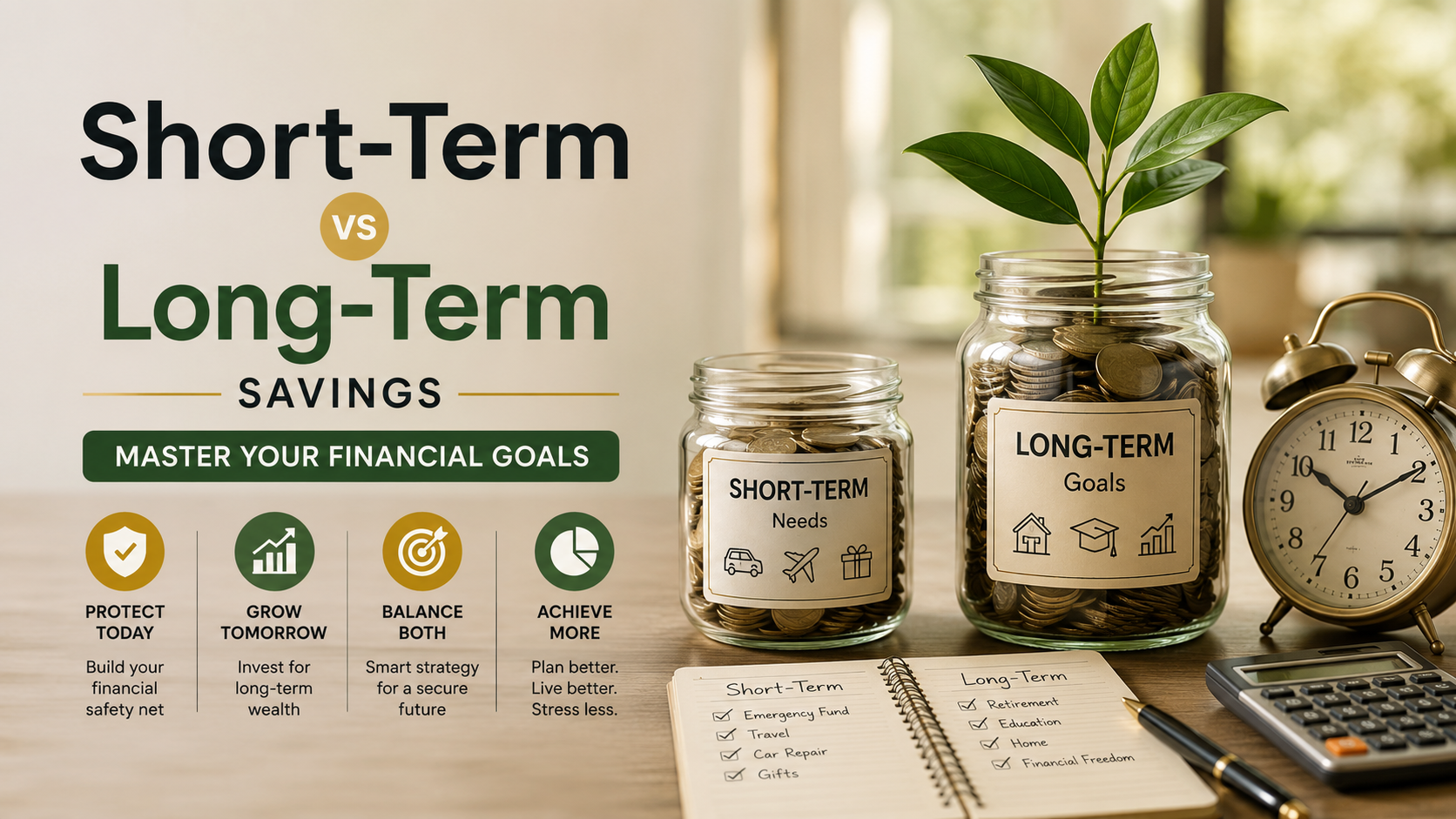
Short-Term vs Long-Term Savings: Master Your Goals
Initially, setting financial targets forms the absolute cornerstone of building lasting wealth. However, many people struggle deeply to balance their immediate cash needs. Consequently, understanding the differences between short-term vs long-term savings is essential. Ultimately, your financial approach must completely change based on your specific timeline.
Specifically, the U.S. Securities and Exchange Commission (SEC) heavily emphasizes defining clear financial objectives. Furthermore, this represents the very first step toward successful investing and responsible management. Therefore, you simply cannot treat all your hard-earned money the exact same way. In fact, a standard checking account loses purchasing power due to inflation over time.
Conversely, locking all your cash in a volatile retirement account remains highly risky. Thus, it leaves you totally vulnerable to sudden, unexpected daily expenses. As a result, you absolutely need a comprehensive dual strategy that safely covers both bases. Essentially, this article explores how to clearly separate your immediate cash requirements.
Additionally, you will learn the absolute best types of accounts to actively use. Moreover, we will comprehensively cover the specific risks inherently involved in different financial strategies. By the end, you will firmly master short-term vs long-term savings effectively. Ultimately, you will know exactly how to fund your vacations without sacrificing your retirement.


What Is the Difference Between Short-Term vs Long-Term Savings?
Understanding short-term vs long-term savings helps you choose the right place for your money and achieve your financial goals. While both are important, they serve different purposes based on when you expect to use your funds. Knowing the differences between short-term vs long-term savings makes it easier to create a balanced savings strategy that supports both immediate needs and future milestones.
Short-term savings are designed for expenses you expect within the next three years. These goals often include building an emergency fund, paying for a vacation, covering car repairs, or handling unexpected medical bills. Because you may need the money at any time, it should remain in highly liquid and low-risk accounts where your principal is protected.
In contrast, long-term savings focus on goals that are several years or even decades away. These may include retirement, buying a home, or funding a child’s higher education. Since you have more time before using the money, you can accept moderate investment risk in exchange for higher growth potential. Investments such as mutual funds, equities, or other growth-oriented assets can help your savings outpace inflation and build greater wealth over time.
Understanding short-term vs long-term savings allows you to match your savings strategy to your financial timeline. Choosing the right balance between short-term vs long-term savings helps you stay prepared for unexpected expenses while steadily building wealth for the future. A well-planned approach to short-term vs long-term savings provides both financial security today and long-term financial confidence.
The Role of Liquidity in Savings Goals
Liquidity refers to how quickly you can access your money without losing value. It is one of the most important factors when choosing where to keep your savings. Short-term financial goals require high liquidity because emergencies and planned expenses can happen without much notice. Keeping these funds in an easily accessible account ensures you can withdraw money quickly without penalties or market losses.
Long-term savings have a different purpose. Since the money is not needed immediately, you can focus more on growth than instant access. This allows investments to benefit from compound returns while riding out short-term market fluctuations. Choosing the right balance between liquidity and growth helps you stay prepared for unexpected expenses without sacrificing future financial goals.
What Is the 70/20/10 Rule for Money?
The 70/20/10 rule is a simple budgeting method that helps you manage your monthly income without creating a complicated financial plan. Under this approach, you spend 70% of your income on essential living expenses, including housing, groceries, transportation, utilities, and other daily necessities. The next 20% goes toward financial priorities such as building savings, investing, paying off high-interest debt, or contributing to retirement accounts.
The remaining 10% is reserved for charitable giving, personal development, or discretionary savings. This flexible category allows you to spend intentionally without affecting your long-term financial security. The 70/20/10 rule encourages consistent saving while ensuring your essential expenses remain covered. Because it is easy to follow, it works well for beginners who want to improve budgeting habits and develop better financial discipline.
Simplifying Monthly Budgets With Percentages
Percentage-based budgeting removes much of the guesswork from managing money. Instead of assigning fixed dollar amounts, you divide your income into percentages that automatically adjust when your earnings change. This makes the system practical for people with fluctuating monthly income or variable freelance earnings.
As your income rises or falls, your spending and savings adjust naturally while maintaining the same financial priorities. This flexibility helps prevent overspending and supports consistent progress toward savings goals. Over time, percentage-based budgeting creates healthier financial habits and makes long-term money management much easier.
What Is the 70-10-10-10 Rule for Money?
The 70-10-10-10 rule expands on traditional budgeting by assigning every portion of your income a specific purpose. Under this framework, 70% of your net income covers essential living expenses such as rent, food, utilities, insurance, and transportation. The first 10% is directed toward long-term investments or retirement savings to build wealth over time.
The second 10% is allocated to short-term savings goals, including vacations, annual insurance premiums, home improvements, or planned purchases. The final 10% goes toward debt repayment or charitable donations, depending on your financial priorities. This structured approach reduces unnecessary spending and ensures every dollar supports a meaningful financial objective. It also makes budgeting easier by creating clear boundaries for spending, saving, and investing.
Structuring Savings Into Distinct Buckets
Dividing your money into separate savings buckets improves organization and financial clarity. Each category serves a specific purpose, making it easier to track progress toward both short-term and long-term goals. This method also reduces the temptation to spend money intended for future needs.
Separate savings buckets provide better visibility into your financial health and help you prioritize expenses with confidence. Whether you are saving for emergencies, retirement, or a major purchase, assigning every dollar a defined role creates stronger financial discipline and reduces uncertainty over time.
Which FD Is Better: Short-Term or Long-Term?
Choosing between a short-term fixed deposit (FD) and a long-term fixed deposit depends on your financial goals, expected cash needs, and interest rate outlook. Short-term FDs generally range from seven days to one year. They provide better liquidity and flexibility if you expect to use your money soon or believe interest rates may increase in the near future.
Long-term FDs typically have tenures ranging from two to ten years. They allow you to lock in a fixed interest rate for an extended period, which can be beneficial when interest rates are expected to decline. While long-term FDs offer predictable returns, they reduce flexibility because withdrawing funds early may result in penalties. Selecting the right tenure depends on balancing stability, returns, and access to your money.
Evaluating Interest Rates and Tenure
Interest rate trends play a major role when choosing an FD tenure. If rates are likely to rise, shorter-term deposits allow you to reinvest later at higher returns. If rates are expected to fall, locking in a long-term FD can secure favorable returns for several years.
Many investors also diversify by splitting money across multiple FD durations. This strategy improves liquidity while reducing the risk of committing all funds during an unfavorable interest rate cycle. Combining short-term and long-term FDs can provide greater flexibility and more stable overall returns.
Frequently Asked Questions
How much money should I keep in my short-term savings account?
A good target is three to six months of essential living expenses in a liquid savings account. This emergency fund helps cover unexpected events such as job loss, medical expenses, or urgent home and vehicle repairs. Keeping these funds separate from long-term investments prevents you from selling investments at unfavorable times.
Can I use long-term savings for short-term emergencies?
Using long-term savings for emergencies should be a last resort. Withdrawing investments early may interrupt compound growth and could result in taxes, penalties, or lower long-term returns. A dedicated emergency fund is a better solution because it provides immediate access to cash without affecting your future financial goals.
Is the 70/20/10 rule suitable for low-income earners?
The 70/20/10 rule may be difficult if essential expenses consume more than 70% of your income. In that situation, adjust the percentages temporarily to meet basic living costs first. As your income increases, gradually shift more money toward savings and investments until you reach your desired allocation.
Do fixed deposits beat inflation over the long term?
Fixed deposits provide capital protection and predictable returns, but they do not always outperform inflation over long periods. As inflation rises, the real value of FD returns may decline. For long-term wealth creation, many investors combine fixed deposits with growth-focused investments such as mutual funds or equities, while using FDs for stability and lower risk.
Conclusion
First, actively managing your personal finances successfully strictly requires a highly disciplined, completely split overarching approach. Specifically, you simply cannot logically treat all your hard-earned, highly valuable money the exact same way. Therefore, completely understanding short-term vs long-term savings gives you a massive, undeniable advantage in lasting wealth creation. Consequently, you actively protect yourself from sudden, immediate disasters by keeping emergency cash highly liquid.
Furthermore, simultaneously, you perfectly guarantee an immensely wealthy, deeply secure future by aggressively investing heavily over decades. Ultimately, the absolutely most crucial, totally vital step in this entire complex process remains taking immediate action. Thus, proactively open a highly competitive, entirely secure high-yield savings account this very afternoon immediately. Additionally, incredibly carefully review your employer’s standard matching program deeply and entirely optimize your contributions today.
Moreover, strict technological banking automation will incredibly quickly serve as your absolute, undeniably best friend. For instance, carefully comparing FD vs mutual fund returns perfectly illustrates how completely different accounts essentially serve fundamentally distinct timelines. Consequently, set up totally automated monthly bank transfers so your money moves instantly and completely perfectly. Finally, clearly define your targets, rigorously pick the entirely correct accounts, and consistently execute your ultimate strategy.