
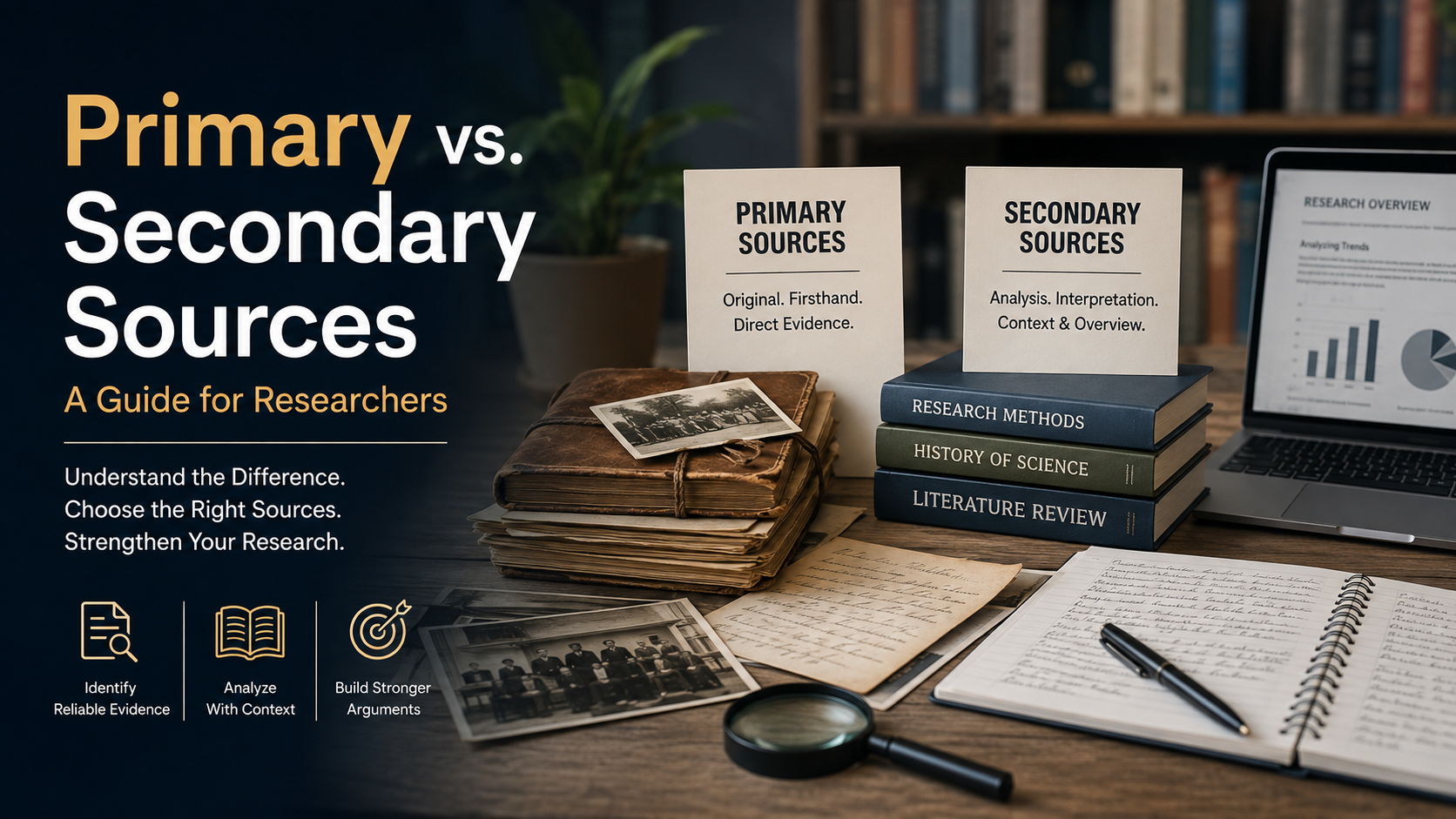
Primary vs. Secondary Sources: A Guide for Researchers
Every strong research paper begins with a reliable foundation of evidence. Understanding primary vs secondary sources helps researchers evaluate information and build stronger arguments. Without this distinction, you may misinterpret evidence, overlook context, or weaken your credibility.
Primary sources provide direct evidence, original data, and firsthand accounts. Secondary sources explain, analyze, compare, or interpret that evidence. Both source types have an important role in academic research.
According to the Library of Congress guide to primary sources, working with original materials helps researchers develop interpretations based on firsthand evidence.
Knowing how to use both sources can also improve your literature searches. Secondary materials can introduce important theories, terminology, and debates. Primary materials then allow you to examine the underlying evidence yourself, while digital literacy skills for students can help you evaluate and use online information effectively.
This guide explains the main differences between the two source types. It also covers examples, identification methods, literature reviews, and practical research strategies.


What is the difference between primary and secondary sources in research?
The main difference between primary vs secondary sources is their relationship to the original evidence. Primary sources provide direct or firsthand evidence from an event, study, person, or creative work. They may include original research data, legal records, interviews, photographs, diaries, or laboratory results.
Secondary sources examine or interpret primary evidence. Authors of secondary sources often compare several original materials and provide additional analysis. Examples include review articles, textbooks, biographies, and scholarly commentaries.
Primary sources therefore give researchers material to evaluate directly. Secondary sources help explain what that material means within a broader academic context.
However, classification depends on the research question. A historical textbook is usually secondary. Yet it could become a primary source when studying how people taught history during that period.
The distinction is not simply about publication date. Instead, consider the source’s purpose, creator, relationship to the evidence, and role in your research.
The Role of Analytical Distance
Analytical distance helps explain the difference between these source categories. A primary source usually sits closer to the original event, observation, experiment, or creative process. It gives researchers evidence without another scholar’s later interpretation.
For example, an interview transcript records what a participant said. A researcher’s article analyzing several interviews adds another layer of interpretation. The transcript is primary evidence, while the analytical article is secondary.
Secondary sources remain valuable because researchers rarely study evidence in isolation. They help identify patterns, competing interpretations, and established debates. They can also reveal how different scholars understand the same evidence.
However, secondary analysis should not automatically replace primary evidence. When a specific claim matters, return to the original material whenever possible.
Think of the two categories as different research tools. Primary sources provide evidence to examine, while secondary sources provide frameworks for understanding it. Using both can produce a more balanced and defensible argument.
What are 5 examples of primary sources and secondary sources?
Examples make the difference between source types easier to understand. Common primary sources include personal diaries, raw survey data, official census records, original laboratory results, and historical photographs. Each provides direct evidence created by participants, researchers, institutions, or observers.
Five common secondary sources include peer-reviewed review articles, academic history textbooks, analytical biographies, documentary films, and systematic literature reviews. These sources generally interpret, summarize, compare, or evaluate information from primary materials.
The distinction can vary by discipline. A laboratory notebook is primary evidence for a scientific investigation. A review article discussing that experiment is secondary. Similarly, Abraham Lincoln’s speech is a primary source. A historian’s later analysis of the speech is secondary.
Researchers should examine the source rather than relying only on its format. Some journal articles contain original research and therefore function as primary sources. Others summarize previous studies and function as secondary sources.
The research question also matters. Always consider how the source will be used before assigning its final classification.
Comparing Source Pairs in Practice
Source pairs can make primary vs secondary sources easier to recognize. Imagine a researcher studying scientific discoveries. The scientist’s original experiment results provide primary evidence. A later review article comparing those experiments is secondary.
The same pattern appears in historical research. A politician’s speech, personal letter, or government document can serve as primary evidence. A historian’s book explaining the document becomes secondary.
In journalism, an eyewitness interview may function as a primary source. A news analysis that compares several interviews can function as secondary material.
Creative fields follow similar patterns. An original painting, manuscript, or recording can provide primary evidence. A scholarly article interpreting that work is secondary.
These examples show why source classification depends on the relationship between the material and your research question.
A useful test is simple: Does the source provide original evidence, or does it analyze existing evidence? Original evidence usually points toward a primary source. Analysis and interpretation usually indicate a secondary source.
When uncertain, examine the author’s role, purpose, citations, and relationship to the subject.
How do I know if it’s a primary or secondary source?
Start by examining the source’s creator, purpose, and relationship to the subject. Ask whether the creator personally witnessed the event, conducted the research, produced the data, or created the original work. If so, the material is likely a primary source.
Next, determine whether the source mainly analyzes information created by someone else. If it compares studies, explains historical events, evaluates evidence, or summarizes previous research, it is generally secondary.
Your research question also affects classification. A 1950s science textbook is normally a secondary source for studying scientific facts. However, it could become a primary source when examining teaching practices during the 1950s.
Publication date can provide useful clues, but it does not determine classification by itself. A recent research paper may contain original experimental findings. An older scholarly article may still provide secondary analysis.
Always examine the content rather than relying on labels such as “journal article” or “book.” The author’s role and the source’s purpose provide stronger evidence.
Evaluating Author Intent and Timeframe
Author intent can reveal whether a source is primary or secondary. Look at why the material was created and what the author intended readers to understand.
A researcher presenting new experimental results is providing primary evidence. A scholar comparing results from several studies is providing secondary analysis.
Citations can also provide useful clues. Secondary sources often contain extensive references because they build arguments from earlier research. Primary sources may contain references too, especially in academic research. Therefore, citations alone cannot determine classification.
The timeframe also matters, particularly in historical research. A document created during an event may provide contemporary evidence. A later interpretation may place that evidence into a broader historical framework.
Ask these questions when evaluating a source:
- Who created it?
- When was it created?
- Why was it created?
- What evidence does it contain?
- Does the author interpret other sources?
- How does it relate to my research question?
These questions help prevent incorrect classification. They also encourage stronger source evaluation before you include evidence in your research and help you avoid misinformation while studying online.
What are the differences between primary and secondary sources in a literature review?
Primary and secondary sources serve different purposes within a literature review. Primary sources provide original evidence that you can examine directly. They may contain experimental results, survey findings, interviews, datasets, or original theoretical proposals.
Secondary sources help you understand the larger academic conversation surrounding that evidence. Review articles and scholarly analyses can reveal major themes, disagreements, research gaps, and methodological trends.
A strong literature review often needs both. Secondary sources can help you discover important studies and understand the field quickly. Primary studies then allow you to evaluate the actual methods, findings, and limitations behind those discussions.
This approach also reduces dependence on secondhand interpretations. If an important claim appears in a review article, trace it back to the original study when possible.
Using both source types creates stronger academic analysis. Secondary materials establish context and show how scholars have interpreted the topic. Primary materials support detailed evaluation of the evidence itself.
The goal is not to use one category more than the other. Instead, select sources based on the role each one plays in answering your research question.
Synthesizing Sources for Stronger Reviews
Effective synthesis requires more than summarizing one source after another. Start with secondary sources to understand the major theories, debates, and research gaps surrounding your topic.
Then examine relevant primary studies closely. Compare their research questions, methods, samples, findings, and limitations. This allows you to determine whether broad claims in secondary literature are supported by the underlying evidence.
For example, a review article may identify a trend across several studies. You can then examine those original studies to assess whether their findings genuinely support that trend.
This method strengthens your literature review because it connects broad scholarly interpretation with direct evidence.
A useful workflow is:
- Use secondary literature to map the research area.
- Identify influential primary studies.
- Read the most relevant primary sources closely.
- Compare findings and methodological differences.
- Use secondary sources to frame your interpretation.
This two-level approach demonstrates both breadth and depth. It shows that you understand the wider scholarly conversation while also evaluating the evidence behind it.
Most importantly, avoid treating secondary interpretations as unquestionable facts. Strong research checks important claims against original evidence whenever practical.
When should I use primary vs secondary?
The right choice between primary vs secondary sources depends on your research objective and stage of writing. Use primary sources when you need to analyze original evidence, test a hypothesis, evaluate research methods, or develop an original interpretation.
Primary materials are especially important when your argument depends on specific findings or firsthand evidence. They allow you to examine information directly rather than relying entirely on another author’s interpretation.
Secondary sources are especially useful during the early stages of research. They can introduce terminology, major scholars, important theories, historical background, and ongoing debates. They also help you locate relevant primary materials.
A balanced strategy often works best. Begin with reliable secondary sources to understand the subject and identify important questions. Then move toward primary evidence for detailed analysis.
This approach can also save time. You gain enough context to search effectively without spending excessive time reading irrelevant original materials.
Your discipline may also influence source preferences. Historical research often emphasizes original documents. Scientific research may require original studies and datasets. Always follow the evidence standards expected in your field.
Optimizing Your Research Strategy
A practical research strategy should move from broad understanding toward detailed evaluation. Start with high-quality secondary sources to establish key terminology, major theories, historical context, and important controversies.
Next, identify the primary sources behind the most relevant claims. Read those materials carefully and compare their evidence with the interpretations you found earlier.
Do not assume that a secondary source’s summary captures every important detail. Original studies may contain limitations, conflicting findings, or methodological choices that summaries overlook.
As you research, organize sources according to their purpose. Separate background material from evidence that directly supports your argument. This makes later writing and citation management easier.
You can also ask three questions throughout the process:
- What does the original evidence show?
- How have other scholars interpreted it?
- What is my own evidence-based conclusion?
This workflow balances context with critical analysis. It also reduces the risk of building an argument entirely on secondhand information.
Ultimately, effective research does not depend on choosing primary or secondary sources exclusively. It depends on knowing when each source type provides the most useful evidence.
FAQ SECTION
Can a source be both primary and secondary?
Yes, a document’s classification depends directly on your specific research question and approach. For example, an encyclopedia published in 1920 is a secondary source if you use it to learn general historical facts. However, if your research project examines how historical encyclopedias framed gender roles in the early twentieth century, that exact same book becomes a primary source because it serves as direct cultural evidence from that era.
Are primary sources always more reliable than secondary sources?
Not necessarily, because primary sources can still contain personal biases, factual errors, or incomplete observations. A diary entry reflects only one person’s subjective perspective, while a single scientific trial might suffer from unrecognized procedural flaws. High-quality secondary sources often provide balanced reliability because expert scholars cross-examine multiple primary records, filter out individual biases, and corroborate findings against extensive data pools before publishing their analyses.
Where can researchers find verified primary sources online?
Researchers can access authentic primary materials through digital archives, government repositories, and university special collections. Renowned digital libraries such as the Library of Congress, the National Archives, and JSTOR provide direct access to scanned historical manuscripts, legal documents, and raw datasets. For scientific fields, databases like PubMed Central and open-science repositories host original laboratory studies, clinical trials, and reproducible datasets.
Why do professors require both source types in research papers?
Professors require both formats to ensure you develop comprehensive research, synthesis, and critical thinking skills. Reviewing secondary literature shows that you understand the established scholarly conversation, foundational theories, and existing academic consensus. Incorporating primary evidence demonstrates your ability to analyze raw data independently, evaluate unfiltered facts, and draw logical, original conclusions rather than merely summarizing other authors’ opinions.
CONCLUSION
Mastering the distinction between primary vs secondary sources is a vital skill for conducting credible, high-impact research. Primary materials give your work authenticity by anchoring your arguments in raw data, direct testimony, and original experimental findings. Secondary materials provide the necessary analytical scaffolding, helping you interpret complex ideas, identify research gaps, and connect your work to established scholarship. Building digital literacy skills for students can also help you evaluate online information and use research sources more effectively.
By applying the evaluation strategies outlined in this guide, you can confidently determine the classification of any document and structure your bibliography effectively. Remember to begin with secondary literature to gain a solid contextual overview, then dive into primary materials to perform your own rigorous analysis. Balancing both source types will elevate the academic rigor of your literature reviews, strengthen your empirical arguments, and ensure your final papers meet the highest scholarly standards. Apply these principles to your next research project to build well-supported, persuasive, and authoritative academic papers.