

SIP vs FD Which is Better? Smart Investment Guide
When building a personal savings strategy, choosing where to park your hard-earned money can feel overwhelming. Two of the most popular paths for individual wealth creation are Systematic Investment Plans (SIPs) and Fixed Deposits (FDs). If you are trying to figure out sip vs fd which is better, the answer depends heavily on your financial milestones, risk tolerance, and investment horizon. Understanding the core mechanics of both options helps you deploy your capital efficiently. Many individuals rush into investment avenues without analyzing how market variables affect their capital over time. This lack of planning often leads to lower-than-expected growth.
To make an informed decision, it is highly beneficial to look at guidance from established financial bodies like the Securities and Exchange Board of India. This institution regulates the mutual fund market and ensures investor protection. While one avenue offers guaranteed returns with virtually zero risk, the other harnesses market dynamics to potentially yield significantly higher wealth over time. This article will dissect both investment vehicles. We will compare their returns, tax implications, and liquidity options so you can choose the ideal tool for your financial journey. By evaluating these critical components side by side, you can build a more resilient financial portfolio. This helps you balance immediate security with aggressive long-term accumulation.
SIP vs FD: Which is Better for Your Growth?
To understand which option fits your wallet, we must look at how they operate in day-to-day financial planning. A Fixed Deposit is a traditional financial instrument where you invest a lump sum for a fixed tenure. This investment comes with a predetermined interest rate. Your money grows safely, completely insulated from market volatility. Banks use these deposits to fund long-term commercial loans. They pass on a portion of that interest income back to you as guaranteed growth. Because the rate remains locked from day one, you always know exactly how much cash you will receive at maturity. This predictability makes it a favorite for risk-averse savers.
Conversely, a Systematic Investment Plan is a method of investing a fixed amount regularly into mutual funds. These are typically equity funds. Instead of timing the market, you buy fund units consistently every single month. When market prices drop, your fixed budget automatically buys more units. When prices rise, you buy fewer units. This mechanism is known as rupee cost averaging. It lowers your average cost of investment over the long haul. It eliminates the emotional stress of trying to guess market peaks or troughs. This allows ordinary savers to build vast equity portfolios over time. You can achieve this with small, manageable monthly contributions.
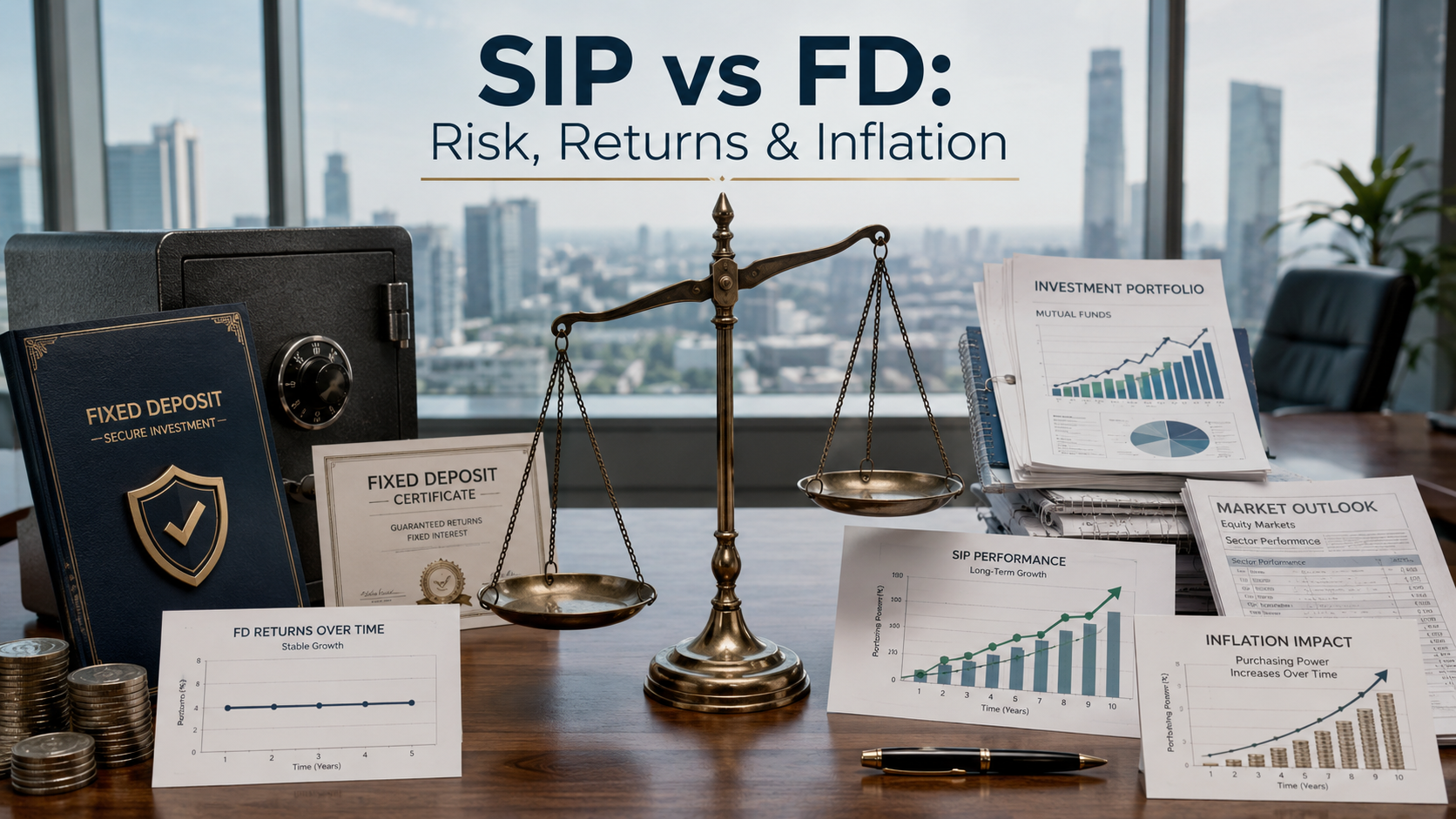

Risk and Return Dynamics
The foundational difference between these two choices lies in the risk-return trade-off. Fixed Deposits are low-risk instruments. The bank guarantees your principal amount and interest payouts. This makes them exceptionally stable. In many jurisdictions, government-backed insurance schemes secure these deposits up to specific limits. This setup provides total peace of mind. However, this absolute safety limits your earning potential. Modern FD rates generally hover around 6% to 8%. This growth barely keeps pace with changing economic conditions and the rising cost of consumer goods. Over time, high safety can mean lower purchasing power.
SIPs carry market risk because they invest directly in corporate stocks or volatile debt securities. However, this structural risk often diminishes significantly over extended periods. Historically, equity-linked SIPs have delivered compound annual returns ranging from 12% to 15% over five or more years. Therefore, when looking closely at sip vs fd which is better, mutual fund investments offer a distinct advantage over fixed-income assets for growth. The fluctuating nature of the stock market means you might see temporary dips. However, patient investors are usually rewarded with substantial capital appreciation. This growth transforms their financial standing over a decade.
Impact of Inflation on Your Savings
Inflation quietly erodes the purchasing power of your money over time. If your investment does not grow faster than the inflation rate, you are technically losing wealth every single day. For instance, think about a basket of groceries that costs 100 currency units today. If that same basket costs 107 next year, your money has lost 7% of its value. To protect your savings, you must choose an investment vehicle that generates a positive real rate of return. This means your returns must adjust for these rising lifestyle expenses.
Real Return = Nominal Interest Rate – Inflation Rate
Because Fixed Deposit returns are entirely fixed, they frequently struggle to beat inflation. This is especially true after accounting for local taxes. SIPs, by investing in equity, tend to outperform long-term inflation. This happens because businesses can raise prices to match inflation. That pricing power drives up stock values over time. This characteristic makes regular market investments a much stronger shield for preserving and growing your future purchasing power. If your objective is to preserve the true value of your retirement nest egg, relying solely on fixed income can leave you financially falling behind over a twenty-year horizon.
Flexibility and Liquidity Compared
Liquidity refers to how quickly you can convert an asset back into cash without losing its core value. FDs lock your money for a specific duration. This timeline ranges from a few months to several years. If you break an FD prematurely due to an emergency, banks usually charge a penalty fee. They also lower your overall interest rate retrospectively. This rigid structure makes it difficult to adjust your strategy. It hurts you if a sudden financial emergency arises. It also limits you if a better investment opportunity presents itself unexpectedly.
SIPs offer excellent operational flexibility for modern savers. You can pause, alter, or stop your monthly contributions at any time without facing penalties or administrative friction. Most open-ended mutual funds allow you to withdraw your capital whenever you need it. They deliver funds to your account within a few business days. However, you must keep an eye out for exit loads. These are small fees applied if you redeem your units within a specific window, usually one year. This fluid system allows you to scale your investments upward as your salary increases. It also lets you downsize during lean financial months.
Tax Treatment on Earnings
Your net investment earnings depend greatly on prevailing tax laws. These regulations can drastically alter your actual take-home returns. The interest earned from a Fixed Deposit is added directly to your annual taxable income. Consequently, it is taxed according to your specific income tax slab. This practice can significantly reduce net returns for high earners. If you fall into the highest tax bracket, a substantial portion of your guaranteed FD interest is paid back to the state. This lowers your effective yield considerably.
Mutual fund investments through SIPs enjoy a much more favorable tax structure under current frameworks. If you hold an equity investment for more than one year, your gains qualify as Long-Term Capital Gains. These gains are often taxed at a much lower flat rate compared to high income tax brackets. This system allows you to retain a larger portion of your accumulated profits. Additionally, small capital gains up to a specific annual threshold are frequently entirely exempt from taxes. This structural tax advantage heavily tilts the scales in favor of systematic market investing. It is a major factor for anyone focused on optimizing their net wealth.
FAQ SECTION
Is SIP safer than an FD?
No, an FD is considerably safer than a SIP from a capital preservation perspective. Fixed Deposits are backed by banking institutions and offer guaranteed returns. This makes them completely immune to daily market fluctuations. Conversely, SIPs invest your capital into mutual funds tied directly to equity or debt markets. Because market values rise and fall based on economic data, corporate earnings, and global events, your investment value will fluctuate. If the market crashes, your portfolio could temporarily lose value. However, holding a SIP for a long period generally smoothens out these short-term risks. This approach often leads to higher returns that comfortably beat inflation over time. Therefore, while FDs offer absolute near-term safety, SIPs provide superior long-term purchasing power safety by actively outgrowing inflation. When assessing sip vs fd which is better, safety depends entirely on your time horizon.
Can I lose money in a SIP?
Yes, it is entirely possible to experience short-term losses in a SIP, particularly during market downturns or economic recessions. Because SIPs purchase mutual fund units linked to volatile stock markets, the value of your portfolio can temporarily drop below your total invested amount. If you panic and withdraw your money during a market dip, you will lock in those actual financial losses. However, this risk decreases significantly if you remain invested over a long horizon, such as five to ten years. Long-term investing allows market cycles to balance out, utilizing rupee cost averaging to lower your average purchase price. Historically, investors who maintain their monthly contributions through market declines recover strongly when the economy rebounds. They turn temporary paper losses into substantial long-term gains. This demonstrates why patience is essential for market-linked instruments.
Which gives higher returns, SIP or FD?
A SIP generally delivers much higher returns than a Fixed Deposit over an extended time horizon. While standard bank FDs provide a stable, locked-in return usually ranging from 6% to 8%, equity mutual funds accessed via SIPs historically yield between 12% and 15% over several years. This substantial difference occurs because equity investments participate directly in corporate profitability and macroeconomic expansion. In contrast, FDs are fixed-income contracts that do not change regardless of how well the broader economy performs. Over a ten-year period, the compounding effect on a SIP’s higher return rate can result in a final wealth pool that is twice as large as a matching investment placed in a standard bank Fixed Deposit. This makes SIPs the clear choice for aggressive wealth accumulation. It also answers the question of sip vs fd which is better for beating long-term inflation.
What is the minimum amount to start a SIP?
One of the greatest benefits of a SIP is its high accessibility for everyday savers and young professionals. You can begin investing in many mutual funds with a minimum amount of just 500 INR per month. This low entry barrier allows you to build a disciplined investing habit without straining your monthly household budget. It also does not require a massive pool of seed capital to get started. In contrast, while you can open a Fixed Deposit with a relatively small amount, maximizing your interest earnings typically requires a larger upfront lump sum payment right at the start. The micro-investing nature of SIPs means that anyone can participate in stock market growth. You can build wealth incrementally with sums that might otherwise be spent on minor daily lifestyle expenses, making it highly efficient.
Can I stop a SIP at any time?
Yes, you can stop, pause, or modify a Systematic Investment Plan whenever you choose without incurring any penalty fees or facing complex paperwork. Mutual fund companies offer high operational flexibility, allowing you to manage your cash flow easily if you face unexpected financial difficulties or job transitions. Once you stop the monthly deduction, your accumulated funds will simply remain invested in the market. They continue to grow based on fund performance until you decide to request a withdrawal. Fixed Deposits do not share this level of structural flexibility, as closing them early attracts premature withdrawal penalties. It also reduces your interest rate and disrupts your long-term savings architecture. This operational freedom makes SIPs far more accommodating to unpredictable real-world financial situations that savers face today.
CONCLUSION
Deciding between a SIP and a Fixed Deposit is not about finding a universally superior financial option. Instead, it is about aligning your capital with your personal timelines, income stability, and comfort with market volatility. Fixed Deposits provide absolute near-term security. This makes them perfect for short-term targets under three years, emergency funds, or conservative savers who cannot afford to lose any principal value. They act as an excellent defensive anchor for your money. They ensure that specific amounts of cash are available exactly when you need them without fail.
If you are planning for long-term objectives like retirement, higher education, or buying a home, a market-linked strategy is vital. Utilizing a regular investment plan allows you to harness the compounding power of equities while mitigating volatility through steady, systematic contributions over time. To strengthen your overall financial knowledge, you can also explore the best personal finance books that cover investing, wealth creation, and smart money management. Evaluating SIP vs FD—which is better—reveals that a balanced financial portfolio often utilizes both tools simultaneously to achieve both safety and growth. By placing emergency cash in stable FDs and wealth-building capital into disciplined SIPs, you protect your present life while securing your future financial freedom.