
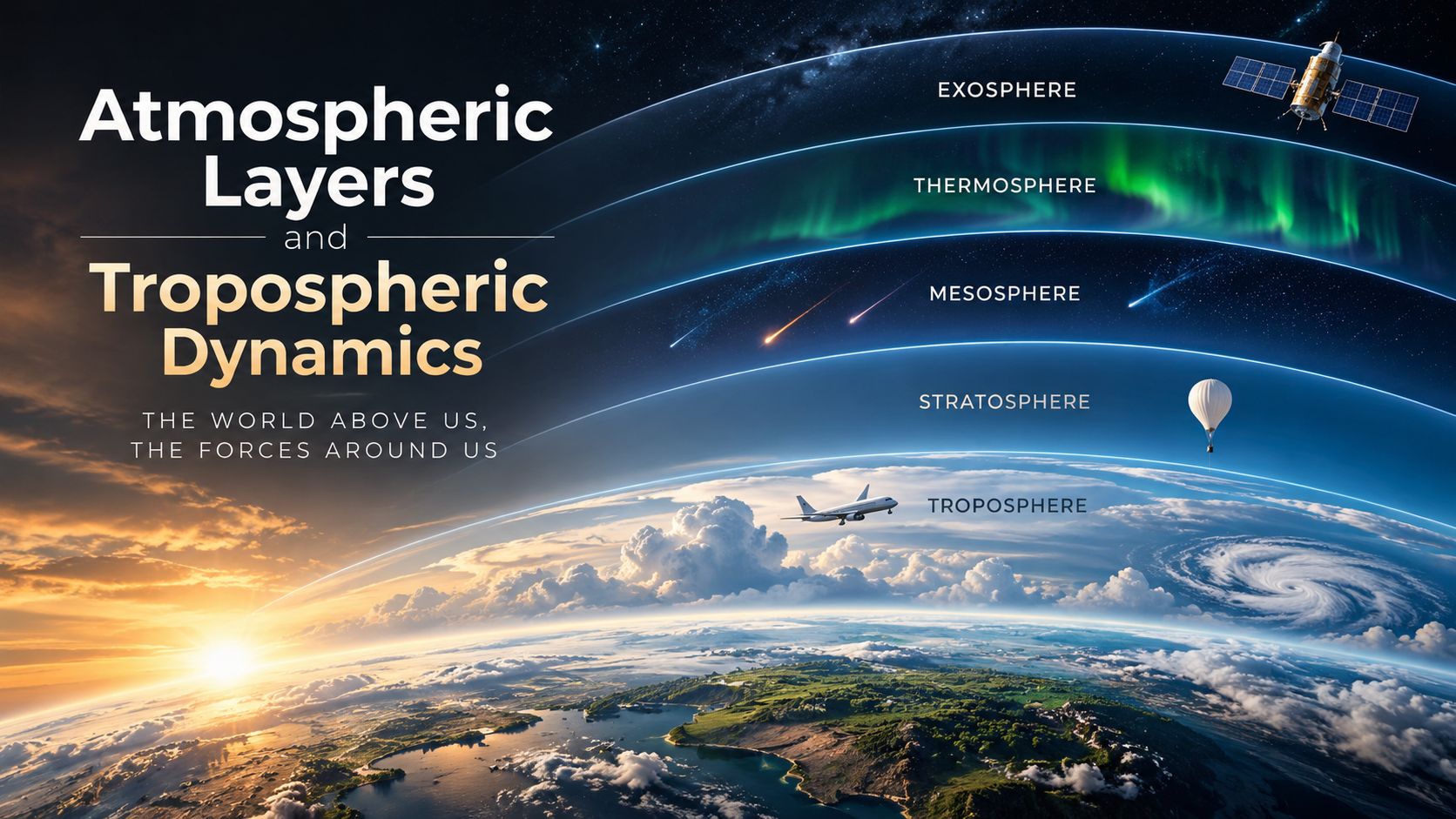
Atmospheric Layers and Tropospheric Dynamics: Structure, Function, and Earth’s Weather Engine
Have you ever wondered how Earth stays warm, breathable, and protected from space? The answer lies in the atmosphere. Studying atmospheric layers and tropospheric dynamics helps explain how Earth’s gaseous envelope supports life and regulates weather. According to the National Oceanic and Atmospheric Administration, the atmosphere is a dynamic system that balances thermal radiation, chemical cycles, and mechanical energy.
The atmosphere also shields life from harmful radiation and helps regulate surface temperatures. Without it, Earth would face extreme temperature changes and intense exposure to space radiation.
Understanding this structure helps explain daily weather, long-term climate patterns, and aerospace operations. The atmosphere is not a single, uniform mass of air. Instead, it contains distinct layers based on temperature, density, and composition.
This guide explores atmospheric layers and tropospheric dynamics in simple terms. You will learn how the troposphere differs from the rest of the atmosphere, how the major layers are arranged, and why each layer matters. You will also discover easy ways to remember the layers and understand why the thermosphere reaches extremely high temperatures.

What is the difference between atmosphere and troposphere?
The atmosphere is the complete gaseous envelope surrounding Earth. Gravity holds this envelope around the planet, extending from the surface into space. It contains several regions with different temperatures, densities, and physical properties.
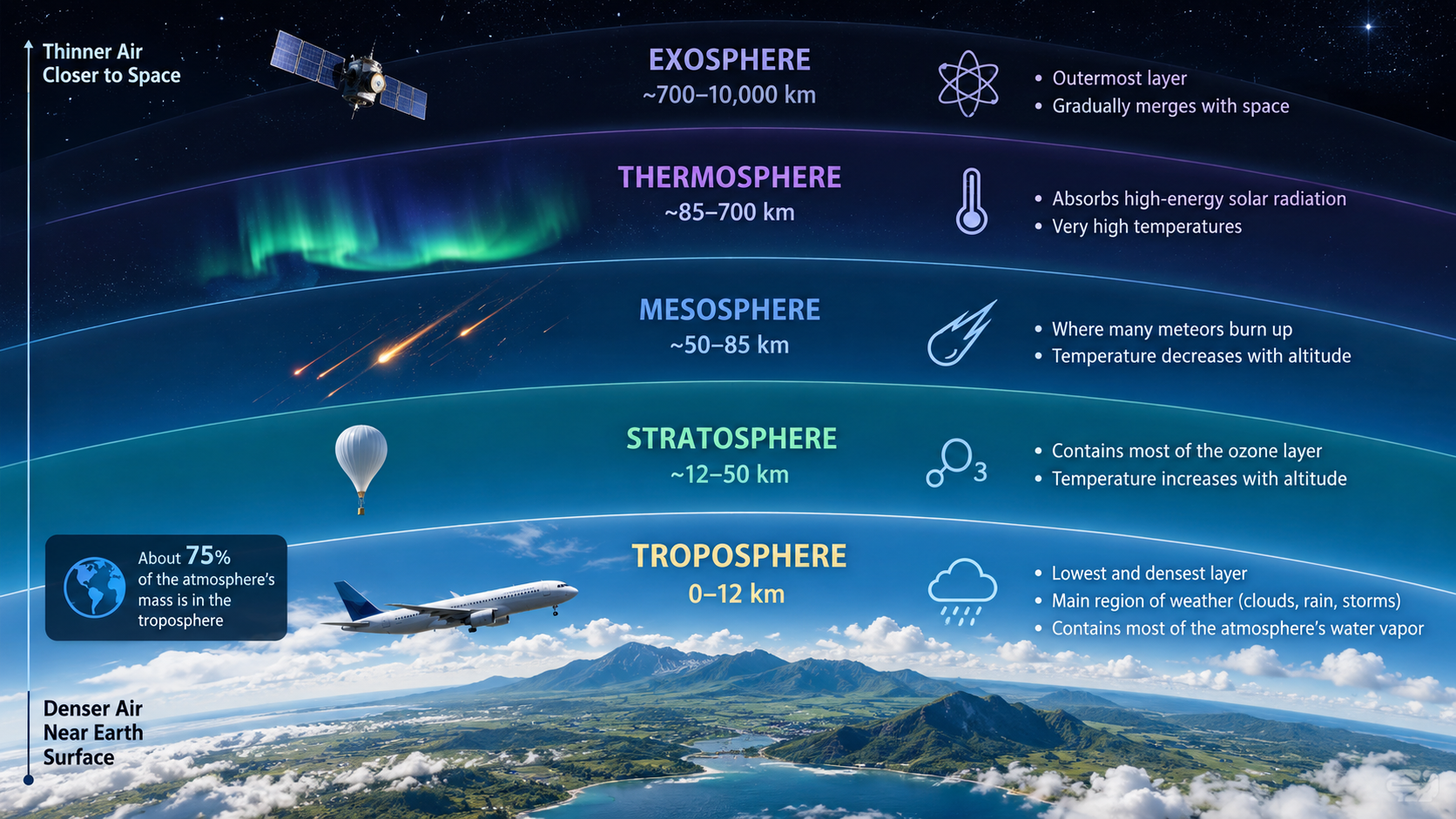
The troposphere is the lowest and densest part of the atmosphere. It begins at Earth’s surface and extends upward to the tropopause. Although it occupies only the lowest portion of the atmosphere, it contains roughly 75% of the atmosphere’s total mass.
The troposphere also contains almost all atmospheric water vapor. This makes it the main region where clouds, rainfall, storms, and other weather processes develop, which are closely connected to the environmental impact of commercial flying.
In simple terms, the atmosphere is the entire planetary shell, while the troposphere is its lowest layer. The difference becomes especially important when studying atmospheric layers and tropospheric dynamics.
Boundary Mechanics and Mass Concentration
The boundary between the troposphere and stratosphere is called the tropopause. It marks an important change in atmospheric temperature behavior.
Within the troposphere, temperature generally decreases as altitude increases. Above the tropopause, temperature begins to stabilize and then increase through much of the stratosphere.
This change creates a stable atmospheric boundary. It limits vertical mixing between the troposphere and stratosphere. Most atmospheric moisture, dust, and weather-related particles therefore remain below this boundary.
The tropopause does not occur at the same altitude everywhere. It is generally higher over warm tropical regions and lower near the colder polar regions.
These variations influence aviation, weather forecasting, and atmospheric circulation. Understanding this boundary is therefore essential when examining atmospheric layers and tropospheric dynamics.
What are the 7 layers of the atmosphere?
Earth’s atmosphere can be divided into several regions based on temperature behavior and physical properties. The commonly taught primary layers are the troposphere, stratosphere, mesosphere, thermosphere, and exosphere.
Two additional regions, the ionosphere and ozone layer, are often discussed alongside these five layers. However, they are not separate primary layers in the same way. The ionosphere overlaps several atmospheric layers, while the ozone layer lies mainly within the stratosphere.
From the surface upward, the five main layers follow this order:
- Troposphere – the main region of weather.
- Stratosphere – contains most atmospheric ozone.
- Mesosphere – where many meteors burn up.
- Thermosphere – absorbs high-energy solar radiation.
- Exosphere – the outermost region that gradually merges with space.
Gas density decreases rapidly with altitude. At the same time, atmospheric particles behave differently as the air becomes thinner. These changes are central to understanding atmospheric layers and tropospheric dynamics.
Thermal Stratification from Surface to Space
Scientists distinguish atmospheric layers partly by studying how temperature changes with altitude. These changes create distinct thermal patterns across the atmosphere.
Temperature generally decreases as altitude increases through the troposphere. It then increases through the stratosphere because ozone absorbs ultraviolet radiation. In the mesosphere, temperature decreases again.
The thermosphere reverses this pattern once more. Temperatures rise sharply because sparse atmospheric gases absorb high-energy solar radiation.
These alternating temperature trends create the atmosphere’s major thermal boundaries. They also affect air density, circulation, chemical reactions, and the movement of aircraft and spacecraft.
For meteorologists, these patterns help explain atmospheric stability and turbulence. For aerospace engineers, they provide important information about orbital drag, satellite operations, and atmospheric resistance, especially when studying reusable spacecraft technology.
Studying these thermal changes provides a clearer understanding of atmospheric layers and tropospheric dynamics and shows why the atmosphere cannot be treated as one uniform region.
What is the 5 importance of atmosphere layers?
Atmospheric layers perform several essential functions that support life and protect Earth. Five major roles stand out.
- Life support: The atmosphere provides oxygen for respiration and carbon dioxide for photosynthesis.
- UV protection: Ozone in the stratosphere absorbs much of the Sun’s harmful ultraviolet radiation.
- Temperature regulation: Greenhouse gases help maintain temperatures suitable for life.
- Space-debris protection: Many smaller meteoroids burn up as they enter the atmosphere.
- Water circulation: The lower atmosphere transports moisture and drives the global water cycle.
These functions work together across different atmospheric regions. The lower atmosphere controls weather and moisture movement, while higher layers provide radiation protection and interact with solar energy.
The relationship between these regions demonstrates why atmospheric layers and tropospheric dynamics matter. Each layer contributes differently, yet all remain connected through energy transfer and atmospheric circulation.
Life Support and Planetary Insulation
The atmosphere acts as both a life-support system and a natural thermal blanket. Without the natural greenhouse effect, Earth’s average surface temperature would be around -18°C, rather than the much warmer conditions experienced today.
Atmospheric gases absorb and redistribute energy throughout the climate system. This process reduces extreme temperature differences between day and night and helps maintain conditions suitable for life.
The atmosphere also transports heat between different parts of the planet. Large-scale circulation moves energy from warmer tropical regions toward colder areas.
At the same time, atmospheric gases absorb or scatter portions of incoming solar radiation. The ozone layer provides additional protection from harmful ultraviolet radiation.
These combined functions show that the atmosphere does more than provide breathable air. Its layered structure regulates energy, protects living organisms, and supports Earth’s water cycle.
How to remember 5 layers of atmosphere?
Remembering the five main atmospheric layers becomes easier when you focus on their first letters. From lowest to highest, they are Troposphere, Stratosphere, Mesosphere, Thermosphere, and Exosphere.
Their initials form T-S-M-T-E. You can use a simple mnemonic to recall this sequence, such as “The Smart Musician Tracks Echoes.”
Another approach is to associate each layer with a memorable feature:
- Troposphere: weather and clouds
- Stratosphere: ozone and stable air
- Mesosphere: meteors
- Thermosphere: auroras and high temperatures
- Exosphere: transition toward space
This method can be easier than memorizing names alone. It connects each atmospheric layer with something distinctive.
The same sequence is useful when studying atmospheric layers and tropospheric dynamics. Once you remember the order, you can add information about temperature, density, and atmospheric processes to each layer.
Anchoring Concepts with Spatial Visualization
A simple way to visualize the five atmospheric layers is to imagine an elevator traveling upward from Earth’s surface.
The elevator starts in the troposphere, where clouds, rain, aircraft, and most weather occur. It then enters the stratosphere, which contains the ozone layer and generally has more stable air.
Next comes the mesosphere, where many incoming meteors burn due to atmospheric friction. Above it lies the thermosphere, where auroras occur and temperatures can become extremely high.
Finally, the elevator reaches the exosphere, the outermost atmospheric region that gradually transitions into space.
This mental journey creates a clear spatial map. It also helps connect each layer with its most important feature.
Using visualization alongside the T-S-M-T-E sequence makes atmospheric layers and tropospheric dynamics easier to understand and remember.
What is the troposphere layer of the atmosphere?
The troposphere is the lowest layer of Earth’s atmosphere. It begins at the surface and reaches an average height of about 12 kilometers. However, its height varies with location and season.
The troposphere can extend to around 18 kilometers near the equator. Near the poles, it may reach only about 8 kilometers.
This layer contains the greatest concentration of atmospheric gases and most atmospheric water vapor. Air pressure is also highest near the surface.
The troposphere receives much of its heat indirectly from Earth’s surface. Solar radiation warms the ground, and the ground then transfers heat to the air above it.
As warm air rises and expands, its temperature generally decreases with altitude. The average environmental lapse rate is about 6.5°C per kilometer.
These conditions create strong convection and mixing. They also make the troposphere the central region for studying atmospheric layers and tropospheric dynamics.
The Dynamics of Weather Formation
The troposphere is the main atmospheric layer responsible for Earth’s weather. Nearly all clouds, rainfall, thunderstorms, and surface winds develop within this region.
Solar energy heats Earth’s surface unevenly. Tropical regions receive more solar energy than polar regions. This difference creates temperature and pressure gradients that drive atmospheric circulation.
Water also plays a major role. Heat causes water to evaporate from oceans, lakes, and land surfaces. Rising moist air cools, causing water vapor to condense into clouds.
Condensation releases heat, which can strengthen rising air and contribute to storm development. Large-scale pressure differences then help move air across regions.
Earth’s rotation also affects these movements through the Coriolis effect. Together, solar heating, moisture, pressure differences, and rotation create complex weather systems.
These processes form the core of tropospheric dynamics and explain why the troposphere acts as Earth’s primary weather engine.
Which layer is called the thermosphere?
The thermosphere lies above the mesosphere and below the exosphere. It begins at roughly 85 kilometers altitude and can extend several hundred kilometers upward.
The layer gets its name from the Greek word therme, meaning heat. Temperatures can rise above 2,000°C because sparse gases absorb high-energy solar X-rays and extreme ultraviolet radiation.
However, these temperatures can be misleading. The thermosphere contains extremely few particles compared with the lower atmosphere. Human skin would not experience the same heating that a conventional thermometer measures.
Heat transfer requires collisions between particles. Because particles are widely separated in the thermosphere, there are too few collisions to transfer large amounts of thermal energy.
Solar activity also causes thermospheric conditions to change. Strong solar storms can increase atmospheric density and affect satellites, an important consideration for reusable spacecraft technology.
These characteristics make the thermosphere an important part of atmospheric layers and tropospheric dynamics, especially for space operations.
Home of Auroras and Low Earth Orbit
The thermosphere is closely associated with spectacular auroras, including the Aurora Borealis in the Northern Hemisphere and Aurora Australis in the Southern Hemisphere.
These displays occur when charged particles from the Sun interact with gases in Earth’s upper atmosphere. The resulting energy produces glowing patterns that can stretch across the night sky.
The thermosphere also overlaps much of the region used by many low Earth orbit spacecraft. The International Space Station operates within this broad atmospheric zone.
Although the air is extremely thin, it still produces a small amount of atmospheric drag. Changes in solar activity can increase that drag by expanding the upper atmosphere, which is important when considering reusable spacecraft technology.
This matters because increased drag can gradually alter satellite orbits. Operators must account for these changes when maintaining spacecraft.
The thermosphere therefore connects atmospheric science with space weather, satellite operations, auroras, and orbital mechanics. It also shows how atmospheric processes remain important far above the weather-producing troposphere.
Frequently Asked Questions
What causes turbulence in the upper troposphere?
Upper tropospheric turbulence develops primarily when fast-moving air currents, like jet streams, collide with slower ambient air masses. Thermal updrafts from strong surface heating and powerful mountain waves also break in the upper troposphere. These rapid shifts in wind direction and velocity create vertical wind shear, producing clear-air turbulence that impacts commercial aircraft.
Why does temperature rise in the stratosphere?
Temperature increases with altitude across the stratosphere because of the concentrated ozone layer. Ozone molecules absorb incoming solar ultraviolet radiation, transforming that radiant photonic energy directly into kinetic heat. This thermal inversion layer prevents vertical air convection, which explains why commercial airplanes prefer cruising in this calm, cloud-free atmospheric stratum.
What is the coldest layer of Earth’s atmosphere?
The mesosphere holds the title of coldest atmospheric layer, with temperatures dropping to nearly -90°C near the mesopause. Located roughly 50 to 85 kilometers upward, this layer lacks sufficient ozone to absorb ultraviolet rays and lacks enough air density to retain radiant heat, causing severe radiative cooling.
Where does Earth’s atmosphere officially end and outer space begin?
The conventional boundary separating Earth’s atmosphere from outer space is the Kármán line, set at an altitude of 100 kilometers above sea level. While traces of gas molecules linger thousands of kilometers out into the exosphere, this altitude marks where aerodynamic lift fails to support standard aeronautical flight.
Conclusion
Understanding Earth’s aerial architecture gives us vital context for how planetary systems sustain biological life. As we have explored, the air column is not a static pool of gas, but an intricate series of specialized thermal zones. From the turbulent ground dynamics of the troposphere to the scorching outer expanses of the thermosphere, every tier serves a fundamental protective purpose. These distinct layers shield organisms from solar radiation, incinerate incoming space debris, balance thermal energy, and cycle moisture across continents.
Deepening your knowledge of atmospheric layers and tropospheric dynamics clarifies how fragile and finely tuned our living environment really is. Whether you are tracking daily weather fronts, studying aviation paths, or reviewing climate science, recognizing how atmospheric strata operate helps you appreciate the systems working quietly above us. Keep exploring atmospheric dynamics to better understand the planetary mechanisms that protect our world.