
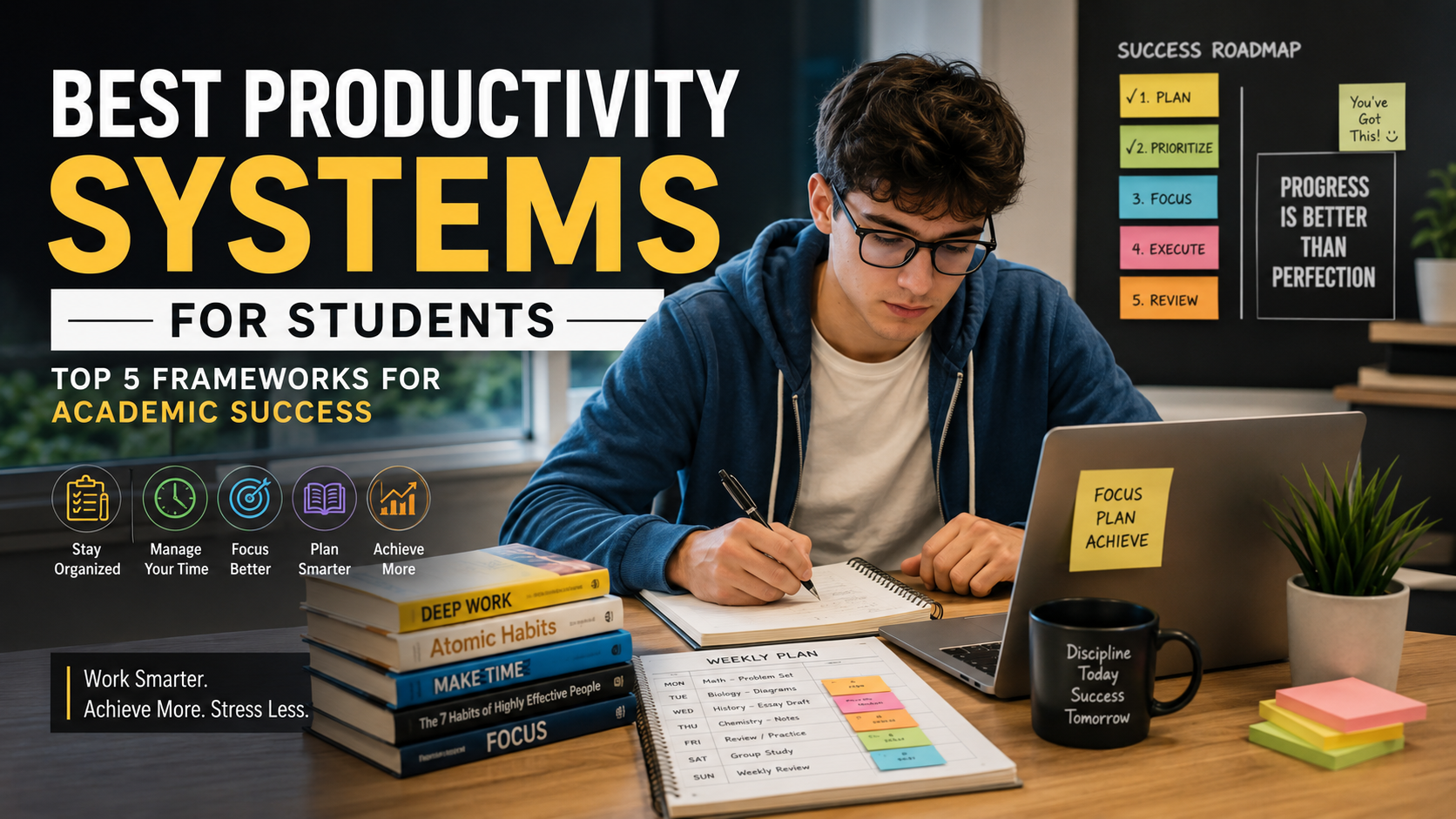
Best Productivity Systems for Students: Top 5 Frameworks for Academic Success
Juggling lectures, assignments, exam prep, and a social life can quickly overwhelm modern learners. Without a structured approach to managing your time, deadlines slip through the cracks. Consequently, burnout becomes inevitable. Implementing the best productivity systems for students is the most effective way to regain control over your schedule. Furthermore, a reliable framework reduces academic anxiety significantly. According to data tracked by the American Psychological Association, chronic procrastination affects a vast majority of university students. This habit frequently harms both mental well-being and academic performance. However, by adopting a reliable framework, you transform chaotic to-do lists into an actionable blueprint for daily success. This systematic shift allows you to approach your coursework with a sense of calm authority. Therefore, you will allocate sufficient time to deep study while maintaining a healthy balance outside the classroom.
This comprehensive guide breaks down the five best productivity systems for students to optimize academic life. First, we will explore how these systems work. Next, we will discuss why they yield results. Finally, you will learn how to choose a personalized learning workflow that aligns with your unique style. By understanding the underlying psychology of these workflows, you can stop relying on fleeting motivation. Instead, you will start building repeatable habits that support long-term educational excellence throughout your academic journey.
Why Traditional To-Do Lists Fail Students
Most students begin their academic journey relying on standard, linear to-do lists. They scrawl these lists in notebooks or phone apps. Although writing down your tasks is a good first step, traditional lists lack critical context. For example, they fail to account for the dynamic nature of a modern curriculum. They do not calculate shifting deadlines or varying energy levels. Moreover, they ignore the sheer scale of major research projects. These large projects require weeks of incremental effort. Consequently, looking at a long, flat list of unorganized tasks often leads to intense analysis paralysis. This confusion causes you to spend more time deciding what to work on next than actually studying.
True academic productivity requires a dynamic system. Your system must actively help you prioritize tasks while managing your cognitive load. Similarly, it should sustain focus over long semester blocks. A basic list treats “buy a highlighter” with the same visual weight as “write history term paper.” Therefore, your brain naturally gravitates toward the easiest task to secure a quick dopamine hit. Meanwhile, high-stakes assignments loom over your head, compounding your stress levels. Inevitably, this pattern leads to counterproductive all-night cramming sessions. Shifting to a comprehensive framework ensures that your daily actions align perfectly with your most important academic goals.
The Best Productivity Systems for Students Evaluated
The ideal framework balances structural simplicity with flexibility. Specifically, it must handle the unpredictable nature of student life. It needs to process trivial daily homework assignments. Simultaneously, it must keep long-term exam goals and final projects in sight without cluttering your mental space. Fortunately, here are the five top-tier workflows that will optimize your study habits, reduce friction, and maximize your intellectual output.
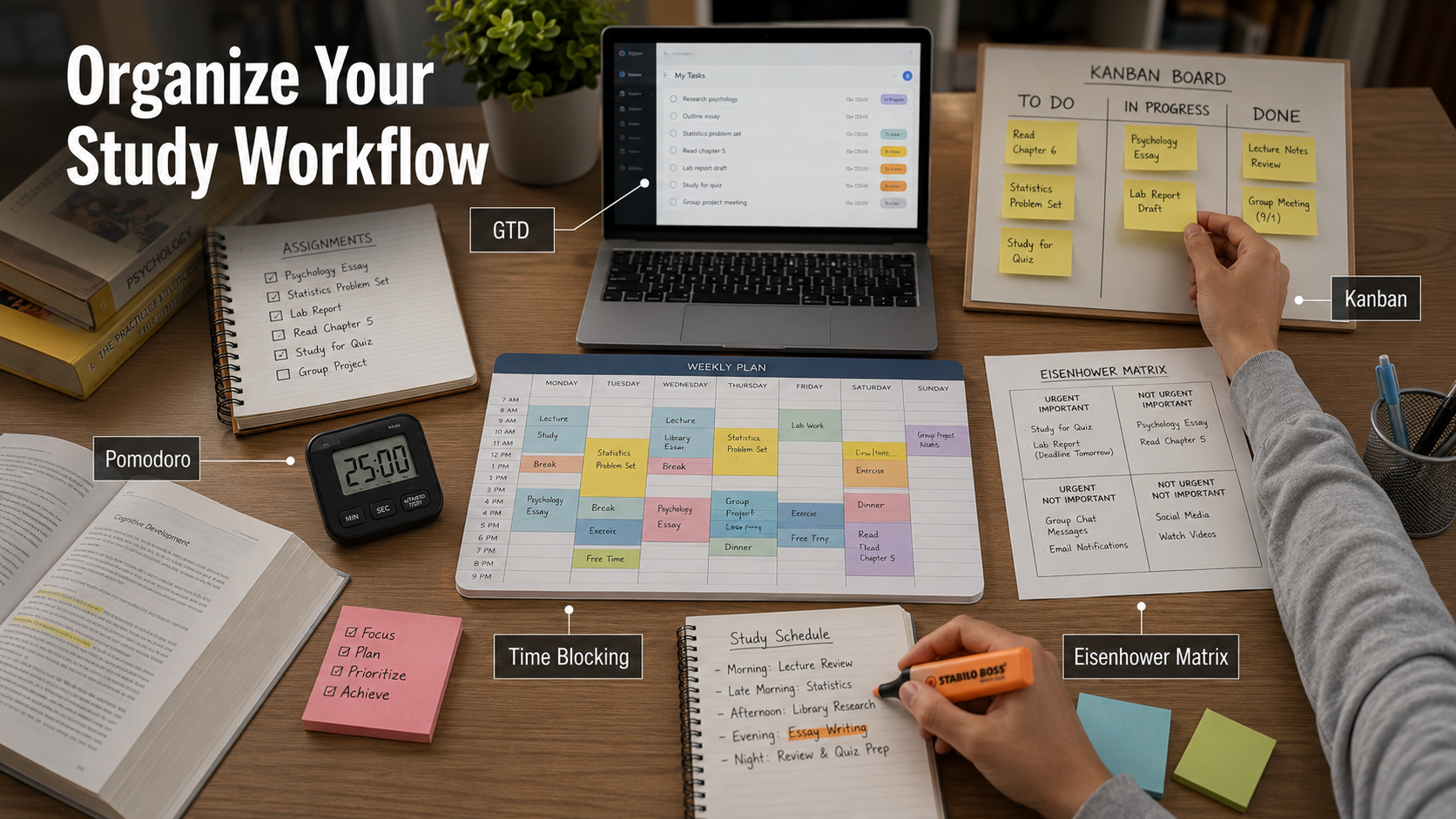

1. The Getting Things Done (GTD) Method for Students
Productivity expert David Allen created the Getting Things Done method. This structured framework rests on a simple, foundational premise: your brain is designed for having ideas, not holding them. For learners, this means offloading every assignment into a trusted digital or physical inbox. You must also offload reading requirements and personal errands. Ultimately, the system operates through five distinct steps. First, capture your thoughts. Second, clarify what they mean. Third, organize them into actionable categories. Fourth, reflect on your progress weekly. Finally, engage with your work confidently.
This framework stands as one of the best productivity systems for students during midterms and finals. During these peak weeks, the sheer volume of information can feel completely overwhelming to track mentally. However, by externalizing your tasks into a structured system, you instantly free up valuable working memory. This clarity allows you to focus entirely on the complex concepts you are studying. As a result, you will not worry about an upcoming math deadline while trying to read for literature class. Instead, you immerse yourself fully in the present task because your system will automatically remind you of the math assignment later. It triggers a notification exactly when the time is right to execute the work.
2. Time Blocking and Time Boxing Study Methods
Time blocking involves dividing your entire day into dedicated, predictable chunks of time. You allocate these blocks for specific activities. Therefore, do not write a vague note like “study biology” on your calendar. Instead, you block out “Tuesday, 2:00 PM to 4:00 PM” exclusively for drawing out and memorizing biology diagrams. This approach transforms your calendar from a reactive tool into a proactive map of your entire day. Consequently, it forces you to confront the reality of how many hours you actually have available. This visibility prevents over-commitment while reducing the friction of starting a study session.
Time boxing takes this strategy a step further by setting a strict, unyielding limit on how much time you will spend on a specific task. For example, you might give yourself exactly 60 minutes to write a rough essay outline. This psychological constraint directly counters Parkinson’s Law, which states that work expands to fill the time available for its completion. By setting a hard boundary, you prevent perfectionism from ruining your schedule. Thus, it stops a minor homework assignment from turning into a multi-day ordeal. This balanced combination keeps you moving forward briskly through your weekly syllabus so you do not get stuck on minor, low-weight details.
3. Visual Kanban Workflows for Learners
Visual learners often get overwhelmed by text-heavy schedules. For them, the Kanban system is an exceptional choice in the category of the best productivity systems for students. Industrial engineers originally designed it for project management, but it adapts perfectly to academics. It uses visual boards and moveable cards to track the real-time flow of work from start to finish. At its simplest, you divide a physical whiteboard or digital screen into three primary columns: “To Do,” “In Progress,” and “Done.” Each assignment or exam preparation milestone gets its own individual card containing notes, subtasks, and specific due dates.
As you progress through your week, you physically or digitally drag the cards across the board into their respective columns. This visual progression provides a continuous sense of accomplishment. Furthermore, it highlights if you are taking on too many tasks at once. If your “In Progress” column has any more than three cards in it, you instantly discover the root cause of your stress. You realize why you feel unfocused. For learners working on multi-stage projects like lab reports or senior theses, Kanban provides unmatched clarity. Therefore, it breaks down a monolithic project into bite-sized, movable visual stages.
4. The Pomodoro Focus Technique
The Pomodoro Technique suits specific types of learners perfectly. Particularly, it helps those who struggle with sustaining focus, experience frequent digital distractions, or procrastinate heavily. The core mechanism involves setting a timer for 25 minutes of intense, completely distraction-free study. You follow this interval immediately with a mandatory 5-minute break. Each of these 25-minute work blocks is called a “Pomodoro.” After completing four cycles in a row, you enjoy a longer, well-deserved break. This rest period lasts 15 to 30 minutes to rest your mind completely.
This structured rhythm keeps your brain fresh and prevents the compounding mental fatigue associated with cramming for hours on end. Since a break remains less than 25 minutes away at any given moment, resisting the urge to check social media becomes much easier. It trains your mind to operate with high intensity during the work intervals. Consequently, this discipline makes your study sessions incredibly efficient. Over time, you can track how many Pomodoros a specific type of assignment takes. This data allows you to estimate your future workload with remarkable accuracy.
5. The Eisenhower Matrix Priority Framework
Every assignment can feel critically urgent during a busy semester. To combat this, the Eisenhower Matrix helps you filter your tasks objectively based on two key criteria: importance and urgency. You divide your current responsibilities into four distinct quadrants that dictate your immediate actions. The first quadrant holds important and urgent tasks to do immediately. Meanwhile, the second quadrant contains important but not urgent tasks that you must schedule. The third quadrant handles urgent but not important items to delegate or minimize. Finally, the fourth quadrant identifies non-important, non-urgent tasks to eliminate entirely.
This framework ranks among the best productivity systems for students because it emphasizes preparation over reaction. Focusing heavily on the second quadrant allows you to prepare for major academic milestones well in advance. Obviously, this foresight eliminates the cycle of last-minute panic. Most learners spend their lives reacting to the first quadrant, so they constantly put out fires. They rush to submit assignments minutes before the deadline. However, you elevate the quality of your academic work by consciously allocating time to the second quadrant. For example, you might start a research paper three weeks early. This proactive approach ensures that you guide your semester instead of letting deadlines dictate your stress levels.
How to Choose the Right Academic Management System
Selecting the best productivity systems for students depends heavily on your specific needs. First, you must identify your primary academic challenges and behavioral bottlenecks. For instance, you might find yourself constantly distracted by your smartphone, or perhaps you are prone to zoning out during long readings. If so, the timed focus of the Pomodoro Technique offers immediate behavioral relief. On the other hand, you might struggle with tracking complex, multi-step term papers across different classes. In that case, a visual Kanban board provides the spatial clarity you need. Therefore, you must diagnose your specific operational weaknesses before adopting a system so the framework acts as a direct solution to your problems.
Moreover, you do not have to limit your routine to just one rigid approach. Many highly successful learners eventually build a customized hybrid system by blending elements of different frameworks to suit their lifestyles. For example, you might use the Getting Things Done method to capture all your incoming assignments. Then, you organize those tasks using the prioritization rules of the Eisenhower Matrix. Finally, you execute them daily using structured time blocks. The best system is ultimately the one that you enjoy using consistently. Thus, it must remain easy to maintain throughout the changing demands of the entire academic calendar year.
FAQ Section
What are the best productivity systems for students who struggle with ADHD?
Visual and time-bound frameworks work best for students managing ADHD because they provide immediate feedback and reduce executive dysfunction. Therefore, the Kanban system is highly recommended. It visualizes progress clearly while limiting the urge to multitask by keeping the “In Progress” column strictly regulated. Pairing a visual Kanban board with the Pomodoro Technique creates a structured, low-friction study environment. Furthermore, the short, 25-minute intervals prevent mental fatigue. They make daunting academic tasks feel approachable rather than paralyzing. Digital tools like Trello or physical sticky notes on a whiteboard make the workflow tactile and engaging. Consequently, this setup aids dopamine regulation and helps sustain focus. Ultimately, these systems externalize working memory, allowing students to focus on learning rather than organizing.
Can I mix different productivity frameworks together?
Creating a hybrid framework is often the most effective approach for handling complex, shifting student schedules. For instance, you can combine the best productivity systems for students to form a personalized workflow. First, use the Getting Things Done method to clear your mind. This step collects all your assignments into a single repository. After capturing everything, you can use Time Blocking on your calendar to dedicate specific hours of your day to executing those tasks without distraction. Mixing systems allows you to customize your workflow to match your current semester workload perfectly. For example, you might use Kanban for collaborative group projects, meanwhile, you use the Pomodoro Technique for solitary exam preparation. The flexibility to combine frameworks ensures that your productivity system evolves alongside your academic needs, preventing the workflow from becoming an administrative burden.
How long does it take to build a new study habit?
Behavioral research indicates it takes roughly 21 to 66 days to form a new habit. However, this timeline depends heavily on the complexity of the routine and your specific environment. When adopting the best productivity systems for students, consistency matters far more than perfection. This rule applies throughout the initial implementation phase. Therefore, start small by applying a system like Pomodoro to just one difficult subject during your first week of testing. Gradually expand the system to cover your entire academic schedule as the rules become a natural, friction-free part of your daily routine. Expecting to transition from total chaos to a flawless productivity system overnight usually leads to frustration. Instead, treat the adoption process as an incremental journey of behavioral adjustment.
What are the best digital tools for student organization?
The best digital tools depend entirely on the specific framework you choose to implement in your daily routine. For the Getting Things Done and Kanban systems, platforms like Notion, Todoist, and Trello offer robust, flexible features. Developers tailored these tools specifically for student workflows, allowing you to attach files and set reminders easily. For time blocking, digital calendars like Google Calendar and Apple Calendar remain the undisputed industry standards. Their cross-device syncing capabilities make them incredibly reliable for busy learners. If you prefer the Pomodoro Technique, apps like Forest or Be Focused add gamified elements that reward your focus. These features make your study sessions highly engaging. However, experiment with a few minimalist tools first to ensure you are actually studying rather than just fiddling with app settings.
How do I prevent academic burnout while staying productive?
True productivity must include scheduled rest because an exhausted brain cannot retain complex academic information effectively. Therefore, systems like Time Blocking should always include dedicated, non-negotiable windows for sleep, physical exercise, and genuine socializing with friends. If your calendar only features classes, assignments, and study blocks without any personal downtime, your daily routine is fundamentally unsustainable. Consequently, it will lead directly to burnout. Use the Eisenhower Matrix regularly to ruthlessly eliminate non-essential tasks and low-value obligations that drain your mental energy. Prioritizing your physical and mental health ensures your mind stays sharp, creative, and resilient for long-term academic success. Real productivity means maintaining a sustainable pace over an entire semester, so you must not simply sprint until you crash.
Conclusion
Finding the best productivity systems for students is an ongoing personal journey of trial, error, and deliberate refinement. Whether you choose the visual clarity of a Kanban board, the strict discipline of time blocking, or the absolute mental clarity of the Getting Things Done method, the ultimate goal remains identical. You must take proactive control of your finite time. These frameworks are not designed to turn you into a rigid machine. Instead, they free up your mental bandwidth so you can enjoy your college experience without constant background anxiety. If you look at optimizing your physical toolkit alongside your mental workflows, investing in the right hardware setups—such as finding functional iPad accessories cheaper than Apple—can drastically reduce your structural friction. Implementing a structured workflow changes your relationship with your studies. Consequently, it shifts your mindset from a reactive state of panic to a proactive state of calm readiness.
Implementing these systems reduces daily stress, completely eliminates the need for unhealthy all-night cram sessions, and dramatically improves your overall academic performance. By treating your time as a valuable resource, you build professional habits that extend far beyond graduation into your future career. Choose just one framework from this guide that resonates with your learning style, test it consistently for the next two weeks, and watch your academic overwhelm transform into calm, organized execution. This shift paves the way for lasting educational success.