
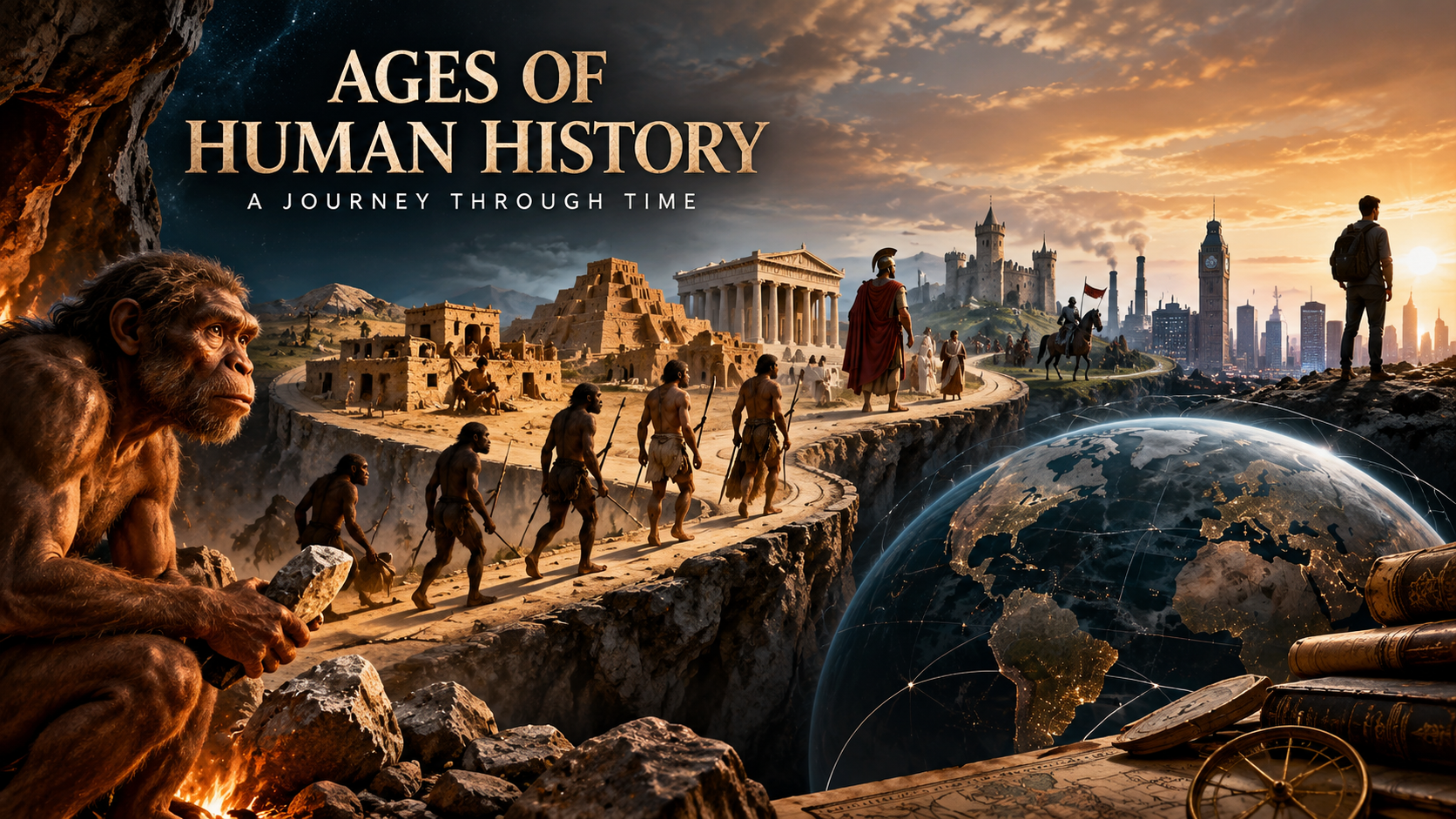
Ages of Human History: The Essential Guide to Our Civilizational Timeline
Have you ever wondered how our ancestors moved from simple stone tools to complex digital networks? Understanding the ages of human history helps us appreciate the scale of human resilience, cultural development, and technological change. Without clear historical divisions, thousands of years of human experience can become difficult to understand.
Archaeologists and historians use different frameworks to organize humanity’s past. The Smithsonian Institution’s Human Origins Program documents major developments in human evolution, technology, and behavior. Archaeological systems also help researchers identify important changes in tools, settlement, agriculture, and social organization.
These divisions are not always universal. Different regions developed at different times and followed different historical paths. Still, broad historical ages provide a useful way to understand major transitions.
In this guide, you will explore the chronological ages of human history, from prehistory to the contemporary world. You will also learn how historians divide the past, when written history began, and why periods such as the Renaissance remain culturally influential.

What is the order of ages in human history?
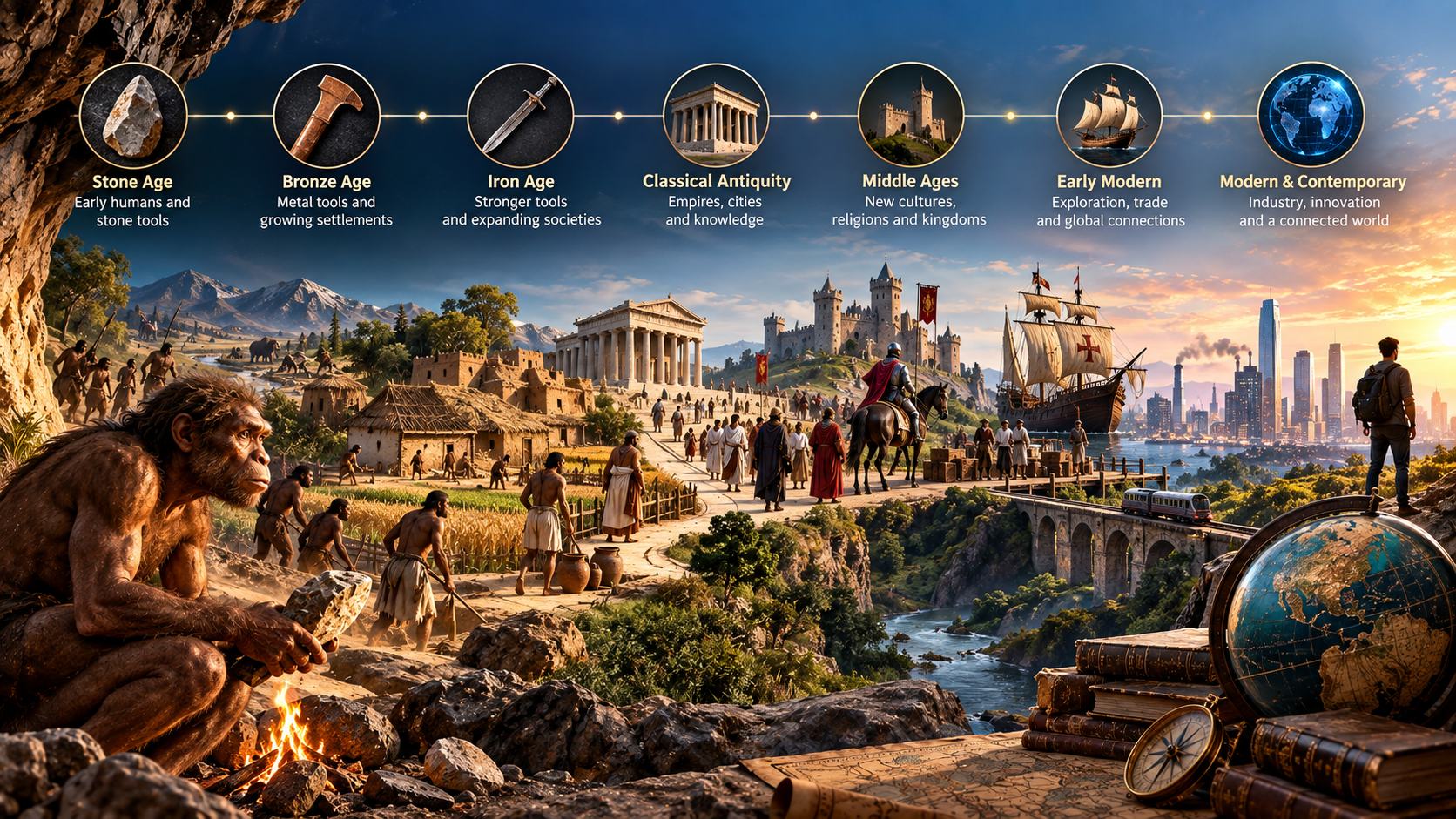
The chronological progression of human development is often explained through the archaeological Three-Age System. This framework divides early technological development into the Stone Age, Bronze Age, and Iron Age. These periods are based mainly on dominant tool and material technologies. For readers exploring historical chronology in more detail, the timeline of human history provides another useful way to understand major periods and transitions.
The Stone Age covers the longest period and includes the Paleolithic, Mesolithic, and Neolithic periods. The Bronze Age followed in different regions as people developed copper-alloy technologies. The Iron Age came later as ironworking became increasingly widespread.
After these broad prehistoric stages, historians often use periods such as Classical Antiquity, the Middle Ages, the Early Modern period, and the Modern or Contemporary era. However, these divisions vary by region.
For example, societies in Africa, Asia, Europe, and the Americas did not experience these transitions at identical times. The ages of human history therefore work best as broad analytical tools rather than rigid global boundaries.
The Breakthrough of Metallurgical Transitions
The development of metallurgy transformed many aspects of human society. Early metalworkers first used naturally occurring metals before learning to extract metals from ores. Copper technology eventually developed into bronze production, while ironworking became important in later societies.
Metal tools could offer advantages over many stone tools. They supported farming, woodworking, construction, warfare, and specialized craftsmanship. Metallurgy also encouraged new forms of trade because communities needed access to specific ores and other materials.
These changes affected more than technology. Skilled metalworkers became important members of many communities. Long-distance exchange networks expanded as societies traded metals, finished objects, and other valuable goods.
However, metallurgy did not automatically create cities or powerful states. Urbanization had many causes, including agriculture, population growth, trade, political organization, and access to resources. The relationship between technology and social development was complex.
Even so, the transition from stone to metal remains an important part of understanding the ages of human history and humanity’s changing ability to transform natural resources.
What is the age of human history?
The answer depends on what we mean by “history.” If we mean the existence of our species, human history extends back roughly 300,000 years, when anatomically modern humans emerged in Africa. If we mean written records, the timeline is much shorter.
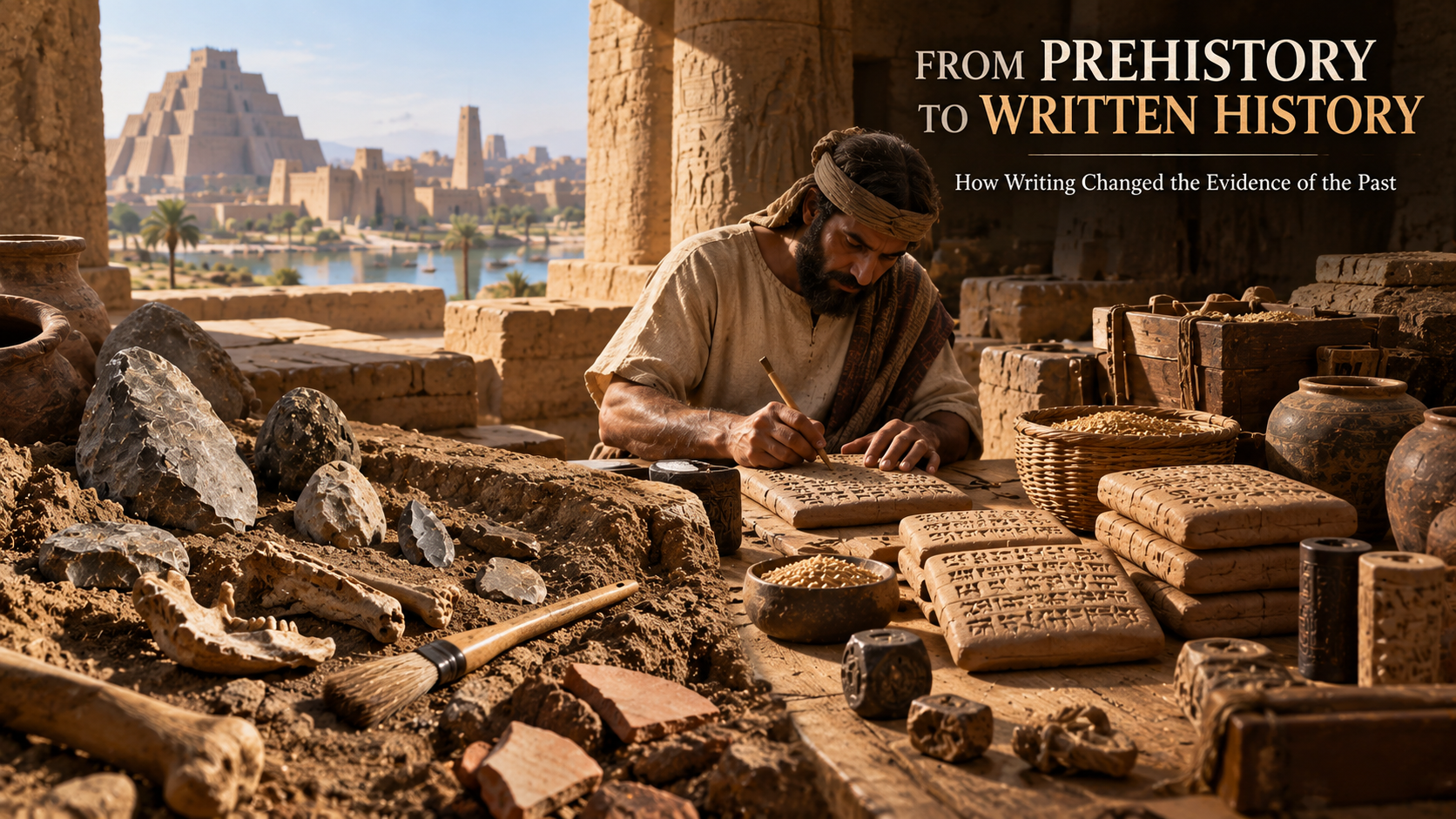
The earliest known writing systems appeared in Mesopotamia during the late fourth millennium BCE. Cuneiform developed among early urban societies in southern Mesopotamia, including Sumerian communities. This development created durable written evidence of economic activity, administration, and other aspects of organized society.
Before writing, researchers rely on archaeology, fossils, artifacts, environmental evidence, oral traditions, and other sources to reconstruct the human past. This period is generally called prehistory. Readers interested in going deeper can also explore resources for researching world history and evaluating different types of historical evidence.
Written history therefore represents only a small portion of humanity’s existence. The vast majority of human experience occurred before surviving written records.
Understanding this distinction is essential when studying the ages of human history. Human societies existed long before they began documenting events in writing.
The Role of Cuneiform and Written Evidence
Cuneiform represents one of humanity’s earliest known writing systems. It developed in ancient Mesopotamia during the late fourth millennium BCE. Early examples were used mainly for administrative and economic purposes rather than historical storytelling.
Writing changed how societies preserved and transmitted information. Officials could record goods, transactions, taxes, laws, and other details without depending entirely on oral memory.
Over time, written systems became more sophisticated. They were used for literature, royal inscriptions, religious texts, legal documents, and correspondence. This created a much richer body of evidence for later historians.
However, writing did not create history itself. People had already experienced complex social, political, and cultural change for thousands of years. Instead, writing created a new type of surviving evidence.
Researchers can therefore combine written sources with archaeological evidence to reconstruct ancient societies more accurately. Written records also have limitations because they often represent rulers, officials, or literate groups.
Cuneiform is important within the ages of human history because it marks a major transition toward societies with extensive written documentation.
What are the five eras of human history?
A common broad framework divides human history into Prehistory, Classical Antiquity, the Middle Ages, Early Modernity, and Late Modernity. This five-era structure is useful for organizing large historical developments, although historians do not universally use the same divisions.
Prehistory covers human life before surviving written records. Classical Antiquity generally focuses on ancient civilizations and cultures, including Greece, Rome, and Han China. The Middle Ages traditionally describe the period between classical antiquity and early modern developments, especially in European history. Exploring the most famous civilizations throughout history can provide additional context for understanding these broad historical periods.
Early Modernity is associated with major changes in trade, exploration, political organization, science, and intellectual life. Late Modernity includes industrialization, mass politics, modern states, and rapid technological development.
These periods overlap and differ across regions. For example, developments in China, India, Africa, the Islamic world, Europe, and the Americas followed distinct timelines.
The five-era model is therefore best viewed as a broad educational framework. It simplifies an enormous subject while helping readers understand major transitions across the ages of human history.
Why the Five-Era Framework Matters
The five-era framework helps organize thousands of years of human development into recognizable periods. It allows readers to identify major changes without studying every individual kingdom, dynasty, or civilization separately.
The model can highlight broad developments such as the rise of agriculture, urban societies, long-distance trade, scientific inquiry, industrialization, and modern communications. These themes connect societies across different geographical regions.
However, the framework has limitations. Historical periods were not experienced uniformly around the world. A transition that happened in one region could occur centuries earlier or later elsewhere.
For this reason, historians often combine broad periodization with regional approaches. They may study South Asian, Chinese, African, European, Islamic, or American history using frameworks suited to those regions. Readers interested in developing a more focused approach can explore different history niches effectively to better understand specialized areas of the past.
The value of the model lies in its simplicity. It provides a starting point for understanding the ages of human history without suggesting that every society followed the same path.
Used carefully, it helps readers connect major developments while recognizing the diversity of human historical experience.
What are the four ages of history?
A widely used Western historical framework divides history into four major periods: Ancient, Medieval, Modern, and Contemporary. This model is common in educational settings, but it does not represent a universal division of world history.
The Ancient period generally begins with early literate civilizations and includes societies such as ancient Egypt, Greece, Rome, Persia, India, and China. The Medieval period traditionally follows antiquity and extends into the late medieval era. Understanding human civilization and its development can help place these societies within the broader story of the ages of human history.
The Modern period is often associated with developments from around the late fifteenth century onward. These include expanding global trade, European overseas expansion, the Scientific Revolution, the Enlightenment, and industrialization.
The Contemporary period generally refers to the nineteenth or twentieth century through the present, depending on the framework being used. It includes industrial society, mass politics, world wars, globalization, digital technology, and space exploration.
These boundaries vary among historians. Still, the four-part model remains one of the most recognizable ways to organize the ages of human history.
The Legacy of the Quadripartite Model
The four-period model has deep roots in European historical writing. Renaissance scholars developed distinctions between ancient, medieval, and their own contemporary world. Later historians expanded this framework into the familiar Ancient, Medieval, Modern, and Contemporary sequence.
Its main strength is accessibility. Large stretches of history can be grouped around major political, cultural, and economic transformations. This makes the framework useful for introductory education.
The model also reflects a particular European intellectual tradition. It should not be treated as a neutral timeline that applies equally to every society.
Many regions have their own historical periodizations. South Asian, Chinese, African, Islamic, and Indigenous histories often use different turning points and categories. Learning how to become a good historian can help readers evaluate these different approaches and understand why historical frameworks vary across regions.
Despite these limitations, the quadripartite model remains useful when presented as one framework among several. It helps readers establish a basic chronological structure before exploring regional histories in greater depth.
Understanding its origins also makes the ages of human history easier to interpret. Historical categories are tools created by scholars, not fixed divisions that existed naturally throughout the past.
What is the most famous era in history?
There is no objectively “most famous” era in world history because fame depends on culture, education, geography, and individual interests. However, the European Renaissance is among the most widely recognized historical periods in popular culture and Western education.
The Renaissance developed in parts of Europe from roughly the fourteenth to seventeenth centuries. It began particularly strongly in Italian city-states such as Florence and later influenced other parts of Europe. Studying the most influential leaders in history also provides useful context for understanding the political and cultural forces that shaped major historical periods.
The movement encouraged renewed interest in classical Greek and Roman literature, philosophy, art, and architecture. Artists developed new approaches to perspective, anatomy, and realistic representation. Thinkers also promoted forms of humanism that emphasized classical learning and human potential.
Leonardo da Vinci and Michelangelo became enduring symbols of Renaissance creativity. Galileo Galilei later contributed to major changes in European scientific thought.
The Renaissance was not simply a sudden break from the Middle Ages. Many Renaissance developments built on earlier medieval achievements.
Its lasting cultural influence nevertheless makes it one of the most prominent periods within discussions of the ages of human history.
The Enduring Global Fascination with the Renaissance
The Renaissance continues to attract attention because its artistic and intellectual achievements remain highly visible. Paintings, sculptures, buildings, books, and scientific ideas from the period still influence modern culture.
Works associated with Leonardo da Vinci and Michelangelo have become internationally recognized symbols of artistic achievement. Renaissance architecture also shaped later European design and influenced architectural traditions beyond Europe.
The period’s emphasis on classical learning and humanist scholarship also left a lasting intellectual legacy. At the same time, the Renaissance was not an isolated movement. It developed through interactions among European, Byzantine, Islamic, and other intellectual traditions.
Its scientific achievements should also be understood within a longer history of knowledge. Many Renaissance thinkers built upon ideas preserved and developed by earlier scholars.
This broader context makes the Renaissance more historically meaningful than simply calling it an era of artistic genius. Its importance comes from the combination of cultural, intellectual, scientific, and social changes that shaped later European history.
For that reason, the Renaissance remains one of the most recognizable periods when exploring the ages of human history.
FREQUENTLY ASKED QUESTIONS
What is the Three-Age System in archaeology?
The Three-Age System is an archaeological framework developed by Christian Jürgensen Thomsen in the early nineteenth century. It categorizes prehistoric and early civilizational artifacts into three sequential technological periods: the Stone Age, the Bronze Age, and the Iron Age. This model allowed early researchers to systematically date excavated materials based on manufacturing complexity and available raw materials. It remains foundational for classifying prehistoric human cultures today.
Which epoch was the longest in human history?
The Stone Age, specifically the Paleolithic period, is by far the longest epoch in human history. Lasting roughly 2.5 to 3 million years, it represents more than 95 percent of all human technological and biological existence. During this extensive era, early humans perfected chipped stone tools, discovered fire management, formed initial family clans, and migrated out of Africa into global ecosystems.
What caused the Bronze Age Collapse?
The Bronze Age Collapse occurred around 1200 BCE, bringing sudden destruction to advanced eastern Mediterranean civilizations, including the Mycenaeans, Hittites, and New Kingdom Egypt. Historians attribute this rapid disruption to a devastating confluence of factors: catastrophic drought, volcanic events, widespread famine, internal political rebellions, technological supply chain failures, and aggressive invasions by mysterious maritime raiders broadly known as the Sea Peoples.
When did the modern historical era officially begin?
Historians generally date the beginning of the early modern historical era to the mid-to-late fifteenth century. Key landmark events include the fall of Constantinople to the Ottoman Empire in 1453, Johannes Gutenberg’s perfection of the movable-type printing press around 1440, and Christopher Columbus’s transatlantic voyage in 1492. These developments rapidly dismantled feudalism, expanded international commerce, and transformed global information exchange.
CONCLUSION
Tracing the vast chronological arc of our past illuminates how inventiveness, adaptability, and cultural exchange formed modern society. From the flint-striking hunter-gatherers of deep prehistory to the daring thinkers of the Renaissance, every distinct epoch solved critical survival challenges while establishing structural systems for future generations. As we have seen, the ages of human history are not merely sterile dates on a museum wall; they represent real human journeys marked by continuous reinvention, hard-won discoveries, and civilizational resilience.
Understanding these foundational periods provides essential perspective on the rapid transformations occurring today. The emergence of automated computing, space exploration, and instant global communication confirms that our contemporary era is writing humanity’s next major technological chapter. By examining past transitions—such as the transformative leap from bronze to iron metallurgy—we can navigate our own emerging era with clarity, wisdom, and foresight. Apply this historical lens to current events, explore primary archaeological records, and observe how our collective past continually shapes every facet of our shared modern landscape.