
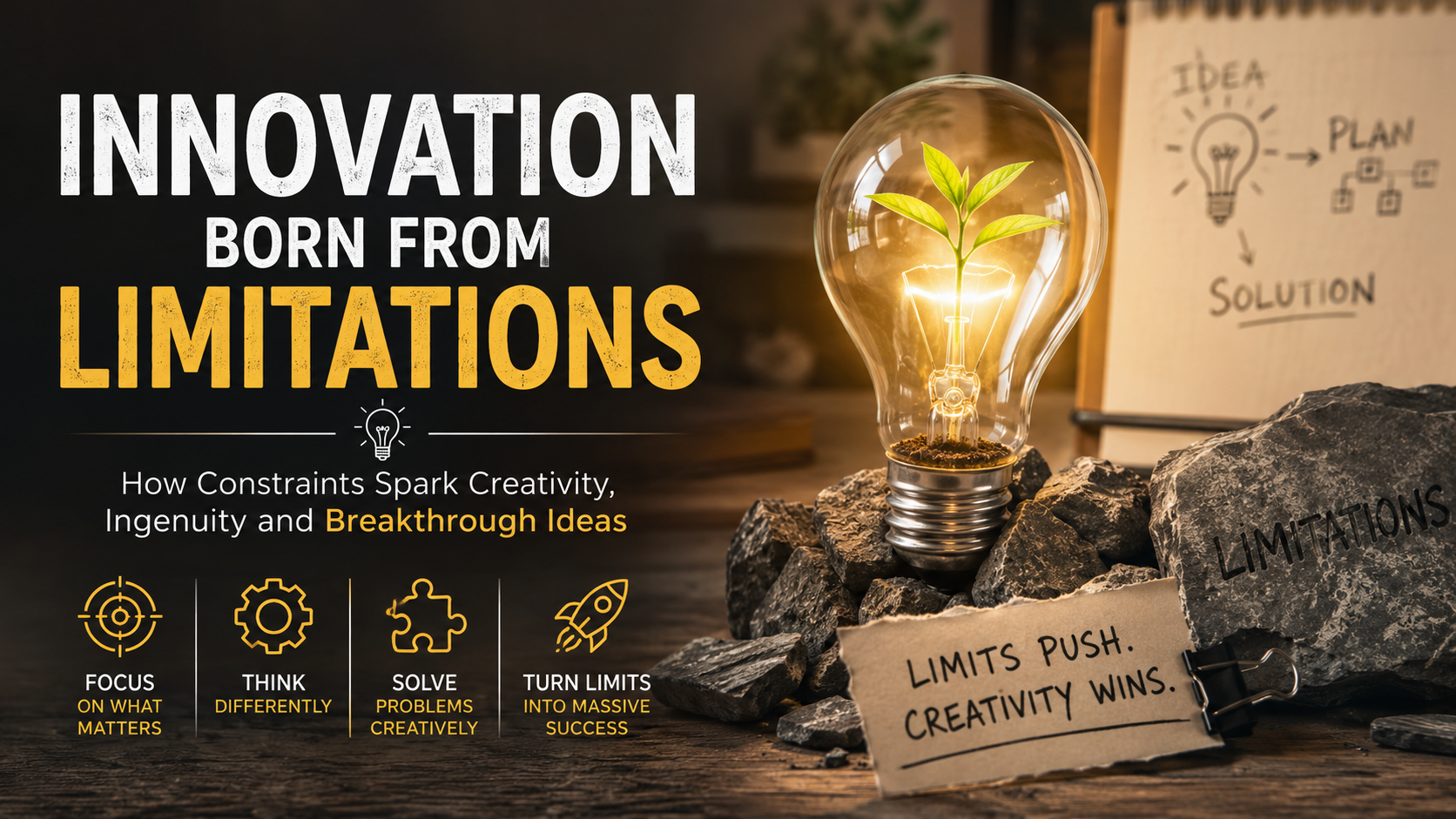
Innovation Born from Limitations
It is easy to assume that limitless resources always lead to the best ideas. However, history tells a completely different story. In fact, some of the greatest breakthroughs happen when teams face severe constraints. Specifically, if you look closely at innovation born from limitations, you will see that scarcity often forces people to think creatively. For instance, the brilliant engineers at NASA famously turned life-threatening constraints into amazing solutions during the Apollo 13 mission.
Consequently, they had to fit a square peg into a round hole using only everyday materials. Furthermore, this concept applies heavily to businesses, modern technology, and our daily lives. Strict constraints force us to strip away the unnecessary quickly. Therefore, we must focus deeply on what truly matters to succeed. Instead of asking for more money, brilliant innovators use exactly what they have. In addition, we will explore several inspiring examples of this powerful concept.
Specifically, we will look at how clever companies and creators have used tight boundaries for massive success. You will learn why having less can actually help you achieve much more. Ultimately, let us dive into the sheer power of creative constraints today. Moreover, you can actively apply this highly effective mindset to your own difficult projects.


What Are the Limitations of Innovation?
While innovation born from limitations can inspire creative problem-solving, it also has clear drawbacks. Severe constraints often force teams to focus on immediate challenges instead of long-term opportunities. As a result, organizations may prioritize quick fixes over meaningful research and development. This approach can delay breakthrough discoveries that require patience, funding, and sustained effort.
Limited resources can also increase stress and burnout. Teams may spend too much time stretching inadequate budgets, tools, or staffing levels. Over time, temporary workarounds can become permanent, creating technical debt and reducing efficiency. Systems built under constant pressure may struggle to scale as demand grows.
Innovation thrives when constraints encourage smarter thinking, not when they create ongoing hardship. Organizations should avoid glorifying scarcity as a permanent strategy. Instead, they should combine healthy limitations with the right level of support, investment, and planning. This balance allows creativity to flourish while ensuring sustainable growth and long-term success.
The Danger of Short-Term Patchwork Solutions
Resource shortages often push teams toward temporary fixes instead of durable solutions. While these quick patches solve immediate problems, they rarely support future growth. As projects expand, maintaining fragile workarounds becomes more expensive and time-consuming.
Eventually, developers spend more time repairing old systems than building new features. Productivity slows, innovation declines, and scalability suffers. Recognizing when a temporary solution has outlived its usefulness is essential. Sustainable innovation requires replacing short-term patches with reliable, long-term architectures before technical debt becomes a major obstacle.
How is innovation born?
Innovation is born when curious minds collide with challenging problems, turning everyday friction into powerful new ideas. Instead of waiting for perfect conditions, creators look at their immediate surroundings and find unconventional uses for ordinary materials. This spark often starts with frustration over an inefficient process or a glaring gap in the market. When people refuse to accept that things must stay the same, they begin experimenting with alternative approaches. Over time, these small experiments compound into massive technological or cultural shifts that redefine entire industries.
The Role of Scarcity in Creative Breakthroughs
Scarcity forces creators to abandon complex blueprints in favor of simple, elegant solutions. When you have fewer resources, every single choice matters deeply. This high-pressure environment eliminates wasteful features and centers attention on core functionality. As history shows time and again, minimalist thinking breeds maximum impact for ambitious projects.
Is Innovation Always Born From Necessity?
While necessity drives many incredible inventions, innovation is not exclusively born from survival or urgent pressure. Sometimes, creative leaps happen purely out of boredom, playfulness, or a sudden flash of artistic inspiration. Inventors often tinker with new concepts without any immediate crisis forcing their hand. Furthermore, corporate research and development labs frequently fund exploratory projects that solve problems people did not even realize they had yet. Therefore, while necessity acts as a powerful accelerator, human curiosity remains an independent engine for discovery.
Exploration Beyond Immediate Survival Needs
Exploratory innovation thrives when creators have the freedom to test wild ideas without urgent stakes. These projects rely on open-ended wonder rather than panic or tight deadlines. By giving teams space to dream, organizations unlock visionary concepts that completely transform future markets and redefine everyday human experiences.
Do Limitations Make Creativity?
Limitations do not automatically create creativity, but they often help direct it. Unlimited choices can overwhelm people and make decision-making difficult. When clear boundaries exist, creators can focus their attention on solving a specific problem instead of exploring endless possibilities.
This focused approach explains why innovation born from limitations often produces practical and effective solutions. Constraints encourage individuals to eliminate unnecessary options and make better use of available resources. Designers, writers, engineers, and entrepreneurs frequently introduce self-imposed limits to improve their work and overcome creative blocks.
However, balance remains important. Constraints should challenge creative thinking without becoming overwhelming. When used effectively, they provide structure that transforms scattered ideas into focused action, leading to stronger solutions and more consistent innovation.
Channeling Infinite Choices Into Focused Action
Too many options can slow progress by creating uncertainty and hesitation. Clear boundaries simplify decision-making and help creators concentrate on what matters most. Instead of spreading attention across countless possibilities, they invest their energy in solving the core challenge.
This focused mindset improves productivity, strengthens problem-solving, and often produces more practical results. Well-designed constraints reduce distractions while encouraging deeper thinking and more purposeful execution.
What Are the 4 Pillars of Creativity?
Understanding the four pillars of creativity helps explain how innovation born from limitations develops in real-world situations. The first pillar is domain knowledge, which provides the expertise needed to understand problems and recognize opportunities. Without a strong foundation, creative ideas often lack practical value.
The second pillar is creative thinking, which involves connecting ideas in original ways and exploring multiple solutions. The third pillar is intrinsic motivation, the internal drive that encourages people to continue despite setbacks and challenges. Finally, the fourth pillar is the environment, including workplace culture, leadership, collaboration, and available resources.
These four pillars work together rather than independently. Strong knowledge, flexible thinking, personal motivation, and a supportive environment create the conditions where creativity can flourish. Even under constraints, balancing these elements increases the likelihood of meaningful and sustainable innovation.
The Vital Role of Intrinsic Motivation
Intrinsic motivation keeps people engaged when challenges become difficult. Individuals driven by curiosity, purpose, or personal satisfaction are more likely to persist through repeated failures. They continue experimenting even when external rewards are limited.
Organizations can strengthen intrinsic motivation by encouraging autonomy, recognizing meaningful contributions, and supporting continuous learning. A motivated team remains resilient, adaptable, and capable of generating innovative solutions over the long term.
Frequently Asked Questions
Can too many restrictions destroy creativity completely?
Yes. Excessive or unrealistic restrictions can reduce morale and discourage experimentation. When people fear failure or harsh consequences, they usually avoid taking creative risks. Innovation born from limitations works best when constraints encourage problem-solving without creating constant pressure or anxiety.
How do agile teams use constraints effectively?
Agile teams use intentional constraints through fixed sprint timelines, limited budgets, and clearly defined priorities. These boundaries reduce scope creep and help teams focus on delivering the highest-value features first. By working within predictable limits, agile teams improve efficiency while encouraging continuous innovation.
Is brainstorming more effective with or without limits?
Brainstorming is usually more productive when it includes clear constraints. Specific challenges, such as reducing costs or meeting a tight deadline, encourage more focused and practical ideas. Completely open-ended brainstorming often generates broad concepts that are difficult to implement.
How can businesses manufacture productive constraints?
Businesses can create productive constraints by setting realistic deadlines, limiting project budgets, reducing unnecessary processes, or assigning smaller cross-functional teams. These intentional boundaries encourage smarter decision-making, faster execution, and greater focus on customer value. When applied thoughtfully, manufactured constraints strengthen innovation without limiting long-term growth.
Conclusion
When you look back at the grand sweep of human history, one pattern becomes clear: having unlimited resources is rarely the true catalyst for breakthrough innovation. Instead, some of the greatest achievements have emerged from difficult circumstances where people were forced to think differently. From life-saving space exploration solutions to revolutionary digital communication platforms, resource scarcity has repeatedly proven that limitations can inspire extraordinary creativity.
The next time you face a shrinking budget or an aggressive project deadline, don’t see it as a permanent obstacle. Instead, treat those restrictions as opportunities to simplify, prioritize, and innovate. Learning the principles of setting up constraints for creative thinking can help you transform limitations into a practical framework for generating better ideas and solving complex problems more effectively.
By embracing a frugal mindset and focusing on what truly matters, individuals and teams can accomplish remarkable results with fewer resources. Ultimately, innovation born from constraints creates stronger, more resilient solutions. Rather than fearing limitations, use them as the spark that fuels your next creative breakthrough.