
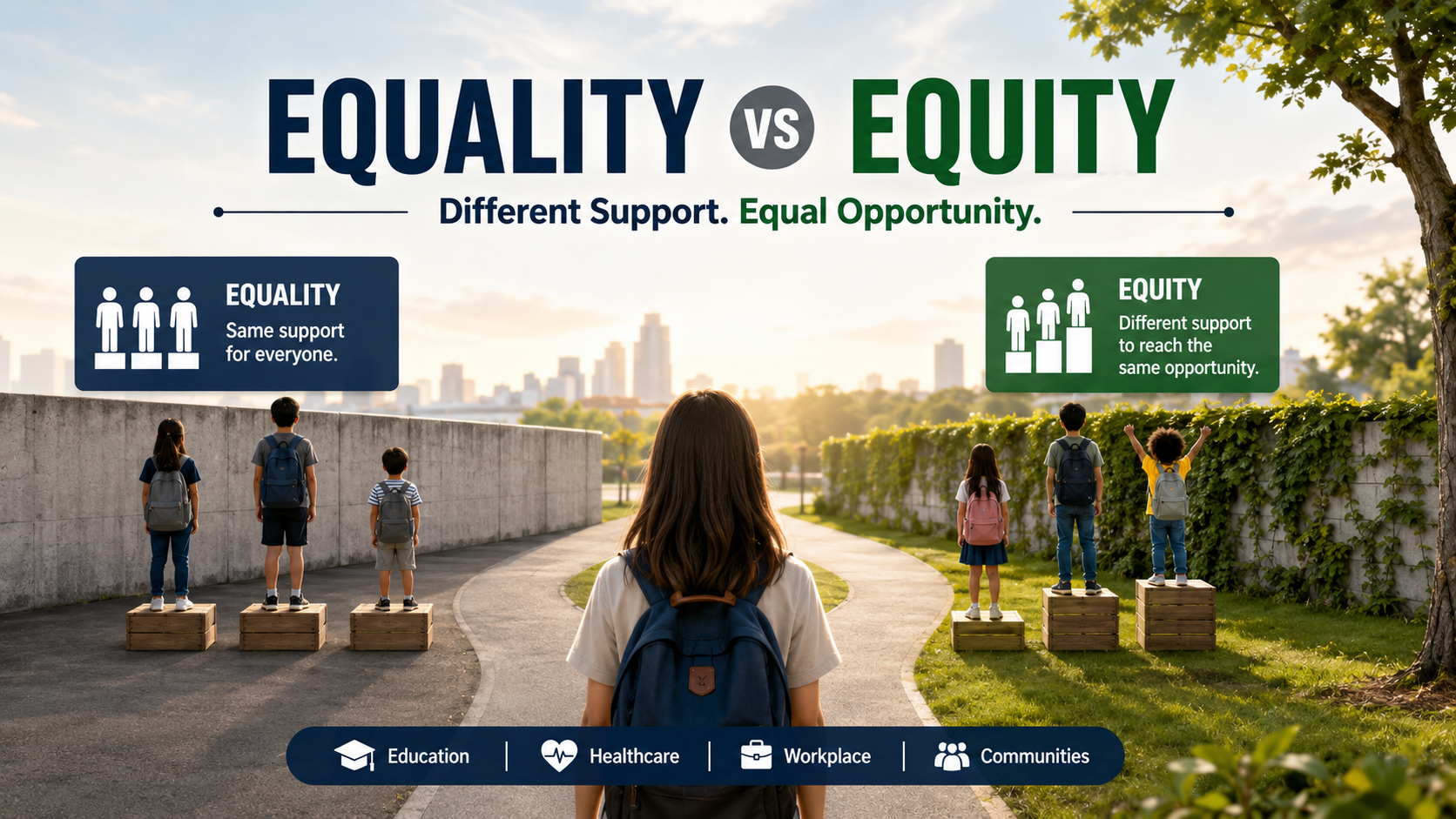
Equality vs Equity: Understanding the Differences with Real Examples
Many people use fairness, fairness of process, and justice interchangeably. However, understanding the difference between equality vs equity is important when discussing inclusion and opportunity. The World Health Organization’s social determinants of health resources highlight how social conditions can create different barriers for different groups.
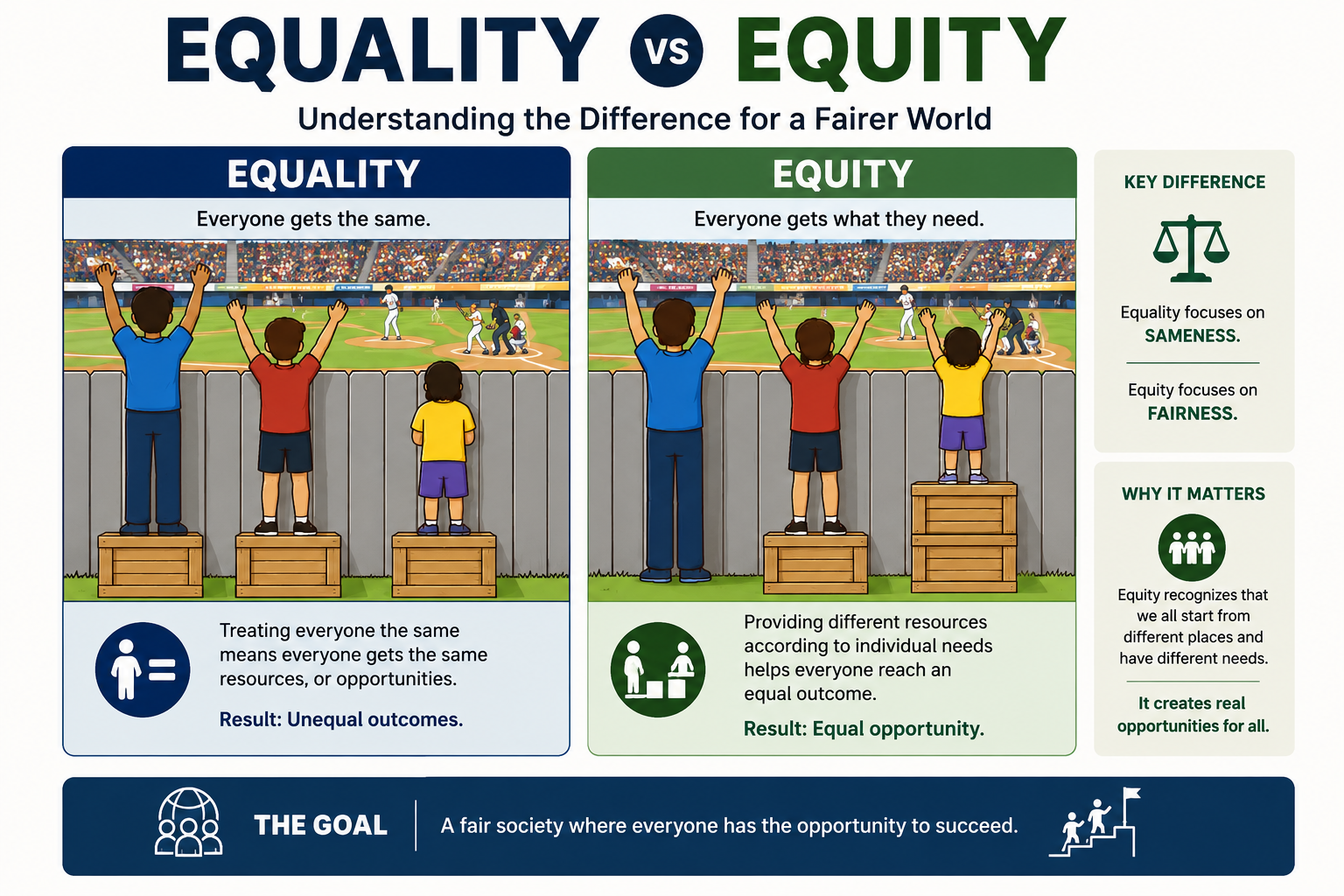
Equality means providing everyone with the same resources, rights, rules, or opportunities. It applies the same standard regardless of a person’s circumstances. Equity, however, recognizes that people may begin from different positions. It provides support according to specific needs and existing barriers.
This difference affects many areas of society. These include education, healthcare, public transportation, employment, and government services. A policy that looks equal may still produce unequal results if people face different obstacles.
Understanding equality vs equity helps organizations create fairer systems. It also makes it easier to recognize when identical treatment is not enough to create equal opportunity.

What are examples of equity in real life?
Equity in real life means identifying barriers and providing support based on individual circumstances. The goal is to give people a fair opportunity to access resources, services, or outcomes. Unlike equality, equity does not require everyone to receive identical assistance.
For example, a public school might provide assistive reading software and additional exam time to a student with dyslexia. Every student receives access to education, but some students need additional tools to participate fully. In healthcare, equity may involve mobile screening clinics serving rural communities that lack nearby hospitals, as discussed in the broader context of a country’s healthcare system.
Public transportation also provides practical examples. Wheelchair ramps, elevators, audio announcements, and tactile paving can improve access for people with disabilities. These features do not give every passenger identical support. Instead, they address specific barriers.
Other examples include progressive taxation and targeted community programs. These approaches recognize different financial circumstances or levels of need. Equity therefore focuses on fair access and opportunity, rather than identical distribution.
Targeted Workplace Accommodations for Better Inclusion
Workplace equity means removing barriers that could prevent employees from performing effectively. An equitable workplace does not assume that identical policies work equally well for everyone. Instead, it considers legitimate differences in employees’ circumstances and needs.
For example, an employer might provide flexible parental leave for workers with caregiving responsibilities. Another employee may need ergonomic equipment because of a physical limitation. Multilingual training materials can also improve access for employees who are more comfortable learning in another language.
These accommodations are not necessarily examples of favoritism. They can represent practical efforts to provide employees with comparable opportunities to succeed. The important distinction is whether the support addresses a genuine barrier.
Equity can also involve flexible scheduling, accessible software, or modified workplace environments. Such measures help organizations reduce unnecessary obstacles while maintaining performance standards.
The broader goal is inclusion. When workplaces recognize different needs, employees can participate more fully. This makes workplace equity an important part of creating fair and accessible employment environments.
Can you have equity without equality?
Yes, equity can exist without equality, because equity does not require everyone to receive identical resources. In some situations, achieving a fair opportunity requires distributing resources differently.
Consider reading glasses as a simple example. Giving every person the same pair of glasses represents equality. However, those glasses may not work for everyone. Some people may need a different prescription, while others may not need glasses at all. Equity focuses on providing the appropriate support for each person.
The same principle can apply to education, healthcare, and public services. A student facing a significant learning barrier may need additional assistance. A community with fewer healthcare resources may require greater investment.
This does not mean equity ignores equality. Equal rights and protections can provide the foundation for equitable systems. However, equal treatment alone cannot always overcome unequal starting conditions.
Therefore, equality focuses on sameness, while equity focuses on fairness based on circumstances. The two concepts can work together, but they are not interchangeable.
Prioritizing Custom Inputs Over Uniform Treatment
Fair outcomes sometimes require different levels of support. This is one of the clearest distinctions between equality and equity. Equality emphasizes uniform treatment, while equity considers whether people have comparable opportunities to succeed.
Imagine a city that gives every public park the same annual funding. On paper, the distribution appears equal. However, some neighborhoods may already have well-maintained parks, while others may have damaged facilities and fewer community resources.
Providing additional funding to underserved neighborhoods creates a different distribution. Yet that unequal investment may help address an existing imbalance. The objective is not to favor one group without reason. Instead, it is to reduce barriers that affect access and participation.
Similar situations can occur in schools. A district may allocate additional resources to schools serving students with greater educational needs. Such decisions can appear unequal when viewed only through spending amounts.
However, equitable resource allocation asks a broader question: What support does each group need to access comparable opportunities?
What is the difference between equity and quality?
The difference between equity and quality comes down to two separate questions. Equity asks whether people have fair access to resources or opportunities. Quality asks how well a product, service, or experience performs against an established standard.
For example, a hospital may provide high-quality medical care using advanced equipment and modern surgical techniques. However, that service may not be equitable if large groups of people cannot afford it or cannot reasonably access the facility.
Quality therefore focuses on performance, effectiveness, reliability, or excellence. Equity focuses on fairness in access and distribution. A service can be excellent in quality but limited in equity. Conversely, a service may be widely accessible but still have poor quality.
These concepts should not be treated as competing goals. High-quality services need equitable access to create broader social value. Improving quality without addressing access can leave disadvantaged groups behind.
Understanding this distinction is useful when evaluating schools, hospitals, workplaces, public programs, and other institutions. Quality measures how good something is. Equity examines who can benefit from it.
Balancing High Standards with Fair Universal Access
High standards and equitable access address different parts of a successful system. Quality ensures that services, products, and institutions meet appropriate performance standards. Equity helps ensure that people can realistically access those services.
Consider a public healthcare program. Modern equipment, skilled professionals, and effective treatments can create high-quality care. Yet people living far from medical facilities may still struggle to benefit from that care.
Equity can address these barriers through transportation assistance, mobile clinics, accessible facilities, or targeted outreach. These measures do not necessarily reduce the quality standard. Instead, they can expand access to the same standard of service.
The same principle applies to education. A school may have excellent teachers and learning materials. Students can still face barriers if materials are inaccessible or transportation is unavailable.
A strong system therefore needs both quality and equity. Quality protects the standard of service. Equity addresses barriers that prevent people from reaching or using that service. Together, they support broader and more meaningful access.
What are examples of equality and equity?
Looking at everyday situations makes the difference between equality vs equity easier to understand. Equality generally means providing the same resource or treatment to everyone. Equity adjusts support according to relevant needs or barriers.
For example, an employer giving every employee the same standard desk demonstrates equality. Providing an adjustable desk to an employee who needs one for accessibility demonstrates equity. Both employees receive appropriate workplace equipment, but their needs differ.
Education provides another example. Equality means giving every student the same printed textbook. Equity could mean providing an audiobook or accessible digital version to a student who cannot effectively use standard print. These differences can also be understood by comparing education systems around the world, where access and support can vary significantly.
Disaster relief offers another useful comparison. Equality may involve giving every family the same food package. Equity may provide infant formula to families with babies or specialized food to people with specific dietary requirements.
These examples show the central distinction. Equality standardizes the input, while equity adjusts the input when circumstances differ. Both approaches can support fairness, but equity is more responsive to individual barriers.
Clear Comparisons in Everyday Community Life
Everyday community services provide simple examples of how equality and equity can produce different approaches. Equality usually applies the same rule or resource to everyone. Equity considers whether people face different barriers under that same system.
For public transportation, equality might mean charging every passenger the same standard fare. Equity could involve reduced fares or subsidized passes for eligible low-income residents or seniors.
Education offers another example. Equality can mean requiring every student to take the same standardized test under identical conditions. Equity may involve approved translation or accessibility assistance for students who need it.
These differences do not automatically make equity preferable in every situation. Uniform rules can be important when consistency and equal legal treatment matter. However, identical treatment can create practical disadvantages when circumstances differ significantly.
The key question is whether the policy creates a fair opportunity to participate. Equality emphasizes consistency. Equity emphasizes responsiveness to legitimate differences.
Understanding this distinction helps explain why organizations sometimes need both approaches. Equal standards can establish a common baseline, while equitable adjustments can remove barriers.
What are 10 examples of equality in society?
Equality in society means providing the same fundamental rights, protections, rules, or baseline opportunities to people regardless of their background. These principles help establish consistent treatment and protect individuals from arbitrary discrimination.
Here are 10 examples of equality in society:
- Universal suffrage: Eligible citizens receive an equal right to vote.
- Fair trial rights: People receive the same basic legal protections during proceedings.
- Equal protection under the law: Laws apply without arbitrary discrimination.
- Primary education access: Children receive access to foundational schooling.
- Marriage rights: Eligible consenting adults receive equal legal recognition.
- Public accommodations: Public facilities should provide nondiscriminatory access.
- Traffic laws: Drivers must follow the same basic road rules.
- Minimum wage protections: Covered workers receive the legally established wage floor.
- Secret ballots: Voters receive equal protection for voting privacy.
- Consumer protections: Retail customers receive the same basic legal safeguards.
These examples demonstrate how equality creates common standards. They do not mean every person has identical circumstances or needs.
Foundational Human Rights that Protect Every Citizen
Foundational rights provide a common framework for how people should be treated within society. Equality before the law is especially important because it establishes consistent legal protections and limits arbitrary discrimination.
Rights such as voting, fair legal proceedings, access to public institutions, and consumer protection create shared social standards. These principles do not guarantee that everyone will experience identical outcomes. Instead, they establish baseline rights that should apply broadly.
For example, equal voting rights allow eligible citizens to participate in democratic processes. Equal legal protections establish a common standard when people interact with the justice system. Public education and nondiscriminatory access to public facilities can also support participation in community life.
However, equal rights do not eliminate every practical barrier. People may still have different resources, disabilities, locations, or circumstances. That is where equity can complement equality.
Equality establishes the basic rule that people deserve equal rights and protection. Equity examines whether additional barriers prevent people from using those rights effectively. Together, these principles provide a stronger framework for fairness and inclusion.
Frequently Asked Questions
Which is better: equality or equity?
Neither is inherently better because equality vs equity involves two complementary approaches to fairness. Equality establishes universal rights, protections, and standards, while equity provides targeted support for people facing different barriers. Communities need both to protect fundamental rights and create genuinely fair opportunities.
Why is equity important in education?
Equity is important in education because students begin with different resources, abilities, languages, and learning experiences. Treating everyone identically can leave some learners behind. Equitable education provides targeted support, such as literacy programs, free meals, language assistance, and accessible technology, helping students overcome barriers and reach their potential.
What is the goal of social equity?
The goal of social equity is to reduce systemic disparities and barriers that prevent certain groups from accessing opportunities. It focuses on distributing resources according to need and improving policies that create disadvantages. Social equity aims to provide fair access to employment, healthcare, housing, education, and civic participation.
How does equality apply to the workplace?
Equality in the workplace means applying the same fundamental rules, rights, and protections to employees and job candidates. It includes fair hiring practices, equal pay for equal work, consistent workplace policies, and protection against discrimination. In the broader discussion of equality vs equity, equality establishes a common employment standard for everyone.
Conclusion
Understanding equality vs equity helps explain why identical treatment does not always produce fair opportunities. Equality establishes universal rights and protections, while equity addresses different needs and barriers. Neither approach works effectively alone. Combining equal standards with equitable support can help schools, workplaces, governments, and communities create fairer opportunities and more inclusive systems for everyone. This balanced approach also connects with modern asset allocation strategies for beginners, where different needs and circumstances can influence how resources are distributed.