
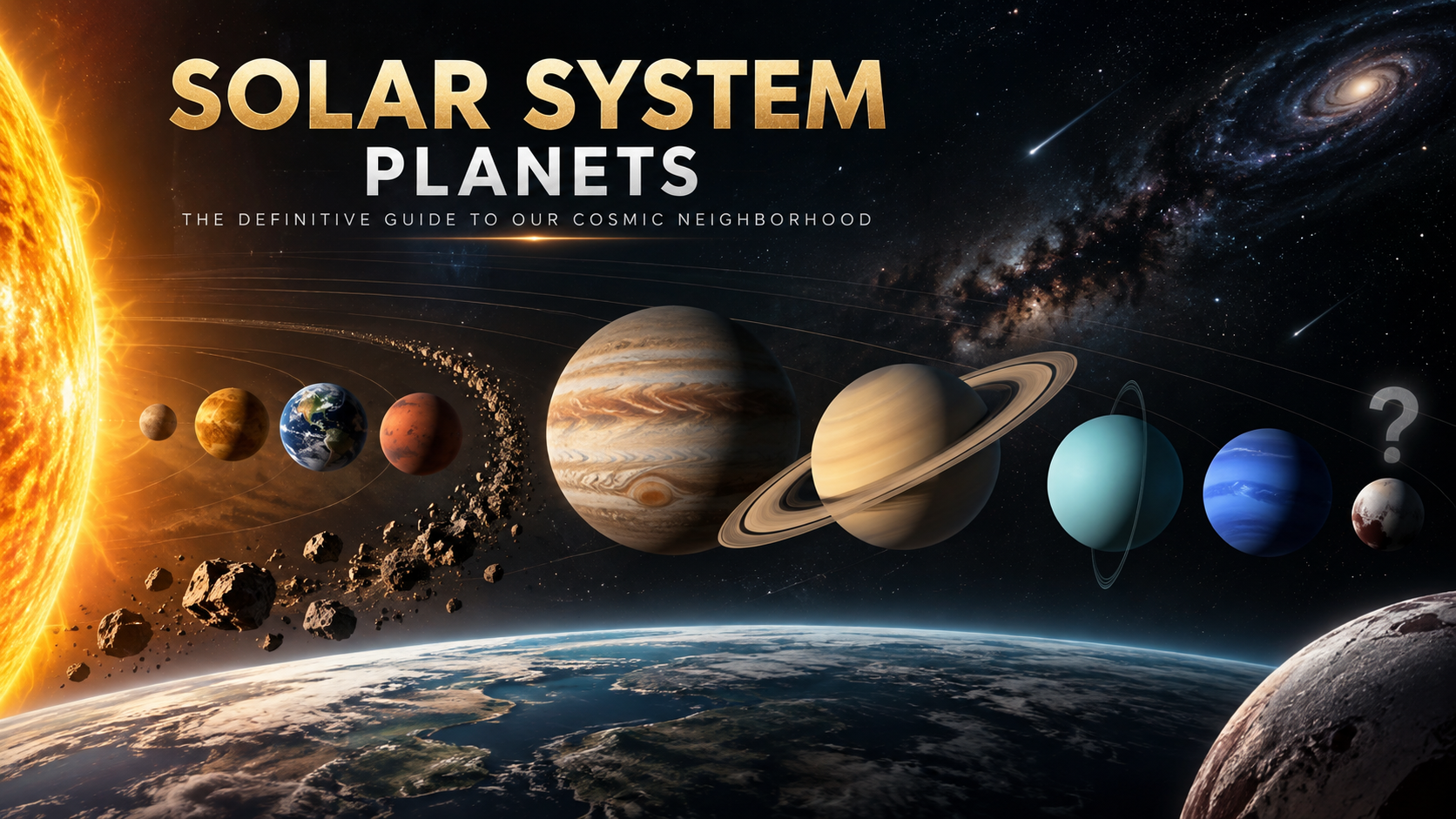
Solar System Planets: The Definitive Guide to Our Cosmic Neighborhood
Looking up at the night sky often sparks curiosity about our cosmic neighborhood. It contains diverse worlds, from scorching rocky planets to enormous, freezing ice giants. Understanding the solar system planets helps us appreciate Earth’s unique environment and the space around it.
Planetary science continues to develop as spacecraft and telescopes reveal new details. According to mission archives from NASA, studying planetary formation and evolution can help scientists understand how planetary systems develop across the cosmos.
Many people still wonder about the changing planetary count and unusual orbital behavior. Older textbooks often listed nine planets because Pluto once held full planetary status. Modern astronomy uses a different classification based on specific scientific criteria.
This guide answers common questions about the solar system planets. We will examine the current planet count, Uranus’s extreme seasons, massive exoplanets, Pluto’s classification, and its formal designation. Together, these topics explain how scientists define and study planetary worlds.

What are the 8 or 9 planets?
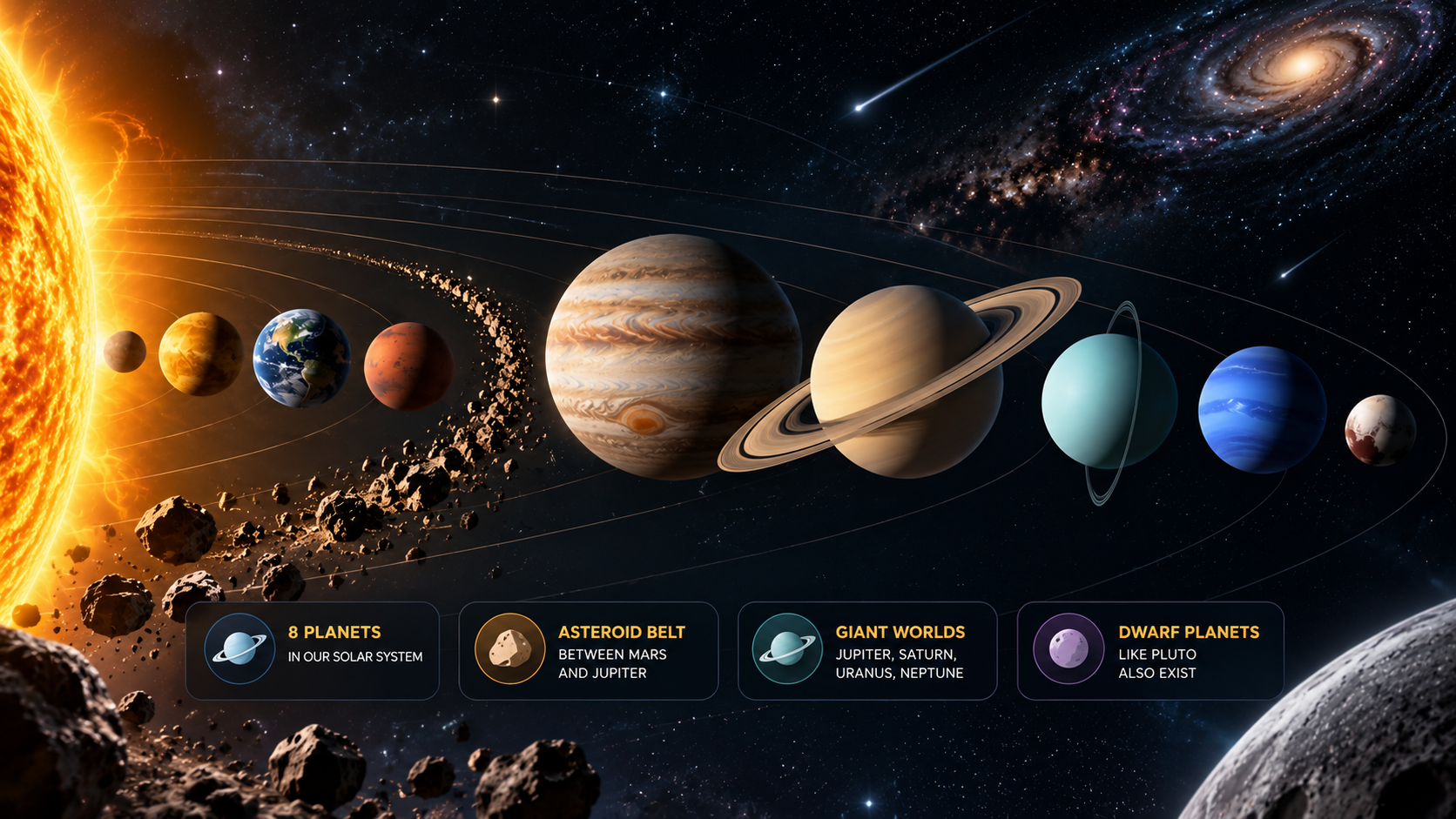
The official count includes eight solar system planets: Mercury, Venus, Earth, Mars, Jupiter, Saturn, Uranus, and Neptune. Pluto was traditionally counted as the ninth planet after its discovery in 1930. However, the International Astronomical Union reclassified Pluto as a dwarf planet in 2006.
The eight major planets follow a clear order from the Sun. Mercury is closest, followed by Venus, Earth, and Mars. Jupiter and Saturn are gas giants, while Uranus and Neptune are classified as ice giants. The asteroid belt separates the inner rocky planets from the outer giant planets.
People may still describe Pluto as the ninth planet when discussing historical astronomy. That wording reflects its former classification rather than the current scientific definition. Today, the solar system planets officially number eight.
This distinction helps separate major planets from dwarf planets and other smaller objects.
The Clear Line Between Major and Dwarf Worlds
Astronomers distinguish planets from dwarf planets using specific criteria. The International Astronomical Union defines a planet as a body that orbits the Sun, has enough gravity to become nearly round, and has cleared its orbital neighborhood.
Dwarf planets meet the first two conditions but do not dominate their orbital regions. Pluto is the best-known example. It travels through the Kuiper Belt, where many other icy objects occupy nearby space.
The difference is therefore not simply about size. A body’s gravitational influence within its orbital zone also matters. Earth, for example, dominates the region around its orbit far more strongly than Pluto does.
This classification helps scientists organize the many objects found throughout our planetary system. It also explains why the list of solar system planets contains eight major worlds.
The distinction does not make dwarf planets unimportant. They provide valuable evidence about the formation and evolution of the outer solar system.
Which planet is dark for 42 years?
Uranus experiences an unusual polar cycle in which each pole can remain in continuous darkness for about 42 Earth years. This happens because Uranus has an extreme axial tilt of roughly 98 degrees. Its rotation axis is therefore oriented almost sideways compared with its orbital plane. Such unusual planetary behavior connects with major predictions in the field of physics about how physical systems behave under extreme conditions.
Uranus takes about 84 Earth years to complete one orbit around the Sun. During that journey, its poles experience dramatically changing sunlight conditions. For roughly half of its orbit, one pole can face the Sun while the other faces away.
As a result, one polar region can experience decades of continuous daylight. The opposite pole experiences a similarly long period of darkness. The situation later reverses as Uranus continues around the Sun.
Among the solar system planets, Uranus therefore has some of the most extreme seasonal patterns. Its unusual orientation makes its climate and atmosphere especially interesting to planetary scientists.
Surviving an Extreme 98-Degree Planetary Tilt
The extreme tilt of Uranus probably resulted from a major event early in the planet’s history. One leading explanation suggests that a massive collision altered its rotation axis billions of years ago.
Scientists continue to study how such an event could have produced Uranus’s unusual orientation. The planet’s sideways rotation strongly affects its seasonal cycle and atmospheric behavior.
When sunlight eventually reaches a previously dark hemisphere, atmospheric activity can change. Telescopes and spacecraft have observed cloud structures and storms within Uranus’s atmosphere. These observations help researchers understand how sunlight influences a planet with such an unusual orientation.
Uranus also has a faint ring system and numerous moons. These features provide additional clues about its formation and evolution.
For the solar system planets, axial tilt plays an important role in determining seasons. However, Uranus stands apart because its nearly sideways orientation creates seasonal conditions unlike those experienced on Earth.
Its long seasons demonstrate how differently planetary climates can develop across the solar system.
What is the biggest planet in the universe?
Jupiter is the largest planet in our solar system. However, identifying the largest planet in the entire universe is much more difficult. Astronomers have discovered thousands of exoplanets, but there is no definitive, universally accepted record holder for the largest planet in the universe.
One notable object is ROXs 42Bb, a young gas giant located roughly 450 light-years from Earth. Estimates place its mass at several times that of Jupiter, although its exact properties remain uncertain. Its large size and unusual characteristics have led to discussion about exoplanets and their potential to host alien life and where planets end and brown dwarfs begin.
This uncertainty matters because extremely massive objects can overlap with the lower mass range of brown dwarfs. Scientists therefore consider both mass and formation history when studying unusual exoplanets.
Among the solar system planets, Jupiter remains the clear largest. Outside our system, however, comparisons are less straightforward because exoplanet measurements can carry significant uncertainties.
How Astronomers Measure Distant Cosmic Giants
Astronomers use several techniques to estimate the properties of distant planets. Transit photometry is one of the most important methods. When a planet passes in front of its host star, it causes a small dip in the star’s observed brightness. These observations depend on advanced instruments such as the world’s biggest telescopes.
The depth of that dip can help researchers estimate the planet’s radius. Scientists can then combine radius measurements with other observations to study the planet’s atmosphere and structure.
The radial velocity method provides another important measurement. A planet’s gravity causes its host star to move slightly. Measuring this motion can help estimate the planet’s mass.
Direct imaging can also reveal young, massive planets under favorable conditions. This method is particularly useful for planets located far from their stars.
These techniques show why comparing distant worlds with the solar system planets requires caution. Measurements can vary depending on the observation method and available data. Astronomers therefore combine multiple observations whenever possible, especially when studying the wildest planets in the Milky Way.
Why is Pluto not considered a planet?
Pluto is not classified as a major planet because it does not satisfy all three criteria established by the International Astronomical Union in 2006. A planet must orbit the Sun, have enough gravity to become nearly round, and clear its orbital neighborhood.
Pluto satisfies the first two requirements. Its orbit takes it around the Sun, and its gravity gives it a rounded shape. However, it does not dominate its orbital region.
Pluto travels through the Kuiper Belt, a distant region containing many icy bodies beyond Neptune. Its gravitational influence is not sufficient to clear most objects from this region.
The 2006 decision therefore placed Pluto in the dwarf planet category. The change also created a clearer scientific distinction between major planets and smaller rounded bodies.
The eight solar system planets remain Mercury, Venus, Earth, Mars, Jupiter, Saturn, Uranus, and Neptune. Pluto remains scientifically important despite its different classification.
Understanding Orbital Clearing in Planetary Science
Orbital clearing describes a planet’s ability to become the dominant gravitational body in its orbital neighborhood. It does not mean that every asteroid or object disappears completely from the region.
Instead, a dominant planet controls nearby material through its gravitational influence. It may absorb objects, eject them, capture them, or place them into stable orbital relationships.
Earth provides a useful example. Its mass allows it to dominate its orbital neighborhood compared with smaller nearby objects. Pluto has far less mass relative to the other bodies sharing its region of the Kuiper Belt.
This distinction was central to Pluto’s 2006 reclassification. Size alone does not determine whether an object qualifies as one of the solar system planets.
Orbital dynamics therefore provide an important scientific basis for planetary classification. They also help researchers understand how planets interact with asteroids, comets, moons, and other objects.
Studying orbital clearing gives scientists insight into how planetary systems develop and how larger bodies shape their surrounding environments.
What is Pluto’s new name?
Pluto did not receive a completely new everyday name after its reclassification. Its official name remains Pluto. However, it was assigned the minor-planet designation (134340) Pluto after the 2006 decision.
The number 134340 identifies Pluto within the Minor Planet Center’s cataloging system. This system helps astronomers organize observations of asteroids, dwarf planets, and other minor bodies.
Pluto was originally discovered in 1930 and was treated as the ninth major planet for decades. After its reclassification, it received its minor-planet number while retaining the name Pluto.
Scientists also classify Pluto as a plutoid. This term refers to dwarf planets that orbit beyond Neptune. Pluto is the prototype of this category.
The change in designation did not reduce Pluto’s scientific importance. Researchers continue to study its surface, atmosphere, interior, moons, and geological history. NASA’s New Horizons mission provided detailed observations of Pluto during its 2015 flyby.
For people learning about the solar system planets, Pluto remains an important example of how scientific classifications can change with new knowledge.
Cataloging Worlds Beyond the Classical Boundary
Cataloging systems allow astronomers to track the enormous number of objects found beyond the traditional planets. The Minor Planet Center maintains identification and observational information for many asteroids, comets, and trans-Neptunian objects.
Assigning a unique number helps researchers distinguish one object from another. It also makes long-term observation and orbital calculations easier.
Pluto’s designation as 134340 reflects this broader cataloging system. It does not mean that Pluto became less significant scientifically. Instead, the designation places it within a larger population of minor bodies.
The Kuiper Belt contains many objects that formed from leftover material in the outer solar system. Studying these bodies can reveal conditions that existed during planetary formation.
This work also helps scientists understand the boundary between major planets, dwarf planets, and smaller icy objects. The classification of Pluto therefore connects directly with broader research into the solar system planets and their origins.
As telescopes improve, astronomers continue discovering distant objects. Better observations may further refine our understanding of how these populations formed and evolved, revealing more scary and surprising facts about the universe.
Which planet has 42 years?
Uranus is associated with the 42-year milestone because its seasons can last about 21 Earth years each, while its polar daylight or darkness can persist for roughly 42 years. Uranus takes approximately 84 Earth years to orbit the Sun.
Its extreme axial tilt of about 98 degrees creates this unusual seasonal pattern. When one pole points toward the Sun, that region can experience continuous daylight for roughly half of the planet’s orbital journey. The opposite pole experiences prolonged darkness.
As Uranus moves around the Sun, the illumination gradually changes. Eventually, the opposite pole receives extended sunlight while the first pole enters a long winter period.
This makes Uranus one of the most unusual solar system planets. Earth experiences seasons because of its 23.5-degree tilt, but its seasonal changes are much shorter.
The Uranian cycle shows how orbital period and axial tilt can combine to produce extreme planetary seasons.
Why Planetary Seasons Vary Across Space
Planetary seasons depend largely on axial tilt, orbital period, and distance from the Sun. A planet’s tilt determines how directly sunlight reaches different regions during its orbit.
Earth has an axial tilt of about 23.5 degrees. As Earth travels around the Sun, this tilt produces familiar seasonal changes. Each season generally lasts about three months.
Uranus has a dramatically different configuration. Its nearly 98-degree tilt causes its poles to experience extraordinary changes in sunlight. Combined with its 84-year orbital period, this produces seasons lasting about 21 Earth years.
The solar system planets therefore demonstrate a wide range of seasonal behavior. Mercury has a very different environment from Earth, while Uranus experiences decades-long seasonal cycles.
These differences show why scientists cannot use Earth’s climate as a universal model for planetary environments. Every planet has its own combination of rotation, tilt, orbit, atmosphere, and surface conditions.
Studying these differences helps planetary scientists understand how worlds evolve under very different physical conditions.
Frequently Asked Questions
How many moons does Jupiter have?
Jupiter has a massive system of natural satellites, with over ninety officially recognized moons orbiting the gas giant. These include the four large Galilean moons discovered by Galileo Galilei: Io, Europa, Ganymede, and Callisto. Each of these major moons displays distinct geological features, ranging from active volcanic vents on Io to subsurface oceans hidden beneath the icy crust of Europa.
What is the hottest planet in the solar system?
Venus holds the title of the hottest planet in our solar system, with surface temperatures scorching enough to melt lead. Even though Mercury is closer to the Sun, Venus features a runaway greenhouse effect driven by its thick carbon dioxide atmosphere and dense clouds of sulfuric acid that trap solar heat effectively.
Can humans ever visit Mars?
Space agencies and private aerospace companies are actively developing technologies with the goal of sending human explorers to Mars in the coming decades. Overcoming major challenges like cosmic radiation, long transit times, and life support systems remains essential before permanent or semi-permanent human settlements can be established on the Martian surface.
What is the smallest planet in the solar system?
Mercury is the smallest planet in our solar system, with a radius measuring roughly one-third that of Earth. Due to its small size and weak gravity, Mercury cannot hold onto a substantial atmosphere, leaving its rocky surface heavily cratered from billions of years of asteroid and meteorite impacts.
Conclusion
Exploring the wonders of solar system planets reveals the incredible diversity and complexity of our cosmic neighborhood. From the scorching rocky landscapes of Mercury to the tilted, dark winters of Uranus, each world offers unique lessons about planetary formation and evolution. Understanding these celestial bodies deepens our appreciation for space science and inspires future generations to look up and question what lies beyond our skies. By keeping up with modern astronomical discoveries, we continue to refine our knowledge of the universe and our unique place within it. Take time to observe the night sky, study planetary movements, and share your newfound astronomical insights with fellow space enthusiasts.