
Director’s Guide to Vocal Warm-Ups for Stage Actors
Every theatrical production demands clarity, stamina, and resonance from its cast. This makes vocal preparation an important part of rehearsals and performances. Structured vocal warm-ups for actors can help reduce unnecessary vocal tension and prepare the voice for demanding stage work. According to guidance from the National Institute on Deafness and Other Communication Disorders, healthy voice use depends on proper vocal care and avoiding excessive strain.
When directors prioritize vocal conditioning, performers can work toward clearer projection and greater vocal flexibility. A thoughtful warm-up can also help actors explore emotional expression without immediately placing heavy demands on the voice. This becomes especially important during long rehearsals and repeated performances.
Throughout this guide, we examine practical vocal conditioning methods designed for stage performers. You will learn useful vocal warm-ups for actors, explore techniques also used by singers, and review the seven core vocal techniques in drama. We also discuss vocal practices associated with Ariana Grande and Billie Eilish, along with classical voice classifications.

What are some good vocal warm-ups for stage actors?
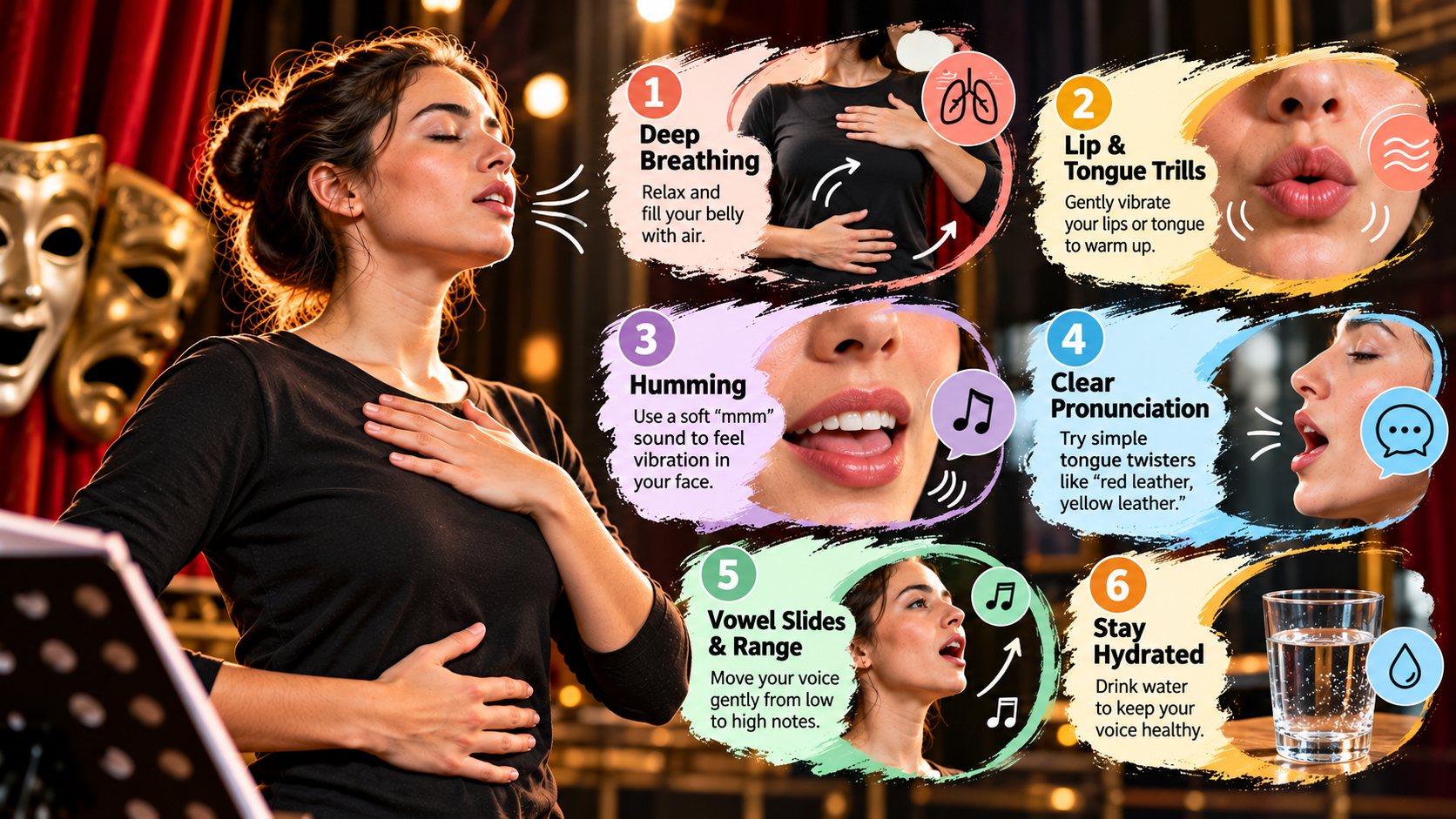
Effective vocal warm-ups for actors should gradually prepare breathing, resonance, articulation, and pitch. Actors can begin with slow diaphragmatic breathing to release unnecessary tension in the neck, shoulders, and jaw. The goal is steady airflow rather than forcing the breath.
Next, gentle lip trills and tongue trills can help activate the voice without demanding excessive volume. Actors can add soft humming on an “mm” sound to encourage forward resonance. These exercises should remain comfortable and controlled throughout the routine.
Directors can then introduce simple articulation drills. Phrases such as “red leather, yellow leather” can improve coordination between the tongue, lips, and jaw. Actors should begin slowly before increasing speed.
Finally, gentle vowel slides and open-vowel exercises can prepare the voice for dialogue. Warm-ups should never create pain, persistent hoarseness, or significant vocal fatigue. If those symptoms occur, the actor should stop and seek appropriate professional advice.
What are the best vocal warm-ups for singers?
Singers often use semi-occluded vocal tract exercises, commonly called SOVT exercises, as part of their vocal preparation. These exercises include lip trills, humming, and straw phonation. They can encourage efficient vocal fold vibration while reducing excessive effort.
A singer can begin with gentle straw phonation at a comfortable pitch. After several repetitions, they can move through short glides without forcing the upper or lower range. This creates a gradual transition into more demanding singing.
Five-tone patterns can follow using comfortable vowels such as “ah,” “oh,” or “ee.” Singers should keep the volume moderate and avoid pushing for higher notes too early. Gentle sirens can also help explore different parts of the range.
The exact routine should depend on the singer, repertoire, experience, and vocal condition. A warm-up should prepare the voice rather than exhaust it. Professional singers may also work with vocal coaches or speech-language professionals to develop routines suited to their individual needs and performance demands.
Utilizing Straw Phonation for Acoustic Balance
Straw phonation is a widely used SOVT exercise that can help singers and actors explore efficient vocal production. The performer phonates gently through a narrow straw while maintaining relaxed breathing and comfortable pitch. Some exercises involve placing the straw into shallow water, often called straw bubbling or water resistance exercises.
The partially narrowed vocal tract can create back pressure that changes how the vocal folds interact with airflow. This may help performers produce sound with less unnecessary effort. However, the exercise should feel easy rather than forceful.
Actors and singers can begin with short, comfortable sounds through the straw. They can then add gentle pitch glides or simple patterns. The purpose is preparation, not maximum range or volume.
Water-based exercises require particular care because excessive bubbling or pressure is unnecessary. Performers should also avoid sharing equipment for hygiene reasons. Anyone experiencing persistent pain, hoarseness, or vocal problems should consult a qualified voice professional rather than relying on warm-ups alone.
What are the 7 vocal techniques in drama?
The seven commonly taught vocal techniques in drama are projection, articulation, pitch, pace, tone, pause, and inflection. Each technique affects how an audience understands both the actor’s words and intentions.
Projection helps an actor produce a clear, supported voice that reaches the audience without shouting. Articulation focuses on precise pronunciation through coordinated movement of the tongue, lips, jaw, and teeth. Pitch involves changes in vocal frequency that can communicate emotion, character, status, or emphasis.
Pace controls how quickly or slowly dialogue is delivered. A faster pace can increase urgency, while slower delivery may create tension or reflection. Tone adds emotional and character-specific qualities to the voice.
Pauses can separate ideas, build suspense, or highlight important words. Inflection changes the pitch or emphasis within a phrase, helping dialogue sound natural and purposeful.
Directors can combine these techniques during rehearsals. Strong vocal work does not simply make actors louder. It helps them communicate meaning, emotion, character, and intention with greater clarity and control.
What is Ariana Grande’s vocal warm-up?
Ariana Grande is known for extensive vocal technique and demanding live performances. Public discussions of her training have highlighted exercises such as straw phonation, vocal sirens, humming, and gentle scale patterns. However, there is no single publicly confirmed routine that should be treated as her complete daily warm-up.
Grande has worked with vocal professionals, including vocal coach Eric Vetro, and has discussed vocal preparation in interviews and social media content. SOVT exercises, including straw-based techniques, are commonly used by professional singers because they can encourage efficient vocal production.
A practical warm-up inspired by techniques associated with professional singers can begin with relaxed breathing. Performers can then use gentle humming, lip trills, or straw phonation before moving into comfortable pitch glides. Short scale patterns can follow as the voice becomes more responsive.
The important principle is gradual progression. Singers should avoid immediately testing their highest notes or singing at full volume. A professional routine should also reflect the individual performer’s range, repertoire, vocal condition, and coaching.
Who has the rarest voice type?
There is no universally accepted single “rarest” voice type because rarity depends on the population, classification system, and characteristics being measured. In classical singing, contralto is generally considered an uncommon female voice type. True countertenors are also relatively uncommon among male classical singers.
A countertenor is typically an adult male singer who performs in a high range using a developed head voice or falsetto technique. Countertenors can perform repertoire traditionally associated with alto or other high vocal parts. Their individual ranges and vocal qualities vary considerably.
A true contralto is characterized by a naturally low female singing range and a distinctive dark or rich timbre. However, simply singing low does not automatically make someone a contralto. Voice classification considers range, tessitura, timbre, and vocal function.
Other classical categories, including soprano, mezzo-soprano, tenor, baritone, and bass, occur more frequently in many performance settings. Directors should therefore avoid assigning voice types based only on one high or low note. Professional assessment considers the complete voice rather than an isolated range.
Did Billie Eilish get vocal training?
Billie Eilish received formal vocal experience as a child through the Los Angeles Children’s Chorus. She joined the organization when she was young and developed experience with choral singing, musical expression, and vocal coordination. This background provided a structured foundation before her professional music career developed.
Choral training can help young singers develop skills such as breath coordination, pitch awareness, ensemble listening, and musical phrasing. Eilish’s later singing style is notably different from traditional large-volume vocal performance. Her controlled, intimate delivery demonstrates that effective singing does not always require powerful projection.
Her brother and collaborator, Finneas, has also played an important role in developing their recording approach. Their work often uses close-mic techniques and carefully controlled dynamics, which can create an intimate vocal sound.
It is therefore inaccurate to assume that Eilish’s soft vocal style reflects a lack of training. Her background included organized vocal education, while her professional style developed through later artistic choices and collaboration. For actors, her example also demonstrates how vocal control and expressive restraint can be valuable performance skills.
Frequently Asked Questions
How long should a stage vocal warm-up last?
A standard theatrical vocal warm-up should last between 15 and 30 minutes. This provides ample time to awaken breath support, release physical tension in the neck, articulate speech sounds, and activate acoustic resonance. Shorter warm-ups may leave muscles tight, while routines extending beyond 45 minutes can induce vocal fatigue before stage work even starts.
Why do actors yawn during vocal warm-ups?
Actors intentionally yawn during vocal warm-ups because it naturally lowers the larynx and raises the soft palate. This physiological movement creates maximal space in the pharynx, reducing throat tension and optimizing acoustic resonance. Yawning also relaxes the jaw and stretches tight facial muscles, facilitating a rich, open, and effortless vocal delivery.
How often should stage actors warm up their voices?
Stage actors should warm up their voices every day they rehearse or perform, ideally completing a targeted session before every show. Even on rest days, light five-minute humming or gentle sirens help maintain tissue elasticity and hydration. Daily vocal conditioning builds enduring stamina and protects performers from acute strain during intensive production runs.
Conclusion
Vocal health serves as the bedrock of compelling theatrical storytelling. By incorporating structured vocal warm-ups for stage actors into daily rehearsals, directors ensure their cast communicates text with power, nuanced emotional intention, and crystalline diction. From basic diaphragmatic alignment to specialized straw phonation, keeping the body warm during cold days can also support overall physical comfort during demanding rehearsals and performances.
Mastering the seven theatrical vocal techniques allows actors to inhabit characters authentically across vast performance spaces. As seen in the rigorous training routines of artists like Ariana Grande and Billie Eilish, consistent vocal discipline underpins expressive freedom. Commit to consistent vocal preparation, treat the vocal tract with athletic care, and watch your stage ensemble thrive under the stage lights.