
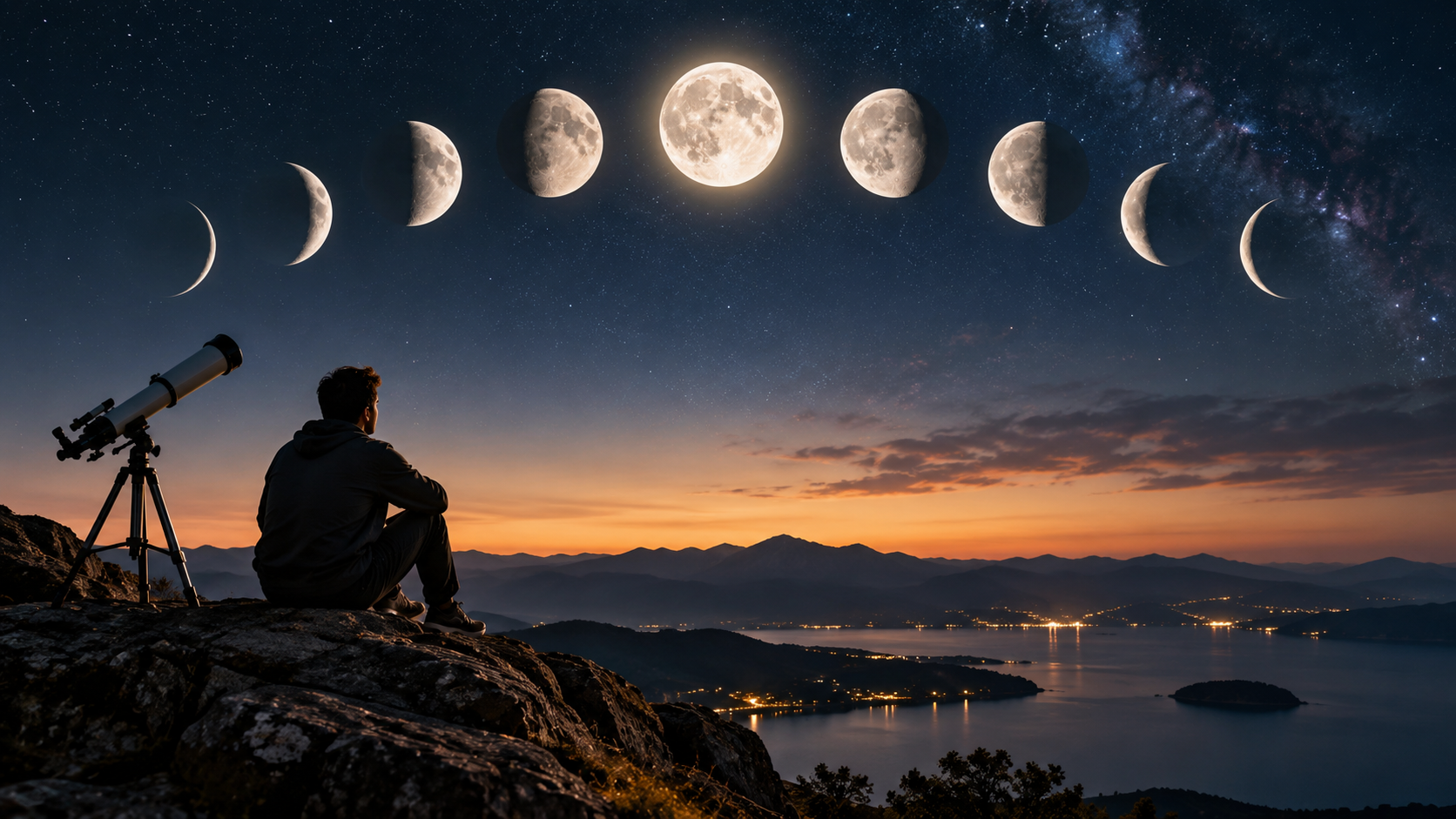
Science Behind Lunar Phases: Why the Moon Changes
Have you ever gazed at the evening sky and wondered why our celestial neighbor never looks quite the same two nights in a row? Understanding the science behind lunar phases reveals the physical mechanics that shape our view of the night sky. The Moon does not produce visible light of its own. Instead, sunlight illuminates its surface, and we see the portion of that light reflected toward Earth. NASA’s explanation of the Moon’s phases provides a useful overview of this changing pattern.
These changing appearances have practical value for backyard skywatchers, night photographers, and anyone interested in observing the natural world. The Moon also influences ocean tides through its gravitational interaction with Earth, although the Sun contributes as well.
Throughout this guide, we explore the geometry behind the Moon’s monthly changes. We will explain why lunar phases occur, examine which lunar events are less common, describe what a nearly full Moon looks like, and discuss whether a very thin 1% crescent can be seen.
By understanding these orbital patterns, you can better appreciate the science behind lunar phases and observe the Moon with greater confidence.
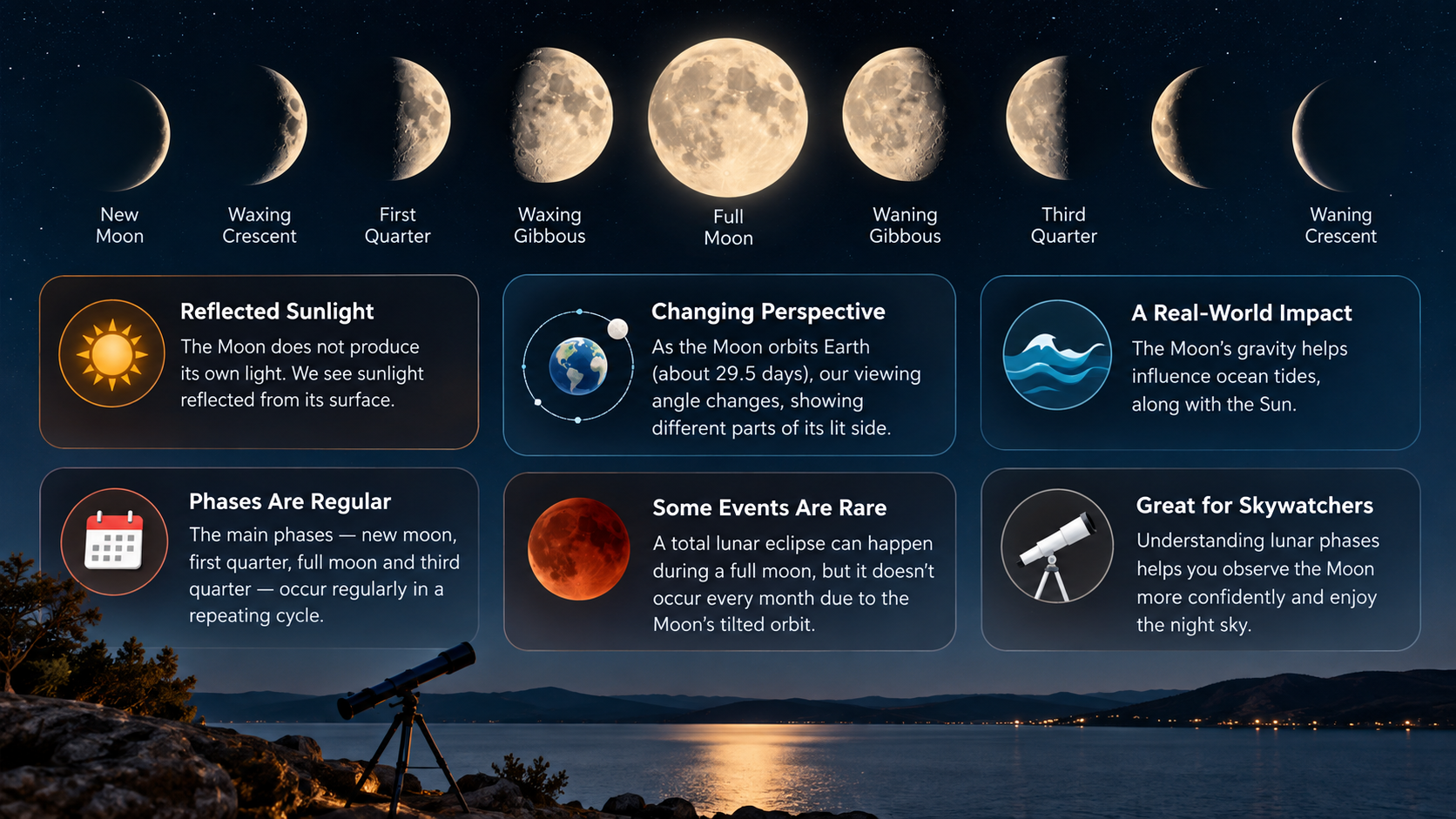

Why do the phases of the moon change?
The Moon’s appearance changes because it continuously orbits Earth while sunlight illuminates half of its spherical surface. As the Moon travels through its approximately 29.5-day synodic cycle, our viewing angle changes relative to its illuminated half. Understanding the Moon in the broader context of the planets of our solar system can also help put its motion into perspective.
The Moon does not physically grow or shrink during this cycle. It also does not regularly enter Earth’s shadow. Instead, we see different portions of the Moon’s sunlit side from Earth. This changing perspective creates the familiar lunar phases and adds to the many fascinating facts about planets in the Milky Way.
The science behind lunar phases is therefore mainly a matter of orbital geometry. When the Moon moves between Earth and the Sun, most of its illuminated side faces away from us. This creates the new moon phase. As the Moon continues along its orbit, increasingly more of its illuminated surface becomes visible.
The main phases include new moon, first quarter, full moon, and third quarter. Between these points, observers see crescent and gibbous phases. The exact appearance depends on the Moon’s position relative to Earth and the Sun.
The Role of Changing Orbital Angles
Our changing perspective results from the Moon’s position in its orbit around Earth. As the Moon moves eastward through the sky, the angle between the Sun, Earth, and Moon changes continuously. This changes how much of the illuminated lunar surface we can see.
After a new moon, the visible illuminated portion gradually increases. This period is called waxing. The Moon first appears as a thin crescent, then grows into a half-moon at first quarter. It eventually becomes a waxing gibbous before reaching the full moon phase.
After full moon, the visible bright portion begins decreasing. This process is called waning. The Moon passes through waning gibbous, third quarter, and waning crescent phases before returning to new moon.
These changes create the eight commonly recognized lunar phases. The cycle repeats because the Moon continually orbits Earth while Earth and the Moon continue orbiting the Sun.
Which moon phase is rare?
The standard lunar phases themselves are not considered rare. Each phase occurs regularly as part of the Moon’s approximately 29.5-day synodic cycle. However, some lunar events associated with particular phases occur much less frequently.
A total lunar eclipse is one example. It happens only during a full moon when the Sun, Earth, and Moon become closely aligned. Earth then moves between the Sun and Moon, causing Earth’s shadow to fall across the lunar surface. Events like these are among the scary universe facts that can make astronomical phenomena especially intriguing.
During totality, the Moon can appear reddish or copper-colored. This appearance is commonly known as a Blood Moon. The red color occurs because some sunlight passes through Earth’s atmosphere before reaching the Moon. Earth’s atmosphere scatters shorter blue wavelengths more strongly while allowing more red light to reach the lunar surface.
Total lunar eclipses do not occur every month. The Moon’s orbit is tilted by about five degrees compared with Earth’s orbital plane. Therefore, the Moon usually passes above or below Earth’s central shadow during full moon.
Why Orbital Incline Prevents Monthly Eclipses
The Moon’s tilted orbital path explains why lunar eclipses are not monthly events. If the Moon orbited Earth in exactly the same plane as Earth’s orbit around the Sun, the geometry would allow much more frequent alignments.
Instead, the Moon’s orbit is inclined by roughly five degrees. During most full moons, the Moon passes either above or below the region where Earth’s shadow would intersect its orbit. As a result, no lunar eclipse occurs.
Eclipses become possible during specific periods called eclipse seasons. These occur when the Sun is positioned near one of the points where the Moon’s tilted orbit crosses Earth’s orbital plane. If a full moon happens near the right alignment, Earth’s shadow can fall across the Moon.
The exact type of lunar eclipse depends on how closely the alignment occurs. A total lunar eclipse happens when the entire Moon enters Earth’s darkest central shadow, called the umbra. Partial and penumbral eclipses occur with different degrees of alignment.
This orbital geometry is an important part of understanding the science behind lunar phases and eclipses.
What moon phase is 99%?
A 99% illuminated Moon is a gibbous moon that is very close to the full moon phase. It can occur shortly before full moon during the waxing stage or shortly after full moon during the waning stage.
When the Moon is 99% illuminated, almost the entire visible lunar disk appears bright. To casual observers, it may look virtually identical to a full moon. Astronomically, however, it is not technically full because the Sun, Earth, and Moon have not reached the precise geometry required for full illumination.
When the illuminated portion increases toward 100%, astronomers classify the Moon as waxing gibbous. When the illuminated portion decreases after the full moon, astronomers classify it as waning gibbous.
The difference can be difficult to notice without careful observation. The exact percentage also changes continuously rather than jumping between fixed values. This means the Moon can pass through 99% illumination during a relatively short period around full moon.
For skywatchers, these subtle changes demonstrate how continuously the lunar appearance changes. There is no sudden transition between gibbous and full moon.
Spotting Surface Relief Near the Terminator
A nearly full Moon can provide interesting views through binoculars or a small telescope. The terminator is the boundary between the illuminated and unilluminated portions of the lunar surface. For beginners, choosing among the best beginner telescopes can make detailed lunar observation easier.
Near this boundary, sunlight strikes the lunar landscape at a lower angle. This creates shadows around craters, mountains, ridges, and other surface features. These shadows can make the Moon’s terrain appear more three-dimensional.
The terminator is often especially useful for lunar observation because shadows create stronger visual contrast. Near a completely full Moon, sunlight reaches much of the visible surface more directly. This can reduce the dramatic shadows that help reveal surface relief.
A 99% illuminated Moon still has a narrow region where the terminator produces noticeable contrast. With suitable optical equipment, observers may be able to distinguish features that are less obvious when the Moon is fully illuminated.
For beginners, binoculars can provide a simple way to explore lunar details. A small telescope can reveal even more features. Observing on different nights also shows how the changing position of the terminator alters the appearance of familiar craters.
Can you see a 1% moon?
Yes, a 1% illuminated Moon can sometimes be seen, but it is difficult to observe safely and accurately. A 1% crescent has only a tiny portion of its visible disk illuminated. It usually appears close to the horizon during twilight, shortly after sunset or shortly before sunrise.
Because the Moon is close to the Sun in the sky at this stage, solar glare creates a major visibility challenge. Atmospheric haze near the horizon can make the thin crescent even harder to detect. Buildings, trees, hills, and clouds can also block the view.
Successful observation requires several factors to line up. A clear horizon, favorable atmospheric conditions, accurate timing, and a suitable viewing location can all help. The Moon’s position also changes from day to day, so a crescent that is easy to locate on one date may be extremely difficult on another. These observations connect naturally with general knowledge about science and astronomy.
Never use binoculars or a telescope to search near the Sun unless the equipment has the appropriate certified solar protection. Looking at the Sun through unprotected optical equipment can cause permanent eye damage.
For this reason, thin-crescent observations are best planned using reliable astronomical information and conducted with strict attention to solar safety.
FAQ SECTION
How long does a complete lunar cycle take?
A complete lunar cycle, known scientifically as a synodic month or lunation, takes approximately 29.53 days to finish. During this timeframe, the moon progresses through all eight distinct stages, starting from a dark new phase, growing into full illumination, and gradually returning to complete darkness again. This orbital duration serves as the historical baseline for our modern calendar months.
Does the moon rotate on its axis while orbiting Earth?
Yes, the moon rotates on its own internal axis at the exact same rate that it orbits Earth, taking roughly 27.3 days. Astronomers call this phenomenon synchronous rotation or tidal locking. Because its rotational velocity matches its orbital pace perfectly, observers on Earth can only ever see one side, leaving the far hemisphere hidden from ground view.
Does Earth’s shadow cause regular nightly moon phases?
No, Earth’s shadow plays no role in producing regular monthly phases. Ordinary lunar changes occur entirely because we view different angles of the moon’s sunlit side as it travels around our planet. Earth’s shadow only falls across the lunar surface during a lunar eclipse, which remains an occasional, distinct astronomical alignment rather than a daily occurrence.
CONCLUSION
Understanding the science behind lunar phases transforms an ordinary glance at the night sky into an engaging astronomical experience. As we have explored, these monthly visual changes result from the ongoing geometric dance between Earth, the Moon, and the Sun, not planetary shadows.
From recognizing why orbital planes make total lunar eclipses so infrequent to appreciating the subtle beauty of a 99% gibbous disk, each stage carries distinct scientific mechanics. Even hunting for an elusive 1% crescent challenges your observational precision and connects you directly with the dynamic rhythms of our solar system.
The next time you step outside after dusk, look up and identify the current lunar stage. Grab a pair of binoculars to inspect the rugged crater details lining the terminator line, or track how the bright surface shifts over consecutive evenings. By applying these foundational concepts, you can easily read the natural calendar written overhead and share this celestial knowledge with fellow stargazers.