
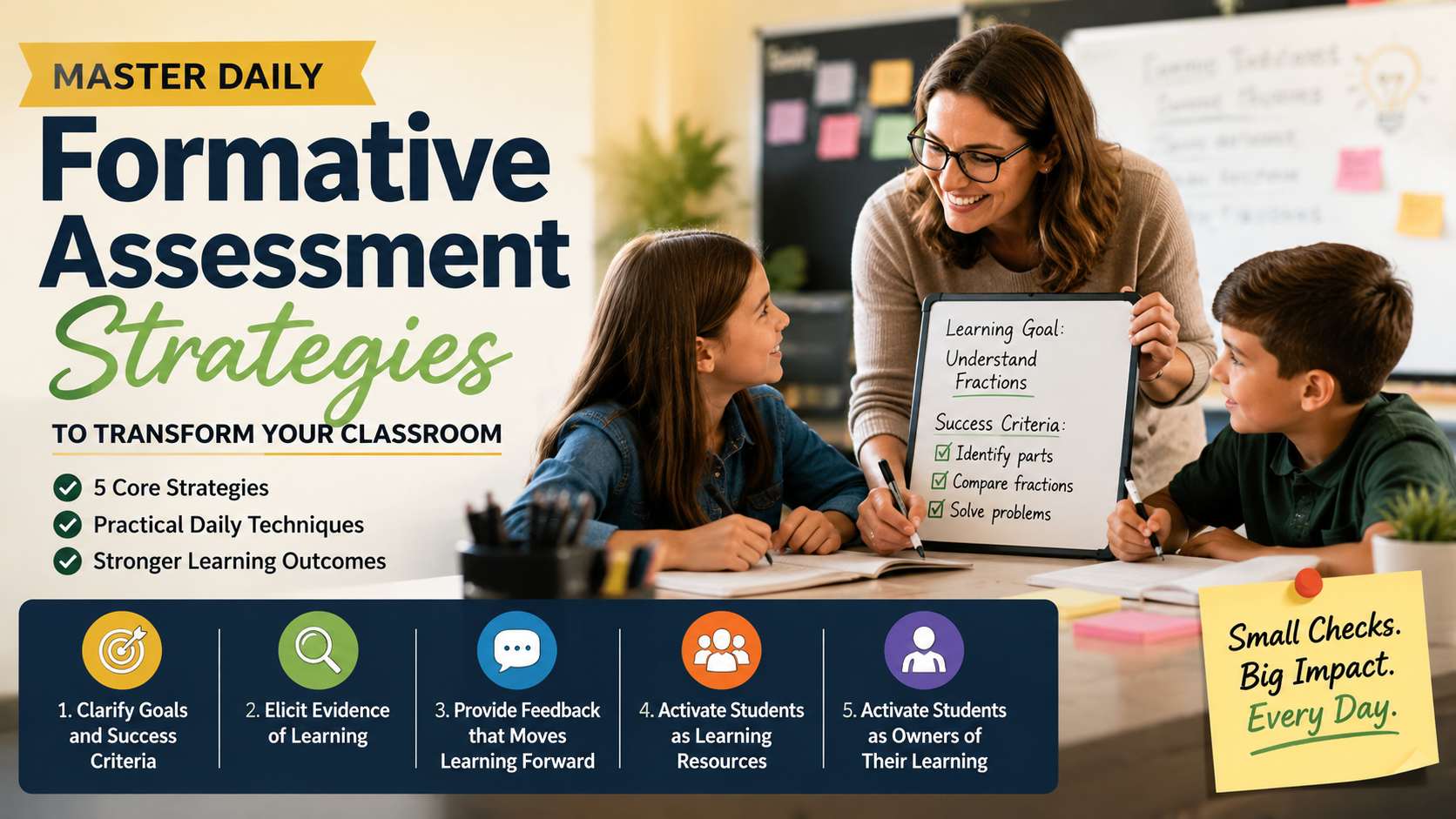
Master Daily Formative Assessment Strategies to Transform Your Classroom
Implementing daily formative assessment strategies is essential for educators who want to monitor real-time student understanding and adjust instruction dynamically. According to the U.S. Department of Education, continuous feedback loops significantly improve learning outcomes and boost student achievement. Daily formative assessments help teachers identify learning gaps before high-stakes exams occur, ensuring that no student falls behind. Throughout this article, we will answer what are the 5 formative assessment strategies, what are the strategies used in formative assessment, what are some examples of formative assessment strategies, what are the 7 methods of assessment, and daily formative assessment strategies for teachers. These insights will provide you with practical, actionable methods to enhance your instructional toolkit and create a more responsive, interactive learning environment every single day.

What Are the 5 Formative Assessment Strategies?
Understanding the five core formative assessment strategies helps teachers make better instructional decisions during daily lessons. These practices are closely associated with the work of education researcher Dylan Wiliam. Together, they create a continuous cycle of checking understanding, responding to evidence, and supporting student progress.
- Clarify learning intentions and success criteria so students understand what they need to learn.
- Elicit evidence of learning through effective questions, discussions, and classroom tasks.
- Provide feedback that moves learning forward rather than simply assigning grades.
- Activate students as learning resources for one another through peer discussion and collaboration.
- Activate students as owners of their learning through reflection, self-assessment, and metacognition.
Teachers can apply these practices through simple daily formative assessment strategies. Start each lesson by sharing clear learning objectives. Then, use targeted questions, think-pair-share activities, or digital response tools to check understanding. Providing meaningful responses to what students demonstrate can also strengthen feedback strategies for student growth.
The goal is not to assess students constantly. Instead, teachers should gather useful evidence and use it to adjust instruction.
Implementing the Five Core Practices
Putting these five practices into action does not require complicated assessment systems. Teachers can begin with one routine for each stage of a lesson. At the start, clearly explain the learning objective and describe what successful work should look like. This gives students a clear target.
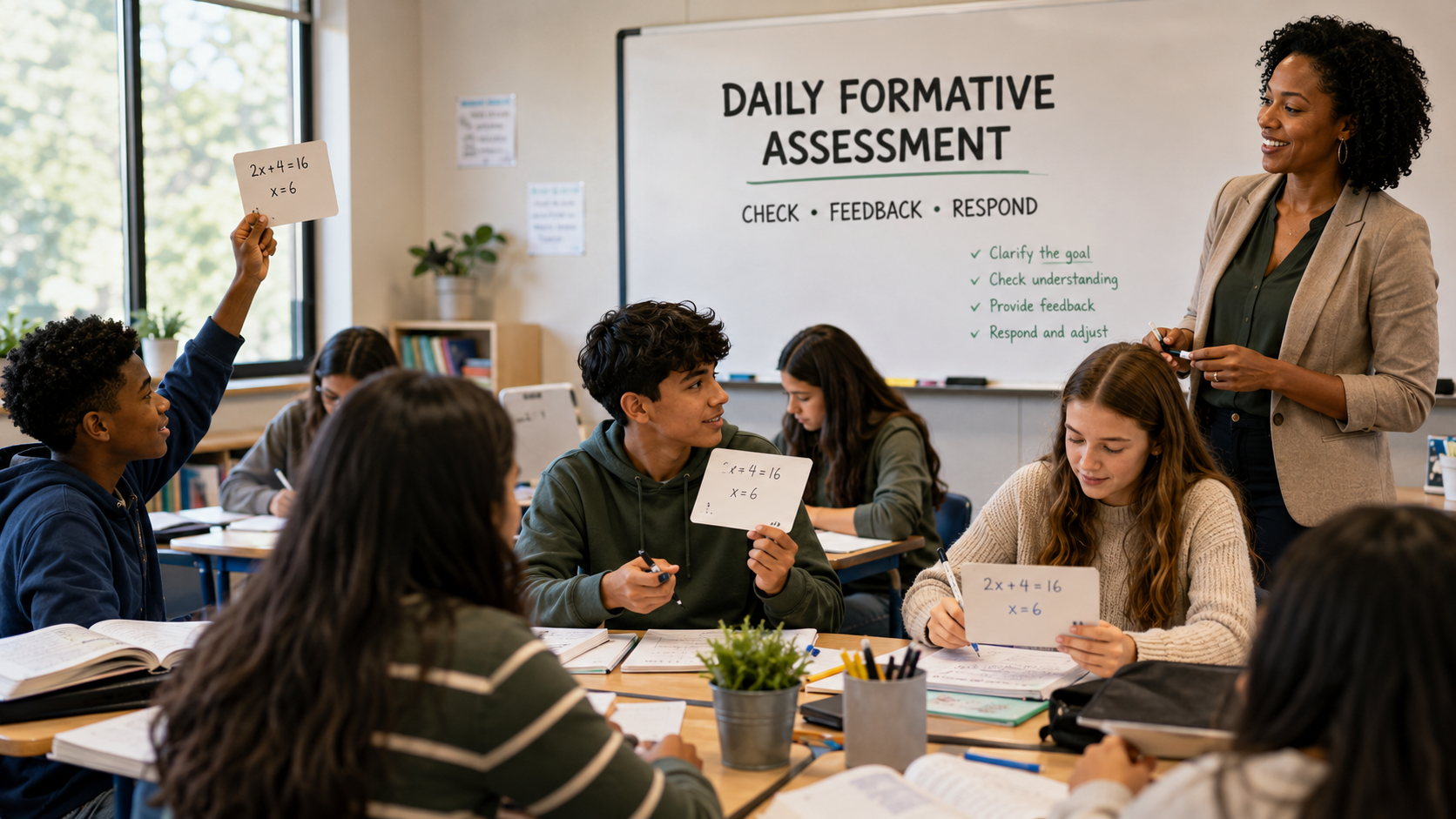
During instruction, use questions and short learning tasks to reveal what students understand. Think-pair-share, mini-whiteboards, quick polls, and response cards can provide immediate evidence. Importantly, teachers should look for misconceptions rather than simply count correct answers.
Feedback should then help students identify their next step. Avoid feedback that only says whether an answer is right or wrong. Instead, explain what needs improvement and how students can improve it.
Finally, include opportunities for peer assessment and self-reflection. Students can compare their work with success criteria or explain what they still find difficult.
This approach makes assessment part of instruction rather than a separate activity. It also gives teachers practical information for adapting the next lesson.
What Are the Strategies Used in Formative Assessment?
Formative assessment includes many techniques that help teachers monitor learning while instruction is still taking place. Unlike summative assessment, which usually evaluates learning at the end of a unit, formative assessment provides information teachers can use immediately.
Common strategies include:
- Low-stakes quizzes to check recall and identify gaps.
- Interactive polls to reveal class-wide understanding.
- Concept maps to show how students connect ideas.
- Quick writing prompts to uncover reasoning and misconceptions.
- Questioning techniques to assess understanding during discussion.
- Self-assessment activities to encourage students to evaluate their progress.
The most effective strategy depends on the learning goal. A short quiz may work well for factual knowledge. An explanation or concept map may provide better evidence of deeper understanding. For a broader look at how schools can organize and evaluate assessment, see the school assessment system guide.
The key is what teachers do with the information. Collecting responses has little value if instruction does not change.
Effective daily formative assessment strategies help teachers adjust pacing, revisit difficult concepts, group students, or provide additional support. They also make mistakes less threatening because students receive opportunities to learn from them.
Leveraging Interactive Digital Tools
Digital assessment tools can make formative assessment faster and more interactive. Platforms such as Kahoot, Nearpod, and Mentimeter allow teachers to collect responses during lessons. These tools can support quizzes, polls, questions, and other quick checks for understanding.
However, technology should not become the assessment strategy itself. A digital quiz has limited value if the questions do not reveal meaningful evidence of learning. Teachers should first decide what they need to know and then select the appropriate tool.
For example, a teacher might use a quick poll after introducing a difficult concept. If many students select the same incorrect answer, the teacher has immediate evidence of a possible misconception. The lesson can then pause for clarification before moving forward.
Digital tools can also encourage participation from quieter students. Students who rarely speak during whole-class discussions can still submit responses. This gives teachers a broader view of classroom understanding.
Teachers should also consider accessibility, device availability, and screen time. Simple paper-based techniques can work just as well when technology is unavailable.
The strongest approach combines digital tools with effective questioning, discussion, feedback, and observation.
What Are Some Examples of Formative Assessment Strategies?
Many formative assessment strategies require very little preparation. They can become short classroom routines that help teachers understand what students know before moving to the next concept.
One common example is the exit ticket. Students answer a question or summarize an important idea before leaving class. Teachers can review responses and identify areas that require attention.
Another useful strategy is the muddiest point. Students identify the concept they found most confusing. This helps teachers discover problems that may not appear during regular discussion.
Traffic light cards provide another quick check. Students use red, yellow, or green to show their level of understanding. Teachers can then decide whether to review the topic, provide support, or continue.
Peer evaluation can also provide useful evidence. Students compare work against clear criteria and identify areas for improvement. Similarly, four-corners activities can encourage students to choose and defend different responses. These collaborative techniques can also support broader student engagement strategies in the classroom.
These techniques work because they make student thinking visible. They also provide information without creating the pressure associated with formal tests.
The best daily formative assessment strategies are simple enough to use consistently. They should fit naturally into instruction rather than interrupt it.
Using Exit Tickets Effectively
Exit tickets are one of the simplest ways to build a consistent formative assessment routine. They usually take only a few minutes and can provide useful evidence about student understanding at the end of a lesson.
The questions should connect directly to the day’s learning objective. For example, teachers might ask students to explain one key concept, solve a short problem, or identify something they still do not understand.
Avoid asking questions simply because they are easy to grade. The purpose is to discover what students understand and where further instruction may be necessary.
After class, teachers can group responses into broad categories such as:
- Secure understanding
- Partial understanding
- Significant confusion
These categories can guide the next lesson. Students showing confusion may need a short review or additional practice. Students demonstrating secure understanding may be ready for extension work. Consistent use of these results can also support student performance tracking over time.
Teachers can also vary the format. Students might write one sentence, solve one problem, explain a process, or identify their biggest remaining question.
Used consistently, exit tickets create a simple feedback loop between teaching and learning. They are especially useful because they turn assessment results into practical information for planning the next instructional step.
What Are the 7 Methods of Assessment?
Assessment methods vary according to the learning objectives, subject, and type of evidence a teacher needs. There is no single list of seven methods that applies to every educational framework. However, several commonly used approaches can be grouped into seven broad categories.
These include selected-response questions, such as multiple-choice items; constructed responses, which require students to produce their own answers; and essay writing, which can evaluate explanation and reasoning. Other methods include performance assessment, oral questioning, portfolios, and teacher observation.
Each method provides different evidence. Multiple-choice questions can efficiently assess factual knowledge. Essays may reveal deeper reasoning. Performance tasks can show whether students can apply knowledge in practical situations.
Portfolios can demonstrate progress over time, while observation helps teachers assess behaviors and skills that may not appear in written work.
Using several methods gives teachers a broader picture of student learning. It also reduces reliance on a single type of assessment. This approach can be especially useful when considering personalized learning in education, where different students may benefit from different ways of demonstrating understanding.
However, variety should have a purpose. Teachers should choose assessment methods based on the evidence they need, not simply use more methods. This principle also strengthens daily formative assessment strategies.
Balancing Observation and Formal Testing
Teacher observation and formal testing provide different types of evidence. Relying entirely on one approach can leave important aspects of learning unnoticed.
Formal tests can efficiently measure knowledge, recall, and specific academic skills. However, they may not show how students collaborate, explain their thinking, solve unfamiliar problems, or respond to feedback.
Observation can help teachers notice these behaviors during normal classroom activities. For example, a teacher may observe how students approach a group problem or explain a concept to a partner. This evidence can reveal misconceptions that a written test might miss.
Performance tasks provide another useful middle ground. Students demonstrate what they can do rather than simply select an answer.
Teachers should also consider fairness and accessibility. Different students may demonstrate understanding more effectively through different formats. Offering varied opportunities can provide a more complete picture of achievement.
The goal is not to eliminate formal testing. Instead, combine formal measures with ongoing evidence from classroom activities.
When used thoughtfully, observation, questioning, performance tasks, and written assessments complement one another. This creates a more balanced assessment system.
Daily Formative Assessment Strategies for Teachers
Teachers do not need elaborate systems to use formative assessment every day. The most sustainable approach is to build a few short routines into existing lessons.
At the beginning of class, use retrieval practice to revisit important concepts from previous lessons. A few warm-up questions can quickly show whether students remember key information.
During instruction, use questioning techniques that involve the whole class. Random response selectors, mini-whiteboards, and short written responses can prevent assessment from being limited to students who volunteer.
Teachers can also pause after difficult concepts and ask students to explain the idea in their own words. This provides evidence of understanding before the class moves forward.
At the end of the lesson, use a quick self-assessment or exit ticket. Students can compare their understanding with the learning target and identify areas that need more practice.
Effective daily formative assessment strategies should be quick, purposeful, and repeatable. They should also lead to an instructional response.
The important question is not, “Did I assess students today?” Instead, ask, “What did the evidence tell me, and what should I do next?” Regularly reviewing these decisions can become part of a teacher self-reflection routine that helps improve instruction over time.
Streamlining Your Daily Assessment Routine
A sustainable assessment routine should reduce unnecessary workload rather than create more marking. Teachers can begin by selecting one or two techniques that fit naturally into their existing lessons. This works especially well when paired with lesson planning strategies that save time and keep assessment routines manageable.
For example, a teacher might use retrieval questions at the beginning of class and an exit ticket at the end. These two routines can provide evidence from both the start and finish of a lesson.
Reusable mini-whiteboards can make whole-class responses quick and visible. Digital exit tickets can also reduce paper and simplify response collection when students have reliable device access.
Teachers should avoid trying every assessment technique at once. Too many routines can make lessons feel fragmented and increase workload.
Instead, establish a simple cycle:
- Set a clear learning target.
- Check understanding during instruction.
- Respond to misconceptions.
- Give actionable feedback.
- Review evidence and adjust the next lesson.
Over time, these routines become part of normal teaching practice. The aim is consistency, not complexity.
The most effective daily formative assessment strategies are those teachers can use regularly without sacrificing instructional time. A small number of well-chosen routines can provide enough evidence to guide meaningful teaching decisions.
FAQ SECTION
What is the main purpose of formative assessment?
The primary purpose of formative assessment is to monitor student learning in real time and provide ongoing feedback that both teachers and students can use to improve instruction. Unlike summative assessments that evaluate learning at the end of a unit, formative assessments identify specific learning gaps early. This allows educators to adjust their teaching strategies immediately, ensuring students master foundational concepts before moving on to more complex or challenging academic material.
How often should formative assessments be used in the classroom?
Formative assessments should ideally be integrated into every single lesson on a daily basis. Because these strategies are designed to be low-stakes and quick, they do not require long instructional blocks or extensive grading time. Brief check-ins, such as quick polls, entry slips, or verbal questioning during discussions, keep the feedback loop active. Consistent daily use ensures that student misconceptions are addressed promptly before they can negatively impact future academic performance.
Are formative assessments graded for official records?
Formative assessments are generally designed to be low-stakes or ungraded learning checks rather than contributors to final grades. The primary goal is to encourage risk-taking, honest self-reflection, and experimentation without the anxiety of punishment for mistakes. When students know an assessment is purely meant to guide their learning journey rather than penalize them, they are more likely to reveal their true confusions, giving teachers much more accurate diagnostic data.
Can formative assessments be adapted for remote or online learning?
Formative assessment strategies adapt exceptionally well to digital, hybrid, and remote learning environments through various interactive software platforms. Teachers can easily utilize digital breakout rooms for collaborative discussions, online polling tools for instant feedback, and virtual whiteboards for visual problem-solving. These digital adaptations ensure that educators can maintain continuous engagement and monitor student progress effectively, regardless of whether the classroom is physically present or operating online.
Conclusion
Mastering daily formative assessment strategies is one of the most powerful ways for educators to elevate classroom instruction and improve student outcomes. By continuously checking for understanding through targeted questions, exit tickets, and interactive routines, teachers can catch learning gaps early and adjust their pacing accordingly. We encourage you to implement at least one new formative assessment technique in your classroom this week and observe the positive impact on student engagement. Embracing these continuous feedback loops creates a dynamic, supportive learning environment where every student has the opportunity to succeed and thrive.