

Is Living Near Wind Turbines Safe?
Renewable energy is expanding worldwide, but many people still ask: is living near wind turbines safe? As wind farms grow across rural areas, nearby residents often raise questions about noise, sleep, health, wildlife, and property values. The World Health Organization (WHO) includes wind turbine noise in its environmental noise guidance. It conditionally recommends keeping average wind turbine noise below 45 dB Lden because higher exposure is associated with adverse health effects.
However, this does not mean that living near every wind turbine creates a health danger. Actual exposure depends on turbine design, distance, terrain, wind conditions, background noise, and local regulations. Research also distinguishes between annoyance and measurable health effects. Health Canada, for example, found increased annoyance as wind turbine noise increased but did not find evidence linking exposure with the measured health outcomes in its study.
This guide examines common concerns about wind turbines. It covers noise, shadow flicker, setback distances, wildlife, and community opposition.

What are the side effects of living near windmills?
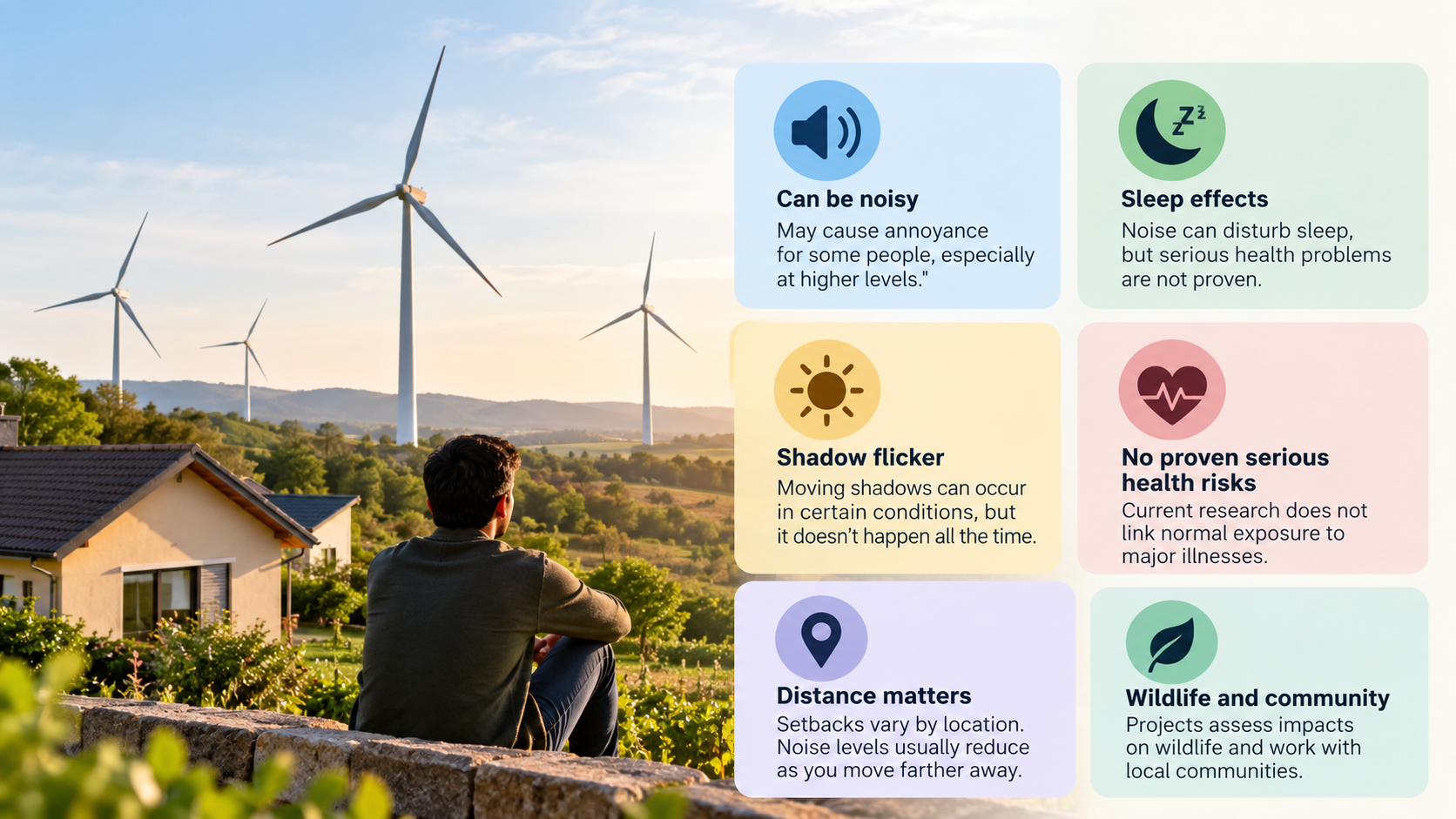
Living near wind turbines can change the surrounding soundscape and landscape. The most commonly reported concerns involve noise, annoyance, sleep disturbance, shadow flicker, and visual changes. These effects do not affect everyone equally, and measured health outcomes should be separated from personal complaints.
Wind turbine noise comes mainly from moving air around the blades and mechanical equipment. At sufficiently high exposure levels, environmental noise can contribute to annoyance and sleep disturbance. However, current evidence does not establish that ordinary wind turbine exposure directly causes serious physical illness. The U.S. Department of Energy states that sound at common residential setbacks is not sufficient to cause hearing impairment or other direct physical health effects.
Residents may also notice shadow flicker when rotating blades pass between the sun and a home. This effect occurs only under specific sunlight, turbine, and viewing conditions. Modern projects can model these conditions and use operational controls to reduce potential disruption.
Managing Shadow Flicker and Sleep Disruption
Shadow flicker happens when turbine blades periodically block sunlight and create moving shadows. The effect can be noticeable inside homes located in certain positions near a turbine. However, it does not occur continuously because sunlight angle, weather, turbine orientation, and operating conditions all affect it.
Health concerns about flicker often focus on photosensitive epilepsy. According to the U.S. Department of Energy, modern turbines generally rotate slowly enough that their shadow-flicker frequency remains below the flashing rate associated with seizure risk.
The more practical concern is visual annoyance or disruption. Developers can model potential flicker before construction and adjust turbine placement or operating schedules. Some projects can also temporarily shut down turbines during predicted periods of significant flicker.
Sleep disruption deserves separate attention. Environmental noise can interfere with sleep, and WHO recognizes noise as a public health concern. However, Health Canada’s wind turbine study did not find evidence supporting a relationship between wind turbine noise exposure and the measured health outcomes it examined.
How far away should you live from a wind turbine?
There is no single worldwide distance that guarantees a home is completely unaffected by a wind turbine. Setback requirements vary by jurisdiction, turbine size, local terrain, noise limits, and planning rules. Therefore, claims that everyone should live exactly half a mile or one to two miles away are too broad. For a comparison of wind and solar technologies, see Wind vs Solar Efficiency.
Instead, authorities generally use predicted noise levels and other site-specific factors when establishing appropriate setbacks. The U.S. Department of Energy notes that setback requirements are commonly determined by factors such as turbine size and local rules.
Distance still matters because sound levels generally decrease as you move farther from the source. However, terrain, wind direction, atmospheric conditions, and background noise can change the actual level experienced at a home.
WHO’s wind turbine guidance conditionally recommends reducing average exposure below 45 dB Lden. This is a population-level health recommendation rather than a universal property-line setback.
If you are considering property near a proposed wind farm, review the project’s noise assessment, setback rules, turbine specifications, and predicted shadow-flicker exposure before making a decision. If the project involves offshore development, you can also explore the future of offshore wind farms.
Understanding Decibel Drops Across Buffer Zones
Wind turbine sound becomes quieter as distance increases, but the reduction cannot be represented accurately with one fixed number for every project. Sound propagation depends on turbine output, atmospheric conditions, terrain, vegetation, wind direction, and the location of the listener.
For this reason, a turbine’s rated sound level cannot simply be converted into a guaranteed residential noise level by using distance alone. Developers normally use acoustic models to predict sound at nearby homes and property boundaries.
Background sound also matters. Traffic, farming equipment, insects, wind in trees, and other environmental sounds can mask or compete with turbine noise. Health Canada’s research found that wind turbine noise annoyance was lower where nighttime background noise exceeded turbine noise by at least 10 dB.
When assessing a property, focus on the predicted sound level at the home, rather than relying only on the distance from the turbine. Check both daytime and nighttime estimates because residents may perceive turbine noise differently after dark.
This approach provides a more reliable picture of potential exposure than using a universal mileage rule.
Do people live in wind turbines?
People do not normally live inside modern utility-scale wind turbines. These structures are industrial facilities designed to generate electricity rather than provide residential accommodation. Their towers contain equipment such as electrical cables, access systems, control equipment, and other components needed for operation and maintenance.
Technicians may enter turbine towers for inspections, repairs, and servicing. Access areas can include ladders, lifts, platforms, and confined workspaces. These areas are controlled because turbines contain electrical and mechanical hazards.
The idea of living inside a turbine is therefore very different from living near one. A nearby home remains a conventional residential property outside the turbine’s restricted operational area.
Historic windmills are a separate case. Some traditional windmills have been converted into homes or other buildings because their original structures can contain larger usable interior spaces. Modern utility turbines have a very different design and purpose.
So, when people ask is living near wind turbines safe, they are usually asking about residential exposure outside the turbine. The relevant issues are therefore noise, shadow flicker, visual effects, planning rules, and other environmental considerations rather than habitation inside the tower.
Repurposed Historic Windmills Versus Modern Utility Towers
Historic windmills and modern wind turbines may look related, but their structures serve very different purposes. Traditional windmills were often built with substantial masonry or timber interiors. Some have later been converted into homes, museums, restaurants, or other usable buildings.
Modern utility-scale turbines use tall steel or concrete towers to support large electrical-generating equipment. Their interiors contain maintenance equipment and industrial systems rather than rooms, plumbing, kitchens, or residential floors.
The difference also affects safety. Utility turbines contain electrical equipment, moving machinery, and restricted access areas. Only trained personnel should enter operational turbine structures.
This distinction matters because images of people inside historic windmills can sometimes create confusion online. A converted historic windmill does not demonstrate that a modern electricity-generating turbine can function as a residence.
For ordinary homeowners, the relevant question is not whether someone can live inside a turbine. It is whether their home’s location and exposure levels comply with local requirements and provide acceptable conditions for daily living.
What are three negative effects of wind turbines?
Wind energy can provide low-carbon electricity, but wind projects can also create environmental and community impacts. Three commonly discussed concerns are noise and annoyance, wildlife impacts, and changes to the landscape. For a broader comparison of clean-energy technologies, see green technology innovations.
First, turbine operation can create aerodynamic sound. Some nearby residents find the recurring sound annoying, particularly when local background noise is low. Research has shown that annoyance can increase with higher wind turbine noise exposure.
Second, turbines can affect wildlife. Birds and bats may collide with rotating blades, making wildlife monitoring and mitigation important parts of responsible wind project development. The U.S. Department of Energy identifies wildlife as one of the major issues considered when evaluating wind energy projects. These environmental considerations are also relevant when exploring the future of offshore wind farms.
Third, turbines change the appearance of rural landscapes. Tall towers, blades, access roads, and electrical infrastructure can alter scenic views and local character.
These effects vary by project. Careful site selection, monitoring, operational controls, and community planning can reduce some impacts.
Why are people so against wind turbines?
People oppose wind turbine projects for different reasons, and those reasons vary between communities. Common concerns include noise, visual changes, wildlife impacts, property values, and the character of rural areas. The U.S. Department of Energy identifies noise, shadow flicker, wildlife, property values, viewsheds, and community concerns among the issues associated with wind development. These concerns can also be considered alongside the broader role of renewable energy in fighting poverty.
Some residents may dislike the appearance of large turbines or believe they change the character of the landscape. Others may worry about noise or shadow flicker. Concerns about property values also appear in public debates, although research summarized by the Department of Energy has generally not found widespread, long-term effects on U.S. property values.
Community involvement can also influence acceptance. Residents may object when they feel project decisions limit opportunities for local input or distribute benefits and burdens unevenly.
Health concerns can increase opposition, especially when people encounter conflicting information online. Project developers and communities should therefore separate evidence from anecdotal reports.
Ultimately, whether a project is acceptable depends on local regulations, measured impacts, community priorities, and project-specific conditions rather than a single universal rule. These factors are part of the wider discussion surrounding clean energy costs and wind versus solar.
Frequently Asked Questions
Do wind turbines cause cancer or emit dangerous radiation?
If you ask, is living near wind turbines safe, current evidence does not show that wind turbines cause cancer or expose nearby residents to dangerous ionizing radiation. Electrical equipment produces non-ionizing electromagnetic fields.
What is wind turbine syndrome, and is it a recognized medical diagnosis?
When considering is living near wind turbines safe, “wind turbine syndrome” is not recognized as a specific medical diagnosis. Reported symptoms may involve sleep disturbance, annoyance, stress, or other factors.
How loud is a modern wind turbine from a typical residential distance?
For people asking is living near wind turbines safe, turbine noise depends on distance, design, wind conditions, and background sound. At nearby residential distances, measured levels can vary considerably.
Can blade failure or ice throw endanger nearby homes?
Another consideration when asking is living near wind turbines safe is physical safety. Blade failure and ice throw are uncommon, but they remain possible risks managed through turbine controls and appropriate setback requirements.
Conclusion
Determining whether living near modern wind infrastructure is truly safe requires balancing objective scientific data against real quality-of-life adjustments. Authoritative health reviews consistently show that properly sited turbines do not cause chronic illness, toxic exposure, or physiological diseases. However, the questions surrounding acoustic annoyance, shadow flicker, visual intrusion, and sleep interference are valid concerns that impact how neighbors experience their living spaces. Safe setbacks remain the key solution for minimizing friction between growing clean energy grids and local communities. When developers maintain generous buffers of half a mile or more, the vast majority of disruptive side effects disappear entirely. Armed with verified facts rather than speculation, homeowners and community planners can make informed, grounded decisions regarding wind power projects in their local areas.