
Atmospheric Light Scattering: Why Is the Sky Blue?
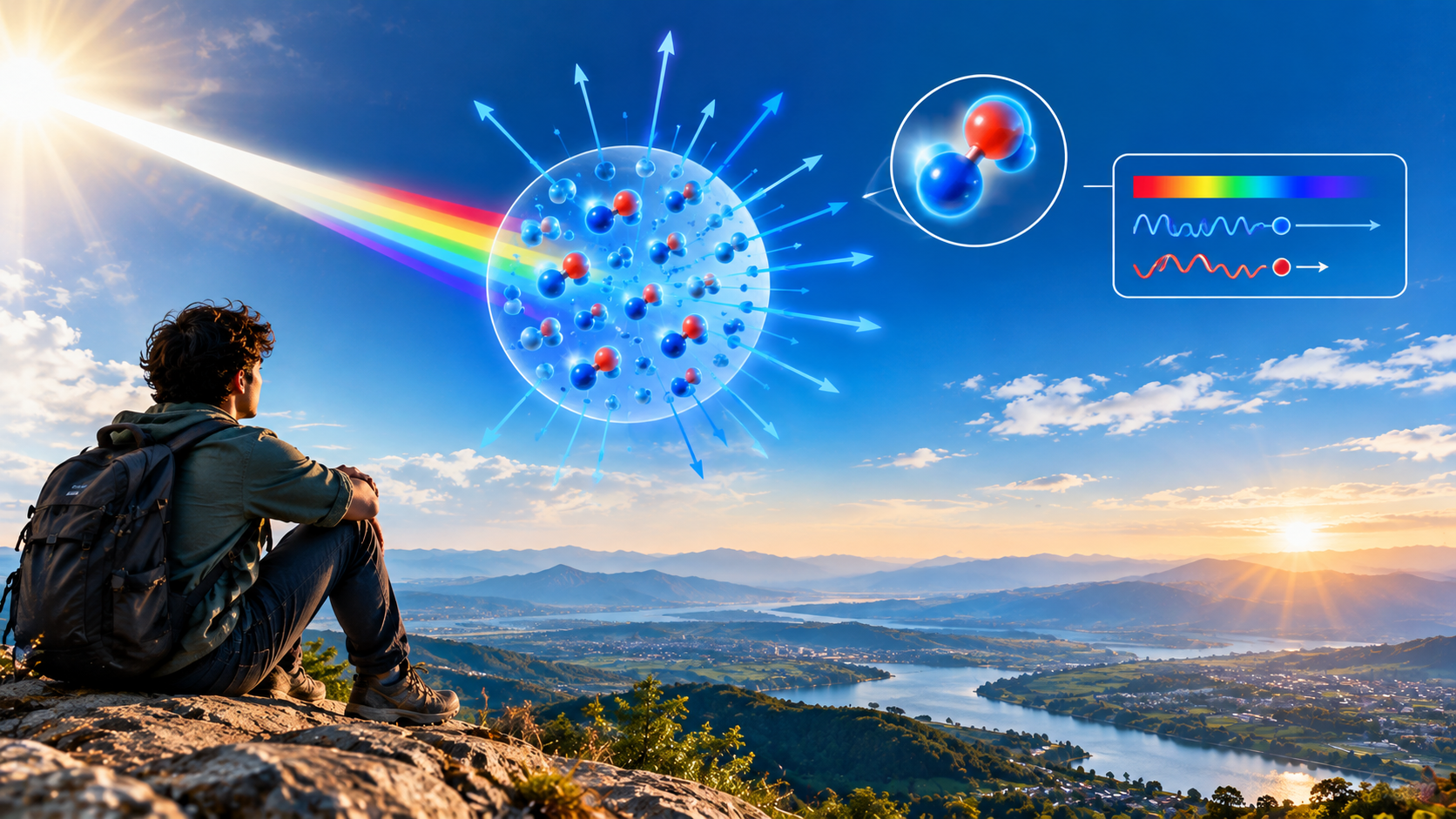
Have you ever looked at a clear afternoon sky and wondered why it appears blue? The answer lies in the physics of atmospheric light scattering. This optical process occurs when sunlight interacts with tiny gas molecules in Earth’s atmosphere. Sunlight may appear white, but it contains all the colors of the visible spectrum.
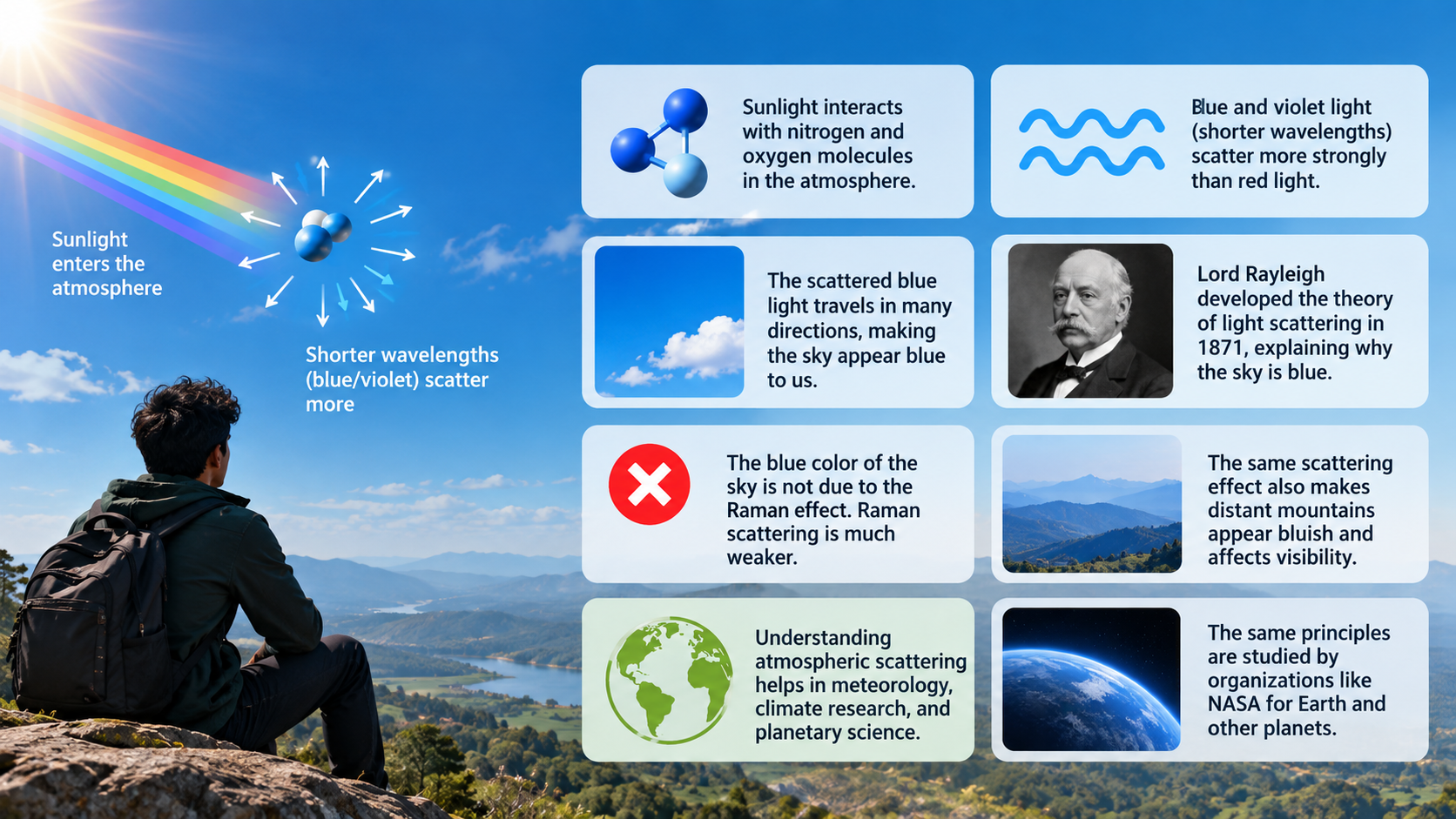
When sunlight enters the atmosphere, nitrogen and oxygen molecules interact with its different wavelengths. Shorter wavelengths, especially blue and violet, scatter more strongly than longer wavelengths such as red. This scattered light then travels in many directions, allowing us to see blue light across much of the sky.
Understanding this process helps explain more than the color of the sky. It also supports research in meteorology, atmospheric science, and planetary science. Organizations such as NASA study how light interacts with atmospheres on Earth and other worlds in our solar system.
In this guide, we will explore why the sky is blue, who explained the phenomenon, and how molecular scattering creates the colors we see.

Who discovered why the sky is blue?
Lord Rayleigh, born John William Strutt, provided the mathematical explanation for why the sky appears blue. In 1871, he developed a theory showing how very small particles can scatter light. His work helped explain why atmospheric gases can scatter sunlight even when the particles are much smaller than visible light wavelengths.
Earlier scientists, including John Tyndall, had investigated whether tiny particles in the atmosphere caused the blue appearance. Rayleigh showed that individual gas molecules could produce the effect without relying on dust or water droplets.
His work established the principle now known as Rayleigh scattering. The theory shows that shorter wavelengths scatter much more strongly than longer wavelengths. Blue light therefore spreads through the atmosphere more efficiently than red light.
Rayleigh’s work became an important part of optical physics. His broader contributions to physics earned him the 1904 Nobel Prize in Physics. His explanation of molecular light scattering remains fundamental to atmospheric science today.
Lord Rayleigh’s Mathematical Breakthrough
Rayleigh’s key contribution was a mathematical relationship between the intensity of scattered light and its wavelength. For particles much smaller than the wavelength of light, scattering intensity is approximately proportional to 1/λ⁴. Here, λ represents the wavelength of the incoming light.
This relationship explains why different colors do not scatter equally. Shorter wavelengths experience much stronger scattering than longer wavelengths. Blue light has a shorter wavelength than red light, so atmospheric molecules scatter blue light more effectively.
The difference becomes especially important when sunlight passes through Earth’s atmosphere. Nitrogen and oxygen molecules are small enough for Rayleigh scattering to dominate under clear-sky conditions.
This mathematical relationship also helps scientists understand other optical effects. It explains why distant mountains can appear bluish and why atmospheric conditions influence visibility.
Rayleigh’s calculations therefore provided more than an explanation for the blue sky. They created a general framework for understanding how light interacts with extremely small particles in gases.
Is sky blue due to Raman effect?
No. The dominant blue color of the daytime sky does not come from the Raman effect. The primary mechanism is Rayleigh scattering, which occurs when sunlight interacts elastically with atmospheric molecules.
The Raman effect involves inelastic scattering. During this process, a photon exchanges a small amount of energy with a molecule. The photon therefore changes its frequency or wavelength. Raman scattering produces characteristic spectral shifts that scientists can use to study molecular structures.
However, Raman scattering is extremely weak compared with ordinary atmospheric Rayleigh scattering. It does not produce enough scattered light to determine the overall color of a clear daytime sky.
Sir C. V. Raman made major contributions to the study of light scattering and discovered the Raman effect in 1928. His discovery became an important tool in spectroscopy.
The distinction matters because both processes involve light interacting with molecules. Their physical outcomes, however, are different. Rayleigh scattering dominates the visible blue sky, while Raman scattering produces much weaker frequency-shifted signals.
Elastic Versus Inelastic Molecular Collisions
Elastic and inelastic scattering differ mainly in what happens to a photon’s energy. In elastic scattering, the photon changes direction but retains essentially the same energy. Rayleigh scattering belongs to this category.
When sunlight enters Earth’s atmosphere, photons interact with nitrogen and oxygen molecules. These molecules temporarily respond to the electromagnetic field of the incoming light. The interaction redirects the light without producing a significant change in photon frequency.
Inelastic scattering works differently. During Raman scattering, some photon energy transfers to or comes from molecular vibrations. The scattered photon therefore leaves with a slightly different energy.
Scientists can measure these small energy changes through spectroscopy. Raman spectroscopy can reveal information about molecular composition and structure.
For the daytime sky, however, elastic Rayleigh scattering is far more important. It occurs much more frequently and produces the widespread blue light visible from the ground.
This distinction helps explain why the Raman effect does not account for the sky’s familiar blue appearance.
Why is the sky blue and not violet?
Violet light has a shorter wavelength than blue light, so Rayleigh scattering actually affects violet light even more strongly. This raises an obvious question: why does the sky look blue instead of violet?
Several factors contribute to the answer. First, sunlight does not contain equal amounts of energy at every visible wavelength. The amount of violet reaching the atmosphere is relatively small compared with nearby wavelengths.
Second, human vision does not respond equally to every color. Our eyes contain three main types of cone cells that respond most strongly to different ranges of wavelengths. Violet light stimulates the short-wavelength cones, but our visual system processes it differently from blue light.
Atmospheric absorption also reduces some of the shortest wavelengths before they reach an observer. As a result, the combination of solar output, atmospheric transmission, scattering strength, and human vision makes the sky appear predominantly blue.
Therefore, the answer is not simply that blue scatters more than violet. Violet actually scatters strongly, but several factors influence the color our eyes ultimately perceive.
Why is the sky blue short answer?
The sky looks blue because sunlight scatters through Earth’s atmosphere. Sunlight contains many visible wavelengths, including red, orange, yellow, green, blue, and violet.
When sunlight enters the atmosphere, it interacts with tiny nitrogen and oxygen molecules. These molecules scatter shorter wavelengths more strongly than longer wavelengths. Blue light therefore spreads across the atmosphere in many directions.
This process is called Rayleigh scattering, a specific form of atmospheric light scattering. Because the scattered blue light reaches our eyes from many parts of the sky, we see a broad blue background rather than only direct sunlight.
Red and orange wavelengths scatter less strongly. They therefore travel more directly through the atmosphere, especially when the Sun is high overhead.
The sky can change color when sunlight travels through more atmosphere. Near sunrise and sunset, shorter wavelengths scatter away from the direct path. More red and orange light can then reach the observer.
In simple terms, the sky appears blue because atmospheric molecules scatter blue wavelengths efficiently throughout the sky.
What is scattering of light and why does the sky appear blue?
Scattering occurs when light interacts with particles or molecules and changes direction. The process does not necessarily mean that the light disappears. Instead, the incoming radiation can spread into different directions.
Earth’s atmosphere contains mostly nitrogen and oxygen molecules. These molecules are much smaller than visible light wavelengths. Their size makes Rayleigh scattering particularly important under clear atmospheric conditions.
Rayleigh scattering affects shorter wavelengths much more strongly than longer wavelengths. Blue light therefore spreads throughout the atmosphere more effectively than red light.
When sunlight enters from above, some blue light travels sideways or downward after interacting with atmospheric molecules. An observer on the ground can then see this scattered light from many directions.
Direct sunlight contains all visible colors together, which makes it appear white or slightly warm. Scattered sunlight, however, becomes enriched in shorter wavelengths.
This process explains the blue appearance of a clear daytime sky. It also explains why atmospheric conditions can change sky colors. Dust, smoke, pollution, and larger particles can introduce additional scattering mechanisms.
Thus, atmospheric light scattering connects the microscopic behavior of molecules with the large-scale appearance of the sky and helps explain how different atmospheric layers interact with sunlight.
Particle Size and Wavelength Interaction
The size of atmospheric particles strongly influences how they scatter light. Rayleigh scattering becomes important when the particles are much smaller than the wavelength of visible light.
Nitrogen and oxygen molecules fit this condition. They interact with sunlight in a way that strongly favors shorter wavelengths. Blue and violet light therefore scatter much more efficiently than red light.
Larger particles behave differently. Dust, smoke, water droplets and clouds, and other aerosols can scatter several wavelengths more evenly. This type of scattering can make the sky look white, gray, hazy, or less intensely blue.
Particle size also helps explain why atmospheric conditions affect visibility. Clean air contains relatively few larger particles, allowing Rayleigh scattering to dominate. Hazy air contains more aerosols, which can change the balance of scattered light.
The wavelength-to-particle-size relationship is therefore central to atmospheric optics. It determines which scattering mechanism becomes important under particular conditions.
By studying these interactions, scientists can better understand atmospheric light scattering, visibility, aerosols, and the changing colors of Earth’s atmosphere.
Frequently Asked Questions
Why does the sky turn red and orange during sunset?
At sunrise and sunset, sunlight travels through a much thicker layer of atmosphere before reaching your eyes. This extended path scatters away almost all short blue and violet wavelengths long before they reach the ground. The longer wavelengths, primarily red and orange, pass through the air with minimal dispersion, painting the horizon in vivid warm tones.
What color would the sky be without an atmosphere?
Without an atmosphere, the sky would appear completely black, even in broad daylight. In a vacuum, there are no air molecules or microscopic particles to deflect or bounce incoming photons. The sun would resemble an intensely bright star shining against an inky black backdrop, exactly as astronauts witness from lunar orbit or deep space.
Why do clouds appear white instead of blue?
Clouds consist of water droplets and ice crystals that are much larger than individual light wavelengths. Instead of scattering light via Rayleigh scattering, they undergo Mie scattering, which disperses all visible wavelengths equally. Because red, green, and blue wavelengths scatter in equal measure, the combined light appears clean white to the human eye.
Conclusion
Understanding atmospheric light scattering reveals how the basic laws of physics shape our daily sensory experience. The bright blue sky is not a static ceiling, but rather a dynamic optical display produced by solar radiation colliding with billions of nitrogen and oxygen molecules. Through elastic Rayleigh dispersion, tiny atmospheric particles constantly redirect short blue wavelengths across the upper atmosphere, illuminating our world with natural color.
We also discover how human biology works hand-in-hand with environmental physics. Even though violet light scatters with greater intensity, our eyes combine solar emission limits with trichromatic cone sensitivity to perceive a sky of brilliant blue. From Lord Rayleigh’s early mathematical proofs to modern satellite tracking, atmospheric dispersion remains central to optical research.
The next time you step outside on a sunny afternoon, take a moment to look upward. You are watching high-speed physics and molecular collisions play out in real time across the horizon.