

Drawing to Learn: The Essential Guide to Building Visual Skills
Can putting pencil to paper change how you think, process information, and see the world? Drawing to learn is more than an artistic activity. It can support comprehension, observation, memory, and creative problem-solving. The National Art Education Association highlights the importance of visual literacy in education. Visual learning can help students develop skills such as critical thinking, spatial awareness, and visual communication.
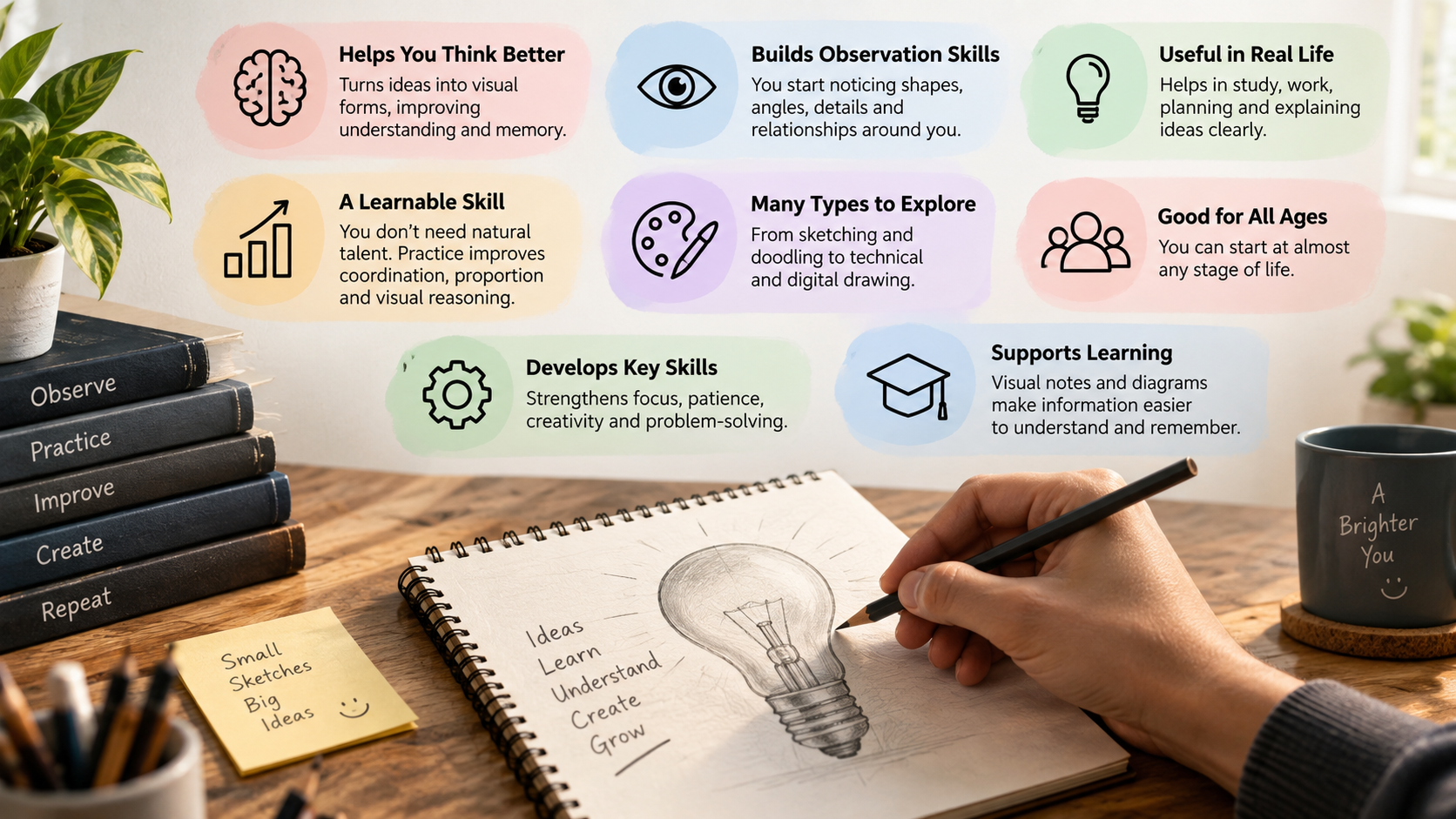
When you sketch, you combine visual attention with physical movement and conceptual thinking. This active process can make information easier to understand and remember. Drawing can also help you turn abstract ideas into simple visual forms.
Many people assume that good drawing requires natural talent. In reality, drawing involves trainable skills. Practice can improve observation, coordination, proportion, and visual reasoning.
Whether you want to create visual notes, explain ideas, or explore creativity, sketching can be useful. This guide explores the value of drawing to learn, the seven major drawing types, the best age to start, and its potential cognitive benefits.

Is it possible to learn drawing?
Yes, it is possible to learn drawing at almost any stage of life. Many people believe artistic ability is something you either have or lack. However, drawing involves practical skills that can improve through structured practice. These include hand-eye coordination, observation, proportion, shape recognition, and control of lines.
When you practice drawing, you gradually learn to notice details that you might previously ignore. You begin comparing angles, distances, shapes, shadows, and negative spaces. These skills become stronger with repeated observation and feedback.
Learning drawing is similar to developing other practical abilities. You do not need to master everything at once. Start with basic shapes, simple objects, and short observational exercises. Over time, these exercises can build a stronger visual foundation alongside best study techniques backed by science.
Drawing to learn also changes how you interact with information. Instead of only reading or listening, you actively interpret and represent what you see. This makes drawing useful for both creative projects and educational tasks.
Developing the Perceptual Skillset
Learning to draw is largely about learning to observe accurately. Beginners often draw what they think an object should look like. Skilled observation requires noticing what is actually in front of you.
Focus on the object’s contours, proportions, angles, textures, and relationship to surrounding space. Try breaking complicated subjects into basic shapes before adding details. This approach makes unfamiliar subjects easier to understand.
Regular observational practice can gradually improve your ability to identify visual relationships. You may notice differences in size, alignment, lighting, and perspective more quickly.
Simple exercises can help develop these abilities:
- Draw everyday objects from different angles.
- Compare proportions before adding details.
- Practice positive and negative space.
- Sketch objects using basic geometric shapes.
- Study light and shadow through simple forms.
These exercises make drawing less dependent on guesswork. They also strengthen the observation skills needed for effective drawing to learn.
Is drawing a good skill to learn?
Drawing is a useful skill for personal, academic, and professional development. Its value extends beyond creating finished artwork. A quick sketch can explain a structure, process, layout, or relationship more clearly than a long verbal explanation.
Architects and engineers use drawings to explore physical structures. Designers sketch ideas before developing polished solutions. Teachers and students can use diagrams to simplify complicated concepts. Even people without artistic careers can use simple drawings for planning and communication, especially when exploring free tools for aspiring designers.
Drawing to learn can be particularly useful when information involves relationships, processes, shapes, or spatial concepts. Creating a visual representation requires you to decide what information matters most. That process can encourage deeper engagement with the subject and complement best productivity systems for students.
Drawing also provides a focused activity away from digital screens. It can encourage patience and deliberate attention. However, its benefits depend on how you use it. Drawing alone does not automatically improve learning. The activity works best when the sketch represents meaningful information and supports active thinking.
Enhancing Everyday Visual Communication
Visual communication can make complicated ideas easier to discuss. A basic diagram can show relationships that may take several sentences to explain. This makes sketching useful during meetings, planning sessions, lessons, and creative projects.
You do not need advanced artistic ability to communicate visually. Simple shapes, arrows, labels, and symbols can often provide enough information. The goal is clarity rather than artistic perfection, particularly when using free tools for aspiring designers.
For example, you could sketch:
- A workflow to explain a business process.
- A layout to plan a website or room.
- A diagram to explain a technical system.
- A timeline to organize project stages.
- A concept map to connect related ideas.
This approach turns drawing to learn into a practical communication method. You can use quick visual notes while studying or working.
The most useful visual communication is usually simple and purposeful. Remove unnecessary details and highlight the relationships that matter. When the viewer understands the idea quickly, the drawing has achieved its purpose.
What are the 7 types of drawing?
The seven foundational types of drawing represent different purposes and approaches. They include observational, contour, gestural, tonal or value, perspective, technical, and expressive or conceptual drawing.
Observational drawing involves studying a real subject and representing what you see. Contour drawing focuses mainly on edges and outlines. Gesture drawing captures movement, posture, and overall action quickly.
Tonal or value drawing focuses on light and dark areas. It helps artists understand form, depth, and lighting. Perspective drawing uses visual rules to create the appearance of three-dimensional space on a flat surface.
Technical drawing prioritizes accuracy, measurements, and clear representation. It is commonly used in fields such as engineering, architecture, and design. Expressive or conceptual drawing focuses more on ideas, emotions, imagination, or personal interpretation.
Learning these categories can broaden your visual vocabulary. You do not need to master all seven immediately. Choose techniques that match your goals and use drawing to learn as a practical way to explore each approach.
What is the best age to learn drawing?
There is no single best age to learn drawing. You can begin as a child, teenager, adult, or older learner. Starting early can help children develop fine motor control, hand-eye coordination, and spatial awareness through regular creative activities.
Adults can also make strong progress. They often bring patience, analytical thinking, and clearer learning goals to practice. These qualities can help them understand proportion, perspective, composition, and shading.
The important factor is not age alone. Consistent practice, useful feedback, and appropriate exercises have a greater influence on progress. A beginner who practices regularly can develop stronger skills than someone who has natural ability but rarely practices.
Drawing to learn can also fit different learning stages. Children may use pictures to explore ideas and describe experiences. Students can sketch diagrams and visual notes alongside student choice in learning. Adults can use drawings for planning, studying, communication, or creative projects.
Instead of waiting for the perfect age, start with manageable exercises. A few minutes of focused practice can gradually build confidence and visual ability.
The Clear Advantages of Adult Learners
Adult learners can approach drawing with deliberate goals and structured practice. They can identify specific weaknesses and choose exercises that address them. This can make practice more focused than simply drawing without a clear objective.
Adults may also understand abstract concepts more easily. Perspective, proportion, anatomy, composition, and lighting can be studied through rules and visual analysis. They can compare examples, follow demonstrations, and evaluate their own work.
However, adult learners also face challenges. Work, family responsibilities, and limited practice time can make consistency difficult. Many adults also judge their early drawings harshly. This can discourage experimentation and slow progress.
A practical approach is to set small goals:
- Practice one skill at a time.
- Keep sessions short and consistent.
- Compare progress over several weeks.
- Study mistakes instead of hiding them.
- Use references when learning unfamiliar subjects.
With this approach, drawing to learn becomes a structured skill-building activity. Progress does not require perfect drawings. It requires repeated observation, experimentation, correction, and practice.
Is drawing mentally stimulating?
Drawing can be mentally stimulating because it requires several forms of attention at once. While sketching, you may need to observe shapes, estimate proportions, control hand movements, remember visual information, and make decisions about what to include.
This combination makes drawing an active task rather than a passive activity. Research on drawing and memory has also explored whether generating images can improve recall compared with simply reading information. The effect can vary depending on the task and learning conditions.
Drawing may also require sustained concentration. When you focus closely on a subject, you temporarily reduce attention to unrelated distractions. Some people find this focused activity relaxing, although drawing should not be treated as a guaranteed treatment for stress or mental health conditions.
Drawing to learn can therefore support active engagement with information. Sketching a scientific process, historical timeline, object, or concept requires you to interpret the material.
The cognitive value comes from the thinking involved. A meaningful drawing can help you organize, connect, and represent information rather than simply copy it.
Overall, drawing is both a creative and cognitive activity. Its benefits depend on purposeful practice and how effectively you connect the drawing with what you are trying to understand.
Frequently Asked Questions
How many hours a day should a beginner practice sketching?
Beginners achieve the best results by practicing for 20 to 30 minutes daily rather than attempting long, exhausting weekend sessions. Short, consistent practice sessions establish muscle memory and build steady hand-eye coordination without causing mental burnout or wrist fatigue. Focused, intentional exercises like drawing clean lines, simple geometric forms, and everyday household items yield rapid, noticeable progress within just a few weeks.
What basic supplies do I need to start sketching?
You only need a standard graphite pencil, an inexpensive sketchbook, and a soft eraser to begin. Avoid spending large amounts on high-end art supplies early on. A simple HB or 2B pencil allows you to explore linework and basic shading easily. Keeping your kit minimal reduces intimidation and makes it effortless to practice anywhere, anytime inspiration strikes.
Do digital tablets make it easier to practice drawing?
Digital tablets offer handy conveniences like instant undo buttons, layered canvases, and customizable brush textures. However, they do not automatically make learning the craft easier. The underlying artistic rules—such as perspective, anatomy, proportion, and tonal value—remain identical across traditional paper and digital screens. Beginners should focus on solid fundamentals regardless of whether they choose physical sketchbooks or digital styluses.
Conclusion
Embracing drawing to learn opens up a powerful channel for clear communication, deeper cognitive focus, and creative self-expression. As we have seen, artistic skill is not an innate gift reserved for a fortunate few; it is a learned language built through consistent observation and deliberate practice. Whether you explore dynamic gesture sketches, precise perspective systems, or relaxing observational studies, every mark on the page strengthens your mind.
Age presents no barrier to picking up a sketchbook. Adults bring analytical maturity and structured determination that make visual study deeply rewarding and remarkably swift. Beyond producing beautiful artwork, regular sketching sharpens mental acuity, reduces everyday stress, and transforms how you perceive the world around you.
Commit to setting aside a few minutes each day to put pencil to paper. Start sketching the simple objects around your desk, practice seeing shapes without judgment, and enjoy the rich cognitive rewards that come with lifelong visual discovery.