

Understanding Modern Asset Allocation Strategies for Beginners
Stepping into the world of investing can feel overwhelming without a clear roadmap. Modern asset allocation strategies help beginners divide their money across various asset classes to balance potential risks and rewards. Understanding how to distribute your capital correctly is essential for long-term financial growth and stability. Whether you are building your first portfolio from scratch or refining an existing plan, knowing the right frameworks makes all the difference. This comprehensive guide answers critical questions about Warren Buffett’s 90/10 rule, the 40-40-20 rule, Harry Markowitz’s Modern Portfolio Theory, the 70/30 strategy, and other primary types of asset allocation strategies. For official regulatory context on financial markets and investor protection, you can visit the U.S. Securities and Exchange Commission. By exploring these time-tested methods, you will gain the knowledge needed to make confident, informed investment decisions that align with your personal financial goals.


What Is Warren Buffett’s 90/10 Rule?
Warren Buffett’s 90/10 rule is a simple investment strategy for people who prefer a hands-off approach to building wealth. Buffett has recommended that the trustee of his estate invest 90% of the cash designated for his wife in a very low-cost S&P 500 index fund. The remaining 10% should go into short-term U.S. government bonds. The idea is to avoid stock picking, market timing, and unnecessary fund-management costs.
A 90/10 portfolio puts most assets in equities, giving investors broad exposure to large U.S. companies and their long-term growth potential. The bond allocation adds a modest layer of stability and liquidity during market declines. However, this strategy can still experience substantial losses because 90% remains invested in stocks.
The approach rests on three principles: low costs, broad diversification, and long-term discipline. It is simple, but it is not suitable for every investor or every time horizon.
Why Low-Cost Index Funds Drive the Strategy
Low-cost index funds are central to Buffett’s 90/10 approach because fees directly reduce investment returns. Even small annual expenses can compound into a meaningful difference over several decades. An index fund also removes the need to identify individual stocks or predict which companies will outperform, which is particularly relevant when comparing FD and mutual fund returns.
An S&P 500 index fund provides exposure to leading U.S. companies across multiple industries. This broad exposure reduces the impact of a single company performing poorly. However, diversification does not eliminate market risk, and the fund remains concentrated in U.S. large-cap stocks.
The main benefits of low-cost index investing include:
- Lower fees: More of the portfolio’s return stays invested.
- Broad diversification: One fund can provide exposure to many companies.
- Simplicity: Investors do not need to research individual stocks.
- Consistency: The fund follows a defined market index instead of relying on manager decisions.
For long-term investors, controlling costs can be more dependable than trying to beat the market.
What Is the 40/40/20 Rule in Investing?
The 40/40/20 rule in investing is a portfolio allocation framework that divides capital among three broad buckets. However, there is no single, universally accepted 40/40/20 formula. One common interpretation uses 40% large-cap domestic equities, 40% international or growth-oriented assets, and 20% fixed-income securities or cash equivalents.
The purpose is to spread risk across different asset classes and geographic exposures. The equity portions provide most of the portfolio’s growth potential, while the 20% defensive allocation can provide stability and liquidity during difficult markets.
This framework can help investors maintain discipline because it creates clear target weights. Still, the right allocation depends on factors such as:
- Risk tolerance
- Investment horizon
- Financial goals
- Need for near-term cash
- Tax considerations
Investors should also remember that international, growth, and fixed-income assets carry different risks. A fixed allocation does not guarantee profits or prevent losses.
Balancing Risk Through Strategic Capital Splits
Balancing risk through strategic capital splits requires investors to monitor their target allocation and rebalance when necessary. Rebalancing means bringing the portfolio back toward its intended percentages after market movements cause them to drift.
For example, suppose an investor starts with 40% domestic equities, 40% international or growth assets, and 20% bonds or cash. If stocks rise sharply, equities may become a much larger share of the portfolio. The investor could then sell some of the overweight assets and add to the underweight allocation.
This process can help maintain the portfolio’s intended risk level. It can also create a disciplined pattern of trimming assets after strong performance and adding to assets that have fallen.
Many investors review their allocation once or twice a year instead of making frequent changes. The key is to follow a clear rule instead of reacting emotionally to market headlines. Rebalancing should also account for taxes, transaction costs, and the investor’s circumstances.
What Is Harry Markowitz’s Modern Portfolio Theory?
Harry Markowitz’s Modern Portfolio Theory (MPT) is a foundational framework for understanding how diversification can improve portfolio construction. Markowitz introduced the theory in 1952, arguing that investors should evaluate each holding by how it affects the risk and return of the entire portfolio.
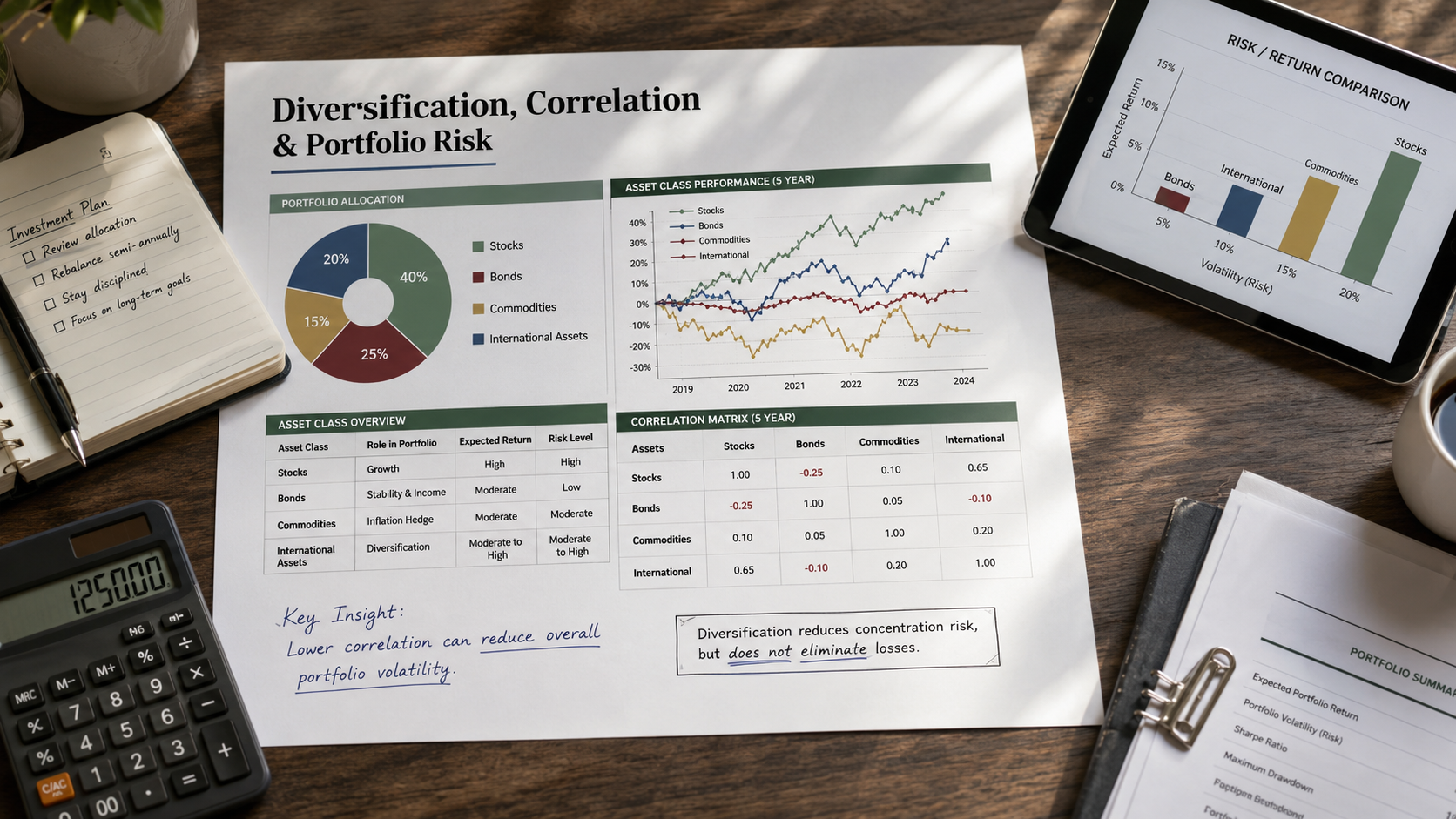
An asset with high individual volatility may still improve a portfolio if its returns do not closely track the portfolio’s other holdings. Combining assets with different correlations can therefore reduce overall portfolio volatility. Stocks and bonds are a common example, although their relationship can change over time.
MPT introduced the concept of the efficient frontier. It represents portfolios that aim to provide the highest expected return for a given level of risk.
The theory does not promise a specific return or eliminate losses. Instead, it provides a framework for thinking about diversification, correlation, expected returns, and risk. Its central lesson is that portfolio construction matters, not just individual security selection.
Understanding Asset Correlation in Portfolio Construction
Asset correlation measures how closely two investments tend to move relative to each other over time. Correlation ranges from -1 to +1. A correlation near +1 means two assets tend to move together, while a correlation near -1 indicates opposite movements.
This concept matters because combining assets with lower correlations can reduce portfolio volatility. If one investment falls while another remains stable or rises, the overall portfolio may experience a smaller decline than a concentrated portfolio.
Relationships between stocks, bonds, commodities, and international markets can change during different economic environments. Assets that appeared diversified in one period may move together during a severe market shock.
Investors should therefore avoid assuming that diversification guarantees protection. Asset correlation is one tool for evaluating investment relationships, alongside liquidity, valuation, credit risk, and investment horizon. This makes correlation especially important when designing a diversified investment portfolio.
What Is a 70/30 Investment Strategy?
A 70/30 investment strategy allocates 70% of a portfolio to growth-oriented assets, usually stocks, and 30% to more conservative assets, such as bonds or cash equivalents. For investors evaluating different ways to build wealth, understanding how FD and mutual fund returns compare can also help when considering the role of conservative and growth-oriented assets.
The 70% equity allocation gives the portfolio substantial exposure to corporate earnings and economic growth. The 30% defensive allocation can provide income, liquidity, and some diversification when stock markets decline. However, the bond portion does not guarantee that the portfolio will avoid losses.
A 70/30 portfolio may suit investors who want meaningful growth but do not want the full volatility of an all-stock portfolio. It can also serve as a starting framework for investors with a medium- or long-term horizon.
Still, there is no universal “correct” allocation. Investors should consider:
- Time horizon
- Risk capacity and tolerance
- Income needs
- Financial goals
- Other assets and liabilities
The allocation should fit the investor.
Choosing the Right Mix for Your Timeline
Choosing the right 70/30 mix depends heavily on your investment timeline and financial goals. An investor with several decades before needing the money may have enough time to recover from major stock-market declines. Someone approaching retirement may have less time to recover and may need greater portfolio stability, making retirement planning across different ages an important consideration.
A 70/30 allocation can reduce equity exposure compared with a 100% stock portfolio, but it can still experience meaningful losses during severe market downturns.
Your decision should consider more than age alone. Think about when you will need the money, how much income you require, and whether you could stay invested during a major decline.
As a goal approaches, some investors gradually increase their allocation to bonds or cash. Others keep a consistent allocation and rebalance regularly. The right approach depends on the goal and the investor’s ability to tolerate volatility. Regular reviews can keep the allocation aligned with changing needs.
Types of Asset Allocation Strategies
Types of asset allocation strategies differ mainly in how actively investors adjust their portfolio weights. Strategic asset allocation sets a long-term target mix and periodically rebalances back to those targets.
Tactical asset allocation allows temporary changes from the target mix when an investor expects certain opportunities or risks. Constant-weighting strategies maintain target percentages through regular rebalancing. Insured asset allocation focuses on maintaining a portfolio floor and increasing defensive positioning if the portfolio approaches that level.
Dynamic asset allocation changes portfolio weights more actively as market conditions, valuations, or economic factors change.
Each method has trade-offs:
- Strategic: Simple and disciplined.
- Tactical: Flexible but more difficult to execute.
- Constant-weighting: Systematic but requires regular monitoring.
- Insured: Focuses on protecting a minimum value.
- Dynamic: Responsive but more dependent on forecasts.
No strategy guarantees better returns. The choice should match the investor’s objectives and capacity for risk.
Selecting the Best Strategy for Your Goals
Selecting the best asset allocation strategy depends on your goals, risk tolerance, time horizon, and ability to manage the portfolio.
Beginners may prefer strategic asset allocation because it provides clear target percentages and reduces the temptation to react to short-term market movements. A diversified mix of stock and bond funds can be easier to maintain than a portfolio requiring frequent decisions.
More experienced investors may consider tactical or dynamic approaches. These methods require more research, monitoring, and discipline. Incorrect forecasts can reduce returns and increase risk.
Before choosing a strategy, consider:
- When you need the money
- How much loss you can financially tolerate
- How much volatility you can emotionally tolerate
- Whether you need regular income
- How often you are willing to review the portfolio
The best strategy is usually one you can maintain through both strong markets and severe downturns.
FAQ SECTION
How Often Should I Rebalance My Investment Portfolio?
You should generally review and rebalance your portfolio once or twice a year, or when an asset class moves significantly away from its target allocation. A common guideline is a 5% deviation, but there is no universal threshold. Rebalancing helps maintain your intended risk level and supports disciplined Modern Asset Allocation Strategies. Avoid making frequent changes because of short-term market movements, which can increase costs and encourage emotional decisions.
Is Asset Allocation More Important Than Stock Picking?
For most long-term investors, asset allocation is more important than trying to select individual winning stocks. Your mix of stocks, bonds, and other assets strongly influences your portfolio’s overall risk and return characteristics. Modern Asset Allocation Strategies emphasize diversification rather than relying on a few successful investments. Stock picking can produce higher returns, but it also creates concentration risk and requires significant research. A diversified allocation provides a more systematic approach to managing investment risk.
Can Beginners Start Investing With a Small Amount of Money?
Yes, beginners can start investing with relatively small amounts of money. Many investment platforms provide fractional shares, while low-cost index funds and ETFs can offer diversified exposure without requiring a large initial investment. Modern Asset Allocation Strategies can be adapted to smaller portfolios by using broad, low-cost funds. Starting early can also matter more than starting with a large amount because consistent contributions and long-term compounding can gradually build wealth.
What Is the Difference Between Stocks and Bonds in a Portfolio?
Stocks represent ownership in companies and generally offer greater long-term growth potential, but they also experience higher price volatility. Bonds represent loans to governments or companies and typically provide interest income while offering different risk characteristics from stocks. Modern Asset Allocation Strategies often combine both assets to balance growth and stability. Stocks can drive long-term capital appreciation, while high-quality bonds may provide income, diversification, and liquidity during periods of market stress.
Conclusion
Understanding Modern Asset Allocation Strategies can help investors build portfolios that match their goals, time horizons, and risk tolerance. Warren Buffett’s 90/10 rule, the 40/40/20 framework, Markowitz’s Modern Portfolio Theory, and the 70/30 strategy illustrate different approaches to diversification. None guarantees profits or eliminates investment risk. The most important step is choosing an allocation you can maintain through market ups and downs. Focus on reasonable diversification, low costs, regular reviews, and disciplined rebalancing. Modern Asset Allocation Strategies work best when applied consistently rather than changed whenever markets become uncertain. For beginners, starting with a simple portfolio and gradually increasing contributions can provide a practical foundation for long-term retirement planning.