
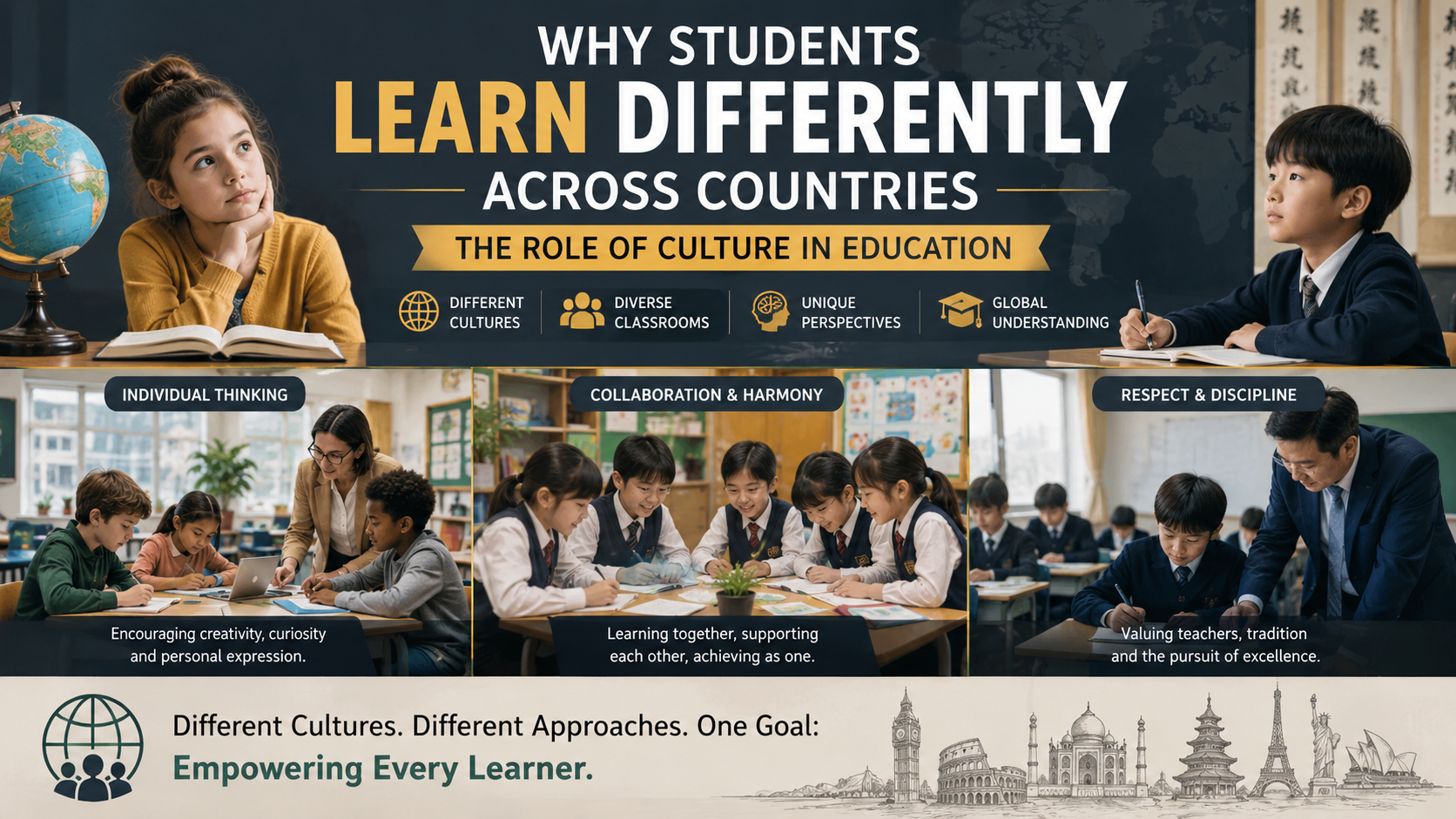
Why Students Learn Differently Across Countries: The Role of Culture in Education
Walk into a classroom in Tokyo. You will likely see students sitting quietly and listening intently. Now, walk into a classroom in Helsinki. Here, you might find students collaborating in groups and moving freely. These striking differences are not accidental or superficial. The role of culture in education deeply influences how societies define success. It structures classrooms and dictates how students should behave. According to global research frameworks published by the UNESCO International Bureau of Education, educational systems naturally reflect a nation’s core values, history, and social norms.
Understanding these differences matters immensely because our world is increasingly interconnected. Cross-cultural communication is now vital for global progress. When we look at global schooling through a cultural lens, we stop labeling systems as simply “better” or “worse.” Instead, we see how deeply rooted expectations shape young minds from an early age. This article explores how distinct cultural dimensions directly impact global learning styles, classroom dynamics, and student well-being. By analyzing these factors, we can better appreciate the vast tapestry of global knowledge.
How the Cultural Environment Shapes Global Teaching Styles
Culture dictates what society values most. These deeply held values directly guide how teachers approach their daily instruction. In many Western nations, the educational framework prioritizes personal autonomy, self-discovery, and critical thinking. Teachers design lessons that actively encourage students to question assumptions. They want students to debate ideas openly and find unique solutions to complex problems. In this setup, the educator acts less like an absolute authority figure. Instead, they serve as a facilitator of knowledge, guiding students along their unique learning journeys. This method aims to foster independent thinkers who feel comfortable challenging old ideas.
Conversely, many Eastern cultures approach the classroom experience through a different lens. They prioritize shared responsibility, deep respect for tradition, and foundational mastery. The academic emphasis often rests entirely on absorbing a core body of knowledge before attempting to innovate or critique. Consequently, teachers focus heavily on lecture-style instruction, repetitive practice, and deep memorization techniques. Both methods have distinct strengths, but they stem from fundamentally different cultural philosophies regarding the ultimate purpose of learning. One prioritizes individual exploration, while the other builds an ironclad foundation through structured guidance and rigorous repetition.
Individualism vs. Collectivism: Diverse Cultural Approaches to Learning
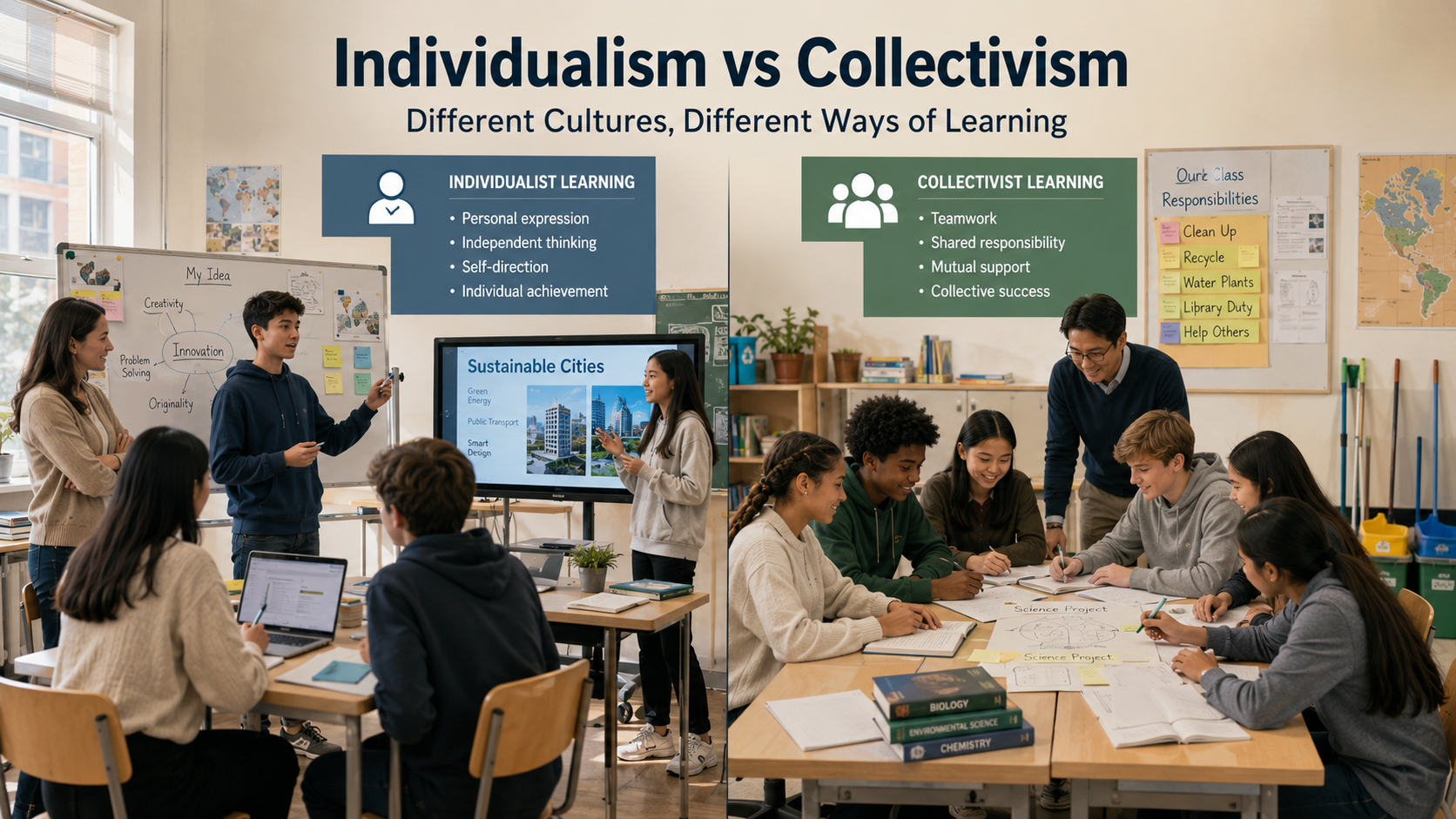

The tension between individualist and collectivist cultures creates entirely different classroom environments. Individualist classrooms are common in countries like the United States, Canada, and the United Kingdom. These systems celebrate unique student achievements and personal expression above all else. Teachers regularly encourage students to speak up and express unique personal opinions during class discussions. Grading systems often rank students individually. This approach naturally promotes a sense of personal ambition and healthy competition among classmates.
In sharp contrast, collectivist classrooms focus heavily on group harmony, mutual support, and collective success. You can see this clearly in countries like Japan, China, and South Korea. From a young age, students learn to work collaboratively and assist struggling peers. They avoid drawing unnecessary individual attention to themselves. Personal pride is minimized in favor of group achievement. Classrooms often function as tight-knit communities where duties like cleaning and serving lunch are shared equally. In these environments, people view mistakes as a collective learning opportunity for the whole class rather than an embarrassing individual failure.
Classroom Dynamics: The Role of Culture in Education and Authority
Another major variable in global schooling is how different societies view authority and social hierarchy. The role of culture in education becomes incredibly clear when analyzing how comfortably a specific country accepts unequal distributions of power. This dynamic directly impacts how students interact with their educators on a daily basis. In cultures that maintain a high respect for strict hierarchy, such as Singapore, India, or Malaysia, teachers hold absolute authority. Students AI-generated naturally rarely question a teacher’s statements, and they consider challenging an educator’s viewpoint highly disrespectful. The flow of information is strictly one-way, creating an environment of strict discipline.
However, cultures that favor equality, like Denmark, Norway, or Sweden, present a completely different picture. Here, teachers and students interact almost as equals. Students freely critique complex ideas and debate openly with their instructors. They even participate actively in shaping their own weekly curriculum. Students often address teachers by their first names, which breaks down traditional barriers to communication. This relaxed dynamic encourages students to speak their minds without fear, fostering confidence and early democratic participation. However, it can also lead to classrooms that feel chaotic to outside observers who are accustomed to strict hierarchical boundaries.
Academic Failure vs. Academic Honor: Cultural Pressures on Students
Culture also governs how students handle academic setbacks, mistakes, and low grades. In many East Asian cultures, academic success is tied directly to filial piety, family honor, and societal expectations. A poor grade is not just a personal disappointment. It can bring immense shame to a student’s entire family, creating a high-pressure environment from early childhood. This intense fear of failure drives exceptionally high test scores and unmatched dedication. However, it also increases psychological stress and anxiety among youth. Success is viewed as the result of hard work and duty, leaving little room for error.
In contrast, many modern Western educational systems adopt a popular philosophical mentality known as “failing forward.” Teachers actively reframe mistakes as natural, healthy, and necessary steps in the lifelong learning process. They do not view errors as final verdicts on a student’s intelligence. While this compassionate approach successfully reduces academic anxiety and builds emotional resilience, it has drawbacks. It can sometimes result in less rigorous study habits. Without the pressure of social shame or strict familial expectations, some students may lack the driving motivation required to master complex material.
Comparing Educational Traditions: Rote Learning vs. Active Application
The ongoing global debate between traditional rote memorization and hands-on, interactive learning is deeply rooted in cultural preferences. Over the past few decades, Western educational systems have largely shifted toward project-based learning models. Educators in these systems believe that students understand complex concepts much better when they actively apply them to real-world scenarios. Students build physical models or work in teams to solve open-ended problems. The goal is to develop practical problem-solving skills and creativity, even if it means covering fewer topics over the course of the academic school year.
However, many Eastern educational systems view rigorous rote memorization as a mandatory foundation for higher-level critical thinking. You cannot creatively solve a complex mathematical or scientific problem, they argue, until you have memorized the underlying formulas perfectly. This cultural divergence explains why international standardized tests often show vast differences in performance based on the specific types of questions asked. Eastern students frequently dominate tests focused on math facts and formula application. Meanwhile, Western students sometimes excel in open-ended assessments requiring creative synthesis, proving that both methodologies develop entirely distinct cognitive strengths.
Frequently Asked Questions
What is the role of culture in education?
The role of culture in education refers to how a society’s shared values, deeply held beliefs, historical traditions, and social norms fundamentally shape its schooling system. Culture serves as the invisible blueprint that influences everything from teaching methodologies and classroom discipline to how students interact with teachers and view academic success. For example, a collectivist culture will naturally focus on group harmony, mutual cooperation, and shared responsibility within the school environment.
Conversely, an individualist culture will prioritize personal expression, unique creativity, and independent achievement above group cohesion. Because education prepares children to become successful adults within their specific society, a country’s school system will always mirror the cultural priorities of the broader population, dictating how knowledge is passed down.
Why do Western and Eastern education systems differ so much?
These two educational systems differ dramatically because they stand upon entirely distinct historical and philosophical foundations. Western education follows ancient Socratic ideals, which prioritize constant questioning, critical analysis, individual autonomy, and the pursuit of personal truth. The system encourages the student to be an independent agent who discovers knowledge through debate and active skepticism.
On the other hand, Eastern education grows from ancient Confucian principles, which emphasize profound respect for authority, rigorous self-discipline, filial piety, collective responsibility, and harmony. Furthermore, Confucian thought promotes the belief that sustained effort and hard work, rather than innate talent, drive academic success. These underlying philosophical differences create entirely distinct classroom environments, behavioral expectations, and teaching styles across the globe.
How does culture affect student motivation?
Culture completely changes the internal and external factors that motivate a student to succeed academically. In societies that highly value individualism, personal goals, self-actualization, and a genuine interest in a specific subject drive students forward. They want to discover their personal passions and achieve success for their own self-fulfillment.
However, in cultures that lean strongly toward collectivism, student motivation grows from external social expectations and deeply ingrained duties. These students want to make their families proud, honor their communities, and secure a stable, prestigious career that allows them to support their loved ones. Failure brings disappointment to the entire social support network, so students avoid it at all costs.
Does a strict cultural focus on education harm student well-being?
A strict cultural focus on education can easily create a challenging double-edged sword for youth. Cultures that place an extraordinarily high value on academic achievement, such as South Korea, Japan, and Singapore, consistently rank at the absolute top of international standardized test scores. However, this intense focus often brings a heavy cost to student well-being, leading to high rates of anxiety, sleep deprivation, and immense psychological pressure from parents and society.
Students spend long hours in regular school followed by private tutoring academies, leaving virtually no time for play, relaxation, or creative hobbies. While these systems produce incredibly knowledgeable and disciplined graduates, the severe mental health toll has forced many governments to reconsider their rigid testing structures to better balance academic excellence with emotional health.
Can educational practices be successfully copied from one culture to another?
Directly copying educational practices from one country and pasting them into another rarely works effectively because teaching methods carry deep cultural roots. For instance, many Western countries have tried to adopt successful East Asian math teaching methods to boost their sagging scores.
However, they struggle to achieve the exact same results because Western societies lack the specific cultural infrastructure—such as widespread parental pressure, societal reverence for teachers, and a massive after-school tutoring industry—that naturally supports those intensive systems. Educational borrowing can only succeed if the imported practices fit the local cultural context, values, and behavioral norms of the target country.
Conclusion
The role of culture in education ultimately determines how children learn, interact, and grow across different nations. There is no singular, perfect method to educate a child. Every educational framework fulfills the specific needs of its society. While Western systems excel at fostering individuality, personal innovation, and open critical debate, Eastern systems thrive in creating deeply disciplined, mathematically rigorous, and highly collaborative environments. Neither approach is inherently superior. Instead, they represent different paths toward human development and social organization.
By recognizing the undeniable role of culture in education, global educators can learn valuable lessons from one another. Instead of rigidly defending one methodology, countries can pick the best elements of each philosophy. This blending can create more balanced, empathetic, and effective learning spaces. For students learning a new language, utilizing the best platforms for learning English can bridge these cultural gaps by offering tailored global tools. Combining Western creativity with Eastern discipline, for example, could prepare students to face complex global challenges. As our world continues to blend, understanding these cultural foundations will be the key to fostering global empathy and improving educational outcomes for future generations everywhere.