
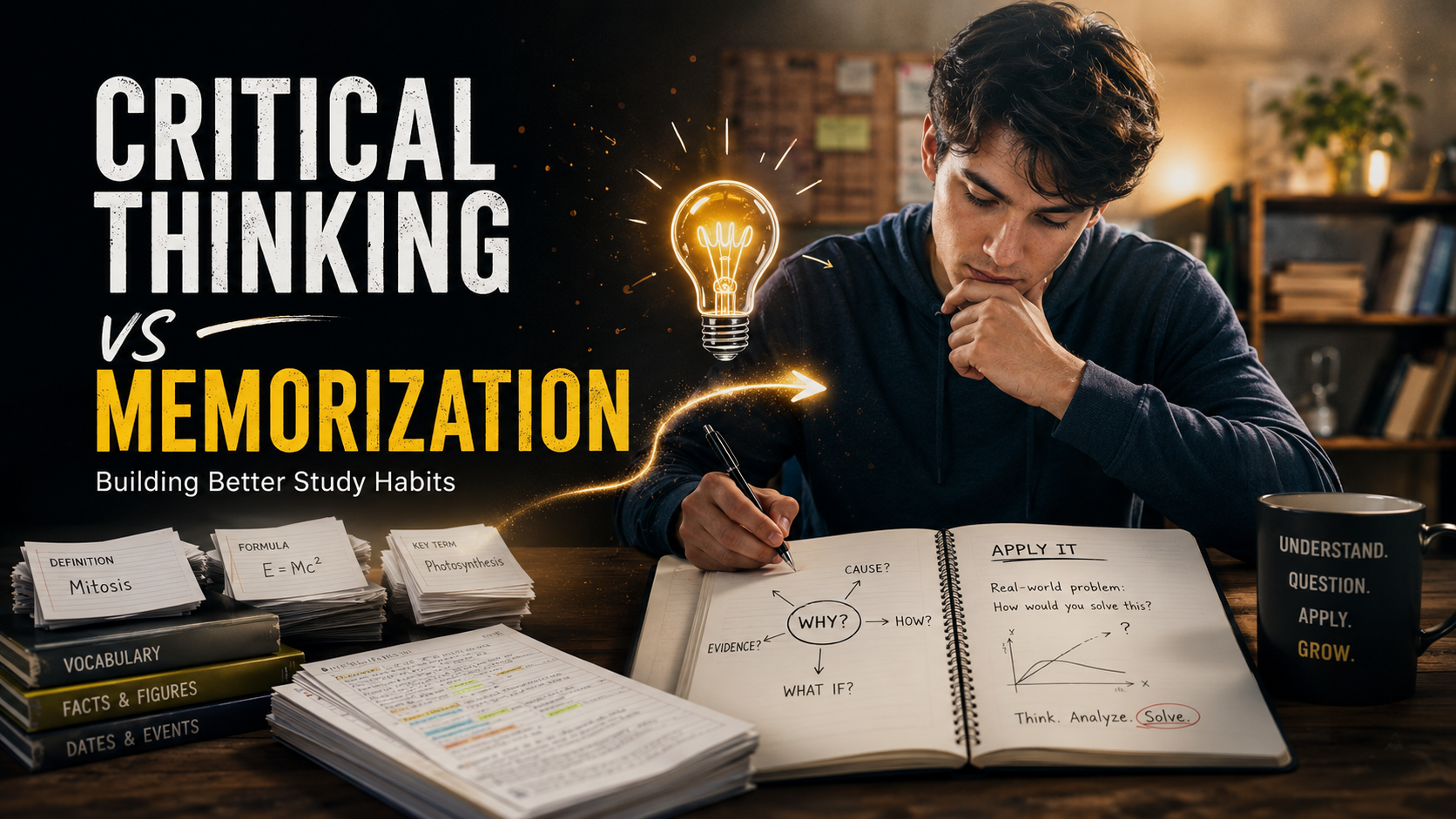
Critical Thinking vs Memorization: Building Better Study Habits
Rote learning has dominated classrooms for generations, yet modern learners face information overload every day. Understanding critical thinking vs memorization is essential for building effective study habits and stronger learning skills. Memorization helps learners store important facts, terms, formulas, and definitions. Critical thinking allows them to evaluate, connect, question, and apply that information in new situations.
Rote memorization can sometimes create an illusion of understanding. Students may recall a definition correctly without knowing how to use the underlying concept. Strong learning requires both skills. Memorization provides useful building blocks, while critical thinking helps learners understand how those pieces fit together.
Research in cognitive psychology shows that deeper processing and active retrieval can support stronger, longer-lasting learning than passive review. American Psychological Association Relying only on surface-level recall can leave students less prepared for unfamiliar problems.
This guide examines effective study habits, digital information skills, retention strategies, perspectives on memorization, and spaced-repetition techniques. Together, these approaches can help you replace short-term cramming with meaningful, long-term learning.
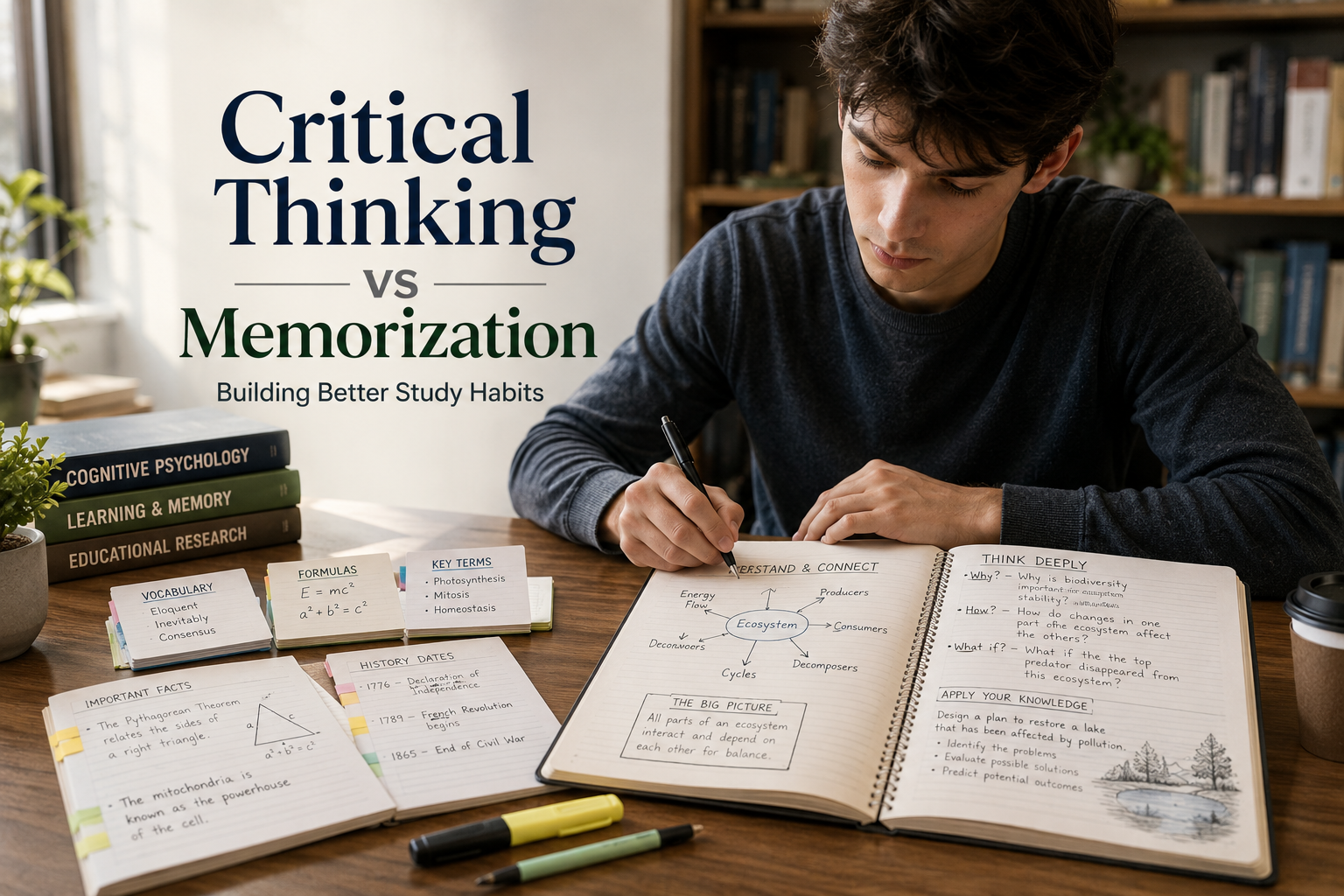

What are 7 effective study habits?
Building strong academic routines requires techniques that encourage active learning instead of passive reading. The first habit is active recall, which involves testing yourself without looking at your notes. This strengthens your ability to retrieve information when you need it.
Second, use spaced repetition to review important material across several sessions. Third, apply the Feynman Technique by explaining difficult ideas using simple language. This quickly exposes gaps in your understanding.
Fourth, organize study periods with time-blocking methods, including the Pomodoro technique. Fifth, use dual coding by combining written explanations with useful diagrams or visual representations. Sixth, use interleaved practice by mixing related subjects or problem types instead of repeating one task.
Finally, create a dedicated study environment with fewer digital distractions. These habits work together because they encourage retrieval, understanding, application, and focused practice. The goal is not simply to study longer. It is to make each study session more mentally active and purposeful.
The Power of Interleaved Practice
Interleaved practice involves switching between related topics, concepts, or problem types during a study session. Instead of solving twenty similar problems consecutively, students might alternate between several types of questions. This approach makes learning more demanding because the brain must identify which strategy applies to each problem.
That extra effort can improve discrimination and flexible problem-solving. Students cannot rely as heavily on automatic repetition. They must examine the problem, recognize its features, and select an appropriate approach.
Interleaving can feel less comfortable than studying one topic repeatedly. Performance may also appear weaker during the practice session. However, that difficulty does not necessarily mean the method is ineffective. Learning often improves when students have to retrieve and apply information under changing conditions.
For exams and real-world tasks, this flexibility matters. Questions rarely arrive in the same sequence as practice exercises. Interleaved practice therefore complements memorization by helping learners decide when and how to use what they know.
Are Gen Z critical thinkers?
Gen Z has grown up with constant access to search engines, social platforms, videos, and digital databases. This environment can encourage useful habits such as comparing sources, questioning claims, and searching for supporting evidence. Many young learners are comfortable moving between different information sources and evaluating competing viewpoints.
However, digital familiarity does not automatically create strong critical thinking skills. Algorithmic feeds can prioritize speed, engagement, and simplified content. Short-form information may encourage quick reactions rather than sustained analysis. Students can also encounter misinformation, confirmation bias, and unreliable sources while researching online.
The stronger conclusion is that Gen Z has both opportunities and challenges. Digital experience can support rapid information discovery and source comparison. At the same time, students still need explicit instruction in reasoning, evidence evaluation, context, and logical analysis.
When educators combine digital literacy with structured questioning, Gen Z learners can develop strong analytical habits. The goal should not be to replace memorization with constant searching. Students still need foundational knowledge. Instead, they should learn how to verify information, understand context, and apply evidence thoughtfully.
Navigating Digital Information Streams
Digital information streams require learners to process large amounts of content quickly. Students may compare articles, videos, social posts, research papers, and other sources within minutes. This can make modern research more dynamic than traditional information gathering.
However, speed can also create problems. Finding several sources does not automatically mean that the information is accurate. Learners must examine who created the content, what evidence supports the claim, and whether independent sources agree.
A useful approach is to combine digital literacy with critical thinking. Before accepting information, students can ask several questions about primary vs secondary sources and how reliable the evidence is:
- Who created this information?
- What evidence supports the claim?
- Is the source credible and current?
- Does another reliable source provide different evidence?
- Is the information presented without important context?
These questions turn browsing into active analysis. They also help learners identify misleading claims and weak arguments.
Digital skills become more valuable when paired with foundational knowledge. The more learners understand a subject, the easier it becomes to recognize errors, missing context, and unsupported conclusions within digital information. Building this foundation is part of lifelong learning that continues beyond formal education.
How to retain 90% of what you learn?
The idea that learners can retain exactly 90% of information through specific activities comes from the widely circulated Learning Pyramid. However, the pyramid’s precise percentages do not have strong scientific support. It is therefore better to treat the 90% figure as a popular learning concept rather than a guaranteed outcome.
What does have stronger support is the value of active learning and retrieval practice. Students generally learn more effectively when they actively retrieve, explain, discuss, and apply information. Simply rereading material can create familiarity without producing strong recall.
To improve long-term retention, try teaching a concept to another person. You can also solve practice problems, create original examples, answer questions from memory, or simulate exam conditions. These activities require your brain to retrieve and organize information.
The most effective approach combines several methods. Use memorization for essential facts, then use critical thinking to connect and apply those facts. This combination supports deeper understanding and makes knowledge more useful beyond the immediate test or assignment.
Immediate Application and Peer Teaching
Teaching another person can reveal whether you genuinely understand a concept. When you explain an idea without relying heavily on your notes, you must organize the information and identify relationships between different points.
The process also exposes knowledge gaps. You may remember a definition but struggle to explain why it matters or how it works. That difficulty provides useful feedback. You can then return to the material and strengthen the missing part.
Peer teaching does not need to involve a formal classroom presentation. You can explain a topic to a classmate, discuss a problem with a study partner, or speak through the solution yourself. The important part is retrieving the information and expressing it in your own words.
Immediate application provides another advantage. After learning a principle, use it to solve a problem or create an example. This connects abstract information with practical use.
These techniques complement memorization rather than replacing it. Memorized knowledge provides the raw material, while explanation and application help turn that knowledge into usable understanding.
What did Einstein say about memorization?
Albert Einstein is often associated with the idea that memorizing facts is less important when those facts can be easily looked up. Stories about Einstein and memorization are frequently repeated, but many popular quotations attributed to him lack clear primary-source evidence.
Still, the broader educational principle fits Einstein’s well-known emphasis on understanding, imagination, curiosity, and independent thought. Memorizing information has value, especially when learners need foundational facts to reason effectively. However, factual recall alone does not demonstrate deep understanding.
Students need basic knowledge before they can analyze complicated ideas. A science student, for example, must know essential terminology before evaluating a scientific argument. A mathematics student needs core formulas and concepts before solving unfamiliar problems.
The real issue is therefore not whether memorization is useful. It is whether memorization becomes the entire learning strategy. Effective education combines recall with reasoning, interpretation, questioning, and application.
This distinction is central to critical thinking vs memorization. Memorization helps build the knowledge base. Critical thinking determines how effectively learners can use that knowledge in unfamiliar situations.
Training the Mind to Reason
Training the mind to reason requires more than collecting information. Learners must practice connecting ideas, evaluating evidence, identifying assumptions, and applying principles to unfamiliar situations.
Memorization remains useful because critical thinking needs a foundation of knowledge. Without basic facts, students may spend too much mental effort searching for information instead of analyzing a problem. Strong learners therefore build knowledge first and then practice using it.
Reasoning becomes stronger when students regularly ask why, how, and what if. These questions encourage learners to move beyond definitions. For example, instead of memorizing a scientific rule, a student can ask why the rule works and what would happen if conditions changed. Applying this approach to research also helps students analyze scientific papers more critically.
Creative thinking also depends on this foundation. When learners understand several concepts deeply, they can connect them in new ways. That ability supports problem-solving across academic and practical situations.
The goal is not to eliminate memorization. It is to prevent memorization from becoming passive learning. Knowledge gives the mind material to work with, while reasoning determines how that material can be used.
What is the 2 7 30 rule for memory?
The 2-7-30 rule is a simple spaced-repetition strategy based on reviewing information at increasing intervals. Under this approach, learners review new material around two days after first studying it. They review it again around day seven and conduct another review around day thirty.
The exact schedule should not be treated as a universal scientific formula. Different learners and subjects may require different review intervals. The key principle is spacing learning over time rather than completing all revision in one session. This approach can be incorporated into independent learning habits to make study more consistent.
Spaced review creates repeated opportunities to retrieve information after some forgetting has occurred. That retrieval effort can strengthen long-term learning and make future recall easier. It also reduces dependence on last-minute cramming.
You can adapt the 2-7-30 schedule to vocabulary, formulas, definitions, historical facts, or technical concepts. During each review, test yourself before checking the answer. If you struggle, review the material and schedule another retrieval opportunity sooner.
Used consistently, spaced repetition can make study sessions more efficient. It works particularly well when combined with active recall, practice questions, and meaningful application.
Overcoming the Forgetting Curve
Human memory naturally changes over time, and information that receives little reinforcement can become harder to retrieve. This process is commonly illustrated through the forgetting curve. The exact rate of forgetting varies between people, subjects, and learning conditions.
Spaced repetition addresses this problem by bringing information back before it becomes completely inaccessible. Each review provides another opportunity to retrieve the material and strengthen recall.
The 2-7-30 schedule offers a practical starting point. Review the material after two days, again around seven days, and once more around thirty days. If you remember something easily, you can extend the interval. If you struggle, review it sooner.
Active recall makes these sessions more useful. Instead of simply rereading notes, close the book and answer questions from memory. Then check your response and correct mistakes.
This approach makes revision more deliberate. Rather than repeatedly exposing yourself to the same information, you practice retrieving knowledge when it is not immediately available. That process supports durable learning and complements critical thinking by keeping essential information accessible when you need to apply it.
Frequently Asked Questions
Why is rote learning ineffective for complex subjects?
Rote learning becomes limited when subjects require reasoning, application, or problem-solving. In critical thinking vs memorization, memorization mainly stores information, while critical thinking helps learners understand relationships between ideas. Students may remember formulas or definitions but struggle to apply them to unfamiliar problems. Complex subjects often require several concepts to work together, so simple repetition cannot provide enough understanding. Rote learning remains useful for foundational facts, but it should support deeper analysis rather than replace it. Combining memorization with practice, explanation, and problem-solving creates stronger and more flexible knowledge.
How does active recall differ from passive reading?
Active recall requires you to retrieve information from memory without immediately checking your notes. Passive reading simply exposes you to information repeatedly, which can create familiarity without proving that you can remember it independently. This distinction is important when comparing critical thinking vs memorization because effective learning requires more than recognizing information. With active recall, you test your ability to reproduce definitions, explain concepts, solve questions, or describe processes. Regular retrieval also helps identify knowledge gaps. Instead of repeatedly reading the same chapter, close your notes and explain what you remember before checking for mistakes.
Can memorization and critical analysis work together?
Yes. Memorization and critical analysis serve different purposes, so treating them as competing approaches creates a false choice. In critical thinking vs memorization, memorization provides essential facts, vocabulary, formulas, and definitions. Critical thinking then helps you evaluate and apply that knowledge. For example, a science student may memorize a scientific principle but still need to understand why it works and when it applies. Effective study combines foundational recall with questioning, comparison, explanation, and practical application. The goal is not to eliminate memorization. Instead, learners should use memorized knowledge as a foundation for deeper reasoning and independent problem-solving.
What is the fastest way to improve analytical habits?
The fastest practical approach is to turn ordinary studying into a process of questioning and explanation. When learning something new, ask why it works, how it works, and when it might fail. Compare different explanations and examine the evidence behind important claims. In critical thinking vs memorization, this approach shifts your focus from simply remembering information to understanding and evaluating it. Try explaining difficult concepts without using your notes, then identify where your explanation becomes unclear. You can also solve unfamiliar problems and question your assumptions. Repeated practice with these habits gradually develops stronger analytical reasoning and more flexible thinking.
Conclusion
Mastering academic success requires moving beyond simple memorization to embrace disciplined analytical thinking. While basic recall provides the foundation for foundational facts, conceptual understanding enables you to adapt, innovate, and solve complex problems in real-world scenarios. Balancing critical thinking vs memorization transforms how you absorb and retain complex information.
By implementing effective habits such as spaced repetition, peer teaching, and active retrieval, you build a sustainable study system that enhances long-term cognitive growth. These habits can become part of lifelong learning rather than ending when a course or examination is complete. Einstein’s timeless insight reminds us that a trained mind is far more valuable than a mental warehouse of searchable data.
Start evaluating your current academic routines today. Replace passive re-reading sessions with active recall challenges, schedule your reviews using structured spaced intervals, and focus on truly understanding the underlying logic behind every concept you encounter.