

Who Can Be a Witness to a Will?
Drafting an estate plan can provide peace of mind, but a procedural mistake can create serious problems later. One important step is properly signing and witnessing the will. When considering who can be a witness to a will, you should choose people who can clearly observe the signing and understand their role. The exact requirements depend on the jurisdiction. For example, in England and Wales, a will generally must be signed in the presence of two witnesses who are both over 18. Both witnesses must then sign the same document in the will-maker’s presence, according to GOV.UK guidance on making a will legally valid.
A witness usually does not need to read the contents of the will. Their role is to observe the will-maker sign, or acknowledge their signature, and then complete the required attestation. The witnesses should also be able to identify themselves and understand what they are witnessing. Understanding why you should create a will can also help clarify why proper execution and witnessing matter.
Choosing suitable witnesses helps reduce later disputes about fraud, undue influence, capacity, or improper execution. However, the rules differ between countries and even between regions within the same country. This guide explains family members as witnesses, interested witnesses, witness eligibility, Indian rules, and what can happen when a will is not properly witnessed.
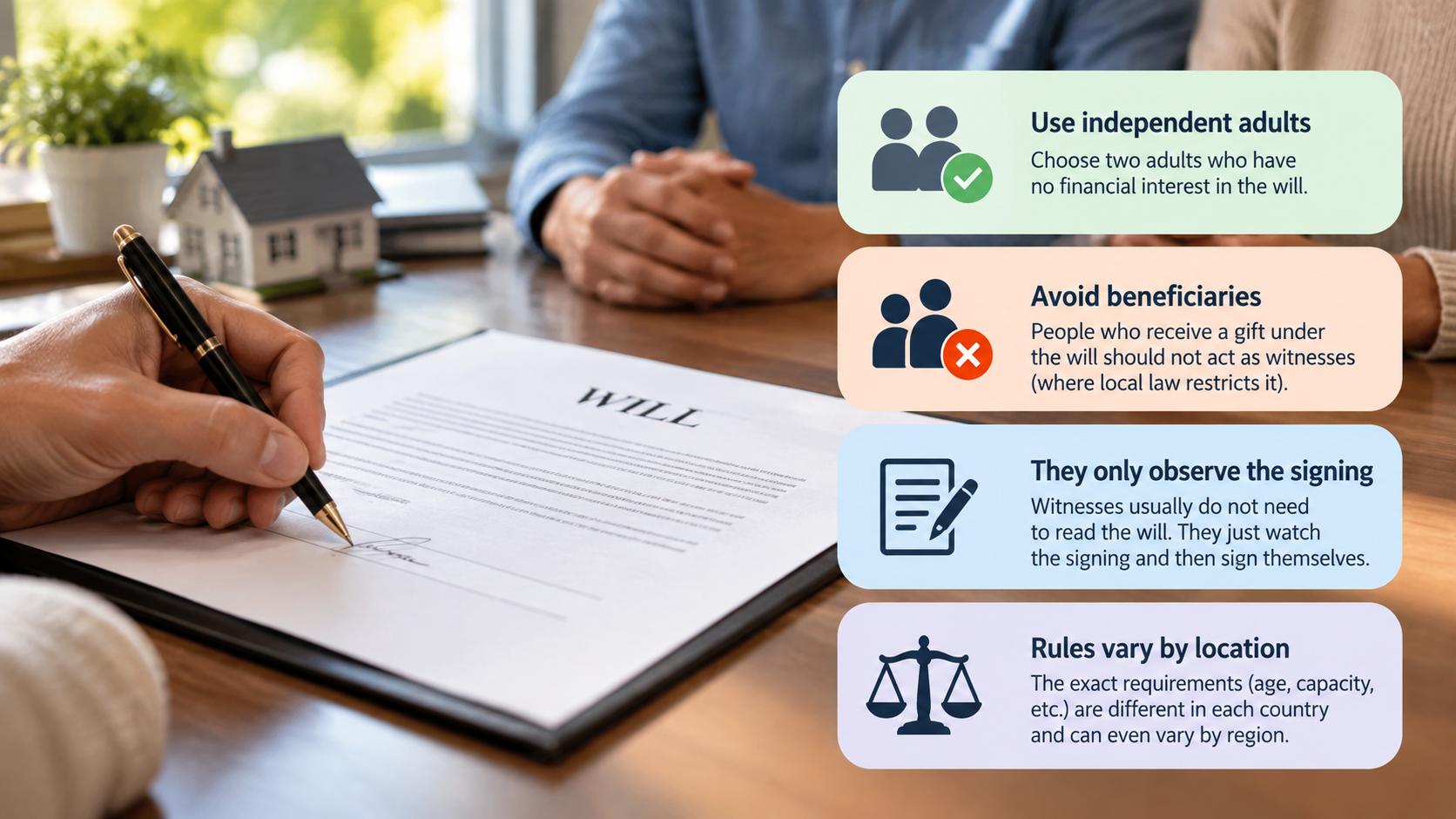

Can a family member act as a witness?
A family member may be able to witness a will, but the consequences depend on local law and whether that person benefits under the will. In England and Wales, a beneficiary or the beneficiary’s spouse or civil partner should not act as a witness because the gift to that person can become void. The will itself does not automatically become invalid simply because an interested person witnessed it. For broader estate-planning context, see how to choose the right executor for your estate.
This distinction is important because saying that a family member can never witness a will would be too broad. A relative who has no financial interest may be legally capable of witnessing, depending on the jurisdiction.
Even when the law permits a relative to witness, using an independent adult is usually a safer practical choice. An unrelated witness can reduce questions about pressure, influence, or conflicts of interest.
When selecting witnesses, consider these points:
- Choose adults who meet the local legal requirements.
- Avoid beneficiaries whenever possible.
- Avoid anyone who may later become involved in a dispute.
- Make sure the witnesses can clearly observe the signing.
The Problem with Interested Witnesses
An interested witness creates a potential conflict because they may personally benefit from the will. In England and Wales, the will remains valid, but a gift to the witnessing beneficiary, or their spouse or civil partner, can be void. This is one reason it is important to understand why you should create a will and how different parts of an estate plan work together.
The practical solution is simple. Anyone receiving a significant gift should not participate as a witness when an independent alternative is available.
This approach also helps create a clearer record of the signing. If the will is challenged later, independent witnesses may provide useful evidence about what happened during execution.
The safest general practice is therefore to use two independent adults with no financial interest in the estate. However, this is a practical recommendation rather than a universal legal requirement. Different jurisdictions apply different rules.
If a family member must be present during the signing, they can often remain separate from the witnessing role. This reduces the risk of confusion about whether they were acting as a beneficiary, witness, or both.
Who cannot be witness to a will?
When determining who can be a witness to a will, you must check the law that applies to the will. There is no single worldwide list of prohibited witnesses. Requirements can differ based on age, capacity, eyesight, beneficiary status, and other circumstances.
For example, England and Wales generally require two witnesses who are at least 18. GOV.UK also states that beneficiaries, and their married partners, should not receive gifts under a will they witness.
Older guidance from the Ministry of Justice explains that the law in England and Wales has also treated certain people, including blind people, differently when determining whether they can properly witness a will. It also notes that a witness should generally have sufficient capacity to understand the witnessing process.
Rather than assuming that every jurisdiction follows the same exclusions, check the applicable law before signing.
As a practical rule, avoid using:
- People who do not meet the required age.
- People who cannot understand the witnessing process.
- Beneficiaries or their spouses where local law creates consequences.
- Anyone whose ability to observe the signing is seriously impaired.
Who cannot be called as a witness?
Being a person who cannot properly witness a will is different from being a person who may later give evidence about the will. These two roles should not be confused. A person may have information about a will without satisfying the legal requirements for acting as an attesting witness.
For example, a court may consider evidence from people who were present around the time of execution. However, whether someone can give evidence, and how much weight that evidence receives, depends on the applicable procedural and evidence rules.
It is therefore too broad to say that anyone with a mental illness, previous intoxication, or another condition can never be called as a witness. The relevant question is usually whether the person can provide reliable and legally admissible evidence in the particular case.
The safest approach is to use witnesses who:
- Clearly understand what they are witnessing.
- Can communicate their evidence reliably.
- Can identify the will-maker and signing process.
- Have no unnecessary financial interest in the estate.
The Role of Independent Professional Witnesses
Independent professionals can provide useful evidence because they may keep records of the signing and the circumstances surrounding it. Solicitors and other qualified professionals may also understand the formal requirements that apply in their jurisdiction.
However, hiring a professional witness does not automatically make a will valid. The document must still satisfy the applicable execution rules.
A professional witness can be particularly useful when the will-maker is elderly, seriously ill, or leaving assets in circumstances that could later attract questions. In those situations, careful documentation may help establish what happened during signing.
The key objective is not simply to find an impressive witness. It is to create a clear and reliable record of proper execution.
If there is a significant risk of a dispute, obtaining advice from a qualified wills or probate professional is more appropriate than relying on a generic witnessing checklist.
Can a family member witness a will in India?
Yes, a family member can generally act as a witness to a will in India if they satisfy the applicable requirements. However, Indian law differs from the rules used in countries such as England and Wales. Estate planning can also involve questions about how savings accounts are handled after you die, particularly when considering how assets are transferred after death.
Section 63 of the Indian Succession Act, 1925, requires two or more witnesses to attest an unprivileged will. Each witness must see the testator sign the will or receive a personal acknowledgment of the signature. Each witness must also sign the will in the testator’s presence. The witnesses do not have to attend the signing together.
Importantly, Section 67 states that the law treats any benefit given to an attesting witness or that witness’s spouse as void to the extent covered by the provision. However, such a benefit does not by itself make the will insufficiently attested.
Therefore, saying that an Indian family member automatically loses their entire inheritance simply because they witnessed the will would be inaccurate.
Using independent witnesses can still be sensible because it may reduce questions about influence or suspicious circumstances.
Is a will valid without a witness?
Whether a will can be valid without witnesses depends on the jurisdiction and the type of will. For an ordinary will in England and Wales, the testator must sign the will in the presence of at least two witnesses. The witnesses must then attest to the signing and sign the will themselves as required. It is also useful to understand how to choose the right executor for your estate when planning how your wishes will be carried out.
India also generally requires two or more witnesses to attest an unprivileged will under Section 63 of the Indian Succession Act, 1925. However, the Act provides separate rules for privileged wills, including certain wills made by soldiers, airmen, and mariners in specified circumstances.
Therefore, you should not assume that every unwitnessed will receives exactly the same treatment. Some jurisdictions recognise special forms of wills or provide exceptions.
For a standard will, however, failing to follow the required witnessing procedure can prevent a court from admitting the document as a valid will.
Before signing, confirm:
- How many witnesses are required.
- Who qualifies as a witness.
- Whether beneficiaries can witness.
- Whether witnesses must be present together.
- Whether special rules apply to your circumstances.
If there is uncertainty, local legal advice is safer than relying on a general online rule.
Frequently Asked Questions
Can an executor of an estate witness the will?
Yes, an executor can witness a will as long as they are not also named as a beneficiary. If an executor receives any personal gifts, property, or residuary shares from the estate, signing as an attesting witness will forfeit their inheritance under standard probate laws. Professional executors, such as solicitors who charge commercial fees for administration rather than receiving legacy gifts, regularly act as valid witnesses without jeopardizing any administrative provisions.
How many witnesses are legally required to sign a will?
Most common-law legal jurisdictions require at least two competent adults to witness the execution of a will. Both witnesses must physically watch the testator sign the document, or acknowledge their signature, and then sign it themselves in the testator’s presence. Certain specific jurisdictions or unique foreign legal systems may require three witnesses under distinct circumstances, but two independent, qualified adults remains the global gold standard for valid estate execution.
Can neighbors or coworkers act as will witnesses?
Yes, neighbors, colleagues, and casual acquaintances can make excellent witnesses. They rarely have an emotional or financial stake in your estate. Ideally, witnesses should be legal adults of sound mind. They should also have no status as beneficiaries or spouses of beneficiaries.
Their independence can help protect your document from accusations of bias, coercion, undue influence, or personal financial interest during probate proceedings.
Conclusion
Understanding who can be a witness to a will is essential to ensuring your estate plan remains legally binding and protected from future disputes. Selecting two independent, competent adults who hold no financial interest in your assets prevents accidental disinheritance, allegations of undue influence, and painful probate litigation. Take the time to execute your signing ceremony correctly today, giving your family true peace of mind and preserving your legacy tomorrow. You can also review how to choose the right executor for your estate when completing your estate-planning arrangements.