

How Society Shapes You and How You Shape It
Have you ever wondered why you think, speak, and behave in certain ways? Your values, habits, beliefs, and daily routines often develop through social interaction. Understanding how society shapes you and how you shape it reveals the ongoing relationship between individuals and the communities around them. The American Sociological Association provides resources on sociology and the study of social life and human interaction.
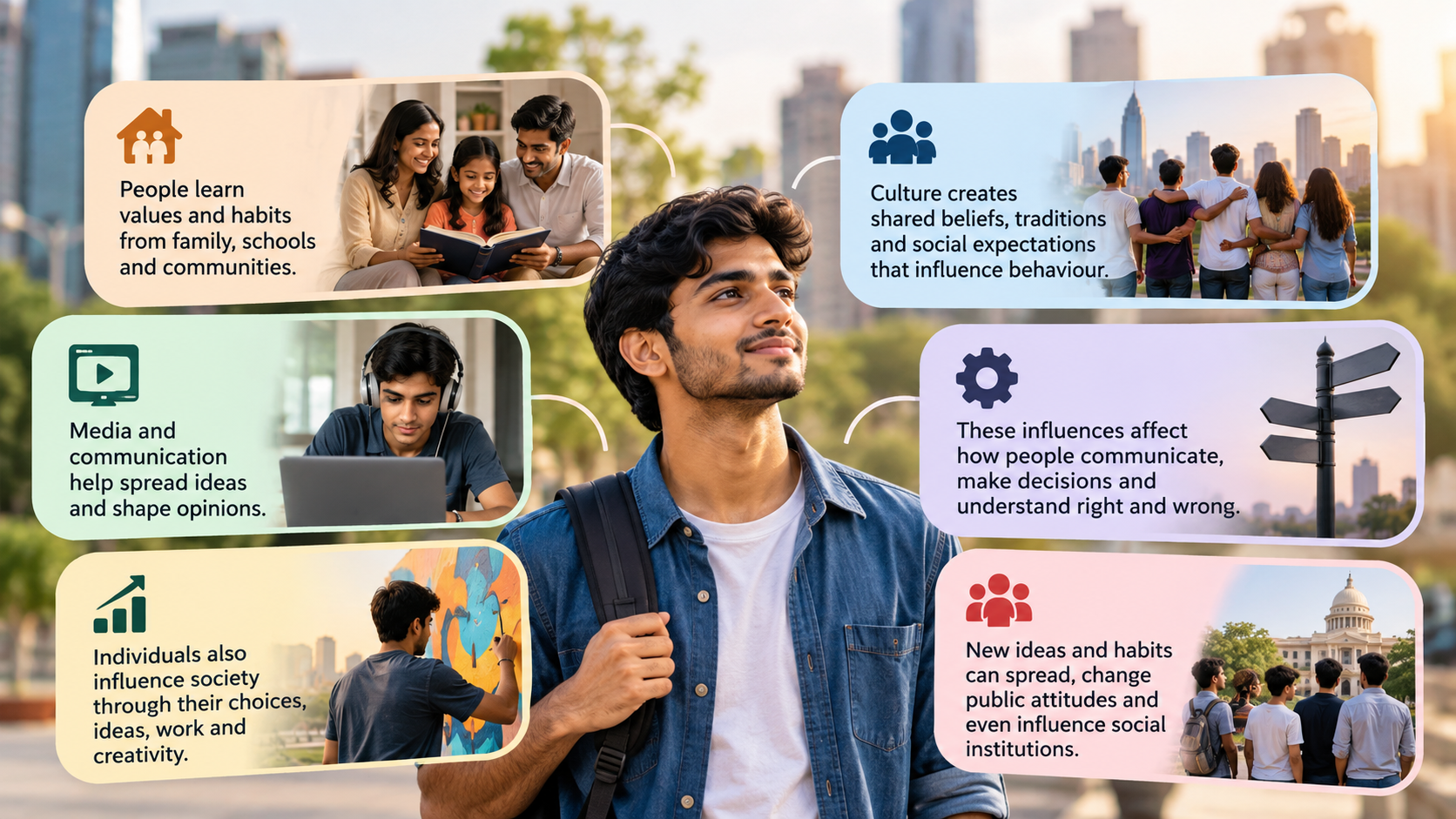
From childhood, people learn shared expectations, cultural traditions, social rules, and legal standards. These influences affect how people communicate, make decisions, and understand right and wrong. Schools, families, workplaces, media, and communities all contribute to this process.
However, society does not shape people in only one direction. Individuals also influence their communities through their choices, ideas, work, creativity, and participation. A new habit can spread across a community. A shared idea can change public attitudes. A social movement can even influence institutions.
This article explores that relationship through four basic questions. How can culture shape society? To explore these ideas further, we will look at an example of society, explain society in five sentences, and provide 20 examples of culture.

How can culture shape society?
Culture shapes society by creating shared ideas about how people should live and interact. It includes beliefs, values, traditions, language, customs, and social expectations. These elements influence everyday behavior and can also affect larger social institutions, including the role of culture in education.
For example, a society that values cooperation may encourage community programs, public services, and collective responsibility. A culture that emphasizes individual independence may place greater importance on personal choice, entrepreneurship, and competition.
Culture also influences education, family life, workplace behavior, and communication. Children learn cultural expectations through parents, teachers, friends, media, and community experiences. Over time, these lessons become familiar patterns of behavior, showing why education is important in our life.
The relationship works in both directions. People do not simply accept culture without changing it. New generations introduce different ideas, lifestyles, technologies, and forms of expression. These changes can gradually influence social expectations.
Therefore, understanding how society shapes you and how you shape it requires looking at culture as an ongoing process. Shared values influence people, while people’s actions gradually reshape those same values.
The Role of Shared Ethical Frameworks
Shared ethical values influence how communities define acceptable behavior and social responsibility. They can affect discussions about education, public services, family responsibilities, workplace conduct, and community support, including systemic barriers in education.
For example, cultures that strongly emphasize collective responsibility may encourage people to support community programs and shared services. Cultures that emphasize personal independence may give greater importance to individual responsibility and personal choice.
These values are usually learned through everyday experiences. Families teach children basic ideas about respect, honesty, responsibility, and cooperation. Schools reinforce many of these lessons through rules and social activities. Workplaces also establish expectations about communication, reliability, and professional behavior.
However, ethical frameworks are not fixed forever. Social attitudes can change when people question existing expectations or introduce new ideas. Younger generations may reinterpret traditions, while communities may adapt to technological and economic changes.
This process shows why how society shapes you and how you shape it is a two-way relationship. Social values influence individual behavior, but repeated individual choices can also change what a community considers normal or important.
Can you give me an example of society?
A clear example of society is contemporary Japan. It is a modern nation-state with defined territory, government institutions, economic systems, laws, and shared social practices. People participate in society through education, employment, family life, public services, and community activities, all of which have developed across the ages of human history.
Japanese society also demonstrates how shared expectations can influence everyday behavior. Social practices often place importance on respect, cooperation, responsibility, and consideration for others. These expectations can affect communication, workplace relationships, public behavior, and community life.
At the same time, Japanese society continues to change. Younger generations, changing lifestyles, technological developments, and evolving workplace practices contribute to new social patterns. Individuals therefore do not simply follow existing customs. Their choices also contribute to gradual social change.
This example helps explain how society shapes you and how you shape it. Social institutions and cultural expectations influence individual behavior. Individuals then reinforce, modify, or challenge those expectations through their daily actions.
Society is therefore not just a collection of rules. It is an evolving system created and maintained through continuous interaction among people.
Urban Communities as Microcosms of Collective Life
Cities provide another useful way to understand society. Tokyo, for example, brings together millions of people who share transportation systems, workplaces, schools, public spaces, and community facilities.
Urban residents must follow certain expectations to live together efficiently. Public transportation requires shared etiquette. Roads require common rules. Buildings, businesses, and neighborhoods depend on cooperation between many people.
At the same time, city residents contribute to changes in urban culture. Shopping habits can influence local businesses and consumer trends. Creative activities may shape entertainment, art, and urban design. New communication styles can also introduce fresh expressions and social trends.
Neighborhood groups also show how individuals contribute to collective life. Residents may organize local events, support community projects, or raise concerns about public facilities. These activities can influence how a neighborhood develops.
Urban communities therefore demonstrate how society shapes you and how you shape it on a smaller, visible scale. The city provides structures that guide behavior, while residents continually influence its culture, services, and social atmosphere.
What is society 5 sentences?
Society is a structured community of people who interact with one another through shared institutions, relationships, and social systems. It provides laws, cultural norms, values, and institutions that help organize collective life. These systems influence how people behave, communicate, work, learn, and cooperate from childhood onward. However, society depends on people to remain active and meaningful because institutions cannot function without human participation. As people’s needs, ideas, and behaviors change, society also changes over time.
This definition shows why society involves more than simply living near other people. A society contains relationships and systems that connect individuals to wider communities.
Families, schools, businesses, governments, religious organizations, and community groups can all form parts of social life. These institutions create structures that help people cooperate and manage shared responsibilities, including gender-based education systems.
Individuals also contribute to society through their work, choices, relationships, and participation. Their actions can reinforce existing traditions or encourage new ways of thinking.
Therefore, how society shapes you and how you shape it describes a continuous exchange. Society influences individuals, while individuals collectively influence the direction of society.
Institutional Support Structures in Daily Life
Institutions provide the organized structures that help society function. Schools, hospitals, courts, businesses, and government agencies each perform different roles in supporting community life.
Schools provide education and help children develop knowledge, skills, and social habits. Hospitals provide healthcare and respond to community health needs. Courts help resolve disputes by applying established laws and legal procedures.
Other institutions also influence everyday life. Businesses provide goods, services, employment, and economic activity. Government agencies manage public programs, infrastructure, records, and regulations.
These institutions do more than provide services. They also reflect the values and priorities of the societies in which they operate. Their rules can influence how people behave and interact with one another.
However, institutions depend on individuals to function properly. Teachers educate students, doctors care for patients, employees operate businesses, and public officials administer services.
This creates another example of how society shapes you and how you shape it. Institutions influence individual opportunities and behavior, while people’s participation helps maintain and gradually change those institutions.
Can you give me 20 examples of culture?
Culture includes the shared practices, ideas, traditions, and expressions that help distinguish one community from another. It can appear in everyday behavior as well as in art, language, family life, and social traditions.
Here are 20 examples of culture:
- Traditional music – Musical styles passed between generations.
- Regional food – Dishes and cooking methods associated with a community.
- Language – Words, expressions, and communication patterns.
- Traditional clothing – Clothing connected with local identity or customs.
- Architecture – Building styles influenced by history and local traditions.
- Literature – Stories, poems, and written traditions.
- Theater – Dramatic performances reflecting social ideas.
- Dance – Traditional and modern forms of movement and expression.
- Festivals – Community celebrations connected with cultural traditions.
- Wedding customs – Practices surrounding marriage and family.
- Funeral traditions – Customs surrounding death and remembrance.
- Religious practices – Shared rituals and spiritual traditions.
- Family structures – Common patterns of family organization.
- Child-rearing practices – Cultural approaches to raising children.
- Table manners – Shared expectations about eating and dining.
- Sports – Activities that communities value and practice.
- Folklore – Stories, legends, and traditional beliefs.
- Workplace etiquette – Expected professional behavior.
- Greeting customs – Common ways people welcome one another.
- Values and moral beliefs – Ideas about responsibility, respect, and right and wrong.
Together, these examples show how culture influences everyday life. They also demonstrate how people preserve, adapt, and reshape culture over time.
Frequently Asked Questions
What is the sociological definition of socialization?
Socialization is the lifelong process through which individuals learn, internalize, and adapt to the values, behaviors, and social norms of their community. It begins in early childhood through family interaction and continues through exposure to educational systems, peer groups, workplace settings, and media. Socialization equips people with the practical skills and psychological tools necessary to function effectively within their social groups.
How do individual actions lead to widespread social change?
Individual actions spark social change when private decisions align with broader public needs and inspire collective action. When one person speaks out, adopts innovative technology, or challenges an outdated norm, others take notice. As more people mirror that behavior, grassroots movements emerge. These coordinated efforts eventually pressure formal institutions to revise policies, laws, and traditional expectations.
Why is cultural diversity beneficial for a society?
Cultural diversity strengthens a population by introducing varied perspectives, problem-solving methods, and creative expressions into the communal dialogue. Exposure to multiple worldviews prevents intellectual stagnation, promotes social empathy, and drives economic innovation. When diverse communities share knowledge and traditions, they build more resilient institutions capable of adapting to unexpected global shifts and complex social challenges.
Conclusion
Navigating the ongoing connection between personal autonomy and community expectations is essential for modern civic life. As this guide has shown, culture serves as the blueprint for social institutions, while organized societies provide the safety and structure individuals need to flourish. From nationwide communities to the arts, rituals, and ethics that compose cultural identity, we are deeply embedded in our social environments.
Recognizing how society shapes you and how you shape it frees you from seeing yourself as a passive bystander. Every standard you uphold, business you support, and conversation you hold leaves an imprint on the broader culture. While collective systems clearly shape your worldview, your deliberate choices hold genuine transformative power. Apply this awareness by critically examining the norms you follow, standing up for constructive values, and using your voice to foster a more compassionate, equitable community for everyone.