

Effective Leadership Communication in the Workplace
Strong organizations thrive on clarity, purpose, and mutual trust. Mastering effective leadership communication helps align teams, boost morale, and support organizational success. When workplace communication lacks clarity, misunderstandings can cause costly delays and employee disengagement. Research highlighted by Harvard Business Review also shows that transparent communication can strengthen employee retention and organizational resilience.
Modern professionals must understand practical leadership and communication models. These frameworks help leaders communicate expectations clearly and encourage genuine collaboration. They also make workplace conversations more structured and productive.
Navigating conversations across corporate hierarchies requires the right approach. This guide explains several practical frameworks, including the 7 C’s of leadership, the 5 C’s of effective communication, and the 5 P’s of effective leadership. It also covers practical techniques for communicating with senior leaders. Whether you lead a department or manage upward, these principles can help you communicate with greater clarity and confidence.


What are the 7 C’s of leadership?
The 7 C’s of leadership describe seven foundational qualities that support effective leadership: Character, Competence, Compassion, Courage, Clarity, Communication, and Commitment. Character builds ethical trust and establishes consistent leadership standards. Competence gives leaders the knowledge and credibility needed for sound decisions. Compassion helps managers understand employee concerns and provide meaningful support. Courage enables leaders to address difficult issues, make calculated decisions, and manage workplace conflict.
Clarity keeps priorities understandable and reduces confusion across teams. Communication connects leadership qualities with everyday workplace interactions. Finally, Commitment demonstrates persistence and accountability toward shared goals. These qualities work together rather than operating independently. A leader may have strong technical skills but still struggle without compassion or clear communication. By developing all seven qualities, managers can create a workplace culture built on accountability, trust, respect, and shared purpose. The framework also supports effective leadership communication because employees receive consistent messages from leaders who understand both business priorities and people.
Cultivating Everyday Executive Character
Character serves as the foundation of the 7 C’s leadership framework. Employees often judge leadership through everyday actions rather than formal statements. Leaders who consistently follow company values create stronger trust within their teams. This consistency becomes especially important when managers face pressure, mistakes, or difficult decisions. Understanding signs of a good company culture can also help leaders recognize how everyday values and behaviors shape employee trust.
Transparent leaders accept responsibility when outcomes fall short. They avoid shifting blame and explain decisions honestly. Such behavior shows employees that accountability applies at every level of the organization.
Character also influences how leaders handle confidential information, workplace disagreements, and competing priorities. Managers who act fairly can strengthen employee confidence in their decisions. They also create an environment where people feel comfortable raising concerns.
Building character does not require dramatic leadership gestures. It depends on consistent behavior over time. Leaders can demonstrate it by keeping commitments, admitting mistakes, treating employees respectfully, and applying standards fairly. These actions establish credibility that supports effective leadership communication. When employees trust the person delivering a message, they are more likely to listen, respond openly, and act on important instructions.
What are the 5 C’s of effective communication?
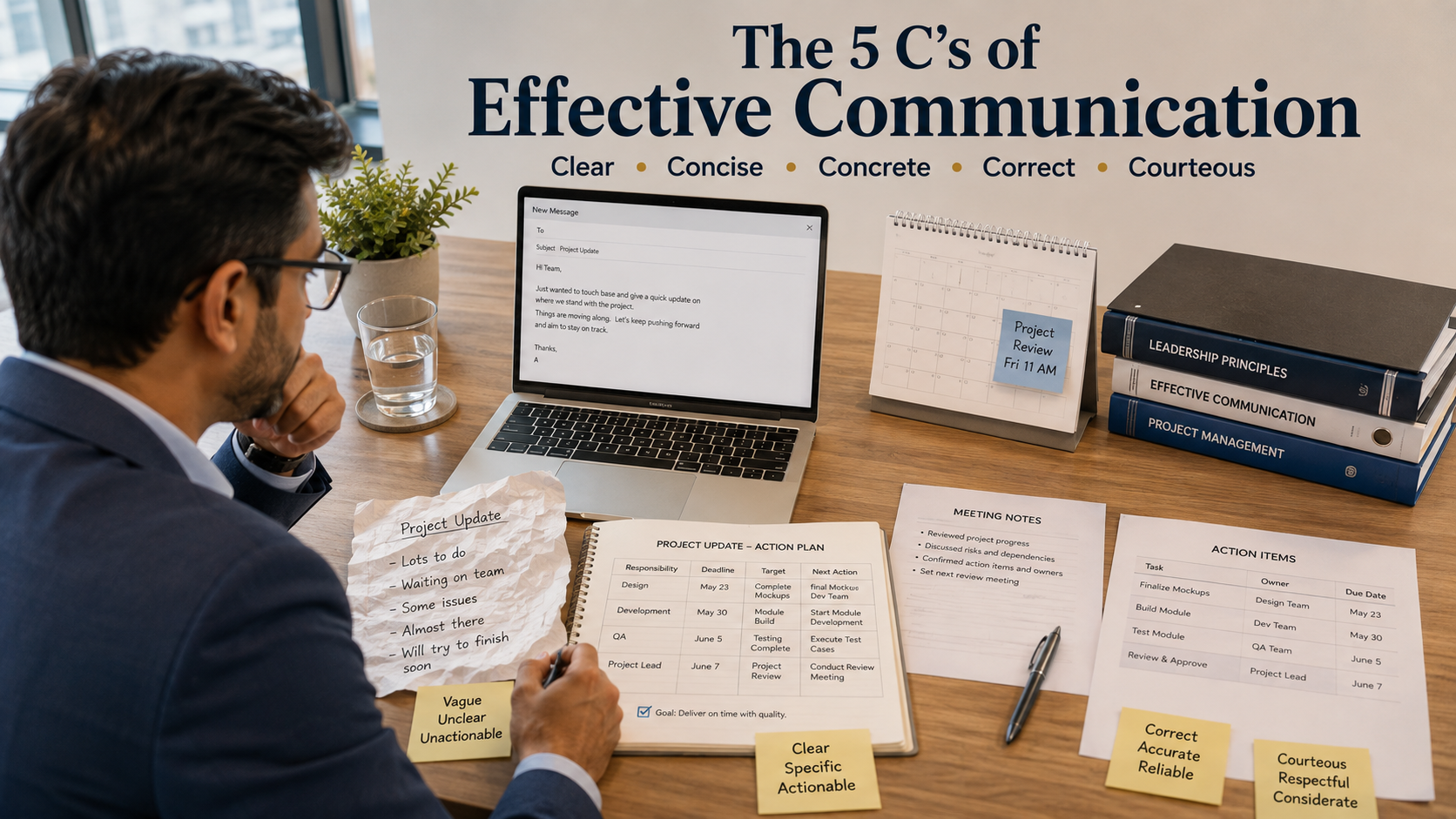
The 5 C’s of effective communication provide practical standards for delivering workplace messages: Clear, Concise, Concrete, Correct, and Courteous. Clear communication removes unnecessary jargon and makes the main purpose easy to understand. Concise communication respects employees’ time by removing unnecessary details and repetition. Concrete communication uses specific facts, figures, deadlines, and action items instead of vague expectations. These principles are also useful when creating better presentations for work, where clear and concise delivery can make complex information easier to understand.
Correct communication ensures that information is accurate, relevant, and presented using appropriate language. Courteous communication maintains a respectful and inclusive tone, even during difficult conversations. These principles can improve communication across departments, management levels, and professional backgrounds.
The 5 C’s also help leaders reduce preventable workplace errors. A message can fail even when the information itself is correct. For example, unclear responsibilities may leave employees unsure about who owns a task. Similarly, vague deadlines can create different expectations across teams. Applying the five principles makes messages easier to understand and act upon. They are especially useful for meetings, emails, performance discussions, project updates, and effective leadership communication with senior management.
Ensuring Concrete Workplace Messaging
Concrete communication removes uncertainty from workplace instructions. Leaders should replace broad statements with specific expectations that employees can understand and measure. For example, asking a team to “improve performance” provides little guidance. A stronger message could identify a specific target, deadline, and measurement method.
Specific communication gives employees a clearer path to execution. It can include project milestones, responsible team members, delivery dates, performance metrics, or required outcomes. These details reduce guesswork and help employees prioritize their work.
Concrete messaging is particularly valuable during cross-functional projects. Different teams may interpret general instructions in different ways. Specific information creates a shared understanding and reduces unnecessary revisions.
Leaders should also confirm important details after meetings. A short written summary can clarify responsibilities and deadlines. It gives everyone a reference point if questions arise later. Leaders can also use how to ask for feedback at work effectively to confirm whether expectations and communication were clear.
Concrete communication does not mean overwhelming employees with information. Leaders should provide the details necessary for action while removing irrelevant background. This balance improves effective leadership communication and helps teams move from discussion to execution with fewer misunderstandings.
What are the 5 P’s of effective leadership?
The 5 P’s of effective leadership provide a practical framework for connecting strategy with execution: Purpose, People, Process, Performance, and Passion. Purpose defines the mission behind organizational decisions and gives employees a clear reason for their work. People focuses on hiring, developing, supporting, and empowering the talent needed to achieve that mission. Process creates repeatable workflows that improve consistency and operational efficiency.
Performance measures progress through relevant goals, metrics, and outcomes. It helps leaders identify gaps and maintain accountability. Passion provides the energy and resilience needed to navigate challenges, maintain momentum, and encourage commitment.
These five elements should work together. A clear purpose can lose impact without capable people. Skilled employees may also struggle when processes are inefficient or performance expectations remain unclear. Likewise, passion cannot replace sound strategy or measurable results.
Leaders can use the 5 P’s when setting departmental priorities, managing projects, developing teams, or communicating strategic changes. The framework helps balance business performance with employee engagement. It also strengthens effective leadership communication by giving leaders a structured way to explain why goals matter and how teams can achieve them. These principles can also support building a high-performing team by connecting people, processes, goals, and performance.
Aligning People with Strategic Purpose
A clear organizational purpose becomes meaningful when employees understand how their work contributes to it. Leaders should connect daily responsibilities with broader business goals. This connection helps employees see more than individual tasks. They can understand the wider outcome their work supports.
For example, a customer service employee may view response times as a routine metric. A leader can connect that metric to customer satisfaction, retention, and business growth. This context gives the task greater relevance without changing its practical requirements.
Strategic alignment also helps teams make better decisions. When employees understand organizational priorities, they can evaluate competing tasks more effectively. They can identify which activities deserve immediate attention and which can wait.
Leaders should reinforce this connection during team meetings, performance discussions, and project updates. However, the message should remain specific and relevant to each role. Employees do not need repeated corporate slogans. They need a clear explanation of how their contribution affects measurable outcomes.
This approach strengthens engagement and supports effective leadership communication. When people understand the purpose behind their responsibilities, leaders can build stronger accountability, collaboration, and commitment across the department.
How to effectively communicate with leadership?
Practicing effective leadership communication when speaking upward requires preparation, professional judgment, and a solution-oriented approach. Start by understanding your manager’s priorities, preferred communication style, and available time. Frame updates around business impact before explaining operational details. This approach helps senior leaders quickly understand why an issue matters.
When raising a workplace problem, avoid presenting only the difficulty. Where appropriate, provide two or three practical options and explain the trade-offs. This shows that you have considered possible solutions rather than simply transferring the problem upward. Learning how to ask for feedback at work can also help employees refine their approach and communicate solutions more effectively.
Active listening is equally important. Pay attention during strategy discussions and clarify expectations when necessary. Acknowledge useful feedback and record agreed actions after important conversations.
Upward communication should also remain honest. Do not hide risks simply because they may reflect poorly on your team. Senior leaders need accurate information to make sound decisions. At the same time, avoid unnecessary detail that distracts from the main issue.
Consistent communication builds credibility over time. When leaders know they will receive clear updates, realistic assessments, and practical recommendations, trust improves. This makes effective leadership communication an important professional skill for employees at every management level.
Master the Executive Summary Approach
Executives manage multiple priorities and often have limited time for detailed operational explanations. The executive summary approach helps leaders communicate important information quickly. Begin meetings, emails, and presentations with the primary outcome, decision, or request. This same principle is useful when preparing for video interviews, where concise and structured answers can help communicate key points effectively.
For example, state the current situation before explaining its history. Identify the business impact, key risk, and recommended action. Supporting information can follow when the executive needs additional context.
A useful executive summary may include:
- The situation: What is happening now?
- The impact: Why does it matter to the business?
- The recommendation: What action do you propose?
- The decision needed: What do you need from leadership?
- The timeline: When does action need to happen?
This structure makes complex information easier to process. It also prevents important requests from getting buried beneath background details. Maintaining psychological safety at work can further encourage employees to communicate concerns, ideas, and important information without hesitation.
The approach does not mean removing necessary context. Instead, it prioritizes information according to executive decision-making needs. Leaders can then ask for deeper details when required.
Using concise summaries consistently can strengthen effective leadership communication. It demonstrates preparation, respects executive time, and makes important business information easier to understand and act upon.
Frequently Asked Questions
Why is active listening vital for business leadership?
Active listening enables managers to understand underlying team concerns rather than just hearing surface words. Leaders who listen attentively validate employee experiences, capture critical operational feedback early, and make better decisions. This practice prevents costly strategic misunderstandings, reduces workplace friction, and fosters an inclusive environment where employees feel secure sharing ideas.
How does emotional intelligence enhance management communication?
Emotional intelligence allows managers to perceive, evaluate, and navigate workplace emotions effectively. Leaders with high emotional intelligence adapt their tone during high-stress situations, resolve peer disputes diplomatically, and provide constructive feedback without triggering defensive reactions. This emotional awareness maintains psychological safety and strengthens team loyalty across changing workplace environments.
What is the biggest barrier to workplace communication?
Information silos and ambiguous instructions represent the most severe communication barriers. When departments fail to share critical data or when managers issue vague assignments without context, project timelines stall. Removing these barriers requires transparent updates, standardized documentation, and regular cross-departmental strategy reviews to keep everyone aligned.
How often should managers hold one-on-one meetings?
Managers should schedule one-on-one meetings weekly or bi-weekly for optimal alignment. Consistent individual check-ins provide dedicated space to review current workloads, address personal blockers, and discuss long-term professional development. Regular one-on-ones build mutual trust and prevent minor misunderstandings from evolving into major operational setbacks.
Conclusion
Strong organizational success requires intentional, transparent, and structured dialogue at every level. By applying the 7 C’s of leadership, you build executive character, courage, and accountability. Implementing the 5 C’s of communication ensures your daily emails, meetings, and instructions remain clear, concise, and actionable. Meanwhile, leaning on the 5 P’s of leadership aligns your workforce, processes, and corporate purpose into an efficient operational engine.
Mastering effective leadership communication also means knowing how to present solutions confidently when collaborating upward with executive decision-makers. Developing these essential communication skills requires deliberate practice, self-awareness, and consistent execution.
Begin integrating these frameworks into your upcoming team meetings, strategy updates, and performance reviews. Focus on delivering concrete details, listening actively to your colleagues, and anchoring conversations around clear objectives. Over time, these communication habits will elevate your management capabilities, foster workplace trust, and drive lasting success throughout your organization.