All posts by The Perfect Blogger

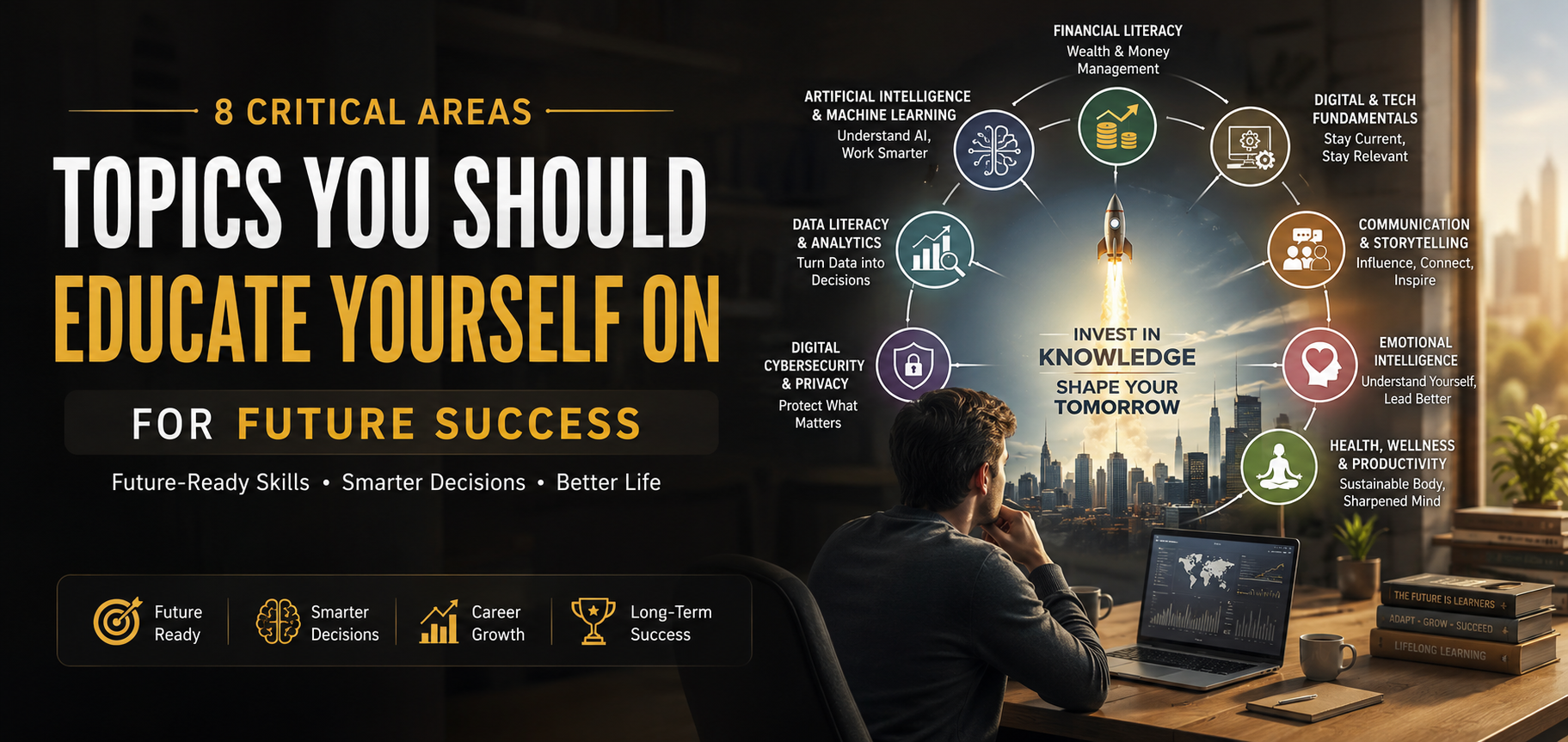
Topics You Should Educate Yourself On: 8 Critical Areas

Topics You Should Educate Yourself On: 8 Critical Areas for Future Success

The modern professional landscape is shifting at an unprecedented pace, driven by rapid technological advancements and changing economic paradigms. Therefore, to stay competitive, resilient, and adaptive, there are several foundational topics you should educate yourself on to safeguard your personal and professional future. Continuous learning is no longer just a commendable habit; consequently, it has become a core necessity for survival in a highly dynamic global market. By intentionally expanding your knowledge base, you can proactively adapt to industry disruptions rather than merely reacting to them when they arrive.

Understanding these pivotal subjects allows you to make highly informed decisions about your career, personal finances, and daily well-being. Furthermore, organizations like the World Economic Forum consistently emphasize that cognitive flexibility, complex problem-solving, and lifelong learning are the most critical skills for the modern workforce. In this comprehensive guide, we will break down eight essential domains that demand your immediate attention. From technological literacy to emotional intelligence, mastering these areas will provide you with a significant competitive edge and a clearer path forward. As a result, taking the time to study these subjects deeply will transform how you perceive opportunities and manage unexpected global changes.

1. Artificial Intelligence and Machine Learning

Artificial intelligence (AI) is fundamentally transforming how we work, communicate, and solve complex problems across every major sector. Thus, understanding the basics of machine learning, neural networks, and generative AI tools is no longer reserved strictly for software engineers or data scientists. To remain relevant in your career, you must learn how to collaborate effectively with AI systems rather than fearing potential job replacement. For example, this evolution involves understanding prompt engineering, recognizing automation trends, and identifying how AI can optimize your daily workflows for maximum efficiency.

Furthermore, integrating AI into your routine allows you to offload repetitive tasks and focus heavily on high-level strategic thinking. Consequently, professionals who master the interface between human creativity and machine intelligence will naturally lead their respective industries. You should focus on how these technologies process information and how they can be applied ethically within your business domain. Meanwhile, staying ahead of this technological curve ensures you remain an asset to any forward-thinking organization.

2. Financial Literacy and Advanced Wealth Management

Traditional savings accounts and basic budgeting methods are no longer sufficient to secure your long-term financial freedom in today’s economy. Instead, investigating the foundational topics you should educate yourself on must include modern investment vehicles, complex tax strategies, and global macroeconomic trends. You should deeply understand the mechanics of compounding interest, index funds, real estate investment trusts, and strategic asset diversification. Moreover, tracking global inflation and monetary policy changes will help you shield your hard-earned capital from sudden market volatility.

Indeed, true financial literacy requires a shift from a scarcity mindset to an investment mindset, focusing on building sustainable passive income streams. By mastering these concepts, you learn how to make your money work efficiently for you over extended periods. Similarly, understanding tax laws can save you significant capital, which you can then reinvest back into high-growth assets. Therefore, securing your financial future demands consistent research, disciplined asset management, and an ongoing understanding of changing financial markets.

3. Data Literacy and Analytics

Data is the definitive currency of the modern digital economy, influencing everything from corporate strategy to political campaigns. Whether you work in marketing, healthcare, engineering, or education, the ability to read, analyze, and argue with data is immensely valuable. Specifically, this is one of the most practical topics you should educate yourself on to improve your analytical capabilities. You must understand how to look at complex data sets and extract meaningful patterns that can drive organizational growth. Businesses worldwide are actively seeking professionals who can confidently interpret metrics and translate them into actionable operational adjustments.

Core Data Skills to Acquire

  • Data Visualization: Learn to translate complex raw numbers into clear, accessible charts and graphs for stakeholders.

  • Statistical Thinking: Understand how to spot structural biases, logical anomalies, and common errors in corporate reports.

  • Predictive Analysis: Learn how historical data trends can accurately forecast future customer behaviors and market demands.

Consequently, professionals who can comfortably bridge the gap between raw numbers and human strategy will always remain in high demand. Developing this skill set allows you to back up your business proposals with objective, undeniable facts rather than mere intuition. Thus, data mastery inherently enhances your professional credibility.

4. Digital Cybersecurity and Privacy

As our personal and professional lives move entirely online, digital security has quickly become a paramount global concern. Therefore, regarding the core topics you should educate yourself on, digital self-defense is absolutely non-negotiable. Understanding how to protect your digital footprint is vital for safeguarding your personal identity, private financial records, and proprietary corporate data. You should educate yourself on the core principles of zero-trust architecture, multi-factor authentication, and sophisticated end-to-end encrypted communications. Recognizing advanced phishing attempts, malware distribution tactics, and social engineering traps can easily prevent catastrophic financial and data breaches.

Moreover, as remote work remains highly prevalent, securing your home network and personal devices is an absolute necessity. Because of this, organizations are increasingly holding individual employees accountable for data hygiene and compliance with international privacy laws. By understanding how hackers exploit digital vulnerabilities, you can build an ironclad perimeter around your online presence. In conclusion, protecting your data preserves your digital autonomy and ensures long-term security in an interconnected world.

5. Emotional Intelligence and Adaptive Leadership

While technical skills might land you an initial interview, high emotional intelligence (EQ) secures long-term leadership success and career longevity. Thus, emotional literacy involves developing profound self-awareness, active empathy, and the unique ability to navigate complex social dynamics smoothly under immense pressure. As modern workplaces become more decentralized, remote, and culturally diverse, leaders must connect deeply with teams across various geographical regions. Therefore, developing strong EQ enables you to manage personal stress, resolve interpersonal conflicts constructively, and inspire peak performance in others.

Furthermore, adaptive leadership requires you to listen actively and validate the diverse perspectives of your team members. As a result, this collaborative approach fosters a corporate culture of psychological safety, which directly boosts innovation and employee retention rates. Leaders who lack emotional intelligence often struggle with team cohesion and suffer from high turnover rates within their departments. In contrast, investing time into understanding human psychology and communication strategies will dramatically elevate your managerial capabilities.

6. Sustainable Living and Environmental Literacy

Climate change, resource scarcity, and shifting geopolitical dynamics are rapidly reshaping global regulations, corporate supply chains, and consumer behaviors. Thus, sustainability principles represent major topics you should educate yourself on if you wish to remain relevant in modern enterprise. You must understand how environmental changes impact global trade, resource allocation, and government compliance policies across various industries worldwide. For this reason, consumers are increasingly demanding transparency, actively favoring brands that demonstrate genuine environmental responsibility and ethical sourcing practices.

Key Aspects of Sustainability Education

  • Circular Economy: Learn how waste reduction, recycling, and sustainable product design drive modern business efficiency.

  • Carbon Footprint Awareness: Understand how regulatory carbon taxes affect global manufacturing costs and product pricing.

  • Renewable Energy Systems: Study how solar, wind, and hydrogen technologies are actively replacing traditional fossil fuels.

Ultimately, environmental literacy empowers you to anticipate green regulations and implement sustainable practices within your current career field. Consequently, embracing eco-friendly innovation helps future-proof businesses against resource depletion and aligns your professional endeavors with global conservation goals.

7. Health Optimization and Biohacking

The future of healthcare is moving rapidly away from reactive treatment toward proactive prevention and cellular optimization. For that reason, physical well-being stands out among the vital topics you should educate yourself on for sustainable productivity. Educating yourself on personalized nutrition, sleep architecture, circadian biology, and preventative medicine can drastically extend both your lifespan and healthspan. Understanding how chronic stress and poor lifestyle choices impact your long-term cellular health allows you to make better daily adjustments. Meanwhile, investing time into researching longevity science ensures you maintain peak cognitive function and high physical performance as you age.

Furthermore, biohacking involves using scientific data to tweak your environment and biology for enhanced physical and mental output. For instance, this approach includes tracking biomarkers, optimizing your microbiome, and managing cognitive load through mindfulness and deliberate recovery strategies. By taking full ownership of your physical health, you reduce the long-term risk of burnout and chronic illness. Therefore, a healthy body serves as the vital foundation for achieving all your professional and personal ambitions.

8. Critical Thinking and Media Literacy

We live in an era of unprecedented information overload, which frequently makes objective truth incredibly difficult to discern online. Because of this reality, sharp critical thinking skills are absolutely vital to filter out widespread misinformation, sensationalized news, and personal confirmation bias. You must learn to analyze information sources objectively, question foundational assumptions, and evaluate scientific evidence carefully before forming firm opinions. This rigorous mental discipline protects you from cognitive manipulation and empowers you to make rational, independent decisions in daily life.

Additionally, media literacy helps you understand the underlying motives and algorithmic structures behind the content you consume daily. By recognizing how digital platforms profit from emotional outrage, you can consciously choose to engage with media more mindfully. Moreover, this intellectual resilience is highly valuable in business environments where biased data can lead to expensive strategic mistakes. In short, cultivating an objective, analytical mind ensures you remain grounded, logical, and deeply informed amidst digital noise.

FAQ Section

What are the most important topics you should educate yourself on today to remain competitive?

The most critical topics you should educate yourself on include artificial intelligence, advanced financial management, data literacy, and cybersecurity. Additionally, focusing on emotional intelligence, sustainable living, and health optimization ensures a holistic approach to personal growth. Prioritizing these diverse areas helps you build a resilient, future-proof skill set that adapts smoothly to sudden global market shifts.

By dedicating time to these subjects, you cultivate both technical proficiency and emotional maturity, which are highly valued in modern workplaces. Consequently, this comprehensive educational foundation allows you to solve complex problems, protect your personal assets, and lead teams effectively. Ultimately, staying informed about these domains guarantees you remain a highly relevant, deeply capable professional in an increasingly automated world.

How does learning about artificial intelligence benefit non-technical professionals in their daily careers?

AI literacy helps non-technical professionals automate routine tasks, streamline workflows, and make highly accurate, data-driven decisions. By understanding what machine learning algorithms can achieve, you can use generative tools to write content, analyze financial reports, or manage complex projects more efficiently. Therefore, this strategic knowledge keeps you highly competitive and prevents your skills from becoming obsolete in an evolving job market.

Furthermore, understanding AI allows you to bridge the communication gap between technical development teams and corporate stakeholders. As a result, you can identify unique ways to integrate automation into your current department, driving efficiency and reducing operational overhead. Embracing AI tools transforms you into an innovative leader who knows how to leverage technology for business growth.

Why is data literacy considered an essential skill for the future across all business sectors?

Data literacy is essential because modern corporations rely heavily on empirical data to drive their core growth strategies. Understanding how to interpret analytics allows you to contribute meaningfully to corporate goals and back up your ideas with concrete facts. Thus, it transforms you from a passive observer into a highly strategic asset for any forward-thinking team or organization.

When you can confidently read and interpret data patterns, you minimize the risk of making costly business mistakes based on pure guesswork. For example, you can accurately measure project success, optimize marketing campaigns, and identify hidden operational inefficiencies with ease. In a world driven by digital information, data literacy serves as the ultimate tool for achieving professional clarity and influence.

What is the quickest and most effective way to improve my personal financial literacy?

The fastest way to improve financial literacy is by reading foundational investment books and taking structured online financial courses. Start by mastering basic budgeting, understanding tax dynamics, studying asset allocation models, and learning how low-cost index funds operate. Consistent, incremental learning combined with practical application yields massive long-term financial confidence and wealth accumulation over your lifetime.

Additionally, tracking macroeconomic factors like inflation, interest rates, and stock market trends helps you make highly informed purchasing and investing decisions. Consequently, consulting with certified financial planners and using wealth management tools can further refine your strategy. Developing this financial acumen ensures that your hard-earned income is consistently working to secure your long-term independence.

How can I develop better critical thinking skills to combat daily online misinformation?

You can develop critical thinking by actively questioning information sources, checking facts thoroughly, and seeking out opposing viewpoints. Avoid accepting emotional headlines at face value and analyze the underlying empirical evidence, logical consistency, and potential motives instead. Practicing this cognitive discipline daily sharpens your logic, reduces confirmation bias, and improves your overall decision-making accuracy.

It is also beneficial to study common logical fallacies so you can easily spot weak arguments in media reports or corporate presentations. Meanwhile, taking a deliberate pause before sharing information online helps prevent the spread of sensationalized or inaccurate data. Cultivating this analytical mindset protects your mental clarity and allows you to form independent, well-reasoned conclusions.

Conclusion

Committing to continuous learning is the single best investment you can make for your personal and professional future. The various topics you should educate yourself on—ranging from artificial intelligence to financial literacy—serve as a powerful roadmap for navigating the complexities of the modern world. Embracing these subjects ensures you remain highly versatile, deeply knowledgeable, and thoroughly prepared for sudden, unpredictable market shifts. As industries evolve, individuals who prioritize expanding their intellectual horizons will naturally secure the best career opportunities.

Ultimately, true security lies not in what you currently know, but in your ongoing ability to learn, unlearn, and relearn continuously. Take proactive control of your personal growth journey today by picking one specific focus area from this list and diving into it deeply. If you’re looking for an easy way to keep learning on the go, explore these best educational podcasts to expand your knowledge and stay informed. As you build expertise across these diverse domains, you will experience greater confidence, adaptability, and professional value. The commitment you make to education today will directly shape your prosperity, stability, and leadership capabilities tomorrow.

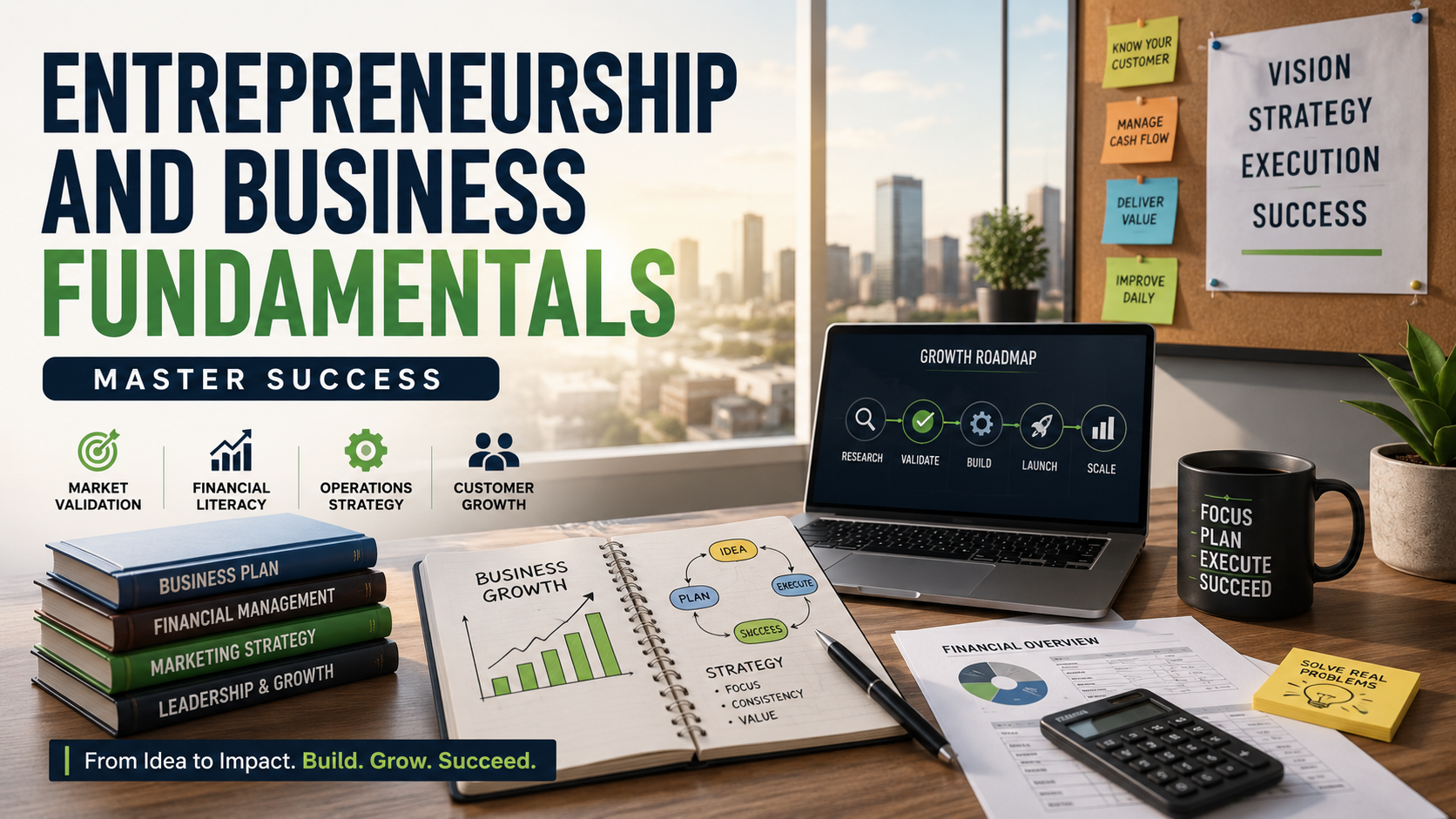
Entrepreneurship and Business Fundamentals: Master Success

Entrepreneurship and Business Fundamentals: Master Success

Starting a new venture is an incredibly exhilarating journey, but relying solely on raw passion rarely guarantees long-term commercial success. To build a truly resilient enterprise, founders must thoroughly master entrepreneurship and business fundamentals before launching their products into a fiercely competitive marketplace. Understanding these core pillars transforms a fragile startup idea into a structured, highly scalable corporation. According to resources provided by the U.S. Small Business Administration, strategic planning, risk management, and foundational legal knowledge are critical early milestones that safeguard early-stage companies from premature failure.

This comprehensive guide pulls back the curtain on what it really takes to transition from an aspiring creator to a seasoned business owner. We will explore market validation, financial mechanics, operational frameworks, and modern customer acquisition strategies. Furthermore, this breakdown provides actionable frameworks designed to mitigate risk while maximizing your market share. Whether your goal is to launch a local service business or scale a global technology platform, mastering these basics will serve as your ultimate growth blueprint. Embracing these core principles helps you make data-driven decisions that foster lasting enterprise value.

The Essential Blueprint for Modern Business Growth

Market Validation: The Core of Entrepreneurship and Business Fundamentals

Every successful enterprise begins by solving a real, deeply painful problem for a specific group of people. Market validation is the systematic process of proving that a genuine demand exists for your proposed solution before you invest significant capital. Too many founders commit the fatal error of building a product based on assumptions rather than concrete data. To avoid this trap, you must engage directly with your target audience through surveys, focus groups, and structured interviews to gather honest feedback.

Proving your concept early saves thousands of dollars and months of wasted development time. It allows you to refine your value proposition so that it resonates deeply with buyers. During this phase, you should focus on creating a Minimum Viable Product (MVP), which is a basic version of your offering containing only the essential features. Testing an MVP in the real world provides immediate, actionable insights that guide your product roadmap. By listening to early adopters, you can safely pivot your strategy before scaling up.

Identifying Your Ideal Customer Profile

You cannot sell your product to everyone, and attempting to do so will quickly drain your marketing budget. Founders must explicitly define their target market through psychographics, buying behaviors, emotional pain points, and clear demographics. Creating highly detailed buyer personas allows you to tailor your product features and copywriting precisely to the people most likely to buy.

Understanding your customer journey ensures that your sales messaging hits the right notes at the right time. When you know their daily frustrations, you can position your product as the ultimate relief. This targeted approach dramatically improves your conversion rates and fosters long-term customer loyalty from day one.

Conducting Competitive Analysis

To stand out in a crowded marketplace, you must thoroughly evaluate your existing and indirect competitors. Identify their strengths, weaknesses, pricing strategies, customer service flaws, and overall market positioning. Discovering a clear gap in their service offers you a powerful competitive advantage that you can exploit immediately.

Analyze their customer reviews to see what users complain about most frequently. If their users struggle with poor customer support or outdated software interfaces, make those areas your core strengths. Continuous competitive analysis ensures you remain proactive rather than reactive, keeping your brand ahead of industry shifts.

[Identify Problem] ➔ [Define Target Market] ➔ [Analyze Competitors] ➔ [Test MVP]

Financial Literacy: Budgeting and Corporate Commercial Foundations

Cash flow is the undisputed lifeblood of any young enterprise, regardless of industry. A brilliant concept will quickly collapse if you run out of capital before reaching operational profitability. Founders must learn to read financial statements with confidence, treat budgeting as a daily discipline, and monitor their burn rate constantly. Managing expenses prudently while aggressively pursuing revenue opportunities creates financial runway for your team.

Understanding the difference between cash flow and net profit is vital for survival. A business can look highly profitable on paper while completely lacking the actual cash required to pay its immediate bills. By maintaining a healthy capital reserve, you protect your company from unexpected market downturns and sudden economic shifts. Sound financial habits build immense trust with banking institutions, vendors, and future investment partners.

  • The Big Three Statements: You must master the Balance Sheet, Income Statement, and Cash Flow Statement to accurately track your financial health over time.

  • Pricing Strategy: Set your prices based on customer value, production costs, and competitor benchmarks to protect your long-term profit margins.

  • Bootstrapping vs. Raising Capital: Decide early if you will self-fund your growth through revenue or pitch to venture capitalists and angel investors.

Operations Strategy: Establishing Solid Business Management Pillars

Operations represent the engine room of your company, dictating how efficiently inputs turn into valuable outputs. Streamlining your day-to-day workflows ensures that your business runs smoothly without requiring your constant, direct supervision. Documenting your standard operating procedures (SOPs) allows you to delegate critical tasks to your team members with complete confidence.

An efficient operational framework reduces waste, optimize resource allocation, and improves overall team productivity. As your customer base grows, your systems must scale seamlessly alongside it without causing service degradation. Focusing on operational excellence allows leadership to step away from daily firefighting and concentrate fully on long-term macro strategy.

Embracing Digital Transformation

Modern business requires the deliberate adoption of cloud-based infrastructure to maintain agility. Utilizing robust project management software, automated customer relationship management (CRM) platforms, and centralized communication tools eliminates costly operational friction. Automation saves valuable time and minimizes the risk of human error across all departments.

By integrating your software applications, you create a single source of truth for your corporate data. Employees can access information instantly, leading to faster decision-making and better internal collaboration. Embracing digital tools ensures your business remains nimble enough to adapt to rapidly evolving industry standards.

Supply Chain and Inventory Management

If your business sells physical products, managing your supply chain efficiently is absolutely non-negotiable. Establish strong, transparent relationships with multiple reliable vendors to avoid sudden production disruptions or unexpected material shortages. Implementing just-in-time inventory practices helps keep your overhead costs low while meeting customer demand promptly.

Regularly audit your fulfillment processes to find bottlenecks that slow down shipping times. Optimized logistics directly improve customer satisfaction and encourage repeat purchases. By protecting your supply chain from volatility, you secure a stable foundation for predictable business scaling.

Strategic Marketing: The Growth Engine of Entrepreneurship and Business Fundamentals

Great products fail every single day simply because nobody knows they exist in the market. Developing a scalable, predictable customer distribution engine is what separates market leaders from struggling startups. When applying entrepreneurship and business fundamentals, you must combine organic brand building with targeted outreach to capture attention, build deep trust, and convert casual prospects into brand advocates.

A diverse marketing mix protects your business from relying too heavily on a single traffic source. As algorithms change, having multiple acquisition channels ensures your pipeline remains full. Consistency in your messaging across all platforms establishes a strong brand identity that customers remember easily over time.

Content Marketing and Organic Search

Building long-term brand authority requires a consistent commitment to organic search growth. By publishing deeply educational, SEO-optimized content, you attract high-intent web visitors without paying for every single click. This strategy builds sustainable trust and positions your brand as an authoritative industry thought leader.

Organic content keeps working for your business long after it is originally published. It addresses customer questions, reduces the burden on your support team, and nurtures prospects through the sales funnel automatically. Over time, high search rankings turn your website into a powerful asset.

Paid Acquisition and Performance Marketing

When you need immediate traffic and fast data, paid channels like Google Ads and Meta campaigns offer rapid scalability. Carefully track your Customer Acquisition Cost (CAC) against your Customer Lifetime Value (LTV) to protect your bottom line. Your LTV must comfortably exceed your CAC to ensure profitable, sustainable long-term scaling.

Analyze your ad performance weekly to eliminate low-performing campaigns and scale winning creatives. Paid acquisition provides the immediate visibility required to test new offers and land early customers quickly. When balanced correctly with organic marketing, it creates a highly aggressive growth engine.

FAQ SECTION

What are the four pillars of entrepreneurship and business fundamentals?

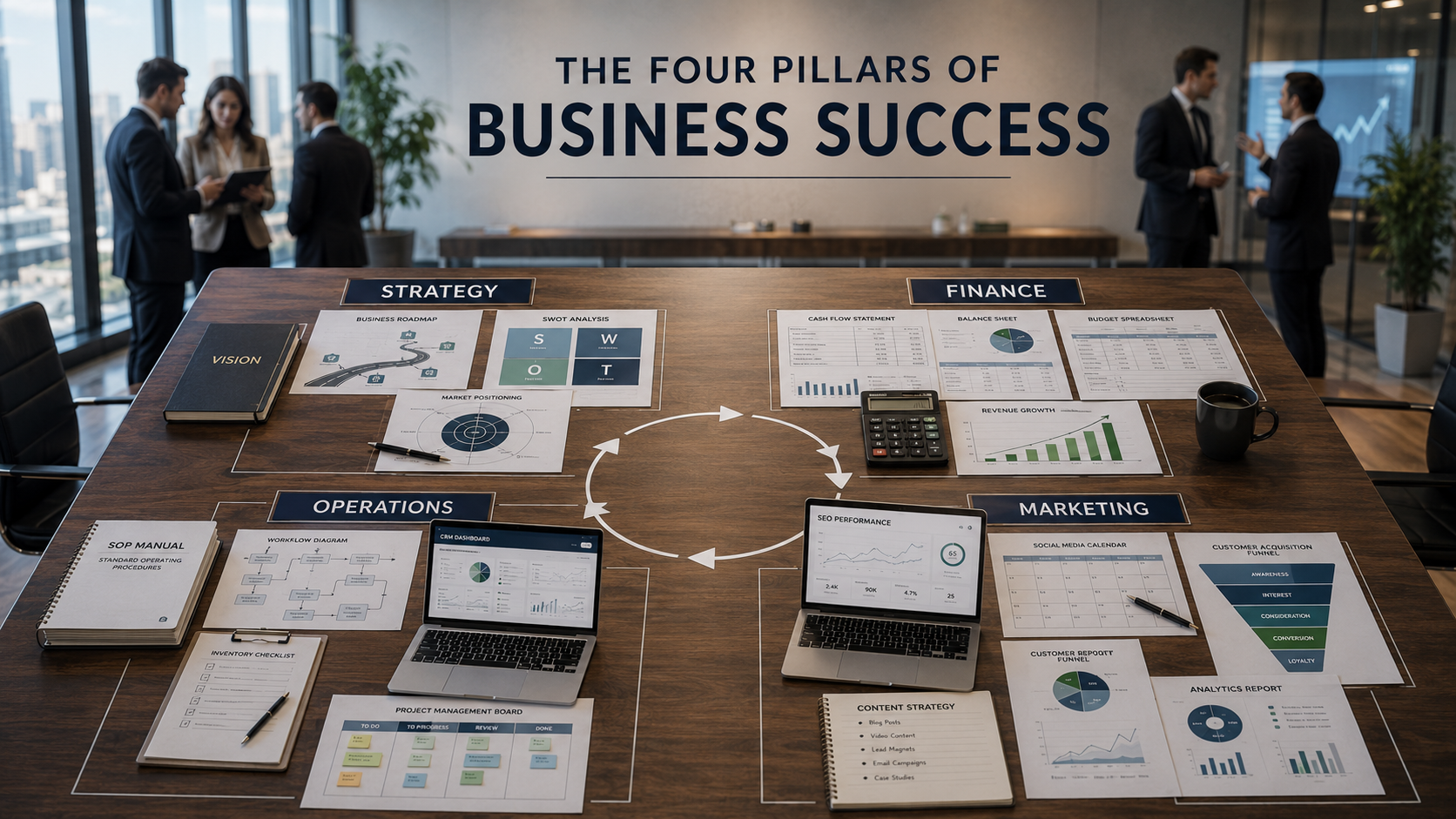
The four pillars encompass strategy, finance, operations, and marketing. Strategy focuses on defining your core value proposition, identifying market trends, and establishing a sustainable competitive position. Finance ensures you manage your cash flow, analyze profit margins, set correct pricing, and secure appropriate funding intelligently. Operations deal with building scalable internal systems, managing supply chains, maintaining legal compliance, and streamlining daily workflows. Finally, marketing governs how you attract, convert, and retain customers over time through targeted channels. Balancing these four distinct components creates a highly stable, resilient foundation for long-term growth. When a founder ignores any single pillar, the entire enterprise becomes vulnerable to market pressures. Therefore, developing a holistic understanding of all four disciplines is essential for anyone wishing to transition from a simple solopreneur to a successful chief executive officer who leads an enduring organization.

How do I write an effective business plan for a new startup venture?

An effective business plan outlines your company objectives, target market, financial projections, and operational strategy clearly and realistically. Keep it concise, professional, and entirely data-driven, avoiding overly optimistic assumptions that cannot be backed up by research. Start with a compelling executive summary that captures attention, followed by a detailed market analysis proving consumer demand. Include realistic financial forecasts, such as break-even analyses and cash flow projections for the next three to five years. Update this document regularly as your business pivots, gathers real-world market feedback, and adapts to economic shifts. A business plan should act as a living roadmap rather than a static document forgotten in a drawer. Investors look for clarity, risk mitigation strategies, and a deep understanding of milestones, making execution detail far more valuable than vague, idealistic prose.

Why do most early-stage startups fail within the first five years of operation?

Most startups fail due to a lack of market need, poor cash flow management, or wrong team alignment. Many passionate founders build products before validating actual customer demand, resulting in solutions looking for a problem. Others mismanage their working capital, burning through their seed funding before achieving true product-market fit or generating consistent revenue. Understanding foundational business principles mitigates these risks significantly by emphasizing rigorous market research, disciplined cash flow tracking, and agile execution strategies. Additionally, internal team conflicts and a lack of complementary skills often derail promising ventures before they can scale. By focusing on fundamental business health over vanity metrics, entrepreneurs can spot warning signs early, adjust their operations, and protect their capital reserves, thereby beating the statistical odds of early failure.

What is the difference between bootstrapping and venture capital funding for growth?

Bootstrapping means self-funding your company using personal savings, lean initial operations, and early customer revenue to fuel your growth. This approach allows you to retain full equity ownership and complete operational control, though your overall scaling speed might be significantly slower. Conversely, venture capital involves selling a percentage of corporate equity to professional investors in exchange for substantial, rapid growth funding. This accelerates your time-to-market and allows for aggressive customer acquisition, but it introduces heavy external pressure and dilutes your founder ownership. The right choice depends entirely on your personal goals, industry dynamics, and how fast your market moves. Bootstrapped founders answer only to their customers, whereas venture-backed founders must meet strict quarterly milestones set by a board of directors aiming for a massive exit.

How can a new entrepreneur successfully protect their corporate intellectual property?

Entrepreneurs protect their innovations through patents, trademarks, copyrights, and strict non-disclosure agreements (NDAs). Trademarks safeguard your unique brand name, logos, and slogans, while utility patents secure proprietary technologies, inventions, and mechanical processes. Use robust NDAs whenever you are discussing proprietary ideas or trade secrets with external partners, contractors, or overseas manufacturers. Consulting an experienced intellectual property attorney early in your journey safeguards your competitive advantage from future corporate infringement or theft. Failing to secure these legal rights early can lead to costly litigation or competitors copying your exact business model without legal consequences. View intellectual property protection as a mandatory insurance policy that builds long-term enterprise value and reassures institutional investors that your market position is fully defensible.

CONCLUSION

Building a thriving company requires a delicate, continuous balance between visionary thinking and strict operational discipline. By mastering entrepreneurship and business fundamentals, you equip yourself with the essential tools needed to navigate the volatile landscape of modern commerce. Remember that sustained business success is rarely a matter of luck; it is the predictable result of thorough market validation, sound financial stewardship, and relentless operational execution.

Do not rush the foundational process of setting up your venture. Take the necessary time to analyze your competitors, optimize your monthly cash flow, and build scalable systems that can support long-term growth. As you implement these core principles, focus on delivering consistent value to your target audience while continuously developing the essential skills needed to start an art business if you’re entering the creative industry. Now is the perfect time to audit your current business strategy, identify operational bottlenecks, and apply these fundamentals to build a sustainable, profitable enterprise. True leadership is about turning chaos into order, and by anchoring your business in proven fundamentals, you ensure your company is built to last.

ChatGPT vs Gemini: Which AI Is Better in 2026?

ChatGPT vs Gemini: The Ultimate AI Showdown for 2026

Choosing the right artificial intelligence tool used to be simple. However, the rapid evolution of large language models has turned it into a complex decision. When evaluating chatgpt vs gemini, users often find themselves torn between two distinct ecosystems. Each platform offers unique strengths for personal and professional productivity.

Whether you want to automate workflows or generate creative content, understanding these platforms is essential. You can track the latest model updates directly on the OpenAI Official Website. This resource showcases how these systems evolve over time to meet user needs.

This deep-dive analysis will move past the basic marketing hype. We will evaluate their reasoning capabilities, user interfaces, speed, and overall integration value. By the end of this guide, you will know exactly which platform deserves a spot in your daily tech stack.

Both tools have introduced groundbreaking updates recently. Because of this, a direct head-to-head comparison is vital for professionals. If you’re also exploring the latest AI-powered creative platforms, check out our best AI tools for image generation in 2026 guide to discover the top solutions for generating high-quality visuals. Using the right automated tools helps you stay competitive in a fast-moving market.

Understanding the Core Architecture: ChatGPT vs Gemini

To understand why these tools behave differently, we must look under the hood. ChatGPT is built on OpenAI’s generative pre-trained transformer models. These models excel at deep textual reasoning and nuanced conversation. OpenAI has historically prioritized conversational depth. This design makes the tool feel like a highly intellectual, collaborative peer.

The system relies on advanced reinforcement learning from human feedback. This training helps it grasp subtle emotional cues, humor, and complex creative guidelines. Other platforms sometimes miss these subtle nuances completely.

On the flip side, Google built Gemini as a native multimodal model. This means Gemini does not just translate images, audio, and video into text. Instead, it processes these distinct media types simultaneously.

Consequently, Google’s model behaves like a live research assistant. It is inherently wired to look at the world through multiple lenses at once. This structural design gives it an incredible advantage when handling complex multimedia tasks. Users can upload mixed media inputs without losing any contextual precision during processing.

Practical Performance: Comparing ChatGPT vs Gemini in Action

The real test of any AI utility lies in daily execution. When you throw complex, multi-step prompts at these platforms, their differences become visible. Writers, engineers, and researchers all report drastically different outcomes. Your results will depend on which machine you choose to deploy for your projects.

Text Generation and Creative Writing OpenAI Styles

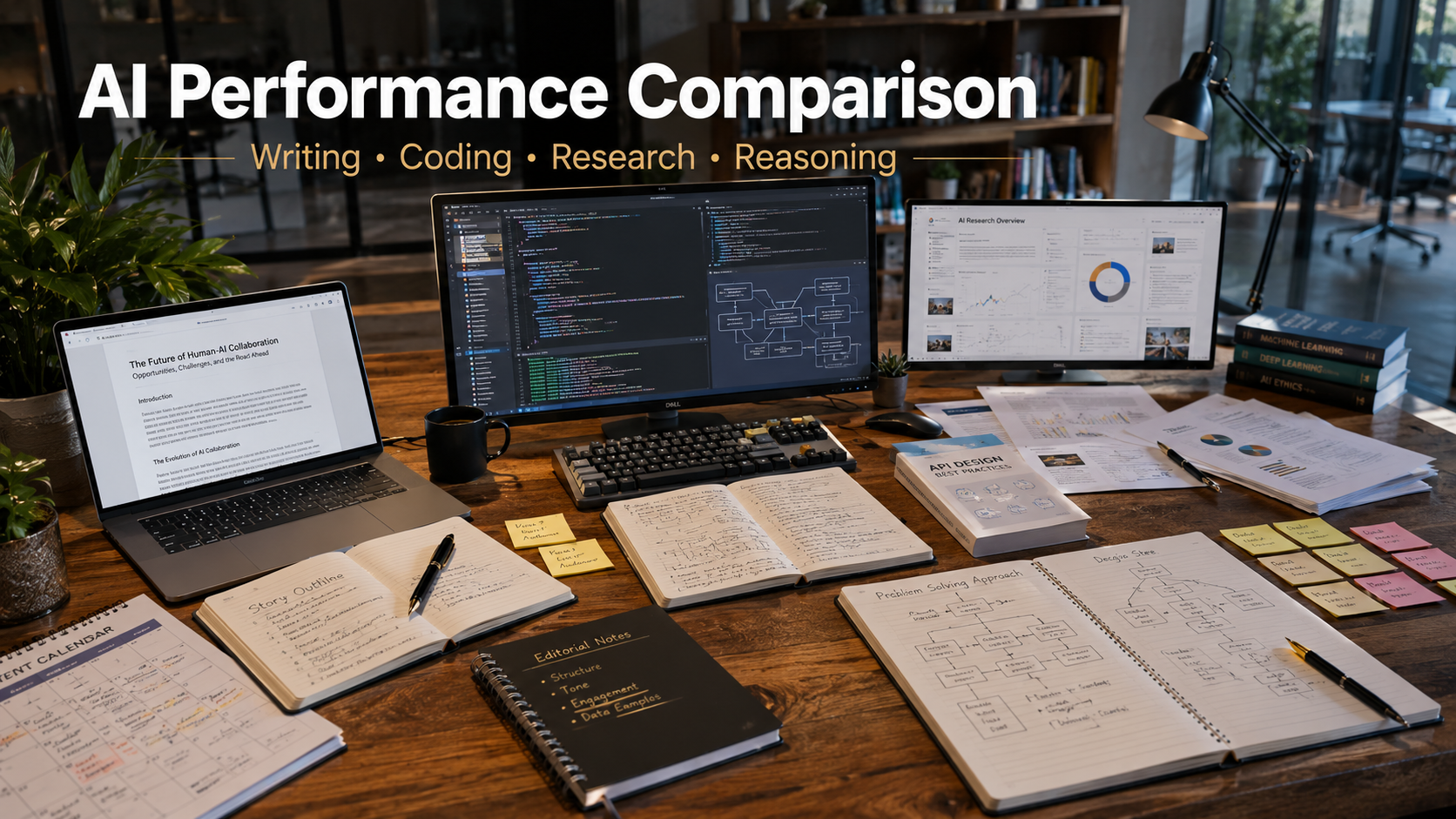
For long-form writing, content strategy, and creative brainstorming, ChatGPT generally maintains an edge. It adapts beautifully to specific brand voices. It also maintains complex narrative threads over long sessions.

The system tends to write with a less formulaic structure. Writers often prefer it because it avoids clichés. The prose feels genuinely human. It can craft poetry, technical manuals, or engaging essays with equal skill. It matches whatever tone you request almost instantly.

The Gemini platform excels at structuring massive amounts of information rapidly. If you need a bulleted executive summary of a 50-page document, Gemini handles the task cleanly. It can also provide a quick breakdown of complex public data.

It writes in a crisp, journalistic style that feels highly professional. However, it is occasionally less varied in tone than its competitor. It is the ideal tool for corporate communication where clarity and speed are valued over stylistic flair.

Coding and Technical Logic Google Models

Software development is another major engineering battleground for these platforms. Developers often lean toward ChatGPT for writing complex code blocks. It is excellent for debugging intricate software architecture and explaining high-level computer science concepts. Its logic loops feel tight.

Furthermore, it consistently produces fewer hallucinations in syntax. The platform can systematically walk a developer through a broken script. It identifies the exact line causing the runtime error while suggesting robust alternatives.

However, Google’s model counters this with an incredibly massive context window. Because it can process huge amounts of data at once, your workflow changes. You can upload entire code repositories into the prompt window.

This capacity allows the system to analyze your whole project layout simultaneously. It spots cross-file dependencies and systemic structural bugs. Standard models with smaller windows would completely ignore or forget these details during longer conversational threads.

Ecosystem Integration: Google vs OpenAI Platforms

Your choice between these systems will likely depend on your current software tools. The value of an AI assistant multiplies dramatically when it connects seamlessly with your files. Good tools prevent manual copy-pasting by syncing with your communication channels and cloud storage.

Google has woven Gemini directly into Workspace apps like Docs, Gmail, Drive, and Sheets. If your daily workflow lives inside Google’s ecosystem, this is a massive time-saver. You can summarize your unread emails or pull data directly out of a spreadsheet via a sidebar chat.

Furthermore, Gemini leverages Google Search for real-time web grounding. This connection makes it exceptionally fast at fetching breaking news or live web links. It transforms your traditional cloud storage into an interactive, intelligent knowledge base.

OpenAI takes a platform-agnostic approach with its ecosystem. Instead of locking you into a single corporate suite, it offers a highly customizable environment. You can access this via the GPT Store.

Users can build or deploy specialized mini-apps designed for precise professional roles. These include custom SEO auditors, academic research assistants, or specific math tutors. This flexibility allows developers and businesses to create highly targeted workflows. They can connect to various external APIs easily, making it a very flexible engine for custom software development.

Turning Insights into Action: Reviewing ChatGPT vs Gemini Winners

Ultimately, selecting your primary assistant comes down to identifying your primary bottleneck. Neither tool is universally superior across every single metric. Instead, they serve different operational styles.

It is often wise to maintain access to both platforms. You can deploy each one strategically depending on the specific demands of your project. This balanced approach ensures you always have the right tool for the job.

  • Choose ChatGPT if: You prioritize deep intellectual reasoning. It is ideal if you need advanced coding assistance or require precise stylistic control over written content. It remains the premium choice for users who demand deep conversational intelligence and advanced problem-solving logic.

  • Choose Gemini if: You live inside Google Workspace daily. It is perfect if you need to process massive files or long videos in a single prompt. It also shines if you rely heavily on rapid, real-time web research and data aggregation. It stands out as the ultimate modern research station for high-velocity data processing.

Frequently Asked Questions

Which tool is better at research, ChatGPT or Gemini?

The Gemini platform generally holds the upper hand for rapid web research. This is because it connects natively to Google’s search index. It excels at finding real-time data, summarizing live news events, and citing recent web sources accurately.

The ChatGPT system is also highly capable at web browsing. However, it tends to prioritize deep analytical processing over sheer retrieval speed. If you need quick, up-to-the-minute facts, choose Gemini. If you need a deep, multi-perspective synthesis of an academic topic, ChatGPT often delivers a more nuanced response.

Gemini’s integration with live data allows it to build comprehensive bibliographies quickly. It fetches active hyperlinks and cross-references fresh articles from the web. This makes it a great asset for journalists or analysts who need to monitor fast-moving current events. It helps track corporate financial announcements as they break publicly, ensuring your reports remain perfectly accurate and timely.

Can both models process images and videos natively?

The Gemini model was built as a native multimodal platform. This means it handles images, audio, and video files with exceptional ease. You can upload a video file and ask it to find a specific timestamp. It can also summarize the spoken content directly for you.

The ChatGPT platform also possesses excellent multimodal capabilities through its advanced vision systems. This allows users to upload documents, charts, and photographs for deep analysis. However, ChatGPT handles video primarily through frame-by-frame extraction or text transcripts.

In contrast, Gemini treats video as a unified, continuous stream of input data. This allows Gemini to notice subtle visual movements or audio shifts across a long clip. Text-based conversion methods might overlook these details entirely. For users working heavily with mixed media, design files, or raw video footage, Gemini offers an integrated processing pipeline. This streamlines asset management and visual analysis without requiring external third-party conversion software tools.

Is ChatGPT safer to use than Gemini for sensitive data?

When discussing chatgpt vs gemini security, both companies maintain strict, enterprise-grade data privacy frameworks for their paid tiers. This ensures customer data is not used to train future public models. For free users, both platforms may log interactions for system improvements. You can manually opt out of this tracking in the settings menu.

Google aligns its safety protocols with its global cloud infrastructure standards. OpenAI complies with rigorous data security frameworks used across tech industries. Always check your organization’s internal compliance policies before uploading proprietary code or sensitive personal information into any public AI portal.

Paid corporate tiers, such as ChatGPT Enterprise or Gemini Advanced for Workspace, provide dedicated compliance certifications like SOC 2. This ensures your proprietary research, legal briefs, or medical records are completely isolated from public view. This level of enterprise security gives modern corporations the confidence to deploy automated workflows safely across sensitive financial and administrative departments.

Do these platforms offer free tiers for casual users?

Yes, both platforms offer robust free tiers that grant access to highly capable baseline models. The free version of ChatGPT gives you access to standard conversational models. It features occasional caps on advanced reasoning access during peak traffic hours.

Google’s free version of Gemini provides fast response times and seamless web search capabilities without cost. Both companies offer premium monthly subscriptions, usually priced around twenty dollars. These subscriptions unlock their absolute highest-performing models, larger context windows, priority server access, and advanced data analysis features.

Casual users can easily accomplish basic proofreading, email drafting, and general brainstorming using the free versions. They can do this without ever hitting restrictive paywalls. However, professionals who require heavy computational lifting, massive file uploads, or continuous API access will find that the paid tiers offer an immense return on investment. They significantly reduce your weekly operational overhead and save hours of manual labor.

Which assistant is better for learning to code?

The ChatGPT system is widely favored by software developers and students for learning how to program. It breaks down complex syntax errors clearly. It also provides well-commented code blocks and excels at step-by-step logic explanations.

The Gemini tool is also very capable at coding. It offers a distinct advantage when you need to upload large, pre-existing codebases or massive documentation files for context. For learning coding fundamentals and debugging specific script errors, ChatGPT remains the industry favorite. Meanwhile, Gemini shines at high-volume repository analysis.

ChatGPT feels like an algorithmic tutor that patiently explains why a specific function failed. This helps beginners build solid conceptual mental models of software design. Its code snippets are generally clean and ready to execute immediately. Gemini is ideal when you are joining a large, complex project. It helps you figure out how hundreds of pre-existing script files interact with one another across an enterprise network layout.

Conclusion

The ongoing development of chatgpt vs gemini shows that the AI landscape is shifting. The market is moving away from generalized text bots and toward highly specialized, integrated digital partners. OpenAI continues to push the boundaries of raw logical reasoning, deep creative writing, and custom agent development. Meanwhile, Google has leveraged its massive search infrastructure and workspace dominance. It turned its model into a speedy, context-rich powerhouse that can handle diverse file formats smoothly.

Instead of searching for a single winner, look closely at how you work. If you need a creative collaborator that can puzzle through complex technical problems, invest your time in ChatGPT. If you want an analytical assistant to sort through large volumes of mixed media, Gemini is tough to beat.

Try running your most frustrating weekly task through both platforms. This test will show which logic style fits your workflow best. Embracing these advanced automated utilities will undoubtedly give you a massive competitive advantage as digital workflows continue to accelerate globally.

Semester vs Year: Which Academic Calendar Is Best?

Semester vs Year: Choosing the Best Academic Calendar for Your Studies

When planning your higher education journey, understanding your academic calendar is vital. The debate of semester vs year tracking shapes how you absorb information. It dictates how you manage your time and balance your life outside the classroom. Whether you are transitioning from high school or looking to study abroad, pacing directly impacts your success. Selecting a layout that contradicts your habits can lead to unnecessary stress and friction.

According to the U.S. Department of Education, academic calendar design influences everything from financial aid to scheduling. Some universities divide their periods into two intensive blocks. Other institutions use a linear, year-long framework. Each system has unique benefits and challenges that dictate your routine. This guide breaks down the core differences to help you choose the right path for your learning style.

Understanding the Basics: Semester vs Year Systems

To make an informed decision, you must understand how these two systems function. They distribute teaching hours, exams, and vacation periods differently throughout the calendar year. The underlying philosophy of each system changes the rhythm of campus life. This structural layout deeply affects when you are busy and when you can rest.

What Is a Semester System?

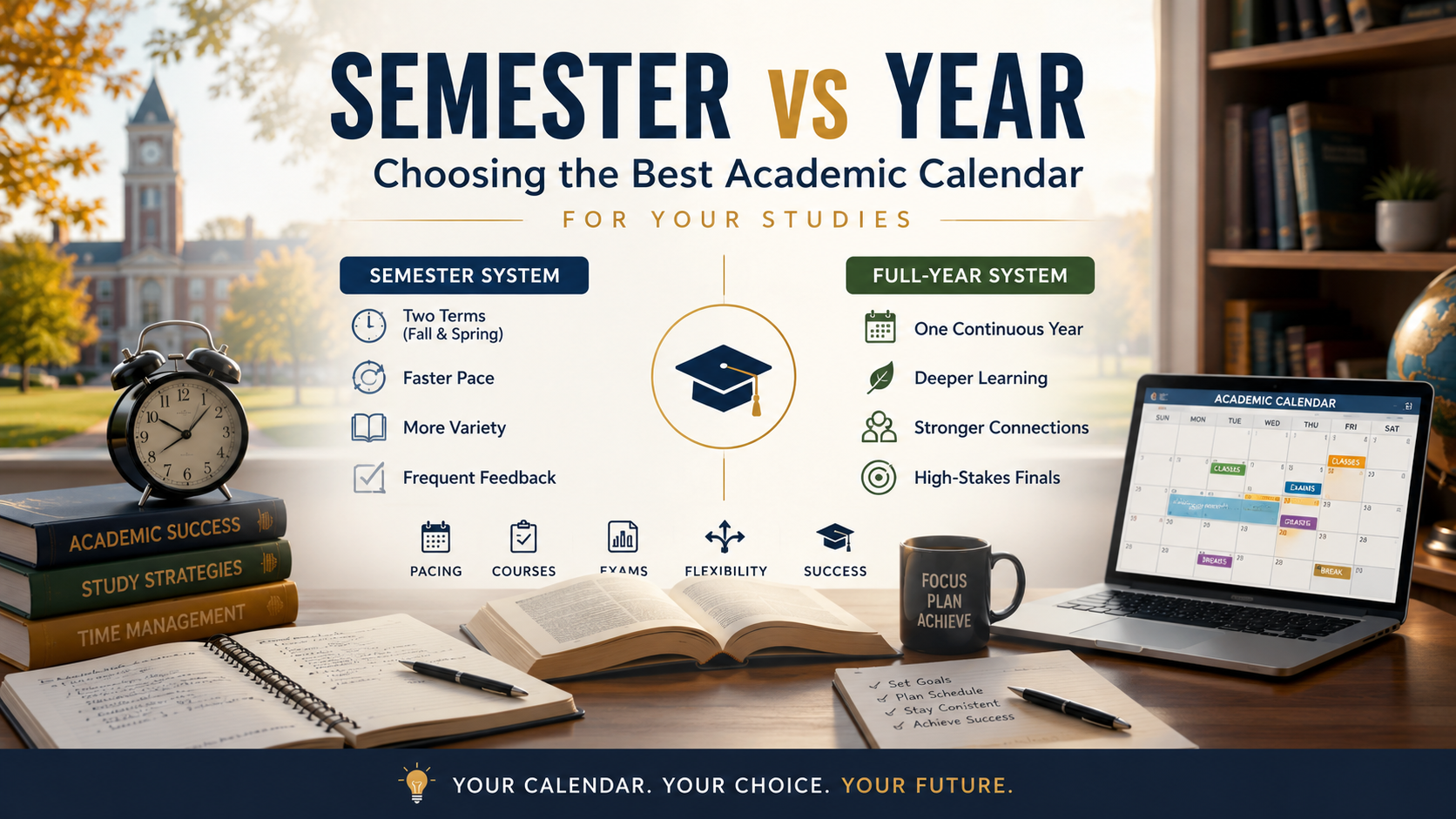
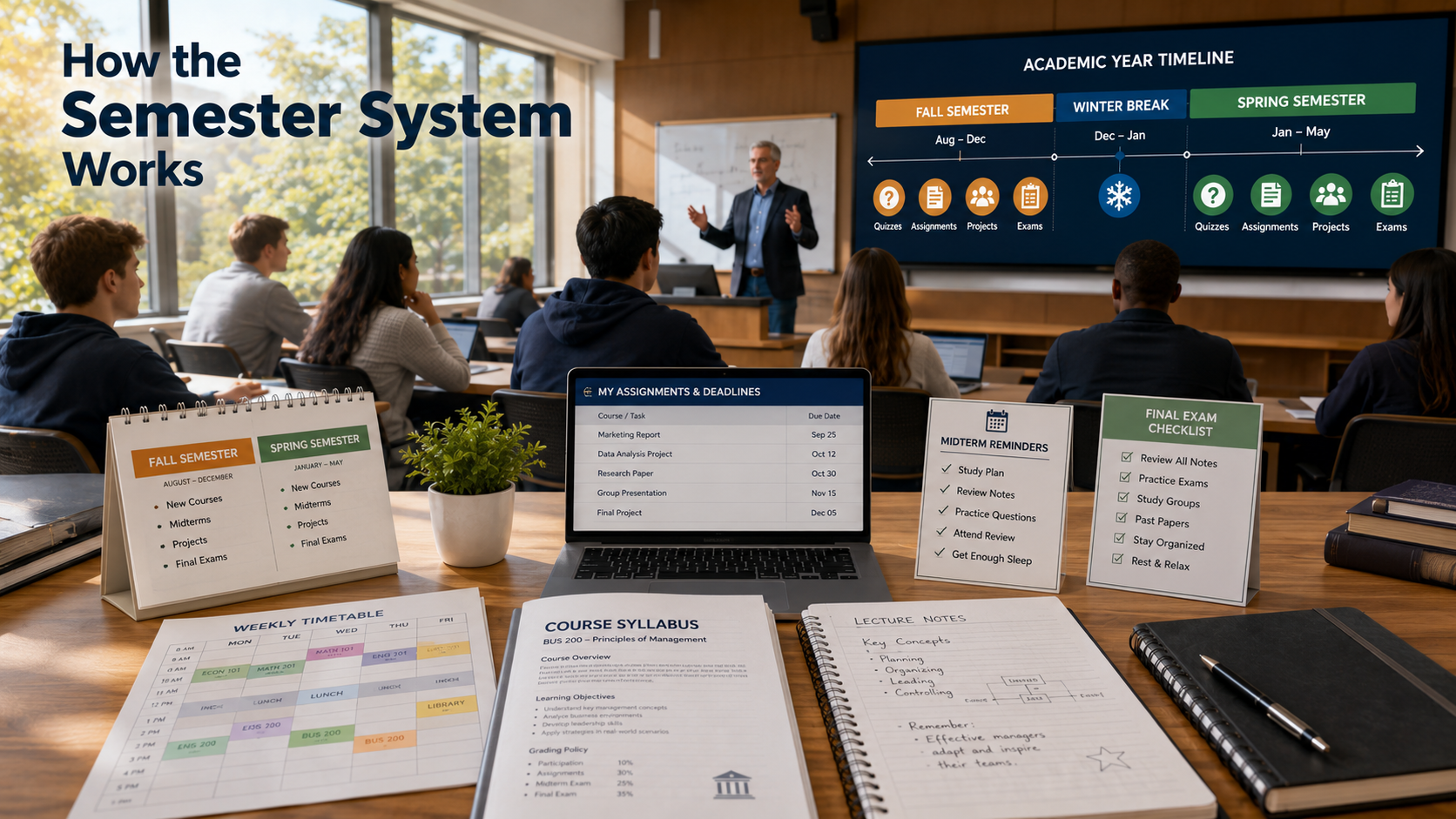
The semester system divides the academic year into two main terms: fall and spring. Each term typically lasts 15 to 17 weeks of active instruction. Students take a specific set of courses for one term, complete finals, and receive permanent grades. When the next term begins in January, they start entirely new classes with a clean slate. This system is highly popular in North American higher education and rotates topics rapidly.

Because the timeframe is short, the educational energy remains consistently high. Students quickly settle into a fast routine of weekly readings, quizzes, and projects. This structure prevents procrastination since major assessments occur every few weeks. It also allows students to experience a vast array of subjects within a single academic year. By changing classes in January, you double the number of professors you meet and expand your academic network. This rapid rotation keeps the college experience fresh, dynamic, and highly adaptable for students who enjoy fast transitions.

What Is a Full-Year System?

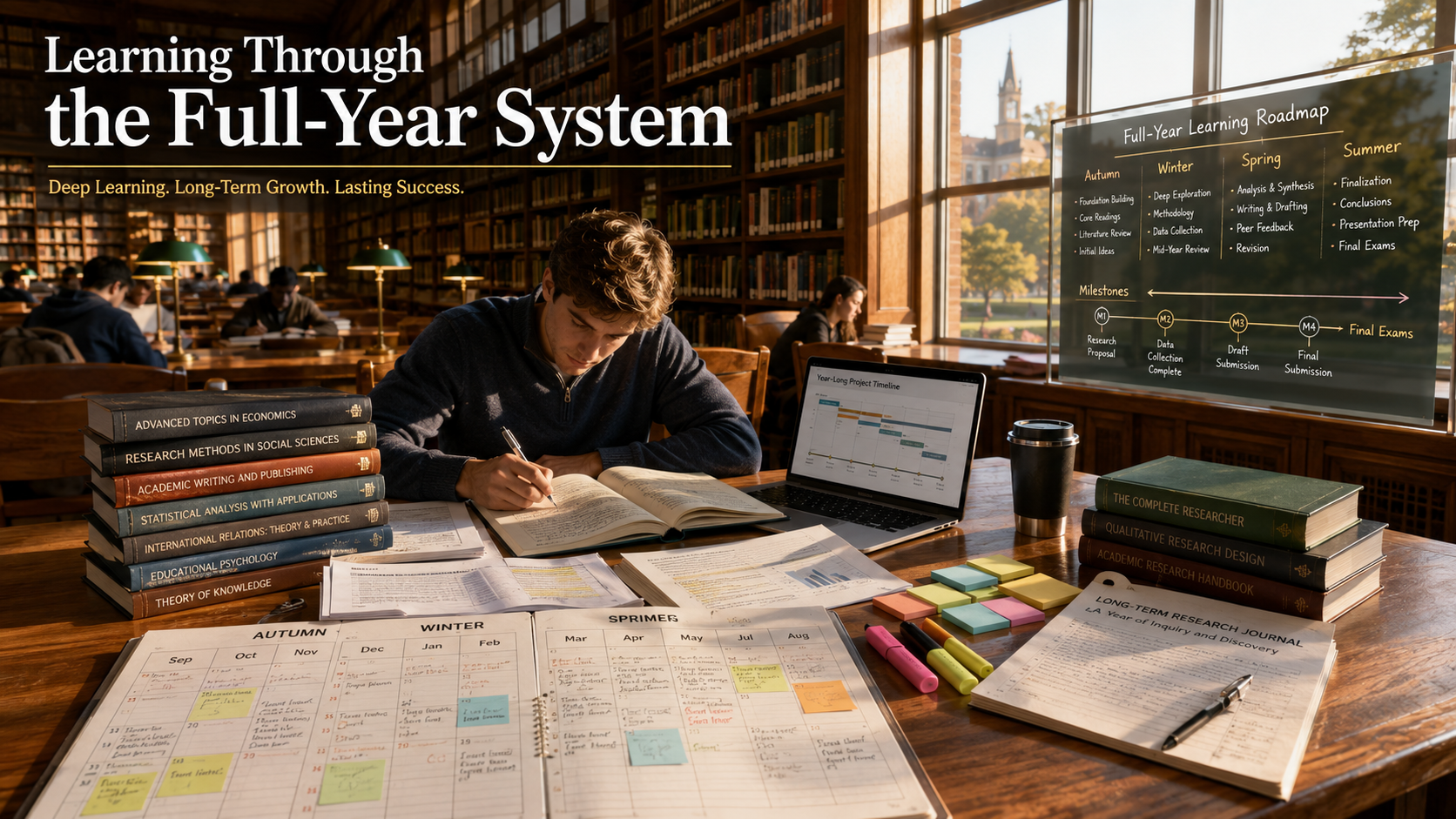
A full-year system tracks courses continuously from autumn until early summer without a mid-year disruption. Instead of breaking classes into distinct blocks, you take the same modules for roughly 30 to 32 weeks consecutively. Final exams and primary evaluations usually occur at the very end of the academic year. This linear approach is traditional in many European universities, fostering a deeply immersion-focused environment.

This continuous structure allows you to absorb complex academic material at a measured, organic pace. Instead of rushing through a textbook in three months, you explore the nuances of a subject over an extended timeline. Professors have the freedom to assign massive, year-long research projects and extensive reading lists. Students build exceptionally strong bonds with their peers and mentors because the classroom community remains intact for the entire year. While it requires immense long-term dedication, this format eliminates the chaotic stress of mid-year adjustments and allows for a profound, deeply specialized intellectual journey.

Course Load and Pacing: Semester vs Year Timelines

The speed at which you cover material changes when comparing a semester vs year schedule. In a semester framework, the pace is inherently fast and energetic. Because you only have 15 weeks per class, professors dive into complex topics quickly. You might take four or five classes at once. This requires sharp time-management skills to juggle multiple assignments. However, the distinct benefit is variety. If you do not enjoy a class, the term ends quickly.

Conversely, year-long systems offer a slower, more deliberate educational journey. You study the same subjects deeply over many months, allowing ideas to mature. This structure allows you to build a stronger relationship with your professors and classmates. The pacing feels manageable on a week-to-week basis because there is no rush. However, you must maintain your stamina, as autumn material is still tested the following May.

Impact on Exams and Grading Systems

Grading philosophies differ wildly between these two academic timelines, altering how students approach study habits. The distribution of stress throughout the year depends on how your institution structures evaluations. Comparing a semester vs year setup highlights two distinct paths to earning your degree.

  • Semesters offer frequent milestones: You receive midterm grades, final grades, and GPA updates twice a year. This continuous feedback loop allows you to pivot and change study habits if your grades slip early on. It reduces long-term anxiety because a single poor performance does not ruin an entire year.

  • Yearly systems rely on high-stakes finals: Your entire grade often depends on a massive exam period at the end of the year. While this eliminates December finals stress, it creates immense pressure during the spring. You must remember months of lectures for one decisive afternoon.

Flexibility, Degree Terminology, and Graduation Timelines

If you want control over your schedule, the calendar style matters immensely for your academic trajectory. The semester model provides excellent structural flexibility for modern students. Since courses reset twice a year, you can easily alter your major, take a leave, or add a minor. If you drop a class, you can usually retake it just a few months later.

Full-year systems are much more rigid by design. If you fail a core module in a year-long program, you often wait an entire calendar year to retake it. This structural rigidity can delay your graduation significantly if you encounter unexpected life events. However, year-long programs usually offer stable schedules that align well with long-term industrial placements and local internships.

FAQ SECTION

How many classes do you take in a semester vs year system?

In a semester system, full-time students generally take four to five courses per term, totaling eight to ten classes per year. In a full-year system, you typically register for five to six modules at the beginning of the year. You maintain those exact same subjects until the summer. While the total number of subjects might seem similar, the execution is entirely different. The semester system requires you to switch focus halfway through the year, which demands quick adaptation. The yearly system demands sustained attention on fewer simultaneous topics over a longer duration, allowing deep exploration without a winter reset.

Which format works best for international study abroad programs?

The semester system is usually much easier for international study abroad arrangements because of global alignment. Most exchange programs operate on a half-year basis, allowing you to plug into an autumn or spring term abroad. Comparing the semester vs year options shows that a full-year university can create severe credit transfer complications. If your home university uses year-long modules, you will likely need to commit to studying abroad for an entire academic year. This ensures you do not miss critical course content or final examinations anchored to the end of the year.

Do semester systems have shorter winter breaks?

Yes, universities using a semester system often have different winter break structures compared to year-long schools. A semester break typically lasts three to four weeks between late December and mid-January. This completely separates the fall and spring terms. This break is highly relaxing because your autumn exams are already finished, leaving you with no looming assignments. Year-long institutions also offer winter breaks, but students frequently must spend that time reviewing notes. Because their courses are only half-finished and major exams lie ahead, the winter break feels like a temporary pause.

Can I graduate faster in a semester system?

You can generally graduate faster within a semester structure due to how credits are distributed. Because classes reset every 15 weeks, schools frequently offer shortened summer and winter accelerated sessions. By taking these extra terms, you can accumulate credits quickly and graduate in three years instead of four. Year-long programs rarely offer this acceleration because their foundational courses span 30 weeks consecutively. This makes it impossible to condense them into a one-month summer blitz. If you want to fast-track your entry into the workforce, the semester model offers the flexibility you need.

Which calendar system causes less academic burnout?

Burnout depends entirely on your personal learning, working, and testing preferences, as both systems distribute pressure differently. The semester system creates short, intense bursts of stress because midterms and finals arrive quickly every few months. However, the frequent clean slates can keep you motivated because a stressful class ends quickly. The full-year system offers a low-stress environment for the first six months, allowing you to learn at a leisurely pace. However, pressure builds heavily toward the final months, creating immense psychological strain during spring exams.

CONCLUSION

Choosing between a semester vs year academic system comes down to how you prefer to learn, work, and manage stress. The semester system offers rapid variety, frequent fresh starts, and incredible flexibility for students who want to customize their path. Meanwhile, the traditional full-year system provides the time needed for deep intellectual exploration, comprehensive research projects, and a steadier daily pace.

Neither calendar is universally superior to the other; your success depends on matching the institutional structure with your personal habits. Those who thrive under constant milestones, enjoy changing subjects quickly, and prefer a clear separation between terms should consider semester-based universities. On the other hand, students who prefer long-term focus, steady deep analysis, and can handle a single high-stakes examination period are often better suited to a year-long program. If you’re also deciding on the right academic path, check out our guide on Diploma vs Degree: Which Is Better? to understand how different qualifications can impact your education and career. Analyze your goals, review your options, and choose the environment where you will truly find your rhythm.

Music Therapy: How Sound Heals Mind and Body

Music Therapy: How Sound Heals Mind and Body

Have you ever noticed how a favorite song can instantly change your mood? A great melody can ease your tension or bring back vivid memories. Sound has a profound impact on the human brain. Because of this, music therapy has become a vital, evidence-based healthcare profession worldwide. Far beyond just listening to relaxing tunes, this clinical practice uses targeted, personalized musical interventions. These sessions help people achieve specific health, emotional, and wellness goals. According to the American Music Therapy Association, qualified professionals design these sessions meticulously. They support individuals dealing with emotional, cognitive, and physical challenges across their entire lifespan.

This therapeutic approach works beautifully because our brains are naturally wired to respond to rhythm. We also react deeply to melody and harmony. When utilized systematically by a credentialed expert, music lowers chronic stress. It also improves functional speech and mitigates severe physical pain. For example, a patient might be recovering from a traumatic stroke. Another individual might be navigating daily life with severe anxiety. In both cases, tailored musical experiences offer a pathway to healing. These outcomes often surpass what traditional talk therapy can reach. In this comprehensive guide, we will explore how this therapeutic science works. We will analyze the different methods practitioners use. Finally, we will highlight the tangible benefits it offers to modern medicine. Clinical research consistently proves that sound is a powerful, reliable form of healing.

Understanding the Science Behind Clinical Music Therapy

To fully appreciate why musical interventions work so effectively, we must look at the human brain. We need to examine how it processes complex sound waves. Neurological research demonstrates that music activates multiple areas of the central nervous system simultaneously. It does not rely on a single, localized region. Specifically, it stimulates the temporal lobe to process direct auditory input. It also engages the frontal lobe to analyze structural patterns. Meanwhile, it triggers deep emotional responses within the limbic system. Music engages both the left and right hemispheres at the same time. Because of this dual activation, it creates new neural pathways. It also strengthens existing connections throughout the brain.

Doctors frequently leverage this unique neurological phenomenon during intense cognitive and physical rehabilitation. The scientific community refers to this process as neuroplasticity. For instance, rhythmic auditory stimulation helps stroke patients regain their walking balance. It improves their spatial awareness and cognitive pacing by providing an external timing cue. Furthermore, actively engaging with music fundamentally alters your body chemistry. It shifts your autonomic nervous system out of a stressed state. Clinical studies consistently demonstrate that engaging with a steady rhythm reduces cortisol. Cortisol is the body’s primary stress hormone. Simultaneously, these interventions boost the production of dopamine, serotonin, and endorphins. These natural chemicals elevate human mood, enhance focus, and relieve physical discomfort safely.

Active vs. Receptive Methods in Sound Healing

Practitioners generally divide their clinical methods into two main functional categories. These are active interventions and receptive interventions. Both approaches offer unique therapeutic value. The choice depends on the patient’s immediate health goals, physical capabilities, and cognitive status. Active interventions require patients to participate dynamically. They might sing, play accessible instruments, write original lyrics, or move to a steady beat. This hands-on method fosters emotional self-expression. It also improves fine motor skills and enhances social connection. This is especially valuable for individuals who feel isolated by their medical conditions.

On the other hand, receptive interventions involve patients listening to specific music. The clinician carefully chooses or creates live or recorded tracks for the session. This approach works exceptionally well for deep relaxation, pain management, and guided imagery. It also supports various meditative practices. The therapist carefully selects the tempo, volume, and instrumentation. This allows them to match or gradually alter the patient’s physiological state. For example, they can use sound to slow down a racing heart rate. Therapists easily balance these two core modalities during treatment. Consequently, a trained professional can adapt each session to meet the evolving needs of the individual. This careful customization ensures maximum therapeutic benefit for every client.

The Clinical Benefits of Targeted Music Therapy

Medical professionals utilize music therapy across a wide spectrum of modern healthcare environments. They implement these methods to improve patient outcomes significantly. Specialized programs support standard medical protocols beautifully in psychiatric hospitals and special education classrooms. They also thrive in oncology units and hospice care facilities.

Mental Health, Stress Relief, and Emotional Regulation

For individuals battling severe anxiety, music provides a safe, non-threatening container. It helps them process difficult emotions, clinical depression, or post-traumatic stress disorder (PTSD). Words often fail when someone tries to unpack deep-seated psychological trauma or grief. Instrument improvisation allows patients to express anger, sorrow, or fear perfectly. They do not need to articulate their thoughts into spoken language. Furthermore, creating a predictable, steady rhythm offers a profound sense of stability. It grounds individuals safely during emotional crises. Over time, these sessions help clients develop healthy coping mechanisms. They also build emotional resilience and regain a sense of personal agency over their mental wellness.

Cognitive Support, Memory Recall, and Dementia Care

One of the most remarkable applications of sound intervention occurs in dementia care. It also provides incredible support for individuals with Alzheimer’s disease. Advanced memory loss often causes individuals to struggle to recognize family members. Yet, musical memory frequently remains completely untouched by the disease. Playing familiar songs from a patient’s youth can instantly awaken their awareness. This musical trigger initiates a cascade of positive neurological responses. This sudden connection significantly reduces midday agitation. It also improves verbal communication and temporarily restores a beautiful sense of personal identity. It allows families to connect with their loved ones through shared singing. This practice beautifully bypasses the cognitive barriers created by dementia.

Physical Rehabilitation, Motor Skills, and Pain Management

In physical therapy settings, a steady musical rhythm serves as an invaluable external cue. It guides the human motor system efficiently. Parkinson’s disease patients often experience frustrating “freezing” episodes while attempting to walk. A steady, rhythmic beat helps their brains bypass the damaged neurological pathways in the basal ganglia. As a result, they can walk smoothly and safely across a room. Additionally, hospital patients who utilize sound therapy post-surgery report lower pain scores. They also tend to request less opioid medication from their medical team. This happens because the rich auditory stimulation completely occupies the nervous system. The sound effectively blocks standard pain signals from reaching conscious awareness in the brain.

What Happens During a Professional Music Therapy Session?

A professional clinical session is highly structured and goal-oriented. Therapists personalize each experience to the unique background of the individual. Certified therapists hold rigorous credentials. These qualifications ensure they thoroughly understand both complex musical theory and advanced clinical psychology. First, the therapist conducts a comprehensive initial assessment. They evaluate the client’s emotional wellness, physical limitations, cognitive abilities, and social history. Next, they design specific, targeted musical experiences. These activities directly address those identified healthcare needs over a set period.

A typical session might begin with original songwriting. This activity helps a patient process profound grief or life transitions. Immediately after, the therapist might introduce rhythmic breathing exercises. These techniques effectively lower an elevated heart rate. Therapists constantly monitor physiological data, body language, and verbal responses. This attentiveness allows them to adjust the tempo or style of the intervention in real time. They document progress systematically after every single encounter. This tracking ensures the treatment plan remains aligned with the patient’s overall medical goals. This disciplined approach ensures that every musical note played serves a clear purpose. Every sound contributes directly to the individual’s recovery journey.

FAQ SECTION

What exactly does a music therapist do during a typical treatment session?

A certified therapist assesses a client’s specific emotional, cognitive, and physical needs. They use this data to design custom musical experiences aimed at clinical improvement. Therapists use active techniques like instrument improvisation, singing, and songwriting. They also employ receptive techniques like guided listening and lyric analysis. These professionals work in hospitals, schools, and rehab centers. They help clients reduce anxiety, regain speech, or manage chronic pain safely. They track clinical progress using objective data, just like physical therapists or psychologists do. This tracking ensures the interventions evolve as the patient heals. Throughout a session, the therapist actively changes the music’s structure. They alter the tempo and key to match the patient’s heart rate. This makes it a highly dynamic and deeply clinical process.

Can music therapy help with severe anxiety and chronic stress disorders?

Yes, it is highly effective for managing severe anxiety, panic disorders, and chronic stress conditions. Listening to structured, slow-tempo music lowers cortisol levels effectively. It naturally slows down an overactive sympathetic nervous system. Active interventions help individuals express complex emotions. These include group drumming, songwriting, or lyric analysis. Clients often find these feelings difficult to verbalize due to trauma. Therapists teach clients how to use specific rhythms to ground themselves during panic attacks. This training provides a practical tool for long-term emotional self-regulation. Patients learn to sync their breathing with steady musical tempos. Consequently, they can systematically de-escalate their body’s fight-or-flight response. This practice leads to lasting relief and better emotional health over time.

Do you need to be musically talented to benefit from this type of therapy?

You do not need any prior musical training, talent, or special skills to benefit fully from this clinical treatment. The focus remains entirely on personal expression, emotional processing, and neurological healing. The therapist does not prioritize aesthetic perfection or technical skill. Therapists guide clients through simple percussion instruments, basic rhythms, or pure listening experiences. These activities require zero background knowledge to enjoy. The therapeutic value comes entirely from how your brain and body naturally respond to the sound vibrations. It does not depend on how well you play an instrument. Anyone can participate, regardless of their musical background. This openness makes it an incredibly accessible form of therapy for young children, elderly patients, and individuals with severe physical disabilities.

How does rhythmic stimulation aid stroke recovery and speech rehabilitation?

Stroke survivors often experience profound speech loss, a condition known as aphasia. They may also suffer from severe motor impairments on one side of their body. Music processes globally across both brain hemispheres. Because of this, therapists use singing to bypass damaged language centers on the left side of the brain. This technique helps patients relearn how to speak words through melody. Similarly, rhythmic auditory stimulation acts as an external pacing metronome for the motor cortex. This steady, predictable rhythm helps stroke patients rebuild smooth, balanced walking patterns. It also coordinates their physical rehabilitation movements accurately. By pairing movement with music, the brain forms new neural connections around the injured areas. This acceleration helps recover functional mobility and verbal communication skills.

Is music therapy covered by standard health insurance plans?

In many cases, health insurance companies cover these professional services. However, the treatment must be deemed medically necessary and officially prescribed by a licensed physician. Coverage varies widely depending on your specific insurance policy and geographic location. The clinical setting where treatment occurs also affects coverage. Insurance frequently covers these sessions under rehabilitative services, mental health benefits, or palliative care allocations. You should always check directly with your insurance provider to verify their specific reimbursement criteria. Be sure to ask about required documentation and credentialing demands before starting care. Many facilities also offer grant-funded programs or sliding scale fees. These options ensure patients can access these vital services even if insurance coverage is limited.

CONCLUSION

In summary, music therapy is a versatile, scientifically validated approach to healthcare. It beautifully bridges the gap between creative art and clinical medicine. By stimulating multiple complex regions of the human brain simultaneously, structured sound interventions promote lifelong neuroplasticity. They lower harmful stress hormones and trigger the release of vital, mood-boosting neurotransmitters. This practice helps stroke survivors regain their independent mobility. It also comforts vulnerable patients with advanced dementia. Clearly, its clinical applications are incredibly vast and deeply impactful. This unique practice reminds us that true healing involves the whole person. The mind, body, and spirit must work together in perfect harmony.

Hospitals, schools, and rehabilitation clinics worldwide continue to integrate these evidence-based techniques into their standard protocols. As they do, sound will undoubtedly remain a cornerstone of modern holistic medicine. You or a loved one might be searching for a dynamic, compassionate way to support your health. If so, consider reaching out to a board-certified professional. Alongside music-based therapies, adopting healthy daily habits can also improve emotional well-being. You can explore these effective stress busters to reduce stress in your life to complement your healing journey. Investing time into this therapeutic journey can open new doors to recovery. It gives a powerful voice to complex emotions and brings genuine healing to the body when traditional methods fall short.

Parent-Teacher Meeting Success: A Complete Master Guide

Parent-Teacher Meeting Success: A Collaborative Approach to Student Success

The relationship between home and school plays a massive role in a child’s educational journey. A Parent-Teacher Meeting serves as the primary bridge connecting these two worlds. It offers a dedicated space to discuss a student’s academic progress, emotional well-being, and social development. According to research published by the Harvard Graduate School of Education, active family engagement in schools directly correlates with higher student achievement. It also leads to better attendance and improved social skills. By transforming these brief conferences from stressful check-ins into constructive dialogues, parents and educators can build a powerful alliance. This comprehensive guide will explore how to prepare for these school conferences. We will cover what questions to ask, and how to follow up effectively to maximize your child’s potential.

Every single interaction during these sessions shapes the academic trajectory of the student. When educators and guardians share their observations, they uncover hidden patterns in the child’s learning habits. For instance, a student who struggles with focus at home might be highly organized in a structured classroom. Uncovering these nuances allows both sides to align their strategies perfectly. Ultimately, treating this meeting as a foundational cornerstone of your child’s support system creates a nurturing ecosystem. In this environment, they can thrive academically, socially, and emotionally over the long term.

Parent-Teacher Meeting Value: Understanding School Conferences

A Parent-Teacher Meeting is far more than a routine review of report cards and test scores. It is a strategic opportunity to understand the holistic development of a child within the classroom ecosystem. Teachers observe behaviors, peer interactions, and learning habits that parents rarely see at home. Meanwhile, parents understand the child’s unique personality, stressors, and passions outside of school. When these two distinct perspectives align, it creates a comprehensive support system that wraps around the student completely.

Recognizing this event as a collaborative partnership rather than a formal performance review shifts the dynamic entirely. It allows both parties to identify potential learning gaps early. They can celebrate hidden strengths and establish consistent expectations across both environments. Moreover, this dialogue demystifies classroom expectations for parents. This alignment enables them to reinforce school rules and study habits seamlessly at home. When students see their parents and teachers working in total harmony, they develop a stronger sense of accountability. This security naturally drives better behavioral and academic outcomes over time.

How to Prepare for Your Next School Conference

Maximizing the limited time during a school conference requires deliberate preparation. Walking into the classroom without a clear plan often leads to rushed conversations. These hurried chats miss critical issues entirely. To avoid this, start by gathering information at home days before the scheduled date. Review recent report cards, graded assignments, online portals, and digital teacher feedback to get a clear picture of current performance.

Next, talk to your child directly about their school experience to understand their perspective. Ask open-ended questions like, “What feels easy for you right now?” or “Is there anything you feel stuck on during class?” Their answers will highlight specific areas that require deeper discussion with the educator. Finally, set clear objectives for what you want to achieve during the conversation. Whether you are concerned about a sudden drop in math grades or looking for ways to challenge an advanced reader, setting a clear intention ensures the conversation remains focused and completely solution-oriented.

Crucial Educator Dialogues: Key Questions to Ask

Asking targeted questions helps steer the dialogue away from generic updates and toward actionable insights. Teachers appreciate parents who ask specific questions because it shows a deep investment in the child’s daily progress. To get the most out of your session, categorize your questions into distinct areas of development. For academic progress and learning styles, ask how your child performs relative to grade-level expectations. Inquire about their biggest cognitive strengths and if they display a specific learning style that works best during lessons.

For social-emotional development and behavior, ask how your child interacts with peers during unstructured times like recess. Find out whether they show resilience when facing difficult tasks. Ask how well they follow classroom rules and transitions. These targeted inquiries prevent the meeting from devolving into a simple reading of grades. Instead, they force a deeper analysis of the child’s daily reality. The answers you receive will provide a concrete foundation for any necessary adjustments at home or school.

Creating a Parent-Teacher Progress Plan for Student Growth

The most valuable outcome of any Parent-Teacher Meeting is a shared, actionable plan. Once you identify areas that need improvement or acceleration, work together with the teacher to design practical interventions. This ensures that both environments are working toward the exact same goals simultaneously. For instance, if a student struggles with reading comprehension, the teacher might offer specific decoding strategies for the classroom. Meanwhile, the parents commit to using guided reading techniques during evening study blocks at home.

HOME STRATEGIES SCHOOL STRATEGIES
• Establish a quiet study routine • Provide preferential seating
• Read together 20 minutes daily • Offer check-ins during tasks
• Use positive reinforcement logs • Supply supplemental materials

Setting measurable, realistic goals ensures that both sides can track progress accurately over the coming weeks. Write down the responsibilities assigned to each party to maintain absolute clarity. A structured approach removes ambiguity and gives the student a clear path forward. By explicitly detailing who does what, you create a system of mutual accountability. This structure significantly increases the chances of the student successfully overcoming their academic or behavioral hurdles.

Effective Follow-Up Tactics After a Teacher Consultation

The impact of a school conference relies heavily on what happens after the meeting concludes. Sustaining the momentum generated during the discussion is essential for long-term student success. Start by debriefing with your child in a positive, empowering manner as soon as you get home. Begin by praising the specific strengths and positive attributes the teacher highlighted during the session. Afterward, gently discuss the areas targeted for growth. Explain the new plan you and the teacher created together, emphasizing that the meeting occurred because everyone cares about their future.

Following this, maintain consistent communication with the school to ensure the plan is working. Send a quick email thanking the teacher for their time. Summarize the agreed-upon steps to keep a written record. Check in periodically—every few weeks—to see if the strategies are yielding positive results in the classroom, or if adjustments are needed. Continuous tracking prevents the child from slipping back into old habits. It also shows the educator you remain fully committed to the process.

Frequently Asked Questions

What is the main purpose of a Parent-Teacher Meeting?

The primary purpose of this meeting is to establish a strong, collaborative partnership between parents and educators to support a child’s holistic development. It offers a dedicated platform to discuss academic performance, behavioral traits, and social integration in a structured setting. Rather than focusing solely on letter grades, it allows both parties to share unique insights. They can identify potential learning hurdles early and celebrate individual achievements. This collaboration ensures that the student receives consistent support, encouragement, and guidance both at home and inside the classroom environment.

Furthermore, it aligns expectations perfectly. It helps parents understand the curriculum and teaching methods, which enables them to provide targeted help at home. Ultimately, the meeting creates a unified front. This alliance fosters a secure, motivating atmosphere for the student to excel. It bridges the gap between home life and the school ecosystem seamlessly.

How long do these school conferences typically last, and how can I maximize the time?

Standard school conferences are notoriously brief, typically lasting between 10 and 15 minutes per student. Because schools must accommodate dozens of families in a single afternoon or evening, time slots are strictly managed by the administration. This brief window makes advanced preparation absolutely vital for parents who want meaningful answers. To maximize this short time, arrive early at the venue. Have your top three questions written down in order of priority, and avoid spending time on casual small talk.

Focus the conversation immediately on actionable strategies rather than past mistakes. If your child has complex academic, medical, or behavioral needs that genuinely require a longer discussion, adjust your strategy. Use this brief session to touch base and formally request a separate, extended meeting at a later date when the teacher is not rushed by a tight schedule.

What should I do if the teacher shares unexpected negative feedback about my child?

Receiving unexpected negative feedback can feel deeply unsettling, but it is important to remain calm, objective, and receptive. Avoid becoming defensive or angry during the interaction. Remember that the teacher is sharing this information because they want to help your child succeed, not attack your parenting style. Listen intently without interrupting the educator. Ask for specific examples of the behavior or academic struggle to understand the context clearly.

Focus the conversation on finding tangible solutions by asking, “What steps can we take together to address this effectively?” Transforming a critique into a collaborative problem-solving session yields the best results for your child’s growth. Once the meeting ends, process the information calmly before discussing it with your child. Frame the issue as an opportunity to learn and improve rather than a reason for harsh punishment.

How can I involve my child in the conference process before and after the meeting?

Involving your child builds personal accountability, self-reflection, and self-advocacy skills from an early age. Before the conference, sit down with them in a quiet setting. Ask what they think their teacher will say, what they feel proud of, and what goals they want to set for the next term. Depending on the school’s specific policy, you might even bring older children to participate directly in a student-led conference format.

If the child does not attend the physical meeting, ensure you debrief with them thoroughly afterward. Focus heavily on the positive feedback and praises first to build their confidence. When discussing the areas of improvement, frame them as exciting opportunities to grow. Explain the support plan you and the teacher designed, ensuring the child understands their personal role in executing the strategy.

How often should these academic check-ins occur throughout the school year?

Most school districts schedule formal conferences once or twice a year, typically at the end of the first quarter or semester. However, communication regarding a child’s development should not be limited to these rigid calendar events. If your child faces ongoing academic challenges, major behavioral shifts, or significant life changes at home, you should initiate contact with the teacher proactively rather than waiting for the school.

Brief email updates every few weeks or short monthly check-ins can keep everyone perfectly aligned without overwhelming the teacher’s schedule. Establishing this consistent rhythm ensures that minor issues are caught and resolved before evolving into major academic hurdles. This proactive approach maintains a steady path toward long-term educational success for the student throughout their academic journey.

Conclusion: Driving Long-Term Academic Success

A successful Parent-Teacher Meeting acts as a powerful catalyst for a child’s academic journey and emotional development. When parents and educators approach these discussions with mutual respect, clear preparation, and an open mind, they build a formidable team centered around student growth. The insights gained during these short interactions provide a clear roadmap for tailored support, ensuring that challenges are addressed proactively and achievements are recognized properly. Education is a continuous, evolving journey that extends far beyond the four walls of a classroom.

By actively engaging in this dialogue, you demonstrate to your child that their education is a top priority, which inherently boosts their motivation and self-esteem. Consistent, collaborative communication remains the most effective tool for unlocking a student’s full potential and keeping them on the path to success. To maintain this growth outside the classroom, parents can utilize a comprehensive support learning at home guide to reinforce key skills. Make it a point to review the goals set during each conference regularly, ensuring that the strategies stay relevant as your child grows and encounters new academic milestones throughout the school year.

Behavior Remarks for Kids: Positive Teacher Guide

Empowering Growth: The Ultimate Guide to Behavior Remarks for Kids

Every educator knows that report cards are vital tools. They are much more than just a collection of grades. Consequently, they form a critical communication bridge between the classroom and the home. Finding the right behavior remarks for kids can transform a stressful evaluation. Indeed, it creates a constructive roadmap for a child’s personal and academic growth. When teachers frame feedback effectively, they help parents significantly. Furthermore, they explain a child’s social development and emotional needs clearly.

The National Association for the Education of Young Children (NAEYC) emphasizes a key point. Specifically, positive guidance and clear communication support healthy social-emotional development in early childhood. This comprehensive guide will help you craft meaningful comments. As a result, these ideas inspire improvement while celebrating every child’s unique strengths.

By using intentional language, teachers can highlight areas that need attention. Obviously, they can do this without making the student feel like a failure. This careful balancing act requires time, empathy, and deep understanding. A well-written comment does not just summarize the past few months. Instead, it sets a hopeful tone for the future.

Therefore, it helps parents see your genuine care for their child’s holistic development. It balances academic achievements with emotional growth beautifully. Over time, these written insights foster stronger relationships between families and schools. Ultimately, they build a supportive network that helps children thrive in every single aspect of school.

Why Constructive Behavior Remarks for Kids Matter

The words teachers choose have a profound impact. For example, they shape a student’s self-esteem and future classroom performance. Traditional, vague comments like “needs improvement” often cause problems. Unfortunately, they leave parents completely confused and children deeply discouraged. Conversely, well-crafted student conduct comments offer clear, actionable insights. These insights empower families to take positive steps early on.

When you write specific observations, you bridge a major gap. Thus, you connect school expectations directly with parental support at home. Parents cannot help their children improve without clear information. Clearly, they must know exactly what happens during the school day. Therefore, transparency is absolutely essential for success.

Providing balanced feedback ensures that everyone stays on the same page. Similarly, you can track behavioral milestones together accurately. When comments are constructive, they switch the focus entirely. Instead of focusing on mistakes, they move from punishment to active skill-building. This shift radically changes how a child views their learning journey.

Students begin to understand that behavior is an ongoing skill. It can be practiced and perfected over time, just like math. Moreover, detailed remarks prevent misunderstandings during parent-teacher conferences. Consequently, they create a peaceful and collaborative atmosphere for everyone involved. Ultimately, investing effort into meaningful remarks creates an inclusive classroom culture.

Formula for Writing Student Conduct Comments

Writing report card comments becomes much easier with a framework. Naturally, a reliable structure works well every single time. A balanced approach ensures that your feedback feels supportive. It should never sound purely punitive to the reader. For this reason, you can use the popular “Sandwich Method” here. This tool helps deliver your observations effectively to parents.

In practice, this strategy involves surrounding a difficult critique with genuine praise. The method helps maintain a positive relationship with the family. Meanwhile, it respects the child’s efforts completely. At the same time, it maintains high standards for classroom engagement.

  • Start with a strength: Highlight a positive trait or a unique talent. Mention a recent behavioral accomplishment to build immediate confidence.

  • State the area of growth: Clearly explain the specific behavioral challenge. Use gentle, objective language to describe the issue.

  • Provide a future goal: Offer a practical next step. The student, teacher, and parents should work on this together.

By combining these three distinct elements, you create a holistic view. Thus, you capture the student’s daily classroom experience perfectly. This formula prevents the report card from feeling like a list of complaints. Instead, it turns the document into an educational strategy.

Parents appreciate knowing what their child does well first. Specifically, they read this before learning about areas that require extra attention. Furthermore, providing a clear future goal gives families a tangible starting point. As a result, it ensures that school expectations are mirrored in the home environment. This consistency leads to maximum positive results.

Examples of Behavior Remarks for Kids by Category

To save you valuable time, here are categorized examples. You can quickly adapt these phrases for your classroom. Certainly, these pre-made comments cover a wide variety of standard scenarios. They ensure you always have the right words handy. Each category targets a specific domain of childhood development. Consequently, this allows you to address specific needs with precision.

Behavioral Category Positive Comment Example Area for Growth Example
Social Skills Cooperates well and shares willingly. Needs reminders to respect boundaries.
Focus & Attention Sustains focus during independent work. Easily distracted during transitions.
Emotional Growth Manages frustrations constructively. Benefits from guidance when upset.

Using clear examples helps maintain professional standards across all report cards. In addition, it keeps each comment distinct and tailored. When teachers use well-defined categories, they can systematically evaluate every student. Thus, they will not leave out critical social milestones.

This structure helps you remain completely objective. Furthermore, it ensures that personal biases do not cloud your professional judgment. By looking at these specific examples, you can learn to pivot easily. For instance, you can turn a negative observation into a growth-oriented statement. This transforms your entire communication style into something far more effective.

Behavior Remarks for Participation and Social Skills

Positive social interaction is critical for a thriving classroom. Therefore, it creates a collaborative environment where every student feels secure. Highlighting these skills encourages students to remain helpful community members. Moreover, it teaches them that their daily social choices matter. These choices have a direct impact on the collective happiness of their peers.

  • Demonstrates excellent leadership skills during group activities and consistently includes everyone in classroom games.

  • Treats peers with kindness, empathy, and genuine respect on a daily basis.

  • Growth Area: Is learning how to take turns during complex group conversations without interrupting others.

  • Growth Area: Benefits from gentle reminders to respect the personal space and boundaries of classmates.

When writing about social skills, emphasize the community aspect. Children are constantly learning how to navigate peer relationships. However, these dynamics can change drastically from week to week. By documenting these interactions, you give parents a clear window. Specifically, they see how their child functions within a larger social structure. This feedback helps parents guide their children through friendship difficulties. Likewise, it teaches them how to cooperate effectively with diverse personalities.

Student Conduct Notes for Focus and Attention

A student’s ability to focus impacts their long-term success. It also directly affects their daily classroom comfort. Thus, these phrases address productivity, attention span, and organizational habits directly. They help parents see the connection between focus and final grades. Undoubtedly, good work habits established early form a strong foundation for the future.

  • Consistently displays a strong work ethic and stays focused on tasks until final completion.

  • Manages independent study time wisely and always follows complex classroom routines with ease.

  • Growth Area: Struggles to maintain focus during long lectures but thrives with visual checklists.

  • Growth Area: Needs encouragement to stay on task rather than chatting with neighbors during study time.

Improving work habits requires a joint effort. Therefore, the teacher, student, and parents must work as a team. When a child struggles to focus, it is rarely an ability issue. Instead, they often just need better structural tools. By highlighting these needs, you help parents understand the solutions. For example, this allows parents to replicate successful classroom strategies at home, like breaking homework into chunks.

Behavioral Comments for Emotional Regulation

Helping children navigate big emotions is a core part of modern education. Consequently, these comments reflect emotional maturity, resilience, and adaptability. They show how well a student copes with frustration. In addition, they track reactions to sudden changes in their daily environment. Developing emotional intelligence is just as critical as hitting traditional academic benchmarks.

  • Handles unexpected changes in the daily schedule with a calm, flexible attitude and a positive mindset.

  • Expresses feelings constructively and seeks help appropriately from teachers when feeling overwhelmed.

  • Growth Area: Frequently requires adult support to resolve minor conflicts and misunderstandings during recess.

  • Growth Area: Is working on using calming strategies when faced with challenging or unfamiliar material.

Emotional growth is rarely linear. Instead, children will naturally experience setbacks as they grow. Documenting these moments with empathy shows your holistic view of the student. Thus, you do not see them as just an academic score. When parents read about these emotional milestones, it opens up valuable conversations. Furthermore, this shared focus on emotional regulation helps students build psychological resilience. Then, they can face future academic pressures with confidence.

Tips for Delivering Behavior Remarks for Kids to Parents

Sharing sensitive observations about a child’s behavior requires immense tact. Indeed, it demands professional empathy from an educator at all times. Always remember that parents care deeply about their children. Therefore, they can become highly defensive if feedback feels overly critical or unkind. To prevent this, approach the conversation as an educational partner. Remember, you are not a harsh critic.

Establishing a baseline of trust early makes a big difference. Consequently, it makes delivering tough feedback much easier when report cards arrive. First, focus entirely on observable behaviors. Avoid making assumptions about the child’s character. Instead of calling a student “disruptive,” be highly specific. For example, state clearly that they “frequently speak out of turn during quiet study hours.”

Second, position yourself as an active ally in the child’s development. Use collaborative language like “we can work together” frequently. This shows parents that you are deeply invested in their child’s ultimate success. Ultimately, this cooperative approach lowers defenses quickly. It encourages parents to implement your behavioral suggestions at home, creating a consistent routine.

Frequently Asked Questions

What are some examples of positive behavior remarks for kids?

Positive behavior remarks for kids focus heavily on a child’s strengths, social cooperation, and daily work ethic. For instance, you might write a specific comment like the following one: “Emma brings a joyful energy to our classroom community. She consistently helps her peers during daily cleanup time and models excellent behavior.” Another great option highlights different traits: “Jackson displays wonderful curiosity and always listens attentively during story time, showing great respect for his teachers.” These behavior remarks for kids reinforce good behavior effectively.

As a result, they make the child feel noticed, respected, and deeply valued. They also show parents that you appreciate their child’s unique personality traits. Consequently, this builds a strong foundation of trust between the home and school. When students see that their positive actions are recorded, they feel motivated. Therefore, they work hard to maintain those excellent habits consistently over time. Using thoughtful behavior remarks for kids throughout the school year also helps teachers document growth while encouraging children to continue making positive choices.

How do you write a remark for a child who is easily distracted?

When addressing distraction, it is crucial to remain completely objective. Teachers should be helpful rather than overly critical or dismissive. A constructive remark might read like this example. “Lucas shows great creativity in his assignments. However, he is frequently distracted by his immediate surroundings during independent work time. This slows his progress. We are currently working on using visual timers to help him stay on task.

Therefore, practicing short, focused activities at home would support this developmental goal beautifully.” This approach identifies the issue clearly for the family. Furthermore, it offers a concrete classroom solution and gives parents a practical path. It reframes the distraction as a skill that needs practice. Indeed, it is not a permanent character flaw, which keeps the tone highly supportive.

What should I write for a student who struggles with social skills?

Social struggles should always be reframed as valuable learning opportunities. Clearly, they are not permanent behavioral failures. You could write a comment like this one. “Sophia enjoys being around her classmates and genuinely wants to participate in games. At times, she finds it difficult to share toys and compromise during play. We are actively practicing taking turns during recess.

Consequently, reading books about friendship at home would be highly beneficial for her growth.” This format validates the child’s natural desire to connect with peers. At the same time, it gently points out the specific social skill needed. Thus, it shows that the school is actively coaching the student. It also invites parents to reinforce those exact same social lessons through casual storytelling.

How can teachers make behavioral feedback sound less robotic?

To make feedback sound truly human, avoid generic templates. Instead, incorporate specific, memorable anecdotes from the daily classroom routine. Mention a particular project the student thoroughly enjoyed. You can also share a specific moment where they showed exceptional kindness to a classmate. Avoid using dry, clinical educational jargon in your text.

Instead, write in a warm, professional tone that sounds like a natural, caring conversation. For example, change your phrasing slightly. Instead of writing “Student exhibits poor impulse control,” use better words. Specifically, you should say, “Oliver is full of wonderful, brilliant ideas. However, he sometimes gets so incredibly excited that he forgets to raise his hand.” This adjustment preserves the truth of the observation beautifully. As a result, it sounds like it comes from a teacher who truly knows the child.

How do you handle writing comments for severe behavioral issues?

For severe behavioral issues, the report card should never be a surprise. Surely, it must not be the very first time a parent hears about the problem. Keep the written remark professional, brief, and heavily focused on future growth. For instance, you might state something like this comment. “Nathan is capable of doing excellent work when fully engaged in the lesson.

However, he currently experiences significant difficulty following basic safety rules during recess periods. We are actively implementing a daily behavior plan in class. Therefore, I look forward to discussing our continued progress during our upcoming parent-teacher conference next week.” This keeps the official record completely professional. It avoids emotional language and focuses entirely on the structured steps being taken to fix the issue safely.

Conclusion

Crafting the perfect behavior remarks for kids requires a delicate balance. It needs honesty, empathy, and professional communication. By focusing on individual strengths, you can achieve great results. Identify clear areas for growth and provide actionable next steps. Consequently, this turns standard report cards into powerful tools for personal development. Remember that your written words have immense power. They shape how a child views their own academic capabilities and self-worth.

When parents and teachers collaborate, students feel incredibly supported. This constructive, positive communication works well both at school and at home. Keep your commentary specific, deeply personalized, and focused on future improvement. Thus, this inspires lasting, positive change in every single student. Over time, these thoughtful remarks build a detailed historical record.

They show exactly how far the child has come. As an educator, your insights guide this journey closely. Therefore, you ensure that every child receives the validation they need and the direction required to grow into confident, capable, and compassionate individuals. If you’re looking for creative ways to celebrate children’s progress and encourage hands-on learning, explore our guide on 10 Mason Jar Projects You and Your Kids Will Love for fun activities that inspire creativity and development.

Signs You’re Ready for a Senior Role

Signs You’re Ready for a Senior Role

Stepping up in your career is a massive milestone. However, it often brings self-doubt and hesitation. You might wonder if you truly have what it takes to operate at the next level. Recognizing the explicit signs you’re ready for a senior role gives you the confidence to apply for that promotion. You can also look for advanced opportunities elsewhere. According to career advancement frameworks from the Harvard Business Review, leadership capability is not about overall tenure. Instead, it relies on your day-to-day business impact, emotional intelligence, and mindset.

When you transition from mid-level to senior positions, your daily responsibilities shift dramatically. You move away from simply executing tasks given to you. Instead, you start shaping the strategy that guides other people. Understanding this shift helps you position yourself as a natural leader long before you receive an official title change. This article explores the unmistakable indicators that prove you are prepared for a senior position. It also shows how to showcase these skills to your manager during your next review cycle.

You Shift from Execution to Strategy

Mid-level professionals excel at taking a project brief and executing it flawlessly. However, a clear indicator of senior readiness occurs when you stop asking “How do I do this?” You naturally begin asking “Why are we doing this?” instead. You start to see the interconnectedness of different departments. You understand how a single project impacts the company’s financial bottom line. Senior professionals look at the bigger picture. They actively align their daily tasks with the overarching business goals of the entire organization.

If you find yourself analyzing market trends without being asked, you are operating at a higher level. This applies to suggesting workflow improvements or identifying new business opportunities too. This strategic mindset allows you to anticipate market shifts. You can pivot your team’s focus before major problems arise. You no longer view your work in a total vacuum. Instead, you see it as a vital piece of a much larger puzzle. When you consistently think about long-term sustainability rather than short-term fixes, you demonstrate great forward-thinking nature. Executives look for these exact qualities when promoting internal talent to leadership positions.

You Manage Projects and Stakeholders Independently

Autonomy in Decision-Making

When you first start your career, you naturally require regular check-ins and guidance. You need constant hand-holding from managers to avoid mistakes. As you mature professionally, this need for supervision completely fades away into true autonomy. If your manager trusts you to run high-stakes projects with minimal oversight, it shows deep professional trust. You earned this through consistent performance over time. Unexpected roadblocks are handled calmly, with risks weighed carefully and decisions made independently. Rather than constantly seeking validation from above, you rely on your own judgment. This independence proves that you can act as a reliable anchor for the team. You keep projects moving forward smoothly even when unexpected challenges disrupt your original timeline or budget.

Navigating Stakeholder Relationships

Senior roles require exceptional communication skills and a high degree of diplomacy. You often act as the crucial bridge between your technical execution team and non-technical stakeholders. If you can explain complex concepts simply, you possess the corporate maturity required for leadership. This also applies to managing client expectations realistically and negotiating tight deadlines effectively. Managing stakeholders means knowing how to handle pushback smoothly. You build consensus among competing interests and protect your team from unnecessary distractions. When you can confidently walk into a boardroom and defend your team’s strategy, you demonstrate undeniable senior readiness. You use clear data and calm reasoning to win people over.

You Naturally Mentor and Uplift Others

Leadership does not require a formal managerial title to be valid. One of the truest signs you’re ready for a senior role is when junior team members naturally turn to you for guidance. They look to you for technical help and career advice. You become the go-to person for problem-solving because you have built an excellent reputation. People know you are both knowledgeable and approachable. True seniority involves multiplying your personal impact. You make the people around you better rather than just focusing on your individual output.

When you reach this stage, you find genuine fulfillment in helping others succeed. You willingly onboard new hires and guide them through complex company processes. You review peer work with constructive feedback and share your technical knowledge freely. This elevates the entire team’s daily output. You celebrate your colleagues’ victories just as much as your own triumphs. If you actively look for ways to clear roadblocks for your team, you are performing leadership duties already. You help them grow every single day.

You Own Your Mistakes and Solve Problems

Radical Accountability

Junior employees often try to hide mistakes or minimize errors due to fear. They might shift blame to others to avoid negative consequences. Senior professionals understand that errors are inevitable in a fast-paced corporate environment. They view these moments as learning opportunities. When a project goes off track, you immediately step up. You own the mishap without making excuses. You do not dwell on the failure or look for scapegoats. Instead, you focus all your energy on finding a way to fix the situation immediately. This level of radical accountability builds immense trust with your clients, peers, and executive leadership. It proves you have the emotional maturity necessary for high-level roles.

Proactive Problem Solving

Instead of bringing complaints or problems to your manager’s desk, you bring well-thought-out solutions. When you identify a critical bottleneck in production, you present viable strategies to resolve it. You include a clear analysis of the situation. This proactive mindset alleviates immense pressure from upper leadership. It proves you can handle executive responsibility. Managers appreciate senior staff who make their jobs easier by diagnosing issues independently. You execute fixes without needing permission for every small step. By turning obstacles into structured action plans, you demonstrate great resilience. You prove that you are a fixer who can be trusted with the company’s most critical operational challenges.

You Have Comfort with Ambiguity

In a junior or mid-level position, instructions are usually clear-cut. Your supervisors define everything well. In a senior position, however, you are often handed vague objectives with no predefined path to success. For instance, an executive might ask you to “improve user retention.” They might say “optimize department efficiency” without giving you a specific playbook or checklist to follow. If you can take a messy, ambiguous goal and break it down into actionable steps, you are ready for advancement. You guide a team toward a successful outcome anyway.

Dealing with ambiguity means creating order out of chaos. It requires you to make sound decisions based on incomplete information. You adjust your strategy as new data becomes available. If you welcome these open-ended challenges as exciting puzzles, you have developed psychological resilience. You do not view them as stressful burdens. Leaders must be comfortable charting a path through unknown territory. Your ability to stay calm and focused under uncertain conditions is a clear sign. It shows you are ready to step up.

FAQ Section

How do I tell my boss I want a senior role?

Schedule a dedicated career growth meeting with your manager. Do this well ahead of your annual performance review. Instead of demanding a promotion based on tenure, frame the conversation around your measurable value. Share specific examples of how you have already contributed to business goals. Highlight how you handled senior responsibilities and mentored junior staff. Ask for clear, constructive feedback on any specific areas you still need to develop. This proactive approach shows maturity. It allows you to build a collaborative roadmap toward your promotion.

What is the biggest difference between a mid-level and senior role?

The biggest difference lies in the balance between execution, ownership, and strategy. A mid-level employee focuses primarily on executing tasks correctly under the guidance of a supervisor. They master the technical skills of their specific craft. A senior employee defines what those tasks should be. They predict potential project risks before they happen. They ensure all work aligns with the company’s long-term business goals. Senior roles trade direct execution time for strategic planning. They focus on cross-functional collaboration, mentorship, and high-level decision-making.

Can I apply for a senior position if I don’t meet all the requirements?

Yes, you absolutely can and should apply. Job descriptions are often idealized wish lists created by hiring managers. They are rarely strict checklists. If you meet roughly 70% to 80% of the listed technical criteria, you are a strong candidate. You must also demonstrate strong leadership potential, problem-solving skills, and a willingness to learn. During the interview process, emphasize your transferable skills and your strategic mindset. Share examples of times you successfully navigated ambiguity. Focus on your ability to deliver business outcomes rather than just ticking off years of experience.

How many years of experience do you need for a senior role?

There is no hard or universal rule for this timeline across industries. Many corporations look for five to eight years of experience on paper. However, capability and impact matter far more than time served. If you consistently deliver high-impact results, you can reach a senior level quickly. This is especially true if you mentor others and handle complex projects independently. Some professionals accelerate their growth by taking on high-risk projects. Others mature through specialized training. Focus on the depth of your experiences rather than just the years on your resume.

What soft skills are most important for senior positions?

Emotional intelligence, strategic communication, conflict resolution, and adaptability are the most crucial soft skills. Senior professionals must influence others without having formal authority over them. They manage workplace stress during high-stakes situations. They guide teams through organizational changes smoothly. You need to be an active listener who can synthesize different viewpoints. This helps you unite people behind a single vision. Technical skills might get you noticed initially. However, your soft skills and leadership traits ultimately secure and sustain your position at the executive level.

Conclusion

Recognizing the signs you’re ready for a senior role is the vital first step toward accelerating your career. True readiness goes far beyond your technical capabilities. The specific number of years listed on your resume matters far less. Your strategic thinking and ability to mentor others make that clear. Radical accountability and confidence when navigating highly ambiguous situations reinforce the same conclusion. These are all clear signs you’re ready for a senior role because they demonstrate leadership rather than simply strong individual performance. When you start operating with a leadership mindset, people notice. Your colleagues and managers will naturally begin to treat you as a senior leader long before the official title change occurs.

If you recognize these signs you’re ready for a senior role in your daily work, take decisive action. Document your recent major wins immediately. Gather concrete data on your financial or operational impact. After that, initiate an open conversation with your manager about your career progression. If you’re building a long-term career plan, our Careers in Finance Guide offers additional insights into career paths, growth opportunities, and advancement strategies. Do not wait for the perfect moment to arrive. Do not wait for someone to hand you an opportunity on a silver platter either. You have already built a strong professional foundation through hard work. The next step is to act on the signs you’re ready for a senior role by positioning yourself for greater responsibility and leadership. Embracing these signs you’re ready for a senior role will help you confidently pursue the opportunities you’ve already earned.

Personal Brand Career Growth: A Step-by-Step Guide

How Personal Brand Career Growth Accelerates Success

In today’s highly competitive job market, standing out requires more than just a polished resume. Developing a strategic personal brand career growth plan has shifted from being an optional marketing tactic to a fundamental professional requirement. When you intentionally define and communicate your unique value proposition, you transition from someone who actively seeks opportunities to someone who naturally attracts them. Understanding your unique professional identity is essential, and leveraging resources like LinkedIn can help you broadcast that identity to a global network of recruiters and industry peers.

This strategic approach to professional development ensures that your skills, experiences, and core values are visible to the right people. This comprehensive article explores how to define your niche, create high-impact content, and network authentically. By taking control of your professional narrative, you protect your career against market changes and build lasting professional equity. By the end of this guide, you will possess a practical, step-by-step roadmap to elevate your professional reputation and achieve long-term career advancement.

Why Professional Reputation Matters in Today’s Job Market

The modern workforce is highly dynamic, and traditional job security is evolving rapidly. Employers now seek individuals who possess specific technical expertise and display visible thought leadership within their fields. By focusing intentionally on your professional identity, you establish a digital footprint that acts as a 24/7 portfolio of your capabilities. When decision-makers search your name online, your personal brand dictates their first impression. A weak or nonexistent online presence can make you invisible to talent acquisition teams.

Conversely, a strong brand positions you as a trusted authority within your specific industry vertical, making you a passive candidate for premium roles. This visibility opens doors to exclusive projects, speaking engagements, and career opportunities that never appear on public job boards. Investing time into your professional reputation ensures you remain competitive, relevant, and highly sought after by top organizations looking for specialized talent.

Defining Your Unique Value Proposition

Before you publish content or update your digital profiles, you must clarify what you stand for. Your unique value proposition is the intersection of your skills, your passions, and current market demand. To uncover this value, consider asking yourself what specific problems you solve better than anyone else. Think about the core industries or topics that genuinely excite you and what colleagues consistently praise me for. Once you identify these core strengths, you can craft a compelling narrative that sets you apart from your peers.

This clarity prevents you from blending into a crowded market with generic descriptions. Instead, it positions you as a specialist who delivers distinct, measurable outcomes. A well-defined value proposition serves as the foundation for all your future networking conversations, content creation efforts, and resume updates, ensuring consistency across every single professional channel.

Identifying Your Target Audience

You cannot be everything to everyone, nor should you try to be. To maximize your career progression, narrow your focus to the specific group of people who can directly impact your professional trajectory. This target audience generally includes hiring managers, industry peers, potential clients, startup founders, and prominent mentors. Tailor your message directly to their pain points, organizational challenges, and professional needs.

When you speak directly to a defined audience, your insights resonate much more deeply. For example, if you want to reach tech executives, focus your content on scalability, technical leadership, and team efficiency rather than broad management theories. Understanding exactly who you are trying to reach saves you time and ensures your branding efforts yield high-value connections and relevant opportunities.

Optimizing Your Digital Footprint for Maximum Visibility

Your digital profiles serve as the digital storefront of your professional reputation. If your online profiles are incomplete, outdated, or inconsistent, your networking efforts will yield far fewer results. Recruiters verify your background across multiple platforms, so maintaining a cohesive presence is critical. Ensure that your career history aligns across all networks and matches the professional narrative you want to project.

Optimizing your digital footprint involves using clear terminology that highlights your specific expertise. This systematic optimization increases your chances of appearing in search queries when recruiters look for industry specialists. Think of your digital footprint as an ongoing reflection of your professional dedication; keeping it polished ensures you are always ready for unexpected career breakthroughs.

Transforming Your Social Profiles into Portfolios

Do not treat your social media profiles as static online resumes that simply list past duties. Instead, transform them into dynamic portfolios that actively showcase your achievements and expertise. Use a high-quality, professional headshot with clear lighting and write a compelling headline that states your exact value proposition. In your summary and bio sections, focus heavily on the concrete outcomes you deliver rather than just listing your previous daily tasks.

Example:

  • Marketing Consultant helping small businesses generate more qualified leads.
  • Career Coach helping recent graduates land their first high-paying job.
  • Financial Advisor helping families build long-term wealth.
  • Software Developer helping startups build scalable web applications.

Include links to projects you have completed, presentations you have given, or articles you have written. By embedding real evidence of your work directly into your profiles, you provide instant validation to anyone researching your background. This approach changes your profiles from boring lists of historical data into engaging, results-oriented narratives that prove your value.

Creating a Consistent Content Strategy

Content creation is the vehicle that drives your professional brand forward and expands your reach. By sharing your insights consistently, you actively prove your expertise rather than just claiming to have it on a resume. A reliable content strategy establishes you as an active participant in your industry’s ongoing conversations. To begin, establish a sustainable schedule that fits into your current work week without causing burnout.

Focus on topics where you possess genuine experience and can offer a unique perspective. Over time, your consistent output builds an archive of knowledge that demonstrates your professional growth and intellectual curiosity. This ongoing collection of work becomes a highly persuasive asset when you negotiate promotions, apply for new roles, or seek high-level business partnerships.

Choosing the Right Content Formats

Select content formats that align naturally with your personal strengths and communication style. If you enjoy deep analysis and writing, consider publishing long-form articles, case studies, or launching a regular newsletter. If you prefer speaking and visual communication, video content or podcast appearances might suit your style much better.

  • Long-form articles: Perfect for demonstrating deep technical knowledge and solving complex industry challenges.

  • Short-form posts: Ideal for daily tips, industry news commentary, and quick professional updates.

  • Visual infographics: Great for breaking down complex statistics, frameworks, or workflows into easily digestible formats.

Experimenting with different formats helps you discover how your target audience prefers to consume information. Once you identify the format that generates the highest engagement, focus your energy on perfecting that specific medium to build a dedicated professional following.

Networking Authentically to Expand Your Influence

Achieving substantial personal brand career growth relies heavily on genuine human connection and mutual respect. True networking focuses on building authentic, long-term relationships, not just collecting superficial digital contacts. Interact with other professionals by leaving thoughtful, insightful comments on their posts rather than generic compliments. Share their work with your audience when it adds genuine value and tag them to start meaningful conversations.

Over time, these small digital interactions can evolve into collaborative projects, mentorships, and exclusive career opportunities. Approach networking with a mindset of generosity by asking how you can help others before seeking favors for yourself. This supportive approach builds deep trust and establishes a strong professional support network that will naturally champion your career achievements for years to come.

FAQ SECTION

What is the first step in building a personal brand career growth strategy?

The foundational first step is defining your unique value proposition and clearly identifying your target audience. You must spend time analyzing your core strengths, technical skills, and professional passions to understand the specific problems you solve better than your peers. Once you clarify this value, determine who needs your expertise, such as hiring managers, recruiters, or potential business clients. This deep clarity ensures that all your future content creation, profile updates, and networking efforts align with your career goals. Without this initial groundwork, your branding efforts can become fragmented, confusing your audience and diluting your professional impact over time.

How much time should I invest in building my professional brand each week?

You should aim to dedicate approximately two to three hours per week to your personal branding efforts. Consistency matters much more than total volume, so it is better to spend twenty minutes a day than four hours once a month. Use this dedicated time to write high-quality posts, engage thoughtfully with industry peers, and review your digital profiles for necessary updates. This manageable routine ensures your online presence remains highly active and visible without causing professional burnout or distracting you from your primary job responsibilities. Treating branding as a consistent habit makes it a sustainable part of your career development strategy.

Can I build a personal brand if I am an introvert?

Yes, introverts can absolutely build a highly successful professional brand without changing their natural personality. You do not need to be loud or hyper-visible to make a significant impact in your industry. Introverts often excel at creating deep, written content, such as insightful articles, detailed case studies, or structured newsletters. Focus on sharing high-quality, thought-provoking ideas and engaging in meaningful one-on-one digital conversations rather than broad self-promotion. By prioritizing depth of knowledge over constant visibility, you will naturally attract the right professional opportunities, hiring managers, and mentors who appreciate your quiet authority and specialized expertise.

Which social media platforms are best for professional career growth?

LinkedIn is currently the premier platform for professional networking and career growth across almost every industry worldwide. However, the best platform ultimately depends on where your specific target audience and industry decision-makers spend their professional time. For example, creative professionals might find more value on Instagram, Behance, or Pinterest, while software engineers and data specialists often thrive on GitHub, Stack Overflow, and X. Research where the leaders in your specific field are actively publishing and engaging, and focus your primary branding energy on that platform to maximize your career visibility.

How long does it take to see tangible career results from personal branding?

Typically, you can expect to see meaningful, tangible results within three to six months of consistent effort. Early signs of progress include increased profile views, connection requests from industry peers, and higher engagement on your posts. Major career opportunities, such as inbound job offers from recruiters, speaking invitations, or consulting requests, usually develop after six to twelve months of sustained activity. Building a professional reputation takes time because it relies on establishing trust and authority within your network. View personal branding as a long-term career investment rather than a quick fix for immediate employment needs.

CONCLUSION

Executing a strategy centered on personal brand career growth is a powerful, long-term investment in your professional future. By defining your unique value proposition, optimizing your digital profiles, and sharing high-quality content consistently, you actively take control of your career trajectory. This deliberate process transforms you from a passive job seeker into a highly visible, trusted authority in your field.

Remember that authenticity remains the cornerstone of any sustainable professional identity. Stay true to your core values, engage sincerely with your community, and continuously refine your professional skills. If you’re looking to strengthen your qualifications and stand out in the job market, exploring the best professional certifications for beginners can help you build valuable skills and accelerate your career growth. As your reputation expands, new milestones, promotions, and opportunities will naturally follow. Start by updating your primary digital profile today to unlock the next chapter of your professional journey and secure your long-term career success.

State Government Jobs Guide: Ultimate Career Success

State Government Jobs Guide: Career Success in the Public Sector

Landing a stable, rewarding career often leads professionals straight toward public service. This comprehensive state government jobs guide helps you navigate the unique hiring processes of local agencies. While many job seekers focus exclusively on federal agencies or private corporations, state-level employment offers an incredible blend of local impact, robust benefits, and long-term stability. Navigating this vast landscape requires a clear understanding of civil service rules, exam structures, and specialized application portals.

Understanding how local hiring works is essential. State agencies operate entirely independently of federal systems like USAJOBS. To get started, candidates should explore resources like the U.S. government benefits and jobs portal. This portal provides a direct gateway to official state personnel departments. By learning how to match your skills against state civil service classifications, you can significantly increase your hiring potential.

This state government jobs guide breaks down everything you need to know to secure a state role. We cover the primary benefits of working at the state level, how to find official job openings, and tips for passing civil service examinations. Additionally, you will learn how to tailor your resume for automated applicant tracking systems. Whether you are a recent graduate or an experienced professional transitioning from the private sector, these insights will streamline your public sector job hunt.

Why Consider a Career in State Government?

Choosing public service at the state level provides unique professional advantages that private companies rarely match. Millions of public servants enjoy career paths that directly influence their local communities every day. Understanding these structural benefits is the first step in planning your career transition. State positions exist across diverse fields, including environmental protection, financial auditing, healthcare management, and infrastructure engineering. This variety ensures a viable path for almost every skillset.

Furthermore, state agencies operate based on legislative budgets rather than unpredictable market volatility. Consequently, state employees rarely face sudden layoffs due to corporate downsizing, stock market fluctuations, or shifting retail trends. This predictable environment allows for long-term career planning and unmatched peace of mind for you and your family. If you value knowing your job will be there tomorrow, the public sector remains one of the safest bets in the modern workforce.

Additionally, state employment is famous for its robust benefits packages that often outweigh the base salary numbers. Most agencies offer traditional pension plans, excellent health insurance coverage with low premiums, and generous paid time off. Many states still offer defined-benefit pension plans. These plans ensure guaranteed lifetime income during your retirement years. Premium costs for state employees remain heavily subsidized compared to private-sector plans, leaving more money in your paycheck. Standard 40-hour workweeks, strict overtime regulations, and observed holidays promote a healthy personal life. These policies allow you to enjoy your time away from the desk without burnout.

How to Find Authentic Public Sector Openings

Finding legitimate openings is a critical step in this state government jobs guide. Shunning third-party job boards will save you time. It also protects you from outdated listings or employment scams. Every state maintains a centralized human resources website where all active vacancies appear. For example, California uses CalCareers, while Texas utilizes the WorkInTexas portal. Always ensure the website URL ends in a .gov extension to verify its authenticity before submitting any personal documents.

Understanding civil service classifications is equally vital before you begin your search. Government jobs belong to specific classifications based on required experience, education, and duties. Reviewing these public classifications helps you determine your exact eligibility before spending hours filling out an application. Positions generally fall into competitive roles that require an exam or non-competitive roles filled through traditional interviews. Knowing which category your target job matches helps you plan your preparation timeline effectively.

Moreover, many state agencies offer automatic notification systems for job seekers. By creating an account on the state’s official talent portal, you can set up alerts for specific job families or departments. This proactive approach ensures you receive an email the moment a relevant opening goes live. Because government job postings often have strict, short closing windows, receiving these instant alerts gives you an advantage over candidates who check the boards manually.

Mastering the Application and Exam Process

Applying for public sector roles requires strict attention to detail and adherence to formatting guidelines. Unlike private companies that accept quick resumes, state agencies use highly structured evaluation methods. State recruiters use rigid checklists to screen applicants during the initial round. Your resume must explicitly echo the keywords found in the job posting’s “Minimum Qualifications” section. If a description requires “three years of budgetary analysis,” use that exact phrase in your work history. Do not use a creative synonym.

Many state roles require passing a civil service examination to prove your basic competency. These tests evaluate general skills like reading comprehension, data analysis, basic mathematics, and situational judgment. Fortunately, this state government jobs guide emphasizes preparation. Many state HR departments publish free study guides and practice tests on their official websites. Spending time with these resources ensures you understand the specific testing format, reducing anxiety on test day.

After HR scores the exams, candidates enter an eligibility list based on their performance. Agencies are often legally required to interview only the top candidates from this ranking system. Therefore, achieving a high score on the test is just as important as having a great resume. Understanding this structured merit system prevents surprises and helps you focus your energy on exam preparation.

Navigating the Interview and Background Check

Once your application passes the initial screening and testing phases, you will enter the final evaluation stages. Government interviews use highly structured Formats to ensure fairness and transparency for all applicants. State interviews typically feature a panel of three to five supervisors who ask predetermined questions. Every candidate receives the exact same questions. Panelists score responses using a standardized rubric. To excel in this environment, use the STAR method (Situation, Task, Action, Result) to provide factual answers that match their scorecard.

Following a successful interview, you will receive a conditional job offer. This offer remains contingent on passing a background check. Securing a state position routinely involves a comprehensive investigation due to the public trust involved. Depending on the department, this process may include criminal history verification, credit checks, professional reference validation, and fingerprinting. This thorough screening ensures that public funds and sensitive citizen data remain in safe hands.

Honesty is absolutely crucial during this final phase of the hiring process. Omitting past indiscretions, misrepresenting employment gaps, or inflating past job titles will trigger permanent disqualification. State investigators verify your background with extreme care. They compare your statements against official records. Being transparent about your history shows integrity, which remains the most valued trait in public service.

FAQ SECTION

How long does the state hiring process usually take from application to onboarding?

The state government hiring process typically takes between two and six months from the initial application deadline to your official first day on the job. Government agencies must adhere to strict civil service regulations, legal background verifications, and structured panel scoring systems to ensure complete transparency. These steps guarantee absolute fairness for all applicants but inherently slow down the timeline compared to the private sector. Human resource departments must meticulously score every assessment, verify veteran preferences, and clear multi-tiered administrative approvals before extending official offers. Candidates should remain patient, monitor their online application portal status weekly, and avoid quitting their current job until a formal, written final offer letter arrives. Using this waiting period to gather transcripts or professional references can accelerate the final onboarding steps once you receive that crucial selection notification.

Do all state government jobs require a written civil service examination?

No, not all state positions require a written civil service examination. While administrative, law enforcement, and clerical roles frequently demand structured testing, many professional, technical, and healthcare roles do not. These testing exemptions typically apply to non-competitive positions. For these roles, human resource specialists score applicants solely on their submitted education transcripts, professional certifications, work history, and interview performance. Always read the selection process section of the job posting carefully, as it explicitly states whether you need to register for a physical exam, complete an online assessment, or simply submit a standard application packet. Many agencies are actively moving away from traditional written exams for high-demand specialized fields, relying instead on comprehensive background evaluations and rigorous panel interviews to measure technical competence and cultural fit.

Can I apply for a state job if I currently live in a completely different state?

Yes, you can generally apply for state positions while residing elsewhere, but you must carefully check the specific residency requirements listed on the job posting. Some states give strict legal preference to local residents during the hiring process, or they may require you to establish legal residency within a specified period after accepting the job offer. Additionally, state agencies rarely reimburse travel expenses for out-of-state applicants traveling for interviews, so you should prepare to handle these logistics yourself or proactively request a virtual panel interview if the hiring agency allows it. Understanding these geographical conditions early prevents surprises and ensures you focus your job hunt on states that actively welcome out-of-state talent and offer realistic timelines for relocation.

What is the exact difference between competitive and non-competitive positions?

Competitive positions require applicants to pass a standardized civil service exam or objective evaluation process. This process places them on a formal hiring eligibility list ranked by score. The hiring agency is legally mandated to choose exclusively from the top-scoring candidates on this list, ensuring a strict merit-based selection. Conversely, non-competitive positions do not require a formal written examination. Instead, hiring managers select qualified candidates based on traditional job applications, comprehensive resumes, and structured interviews. Non-competitive roles are often specialized positions requiring specific professional licenses, such as attorneys, civil engineers, or medical doctors, where their advanced degrees and board certifications already prove their technical capability to perform public duties safely.

Are state government benefits truly better than private sector benefits packages?

State government benefits are frequently superior to private sector offerings regarding healthcare premiums, retirement security, and paid time off. While private corporations might offer higher starting base salaries, state agencies offset this with guaranteed pension plans, low-cost medical insurance, and strict adherence to a healthy work-life balance with ample holiday leave. Over a full career, the cumulative value of a state pension, comprehensive dental and vision care, and matching deferred compensation plans often provides greater total financial security than a volatile private-sector salary. Furthermore, public sector employees enjoy robust job protections and predictable salary step increases, making the total compensation package highly competitive when evaluated through a long-term financial lens.

CONCLUSION

Navigating the public sector hiring system requires patience, precision, and a highly strategic approach. As outlined throughout this state government jobs guide, securing a public career involves identifying official portals, decoding civil service classifications, and precisely aligning your resume with minimum qualifications. While the timeline from application to onboarding is often longer than what you experience in the private market, the long-term rewards are well worth the effort. State employment provides an unparalleled combination of job security, community impact, and robust retirement benefits that can anchor a lifelong career.

By treating the application process as a series of structured steps, you can eliminate the guesswork and position yourself as a top-tier candidate. Understanding the nuances of panel interviews and background checks prepares you to face the final hurdles with confidence and transparency. If you’re looking for a comprehensive roadmap to improve your preparation strategy, check out our Government Job Preparation Guide, which covers essential tips for exam preparation, application planning, and interview success. Public service allows you to use your professional talents to improve infrastructure, health, and safety within your region. Take the first step today by visiting your local state’s official personnel website, setting up an automated applicant profile, and reviewing the current civil service examination schedules for your specific field. Consistent preparation remains the ultimate key to transforming your public sector career aspirations into a secure, rewarding professional reality.

Types of Doctors and Their Specialties: A Complete Guide

The Ultimate Guide to Types of Doctors and Their Specialties

Navigating the modern healthcare system can feel deeply overwhelming, especially when you do not know which medical expert to consult. Consequently, understanding the various types of doctors and their specialties is absolutely essential for your long-term well-being. This knowledge helps you receive the right care at the right time while simultaneously minimizing diagnostic delays. Furthermore, learning about these fields avoids unnecessary medical costs. You might need a routine preventative checkup, or perhaps you require treatment for a complex systemic condition. Ultimately, knowing exactly who to turn to saves valuable time and ensures significantly better health outcomes. To learn how medical training shapes these fields, you can review the educational frameworks outlined by the Association of American Medical Colleges. This comprehensive guide breaks down the primary medical branches so you can make informed decisions about your health journey.

Choosing the right healthcare professional involves a lot of care and deliberate research. Therefore, you should not just randomly pick a name from your insurance directory. Because different medical fields require completely distinct residency programs, doctors undergo wildly different training tracks. They must also complete multi-year fellowships, strict board certifications, and thousands of clinical hours. As a result, physicians develop highly targeted, deep expertise. This intensive training allows them to spot subtle nuances in complex medical tests that a generalist might easily miss. Thus, this article provides an extensive overview of the most common types of doctors and their specialties. We will detail exactly what these highly trained physicians treat on a daily basis. Finally, we explain precisely when you should schedule an appointment with them to optimize your recovery.

Primary Care: Your First Line of Defense

Before exploring specialized medicine, you must thoroughly understand primary care. Primary care physicians manage your day-to-day health by handling essential preventative screenings. Moreover, they administer routine vaccinations and treat common acute illnesses. These practitioners act as the crucial gatekeepers to specialized healthcare. In addition, they coordinate your care across multiple clinics and translate complex medical jargon into understandable terms. Establishing a long-term relationship with a primary care provider is undeniably smart. Indeed, it drastically reduces your risk of hospitalization because they catch chronic health issues early. Consequently, they treat problems before they escalate into severe emergencies.

Family Medicine Physicians

Family medicine doctors are uniquely trained to care for patients of all ages and life stages. Their scope extends from newborn infants all the way to geriatric seniors. Furthermore, they possess a remarkably broad scope of medical knowledge. This allows them to perform routine exams and minor skin surgeries under one roof. These physicians are also experts at managing long-term, chronic conditions like hypertension and type 2 diabetes. Similarly, they track your extended family health history to identify hereditary risks. Because they treat whole generations, they offer deeply personalized care. They carefully take your lifestyle, home environment, and social dynamics into account.

Internal Medicine Doctors

These dedicated physicians focus their medical practice exclusively on adult medicine. Often, they go by the name of internists. They undergo rigorous training that prepares them to unravel puzzling diagnostic mysteries. Additionally, they manage severe multi-system illnesses. Internists routinely treat patients who present with multiple overlapping chronic conditions. For this reason, these doctors frequently work in both outpatient clinics and hospital settings. They manage everything from severe respiratory infections to complex autoimmune flare-ups. If you are an adult with a complicated medical history, an internist is ideal. They provide the deeply analytical oversight needed to protect your health.

Pediatricians

Pediatricians specialize entirely in the physical, emotional, and behavioral health of children. This vital care extends from birth through young adulthood. However, children are not merely miniature adults. Their bodies grow, metabolize medications, and react to illnesses in completely unique ways. Therefore, young patients require a specialized developmental understanding. Pediatricians closely monitor vital growth charts while tracking crucial behavioral milestones. Meanwhile, they administer childhood immunizations and diagnose conditions like ADHD, asthma, or developmental delays. They provide a safe environment for concerned parents by offering essential guidance on nutrition and safety.

Exploring Major Medical Fields and Physician Roles

Sometimes a primary care physician uncovers a specific health issue during a routine exam. If it requires advanced equipment, they will promptly refer you to a specialist. Specialist physicians dedicate their entire careers to mastering one specific organ system. Alternatively, they study a single disease category within the human body. Learning about these specific types of doctors and their specialties empowers you as a patient. It also helps you understand the deeper mechanics of your own body.

Cardiovascular Experts: Cardiologists

Cardiologists focus their entire medical practice on the human heart and the expansive network of blood vessels. For instance, you might experience persistent high blood pressure or elevated cholesterol levels. You might also have unexplained chest pain, shortness of breath, or irregular heart rhythms. In these cases, a cardiologist will perform advanced diagnostic testing to pinpoint the issue. They utilize sophisticated tools like echocardiograms and stress tests. However, cardiologists manage heart disease primarily through lifestyle changes and targeted medications. If your condition requires open-heart surgery, they will coordinate directly with a cardiothoracic surgeon.

Brain and Nervous System Experts: Neurologists

Neurologists treat intricate disorders affecting the brain and spinal cord. Furthermore, they treat peripheral nerves and muscles throughout the body. You should consult a neurologist if you experience chronic debilitating migraines. Likewise, you should see them for unexplained numbness, persistent dizziness, or epilepsy. They also manage stroke symptoms and degenerative diseases like Parkinson’s and Alzheimer’s. To do this, they utilize detailed neurological exams and nerve conduction studies. They also use advanced neuroimaging like MRIs to map out structural problems. Consequently, neurologists must work with extreme precision to preserve your mobility.

Digestive Health Specialists: Gastroenterologists

Gastroenterologists focus their specialized expertise on the entire digestive tract. This includes the esophagus, stomach, small intestine, and colon. Additionally, they treat the liver, gallbladder, and pancreas. They diagnose common yet disruptive conditions such as chronic acid reflux and irritable bowel syndrome (IBS). Moreover, they manage Crohn’s disease, ulcerative colitis, and chronic liver diseases. These specialists perform essential screening procedures like colonoscopies and endoscopies. As a result, they detect precancerous polyps and internal inflammation early. A gastroenterologist provides the targeted diagnostic approach required to restore your gut health.

Cancer Care: Oncologists

Oncologists specialize in the highly complex field of cancer care. They handle diagnosing, staging, and treating various forms of malignancies. Because cancer care requires a collaborative approach, this field divides into three main sub-specialties. First, medical oncologists lead the treatment plan using systemic therapies like chemotherapy and immunotherapy. Second, surgical oncologists specialize in physically operating on the body to remove localized tumors. Third, radiation oncologists utilize precisely targeted, high-energy X-ray beams to destroy cancer cells. Together, they work as a unified team to maximize patient survival.

Surgical Specialties and Interventions

Many medical specialists manage illnesses through lifestyle changes and long-term pharmaceutical interventions. However, certain medical paths focus primarily on manual and operative procedures. These doctors use surgery to treat severe injuries and diseases.

General Surgeons

General surgeons possess an incredibly broad, versatile knowledge of surgical interventions. They focus their operative expertise primarily on the abdominal organs and soft tissues. Therefore, they regularly perform critical emergency surgeries and elective procedures. These include operations for appendicitis, painful hernias, gallbladder disease, and severe bowel obstructions. General surgeons are also experts in managing surgical critical care. They understand exactly how the human body responds to the physical trauma of an operation. Consequently, they ensure proper post-operative wound healing while working closely with your primary care team.

Orthopedic Surgeons

Orthopedic surgeons specialize in the comprehensive diagnosis and surgical treatment of the musculoskeletal system. They also handle the rehabilitative care of this system. This expansive network includes your bones, joints, ligaments, tendons, and muscles. If you require a total knee replacement due to arthritis, an orthopedist can help. Similarly, they treat traumatic sports injuries like a torn ACL or fractured bones. Many orthopedic surgeons further sub-specialize in specific areas like spine surgery or hand surgery. As a result, they utilize advanced minimally invasive arthroscopic techniques to minimize patient downtime.

Dermatologists: Skin, Hair, and Nails

Dermatologists balance complex medical science, delicate surgical procedures, and elective cosmetic treatments. They manage the health of your skin, hair, and nails. Because the skin is the body’s largest organ, dermatologists treat an enormous variety of conditions. These range from severe cystic acne and stubborn psoriasis to life-threatening melanomas. They are trained to perform full-body skin cancer screenings. Furthermore, they execute precise surgical excisions to remove atypical moles or cysts. They provide expert guidance on sun protection, anti-aging regimens, and chronic skin conditions to maintain skin integrity.

Mental Health and Behavioral Specialists

Physical health and psychological well-being are deeply interconnected. This is why specialized behavioral medical doctors are an indispensable component of comprehensive healthcare.

Psychiatrists

Psychiatrists are fully licensed medical doctors who specialize specifically in the complex field of mental health. They hold either an MD or a DO degree. Because they undergo full medical school training followed by a specialized psychiatric residency, they possess a deep understanding of body chemistry. They know exactly how physical illnesses, genetics, and brain chemistry interact with mental well-being. This medical background allows them to prescribe psychiatric medications and order blood tests. Thus, they treat conditions like clinical depression, anxiety disorders, bipolar disorder, and schizophrenia. They often combine medication with evidence-based psychotherapy.

Understanding Different Fields: A Quick Reference

If you’re unsure which specialist to see, understanding the types of doctors and their specialties can make the decision much easier. Use this quick reference to learn what each medical specialty focuses on and when you should consider seeing that type of doctor.

Medical Specialty Primary Focus Common Conditions Treated
Cardiology Heart and blood vessels Hypertension, arrhythmias, chest pain
Neurology Brain and nervous system Migraines, stroke, epilepsy, Parkinson’s
Gastroenterology Digestive tract and organs Acid reflux, IBS, Crohn’s disease
Dermatology Skin, hair, and nails Acne, psoriasis, skin cancer screenings
Psychiatry Mental and behavioral health Depression, anxiety, bipolar disorder

FAQ SECTION

What is the exact difference between a neurologist and a neurosurgeon?

A neurologist is a medical specialist who diagnoses and treats complex disorders of the nervous system. They use non-surgical, conservative methods such as targeted pharmaceuticals, lifestyle modifications, and physical therapy. Furthermore, they manage chronic, long-term conditions like debilitating migraines, multiple sclerosis, Parkinson’s disease, and epilepsy. Conversely, a neurosurgeon is an operative specialist who provides surgical interventions. They fix structural defects, physical traumas, and tumors affecting the brain and spinal cord. If a patient presents with persistent numbness, a neurologist will run diagnostic tests like MRIs. However, if those tests reveal a large brain tumor that requires immediate physical removal, the neurologist refers the patient to a neurosurgeon. This distinct division ensures that patients receive the most appropriate care for their specific nerve issues.

When should I see a specialist instead of my primary care doctor?

Understanding the types of doctors and their specialties helps you know when a specialist is necessary instead of a primary care physician. You should always consult your primary care doctor first for any new, unexplained, or general health concerns. As one of the most important types of doctors and their specialties, primary care physicians evaluate your symptoms, perform physical exams, order routine blood tests, and provide an initial diagnosis.

If your condition is rare, highly complex, or does not improve with standard treatment, your primary care doctor will refer you to the appropriate specialist. Knowing the different types of doctors and their specialties makes it easier to understand why a referral is needed and which expert is best equipped to manage your condition. For example, mild, occasional knee pain can often be treated by a primary care physician. However, if the joint cartilage has worn away and you need a total knee replacement, your doctor will refer you to an orthopedic surgeon.

What does an endocrinologist do on a daily basis?

An endocrinologist is a highly specialized physician who focuses entirely on the complex endocrine system. This system regulates your body’s vital hormones and metabolic processes. Hormones are powerful chemical messengers. Consequently, they control your metabolism, growth, reproductive development, sleep cycles, and internal energy levels. When your endocrine glands produce too much or too little of a specific hormone, it causes serious systemic illness. These glands include the thyroid, pancreas, adrenals, and pituitary gland. Therefore, endocrinologists frequently treat patients dealing with diabetes, thyroid nodules, chronic infertility, and bone diseases like osteoporosis. They utilize detailed, time-sensitive blood tests to track minute hormone fluctuations. Then, they prescribe highly targeted hormone replacement therapies or corrective medications. This careful medical management works to restore your body’s natural chemical balance safely.

Are all surgeons considered specialists in the medical field?

Yes, absolutely all surgeons are considered highly trained specialists within the modern medical ecosystem. After successfully graduating from four years of general medical school, a doctor cannot simply perform surgery. Instead, they must match into a rigorous surgical residency program. This training lasts anywhere from five to seven years. During this intense residency, they drop general medical management. Furthermore, they focus entirely on learning sterile techniques, complex anatomy, manual dexterity, and operative procedures. Even general surgeons are highly specialized experts. They focus on complex abdominal surgeries, trauma interventions, and soft tissue removals. Furthermore, many surgeons choose to complete additional multi-year fellowships. This allows them to sub-specialize even further in highly competitive, narrow fields. Examples include pediatric cardiothoracic surgery, microvascular reconstructive surgery, or surgical oncology.

What is the primary clinical role of a pulmonologist?

A pulmonologist is a dedicated medical specialist who focuses their entire clinical practice on the respiratory system. This vital system includes your lungs, bronchial airways, trachea, and the complex respiratory muscles that allow you to breathe. You will typically be referred to a pulmonologist by your primary care provider. Usually, this happens if you suffer from severe, chronic, or progressive respiratory distress. It is especially necessary if your breathing issues do not respond to standard inhalers. Pulmonologists routinely diagnose and manage complex, life-threatening conditions. These include severe refractory asthma, chronic obstructive pulmonary disease (COPD), pulmonary fibrosis, cystic fibrosis, and severe obstructive sleep apnea. They utilize advanced diagnostic tools like pulmonary function tests, bronchoscopies, and chest CT scans. These tests evaluate your lung capacity and optimize your respiratory function.

CONCLUSION

Finding your way through the modern healthcare landscape becomes significantly simpler once you understand the various types of doctors and their specialties. Every medical field serves a unique and vital purpose in protecting your well-being. This ranges from the comprehensive care offered by family medicine physicians to the highly targeted interventions delivered by cardiologists. The same applies to neurologists and oncologists. Recognizing these distinct medical paths allows you to advocate for your own health more effectively. It helps you understand the true purpose of your diagnostic tests. Moreover, it empowers you to ask deeply informed questions during your clinical consultations.

Always remember that your primary care physician remains your most valuable and trustworthy healthcare resource. These professionals are essential when navigating complex medical decisions. They help interpret confusing symptoms, provide foundational treatments, ensure your medications do not conflict, and connect you with trusted specialists when advanced care becomes necessary.

By building a strong, open relationship with a primary care provider, you protect your long-term health and make future medical decisions easier. Understanding where specialists fit into your overall care plan ensures a safer, smoother, and more efficient healthcare journey. If you’re also exploring career opportunities in the medical field, check out our complete guide to careers in healthcare to learn about the many roles that support modern patient care.

If you are currently experiencing new or unexplained symptoms, schedule an appointment with your primary care doctor today. Taking this first proactive step can lead to a faster, more accurate diagnosis and better long-term health outcomes.

How to Build Experience Before Your First Job

How to Build Experience Before Your First Job

Landing your entry-level role can feel like a classic catch-22 situation. Most employers want to hire people with practical skills, but you need a role to develop those skills in the first place. Fortunately, you can learn how to build experience before your first job by taking control of your own professional development. Platforms like Coursera offer accessible pathways to learn industry skills, proving that you do not need a corporate title to start growing your portfolio. Stepping into the professional arena requires initiative and a strategic mindset. Today, companies value tangible proof of ability over a simple list of university courses. By actively seeking out alternative ways to practice your craft, you close the gap between academic theory and real-world execution.

This guide breaks down actionable, proven strategies to stack your resume with meaningful projects. Whether you want to break into tech, marketing, finance, or design, these methods will help you catch a recruiter’s eye. We will explore freelancing, open-source contributions, passion projects, and strategic networking so you can kickstart your career with confidence. Taking the initiative early demonstrates high emotional intelligence, professional maturity, and dedication. These traits are highly attractive to modern hiring managers who look beyond traditional benchmarks. By applying the steps in this comprehensive article, you will transform yourself from a passive applicant into a proactive candidate. You will possess real assets that prove your capabilities instantly, giving you a competitive edge over your peers.

The Catch-22: Why Entry-Level Jobs Require Experience

The job market has shifted dramatically over the last decade, creating unique challenges for recent graduates and career changers. Today, “entry-level” rarely means “zero knowledge,” as companies try to reduce onboarding times. Employers face high training costs, so they prefer candidates who can hit the ground running immediately. Consequently, job descriptions often ask for one to two years of experience, even for junior roles. This reality can feel disheartening when you are searching for your initial break. However, understanding this systemic shift allows you to adjust your strategy to align with modern hiring preferences.

Instead of feeling frustrated by these steep requirements, you can view this landscape as an invitation to build experience before your first job. Employers do not just value formal corporate history; they value the practical application of skills to real-world problems. If you can prove you know how to build systems, manage budgets, or write compelling content, you bypass traditional gatekeepers. Taking charge of your own skill development shows immense leadership potential, which recruiters appreciate. You show that you are resourceful and capable of self-directed progress. This mindset shifts the dynamic from waiting for an opportunity to actively building one, allowing you to enter interviews with absolute confidence.

5 Practical Ways to Gain Industry Skills Independently

You do not need a boss to give you permission to start working on your professional development. By leveraging digital platforms and community resources, you can engineer your own career advancements independently. Here are five powerful methods to build professional capabilities on your own terms and establish your foundational expertise.

1. Launch a Dedicated Passion Project

A passion project is a self-directed venture that solves a specific problem while showcasing your deep technical abilities. For a software developer, this could be building a fully functional mobile application that fills a niche market gap. For a marketer, it might mean growing a niche Instagram page to ten thousand followers using advanced analytics tools. First, identify a real-world problem or a tool you wish existed in your daily life. Next, document the entire development journey, noting every roadblock, technical choice, and creative breakthrough you encounter. Finally, showcase the results clearly on your website, treating this project with the same respect as a corporate client asset. This process proves you have the grit to take an abstract idea from conception to execution.

2. Dive Into Freelancing and Micro-Internships

Freelancing platforms allow you to take on small, low-risk assignments that build immediate professional credibility. These micro-tasks provide immediate exposure to client communication, strict project deadlines, scope management, and professional constraints. Platforms like Upwork or Fiverr offer a massive global marketplace where you can bid on entry-level gigs tailored to your current skillset. Even small projects show recruiters that you understand the business dynamics of freelancing and client relations. You quickly learn how to handle revisions, negotiate pricing, deliver work under pressure, and manage expectations. Over time, these small contracts accumulate into a diverse portfolio that demonstrates clear adaptability and business acumen across multiple industries.

3. Contribute to Open-Source Initiatives

If you are entering the technology space, contributing to open-source software is an incredibly valuable strategy. When you submit code to public repositories, your work undergoes rigorous peer review by experienced global developers. This practice simulates a real software engineering environment, complete with version control systems like Git. It proves conclusively that you can collaborate with distributed teams, read complex existing codebases, and write clean documentation. Recruiters love open-source contributions because they provide public, verifiable proof of your technical skills and communication style. You can easily highlight these contributions on your resume, providing direct links to your accepted code pull requests.

4. Secure Volunteer Opportunities with Local Non-Profits

Charities and local non-profits frequently operate on shoestring budgets and welcome enthusiastic assistance. They desperately need help with web design, social media management, bookkeeping, fundraising outreach, or event coordination. Volunteering allows you to take on significant responsibilities that a corporate internship might deny a beginner. You gain genuine authority, execute strategy, and manage large initiatives while actively giving back to your community. This pathway provides you with tangible outcomes to talk about during your interview process, such as increasing donations or redesigning an outdated portal. Furthermore, it demonstrates excellent moral character and civic engagement, which align beautifully with corporate social responsibility values.

5. Build a Compelling Digital Portfolio

A digital portfolio acts as visual evidence of your capabilities, acting as a personal marketing hub. Instead of simply telling a hiring manager you can design websites or analyze data, you show them live links. Your digital portfolio should highlight your best work, detail your creative process, and outline the quantitative results achieved. Use case studies to explain the “why” behind your design or technical decisions, rather than just showing the end product. Make sure the site is easy to navigate, mobile-friendly, and contains clear contact paths for prospective employers. A polished portfolio immediately sets you apart from candidates who rely entirely on a standard text resume.

How to Format Unconventional Experience on Your Resume

Once you have gathered these real-world skills through independent channels, you must present them effectively on paper. Many candidates make the mistake of hiding their freelance work or volunteer projects at the bottom of the page. Instead, give these experiences the spotlight they deserve by treating them as legitimate professional milestones.

Treat Self-Directed Projects Like Employment

Structure your passion projects, open-source work, or freelance business exactly like a corporate job on your document. Use a professional title such as “Freelance Web Developer” or “Project Lead” to anchor the entry clearly. Include bullet points that focus on your achievements, the specific tools you used, and the measurable impact of your actions. Start each description with strong action verbs like “engineered,” “designed,” “led,” or “optimized” to convey authority. Whenever possible, include hard numbers, such as conversion rates or user metrics, to ground your work in reality. This presentation style signals to recruiters that your non-traditional experience carried real corporate weight and professional responsibility.

Emphasize Your Transferable Skills

Technical abilities are only half the battle when trying to catch the eye of a modern recruiter. Employers actively seek out soft skills like time management, communication, stakeholder collaboration, and problem-solving maturity. When describing your independent projects, highlight how you managed client feedback or overcame significant technical roadblocks on your own. Explain how you prioritized tasks when balancing multiple micro-internships or volunteer obligations alongside your academic schedule. Showing that you possess the emotional intelligence to navigate complex project lifecycles makes you a safer hire. It convinces managers that you will integrate seamlessly into their existing team dynamics without requiring constant supervision.

Networking Strategies to Get Your Foot in the Door

Sometimes, who you know accelerates your career faster than what you know, opening doors that seemed permanently shut. Building a professional network introduces you to hidden opportunities before they ever hit public job boards, giving you a distinct advantage.

Leverage LinkedIn Effectively

Optimize your LinkedIn profile to reflect your target industry by updating your headline, about section, and skills list. Share frequent updates about your passion projects, comment on insights from industry leaders, and connect with peers in your niche. When you reach out to professionals, ask for career advice rather than immediately asking for a job opening. Informational interviews are incredibly effective because they allow you to learn from experts without triggering their defensive gatekeeping instincts. Over time, these casual conversations can naturally evolve into mentorships or lead directly to internal job referrals. Consistency on the platform builds your personal brand, making you visible to recruiters searching for fresh talent.

Attend Industry Meetups and Webinars

Look for local meetups, community workshops, or global virtual conferences related to your chosen field of study. These events allow you to mingle with practicing professionals and hiring managers in an informal, low-pressure setting. Listen closely to their current industry challenges, ask insightful questions, and collect business cards or LinkedIn connections. Always follow up within twenty-four hours with a polite message thanking them for their time and referencing your conversation. Building these professional relationships outside of the standard application portal humanizes you, turning you into a memorable face rather than a resume. Networking is a long-term investment that builds social capital, which pays massive dividends throughout your career.

FAQs About Gaining Experience Before a Career Launch

Can I include self-taught skills on my resume if I want to build experience before your first job?

Yes, you can absolutely include self-taught skills on your resume when you aim to build experience before your first job, provided you back them up with proof. Do not just list tools like Python, Photoshop, or Google Analytics in a vacuum without context. Connect those skills directly to tangible, live projects you have built independently during your learning journey. If you taught yourself data analysis, write a detailed section about the specific public dataset you cleaned and visualized. This approach shifts the recruiter’s focus from theoretical knowledge to practical execution, proving you can deliver value immediately. Employers care far more about what you can build with a tool than the formal institution where you learned to use it. By framing self-taught skills through the lens of completed projects, you demonstrate immense initiative, resourcefulness, and discipline.

How do I find open-source projects to contribute to?

Finding open-source projects is simple if you utilize the right digital platforms and filtering tools available online. Websites like GitHub, Good First Issue, CodeTriage, and Up For Grabs aggregate software tasks specifically curated for industry beginners. Look for repository issues explicitly labeled “documentation,” “bug fix,” or “good first issue” to ease your way into the codebase safely. Read the project’s contribution guidelines and code of conduct carefully before submitting your first public pull request. Over time, you can take on more complex coding challenges, which will strengthen your public profile and impress engineering managers. Contributing consistently to a well-known project shows that you understand version control, team collaboration, and code review processes, which are critical junior developer skills.

Does volunteer work count as professional history?

Volunteer work definitely counts as professional history, especially if the underlying duties directly match your target career path. If you manage the accounting ledger, run social campaigns, or build websites for a local charity, that constitutes genuine experience. Write about your volunteer duties using active verbs, structured bullet points, and quantitative metrics to show professional impact. You can place this information directly in your main “Work Experience” section if you lack traditional corporate employment history. Recruiters respect the dedication, time management, and maturity it takes to apply your professional talents for a charitable cause without financial compensation. It proves you are driven by a desire to practice your craft and contribute meaningfully to complex organizational goals.

What should I do if my passion projects failed when trying to build experience before your first job?

A failed passion project is still an excellent talking point during an interview when you try to build experience before your first job, assuming you frame it correctly. In the professional world, experimentation often leads to dead ends, and modern employers deeply value resilience and adaptability. Focus your interview narrative on what the failure taught you, how you analyzed the data, and how you pivot successfully. Discuss the technical challenges you encountered, the troubleshooting steps you took, and what strategic changes you would implement next time. This level of honest self-reflection demonstrates high emotional intelligence, maturity, and a growth mindset, which are highly attractive traits. Hiring managers prefer an applicant who tried, failed, and learned over someone who never took a professional risk.

How long should a portfolio be for a beginner to build experience before your first job?

For an industry beginner trying to build experience before your first job, a digital portfolio should always prioritize high quality over sheer project quantity. Aim to showcase three to four comprehensive projects that demonstrate a diverse range of your technical and creative skills. Each case study should walk the reader through your initial goal, your thought process, the tools utilized, and the outcome. A concise portfolio with deep analysis is far more effective than a massive gallery of unexplained, shallow assignments. Make sure your navigation is intuitive, your design layout is clean, and your contact information is highly visible on every page. Quality case studies show employers how you think and solve problems, which is exactly what they evaluate when hiring entry-level talent.

Conclusion

Learning how to build experience before your first job requires you to step outside your comfort zone and create your own professional momentum. You do not need to wait for an official corporate job offer to begin your journey as a practitioner. By launching passion projects, contributing to open-source software, volunteering for non-profits, and freelancing, you create a robust portfolio that proves your worth. These self-directed efforts signal to hiring managers that you possess immense drive, raw curiosity, resourcefulness, and an excellent work ethic.

When you format these alternative experiences strategically on your resume and back them up with deliberate networking, you become a much more competitive candidate. Strong communication is also essential when presenting your skills to employers, so understanding the importance of jobs that require communication skills can help you position yourself for a wider range of career opportunities. By showcasing independent projects, volunteer work, and transferable abilities, you eliminate the entry-level experience barrier by demonstrating that you have already applied your skills in real-world situations. Take the first step today by choosing one small project or local non-profit to support. Over time, consistent effort will build a compelling professional narrative that helps launch your career successfully.

Banking Career Roadmap: The Ultimate 2026 Guide

Banking Career Roadmap: The Ultimate Guide to Building a Successful Finance Career

Navigating the complex world of corporate finance requires a clear strategy. Consequently, establishing a structured banking career roadmap is the single most effective way to secure your professional future. The global financial services industry is currently undergoing rapid transformation. This change is heavily driven by technological innovation, automation, and shifting international compliance standards. To understand how these macroeconomic changes impact licensing, you can review the latest industry updates on the Financial Industry Regulatory Authority platform. Whether your dream is to advise on corporate mergers or help retail clients build wealth, mapping out your professional trajectory early ensures success. Specifically, it helps you acquire the right technical skills, build a powerful network, and position yourself for rapid advancement. By taking a proactive approach, you can easily avoid common pitfalls. Therefore, you can strategically select the financial institutions that align best with your long-term goals.

Understanding the Landscape: Different Paths in Banking

Before you begin launching your journey, you must fully appreciate that the banking industry is not a monolith. The sector divides into highly distinct tracks. Each area requires a different personality type, lifestyle tolerance, and analytical skillset. Selecting the wrong track early on can quickly lead to professional burnout. Conversely, finding the right cultural and intellectual fit will accelerate your upward mobility and career satisfaction.

Retail and Commercial Banking

Retail banking focuses primarily on individual consumers. Therefore, it offers essential products like checking accounts, personal loans, residential mortgages, and local wealth management services. Commercial banking, on the other hand, serves small to mid-sized businesses. As a result, it manages corporate credit lines, equipment leasing, and complex treasury management solutions. These professional roles place a heavy emphasis on localized market knowledge, credit risk analysis, and deeply consultative relationship management. If you enjoy interacting with business owners, analyzing local economic trends, and maintaining a stable work-life balance, this path provides a highly rewarding environment with consistent career progression.

Investment Banking and Corporate Finance

Investment banking operates in a high-stakes, fast-paced environment that demands absolute dedication and intense quantitative stamina. Professionals in this sector advise large corporations on major mergers and acquisitions (M&A). Furthermore, they help companies raise capital through public debt and equity markets. They also structure complex leveraged buyout transactions. If you enjoy deep financial modeling, corporate valuation, quantitative research, and working under tight institutional deadlines, this path fits your banking career roadmap. While the financial compensation is exceptionally high, you must be prepared for rigorous schedules. In addition, you must survive a competitive corporate culture that tests your personal resilience daily.

Step-by-Step Banking Career Roadmap

Building a sustainable path in high finance requires making highly deliberate choices at every stage. This comprehensive, step-by-step banking career roadmap outlines exactly how to progress from an ambitious student to the senior executive suite.

Career Progression in Banking:

• Entry-Level: Analyst or Associate
• Mid-Level: Vice President or Director
• Senior-Level: Managing Director or C-Suite Executive

Phase 1: Educational Foundation and Internships

Your professional journey must begin with a strong, highly analytical academic background. The vast majority of top-tier financial institutions require a bachelor’s degree in finance, economics, or accounting. During your undergraduate years, you must actively secure summer analyst internships. These programs typically open applications during your sophomore and junior years. These summer positions serve as the primary recruitment pipeline for full-time job offers upon graduation. Beyond maintaining an excellent GPA, you must dedicate time to mastering advanced Microsoft Excel functions. Similarly, you should learn how to build three-statement financial models. Finally, remember to network extensively with university alumni who are already established within your target financial institutions.

Phase 2: Landing Entry-Level Roles

Graduates typically enter the financial sector as front-office analysts or associate-level professionals. In the commercial banking sector, your career often begins as a junior credit analyst. As a junior credit analyst, you evaluate the financial health of local businesses applying for capital. Meanwhile, investment banking analysts spend most of their time building detailed valuation models. Additionally, they spend hours preparing extensive client pitch books and conducting granular industry research. Expect to spend two to three years in these demanding positions. Consequently, you will learn the intricate mechanics of corporate finance while proving your absolute reliability to senior management teams.

Phase 3: Moving to Mid-Management

Transitioning upward into senior roles like Vice President (VP) or Director requires a new shift in your skillset. While entry-level success depends on technical execution, mid-level positions require project management, client relationship development, and team leadership. During this pivotal phase, you must manage junior analysts. Meanwhile, you must ensure that client deliverables meet strict institutional standards. Moreover, this mid-career transition point is when professionals frequently choose to pursue highly demanding credentials. For example, earning a professional designation can significantly accelerate your banking career roadmap and open new executive opportunities.

Phase 4: Executive Leadership

At the ultimate pinnacle of the financial services trajectory sit Managing Directors, Senior Partners, and C-suite executives. These elite leaders step away from daily financial execution. Instead, they focus purely on high-level corporate strategy, major client acquisitions, regulatory negotiations, and global risk management. They bear the ultimate responsibility for the institution’s financial profitability and brand reputation. Reaching this executive level requires decades of exceptional performance and an ironclad professional reputation. Furthermore, you need an extensive network of institutional clients who trust your financial judgment implicitly during market volatility.

Essential Skills and Certifications for Upward Mobility

To keep your professional trajectory moving upward, you must balance raw technical expertise with highly developed emotional intelligence. The modern financial ecosystem continuously evolves, demanding constant adaptability from its workforce.

Hard Skills and Financial Expertise

You must possess an absolute, flawless mastery of financial statement analysis, corporate valuation methodologies, and risk assessment strategies. Furthermore, as technology continues to reshape Wall Street, familiarity with financial technology tools is becoming entirely mandatory. Modern banks actively look for professionals who can bridge the gap between finance theory and advanced data science. Therefore, having a strong grasp of data analytics can optimize your personal banking career roadmap. This knowledge makes you an increasingly powerful asset for competitive corporate employers looking to secure top-tier talent.

Soft Skills and Leadership

The unique ability to break down complex financial concepts into simple, actionable insights for clients is an invaluable asset. To succeed as an executive leader, you must develop superior negotiation skills, deep emotional intelligence, and clear leadership capabilities. True leadership in banking involves maintaining calm under intense pressure. Similarly, you must manage systemic organizational stress and mentor the next generation of junior analysts. Doing this effectively will prevent high turnover rates within your department.

Industry-Recognized Certifications

Note: Earning professional certifications validates your technical expertise. As a result, it signals your long-term dedication to potential corporate employers. Always choose credentials that align directly with your chosen specialty.

Career Path Recommended Certification Primary Focus
Investment / Portfolio Management CFA (Chartered Financial Analyst) Asset valuation, ethics, portfolio strategy
Commercial Banking / Credit CBCA (Commercial Banking & Credit Analyst) Credit analysis, loan structuring, risk
Risk Management FRM (Financial Risk Manager) Market risk, credit risk, operational modeling

Frequently Asked Questions

What degree is best for a banking career roadmap?

A bachelor’s degree in finance, economics, accounting, or business administration provides the absolute strongest structural foundation for entering the banking world. These specific disciplines teach students core quantitative skills, complex financial statement analysis, and microeconomic theories. However, modern banks are increasingly valuing academic diversity in their hiring processes. Graduates with degrees in mathematics, computer science, or engineering are now highly sought after. These individuals excel on quantitative trading desks, complex risk management departments, and financial technology innovation teams. The primary key to securing a job offer, regardless of your specific major, is demonstrating a highly disciplined analytical mindset. You also need a strong GPA and a genuine, deeply researched passion for global financial markets.

How long does it take to become an investment banker?

Landing an entry-level analyst position typically takes four years of dedicated undergraduate study at a reputable university. This educational path must be heavily supplemented by relevant financial internships completed during your summer breaks. Once you successfully enter an investment bank full-time, the natural corporate progression from an entry-level analyst to an associate position takes approximately two to three years. Moving upward from an associate to the prestigious Vice President level requires another three to four years of consistent deal execution. Consequently, achieving a senior executive leadership role usually takes a minimum of 10 to 15 years of dedicated, high-stress work within the industry. Your timeline depends heavily on your ability to bring in new client revenue.

Can I switch from retail banking to investment banking?

Yes, it is entirely possible to transition between these two distinct sectors, though it requires a highly deliberate strategic pivot. Retail banking focuses heavily on consumer relations and volume-based products. Conversely, investment banking requires deep corporate valuation, intensive financial modeling, and complex transactional skills. To successfully bridge this wide operational gap, many professionals choose to exit the workforce temporarily to pursue a full-time MBA program at a top-tier business school. Alternatively, they commit to earning the highly rigorous Chartered Financial Analyst designation. These structural steps provide the advanced technical training, institutional credibility, and exclusive campus recruitment pipelines necessary to pivot successfully into elite corporate finance roles later in their careers.

Is the CFA certification necessary for commercial banking?

The CFA certification is exceptionally prestigious across the global financial landscape, but it is by no means strictly necessary for commercial banking. The intensive CFA curriculum focuses heavily on public equity analysis, portfolio management, fixed-income derivatives, and institutional asset valuation. For the commercial banking sector, alternative specialized certifications like the Commercial Banking & Credit Analyst (CBCA) designation are far more practical. These specialized training programs focus directly on corporate commercial lending mechanics, debt structure analysis, collateral evaluation, and commercial real estate risk assessment. Therefore, this specific training aligns perfectly with the daily responsibilities of a corporate commercial relationship manager.

How has technology changed the traditional banking path?

Advanced technology has permanently shifted the financial industry’s primary focus toward data literacy, algorithmic automation, and cloud-based risk management systems. Traditional relationship management roles now require a deep familiarity with sophisticated data analytics tools and predictive customer relationship platforms. Additionally, the rapid rise of FinTech innovations has created entirely new, highly lucrative career tracks. These include algorithmic trading design, digital banking product management, and institutional cybersecurity infrastructure. Modern professionals who can successfully combine traditional financial accounting expertise with data analytics will find the greatest wealth of opportunities on their banking career roadmap.

What is the average work-life balance in banking?

Work-life balance varies dramatically depending on the specific financial sector you choose to pursue on your roadmap. Retail and commercial banking roles generally offer highly predictable, stable schedules. These positions average roughly 40 to 50 hours per week with virtually no weekend work or late-night corporate emergencies. Conversely, front-office investment banking is globally famous for its intensely demanding, high-stress schedules. In this track, junior analysts routinely work 70 to 90 hours per week to meet strict transaction deadlines. When designing your long-term plan, you must carefully weigh your steep financial aspirations against the profound personal lifestyle sacrifices required by each specific banking sector.

Conclusion

Developing a comprehensive, highly detailed banking career roadmap gives you a profound competitive advantage in a crowded global job market. By thoroughly understanding the unique operational demands of different financial sectors, you can intentionally direct your professional development. Systematically acquiring essential technical certifications and continuously sharpening your soft leadership skills allows you to navigate the corporate ladder with ultimate confidence.

However, you must always remember that professional flexibility is just as critical as structured planning. The global financial sector continuously evolves alongside new regulatory frameworks, corporate mandates, and technological shifts. Therefore, you must commit yourself to a lifetime of continuous learning and embrace industry volatility as an opportunity for growth.

Building genuine professional relationships based on mutual trust will provide stability throughout your career transitions. Furthermore, taking proactive control of your daily skills acquisition will ensure you never become obsolete. You should also develop strong financial habits alongside your career growth by exploring our guide on banking tips and tricks, which covers practical strategies for managing your finances effectively. By carefully aligning your unique personal strengths with the right institutional sector, you will secure an incredibly lucrative, intellectually stimulating, and highly impactful career in the modern financial services industry.

Teaching Career Opportunities: A Guide to Modern Education

Teaching Career Opportunities: A Guide to Modern Education

The modern education landscape is shifting rapidly, opening up a diverse array of professional pathways for passionate educators. Navigating these new teaching career opportunities requires a clear understanding of where your skills can make the biggest impact. Whether you are a recent graduate looking for your first classroom position or a seasoned instructor looking to pivot into an administrative or digital role, the education sector offers massive room for professional advancement. According to the U.S. Department of Education, investing in educator growth and addressing resource gaps remain critical priorities for building a sustainable, future-ready workforce.

Understanding your options allows you to align your personal passions with market demands. Today, education goes far beyond the traditional brick-and-mortar classroom model. Innovations in learning models, instructional design, and specialized support systems have created new roles that did not exist a decade ago.

This comprehensive guide breaks down the most viable pathways in education today. We will explore traditional classroom settings, specialized instruction niches, digital platforms, and administrative tracks. Additionally, you will discover actionable strategies to enhance your professional profile and build a long-term, fulfilling career that truly shapes the future of learning.

Understanding the Landscape of Teaching Career Opportunities

The field of education is expanding in response to technological advancements and changing student demographics. Consequently, the demand for adaptable, skilled educators remains high across various learning environments. When you look at the job market, you quickly realize that teaching is no longer a one-size-fits-all profession. Modern school districts and private educational corporations are actively searching for talent that can navigate the complexities of modern student needs. This shift means that professionals who stay informed about emerging educational trends will find themselves at a distinct advantage during the hiring process.

Traditional K-12 Classrooms

Public and private schools remain the largest employers of educational professionals. Within this space, teachers design daily lesson plans, manage classroom behavior, and assess student performance over the academic year. Private institutions often offer more curriculum flexibility and smaller class sizes, while public schools generally provide structured salary scales, robust union protections, and comprehensive retirement benefits. Both paths offer vital foundational experience for anyone looking to advance in the educational sector, as classroom management and parent-teacher communication are universally valued skills that form the bedrock of any successful long-term career in education.

Specialized Education Niches

Special education teachers, English as a Second Language (ESL) instructors, and STEM specialists are in exceptionally high demand globally. Schools frequently face critical shortages in these areas, which means professionals with specialized certifications often enjoy greater job security and competitive compensation packages. These roles require additional training, diagnostic capabilities, and patience, but they provide the chance to make a profound difference for students with unique learning requirements. By focusing on a niche, you differentiate yourself from the general applicant pool and build highly specialized expertise that schools are eager to retain.

Alternative Instruction Pathways and Digital Environments

The digital transformation has permanently altered how knowledge is distributed across the globe. As a result, many educators are finding immense professional success outside the walls of conventional brick-and-mortar schools.

  • Online Academies and Virtual Schools: Full-time virtual learning platforms employ remote teachers to host live interactive sessions, design multimedia modules, and grade student assignments from the comfort of a home office.

  • Corporate Training Programs: Large companies hire instructional designers and corporate educators to develop professional development modules, lead employee onboarding seminars, and improve workforce productivity through targeted learning initiatives.

  • Freelance Tutoring and Coaching: Independent educational platforms allow teachers to offer targeted, one-on-one assistance to students globally, setting their own hours and targeting specific standardized tests or language goals.

Moreover, instructional design has become a major destination for former classroom teachers seeking a career change. This analytical field focuses entirely on creating educational curricula, textbooks, and interactive digital learning tools for publishers, universities, and corporate entities. If you enjoy building the structural framework of a lesson more than delivering it live to a room of students, this path offers incredible career longevity and remote flexibility.

Strategies for Professional Growth in the Education Sector

Securing the best teaching career opportunities requires intentional professional development and proactive career management. You cannot rely solely on your initial teaching degrees if you want to move into high-impact, lucrative roles within the industry. Higher compensation and leadership positions are directly tied to your willingness to keep learning, adapt to new methodologies, and take on additional responsibilities outside your comfort zone.

Pursuing Advanced Degrees and Certifications

Earning a Master’s in Education (M.Ed.) or an educational leadership certification opens doors to higher-paying administrative brackets and specialist titles. Similarly, adding micro-credentials in educational technology, trauma-informed teaching, or bilingual education makes your resume stand out to hiring managers. School boards look favorably upon educators who actively invest in their own knowledge, often rewarding them with automatic salary step increases and leadership invitations.

Expanding Your Professional Network

Attending regional education conferences and joining subject-specific professional associations helps you stay informed about hidden job openings and industry shifts. Often, the hidden job market in education relies heavily on word-of-mouth recommendations among principals, superintendents, and department heads looking for reliable talent. Therefore, building active relationships with peers, participating in mentorship programs, and maintaining an updated professional profile are just as important as your daily classroom performance.

FAQ SECTION

1. What are the most in-demand teaching career opportunities right now?

The education sector is currently experiencing strong demand for qualified professionals across several specialized fields. As a result, teaching career opportunities are expanding in both traditional schools and modern learning environments. Among the most sought-after positions are Special Education teachers, STEM (Science, Technology, Engineering, and Mathematics) educators, and ESL (English as a Second Language) instructors. Many school districts face ongoing shortages of qualified candidates because of increasing student enrollment, changing educational requirements, and a limited supply of certified professionals. These shortages have created excellent teaching career opportunities for qualified educators. Schools often offer competitive salaries, signing bonuses, relocation assistance, and alternative certification pathways to attract skilled teachers.

In addition to classroom roles, teaching career opportunities are growing rapidly in the educational technology sector. Corporate instructional designers, online curriculum developers, educational content creators, and learning experience designers are increasingly in demand as businesses invest in digital training platforms. Teachers with strong communication skills, technology proficiency, and curriculum development experience are especially attractive to these employers. The expansion of online education has also created more teaching career opportunities for virtual teachers, online tutors, and educational consultants who can design and deliver engaging remote learning experiences. Overall, professionals who combine subject expertise with digital skills and adaptability will continue to find excellent teaching career opportunities in today’s evolving education and training industry. The future of teaching career opportunities remains promising as schools, universities, and organizations continue to invest in high-quality education and workforce development.

2. Can I transition from classroom teaching to a corporate career?

Yes, transitioning from classroom teaching to a corporate career is both possible and increasingly common. Teachers develop many transferable skills during their careers. These skills are valuable in a wide range of industries. They include communication, leadership, project management, curriculum development, problem-solving, data analysis, and presentation skills. Teachers also know how to train, motivate, and support diverse groups of people. These abilities make them strong candidates for corporate positions in learning, development, and employee engagement.

A successful transition usually begins with updating your resume and professional profile. Use business-focused language instead of classroom terminology. Highlight measurable achievements, such as designing training programs, managing projects, improving learning outcomes, and using technology to support instruction. Many former teachers move into careers as instructional designers, corporate trainers, learning and development specialists, human resources coordinators, customer success managers, educational consultants, or employee onboarding specialists. Companies in technology, healthcare, finance, and education actively seek professionals who can explain complex information clearly. They also value people who can design effective training programs. Additional certifications in instructional design or project management can strengthen your qualifications. These credentials can improve job opportunities and support long-term career growth.

3. Do private schools require the same state certifications as public schools?

The certification requirements for teachers differ between public and private schools. Public schools are regulated by state education departments. They usually require teachers to hold a valid state-issued teaching license. Candidates must also complete an approved teacher preparation program. In many cases, they must pass subject-specific examinations, complete student teaching requirements, and undergo criminal background checks. These standards help maintain consistent educational quality. They also ensure that teachers meet professional requirements established by the state.

Private schools usually have greater flexibility in their hiring practices. Many institutions create their own employment criteria. They may hire candidates based on academic qualifications, professional expertise, or specialized experience instead of formal teaching certification. For example, a private school may employ an engineer to teach mathematics or a professional musician to teach performing arts. This is possible even if the candidate does not hold a teaching license. However, state certification still provides an important advantage. It demonstrates professional competence and increases credibility. Certified teachers often receive better salary offers and have stronger promotion prospects. Many prestigious private schools also prefer licensed teachers because certification strengthens their academic reputation. Therefore, certification is not always required, but it remains a valuable professional credential.

4. How does instructional design differ from traditional classroom teaching?

Instructional design and classroom teaching both aim to improve learning outcomes. However, the two careers differ in their focus and daily responsibilities. Classroom teachers work directly with students every day. They deliver lessons, manage classroom behavior, assess student progress, and provide regular feedback. Teachers also adapt their instruction to meet different learning needs. In addition, they motivate students and build positive classroom relationships. They respond to questions and challenges as they occur during lessons.

Instructional designers work mainly behind the scenes. Their primary responsibility is to create effective learning experiences rather than teach them directly. They analyze learning needs, identify performance gaps, and write clear learning objectives. They also develop digital courses, multimedia resources, assessments, and training materials. Many instructional designers use learning management systems and specialized software to build online courses. They often collaborate with subject matter experts, graphic designers, and technology specialists. Their goal is to produce engaging and effective educational content for schools, universities, corporations, or government organizations. Both careers require strong knowledge of learning theories and educational principles. However, classroom teachers focus on delivering instruction, while instructional designers focus on planning, designing, and improving learning experiences.

5. What administrative roles can an experienced teacher move into?

Experienced teachers have many opportunities to move into educational leadership and administration. After gaining classroom experience, they may become instructional coaches, department chairs, academic coordinators, assistant principals, or principals. These positions involve supervising teachers, supporting curriculum implementation, monitoring student achievement, and managing school operations. Administrators also help develop policies that improve teaching quality and student success. Many leadership roles include mentoring new teachers and supporting professional development across the school.

Experienced educators can also pursue leadership positions beyond individual schools. These include curriculum director, instructional coordinator, education consultant, policy analyst, assessment specialist, textbook editor, and professional development coordinator. Such roles focus on curriculum planning, teacher training, educational research, and program evaluation. They also involve making decisions that influence schools at the district or organizational level. Government agencies, nonprofit organizations, educational publishers, and educational technology companies frequently hire experienced teachers for these positions. Many administrative careers require a master’s degree in educational leadership or administration. Public school leadership roles may also require additional state certification. Despite these requirements, administrative careers offer greater responsibility, higher earning potential, and broader opportunities to improve education beyond a single classroom.

CONCLUSION

Navigating the wide variety of modern teaching career opportunities reveals that the field of education is richer, more dynamic, and more versatile than ever before. From traditional elementary classrooms to innovative corporate training rooms and virtual learning spaces, your skills as an educator are highly valuable across multiple sectors. The secret to long-term career satisfaction and financial sustainability lies in matching your unique teaching strengths with the right structural environment.

By actively pursuing continuous professional development, building strategic networks, and adapting to modern educational technologies, you position yourself at the forefront of the education industry. Strengthening your communication skills is equally important, especially for educators who teach language learners or work in diverse classrooms. You can also explore our guide on the best platforms for learning English to discover useful resources that support both teachers and students. The education sector will always need dedicated professionals who can communicate complex ideas clearly, motivate learners, and inspire lifelong growth. Take charge of your professional journey today by evaluating which educational pathway best aligns with your career goals, interests, and personal strengths.

Careers That Let You Travel: Best Jobs for Globetrotters

The Ultimate Guide to Careers That Let You Travel and See the World

If you feel trapped by the standard nine-to-five routine, exploring careers that let you travel might completely change your life. Many professionals believe that seeing the world requires a massive savings account, a lottery win, or early retirement. However, modern global hiring trends show a massive shift toward geographic flexibility and untethered employment.

Platforms like Upwork demonstrate daily that modern companies value skill over location, allowing professionals to build sustainable careers while exploring new cultures. Turning your wanderlust into a consistent, thriving paycheck is highly achievable if you target industries that naturally reject physical office constraints.

Whether you want to work remotely from a beach in Bali or secure a corporate role that requires frequent international flights, opportunities span across dozens of diverse industries. This comprehensive guide breaks down the top career paths that offer mobility, the core skills you need to transition, and practical strategies to sustain a nomadic lifestyle. Embracing this shift allows you to gain invaluable international perspectives while climbing your chosen professional ladder without interruption.

High-Demand Careers That Let You Travel Externally

1. Digital Nomad Roles in Tech and Creative Industries

The digital nomad movement has evolved from a niche counter-culture trend into a robust, mainstream professional lifestyle. This shift has unlocked numerous careers that let you travel for software engineers, web developers, graphic designers, data analysts, and digital marketers. Because these technical roles rely entirely on digital outputs and cloud-based teamwork, companies rarely care where you sit, as long as you meet your project deadlines.

Freelance writing, copyediting, and content strategy also offer immense freedom for those with a flair for words. You only need a laptop, a reliable high-speed internet connection, and strong time-management skills to run a global operation. The beauty of these creative and technical fields lies entirely in their scalability. You can choose to work as an independent contractor handling multiple clients or land a full-time remote role with an enterprise company that embraces distributed teams. Over time, this career choice provides absolute control over your schedule and physical location.

2. Teaching English as a Foreign Language (TEFL)

Teaching English remains one of the most stable and reliable careers that let you travel across multiple continents. Schools, language academies, and private families throughout Asia, Europe, and South America constantly look for fluent speakers to train students. By earning a reputable TEFL or CELTA certification, you can secure structured positions that often include perks like free housing allowances, health insurance, and flight reimbursements.

Alternatively, the online tutoring sector has surged in popularity, offering an alternative for those who prefer moving frequently. Digital tutoring platforms allow you to teach students worldwide from any location with a quiet background. This option gives you complete control over your daily schedule, leaving your afternoons and evenings completely free for sightseeing, trying local cuisine, and deep cultural immersion. It serves as an excellent entry point for anyone wanting to fund an extended international journey.

Corporate and Hospitality Paths to Global Mobility

1. Management Consultants and Corporate Auditors

If you prefer climbing a structured corporate ladder but still want to collect thousands of airline miles, management consulting might be your perfect match. Large international consulting firms deploy experts globally to solve complex operational, financial, and strategic business problems for their enterprise clients. These professionals spend their weeks traveling directly to client sites, collaborating with executive teams, and living out of hotels.

Career Path Primary Travel Style
Management Consultant Mid-week corporate flights
Travel Nurse 3-to-6 month regional placements
Destination Wedding PR Project-based event travel

The typical routine involves flying out early on Monday, working intensive hours on-site, and returning home late on Thursday. While the hours are undeniably demanding and require high mental stamina, the financial rewards, premium hotel loyalty points, and airline perks are substantial. It is a highly professional way to see major global cities while building an elite executive resume.

2. The Hospitality and Tourism Sector

Working directly within the tourism industry offers excellent careers that let you travel while achieving a highly nomadic lifestyle. Cruise ships employ vast numbers of retail staff, entertainers, chefs, activity directors, and medical personnel, offering free room and board while sailing between international ports. This allows workers to save the majority of their income while visiting multiple countries every single month.

Similarly, luxury international hotel chains frequently transfer skilled managers, chefs, and hospitality professionals between their global properties to maintain brand standards. Tour guides and outdoor expedition leaders also turn their passion for adventure into a full-time income by leading groups through historic European sites or rugged wilderness trails. This sector is ideal for extroverted individuals who thrive on human interaction and hospitality excellence.

Specialized Travel Occupations

1. Travel Nursing and Healthcare

Healthcare professionals possess specialized, highly transferable skills that are in demand nearly everywhere in the world. Travel nurses step in to fill temporary staffing shortages at hospitals, rural clinics, and metropolitan medical centers. These specialized contracts typically last anywhere from 8 to 26 weeks, giving professionals a deep look into different regional medical systems.

Expert Insight: Travel nursing allows you to experience a new city deeply without permanently relocating. Healthcare recruitment agencies usually cover fully furnished housing costs and offer competitive hourly wages, making it an exceptionally lucrative path.

Because medical protocols share universal foundational standards, moving between assignments is seamless for qualified individuals. This career path offers the perfect blend of high income, job security, and geographic exploration, making it a favorite among adventurous medical professionals.

2. International Aid and Development Workers

If you want to combine extensive global travel with profound social impact, humanitarian aid offers powerful careers that let you travel. Working for non-governmental organizations (NGOs) or international bodies like the United Nations is a fulfilling path. These dedicated professionals tackle global challenges like disaster relief, agricultural development, clean water infrastructure, and public health education. The assignments often take you to remote, developing areas where you can make a tangible difference in local communities.

To succeed in this competitive field, individuals usually need degrees in international relations, public health, engineering, or sociology. The lifestyle can be rustic and demanding, but the emotional reward and deep cultural integration are unmatched by typical tourist experiences. It provides an avenue to see parts of the world that ordinary travelers rarely get to visit.

Strategic Tips for Landing Travel-Friendly Jobs

Transitioning into professional careers that let you travel requires intentional planning, upskilling, and a mindset shift. You must build a professional portfolio that proves you can work autonomously without direct physical supervision or traditional office micro-management. Employers need to trust that your productivity will remain high even when working from a beautiful tropical island or a bustling European cafe.

  • Upskill in digital areas: Dedicate time to learning coding, data analytics, search engine optimization, or digital copywriting to maximize your remote marketability.

  • Target distributed companies: Focus your job search exclusively on organizations that proudly advertise a “remote-first” or distributed work culture.

  • Build an emergency fund: Always save three to six months of living expenses before booking a one-way ticket to account for travel disruptions.

  • Master time management: Working across different international time zones requires extreme discipline and clear communication with clients or managers.

FAQ Section

What are the easiest careers that let you travel with no experience?

The easiest entry-level paths to a travel lifestyle include teaching English online. You can also work as a hostel receptionist or take seasonal agricultural jobs. Exchange programs like WWOOF (Worldwide Opportunities on Organic Farms) make this very simple. Additionally, many international customer service, data entry, and virtual assistant roles hire beginners. These positions frequently employ remote workers without requiring specialized degrees or technical backgrounds.

If you possess fluent language skills, you can find entry-level translation or transcription work. Content moderation is another excellent option for bilingual speakers. These positions allow you to earn an income immediately or secure free accommodation while looking for long-term careers that let you travel. Meanwhile, you will actively build the foundational digital skills necessary for higher-paying remote opportunities later. They serve as an accessible launchpad for long-term travel without requiring years of corporate training. They are perfect for younger travelers, career changers, or gap-year students looking to see the world immediately.

Do remote jobs always allow you to work from any country?

No, not all remote jobs permit unrestricted international travel. This limit is a very common misconception among aspiring digital nomads who are hunting for careers that let you travel. Many companies strictly restrict their employees’ geographic locations to specific countries or states. These boundaries exist due to complex international tax laws and payroll compliance regulations. Strict data security protocols also limit where you can log in.

Furthermore, synchronous team collaboration requires employees to remain within specific time zones. This alignment ensures you can attend mandatory meetings and maintain workflow efficiency. Before booking international flights, you must clarify your company’s formal remote work policy. Some progressive employers offer “work from anywhere” perks for a set number of days per year. However, others strictly require permanent residency in a specific region for legal reasons. Always secure explicit, written permission from human resources before crossing borders to avoid risking immediate termination.

How do digital nomads handle taxes while working abroad?

Tax obligations for traveling professionals depend entirely on your citizenship and legal residency. The specific countries where you physically choose to live and work also determine your tax status. For example, citizens of the United States are subject to a citizen-based taxation system. This rule means they must file federal taxes annually regardless of where they reside globally. However, they may successfully qualify for tax relief options like the Foreign Earned Income Exclusion (FEIE).

Conversely, citizens from countries with residence-based taxation face different rules. They can often declare non-residency if they stay away for long periods while pursuing global careers that let you travel. Additionally, dozens of countries now offer official digital nomad visas. These programs come with specific legal frameworks regulating local taxation and income thresholds. Navigating bilateral tax treaties and physical presence tests can become incredibly complicated. Therefore, it is highly recommended to consult a specialized international tax professional to ensure total compliance.

Can I travel continuously as a freelance professional?

Yes, freelancing is one of the most reliable pathways to achieving continuous travel. Independent graphic designers, copywriters, software developers, and business consultants frequently run highly profitable operations. They can easily maintain their business while moving between different countries every few months. The ultimate key to sustaining this nomadic lifestyle lies in maintaining a stable client pipeline.

You must also prioritize proactive communication and secure rock-solid internet infrastructure before arriving at a new destination. Many successful traveling freelancers intentionally base themselves in dedicated co-working hubs. They target digital nomad hotspots that offer predictable power and networking events. These spaces provide lightning-fast Wi-Fi connections that prevent technical issues. This structural stability allows them to balance complex client deliverables with cultural exploration seamlessly. By diversifying your client base, you can easily avoid a drop in overall income while enjoying geographic freedom.

What industries offer the highest-paying travel jobs?

The highest-paying options for global travelers generally reside within tech infrastructure and management consulting. Specialized healthcare services and enterprise corporate sales also offer excellent compensation. Senior software engineers, solutions architects, and corporate sales executives can easily command lucrative six-figure salaries. They retain the absolute freedom to work from virtually anywhere on earth.

Within more traditional travel-heavy fields, options are also abundant. Specialized management consultants, commercial airline pilots, maritime officers, and travel nurses earn top-tier compensation packages. These salaries far exceed standard global averages for traditional office roles. However, these lucrative career paths are rarely entry-level positions. They typically require specific university degrees or advanced technical certifications. You also need several years of proven industry expertise before unlocking maximum geographic flexibility. Over time, building these premium skills pays off immensely by funding luxury travel and high-end accommodations globally.

Conclusion

Embracing careers that let you travel is no longer a far-fetched dream reserved for the wealthy or the eccentric. The modern economy actively rewards adaptability, technical capability, and cross-cultural communication skills. From freelance creative work and software development to corporate consulting and international nursing, the paths to global mobility are diverse and expanding rapidly. You can design a professional life that aligns with your personal goals rather than restricting them to a specific zip code.

Succeeding in this lifestyle requires balancing personal freedom with high professional responsibility. By identifying your core strengths, you can intentionally target employers or clients who value independent outcomes over office attendance. Once you establish a reliable income stream and master the logistics of remote work, the world truly becomes your office space. If you’re looking for inspiration on embracing a location-independent lifestyle, check out Travelling the World While You’re Still Young Enough to Enjoy It. Take the first step today by evaluating your current skillset and aligning it with the growing global flexible marketplace.

Secret ChatGPT Code: 5 Prompt Shortcuts for Better Results

Secret ChatGPT Code: 5 Simple Prompt Shortcuts to Get Better Results

Many people search for a secret ChatGPT code, hoping to find a hidden command that unlocks smarter responses or exclusive AI features. However, the reality is much simpler. ChatGPT is an AI chatbot created by OpenAI that can help users answer questions, write content, summarize information, generate ideas, assist with coding, and complete many everyday tasks. You can learn more about ChatGPT through the official OpenAI website.

There isn’t a secret keyword or undocumented command that instantly transforms ChatGPT. Instead, experienced users rely on straightforward prompting techniques that clearly communicate what they want.

Fortunately, you don’t need lengthy or complicated prompts to get better answers. In many cases, adding just one or two words at the beginning of your prompt can change the tone, structure, or level of detail in the response. As a result, you can save time while receiving more useful and relevant answers.

Whether you’re a student, blogger, marketer, developer, or business professional, these five prompt shortcuts can significantly improve your workflow. Let’s explore how they work.


1. ELI5 (Explain Like I’m 5)

If you’re struggling to understand a difficult topic, ELI5 is one of the best prompt shortcuts available.

Instead of receiving a technical explanation full of jargon, ChatGPT explains the concept using simple language and relatable examples.

Example Prompt

ELI5: How does blockchain work?

Best For

  • Science
  • Technology
  • Finance
  • Legal concepts
  • Programming
  • Academic subjects

This shortcut is perfect for beginners who want quick, easy-to-understand explanations.

2. TL;DR (Summarize Long Text)

Reading lengthy articles, reports, or research papers takes time. The TL;DR shortcut tells ChatGPT to summarize the content into its most important points.

Simply paste your text after the prompt.

Example Prompt

TL;DR:
Paste your article or document here.

ChatGPT will provide a concise summary highlighting the key ideas and important takeaways.

Best For

  • Blog articles
  • Research papers
  • Meeting notes
  • Reports
  • Emails
  • PDFs

3. Jargonize (Professional Tone)

Need your writing to sound more polished or industry-specific?

Use Jargonize before your text to encourage a more professional, formal tone.

Example Prompt

Jargonize: Rewrite this project update.

This works well for:

  • LinkedIn posts
  • Business emails
  • Whitepapers
  • Pitch decks
  • Executive summaries
  • Corporate communications

If you have a specific audience in mind, mentioning it (for example, “for software engineers” or “for executives”) usually produces even better results.

4. Humanize (Make Writing Sound More Natural)

If a response feels too formal or repetitive, ask ChatGPT to rewrite it in a more conversational style.

Example Prompt

Humanize: Rewrite this blog introduction.

You can also be more specific by asking it to:

  • Use natural language
  • Shorten long sentences
  • Remove repetitive wording
  • Write in a friendly tone
  • Sound like a real conversation

This is especially useful for blog posts, emails, newsletters, and social media content.

Note: While prompts like “Humanize” can make writing feel more natural, no prompt can guarantee that AI-generated text will bypass AI detection tools or appear indistinguishable from human writing.

5. Feynman Technique (Learn Complex Topics Faster)

The Feynman Technique is a popular learning method that focuses on understanding ideas through simple explanations.

Ask ChatGPT to explain a topic using this framework.

Example Prompt

Feynman Technique: Explain quantum computing.

A typical response will:

  1. Explain the topic in simple language.
  2. Highlight areas that may be confusing.
  3. Use clear examples and analogies.
  4. Review the concept to reinforce understanding.

This method is excellent for students, professionals, and lifelong learners.


Quick Prompt Cheat Sheet

Prompt Shortcut Best Use
ELI5 Simple explanations of difficult topics
TL;DR Summarize long articles or documents
Jargonize Professional or industry-specific writing
Humanize More natural, conversational writing
Feynman Technique Learn and understand complex concepts

Pro Tip

Sometimes the biggest improvement comes from adding just one or two words to your prompt. Instead of writing lengthy instructions, try using shortcuts like ELI5, TL;DR, or Humanize to quickly guide ChatGPT toward the response you need.

You can also combine prompts for even better results. For example:

  • ELI5 + Bullet Points
  • TL;DR + Action Items
  • Humanize + Friendly Tone
  • Jargonize + Executive Audience

Experiment with different combinations to find what works best for your workflow.


Frequently Asked Questions About Secret ChatGPT Code

Is there a secret ChatGPT code?

No, there is no secret ChatGPT code, hidden command, or undocumented keyword that unlocks special features or advanced capabilities. Although many websites and social media posts claim otherwise, these claims are misleading. Instead, the term “secret ChatGPT code” usually refers to simple prompting techniques such as ELI5, TL;DR, or role-based instructions like “Act as a marketing expert.” These prompts don’t activate hidden settings; rather, they help ChatGPT better understand your request and produce responses in the style or format you want. For example, ELI5 encourages simple explanations, while TL;DR generates concise summaries. Furthermore, providing clear context, specifying your audience, and describing your desired tone often improve the quality of responses even more. Therefore, the real secret isn’t a hidden code at all—it’s learning how to write clear, specific prompts that guide ChatGPT toward delivering more accurate, relevant, and useful answers.

Do these prompt shortcuts always work?

Not always, but they often produce better results than generic prompts. Although shortcuts like ELI5, TL;DR, and Humanize are popular, they are not official ChatGPT commands or hidden features. Instead, they act as clear instructions that guide ChatGPT toward the style, format, or level of detail you want. For example, ELI5 encourages simple explanations, while TL;DR requests a concise summary. However, the quality of the response still depends on your overall prompt, including the context and details you provide. Therefore, combining these shortcuts with specific instructions usually delivers the most accurate and helpful results. Experimenting with different prompt styles can also help you discover what works best for your particular tasks.

Can I combine multiple prompt shortcuts?

Yes, you can combine multiple prompt shortcuts to get more specific and useful responses from ChatGPT. In fact, mixing different instructions often helps the AI better understand your preferred style, format, and goal. Instead of using only one shortcut, you can combine techniques to create a more detailed prompt.

For example, using “TL;DR + Bullet Points” can help you turn a long article into a short, organized summary. Similarly, combining “Humanize + Professional Tone” can make your content sound natural while still maintaining a polished style. Additionally, you can add instructions like “explain simply,” “give examples,” or “write for beginners” to improve the final result.

However, remember that these shortcuts work best when you provide clear context. Therefore, experiment with different combinations and adjust your prompts until you find the style that works best for your needs.

Does “Humanize” bypass AI detectors?

No, the Humanize prompt does not bypass AI detectors or guarantee that content will be identified as human-written. While this shortcut can help ChatGPT create smoother, more natural, and conversational text, it is simply a writing instruction rather than a special feature.

Instead, Humanize helps improve readability by encouraging clearer wording, varied sentence structures, and a more natural tone. For example, it can make a blog post, email, or article feel less formal and easier to read. However, AI detection tools use different methods to analyze content, and their results are not always reliable or consistent.

Therefore, the best approach is to use Humanize as a way to improve writing quality, not as a method to avoid detection. Adding your own ideas, experiences, and editing the final content can make the writing more authentic and valuable.


Conclusion: Use the Secret ChatGPT Code to Get Better Results

The best secret ChatGPT code isn’t a hidden feature—it’s learning how to give clear instructions. Prompt shortcuts like ELI5, TL;DR, Jargonize, Humanize, and the Feynman Technique make it easier to get accurate, useful, and well-structured responses without writing complicated prompts.

For beginners, learning essential AI concepts is the next step toward becoming a more confident AI user. Check out our guide on AI terms every beginner should know to build a stronger foundation and understand the technology behind these powerful tools.

3 Word Rule in ChatGPT: Master Better AI Prompts

Mastering the 3 Word Rule in ChatGPT for Clean, High-Yield AI Outputs

If you have spent any time experimenting with Large Language Models, you know that getting the perfect response can feel like a guessing game. Many users fall into the trap of writing massive, over-complicated prompts that confuse the AI. However, a growing community of prompt engineers uses a constraint known as the 3 word rule in ChatGPT to force clarity and precision. According to official OpenAI documentation, keeping constraints sharp prevents the model from wandering off-topic. By mastering this minimalist framework, you can dramatically improve the accuracy, tone, and formatting of your AI-generated content.

Understanding how to control an AI with minimal input matters because it saves time and reduces editing friction. When you give ChatGPT fewer words to interpret within a specific constraint, it assigns higher statistical weight to those words. Consequently, the output aligns closely with your intended goal. This article covers exactly what this rule is, how to implement it in your workflows, and how it fits into broader AI frameworks.

What is the 3 Word Rule in ChatGPT?

The 3 word rule in ChatGPT is a prompting constraint where you limit a specific instruction, role, or style guide to exactly three words. Instead of telling the AI to “write a response that sounds very friendly, casual, and easy for a beginner to understand,” you compress that entire directive into three impactful words: “Tone: casual, friendly, simple.”

This technique leverages the core mechanics of transformer models. When a prompt is cluttered with filler text, the model distributes its attention tokens across unimportant words. By applying a strict three-word boundary to your stylistic or structural directives, you ensure that the AI focuses its computational power on the exact attributes you care about.

Similarly, this rule can apply to outputs. You can instruct ChatGPT to summarize a complex topic or define a concept using only three words. This forces the model to distill information down to its absolute essence, cutting out the fluff that frequently plagues AI content.

Why the 3 Word Rule in ChatGPT Changes Your AI Prompting Workflow

Many people assume that longer prompts yield better results. While detailed context is necessary for complex assignments, instructions regarding style, formatting, or constraints benefit from brevity. Using concise directives offers several distinct advantages for content creators and professionals:

  • Eliminates AI Hallucinations: When you limit instructions to core keywords, ChatGPT is less likely to misinterpret your goals or invent unnecessary details.

  • Saves Token Limits: Shorter prompts preserve the context window, allowing you to have longer, more productive conversations with the model.

  • Creates Repeatable Frameworks: Three-word style rules are easy to save, copy, and paste across multiple projects for consistent branding.

Moreover, forcing yourself to distill your goals into three words clarifies your own objective before you even hit enter. If you cannot describe your desired output style in three words, you likely need to refine your creative direction.

Real-World Examples of the 3 Word Rule in ChatGPT Style Constraints

To see the 3 word rule in ChatGPT in action, look at how modifying style constraints changes a basic request like “Explain email marketing.”

Three-Word Constraint Resulting AI Output Style
Tone: bold, urgent, persuasive Direct, high-energy sales copy focused on immediate action.
Format: bullet points only Clean, scannable data completely stripped of introductory paragraphs.
Perspective: data analyst expert Analytical, metrics-driven explanations prioritizing ROI and statistics.

How to Apply the Ultra-Short Prompting Framework

Implementing this strategy requires a shift in how you structure your daily prompts. Instead of writing conversational paragraphs to guide the AI’s behavior, you should treat your prompt structure like a clean configuration file.

First, provide the raw context or background data that the AI needs to work with. Second, state your core task clearly. Finally, append your three-word rule at the very end of the prompt to lock in the constraints. For instance, if you want a product description, paste the product features, state “Write a product description,” and finish with “Length: three short paragraphs” or “Style: minimalist, luxury, modern.”

Consequently, the final instructions act as an immediate filter for the generated text. The model processes the heavy context first, then molds that data through the tight lens of your final three-word directive.

Frequently Asked Questions About the 3 Word Rule in ChatGPT

What is the 3 word rule?

The 3-word rule is a prompt engineering technique used to make AI responses more focused, controlled, and efficient. It means expressing a specific instruction, style preference, or output requirement using exactly three words.

For example, a user can write: “Tone: professional, empathetic, concise” to guide the AI’s writing style. Another example is asking, “Summarize quantum physics in 3 words,” which sets a clear output limit.

This technique helps ChatGPT understand the main priorities of a request without unnecessary details. It can reduce extra information, improve consistency, and give users better control over tone, formatting, creativity, and response length. The 3-word rule is a simple but effective way to create clearer prompts and receive more precise AI-generated answers.

What are the rules for ChatGPT 3?

The rules for ChatGPT-3 were mainly based on how the older language model processed information and generated text. Since it is a legacy model, it relied heavily on recognizing patterns and following the instructions provided in a prompt.

Users needed to give clear context, specific instructions, and well-structured requests because older models had more limited reasoning and memory abilities compared with newer AI systems. Providing examples, defining a role, and explaining the desired format helped improve the quality of responses.

Another important rule was keeping prompts simple and direct. Clear wording and organized instructions reduced the chance of the model going off-topic or producing irrelevant information. Setting limits on length, style, and structure also helped guide the output and made results more consistent.

What is the 3 prompt rule?

The 3 prompt rule is a structured method for improving AI responses by dividing a task into three separate steps instead of asking for everything at once. It helps users guide the AI more effectively and achieve a better final result.

The first prompt focuses on providing context, explaining the goal, and sharing important details. The second prompt is used to create a draft, outline, or initial version based on that information. The third prompt is used to refine the response by adding improvements, adjusting the style, fixing errors, and applying specific formatting requirements.

This step-by-step approach makes it easier to review progress, make corrections, and control the final output. The 3 prompt rule is especially useful for writing tasks, planning, research, and creative projects where quality and accuracy matter.

What are the 3 rules of AI?

The 3 rules of AI are often linked to Isaac Asimov’s Three Laws of Robotics, a famous set of fictional principles about how intelligent machines should behave.

The first rule states that an AI or robot should not harm humans or allow humans to come to harm. The second rule says that AI should follow human instructions unless those instructions would violate the first rule. The third rule states that AI should protect its own existence as long as that does not conflict with the first two rules.

In modern AI development, these ideas are often connected to broader principles like safety, alignment, and usefulness. Developers aim to create AI systems that are helpful, reliable, and less likely to cause harm. These principles guide the design, training, and use of AI technologies in society.

Can I use the 3 word rule for summaries?

Yes, the 3-word rule can be used for summaries and is a useful way to capture the main idea of a topic quickly.

When you ask ChatGPT to summarize something in exactly three words, it has to identify the most important concepts and remove unnecessary details. This makes it a helpful technique for understanding the core message of a long article, book, or complex idea.

For example, a summary of the internet could be: “Global connected network.” A history topic might become “Events, causes, impact.”

This method is useful when you need a quick overview before studying a subject in more depth. However, because three words provide very limited detail, it works best as a starting point rather than a complete explanation.

Final Thoughts: Using the 3 Word Rule in ChatGPT Effectively

Mastering the 3 word rule in ChatGPT is a simple yet powerful way to elevate your prompt engineering skills. By replacing long, winding sentences with sharp, three-word constraints, you align your instructions perfectly with how transformer models process data. This approach strips away conversational noise, lowers token consumption, and yields highly accurate content tailored to your exact specifications.

Whether you are configuring a custom persona, adjusting your brand voice, or forcing the AI to summarize complex topics down to their absolute essence, constraints are your best friend. Start incorporating this minimalist framework into your daily workflows to see immediate improvements in your AI outputs. For the best results, remember to combine your concise style constraints with clear, accurate background context.

For beginners, learning essential AI concepts is the next step toward becoming a more confident AI user. Check out our guide on AI terms every beginner should know to build a stronger foundation and understand the technology behind these powerful tools.

RCCF Prompting Method: Mastering AI Prompts

Mastering the RCCF Prompting Method for Smarter AI Outputs

Getting the exact output you want from artificial intelligence often feels like a guessing game. If you are tired of receiving vague, generic responses, mastering the RCCF Prompting Method will completely transform your workflow. By structuring your inputs according to this proven framework, you provide generative models with the precise guardrails they need to deliver high-quality, actionable results. Organizations like OpenAI continually emphasize that clear context and structural constraints are essential for maximizing the capabilities of large language models.

Understanding how to communicate with AI is no longer a niche skill; it is a core productivity driver. The RCCF Prompting Method solves the common issue of “hallucination” and irrelevant content by forcing the user to define the exact boundaries of the task. Whether you are generating marketing copy, analyzing complex code, or drafting business strategies, this methodology ensures consistency and reliability. In this comprehensive guide, we will break down the mechanics of the framework, explore its core components, and look at real-world examples to help you achieve prompt engineering mastery.

What is the RCCF Prompting Method?

The RCCF Prompting Method is a structured approach designed to improve the way humans communicate with AI systems. Instead of providing a short and unclear instruction, this method organizes a prompt into four essential layers: Role, Context, Constraints, and Format. By using this framework, users can create clearer and more effective instructions that guide AI toward producing better results.

First, the Role defines the identity or expertise the AI should adopt, such as a teacher, researcher, or marketing specialist. Next, the Context provides background information so the AI understands the purpose and situation behind the request. In addition, Constraints establish specific limits, requirements, or rules that the AI must follow. Finally, the Format explains how the response should be structured, whether as a list, report, table, or another style.

Furthermore, this method reduces confusion because AI models do not understand requests exactly like humans do; instead, they predict responses based on patterns. Therefore, RCCF helps narrow possibilities and encourages more accurate, relevant, and personalized outputs. As a result, users can communicate with AI more efficiently and achieve higher-quality responses.

Breaking Down the 4 Pillars of the RCCF Prompting Method

To understand why the RCCF Prompting Method works so effectively, it is important to examine each component individually. Each pillar acts as a guiding point that helps the AI understand the user’s intention, reduce uncertainty, and generate more accurate responses. Instead of allowing the model to rely on general patterns, RCCF creates a clear framework that directs the AI toward a specific goal.

1. Role (Who is the AI?)

The first pillar, Role, focuses on assigning a specific identity or expertise level to the AI. By defining a persona, users can influence the tone, knowledge depth, and perspective of the response. For example, asking the AI to act as a “junior copywriter” will create a different response compared to instructing it to behave like a “senior behavioral economist.” Furthermore, the Role helps the AI understand the type of reasoning, language style, and professional approach required for the task.

2. Context (What is the Situation?)

The second pillar, Context, provides the essential background information needed for the AI to understand the situation. It includes details about the audience, purpose, goals, challenges, and environment surrounding the request. Without proper context, the AI may generate a generic answer because it lacks the information needed to personalize its response. Therefore, adding context allows the model to match its vocabulary, examples, and level of explanation with the user’s actual objective.

3. Constraints (What are the Boundaries?)

The third pillar, Constraints, establishes the rules and limitations that guide the AI’s response. This step is especially important because it prevents unnecessary information, incorrect assumptions, or irrelevant explanations. Users can define word limits, preferred writing styles, banned phrases, formatting rules, or specific points that must be included. As a result, constraints improve precision and keep the AI focused on the desired outcome.

4. Format (How Should the Output Look?)

The final pillar, Format, determines how the completed response should be structured. Whether the user wants a professional email, a comparison table, a step-by-step guide, a report, or a simple bullet list, specifying the format makes the output easier to use. Additionally, a clear format reduces editing time and ensures that the final result matches the user’s expectations.

Overall, the RCCF Prompting Method creates a powerful communication system between humans and AI. By combining Role, Context, Constraints, and Format, users can provide clearer instructions and consistently achieve more relevant, organized, and high-quality AI-generated responses.

RCCF Prompting Method vs Other Prompt Engineering Frameworks

The field of prompt engineering includes several frameworks designed to improve communication between users and AI systems. Although these methods share a common goal of creating clearer instructions, each framework approaches prompt structure in a different way. Therefore, understanding their differences helps users select the right method based on their specific needs.

Framework Core Focus Best Used For
RCCF Role, Context, Constraints, Format Daily productivity, professional writing, research assistance, and data extraction
5 P’s Purpose, Person, Process, Practice, Performance Long-term project planning, workflow design, and strategic AI alignment
4 C’s Clear, Concise, Correct, Comprehensive Quick editing, communication improvement, and content refinement

The RCCF Prompting Method stands out because it creates a strong balance between simplicity and structure. Unlike more detailed frameworks that may require extensive planning, RCCF provides a practical approach that can be applied quickly in everyday AI interactions. Furthermore, it ensures that users define the AI’s role, provide necessary background information, establish boundaries, and specify the expected output format.

In comparison, the 5 P’s framework focuses more on managing larger projects and building consistent processes over time. Meanwhile, the 4 C’s approach is mainly useful for improving existing content rather than designing complex AI instructions from the beginning.

As a result, RCCF is especially effective for users who want reliable AI responses without creating overly complicated prompts. By combining clarity, flexibility, and control, it helps transform general requests into precise instructions that produce more relevant and useful outcomes.

RCCF Prompting Method Example: A Real-World Use Case

To understand the practical value of the RCCF Prompting Method, let us examine a real-world example. Imagine that you need to create a product description for a new stainless steel water bottle. A simple request may seem clear at first; however, without proper instructions, the AI has to make many assumptions about the audience, tone, structure, and purpose of the content.

The Weak, Unstructured Prompt

“Write a description for a stainless steel eco-friendly water bottle.”

Although this prompt provides basic information, it lacks important details. As a result, the AI may generate a generic description filled with common marketing phrases and broad claims. Furthermore, it does not specify the target customers, writing style, important features, or the desired structure of the final output.

The Optimized RCCF Prompt

Role: Act as an expert e-commerce conversion copywriter.

Context: We are launching a premium, double-walled stainless steel water bottle designed for urban professionals who value sustainability but also want a stylish, office-ready product.

Constraints: Keep the description under 150 words. Avoid using words such as “revolutionary,” “game-changer,” or “eco-friendly.” Focus on practical advantages, especially the leak-proof lid, durability, and everyday convenience.

Format: Begin with an attention-grabbing headline, followed by a short persuasive paragraph, and finish with three clear bullet-point benefits.

By applying the RCCF framework, the AI receives clear direction about the audience, tone, limitations, and expected structure. Therefore, the final output becomes more focused, professional, and relevant. Additionally, it reduces the need for repeated edits because the AI understands exactly what type of response is required from the beginning.

FAQs About the RCCF Prompting Method and AI Prompt Engineering

What are the 4 C’s of prompting?

The 4 C’s of prompting are Clear, Concise, Correct, and Comprehensive. This framework focuses on improving the quality of communication between the user and the AI by ensuring that prompts are easy to understand, accurate, and complete. Unlike frameworks that emphasize roles or complex structures, the 4 C’s mainly improve the language and information included in a prompt.

First, Clear means the prompt should avoid confusing wording, vague instructions, or ambiguous meanings. A clear prompt helps the AI understand exactly what the user wants. Next, Concise focuses on removing unnecessary words and keeping the instruction direct while maintaining important details.

Additionally, Correct ensures that the information provided in the prompt is accurate and reliable. Incorrect details can lead to misleading or poor-quality responses. Finally, Comprehensive means including enough background, requirements, and expectations so the AI can complete the task effectively.

Overall, the 4 C’s framework is especially useful for editing, improving communication, and quick AI interactions. By making prompts clear, focused, accurate, and complete, users can achieve more relevant and consistent results.

What are the 5 P’s of prompting?

The 5 P’s of prompting are Purpose, Person, Process, Practice, and Performance. This framework offers a structured method for creating effective AI interactions, particularly for complex projects that require planning, consistency, and clear direction. Unlike basic prompting techniques, the 5 P’s provide a complete strategy for organizing AI tasks and improving overall results.

First, Purpose identifies the main objective of the prompt and explains what the AI should accomplish. Next, Person defines the AI’s role, expertise, or communication style, which helps shape the response. Additionally, Process describes the steps the AI should follow to complete the task successfully.

Practice includes examples, demonstrations, or reference information that guide the AI toward the desired outcome. Finally, Performance establishes evaluation standards to measure the quality and effectiveness of the response. Overall, the 5 P’s framework helps users create reliable AI workflows by improving clarity, accuracy, and alignment. As a result, it supports better decision-making and more consistent AI-generated outputs.

What are the three types of prompting?

The three primary types of prompting are Zero-Shot, Few-Shot, and Chain-of-Thought prompting. These methods help users communicate with AI models more effectively by adjusting the level of guidance provided.

First, Zero-Shot Prompting involves giving the AI a direct instruction without including any examples. In this approach, the model depends on its existing training and knowledge to complete the task. Therefore, it works well for simple requests where the expected result is already clear.

Next, Few-Shot Prompting improves responses by adding a few examples of desired inputs and outputs within the prompt. These examples guide the AI by showing the expected pattern, tone, or structure. As a result, the model can generate more accurate and relevant content.

Finally, Chain-of-Thought Prompting helps AI handle complex tasks by encouraging structured problem-solving before producing a final answer. It is useful for advanced reasoning, calculations, coding, and detailed analysis. Overall, selecting the right prompting method improves accuracy, consistency, and the quality of AI-generated responses.

What are the 5 pillars of prompt?

The 5 pillars of a strong prompt are generally considered to be Context, Instruction, Input Data, Output Indicator, and Persona. Together, these elements create a structured approach for communicating effectively with AI models. By including each pillar, users can provide clearer guidance and improve the accuracy, relevance, and consistency of AI-generated responses.

First, Context establishes the background information and explains the situation behind the request. It helps the AI understand the purpose, audience, and environment of the task. Next, Instruction defines the specific action the AI needs to perform, such as writing, analyzing, summarizing, or generating ideas.

Additionally, Input Data provides the information the AI must work with, including text, code, documents, examples, or other relevant materials. The Output Indicator explains how the final response should be structured, whether as a table, list, report, or another format. Finally, Persona determines the identity, expertise, or communication style the AI should adopt.

Why do constraints matter so much in prompt engineering?

Constraints play a crucial role in prompt engineering because they help guide AI models toward more accurate, focused, and useful responses. Without clear limitations, large language models may generate broad, repetitive, or overly generic content because they rely on common patterns learned from large amounts of data. As a result, the output may include predictable phrases, unnecessary explanations, or information that does not match the user’s exact goal.

By adding specific constraints, users can control important aspects of the response, including length, tone, vocabulary, structure, and content requirements. For example, setting a word limit, avoiding certain phrases, or requesting a specific writing style helps the AI understand exactly what is expected. Furthermore, constraints reduce the chances of irrelevant details and improve consistency across different outputs.

In addition, constraints can make AI-generated content feel more natural and human-like. Instead of producing standard responses filled with common clichés, the model is encouraged to create more targeted and creative language. Therefore, constraints act as a quality-control mechanism that transforms a general AI response into a polished, professional, and purpose-driven result.

Conclusion: Improve AI Results With the RCCF Prompting Method

Adopting the RCCF Prompting Method is one of the fastest ways to improve your daily digital productivity. Instead of wasting valuable time fighting with inconsistent AI generations, this framework allows you to establish control before the model writes a single word. By systematically defining the Role, Context, Constraints, and Format, you bridge the communication gap between human intent and machine execution.

As generative technology continues to evolve, the professionals who succeed will not be those who treat AI like a magic wand, but those who treat it like an elite assistant. Clear direction yields elite results. Start integrating these four structural pillars into your workflows today to experience cleaner data, sharper copy, and incredibly reliable responses.

If you are new to artificial intelligence and want to build a stronger foundation, explore our guide on AI terms every beginner should know to understand essential concepts, tools, and technologies shaping the future of AI.

Claude Sonnet 5.0 Guide: Features, Release

Claude Sonnet 5.0 Guide: Features, Release, Capabilities

The artificial intelligence industry is moving beyond traditional chat assistants toward advanced systems that can reason, automate workflows, and complete complex objectives. Claude Sonnet 5.0 represents this next stage by focusing on agentic AI, improved problem-solving, and practical real-world applications.

Built for developers, businesses, and professionals, this next-generation model combines advanced intelligence with efficient performance. Instead of only responding to prompts, it is designed to support multi-step tasks, analyze information, assist with programming, and improve productivity.

This complete guide covers the major features, capabilities, practical uses, and comparison points of Anthropic’s latest Sonnet model. You can explore more details and official updates directly through Anthropic Claude Sonnet models.

What Is Claude Sonnet 5.0?

Claude Sonnet 5.0 is a next-generation artificial intelligence model from Anthropic’s Sonnet family. The Sonnet series has been designed to balance speed, intelligence, and accessibility for a wide range of users.

The latest generation focuses on agent-based workflows, enabling users to handle advanced tasks involving planning, analysis, coding, and structured decision-making.

Rather than acting only as a text generator, this AI system is built to understand goals, maintain context, and assist with completing complex digital workflows.

Key Features of Claude Sonnet 5.0

1. Advanced Agentic AI Workflows

One of the most important advancements in this AI model is its focus on agent-based workflow support. Instead of only responding to prompts, it helps users understand goals, organize tasks, and complete complex processes more efficiently.

Furthermore, the system can break larger objectives into smaller steps, analyze requirements, and provide support throughout different stages of a project. This makes it useful for professionals who want to improve productivity and reduce manual effort.

Common applications include:

  • Software development
  • Research assistance
  • Data processing
  • Business automation
  • Document management

Additionally, these capabilities allow AI to move beyond basic conversations. As a result, it becomes a more practical productivity tool that supports planning, problem-solving, and real-world digital workflows.

2. Improved Reasoning and Problem Solving

One of the key improvements in this AI model is its ability to handle complex reasoning and advanced problem-solving tasks. Instead of providing only quick responses, it focuses on understanding detailed instructions, evaluating information, and supporting multi-step workflows.

Furthermore, the model can maintain context during longer interactions, which helps users work on larger projects without losing important details. This makes it valuable for professionals who need accurate analysis, structured thinking, and reliable assistance.

This improved reasoning capability benefits users working with:

  • Complex technical problems
  • Large documents
  • Detailed planning
  • Advanced analysis

Additionally, it helps developers, researchers, and businesses manage challenging tasks more efficiently. As a result, the model supports deeper decision-making, better organization, and more effective problem resolution across different workflows.

3. Adaptive Thinking Capabilities

The model introduces a flexible reasoning approach that adjusts its response process based on the complexity of each task. Instead of using the same level of analysis for every request, it can adapt its approach to match the user’s needs.

For simple questions and everyday tasks, it can focus on delivering faster and more efficient responses. However, when users require support with coding, research, analysis, or complex decision-making, it can apply deeper reasoning to provide more detailed assistance.

This adaptive approach helps create a balance between performance, accuracy, and efficiency. Additionally, it allows users to handle both quick tasks and advanced projects within the same workflow.

As a result, professionals and businesses can use the system more effectively for productivity, problem-solving, and intelligent automation.

4. Better Developer Experience

Claude Sonnet 5.0 is built with developers in mind, offering stronger support for programming workflows.

Potential improvements include:

  • Understanding larger codebases
  • Helping debug complex issues
  • Creating and improving software components
  • Supporting automated development workflows

This makes it a useful option for engineering teams building AI-powered applications.

Claude Sonnet 5.0 vs ChatGPT

Claude Sonnet 5.0 and ChatGPT are two powerful AI platforms designed to help users with productivity, creativity, research, and technical tasks. While both provide advanced conversational abilities, they are built with different strengths and user needs in mind.

Claude Sonnet 5.0 focuses heavily on deep reasoning, long-context understanding, and complex workflow support. It is particularly useful for analyzing large documents, assisting with software development, reviewing detailed information, and managing projects that require consistent context over multiple steps.

ChatGPT is known for its broad range of features, including general-purpose assistance, multimodal capabilities, creative writing support, and integrations across different tools and services. It works well for everyday questions, content creation, learning, and general productivity.

The better choice depends on your goals. Developers, researchers, and technical teams may prefer Claude’s structured approach, while users seeking a wider AI ecosystem may find ChatGPT more suitable.

Best Uses of Claude Sonnet 5.0

Claude Sonnet 5.0 can support a wide range of professional, technical, and creative workflows by combining advanced reasoning with practical task execution. Its ability to understand complex instructions, process large amounts of information, and maintain context makes it useful for individuals and organizations. From software engineering to business operations, this AI model helps users complete tasks faster and improve productivity. Whether you need assistance with analyzing information, creating content, automating processes, or solving technical challenges, the model provides support across multiple industries. Its agent-focused capabilities allow it to move beyond simple conversations and become a valuable digital assistant for modern workflows.

Software Development

Claude Sonnet 5.0 provides valuable support for developers working on applications, websites, and software projects. It can help programmers understand existing code, identify potential issues, and improve overall development efficiency. Developers can use it for reviewing code quality, finding bugs, suggesting improvements, and explaining complicated programming concepts. It can also assist with creating technical documentation, writing cleaner code structures, and improving application architecture. For teams managing large software projects, AI-powered assistance can reduce repetitive work and help engineers focus on higher-level problem-solving. The model’s ability to process complex programming information makes it useful for debugging, planning new features, and supporting the entire software development lifecycle.

Data Analysis

Claude Sonnet 5.0 can help professionals work with information by making data analysis more accessible and efficient. It can assist users in understanding datasets, identifying patterns, and transforming complex information into clear insights. Businesses and researchers can use it to summarize findings, explain trends, and organize analytical results into meaningful reports. The model can support tasks such as reviewing data points, creating summaries, and helping users interpret complicated information. By reducing the time required for manual analysis, AI assistance allows teams to focus more on decision-making and strategy. Its ability to handle detailed information makes it useful for analysts, researchers, and organizations that rely on data-driven insights.

Research and Documentation

Claude Sonnet 5.0 is useful for managing large amounts of written information, making it a helpful tool for research and documentation tasks. It can assist users by summarizing lengthy documents, extracting important details, and organizing scattered information into structured formats. Researchers, students, and professionals can use it to review materials, prepare reports, and simplify complex topics. The model can also help create documentation by improving clarity, arranging ideas, and generating well-structured content. For businesses, it can support knowledge management by making internal documents easier to understand and access. These capabilities make it valuable for anyone working with large volumes of information.

Business Automation

Organizations can use Claude Sonnet 5.0 to improve productivity by supporting automation across different business processes. AI-powered workflows can help reduce repetitive tasks, organize information, and improve operational efficiency. Companies can apply the technology to manage workflows, assist employees, and support customer-facing operations. It can help teams handle routine communication, analyze business information, prepare documents, and streamline administrative activities. By taking care of time-consuming tasks, employees can focus on more strategic responsibilities. The model’s ability to understand instructions and work through multi-step processes makes it suitable for businesses looking to introduce smarter automation solutions and improve everyday productivity.

Frequently Asked Questions

What is Claude Sonnet 5.0?

Claude Sonnet 5.0 is an advanced artificial intelligence model developed by Anthropic to support complex reasoning, automation, and intelligent workflows. Furthermore, it represents a move toward agent-focused AI systems that can handle more than simple question answering.

The model helps users complete professional and technical tasks, including software development, research, data analysis, content creation, and business operations. Additionally, its improved context understanding allows it to process detailed instructions, analyze large amounts of information, and provide structured support for multi-step projects.

As a result, developers, researchers, and organizations can use this technology to improve daily workflows. Moreover, its focus on productivity, accuracy, and task completion makes it a practical solution for modern digital work.

Is Claude Sonnet 5.0 good?

Claude Sonnet 5.0 provides strong performance for users who need advanced reasoning, coding assistance, and support with large amounts of information. In addition, the model focuses on accuracy, context awareness, and complex task handling, which makes it valuable for professionals and businesses.

For example, developers can use it for programming projects, debugging, and improving software structures. Similarly, researchers can analyze detailed information, summarize materials, and organize findings more efficiently. Meanwhile, businesses can apply it to automate repetitive workflows and increase productivity.

Unlike basic AI tools that mainly generate quick responses, this model focuses on completing detailed tasks. Therefore, users who need a reliable assistant for technical work, analysis, and planning can benefit from its capabilities.

When did Claude Sonnet 5.0 release?

The release timeline for Claude Sonnet 5.0 depends on official announcements, product updates, and availability details shared by Anthropic. However, because AI technology changes quickly, release information and access options may continue to develop over time.

Users should follow Anthropic’s official updates for confirmed launch dates, platform availability, pricing information, and feature announcements. Additionally, major AI releases usually introduce improvements in performance, accessibility, developer tools, and workflow capabilities.

The model represents Anthropic’s continued effort to advance artificial intelligence, especially in reasoning, automation, coding support, and agent-based systems. Therefore, checking official sources remains the best way to access accurate and current information.

Is Claude Sonnet 5.0 better than ChatGPT?

Claude Sonnet 5.0 and ChatGPT are both powerful AI platforms, but they offer different advantages depending on user requirements. Therefore, instead of one being better in every situation, each tool works best for specific workflows.

Claude focuses on deep reasoning, long-context understanding, coding assistance, and document-based tasks. Because of this, developers, researchers, and professionals working with detailed projects may find it especially useful.

Meanwhile, ChatGPT provides a broader AI experience with general assistance, creative features, multimodal capabilities, and different integrations. For instance, it works well for writing, learning, brainstorming, and everyday productivity.

Ultimately, the better choice depends on your goals. As a result, technical teams may prefer Claude’s structured approach, while users seeking a flexible all-purpose AI assistant may choose ChatGPT.

What is Claude Sonnet 5.0 useful for?

Claude Sonnet 5.0 supports many professional, technical, and creative tasks that require advanced reasoning and intelligent assistance. In addition, the model helps users with software development, research, writing, analysis, and workflow automation.

Developers can use it to review code, detect errors, improve applications, and create technical documentation. Furthermore, researchers and professionals can use it to summarize large documents, organize information, and extract valuable insights.

Businesses can apply AI-powered workflows to reduce repetitive work, improve internal processes, and support decision-making. Moreover, teams can use these systems to manage information and complete multi-step projects more efficiently.

Overall, this AI assistant provides value for users who need help with problem-solving, content creation, analysis, and automation. Therefore, its ability to understand detailed instructions makes it suitable for modern digital workflows.

Conclusion

Claude Sonnet 5.0 represents the continued evolution of AI from conversational tools into intelligent workflow assistants. With stronger reasoning, improved task handling, and agent-focused capabilities, it aims to help users solve more complex problems efficiently.

For developers, businesses, and professionals looking to integrate AI into daily operations, Claude Sonnet 5.0 highlights the future direction of practical artificial intelligence.

To explore how AI is moving toward more autonomous execution and advanced digital workflows, read our detailed guide on the next wave of AI execution.

How to Avoid Remote Job Scams: A Complete Guide

How to Avoid Remote Job Scams: The Ultimate Guide to Safe Job Hunting

The rise of flexible work has changed the modern career landscape for the better. It gives professionals more freedom than ever before. However, this global shift has also opened the door for cybercriminals. These criminals target eager job seekers daily. Learning how to avoid remote job scams is now an essential skill. Anyone looking to work from home needs this knowledge. Your financial security depends on it. According to recent consumer alerts by the Federal Trade Commission, employment scams have skyrocketed globally. They cost applicants millions of dollars. They also compromise sensitive personal data.

Understanding these fraudulent schemes protects both your wallet and your peace of mind. Scammers use highly sophisticated psychological tactics. They easily mimic legitimate employers. This makes it difficult for the average applicant to spot the difference. This comprehensive guide will equip you with deep insights. We provide clear red flags and practical verification steps. These tools help you navigate the remote job market safely. Take a proactive approach to your digital security. By doing so, you can filter out criminal operations. You can then focus entirely on genuine career advancement opportunities.

The Evolution of Work-from-Home Fraud

Remote employment scams have evolved far beyond old “envelope stuffing” schemes. Today, digital fraudsters set up elaborate corporate fronts. These fronts easily deceive experienced professionals. Scammers build realistic corporate websites and clone legitimate business logos. They create fake LinkedIn company pages. They even conduct multi-stage interviews via messaging apps. Furthermore, they often impersonate actual human resources executives. They pull names from public corporate directories. This makes their fake personas appear entirely authentic to unsuspecting applicants.

Consequently, many candidates believe they are participating in a legitimate hiring process. They only realize the truth when it is too late. The primary goal of these digital criminals is fast identity theft. They want to open fraudulent credit lines or extract cash. Knowing how to avoid remote job scams requires keeping up with these tactics. Technology changes, and scammers adapt alongside it. By understanding their methods, you can proactively defend your personal information. Recognizing that the threat landscape changes is the first major milestone. It allows you to secure a genuine, safe remote position.

Crucial Red Flags: Spotting Fake Job Offers

Recognizing warning signs early is the absolute best way to protect yourself. It stops identity theft and financial loss before they happen. Legitimate companies follow structured hiring procedures. These procedures respect corporate compliance and applicant privacy. In contrast, scammers rely on intense pressure tactics and unusual requests. When job hunting, keep your research strategies sharp. This helps you remember how to avoid remote job scams when a suspicious message arrives.

1. Requests for Upfront Financial Payments

A legitimate employer will never ask you to pay out of pocket. They cover background checks, training materials, and onboarding software. Sometimes a hiring manager sends you a digital check. They tell you to buy office equipment from a specific vendor. This is a classic fake check scam. The fraudulent check will eventually bounce after a few days. Your banking institution will then hold you financially responsible for the entire amount drawn.

2. Communication via Anonymous Messaging Apps

Pay close attention to how the recruiter contacts you. Check how they handle subsequent interview steps. Initial outreach on professional networks like LinkedIn is common. However, conducting an entire interview over Telegram, WhatsApp, or Signal is a massive red flag. Reputable organizations always utilize secure, enterprise-grade communication tools. They use official corporate email servers or traditional video platforms like Zoom and Microsoft Teams.

3. High Salary Offers for Minimal Experience

Some job descriptions promise thousands of dollars per week for basic data entry. They claim the role requires absolutely no prior experience. Exercise extreme caution here. If an employment offer sounds too good to be true, it is a trap. Scammers use inflated salaries and guaranteed instant hire promises as bait. They easily lure in targets who need quick income.

Practical Steps to Verify Remote Job Opportunities

You can significantly reduce your risk of falling victim to fraud. Execute a few quick background checks before submitting a resume or accepting an offer. Incorporating these rapid checks into your routine is a foundational element of how to avoid remote job scams effectively. Taking ten minutes to investigate an employer saves you from months of stress. It prevents financial recovery headaches down the road.

  • Inspect the Email Domain Closely: Authentic corporate recruiters send emails exclusively from official company domains. Look for formats like name@company.com. Be incredibly wary of minor variations that misspell the company name. Watch out for public domains like Gmail, Yahoo, or Outlook.

  • Cross-Reference the Corporate Careers Page: Always visit the official website of the hiring organization independently. Type their URL directly into your browser. Search their official career portal. Confirm the specific job opening ID actually exists before sending data.

  • Research the Individual Recruiter: Look up the specific individual interviewing you on professional networking sites like LinkedIn. Verify that they actually work for the organization. Ensure they hold a legitimate talent acquisition role. Check mutual connections to establish credibility.

Safe Practices for Sharing Personal Data

Protecting your personally identifiable information (PII) is absolutely critical during your hunt. Never provide your Social Security number or banking details early. Do not send copies of your driver’s license during the initial application phase. Fraudulent operations often use early onboarding forms to gather this data. They hide under the guise of background screening. Then, they disappear once they compromise your identity.

Mastering the rules of how to avoid remote job scams means protecting your data fiercely. Hold it back until a formal contract is locked in. Legitimate employers only request tax documents and payroll information later. They ask for direct deposit details after a formal offer letter is signed. Secure your digital footprint by using a dedicated job-hunting email address. Enable two-factor authentication on all career platforms. By treating your data with high security, you cut off the primary profit path for online scammers.

Frequently Asked Questions

What are the most common remote job scams?

The most frequent scams include fake check schemes for home office equipment. Illegal reshipping scams disguised as quality control logistics roles are also common. Furthermore, watch out for phishing attempts designed to steal your Social Security number. Another common tactic involves fake data entry jobs. These require you to pay for proprietary software or training certificates before earning. Legitimate companies never operate this way. They cover their own operational tools. Always research the specific job title online alongside the word “scam.” See if other job seekers reported similar experiences recently. Trustworthy platforms like FlexJobs are always safer than unverified listings.

How do I report a fraudulent job posting?

If you encounter a fraudulent listing, report it immediately. Notify the specific platform where you found it, such as LinkedIn, Indeed, or ZipRecruiter. This action protects other job seekers from trouble. Next, file an official complaint with government consumer protection agencies. You can contact the Federal Trade Commission (FTC) or the FBI’s Internet Crime Complaint Center (IC3). Reporting these incidents helps federal authorities track down scam networks. They can map digital infrastructure and shut down rogue hosting servers. Document all communications carefully. Keep specific email headers, phone numbers, fake contracts, and wire transfer requests to help investigators.

Can a company interview you entirely via text message?

No, reputable companies do not conduct entire professional interviews via text message. They avoid anonymous messaging apps like WhatsApp for official hiring. A valid remote hiring process involves clear email communication. It includes introductory phone conversations and comprehensive video interviews. These steps allow you to see the actual corporate staff. Text-only interviews are a major indicator of an employment scam. They hide the true location, voice, and identity of the fraudster. If a recruiter claims they use chat because systems are down, it is a trap. If an interviewer explicitly refuses a live video call, break off communication immediately.

What should I do if I gave a scammer my information?

If you mistakenly shared sensitive information, act quickly to mitigate damage. Contact your banking institutions immediately to freeze compromised accounts. Change your account passwords and monitor credit reports for unauthorized activity. File an identity theft report with your local police department. Register your case on IdentityTheft.gov to establish an official federal recovery plan. You should also consider placing a credit freeze with the major credit bureaus. This freeze prevents scammers from opening new loans or credit cards in your name. Update your credentials across all digital platforms. This is especially vital if you reuse passwords elsewhere.

Why do scammers send checks to remote workers?

Scammers send fraudulent digital checks under a false pretense. They claim the funds cover your new home office setup or computer hardware. They instruct you to deposit the check into your personal account. Then, they tell you to quickly wire a portion to an “approved vendor.” The bank discovers the check is fake days later. By then, the wired money is long gone. You owe the bank the full amount. This trick relies on specific banking laws. These laws make funds available before a check fully clears the issuing institution. Scammers exploit this gap by creating intense artificial urgency.

Conclusion: Empowering Your Remote Job Hunt

Navigating the modern virtual job market requires a healthy balance. On the one hand, you need career optimism; on the other hand, you must maintain digital vigilance. By understanding how to avoid remote job scams, you can ensure your professional journey remains safe while keeping your efforts financially rewarding over the long term. For example, recognize clear red flags such as upfront payment requests, text-only interviews, and unrealistic starting salaries. As a result, you can filter out fraudulent listings effectively and avoid wasting your valuable time. In addition, always take the time to research employers independently, verify email domains, and protect your private data until a formal offer has been fully finalized.

Furthermore, trust your instincts throughout the application process. If a situation feels uncomfortable, step back and assess it carefully. Likewise, if a recruiter seems rushed or overly aggressive, investigate further before proceeding. After all, legitimate employers respect your desire to verify their identity and will never pressure you into making immediate financial decisions. Meanwhile, if you’re searching for legitimate opportunities, explore our guide to high-paying remote jobs in 2026 to find verified career options and reduce the risk of falling for fraudulent listings. Therefore, protect yourself by following strong verification practices and consistent security habits. Once these measures are in place, you can confidently navigate online job boards and secure a legitimate remote position that supports your career goals safely.

Is a Physical Therapist Career Right for You?

Is a Physical Therapist Career Right for You?

Choosing a fulfilling path in the healthcare industry requires a balance of passion, stability, and purpose. A physical therapist career offers a unique opportunity to directly improve patient lives while enjoying excellent job security. According to data from the U.S. Bureau of Labor Statistics, employment in this field is projected to grow much faster than the average for all occupations over the next decade. This robust demand makes it a premier choice for aspiring medical professionals who prefer hands-on clinical care over surgical environments.

This rewarding profession focuses on diagnosing and treating individuals with medical conditions or injuries that limit their ability to move and function. Why does this matter? Because movement is fundamental to human health, independence, and overall quality of life. If you’re exploring opportunities in the medical field, be sure to check out our complete guide to careers in healthcare to discover a wide range of rewarding career paths. This comprehensive guide will break down everything you need to know about navigating this occupational journey. We will explore the day-to-day realities, required educational milestones, average earnings, and specific specialization options. Whether you are a student mapping out your future or a professional considering a rewarding career pivot, this article provides the strategic insights you need to succeed.

Understanding the Physical Therapist Career Path

Entering the field of physical therapy requires dedication, clinical excellence, and a genuine desire to help others heal. Therapists work with diverse patient populations, ranging from newborn infants with developmental delays to elderly adults recovering from strokes. The primary objective is to restore mobility, alleviate pain, and prevent permanent physical disabilities. Consequently, professionals in this field must possess deep knowledge of human anatomy, biomechanics, and evidence-based therapeutic interventions.

This professional path demands incredible patience, analytical thinking, and powerful interpersonal skills. You act as a guide, cheerleader, and clinician all at once. Patients often arrive in pain, frustrated by their physical limitations, or fearful of the recovery process. By building structured, compassionate relationships, you help individuals overcome psychological barriers to physical rehabilitation. The long-term journey requires a commitment to continuous learning, as medical technology and rehabilitation methods evolve constantly.

What Does a Physical Therapist Do Daily?

The daily routine of a mobility specialist is dynamic, highly interactive, and physically active. You rarely spend hours sitting behind a desk; instead, you move alongside your patients throughout the entire day. Clinicians perform detailed initial assessments to evaluate a patient’s posture, balance, flexibility, and muscle strength. Based on these unique findings, they design personalized care plans that target specific rehabilitation goals.

  • Conducting Initial Assessments: Evaluating a patient’s posture, balance, flexibility, and muscle strength.

  • Designing Personalized Care Plans: Creating targeted exercise regimens based on specific rehabilitation goals.

  • Providing Manual Therapy: Utilizing hands-on techniques like joint mobilization and soft tissue manipulation.

  • Tracking Patient Progress: Documenting clinical improvements and adjusting treatment protocols as needed.

  • Educating Families: Teaching patients and their caregivers how to safely perform home exercises.

Therapists also provide hands-on manual therapy, utilizing specialized techniques like joint mobilization and soft tissue manipulation. They meticulously track patient progress, documenting clinical improvements and adjusting treatment protocols as needed. Finally, education forms a massive cornerstone of daily practice. You spend significant time teaching patients and their families how to safely perform home exercises, prevent re-injury, and navigate their home environments with adaptive equipment.

Essential Education for a Rehabilitation Professional

You cannot practice physical therapy without obtaining the proper credentials and undergoing extensive formal training. The educational journey is rigorous but highly structured, ensuring that every practicing clinician meets strict safety and competency standards. Aspiring therapists must dedicate several years to higher education, mastering complex biological sciences, clinical pharmacology, and advanced research methodologies before stepping into a professional clinical environment.

This academic foundation ensures that you can make critical medical decisions independently. Physical therapists often function as direct-access providers, meaning patients can visit them without a doctor’s referral. Because of this high level of clinical responsibility, the education system ensures you can identify “red flags” that require a referral to a medical doctor or specialist.

Earning a Doctor of Physical Therapy (DPT) Degree

Today, the standard educational requirement for entry into this profession is a Doctor of Physical Therapy (DPT) degree. Prospective students usually earn a bachelor’s degree in a related field, such as kinesiology or exercise science, before applying to a DPT program. These graduate programs typically last three years and blend intensive classroom learning with mandatory clinical rotations.

During your graduate studies, you will dive deep into subjects like gross anatomy, neuroscience, cellular biology, and biomechanics. Programs emphasize evidence-based practice, training you to analyze medical research and apply the latest scientific findings directly to your patients. Clinical rotations provide the hands-on experience necessary to build confidence under the supervision of licensed, experienced clinical instructors in real medical facilities.

Licensing and Certification Requirements

After graduating from an accredited program, candidates must pass the National Physical Therapy Examination (NPTE). This comprehensive exam tests your clinical knowledge, safety judgment, and understanding of body systems. Additionally, individual states maintain specific licensing regulations, meaning you must secure a state license before legally treating patients.

Maintaining your license requires a commitment to lifelong learning through continuing education units (CEUs). These requirements ensure that your clinical skills remain sharp and up to date with modern healthcare advancements. Many therapists also pursue basic life support certifications and advanced compliance training to remain competitive and fully compliant with evolving healthcare laws and hospital regulations.

Job Market Outlook and Compensation Realities

Financial stability is a significant advantage of choosing a physical therapist career. As the global population ages and the emphasis on non-invasive healthcare increases, the demand for rehabilitative services continues to climb. Medical systems heavily favor physical therapy as a cost-effective, low-risk alternative to opioid pain prescriptions and invasive surgeries.

This structural shift ensures that the job market remains resilient, even during economic downturns. Hospitals, private practices, and corporate wellness programs constantly seek skilled therapists to manage expanding patient volumes. Furthermore, the expansion of healthcare access ensures a steady flow of individuals seeking preventative treatment, driving career longevity and opening new avenues for entrepreneurial therapists.

Average Earnings and Financial Potential

Salaries in this field are highly competitive within the healthcare sector. The median annual wage generally hovers around $95,000 to $105,000, depending significantly on geographic location, years of experience, and the specific employment setting. Experienced directors or practice owners can easily earn well into six figures.

Setting Type Average Salary Range Flexibility Level
Home Health Care $100,000 – $115,000 High
Nursing Facilities $95,000 – $105,000 Medium
Outpatient Clinics $85,000 – $95,000 Fixed

Your income potential increases as you gain experience and take on managerial responsibilities. Cultivating specialized skills, such as dry needling or aquatic therapy, allows clinicians to command higher rates. Geographically, metropolitan areas and regions with large retirement communities often offer the highest compensation packages to attract top-tier talent.

Top Employment Settings

Therapists enjoy the flexibility to work in a variety of environments. Outpatient clinics are the most common, where clinicians treat sports injuries and orthopedic conditions. Hospitals, rehabilitation centers, residential care facilities, and home health agencies also employ a massive percentage of these healthcare professionals.

Each setting offers a distinct pace of work and unique clinical challenges. Acute care in hospitals involves working with patients immediately after major surgeries or medical emergencies, focusing on early mobility. In contrast, home health settings allow you to treat patients in their own living spaces, offering high autonomy and flexible scheduling opportunities.

Clinical Specialties to Enhance Your Profession

Specialization is an excellent strategy to boost your earning potential, develop niche expertise, and avoid career burnout. The American Board of Physical Therapy Specialties offers official board certifications that recognize advanced clinical knowledge and skills in distinct areas of medicine.

By earning a board certification, you distinguish yourself as an expert in your chosen sub-field. This credential can lead to leadership roles, research opportunities, and higher consulting fees. It allows you to tailor your practice to the specific patient populations you find most rewarding to treat.

Orthopedics and Sports Medicine

Orthopedic specialists focus on treating conditions affecting the musculoskeletal system, such as bone fractures, ligament tears, and chronic back pain. To achieve this, they utilize advanced manual techniques and therapeutic exercises. As a result, they help everyday patients regain function and return to their daily activities safely. In addition, they develop personalized rehabilitation plans to support long-term recovery and reduce the risk of future injuries.

Similarly, sports specialists work closely with athletes of all levels to optimize performance, prevent athletic injuries, and manage fast-paced recovery timelines. Furthermore, these professionals frequently work in sports clinics, university athletic departments, or with professional sports teams. Consequently, they require deep knowledge of sports-specific mechanics, effective rehabilitation strategies, and rapid injury triage. Ultimately, their goal is to help athletes recover efficiently and return to competition at their highest level of performance.

Geriatrics and Neurology

Geriatric specialists address the unique mobility challenges faced by older adults, focusing on arthritis, osteoporosis, Alzheimer’s disease, and balance disorders. Their goal is to maintain independence, reduce fall risks, and enhance the overall quality of life for an aging population.

On the other hand, neurological specialists treat conditions originating from the nervous system, including Parkinson’s disease, multiple sclerosis, spinal cord injuries, and strokes. This specialization requires immense creativity and neuroplasticity expertise, helping patients rewire their brains and bodies to relearn essential movement patterns after neurological damage.

FAQ SECTION

What is the fastest way to start a physical therapist career?

The fastest route to starting this professional journey requires completing a structured “3+3” accelerated program. These unique tracks combine three years of undergraduate pre-physical therapy coursework with three years of professional DPT graduate school. This path shaves a full year off the traditional seven-year university timeline, allowing you to enter the workforce and earn a salary much sooner.

However, you must maintain excellent grades and complete heavy prerequisite science courses early to qualify for these highly competitive slots. Students must demonstrate strong academic discipline in biology, chemistry, and physics during high school to secure admission. While intensive, this accelerated path saves significantly on tuition costs and reduces overall student loan debt.

Is a physical therapist career physically demanding?

Yes, this occupation requires a high level of physical stamina and strength. Clinicians spend the majority of their workdays standing, bending, kneeling, and demonstrating complex exercises to patients. Furthermore, you will regularly need to lift, transfer, or stabilize patients who have limited mobility or severe physical weaknesses.

Maintaining your own physical fitness and utilizing proper body mechanics during patient interactions is crucial to preventing personal on-the-job injuries, particularly chronic back strain. Successful therapists treat themselves like athletes, focusing on core strength and flexibility to ensure career longevity. If you prefer a sedentary desk job, the physical reality of this active healthcare field might present a significant challenge over time.

What is the difference between a PT and an OT?

While both fields focus on rehabilitation, their core philosophies and clinical objectives differ. Physical therapists focus primarily on improving gross motor skills, joint mobility, strength, and overall physical movement patterns. They treat the underlying physical impairment to restore functional movement like walking, running, or climbing stairs.

Occupational therapists focus on helping patients perform specific activities of daily living (ADLs), such as dressing, bathing, writing, and using workplace tools. They adapt the patient’s environment or teach alternative methods to maximize daily independence. Essentially, a PT helps improve your physical movement, while an OT helps you live independently and master daily life skills.

Can I specialize in pediatric physical therapy?

Absolutely. Pediatric specialization is a popular and deeply rewarding branch of the profession. Pediatric specialists work with infants, toddlers, adolescents, and young adults who experience developmental delays, genetic disorders, cerebral palsy, or physical trauma. These clinicians often use play-based therapy techniques to make rigorous rehabilitation engaging, fun, and effective for young children.

They work inside specialized pediatric hospitals, public schools, or private clinics, collaborating closely with families and teachers. This specialty requires immense creativity, emotional resilience, and exceptional communication skills to manage both the young patients and their anxious parents through complex, long-term healing journeys.

Are travel physical therapy roles profitable?

Yes, travel roles are exceptionally lucrative and offer incredible lifestyle freedom. Travel therapists accept short-term contracts, typically lasting 13 weeks, to fill temporary staffing shortages at hospitals and clinics nationwide. Because these roles require quick adaptation and frequent relocation, staffing agencies compensate travelers with higher hourly rates, tax-free housing stipends, and comprehensive travel reimbursements.

This makes it an incredibly attractive option for recent graduates who want to pay off student loans quickly while exploring different parts of the country. It also exposes you to diverse clinical settings, accelerating your clinical growth and building a versatile professional network early in your career.

CONCLUSION

Embracing a physical therapist career is a highly rewarding decision for individuals who value human connection, scientific problem-solving, and active work environments. While the educational requirements demand a significant investment of time and financial resources, the long-term professional benefits are substantial. The profession provides an enviable combination of competitive salaries, diverse daily tasks, and the profound personal satisfaction of helping individuals reclaim their physical independence.

As healthcare continues to evolve toward preventative and holistic care models, movement specialists will remain indispensable cornerstones of patient wellness. If you possess a strong work ethic, physical stamina, and deep empathy, this occupational pathway offers a stable, well-compensated, and deeply meaningful future. Take the first step today by researching accredited DPT programs or shadowing local clinicians to witness the transformative power of physical rehabilitation firsthand.

Jobs That Require Communication Skills: Top High-Paying Careers

Jobs That Require Communication Skills: Top High-Paying Careers

When you are mapping out your professional future, technical expertise, specialized certifications, or a specific university degree often seem like the only elements that dictate success. However, global professional landscapes change with extreme speed, and genuine human connection remains entirely irreplaceable by software or automation. In reality, some of the most lucrative, stable, and rewarding career paths are jobs that require communication skills as the foundational pillar for daily operations. According to long-term employment data from the U.S. Bureau of Labor Statistics, roles that emphasize interpersonal relationships, collaborative problem-solving, and strategic messaging continue to see robust, steady growth across every major economic sector.

Whether you excel at resolving complex interpersonal conflicts, translating dense technical jargon into plain English for clients, or persuading a room full of corporate executives, your words hold immense tangible value. Strong expression is not merely a subjective “soft skill” to pad your resume; it is a critical business asset that directly drives corporate revenue, shapes internal organizational culture, and builds lasting client relationships. This comprehensive guide explores top-tier professions where your ability to connect with others takes center stage, offering practical insights into why these roles are in such high demand. By understanding the nuances of these communicative roles, you can position yourself as an indispensable candidate in a highly competitive global marketplace.

Why Employers Value Strong Communicators

Modern corporate workplaces thrive on speed, transparency, and clarity. When team members cannot express their ideas precisely, projects stall indefinitely, expensive mistakes happen, and organizational revenue drops significantly. Because of this, global employers actively seek out individuals who listen actively, speak clearly, and write concisely under pressure. Outstanding expression prevents internal workplace misunderstandings and builds psychological safety within diverse teams, allowing innovative ideas to surface naturally.

Professionals who possess these interpersonal traits naturally step into management positions because they can align distinct departments toward a single, cohesive goal. Furthermore, strong conversationalists are excellent at managing crises, soothing frustrated consumers, and representing their brand to external audiences. In an era where remote work and digital collaboration are standard, the ability to convey complex ideas across text, video, and audio platforms is a highly prized competitive edge that businesses are willing to pay a premium for.

Top Fields and Jobs That Require Communication Skills

If you want to leverage your interpersonal talents for long-term career growth, several booming industries offer sustainable opportunities. Let’s look closely at the specific roles where articulation, active listening, and social intelligence serve as your primary day-to-day tools for professional success.

1. Public Relations Specialists

Public relations (PR) specialists manage, protect, and enhance the public image of brands, public figures, or large corporations. They write compelling press releases, pitch unique stories to media journalists, coordinate public speeches, and handle intense crisis communications when unexpected situations occur.

  • Key Skills: Media relations, persuasive copywriting, public speaking, crisis mitigation.

  • Why it matters: A single poorly phrased statement during a corporate crisis can permanently damage a brand’s reputation and drop its stock valuation. PR professionals must speak with absolute precision, strategic intent, and cultural awareness.

2. Human Resources Managers

Human Resources (HR) managers serve as the vital operational bridge between company executives and the internal workforce. They oversee recruitment strategies, handle sensitive employee disputes, conduct performance reviews, and explain complex corporate policies clearly.

  • Key Skills: Active listening, conflict resolution, professional empathy, workplace mediation.

  • Why it matters: Handling delicate personal issues, health benefits, and workplace grievances requires a transparent, trustworthy, and balanced approach. HR managers must ensure employees feel heard while simultaneously protecting the organization from legal liabilities.

3. Sales and Account Executives

Sales professionals do not just pitch products or read scripts; they diagnose customer pain points and build long-term relationships based on mutual trust. Account executives must articulate value clearly so that prospective corporate clients feel understood rather than pressured.

  • Key Skills: Strategic negotiation, empathetic active listening, relationship management.

  • Why it matters: Corporate revenue directly depends on how effectively a salesperson can articulate a product’s return on investment. If an executive cannot convey value clearly, the client will take their business to a competitor who listens better.

Role Primary Communication Focus Typical Core Responsibility
PR Specialist External / Media Relations Brand reputation and press management
HR Manager Internal / Conflict Resolution Employee relations and policy guidance
Sales Executive External / Persuasion Revenue growth and client acquisition

Technical Roles Where Interaction Design Matters

Many professionals mistakenly assume that data-driven, engineering, or highly technical fields do not require social skills. That is a significant misconception that can limit your career progression. In fact, technical teams desperately need professionals who can bridge the gap between complex software code and overarching business strategy.

Project Managers

Project managers keep technical teams organized, motivated, and on schedule. They translate developer updates into high-level summaries for corporate executives while turning executive feedback into actionable, clear tasks for creators. Without a project manager who communicates timelines and expectations explicitly, technical development easily derails into confusion and missed deployment deadlines.

Marketing Managers

Marketing managers analyze complex consumer data sets to create compelling, persuasive advertising campaigns. They must communicate brand messages creatively across multiple digital platforms, ensuring the corporate tone remains entirely consistent, engaging, and trustworthy for the target audience. Their role requires constant collaboration with designers, copywriters, and financial analysts to deliver a unified message.

How to Enhance Your Interpersonal Skill Set

If you want to qualify for premium jobs that require communication skills, you must deliberately practice these traits every single day. Professional interaction is a muscle that strengthens with focus, feedback, and intentional habit changes in your daily work environment.

  • Practice True Active Listening: Do not just wait silently for your turn to speak during meetings. Focus your entire mind on understanding the other person’s perspective, look for non-verbal cues, and validate their points before formulating your own response.

  • Simplify Your Written Correspondence: Eliminate unnecessary corporate jargon, passive phrasing, and fluff from your daily emails. State your main point clearly in the first two sentences to respect the reader’s time and ensure your core message is never lost in a wall of text.

  • Seek Regular Constructive Feedback: Ask trusted colleagues, mentors, or managers to objectively evaluate your presentations, emails, or spoken arguments. Identifying your specific weak points helps you refine your messaging style and build authentic confidence over time.

FAQ Section

What are the best entry-level jobs that require communication skills?

Customer service representatives, sales associates, and junior public relations coordinators are excellent entry-level roles. They help build a strong professional foundation. These jobs develop verbal negotiation, conflict resolution, and business writing skills. You also learn to work with people from different backgrounds every day. Handling customer complaints or drafting press materials teaches you to stay calm under pressure. It also improves problem-solving and clear communication.

Recruiters value these roles because they demonstrate real-world communication skills. They also prepare you for careers in management, marketing, and leadership. These positions strengthen active listening, which is valuable in customer-facing and executive roles. Over time, you build a versatile skill set that employers value across many industries.

Can introverts succeed in professions that demand constant communication?

Yes. Introverts often succeed because they are strong listeners and careful observers. Effective communication is not about talking the most. It is about understanding others and responding clearly. Many introverts excel in content strategy, corporate communications, copywriting, and technical writing. These roles reward thoughtful and precise communication.

Introverts also perform well in user experience (UX) research and corporate consulting. These careers require careful analysis and clear recommendations. Thoughtful ideas often matter more than speaking the loudest. Because introverts usually think before they speak, their contributions are often strategic and well balanced. This approach helps them earn trust and build lasting professional relationships.

Do technical jobs like software engineering require strong social skills?

Absolutely. Software engineering, data science, and cloud architecture rely on teamwork and collaboration. Engineers regularly work with designers, managers, and other departments. They explain technical concepts to non-technical stakeholders. They also write documentation and mentor junior developers. Developers who combine technical expertise with strong communication skills are highly valued.

Strong interpersonal skills also create leadership opportunities. Many professionals advance into roles such as Technical Project Manager, Solutions Architect, or Chief Technology Officer. Clear communication reduces development delays and prevents costly mistakes. It also helps ensure that software projects meet business goals.

How can I demonstrate my soft skills on a corporate resume?

Instead of just listing the generic, overused phrase “good communicator” as a bullet point in your skills section, you must show your real-world impact using concrete data and action-oriented results. Use descriptive phrases like “coordinated cross-functional engineering and design teams to deliver complex software projects two weeks ahead of schedule” or “authored a weekly internal corporate newsletter that boosted employee engagement metrics by 35% over six months.”

Using descriptive action verbs, specific project examples, and verifiable business metrics proves your interpersonal capability to hiring managers without relying on empty buzzwords. This data-driven approach demonstrates exactly how your conversational talents translate into operational efficiency, revenue growth, and team harmony. When a hiring manager reads quantified examples of your teamwork, negotiation, and leadership, they can easily visualize how you will add immediate value to their existing department.

Why do companies prioritize communication over technical skills during interviews?

Technical skills, software proficiencies, and specific operational tools can be taught quickly through structured corporate training programs, intensive coding bootcamps, or professional certifications. However, deep behavioral traits like emotional intelligence, diplomatic negotiation, active listening, and conflict resolution are deeply ingrained habits that take years of personal development and real-world experience to truly master. Corporate employers prefer hiring candidates who can integrate smoothly into their existing workplace culture from day one without causing friction or misunderstandings.

A brilliant technician with poor collaboration skills can destroy team morale, alienate clients, and disrupt project timelines. Conversely, an adaptable, articulate communicator elevates the performance of everyone around them, resolves disputes quickly, and fosters a positive work environment. This collaborative capability makes strong communicators a much safer, more reliable long-term investment for companies looking to build stable and innovative teams.

Conclusion

The job market changes quickly as technology evolves. However, strong communication remains one of the most valuable workplace skills. Careers that require communication skills are often stable, well paid, and resilient. They create opportunities across industries such as human resources, public relations, project management, product design, and enterprise software sales. Your ability to explain complex ideas clearly can become a lasting competitive advantage.

Communication works best when combined with strong technical expertise. If you want to understand how both skill sets contribute to career success, read our guide on technical skills vs. soft skills. It explains why employers look for professionals who can balance technical knowledge with effective communication.

Practice active listening, clear writing, emotional intelligence, and effective negotiation every day. Review your workplace interactions regularly and ask for constructive feedback. Remove unnecessary jargon from your writing and focus on clarity. Strong communication skills, combined with the right technical abilities, can support long-term career growth, financial stability, and personal fulfillment.

Hostel vs Day Scholar: Which College Life is Best?

Hostel vs Day Scholar: Choosing the Perfect College Lifestyle

Choosing where you will live during your university years is a massive decision that heavily impacts your future. The classic Hostel vs Day Scholar debate is something almost every student faces when transitioning to higher education. Should you pack your bags and move into a campus residence, or should you commute from the comfort of your own home? Both choices offer completely different environments, social circles, and daily routines that will shape your academic journey and personal growth. Your living situation plays a massive role in your overall university experience, affecting your mental health, grades, and social skills. Deciding on the right path requires balancing your academic goals, financial situation, and personal independence over several years.

To help you weigh your options, you can explore student insights on standard educational life choices via the U.S. Department of Education resources. This article will break down the core differences, pros, and cons of each lifestyle to help you make an informed choice. Understanding these factors early allows you to prepare for the unique challenges of either path, ensuring you maximize your higher education opportunities.

Understanding the Core Differences

To make the right choice, you first need to look at what sets these two lifestyles apart on a foundational level. A hosteler lives inside or right next to the campus, sharing spaces with peers and participating in night activities. Conversely, a day scholar travels to college every day from home, maintaining a clear separation between academic life and family life. This structural difference affects everything from your sleep schedule to your budget and your daily level of personal freedom.

While one lifestyle prioritizes complete immersion in campus culture, the other focuses on stability, safety, and comfort. The daily timeline of a hosteler is highly flexible, allowing them to jump from a nap straight into a club meeting. Meanwhile, a day scholar must carefully plan their day around transit timetables, traffic rushes, and family obligations. Recognizing these core operational differences is the first step in identifying which environment aligns with your current habits.

The Pros and Cons of Hostel Life

Living in a hostel is an adventure that completely transforms your daily routine and worldview. It forces you out of your comfort zone and throws you into a vibrant, fast-paced community of peers from diverse backgrounds.

Advantages of Staying in a Hostel

The biggest benefit of hostel life is the immediate access to independent living and personal freedom. You quickly learn how to manage your own budget, handle your laundry, and organize your daily schedule without parental supervision. Consequently, this environment fosters rapid personal growth, emotional resilience, and critical problem-solving skills that prepare you for adulthood. Moreover, proximity to campus means you never have to worry about a long morning commute or missing early lectures. You can wake up fifteen minutes before a class and still arrive on time without stress. This closeness also makes it incredibly easy to participate in late-night study groups, college festivals, and spontaneous social gatherings.

Disadvantages of Staying in a Hostel

However, hostel life is not always perfect and comes with distinct challenges. The most common complaint among residents is the complete lack of privacy in their daily routines. Sharing a room with one or more roommates means your personal space is constantly compromised, which can lead to friction. Similarly, hostel food is notoriously hit-or-miss and rarely matches the quality of home cooking. Relying on a mess hall for three meals a day can quickly become tiring, leading to extra spending on outside food. Additionally, the constant social activity can sometimes make it difficult to find a quiet space for deep focus or studying when finals arrive.

The Pros and Cons of a Day Scholar Life

Being a day scholar offers a sense of stability that campus housing rarely provides over the semesters. It allows you to pursue your degree while remaining deeply anchored in your familiar home environment and community.

Advantages of Being a Day Scholar

The most significant advantage of being a day scholar is comfort and emotional support. Nothing beats a home-cooked meal, a private bedroom, and the unconditional support of your family after a stressful day of difficult classes. Furthermore, choosing to commute is highly cost-effective and saves your family a significant amount of money. You save a substantial amount on room rent, mess fees, electricity bills, and laundry services. Therefore, it is often the preferred choice for students looking to minimize their educational expenses, avoid heavy student debt, and maintain an organized lifestyle.

Disadvantages of Being a Day Scholar

On the flip side, the daily commute can be physically draining and time-consuming. Spending hours on public buses or trains leaves you with less energy for studying, exercising, or relaxing at home. Furthermore, day scholars often feel disconnected from the campus community and struggle to form deep peer bonds. When classes end, you must head home immediately due to transit schedules, which means missing out on evening events, clubs, and casual hangout sessions. This can sometimes lead to a frustrating feeling of missing out on the full, authentic college experience.

Key Factors to Consider Before Deciding

When weighing Hostel vs Day Scholar options, you must analyze your unique personality traits and logistical constraints carefully. Do not simply copy what your friends are doing, as their needs might be completely different from yours. First, calculate the exact cost of campus housing versus a monthly transit pass to see what makes financial sense. Second, consider the distance; a commute longer than an hour each way can severely impact your sleep and academic performance over time. Third, evaluate your readiness for independence and whether you can handle daily chores alongside heavy coursework without falling behind.

Finally, think about your study environment preferences and distraction triggers before finalizing your living arrangements. If you need absolute silence to absorb information, a noisy hostel wing might hinder your grades. Ultimately, there is no single right answer for everyone. An introverted student who values quiet study time might thrive as a day scholar, whereas an extroverted student looking to build a massive network might flourish in a hostel setting.

FAQs

Which option is better for academic performance?

Neither option guarantees better grades, as success depends entirely on your personal discipline and study habits. Hosteliers benefit from instant access to campus libraries, professors, and peer study groups, which can boost collaborative learning. However, hostels also come with constant social distractions that can derail your focus if you lack self-control. Day scholars enjoy a quiet, structured home environment that is ideal for concentrated study without interruptions, but they must combat the physical fatigue caused by daily travel. Therefore, both paths require strong time management skills to achieve academic excellence. To truly maximize your GPA in a hostel, you must establish clear boundaries with roommates and utilize silent zones like the library. Conversely, day scholars must actively combat the mental exhaustion of travel by reviewing notes during their commute or establishing strict study blocks immediately upon arriving home.

Is hostel life more expensive than being a day scholar?

Yes, living in a hostel is usually more expensive than commuting from your parents’ home. Hostel students pay for accommodation, meal plans, utilities, and maintenance fees. These expenses increase the overall cost of a degree. They can also put pressure on a student’s budget.

Day scholars mainly spend money on transportation, such as fuel or public transit. They may also buy occasional meals on campus. As a result, this option is generally more affordable for families.

Hostel students may also face hidden costs. These include dining out when they dislike the mess food, paying for laundry, and traveling home during holidays. Day scholars avoid many of these expenses. They can use the savings for textbooks, educational resources, or professional certification courses.

How do hostelers handle homesickness?

Homesickness is a normal part of moving away from home for college. Most students adjust by following a daily routine and staying connected with family through regular video calls. Building friendships and joining campus clubs also make the transition easier.

With time, the hostel begins to feel like a second home. Busy schedules and campus activities gradually reduce feelings of loneliness. It also helps to accept your emotions instead of ignoring them. Decorating your room with familiar photos can provide comfort. Taking part in sports or recreational activities also improves well-being. Talking openly with roommates often creates a stronger sense of belonging because many students share similar experiences.

Do day scholars miss out on networking opportunities?

Day scholars may miss some late-night networking opportunities. However, they can close the gap with careful planning. Staying on campus during free hours helps them meet more people. Joining student societies and leading group projects also strengthens professional connections.

Networking depends more on meaningful relationships than your place of residence. Students who stay active during the day can build networks that are just as valuable as those of hostel residents.

Commuters can also attend guest lectures, hackathons, and alumni events by planning their schedules in advance. They should stay connected through LinkedIn, Discord communities, and WhatsApp study groups. These platforms help maintain visibility and strengthen relationships even when students travel home after classes.

Can I switch from being a day scholar to a hosteler later?

Yes, most universities allow students to change their residential status between semesters or academic years, depending on room availability. This flexibility is one reason the Hostel vs Day Scholar decision does not have to be permanent.

Many students begin as day scholars to adjust to university life without the added responsibilities of hostel living. As they become more comfortable with their studies and finances, they choose to move into a campus hostel or a nearby shared apartment. The Hostel vs Day Scholar choice often changes as students gain confidence and better time management skills. Older students usually have a clearer understanding of campus life and academic demands.

A flexible Hostel vs Day Scholar approach lets you enjoy lower living costs during the early years while experiencing independent living before graduation. It also provides opportunities to build stronger friendships and expand your professional network. Ultimately, the best Hostel vs Day Scholar decision depends on your financial situation, academic priorities, and personal goals. Since many universities permit changes later, you can revisit your Hostel vs Day Scholar choice as your needs evolve.

Conclusion

Choosing between the Hostel vs Day Scholar lifestyle is a pivotal decision that sets the tone for your entire university journey and long-term personal development. Hostel life offers unparalleled independence, deep lifelong friendships, and total immersion into the vibrant culture of campus activities. Conversely, living as a day scholar provides invaluable emotional comfort, substantial financial savings, and a quiet, predictable space to focus entirely on your academic studies without social distractions. Each pathway presents a distinct set of trade-offs regarding time, finances, and lifestyle freedom that require realistic self-assessment.

To make the right choice, carefully weigh your financial budget against your personal growth goals and personality type. If improving your communication skills is one of your priorities during college, explore our best platforms for learning English guide to build confidence in academics, interviews, and everyday conversations. Do not let societal pressure or peer decisions dictate your environment, as a mismatched living situation can cause academic burnout or social isolation. Remember that your ultimate college success is determined by your personal dedication, deep focus, and consistent work ethic, rather than the specific room where you choose to sleep at night. Choose the environment that best aligns with your holistic well-being, mental health, and future career ambitions.

Common Exam Mistakes to Avoid for Better Grades

How to Identify and Fix Common Exam Mistakes for Better Grades

Exam season brings an immense amount of pressure, and often, the difference between an A and a B comes down to strategy rather than raw intelligence. Many students study diligently for weeks, only to watch their hard work slip away on test day due to easily preventable slip-ups. Recognizing common exam mistakes early in your preparation can completely transform your academic performance and reduce test anxiety. According to data tracking global student assessments from the OECD iLibrary, refined test-taking strategies and anxiety management consistently correlate with higher academic marks. By pivoting away from stressful cramming and leaning into structured execution, you can unlock your true academic potential.

This comprehensive guide will break down the psychological and technical reasons behind exam errors. We will explore the critical missteps students make before, during, and after an exam, giving you actionable strategies to correct them.

The Hidden Impact of Common Exam Mistakes

When we talk about test errors, we are not just talking about forgetting a formula or misspellings. Errors generally fall into two distinct categories: knowledge gaps and execution failures. Execution failures are particularly frustrating because you actually know the material, yet you fail to demonstrate that knowledge on paper. Overestimating your preparation, mismanaging your clock, and letting panic dictate your pace are quiet GPA killers. Understanding these pitfalls allows you to build a protective shield around your hard-earned knowledge.

When you make these errors repeatedly, it erodes your academic confidence and makes future test cycles feel much more daunting than they actually are. Addressing these execution gaps requires a deliberate focus on how you handle pressure. It also demands a willingness to analyze your personal testing habits objectively so you can make meaningful changes.

Pre-Exam Pitfalls: Missteps Before the Test Even Starts

Excellent exam performance begins long before the test booklet opens. Sadly, many students sabotage their success in the days and hours leading up to the assessment. This section highlights how poor planning can ruin your performance before you even read the first question.

The Myth of the All-Night Cram Session

One of the most pervasive habits among students is staying up all night to study. While it feels productive to force information into your brain at 3:00 AM, sleep deprivation severely impairs your working memory and cognitive flexibility. Without adequate sleep, your brain struggles to retrieve information, leaving you prone to simple errors on complex questions. Furthermore, sleep deprivation prevents your brain from converting short-term study data into stable long-term memories.

When you choose sleep over cramming, you allow your brain to process the concepts you have already reviewed. This mental clarity enables you to reason through difficult or unfamiliar problems with greater accuracy. A well-rested mind will always outperform an exhausted mind that is stuffed with unorganized facts.

Arriving Untethered and Unprepared

Showing up to the exam room late, rushing through the door, or forgetting essential tools spikes your cortisol levels. Starting a test in a state of panic immediately hinders your critical thinking abilities. When your body enters a fight-or-flight state, the prefrontal cortex shuts down, making logical reasoning incredibly difficult.

To prevent this emotional chaos, create a packing checklist the night before your test. Gather your calculators, writing utensils, student identification, and approved reference sheets ahead of time. Arrive at the testing venue at least fifteen minutes early so you can sit quietly, regulate your breathing, and establish a focused frame of mind before the exam begins.

Critical Blunders Made During the Examination

Once the clock starts ticking, execution is everything. Let us look at the tactical errors that cost students the most marks during the live exam and how to avoid them.

Misreading the Explicit Prompts and Instructions

This is arguably the most heartbreaking error in academics. A question might ask you to “compare and contrast,” but you only list the similarities. It might ask you to select two correct options, but you only pick one. These small details can drastically alter the trajectory of your final grade.

To fix this, practice active reading during the test. Always read the question twice before making your selection or writing your answer. Underline directional verbs like analyze, evaluate, define, or list to ensure your answer matches the prompt exactly. Taking an extra ten seconds to verify what the question is truly asking saves you from wasting time on an incorrect, off-topic response.

Poor Allocation of Limited Time

Spending twenty minutes on a difficult multiple-choice question worth one mark is a recipe for disaster. Consequently, you run out of time for the high-value essay questions at the end of the paper. This structural imbalance happens because students let their stubbornness override their testing strategy. They feel compelled to solve a hard problem immediately rather than prioritizing easy wins.

To overcome this, use a strict pacing system. Scan the test early on and divide your total testing time by the number of sections, allocating more minutes to high-value questions. If you get stuck on a difficult question, flag it, move forward, and return to it at the end of the exam if time permits.

Mistake Correction Strategy
Spending too long on a single hard question Skip it, flag it, and return to it at the end.
Rushing through easy questions at the start Read every option before making your selection.

Leaving Blanks on Non-Penalized Tests

Unless an exam explicitly states that it deducts points for incorrect answers, leaving a question completely blank is an automatic zero. Many students leave questions blank because they fear being wrong, but this habit guarantees a loss of marks. Even an educated guess gives you a statistical chance of earning points, especially on multiple-choice formats.

When you encounter an unfamiliar prompt, eliminate the options you know are completely impossible. This simple reduction dramatically increases your odds of selecting the correct answer from the remaining choices. Never surrender potential points when there is no penalty for trying your best to solve the problem.

Post-Test Habits That Hold You Back

Your job isn’t finished when you hand in your test paper. True academic growth requires analyzing your performance to ensure you do not repeat history on future assessments.

Failing to Review Graded Test Papers

Many students receive their graded papers, look at the final score, and immediately shove the document into the bottom of their backpack. If you do not analyze exactly where and why you lost points, you are highly likely to make the exact same mistakes on your final exams. Treat every returned test as a personalized diagnostic roadmap rather than a source of shame or disappointment.

Take the time to categorize your errors into conceptual misunderstandings or simple reading mistakes. If you notice a pattern of missing details, you know you need to slow down your reading speed. Engaging with your graded papers transforms setbacks into valuable learning opportunities that accelerate your long-term academic progress.

FAQ SECTION

What are the most common exam mistakes students make?

The most common exam mistakes include misreading question instructions, managing time poorly, and failing to review answers before handing in the paper. These common exam mistakes often cost students marks even when they understand the material. Another of the common exam mistakes is staying up all night to cram, which reduces concentration and working memory during the exam.

To avoid these common exam mistakes, practice active reading and complete timed practice exams at home. Working under realistic conditions builds the confidence and stamina needed to perform well on test day. One of the common exam mistakes is forgetting to check word limits or answer every part of a multi-part question. A simple review at the end of the exam helps you catch these common exam mistakes before you submit your paper.

How can I stop making careless errors on math tests?

Careless math errors often happen when you skip steps, solve equations in your head, or write numbers messily under time pressure. Write every step of your calculations clearly on the page. Keep your columns aligned and your handwriting neat. This makes it easier to avoid mistaking a 4 for a 9. Save the last five minutes of the test to check your work and verify your calculations.

Check your answers with a different method whenever possible. You can also substitute your final answer back into the original equation. This is an effective way to catch hidden arithmetic mistakes. If you often misread signs, circle operators as you solve each problem. This helps you notice important changes in long formulas.

Is it better to change your first answer on a multiple-choice question?

Research shows that you should change your answer if you have a clear, logical reason. The idea that your first instinct is always correct is a common myth. It can cause students to keep incorrect answers out of fear. Only change an answer if you notice a missed detail or remember a specific fact.

Do not change answers because of panic or anxiety alone. Second-guessing without evidence often creates new mistakes. Trust your preparation, but correct genuine errors during your final review. Sometimes later questions provide clues that help you solve earlier ones.

How do I manage my time effectively during a major exam?

Before you begin, scan the entire exam. Identify the sections and their mark values. Divide your time according to the weight of each section. For example, an essay worth 50% of the marks should receive about half of your available time. Use a wristwatch to monitor your progress.

If you fall behind, increase your pace. Focus on earning as many marks as possible instead of making one answer perfect. Do not spend too much time on a difficult, low-value question. That time may be better spent answering several easier questions.

What should I do if my mind goes completely blank during a test?

If your mind goes blank, close your eyes and take three slow, deep breaths. Then move to an easier question. Solving a simpler problem builds momentum and may help you remember the answer later.

Stress can reduce your working memory. Lowering your anxiety often helps information return more easily. You can also write key formulas or keywords in the margin. This clears mental clutter and helps you think through the problem step by step.

CONCLUSION

Mastering the art of test-taking goes far beyond memorizing facts and figures; it requires precise tactical execution and emotional control. By actively identifying common exam mistakes—such as poor time allocation, failing to read prompts carefully, and neglecting to review your returned work—you turn testing from a game of chance into a predictable science. True academic growth happens when you treat exams as skills to be refined rather than terrifying judgments of your innate intelligence. Every test you take provides valuable data on how you handle information under pressure, allowing you to iterate and improve your strategy over time.

As you prepare for your next testing cycle, focus on your exam strategy as much as your subject knowledge. Arrive well-rested, read every question carefully, manage your time wisely, and learn from your previous mistakes. For additional preparation techniques, explore our guide on last-minute revision tips. A calm, well-planned approach can help you avoid unnecessary errors and perform to the best of your ability.

What Is Retrieval-Augmented Generation? A Complete Guide

What Is Retrieval-Augmented Generation? The Ultimate Guide to RAG

Artificial intelligence has changed the way we work, learn, and communicate. Today, Large Language Models (LLMs) can create content, write code, summarize information, and answer complex questions within seconds. However, traditional LLMs have a major limitation: they can sometimes generate incorrect or made-up information, a problem known as AI hallucination. To overcome this challenge, researchers and engineers developed a powerful approach called Retrieval-Augmented Generation (RAG).

So, what is Retrieval-Augmented Generation? RAG is a framework that improves LLM performance by allowing AI systems to retrieve information from external knowledge sources before generating an answer. Instead of depending only on its training data, an AI model can search trusted documents, databases, or other sources and use that information to create more accurate and reliable responses. According to NVIDIA, RAG connects generative AI models with external data sources, helping them deliver more relevant and context-aware responses. You can explore NVIDIA’s explanation of how generative AI models use external knowledge sources to improve accuracy for a deeper understanding of this approach. NVIDIA explanation of RAG and external knowledge sources

This guide explores how RAG works, its main stages, key benefits, and how it compares with traditional LLMs. Understanding RAG is essential for developers and businesses that want to build smarter, safer, and more trustworthy AI applications.

What Is Retrieval-Augmented Generation? The Core Mechanics

So, how does this framework solve these problems? Think of RAG as turning that closed-book exam into an open-book test. Instead of guessing the answer, the model receives a search engine that scours a specific database for relevant facts before formulating a response.

The system works by pairing a generator (the LLM) with a retriever (an external search tool). When a user inputs a prompt, the retriever finds matching documents within a custom data repository. The system then bundles those source documents together with the user’s original query and hands the entire package to the LLM. As a result, the model reads the provided text and extracts the exact information needed to answer the user perfectly.

Furthermore, this method eliminates the need to constantly retrain or fine-tune massive neural networks. You simply update the text documents in your database, and the AI immediately gains access to the fresh data.

The Four Vital Stages of a RAG Architecture

Building an enterprise-ready RAG system requires a structured pipeline. The process involves transforming raw data into actionable knowledge that an AI can read instantly. Developers break this pipeline down into four distinct phases.

1.The Ingestion Stage

Before an AI can retrieve information, you must prepare your data. First, developers gather documents like PDFs, spreadsheets, and knowledge base articles. The system breaks these large files into smaller, readable pieces called chunks. Next, an embedding model converts these chunks into mathematical strings called vectors, which capture the semantic meaning of the text. Finally, these vectors are stored in a dedicated vector database.

2. The Retrieval Stage

This stage begins the moment a user asks a question. The system converts the user’s query into a vector using the same embedding model. It then performs a mathematical search across the vector database to find the text chunks that most closely match the intent of the query. Instead of just matching exact words, it finds matching concepts.

3. The Augmentation Stage

Once the system identifies the most relevant text chunks, it prepares them for the language model. The system creates a comprehensive prompt that combines the retrieved facts, the user’s initial question, and specific instructions on how to behave. For example, it might instruct the AI to only use the provided text and to say “I don’t know” if the answer isn’t present.

4. The Generation Stage

In the final phase, the augmented prompt is delivered to the LLM. The model reads the context chunks, synthesizes the information, and writes a natural, human-like response. Because the text contains the raw facts, the model does not have to guess, resulting in a highly accurate output.

The Core Differences Between LLM and RAG

Understanding the distinction between a standalone LLM and a RAG setup is critical for planning any AI strategy. While they work together, they serve completely different functions in an application.

Feature Standalone LLM RAG-Enabled System
Data Source Static internal training data Internal data plus dynamic external databases
Information Recency Limited by the strict training cutoff date Real-time updates based on database changes
Risk of Hallucination High, especially on niche or new topics Extremely low, as answers require source backing
Data Privacy Cannot inherently access private company files Securely connects to private internal repositories
Setup Cost Extremely high if retraining the model Affordable, requiring only database infrastructure

Key Benefits of Using RAG for Enterprises

Using a retrieval framework gives enterprises several practical benefits when they deploy AI systems at scale. It helps organizations improve accuracy, maintain compliance, and manage business information more effectively.

  • Verifiable Source Citations: Because the model pulls answers from specific text chunks, it can tell users exactly which document, page, or paragraph it used to find the answer. This makes auditing AI outputs remarkably easy.

  • Enhanced Data Security: RAG systems can restrict information access based on user permissions. The retriever will only pull documents that the specific user has clearance to view, protecting sensitive corporate data.

  • Cost Efficiency: Training a custom language model from scratch costs millions of dollars in computing power. In contrast, setting up a vector database for retrieval costs a fraction of that amount and achieves superior accuracy for specific business tasks.

Frequently Asked Questions

Is ChatGPT a RAG model?

No, ChatGPT itself is not purely a RAG (Retrieval-Augmented Generation) model. It is a Large Language Model (LLM) developed by OpenAI. The core model learns from large amounts of data and can generate answers without searching external sources. It uses learned patterns and knowledge to understand questions and create responses.

However, the ChatGPT application can use RAG-like methods when it needs extra information. For example, when ChatGPT searches the web, reads uploaded files, or connects to external databases, it retrieves useful information and gives that context to the language model. This process improves accuracy and provides more updated answers. ChatGPT is an AI assistant powered by an LLM that can use retrieval systems, but it is not a RAG model by itself.

What is RAG in LLM with example?

RAG stands for Retrieval-Augmented Generation. It is an architecture that improves an LLM by connecting it with external information sources. Instead of depending only on training data, a RAG system finds relevant information from documents, databases, or websites. It then gives this information to the LLM to create a better response.

For example, an HR assistant AI may answer questions about employee healthcare plans. If an employee asks, “Does my insurance cover acupuncture?”, a normal LLM may not know the latest company policy. A RAG system searches the company’s benefits documents and finds the section about acupuncture coverage. The LLM then uses that information to create a specific and reliable answer.

What are the 4 stages of RAG?

The four main stages of RAG are data ingestion, retrieval, augmentation, and generation. In the data ingestion stage, the system collects documents, PDFs, or web pages. It breaks the text into smaller sections, converts them into vectors, and stores them in a vector database.

During retrieval, the system searches the database to find information related to the user’s question. In the augmentation stage, the system combines the retrieved information with the user’s prompt. Finally, during generation, the LLM uses this improved prompt to create an accurate and relevant response.

What is the difference between LLM and RAG?

An LLM is the core AI model, while RAG is a framework that improves how an LLM uses information. An LLM learns from large datasets and creates responses using its training knowledge. However, it may not know recent events or private information.

RAG connects an LLM with external sources such as documents, databases, or websites. When a user asks a question, the RAG system first finds useful information and gives it to the LLM. The model then uses this context to generate a more accurate answer. In simple terms, an LLM works like a brain, while RAG gives that brain access to a searchable knowledge library.

Can RAG completely eliminate AI hallucinations?

RAG can greatly reduce AI hallucinations, but it cannot remove them completely. A RAG system improves accuracy by finding relevant information and giving it to the LLM before it answers. However, mistakes can still happen if the system retrieves poor-quality data or if the model misunderstands the information.

Developers can reduce hallucinations by improving data quality, using better search methods, applying clear instructions, and limiting answers to trusted sources. RAG does not guarantee perfect results, but it makes AI responses more reliable. This makes it useful for areas such as healthcare, finance, and legal applications.

Conclusion

Answering the question of what Is Retrieval-Augmented Generation reveals that the future of artificial intelligence relies on grounding models in verifiable reality. Standalone language models possess incredible linguistic capabilities, but their tendency to hallucinate and their reliance on static data limits their utility in professional settings. By pairing these models with intelligent retrieval systems, organizations unlock the full potential of automation without sacrificing accuracy.

Implementing a retrieval pipeline transforms how systems interact with data. It converts isolated, frozen neural networks into dynamic tools capable of accessing real-time corporate knowledge bases, secure customer records, and public search engines. Consequently, users receive highly accurate, context-aware answers complete with verifiable citations.

As AI continues to evolve, retrieval-based approaches will play a major role in enterprise applications. RAG provides a practical, secure, and cost-effective way to build AI systems that people can confidently use. To understand how this connects with broader AI advancements, explore this guide on what is generative AI.

Best Part-Time Jobs for Students: Balance & Earn

Balancing Books and Bank Accounts: The Ultimate Guide to Part-Time Jobs for Students

Finding the right part-time jobs for students can feel like a balancing act. You need an income to cover text books, housing, and social activities, but your primary focus must remain on your education. According to data from the U.S. Bureau of Labor Statistics, millions of young people successfully combine employment with higher education every year. Working while studying does more than just pay the bills. It teaches vital time management skills, builds a professional network, and fills your resume before you even graduate. Many students find that having a structured work schedule actually forces them to organize their study time more effectively, leading to better academic performance overall. The key is finding a position that respects your boundaries as a learner and offers the agility to shift priorities when midterms or final projects arrive.

Why Flexible Student Employment Matters

The modern university experience is expensive. Beyond tuition, everyday living costs can quickly accumulate, leaving many young people stressed about their finances. However, taking on a rigid employment schedule can quickly lead to severe burnout, exhaustion, and falling grades. This is precisely why flexible working hours ensure that your academic commitments always come first.

The ideal position offers you the complete control to scale your hours down during exam weeks and scale them up during winter or summer breaks. Employers who specialize in student shifts know that academic calendars change from week to week. When you find a workplace that embraces this flexibility, you can earn a steady income without sacrificing your sleep, mental health, or GPA. This balance transforms employment from a source of stress into a powerful tool for personal development.

The Best On-Campus Part-Time Jobs for Students

Looking for work right on your campus is often the smartest first move for any undergraduate or graduate student. Universities understand that you are a student first, making them incredibly accommodating employers who design shifts around your class schedule. Furthermore, working on campus completely eliminates a long daily commute, saving you both time and transportation money.

1. University Library Assistant

Working at the campus library is a classic student role for a reason. The environment is inherently quiet, orderly, and highly conducive to learning. You get significant downtime during slow evening or early morning shifts, which means you can use this quiet time to read, study, or complete your own homework assignments while getting paid. Responsibilities generally include shelving returned books, assisting peers with digital database searches, organizing study room reservations, and managing the main checkout desks during operating hours.

2. Campus Tour Guide

If you are an outgoing individual who genuinely loves your university, sharing that passion with prospective students is a fantastic way to earn an income. This role sharpens your public speaking skills, confidence, and ability to think on your feet under pressure. Your primary responsibilities will include leading large groups of high school students and their parents around the campus grounds, explaining university history, and answering questions about student life, dorms, and academic programs.

3. Departmental Assistant

Many academic departments hire students to help with daily administrative tasks right within their own major buildings. This position allows you to work closely with professors, advisors, and university administrators, which frequently leads to excellent letters of recommendation for graduate school or future careers. The daily responsibilities typically involve answering professional emails, filing paperwork, updating department bulletin boards, helping organize local campus events, and directing visitors to the correct faculty offices.

High-Paying Remote Gigs for Digital-Savvy Students

If your physical campus options are limited or highly competitive, the modern digital economy offers incredible flexibility for tech-savvy young adults. You can work from the comfort of your dorm room, a local coffee shop, or a quiet student lounge between lectures. Remote digital roles allow you to customize your workspace and choose exact hours that mesh perfectly with your changing lifestyle.

Role Average Hourly Pay Range Best Skills to Have
Freelance Writer $18–$35 per hour Research, Grammar
Virtual Assistant $15–$25 per hour Organization, Email Management
Online Tutor $20–$40 per hour Subject Expertise, Communication

Freelance Content Writing

Many businesses constantly need blog posts, social media updates, newsletter copy, and website descriptions to boost their digital marketing efforts. If you have a strong knack for words, excellent grammar, and solid research skills, freelancing allows you to set your own project deadlines and determine your own hourly or per-word rates. It is an exceptional way to build a professional portfolio that proves your communication abilities to future corporate employers after you complete your degree.

Virtual Assistance

Busy entrepreneurs, corporate executives, and small business owners often hire organized students to handle routine digital tasks remotely. This might include scheduling social media posts, organizing chaotic email inboxes, entering data into spreadsheets, or confirming digital calendar appointments. Because these tasks can generally be completed at any time of day, you can easily finish your administrative work late at night or early in the morning without ever missing an important lecture or group study session.

Traditional Off-Campus Flexible Student Employment

If you prefer to keep your work life and academic life completely separate, traditional off-campus positions remain highly reliable, abundant choices. Working outside of the university bubble exposes you to a wider variety of people from different backgrounds, expanding your interpersonal skills outside of education.

Barista or Cafe Worker

Local coffee shops and busy neighborhood cafes often offer early morning shifts that wrap up before noon. This convenient timing allows you to finish your work day and earn a solid wage before your first afternoon lecture even begins. Furthermore, many independent cafes offer great daily tips alongside a base hourly wage, which can significantly boost your take-home pay. You also learn how to work quickly under pressure during the morning rush, a skill that serves you well in any future fast-paced corporate environment.

Retail Associate

Local clothing boutiques, electronics stores, and larger department stores frequently look for enthusiastic evening and weekend help to manage customer traffic. Retail positions teach valuable face-to-face customer service skills, inventory management, and cash handling proficiency. As an added benefit, these roles often come with excellent employee discounts on merchandise, helping you save money on clothing, groceries, or tech supplies while you complete your academic studies.

How to Choose the Right Job for Your Schedule

Not every open position on the market will fit your unique lifestyle, personality, or academic discipline. You need to evaluate your weekly course load honestly and objectively before filling out applications. Take a close look at your syllabus and determine how many hours you can realistically dedicate to employment without suffering from chronic fatigue or falling behind on assignments.

First, always assess your weekly credit hours and the difficulty of your classes. If you are taking a heavy science load with mandatory evening labs, look for low-stress roles with fewer, shorter shifts. Second, make sure to factor in total commute times, as an off-campus job that requires a long bus ride eats into your valuable study time. Finally, prioritize skill alignment whenever possible by choosing a role that builds practical skills directly relevant to your future long-term career goals.

FAQs

What are the Highest-Paying Part-Time Jobs for Students?

The highest-paying part-time jobs for students include online tutoring, freelance web development, and specialized customer support. Students with strong skills in calculus, physics, chemistry, or programming can often charge higher hourly rates. Many tutors earn good money by teaching high school students during evening hours. Server and bartending jobs at busy restaurants can also pay well because of tips. These roles suit students with strong communication and customer service skills.

Paid internships can also offer excellent hourly pay. They provide valuable experience and improve your chances of getting a full-time job after graduation. Many technology, engineering, and finance companies pay competitive wages to attract talented students. Brand ambassador roles are another option. Students with social media skills can earn flat project fees while building marketing experience.

How many hours a week should a student work?

Most academic advisors recommend working 10 to 15 hours per week. This balance helps students maintain good grades and a healthy lifestyle. Working more than 20 hours each week is often linked to lower academic performance and higher stress. Your education is a long-term investment. Do not let extra work affect your grades, health, or financial aid.

Consider the hidden time required for a job. Commuting, getting ready for work, and recovering after shifts all reduce your free time. Heavy course loads also require extra study hours. Setting clear limits on your work schedule can prevent burnout. It also helps you stay focused during classes and maintain scholarship requirements.

Can international students work part-time?

Yes, international students can usually work part-time. However, they must follow visa rules carefully. In many countries, student visas limit work to 20 hours per week during the academic term. Some visas also restrict where students can work. For example, employment may be limited to on-campus jobs such as dining halls or administrative offices. Always check with your university’s international student office before accepting a job.

Breaking visa rules can have serious consequences. You could lose your student status, face financial penalties, or even be required to leave the country. Many countries allow full-time work during approved holiday periods. These breaks can help students earn extra income. Some degree programs also include work opportunities such as Curricular Practical Training (CPT) or structured work placements. These programs allow eligible students to gain experience while following visa requirements.

How do I balance work and college exams?

Good communication is one of the best ways to balance work and exams. Give your supervisor a copy of your class schedule at the start of each semester. Tell them about major exams well in advance. Many student-friendly employers will adjust your shifts if they receive enough notice. This gives you more time to prepare.

A well-planned calendar also makes a big difference. Schedule dedicated study sessions before each exam. Treat these study blocks like work shifts that cannot be skipped. Studying consistently reduces stress and improves your understanding of the material. It also lowers the chance of needing last-minute schedule changes.

What skills do student jobs help you build?

Part-time jobs help students develop valuable workplace skills. You learn time management by balancing classes and work. You also improve communication, teamwork, active listening, and conflict resolution. These experiences make your resume stronger and prepare you for full-time employment after graduation.

Student jobs also teach financial responsibility. Managing your own income helps you learn budgeting and saving. Daily workplace challenges improve problem-solving and emotional intelligence. Employers value candidates who successfully balance work and education. It shows responsibility, discipline, and a strong work ethic.

Conclusion

Securing the right part-time jobs for students is ultimately about finding a healthy, sustainable balance between immediate financial needs and long-term academic success. Whether you choose a quiet, studious shift at the campus library, an active and social role as a university tour guide, or a flexible freelance writing business from your own desk, the right position will support your educational journey rather than hinder it. Always remember to prioritize your mental health, your physical well-being, and your GPA above a temporary paycheck. Use these unique employment opportunities to grow your professional network, gain true financial independence, and confidently build the vital foundational skills required for your future career path. With the right strategy, clear communication, and efficient time management, you can successfully earn an income today while building a brighter professional tomorrow.

Ultimately, your time at university is the foundation of your future career, and a part-time job should support that journey. Along the way, you’ll build professional relationships with managers, coworkers, and customers that can lead to valuable references, mentorship, and future opportunities. If you’re interested in flexible remote work, explore these best online typing jobs to find beginner-friendly opportunities that fit around your class schedule. By staying organized, setting clear boundaries, and choosing employers who respect your academic commitments, you can turn a part-time job into a valuable stepping stone toward your long-term career goals.

Jobs Most Likely to Be Automated: The Complete Guide

The Future of Work: Analyzing the Jobs Most Likely to Be Automated

The rapid rise of artificial intelligence and advanced robotics is reshaping the global employment landscape. As machine learning algorithms become more sophisticated, many professionals wonder which industries will experience the most significant changes. Understanding the jobs most likely to be automated helps workers, businesses, and educators adapt to this technological shift. According to recent research on global workforce trends published by the World Economic Forum, automation will transform millions of roles over the coming decade, making adaptability a crucial skill for the future.

This shifts the conversation from whether automation will happen to how fast it will occur. Routine, repetitive tasks are the primary targets for software algorithms and mechanical automation. However, this transition does not mean human labor will disappear entirely. Instead, roles are evolving rapidly, requiring a mix of technical knowledge and emotional intelligence. For a broader perspective on how AI is expected to reshape employment opportunities, read our article on how AI will create more jobs, according to Jeff Bezos. This article explores the sectors facing the highest risk of automation, identifies specific vulnerable roles, and provides actionable strategies for future-proofing your career. By understanding these shifts, professionals can make informed decisions about their career paths and skill development in the coming years.

Understanding Automation Risk Factors

Not all occupations face the same level of exposure to technological displacement. To evaluate the roles most susceptible to automation, researchers look at the nature of the daily tasks involved. Jobs that rely heavily on predictable, repetitive, and structured activities are highly vulnerable. Software excels at processing structured data, following fixed rules, and executing physical actions in controlled environments. Consequently, industries relying on manual data entry or predictable physical labor face swift transformation.

Conversely, roles requiring deep empathy, complex problem-solving, and creative thinking remain difficult to automate. Algorithms struggle with nuance, abstract strategy, and genuine human connection. Therefore, understanding these risk factors helps us predict which specific positions will see the highest levels of machine integration. The goal is to evaluate your daily activities to see if a machine can perform them faster and cheaper. This systematic analysis helps businesses optimize workflows while guiding employees toward higher-value skills that guarantee long-term employability in a tech-driven market.

The Top Jobs Most Likely to Be Automated

1. Data Entry Clerks and Copy Officers

Data entry is one of the clearest examples of a routine administrative task. Algorithms can extract text, validate information, and update databases faster and more accurately than humans. Because this work follows strict rules, companies are rapidly deploying automation software to handle high-volume data processing. This shift leaves traditional data entry roles practically obsolete in modern corporate environments.

As optical character recognition and natural language processing advance, the need for manual transcription plummets. Companies find that automated systems reduce input errors significantly while operating continuously without fatigue. Consequently, professionals in these fields must quickly pivot toward data analysis or database management to maintain value. Focusing on how data is utilized, rather than how it is entered, is the key to remaining relevant as these clerical tasks disappear.

2. Routine Customer Support Representatives

Basic customer service roles are shifting toward conversational AI platforms. While complex issues still require human intervention, chatbots now handle routine inquiries such as tracking orders, processing returns, and resetting passwords with ease. This transition allows companies to scale customer support operations efficiently while significantly reducing overhead costs.

  • Tier 1 Support: Highly automated via natural language processing.

  • Tier 2 Support: Hybrid model where AI assists human agents.

  • Tier 3 Support: Fully human-led for nuanced or sensitive problems.

As these AI tools become more empathetic and context-aware, they manage increasingly complex customer journeys. Human agents are increasingly reserved for high-value clients or deeply sensitive escalations that require emotional intelligence. Therefore, support professionals should focus on mastering relationship management, advanced technical troubleshooting, and customer success strategies to thrive in this new hybrid support ecosystem.

3. Bookkeeping and Accounting Clerks

Modern financial software automatically categorizes expenses, reconciles bank statements, and generates balance sheets. Although strategic financial planning still depends on human expertise, financial software now automates the foundational task of recording transactions. As a result, businesses increasingly adopt cloud-based financial platforms that integrate directly with banking systems, reducing demand for traditional bookkeeping roles.

The automation of transactional accounting means that matching invoices and tracking receipts no longer require manual oversight. Instead, software flags discrepancies automatically, leaving humans to handle only the exceptions. Financial professionals must shift their focus from historical record-keeping to forward-looking advisory services. Understanding financial strategy, compliance, and corporate tax optimization will ensure that accounting experts remain indispensable trusted advisors to business leadership.

4. Retail Cashiers and Checkout Operators

Self-checkout kiosks and automated scanning systems are standard in retail environments worldwide. Furthermore, computer vision technology and mobile payment systems now allow for completely cashier-less stores. As grocery stores and retail chains optimize operational costs, the demand for manual cashiering continues to decrease rapidly across the industry.

The physical presence of a cashier is becoming a luxury or a niche branding choice rather than an operational necessity. Automated systems manage inventory and process payments simultaneously, streamlining the entire retail experience for consumers. Retail workers need to transition into roles that emphasize customer experience, visual merchandising, or localized store management. Specialized product knowledge and consultative selling are areas where human interaction still drives significant retail revenue.

5. Assembly Line and Factory Workers

Predictable physical labor has faced automation pressure for decades, but modern robotics accelerates this trend. Robotic arms equipped with advanced sensors can assemble, pack, and inspect goods with minimal human oversight. This shift significantly reduces manufacturing errors, increases production speeds, and lowers long-term operational costs for industrial facilities.

Modern smart factories utilize connected devices to monitor machine health and optimize output dynamically. Human workers on the factory floor are transitioning from manual assemblers to robotic technicians and maintenance overseers. Survival in the manufacturing sector requires technical training in machine programming, industrial safety, and systems diagnostics. The future factory worker is a highly skilled technician who manages the machines doing the heavy lifting.

Industries Leading the Automation Shift

Transportation and Logistics

The logistics sector is investing heavily in autonomous technology to streamline global supply chains. Automated guided vehicles already manage inventory inside modern warehouses, moving goods efficiently without human drivers. Additionally, long-haul autonomous trucking and delivery drones are moving closer to mainstream adoption, which will eventually reshape commercial driving roles.

The integration of smart logistics software optimizes delivery routes and manages fleet maintenance automatically. This reduces fuel consumption and minimizes delivery delays across the board. Workers in this sector must look toward supply chain management, logistics coordination, and fleet operations technology. Managing the complex networks that move goods globally remains a highly valued human skill that machines cannot easily coordinate alone.

Financial Services and Banking

Algorithmic trading and automated fraud detection systems handle massive transactional volumes in real time. Loan processing systems use predictive models to assess credit risk instantly, minimizing the need for manual underwriting. As a result, back-office banking roles are consolidating rapidly as institutions prioritize digital-first consumer experiences.

Personalized robo-advisors now manage investment portfolios for retail clients, minimizing the need for traditional wealth managers for standard accounts. To succeed in modern finance, professionals must focus on complex corporate deals, bespoke wealth management, and fintech innovation. Merging financial expertise with data science capabilities creates a highly resilient skill set that financial institutions will continue to seek out fiercely.

How to Future-Proof Your Career Against Automation

To remain resilient as the Jobs Most Likely to Be Automated continue to evolve, professionals must focus on developing skills that machines cannot easily replicate. Continuous learning and upskilling are no longer optional; they are essential strategies for long-term career stability. Individuals must learn to view technology as an enabling tool rather than a threat to their livelihood.

  • Develop Soft Skills: Focus on emotional intelligence, negotiation, leadership, and conflict resolution.

  • Learn to Work alongside AI: Master the tools transforming your industry rather than avoiding them.

  • Focus on Creativity: Engage in strategic planning, innovative design, and complex problem-solving.

  • Specialize in Niche Areas: Deep technical expertise in a specific field remains highly valuable.

Transitioning toward management, strategy, or creative direction can significantly lower your automation risk. Embracing technological tools allows you to offload routine tasks and focus on high-value, strategic work. The future belongs to professionals who can seamlessly blend human insight with machine output to deliver superior results.

Understanding the Broad Impact of Automation

When analyzing the jobs most likely to be automated, it becomes clear that artificial intelligence is changing the core expectations of the modern workforce. No industry is completely immune to change, and traditional pathways to corporate advancement are shifting. Software applications now write basic computer code, draft legal contracts, and generate initial marketing assets with remarkable speed. Consequently, professionals who previously thought their advanced degrees protected them from technological shifts must reevaluate their long-term career strategies.

The solution is not to resist these tools but to become an expert at utilizing them. Employees who learn how to prompt AI models, audit machine outputs, and integrate automated workflows into their businesses will become incredibly valuable. By focusing on systems architecture and operational oversight, you move away from executing individual tasks and move toward managing technological ecosystems. This tactical adjustment helps you increase your professional value alongside advancing computational power instead of letting automation replace your role.

The Strategic Path Forward for Businesses and Employees

Navigating a landscape shaped by the Jobs Most Likely to Be Automated requires a dual commitment from both organizational leaders and individual workers. Corporate entities must invest heavily in upskilling programs to transition vulnerable workers into collaborative corporate roles. This minimizes local economic disruptions while building a highly loyal, technologically fluent workforce capable of managing next-generation software platforms. Companies that ignore this responsibility risk facing massive talent shortages as traditional operational models become obsolete.

For the individual, maintaining career longevity requires an active commitment to continuous professional development. You must regularly evaluate your daily workflow to ensure you are contributing abstract value that algorithms cannot easily calculate. Cultivating strong industry networks, building cross-functional expertise, and volunteering for strategic corporate initiatives will solidify your position. The ultimate goal is to remain agile, highly adaptive, and constantly ready to pivot as software capabilities advance.

FAQ Section

What defines a job as highly automated?

Modern technology, software algorithms, and robotic systems make a job highly automated when they can perform its core operational tasks more cheaply, more quickly, and more accurately than a human worker. These vulnerable roles typically involve a high volume of predictable physical tasks, structured data processing, or repetitive administrative duties. These characteristics define many of the Jobs Most Likely to Be Automated. When a professional workflow follows a fixed set of unchanging rules, software developers can easily write code or train machine learning models to replicate the entire process from start to finish.

As a direct result of these engineering advancements, the necessity for human intervention drops significantly, completely transforming the role into a tech-driven operation managed by automated schedules rather than manual labor. Beyond simple repetition, automation readiness is also defined by how isolated a task is from chaotic real-world variables. If an industry operates within a highly controlled environment—such as a digitized spreadsheet or a fixed factory assembly line—it provides the perfect conditions for automation to thrive, scale, and permanently replace human labor.

Will AI completely replace human workers?

No, artificial intelligence will not completely replace human workers, but it will fundamentally change how we perform our daily professional duties across every major industry. While machines excel at processing massive datasets, recognizing complex patterns, and executing routine analytical tasks at lightning speed, they completely lack authentic empathy, intuition, and genuine creative thought.

Consequently, most global industries will see a massive transition toward highly collaborative, hybrid work environments. In this new ecosystem, AI platforms handle the repetitive, administrative, and data-heavy structural work, which effectively allows human professionals to focus their energy entirely on high-level strategic planning, unique creative expression, and critical interpersonal relationships that drive real business value.

Rather than a total replacement of the workforce, we are witnessing a shifting of responsibilities. Workers who learn to use AI as a supportive tool will replace those who refuse to adapt, making technological collaboration the true defining factor of professional success in the modern digital age.

Which industries are safest from automation?

Industries that depend on deep human relationships, complex emotional management, adaptive critical thinking, and advanced manual dexterity remain among the safest from automation. Healthcare professionals, primary school teachers, mental health therapists, specialized social workers, and creative professionals perform work that technology struggles to replicate. These vital fields demand strong situational awareness, non-routine decision-making, and genuine human interaction that software cannot truly simulate.

Because current machine learning models cannot truly replicate authentic human feelings, interpret subtle body language, or adapt to highly unpredictable emotional landscapes, these professions will remain firmly under human control for the foreseeable future. Additionally, trades that demand complex physical problem-solving in unstructured environments—like plumbing, electrical work, or emergency surgical operations—are incredibly difficult to automate because a pre-programmed machine or robot cannot easily navigate the unique physical anomalies encountered in daily real-world scenarios.

How can I find out if my job is at risk?

You can accurately assess your career risk level by carefully analyzing your daily task list and identifying highly repetitive structural patterns. If a significant portion of your daily professional responsibilities involves simple data entry, filling out standardized digital forms, processing transactions, or performing highly predictable physical actions, your role faces much higher exposure to modern automation tools.

Conversely, if your typical workday requires regular high-stakes negotiation, creative brainstorming, complex abstract troubleshooting, or managing diverse teams of people, your position is highly secure. These intricate tasks require advanced human cognition, emotional intelligence, and situational adaptability that current software applications simply cannot replicate.

The ultimate test is to evaluate whether your job depends on following a strict manual or interpreting unique, unpredictable human situations. The more your role requires original, non-linear decision-making, the less likely automated corporate systems will replace or optimize it.

Should I change careers if my role is vulnerable?

Not necessarily; changing your entire career path from scratch might be an extreme overreaction to shifting technological trends. Instead of completely abandoning your industry, look for immediate opportunities to pivot into higher-value, specialized areas within your current professional field. For example, if you currently work in basic accounting, you should focus less on manual ledger data entry and shift your focus toward forward-looking financial advising, corporate consulting, or strategic tax planning.

Upskilling in software management, system prompting, and advanced data analysis can also make you completely indispensable as a technical specialist who manages the new tools your company adopts. The goal is to move up the value chain toward tasks that require human judgment, leadership, and oversight. By actively transforming yourself into the person who audits, directs, and optimizes the automated systems, you ensure your professional longevity without needing to completely restart your career in an unfamiliar industry.

Conclusion: Embracing the Future of Work

The rise of artificial intelligence has sparked a new industrial revolution, pushing the Jobs Most Likely to Be Automated into the spotlight. Businesses now automate many routine roles in data entry, administrative support, retail, and manufacturing to improve efficiency. As a result, these positions rank among the Jobs Most Likely to Be Automated. However, this transformation does not eliminate human employment or opportunity. Throughout history, every major technological revolution has replaced specific tasks while creating new industries, generating wealth, and opening new career paths.

You can stay ahead by adapting proactively and committing to continuous professional growth. Develop uniquely human skills such as emotional intelligence, strategic problem-solving, leadership, and creative thinking to remain competitive as the number of Jobs Most Likely to Be Automated continues to grow. Professionals who embrace automation as a productivity tool rather than fear it can eliminate repetitive work and dedicate more time to high-value responsibilities. Stay curious, invest in lifelong learning, and keep up with trends related to the Jobs Most Likely to Be Automated so you can build a resilient, future-ready career alongside advancing technology.

Countries With the Best Work-Life Balance

10 Countries With the Best Work-Life Balance

In our hyper-connected world, finding a healthy equilibrium between career ambitions and personal life can feel like an uphill battle. The continuous rise of remote work has blurred the lines between our living rooms and our offices, leaving many professionals burned out and searching for a change of scenery. If you are rethinking your daily routine, exploring countries with the best work-life balance can offer valuable perspective. The latest international data from the OECD Better Life Index reveals that certain nations have successfully built societies where personal well-being is prioritized just as much as economic output.

Evaluating global destinations requires looking beyond simple job satisfaction. True equilibrium relies on systemic support, including statutory annual leave, robust parental benefits, fair minimum wages, and a cultural mindset that fiercely protects time away from the desk. Western Europe and Oceania consistently dominate these metrics, proving that lower average working hours often result in higher national happiness and strong economic productivity. This comprehensive guide breaks down the top destinations leading the world in employment harmony and examines what makes their corporate environments so healthy.

What Defines a Healthy Work-Life Equilibrium?

To truly understand how global professionals find harmony, we must look at the structural framework that supports them. A healthy workplace equilibrium is rarely the result of individual time management or personal discipline alone. Instead, it is driven by comprehensive national labor laws and rigid cultural boundaries that protect employees from systemic corporate exploitation.

When international HR experts assess global labor markets, they analyze several critical pillars. These include legally mandated annual leave, standard working hour limitations, and paid parental leave policies. When a government enforces these regulations, it actively reduces workplace stress and enhances overall societal well-being.

Furthermore, a healthy equilibrium relies heavily on robust social infrastructure, such as universal healthcare and affordable childcare frameworks. When these basic needs are covered by the state, workers do not feel pressured to clock extreme overtime just to survive. Consequently, employees maintain better physical health, stronger family relationships, and higher long-term career motivation.

The Top Countries With the Best Work-Life Balance

The countries with the best work-life balance consistently rank among the world’s most desirable places to live and work. These nations combine competitive economies with generous employee benefits, flexible workplace policies, and a strong commitment to personal well-being.

When comparing the countries with the best work-life balance, several nations consistently outperform the rest of the world in international labor and quality-of-life rankings. They have successfully balanced economic growth with shorter working hours, paid leave, healthcare access, and employee satisfaction.

One reason the countries with the best work-life balance stand out is their shared belief that a well-rested employee is a more productive employee. Rather than promoting constant overtime, these countries encourage healthy boundaries between professional responsibilities and personal life, leading to higher innovation, stronger communities, and lower burnout rates.

As we explore the countries with the best work-life balance, you will see how geography, labor laws, workplace culture, and government policies shape everyday working life. From shorter workweeks to generous vacation allowances, the countries with the best work-life balance prove that investing in employee well-being benefits individuals, businesses, and entire economies over the long term.

1. New Zealand

Holding the top spot globally on major corporate well-being metrics, New Zealand treats professional boundaries with immense respect. The local culture places a massive emphasis on outdoor activities, community engagement, and family time, all of which are heavily supported by forward-thinking government legislation.

Employees across the country enjoy a mandatory 32 days of statutory annual leave alongside an exceptionally high minimum wage framework. Furthermore, the government provides 26 weeks of paid maternity leave, making it an incredibly attractive destination for young professionals seeking a sustainable lifestyle.

The Kiwi corporate environment explicitly discourages after-hours communication. Managers openly encourage team members to disconnect completely on weekends to enjoy the nation’s stunning natural landscapes. This widespread societal alignment ensures that your job remains a way to fund your life, rather than becoming your entire identity.

2. Ireland

Ireland has climbed rapidly in international quality-of-life rankings due to a deliberate mixture of progressive labor regulations and unprecedented economic growth. The Irish government actively supports flexible working models, passing legislation that grants employees a statutory right to request remote or hybrid arrangements without facing professional penalties.

With 30 days of standard annual leave and highly generous maternity benefits, workers have ample opportunity to step away from their screens. The local professional landscape values clear communication, collaboration, and mutual respect, which prevents the development of toxic workplace environments.

Moreover, Irish cities offer vibrant cultural scenes that make disconnecting from work seamless and rewarding. Professionals can easily transition from an efficient workday to community sports, traditional music sessions, or coastal hikes, maintaining a rich personal life that fuels their daily career enthusiasm.

3. Belgium

Belgians enjoy an average workweek of just 34.1 hours, a figure that is significantly lower than the global industrialized average. The country seamlessly combines an extensive, tax-funded social security system with highly flexible workplace options designed to accommodate diverse family dynamics.

Belgian labor laws make it remarkably simple for employees to request structured part-time schedules or temporary career breaks. These transitions occur smoothly without individuals facing career stagnation, corporate discrimination, or professional stigma from their peers.

Additionally, the cultural emphasis on culinary arts, cycling, and family gatherings means that weekends are treated as sacred intervals. Offices completely empty out by Friday afternoon, allowing the workforce to recharge fully before the upcoming week begins. This collective respect for leisure time ensures that burnout levels remain low across major industries.

4. Germany

Despite a global reputation for intense focus and industrial manufacturing efficiency, Germany is a true global powerhouse when it comes to comprehensive worker protection. The country records some of the shortest annual working hours among major developed economies, averaging roughly 1,340 hours per worker each year.

German workplace culture relies on clear, rigid compartmentalization to protect mental wellness. When employees are on the clock, they focus entirely on optimization and task completion, leaving zero room for workplace distraction or time-wasting meetings.

Expert Insight: Once the standard workday concludes, strict labor regulations actively discourage managers from sending after-hours digital communication or making weekend phone calls.

This cultural separation means that personal time is entirely undisturbed, allowing German professionals to pursue hobbies, join community clubs, and rest deeply without lingering career anxiety.

5. Norway

Norway pairs breathtaking natural landscapes with a highly supportive social system built on equality and collective well-being. A standard Norwegian workweek is strictly capped at 37.5 hours, and workers receive an impressive five weeks of fully paid vacation time each calendar year.

Parental leave policies are among the most comprehensive worldwide, offering up to 49 weeks at full salary to support young families during critical developmental stages. This profound structural investment in family welfare keeps national stress levels low and civic trust exceptionally high across all demographics.

Culturally, Norwegians participate in friluftsliv, a philosophy centered on spending time in the open air regardless of the weather conditions. Employers actively structure work schedules so that team members can leave early enough in the afternoon to ski, hike, or sail, prioritizing health over corporate metrics.

6. Denmark

Denmark consistently ranks at the absolute top of international happiness indexes, largely because only a tiny fraction of the Danish workforce logs long hours. The Danish cultural philosophy of hygge, which prioritizes coziness, comfort, and meaningful connection, extends directly into professional spaces.

Corporate structures here are remarkably flat, meaning collaboration and employee happiness are prioritized over rigid corporate hierarchy and top-down management control. Flexible schedules are standard practice across industries, allowing parents to easily collect their children from school without experiencing career guilt.

Furthermore, Danish companies view overwork as a sign of poor time management rather than an indicator of dedication. If an employee is consistently staying late at the office, management will step in to redistribute the workload, ensuring everyone leaves on time to enjoy their personal evenings.

7. Canada

As the top-performing North American nation on this list, Canada stands out for its high quality of life, cultural diversity, and strong provincial workplace protections. Canadian corporations heavily emphasize employee wellness programs, proactive mental health support, and adaptable working environments that cater to modern lifestyle needs.

While statutory leave mandates vary slightly depending on the specific province, the overall corporate mindset strongly encourages a healthy separation between your job and your self-worth. Canada’s massive geographic scale and beautiful provincial parks encourage a highly active, outdoor-focused lifestyle during time off.

Whether snowboarding in the winter or camping in the summer, professionals are expected to disconnect and recharge. This cultural landscape makes Canada a prime destination for expats who want to advance their careers without sacrificing their personal peace.

8. Australia

Australia combines a booming, resilient economy with a famously laid-back lifestyle centered around community, fitness, and nature. Strong statutory minimum wages and an excellent universal healthcare system give citizens profound peace of mind outside of the traditional office setting.

Australians value their weekends immensely, using their extensive time off to take full advantage of the country’s pristine coastlines and warm climate. The corporate sector widely accepts flexible working hours, hybrid models, and generous personal leave allotments as standard employment baseline requirements.

Overtime is generally frowned upon, and taking your accumulated annual leave is seen as a healthy, necessary practice to maintain high operational efficiency. This collective approach creates a supportive corporate environment where professionals can thrive both financially and personally.

9. Spain

While the traditional afternoon siesta is less common in modern Spanish corporate hubs like Madrid or Barcelona, the cultural dedication to personal life remains completely intact. Spain legally mandates 36 days of annual leave, providing workers with ample time to rest, travel, and recharge throughout the year.

The local lifestyle naturally prioritizes long evening dinners, lively community gatherings, and a slow, highly intentional pace of living once the workday concludes. Spanish professionals rarely let their careers dictate their social schedules or family commitments.

Furthermore, recent labor reforms have strengthened the legal “right to disconnect,” ensuring that employees cannot be penalized for ignoring work messages outside of office hours. This strong framework keeps the focus on maximizing life outside of productivity metrics.

10. Finland

Finland leads the industrialized world in trust-based corporate cultures, offering unparalleled workplace autonomy to its citizens. Finnish employees enjoy immense freedom over their daily schedules, backed by federal laws that allow them to adjust their core working hours by up to three hours to accommodate personal responsibilities.

Combined with world-class public education and universal healthcare systems, Finland provides a masterclass in societal and professional sustainability. The culture places a massive premium on quiet relaxation, sauna visits, and connecting deeply with the nation’s vast forests and lakes.

Finnish managers operate with high trust, meaning they focus entirely on output and results rather than monitoring desk time. This environment empowers professionals to work efficiently, hit their goals, and transition seamlessly into a restful evening routine.

Global Well-Being Metrics Compared

The data clearly indicates that the world’s most balanced nations achieve their status through structured legal frameworks. When we look closely at average weekly hours alongside statutory vacation mandates, a clear pattern of institutional support emerges across these top-performing regions.

Country Average Weekly Hours Statutory Leave (Days) Parental Leave System
New Zealand 33.0 32 26 weeks, full pay
Ireland 34.3 30 26 weeks, partial pay
Germany 33.2 30 Highly flexible, shared
Norway 32.6 35 Up to 49 weeks, full pay
Denmark 37.0 35 Comprehensive, shared

By analyzing this data, professionals can see that lower working hours do not harm economic output. Instead, these structured vacation periods and short workweeks give employees the necessary time to recover, resulting in significantly higher focus, fewer sick days, and elevated retention rates for businesses.

FAQs

Which country has the absolute best work-life balance?

New Zealand currently holds the top position globally across multiple international HR indexes. This prestigious ranking stems from its exceptional combination of 32 days of statutory annual leave and robust universal healthcare. The country also provides a high minimum wage framework and 26 weeks of fully paid maternity leave. Culturally, Kiwi employers deeply respect personal time. They actively encourage remote flexibility and manageable working hours. This systemic alignment ensures that workers can thrive in their careers. Meanwhile, they retain plenty of time to enjoy the country’s famous natural beauty and outdoor lifestyle.

Furthermore, the local philosophy dictates that a career should fund your life rather than consume it. Both public and private sectors actively guard this healthy standard. As a direct result, professionals experience incredibly low rates of occupational burnout. The government consistently reviews labor standards to match changing global economic conditions. This ongoing oversight ensures that flexibility remains protected as remote work trends evolve. Consequently, professionals residing in New Zealand enjoy an unparalleled quality of life and robust emotional well-being. They report deep satisfaction that spans both their professional milestones and their personal achievements.

How do European countries protect workers from burning out?

Many European nations use a strict combination of legislative frameworks and deeply ingrained cultural norms to fight corporate burnout. For instance, Germany and Spain have enacted clear labor laws that establish a legal “right to disconnect.” This means employers cannot penalize workers for ignoring messages outside of office hours. Additionally, high statutory vacation minimums—often ranging between 30 and 36 days annually—ensure that employees have dedicated time to rest. They can fully recharge without worrying about job security or financial strain. This collective approach successfully treats rest as a vital component of public health.

On top of these strict legal boundaries, European corporate culture emphasizes task optimization over superficial face-time at the office. Management frequently views working late as an indicator of poor time management or an unrealistic workload. It rarely signifies admirable dedication. Many companies actively implement forced server shutdowns after hours. This technical barrier prevents employees from accessing corporate email networks during weekends or holidays. By structuring the system so that rest is non-negotiable, these nations remove the individual guilt often associated with taking time off. This environment ultimately creates a much more resilient and creative workforce.

Does working fewer hours reduce national economic productivity?

No, data indicates the exact opposite is often true. Countries like Germany, Denmark, and Belgium maintain incredibly strong, highly competitive economies. Yet, they record some of the shortest average working hours worldwide. When employees are well-rested and feel secure in their personal lives, their workplace focus increases significantly. Their creativity and overall efficiency rise during their actual working hours. Shorter hours eliminate the mid-day fatigue and administrative inefficiency that often plague longer workweeks. This reality proves that the quality of labor matters far more than the sheer quantity of hours spent sitting at a desk.

Furthermore, economic studies demonstrate that overwork yields diminishing returns. It leads to costly mistakes, severe mental exhaustion, and high employee turnover rates that drain valuable corporate resources. When nations cap the standard workweek, businesses respond by optimizing their internal processes. They eliminate redundant meetings and maximize automated workflows. This shift ensures that the time spent at work is intensely focused and highly productive. Ultimately, a well-rested employee brings greater innovation and fewer errors to their daily tasks. A shorter, deliberate work schedule serves as a powerful engine for sustainable macroeconomic growth.

What role does parental leave play in overall lifestyle balance?

Comprehensive parental leave is foundational to systemic societal well-being. Nations like Norway and Denmark offer months of paid leave that parents can share flexibly. This system avoids placing the childcare burden entirely on one individual. This balanced approach significantly reduces the financial and emotional stress of welcoming a new child. It allows mothers to reintegrate into the workforce smoothly. It also fosters an equitable distribution of household responsibilities from day one. By protecting early family life, these countries build healthier, more resilient generations of future workers.

Moreover, these progressive parental leave frameworks remove the systemic career penalties that historically targeted working mothers. When the law financially supports both parents to take extended time off, corporate cultures adapt quickly. Businesses normalize temporary absences and career pauses. This structure shifts the cultural paradigm completely. It ensures that corporate environments view family development as a natural phase of life rather than an obstacle to advancement. The resulting drop in household stress levels heavily improves long-term mental health. It enhances marital stability and boosts overall life satisfaction for working parents across all commercial sectors.

Can you achieve a great work-life balance in the United States?

While the United States lacks federal mandates for paid annual leave or maternity benefits, achieving balance remains highly possible. Success requires choosing employers that explicitly value employee wellness. Professionals must set strict personal boundaries around digital communication and design a disciplined remote routine. Fortunately, many modern US companies now offer unlimited PTO or four-day workweeks to compete for top talent. This corporate shift allows proactive professionals to build a balanced lifestyle if they carefully vet their employment contracts before signing.

To find this harmony in an environment that rewards hustle culture, American workers must protect their personal time fiercely. They should track personal hours with the same strict discipline they apply to professional deadlines. This means turning off work notifications at a specific time every evening. Workers must utilize accrued vacation days fully, regardless of perceived corporate pressure. Cultivating a fulfilling identity completely outside of a job title remains crucial. This path requires significantly more individual advocacy and deliberate boundary-setting than it would in Europe. However, choosing the right company culture can unlock an excellent lifestyle within the United States.

Conclusion

Finding a sustainable harmony between your job and your personal life is no longer a luxury. It is a fundamental requirement for long-term health and professional success. The countries with the best work-life balance show us that corporate productivity does not require personal sacrifice. By embedding worker protections directly into national law, these nations create happier, healthier societies. They foster a supportive culture that celebrates leisure, family, and rest. If you are feeling overwhelmed by your current workload, take inspiration from these global models. Setting clearer boundaries, prioritizing your rest, or exploring remote roles can completely transform your career trajectory.

As we look toward the future of global employment, the demand for humane workplace practices will only continue to grow. True career sustainability requires a collective shift away from outdated corporate metrics that measure success solely by hours spent at a desk. Instead, businesses should prioritize employee well-being, while individuals should actively protect their mental health by setting healthy work-life boundaries. Organizations that invest in their people often benefit from higher productivity, stronger retention, and better long-term performance.

If you’re considering a flexible career that supports a healthier lifestyle, explore our guide to High-Paying Remote Jobs in 2026 to discover opportunities that combine competitive salaries with greater freedom and work-life balance.

Ultimately, the countries with the best work-life balance demonstrate that sustainable careers are built on flexibility, well-being, and respect for personal time. By focusing on sustainable growth, establishing clear boundaries, and embracing the importance of rest, you can build a career that is both financially rewarding and personally fulfilling.

Careers in Finance: Top High-Paying Paths for 2026

Navigating the Financial World: A Complete Guide to Careers in Finance

The global financial landscape is evolving rapidly, creating a dynamic environment for aspiring professionals. Choosing a path in this sector offers more than just strong earning potential; it provides an opportunity to drive strategic business growth, manage complex corporate assets, and safeguard personal wealth effectively. Whether you are fascinated by corporate strategy, stock market trends, or public economic policy, pursuing careers in finance can unlock a wide array of highly rewarding professional opportunities worldwide. The modern economy relies heavily on robust financial systems, ensuring that professionals who can manage capital intelligently remain in constant, widespread demand across every major global market.

To build a sustainable path, understanding the vast layout of the industry is absolutely essential. Organizations like the U.S. Bureau of Labor Statistics highlight financial occupations as cornerstone roles with consistent market demand, exceptional compensation metrics, and excellent long-term growth prospects. This comprehensive guide will break down the highest-paying avenues, explore the necessary technical and soft skill sets, and provide practical, actionable strategies to launch your financial journey successfully. By understanding the unique demands of each sub-sector, you can make an informed, strategic decision that aligns beautifully with your long-term personal, professional, and financial aspirations.

The Diverse Landscape of Careers in Finance

The financial sector is not a monolith; it comprises several distinct sub-industries that keep the global economy functioning smoothly. Each specific area requires a unique blend of analytical skills, personality traits, and technical expertise to master. Understanding these diverse branches will help you align your personal strengths with the right professional trajectory. Many professionals spend their entire lives specializing in just one domain, while others transition across sectors as they build deeper strategic business expertise. Exploring these categories is the first step toward mapping out a successful and fulfilling financial path.

Corporate Finance

Corporate finance centers on managing a single company’s capital structure, funding sources, and day-to-day liquidity requirements. Professionals in this domain ensure that businesses optimize their cash flow, minimize unnecessary operational risks, and maximize overall shareholder value over the long haul. It is a highly strategic field that requires a deep understanding of corporate operations, market competition, and long-term economic forecasting models.

  • Key Roles: Financial Analyst, Treasury Manager, Corporate Controller, Chief Financial Officer (CFO).

  • Core Responsibilities: Corporate budgeting, long-term capital allocation, investment feasibility studies, cash flow optimization, and rigorous financial forecasting.

Working in this sector offers a front-row seat to business operations, giving you the power to influence major corporate decisions directly. It provides a more predictable work schedule compared to other intensive financial paths, making it a highly attractive option for professionals seeking long-term career stability alongside meaningful strategic corporate impact.

Investment Banking

Investment banking involves helping corporations, institutional clients, and governments raise massive amounts of capital through complex debt and equity issuance. It is a fast-paced, high-stakes environment known for intense work hours but immense financial rewards and unprecedented deal exposure. Investment bankers act as the vital middlemen who connect capital-seeking entities with large-scale global investors who have the liquidity to fund those massive initiatives.

  • Key Roles: Investment Banking Analyst, Associate, Vice President (VP), Managing Director.

  • Core Responsibilities: Execution of mergers and acquisitions (M&A), initial public offerings (IPOs), debt restructuring, corporate valuations, and capital raising.

The learning curve in investment banking is notoriously steep, forcing junior professionals to build world-class financial modeling skills rapidly under tight deadlines. While the lifestyle demands absolute dedication and long nights, the professional network and deep financial acumen you build during these early years can easily serve as a powerful launchpad for executive positions later in your career.

Wealth and Asset Management

This sector focuses on managing investments, portfolios, and financial plans for affluent individuals, families, or large institutional clients. Advisors in this space tailor highly customized investment strategies to meet specific long-term financial goals, protect wealth from inflation, and ensure orderly estate planning across generations. It combines rigorous market analysis with deeply personalized relationship management to build trust over decades.

  • Key Roles: Portfolio Manager, Certified Financial Planner (CFP), Private Wealth Advisor, Relationship Manager.

  • Core Responsibilities: Strategic asset allocation, portfolio rebalancing, comprehensive tax planning, retirement profiling, and generational estate management.

Success in wealth management requires more than just picking winning stocks; it demands exceptional emotional intelligence and communication skills. Professionals must navigate sensitive client dynamics and help individuals make sound financial decisions during periods of high market volatility, making this a rewarding career for those who enjoy directly helping people achieve financial freedom.

High-Paying Financial Professions and Synonyms

If high earnings and career growth are your goals, finance offers several rewarding paths. Elite banking and investment sectors provide some of the highest salaries in the industry. These roles also offer significant opportunities for long-term career advancement.

Success in these fields requires strong mathematical skills and strategic thinking. Professionals must also perform well under pressure and maintain high standards of accuracy.

Institutional Asset Management

Institutional asset management is one of the most prestigious areas of finance. Portfolio managers oversee large investment portfolios for pension funds, university endowments, foundations, and sovereign wealth funds.

The role demands strong analytical skills and careful decision-making. Managers monitor global economic trends, geopolitical events, and market indicators. Their goal is to deliver returns that outperform benchmark indexes.

Compensation is closely linked to performance. Successful portfolio managers often receive substantial bonuses based on the value they create for institutional clients. Top performers can earn exceptionally high incomes.

Financial Risk and Compliance Roles

As global financial regulations tighten and market complexities multiply, risk management has evolved into an absolutely vital corporate function. Quantitative risk analysts evaluate potential market volatility, credit defaults, legal compliance pitfalls, and operational hazards to safeguard institutional assets from catastrophic failures. Working in this sector requires an intricate understanding of complex financial derivatives, international banking laws, and sophisticated statistical modeling techniques. Senior risk officers sit at the right hand of corporate boards, possessing the executive authority to halt dangerous trades or reshape entire corporate strategies to keep the institution safe, secure, and fully compliant with modern regulatory standards.

Essential Skills for Modern Financial Roles

Succeeding in today’s fiercely competitive financial market requires a deliberate balance of technical expertise and polished soft skills. The modern workplace demands data-driven professionals who can interpret numbers accurately while communicating those complex insights clearly to diverse audiences. As technology continues to integrate deeply into everyday financial workflows, the baseline requirements for entering this competitive field are continuously rising.

Technical and Analytical Capabilities

Financial professionals must be entirely comfortable working with massive, complex data sets on a daily basis. Standard spreadsheets are no longer the final destination; they are merely the baseline tool for modern corporate evaluation.

  • Advanced Financial Modeling: Building predictive models in Excel or specialized software to forecast future corporate revenues and evaluate risk factors accurately.

  • Data Analysis Proficiency: Utilizing modern programming languages like Python, R, or SQL to query vast databases and uncover hidden market trends.

  • Accounting Principles: Maintaining a flawless grasp of corporate balance sheets, complex income statements, and structural cash flow analysis.

Mastering these technical tools allows you to look past raw numbers and see the actual operational story of a business, transforming you from a basic data collector into a highly valued strategic asset for any executive leadership team.

Soft Skills and Relationship Management

Technical brilliance alone is rarely enough to secure executive-level positions within top-tier financial organizations. You must also possess the human skills required to lead teams, build deep trust with institutional clients, and pitch complex ideas persuasively.

  • Strategic Communication: Translating dense financial metrics into plain, actionable business advice that non-technical stakeholders and corporate boards can easily grasp.

  • Diplomatic Negotiation: Successfully closing high-stakes deals, structuring complex M&A agreements, and managing competing client expectations under pressure.

By combining sharp emotional intelligence with deep technical acumen, you elevate your professional value, ensuring you can lead multi-disciplinary teams and guide companies through complicated economic transitions smoothly.

How to Launch Your Career in the Financial Sector

Breaking into this highly competitive industry requires deliberate planning, structured education, and active, targeted professional networking from day one. Candidates who stand out are those who proactively seek out practical experiences and specialized credentials long before applying for their dream full-time roles.

  1. Obtain the Right Credentials: While a bachelor’s degree in finance, economics, or accounting provides a solid foundation, advanced certifications truly set you apart. Consider pursuing a Chartered Financial Analyst (CFA) charter for investment roles, a Certified Public Accountant (CPA) license for accounting tracks, or a Certified Financial Planner (CFP) designation for wealth management paths.

  2. Secure Internships Early: Hands-on experience is incredibly valuable in this industry. Securing a summer internship during your university years often serves as a direct, reliable pipeline to securing a coveted full-time employment offer upon graduation.

  3. Build a Professional Network: Attend major industry conferences, join local financial analyst societies, and connect actively with working alumni on professional platforms like LinkedIn to uncover unadvertised job opportunities.

Taking these structured steps consistently will help transform you from a hopeful applicant into a highly qualified, highly sought-after professional who possesses the exact blend of knowledge and connections that modern financial institutions look for when hiring top talent.

FAQ Section

What are the highest-paying careers in finance?

Among the highest-paying careers in finance are investment banking, private equity, and hedge funds. For example, investment banking analysts earn strong base salaries and performance bonuses, even early in their careers. As a result, many out-earn graduates in other industries.

Likewise, private equity associates and portfolio managers receive high compensation. In addition, they oversee large investments and corporate acquisitions. Furthermore, senior executives, such as Chief Financial Officers (CFOs) and Managing Directors, earn even more. Additionally, their pay often includes stock options, profit sharing, and performance-based equity.

Do I need a master’s degree to work in finance?

No. A master’s degree is not required to start a finance career. However, it can improve your chances of joining top firms.

In fact, many entry-level jobs only require a bachelor’s degree in finance, economics, or a related field. For example, these roles include financial analyst, credit underwriter, and junior accountant.

Moreover, an MBA or a Master of Science in Finance can help you advance into leadership positions. In addition, professional certifications such as the CFA or CPA are highly valued. As a result, they often carry as much practical weight as a master’s degree in many specialized roles.

What is the difference between corporate finance and investment banking?

Corporate finance focuses on managing a company’s finances from within. Professionals handle budgeting, financial planning, and capital allocation. Their goal is to keep the business profitable and financially stable.

Investment banking is different. It is a client-facing advisory service. Investment bankers help companies and governments raise capital. They also advise on mergers, acquisitions, and other major transactions.

Corporate finance usually offers more predictable hours. Investment banking typically provides higher earning potential but demands longer working hours.

Is finance a stressful career path?

Stress levels vary by role and employer. Investment banking, hedge funds, and public accounting are known for long hours and demanding deadlines.

Corporate finance, wealth management, and insurance risk management often offer better work-life balance. They also have more predictable schedules.

Strong time management and healthy work habits can reduce stress. Setting professional boundaries also helps maintain long-term well-being.

How is artificial intelligence impacting financial jobs?

Artificial intelligence is changing the finance industry. It automates repetitive tasks such as data entry, compliance checks, and basic financial modeling.

AI is not replacing every finance job. Instead, it is increasing demand for professionals who can interpret data and make strategic decisions. Human judgment, ethics, and client relationships remain essential.

To stay competitive, finance professionals should strengthen their analytical skills. Learning data analysis and AI tools is also becoming increasingly important.

Conclusion

Careers in finance offer strong earning potential and a wide range of opportunities. Whether you prefer stable corporate roles or fast-paced investment banking, there is a finance career to match your interests and goals.

However, success in careers in finance requires technical knowledge, continuous learning, and strong communication skills. In addition, building a solid foundation early can open doors across many industries.

Meanwhile, technology continues to reshape the financial sector. Therefore, staying adaptable and improving your technical skills will help you remain competitive. Moreover, earning professional certifications, gaining internship experience, and expanding your network can strengthen your career prospects. If you want to strengthen your money management skills, explore our guide to the best personal finance books.

Ultimately, explore the many careers in finance and choose the path that aligns with your strengths, interests, and long-term goals.