
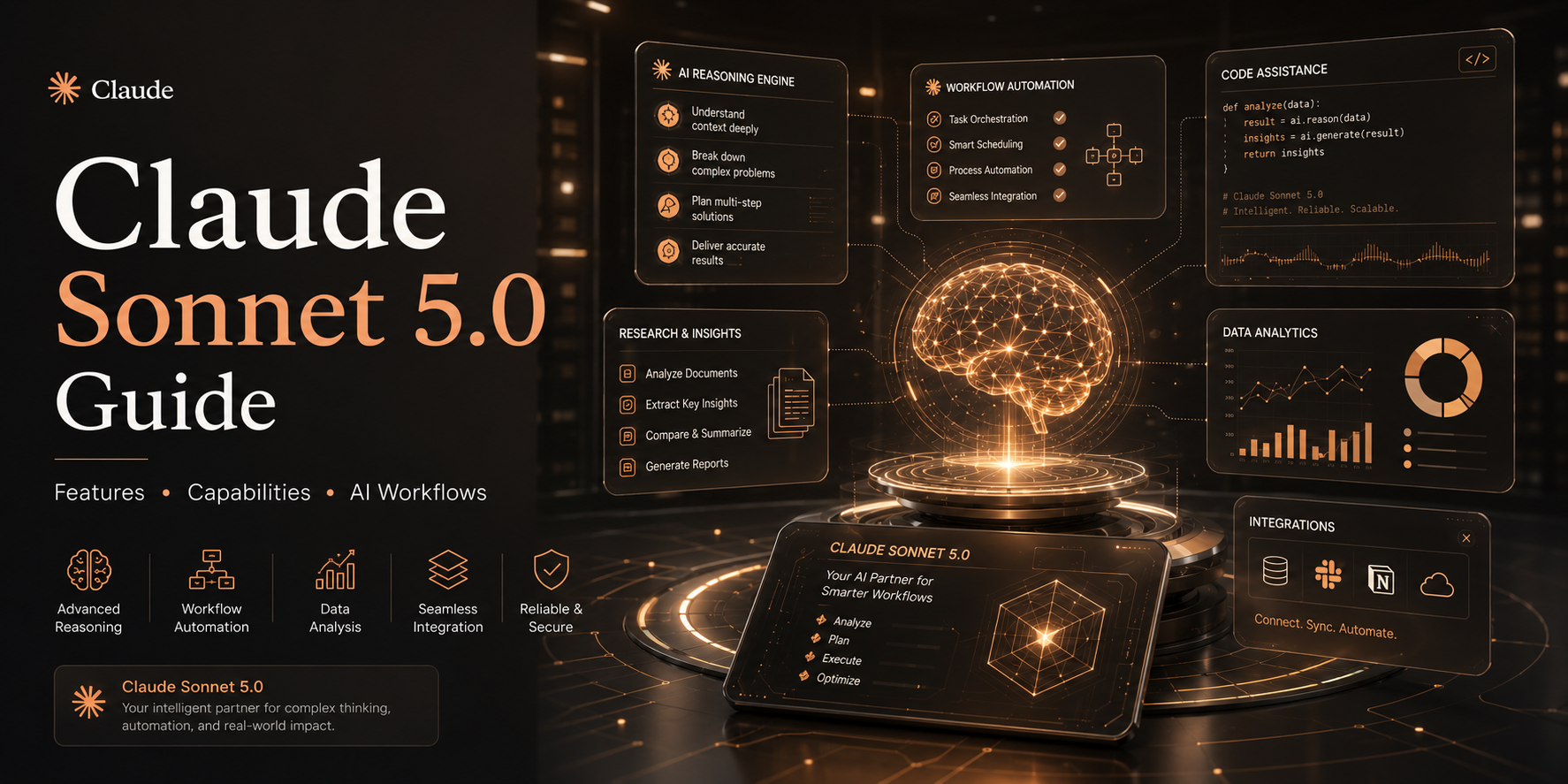
Claude Sonnet 5.0 Guide: Features, Release, Capabilities
The artificial intelligence industry is moving beyond traditional chat assistants toward advanced systems that can reason, automate workflows, and complete complex objectives. Claude Sonnet 5.0 represents this next stage by focusing on agentic AI, improved problem-solving, and practical real-world applications.
Built for developers, businesses, and professionals, this next-generation model combines advanced intelligence with efficient performance. Instead of only responding to prompts, it is designed to support multi-step tasks, analyze information, assist with programming, and improve productivity.
This complete guide covers the major features, capabilities, practical uses, and comparison points of Anthropic’s latest Sonnet model. You can explore more details and official updates directly through Anthropic Claude Sonnet models.
What Is Claude Sonnet 5.0?
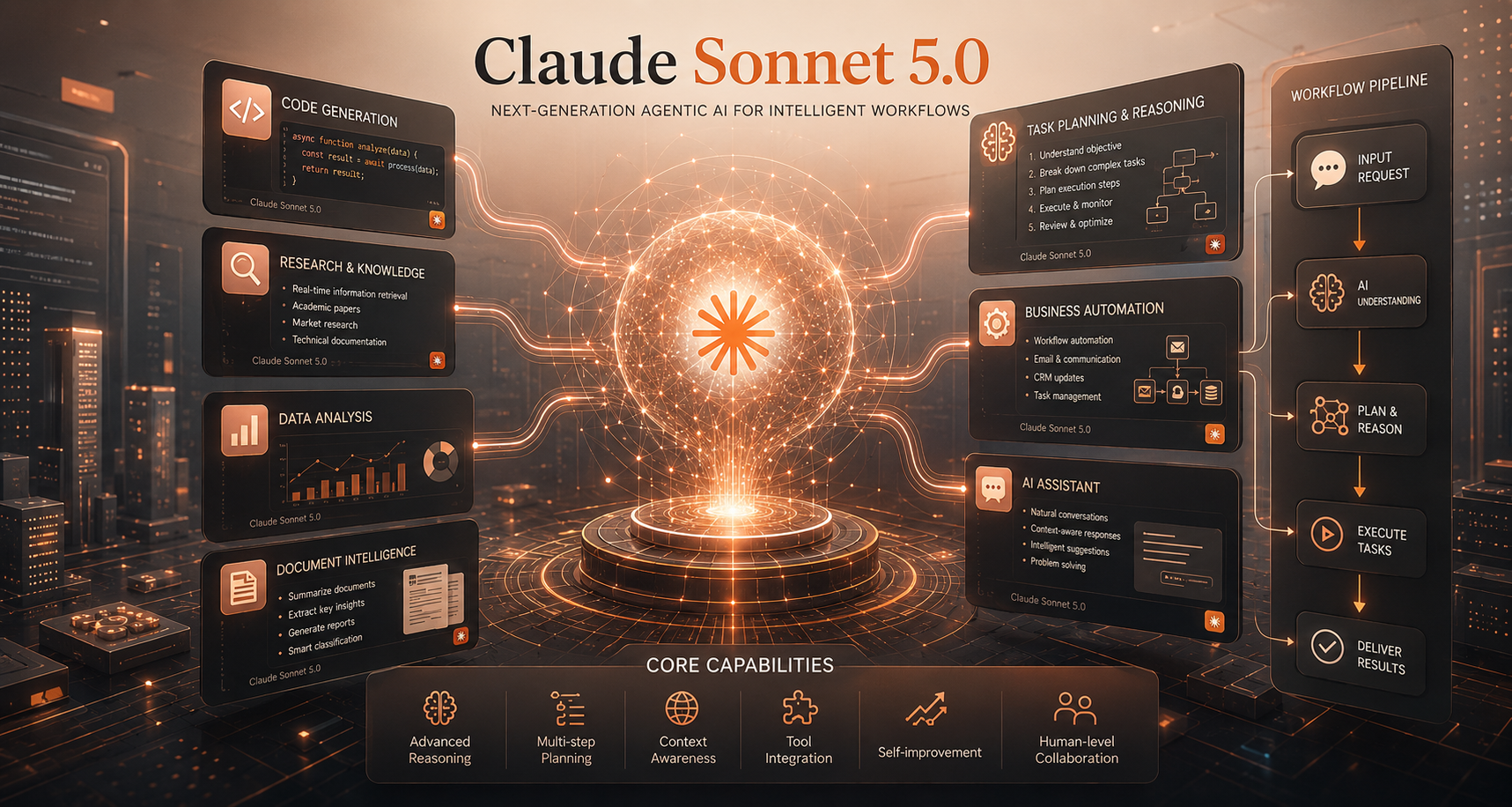

Claude Sonnet 5.0 is a next-generation artificial intelligence model from Anthropic’s Sonnet family. The Sonnet series has been designed to balance speed, intelligence, and accessibility for a wide range of users.
The latest generation focuses on agent-based workflows, enabling users to handle advanced tasks involving planning, analysis, coding, and structured decision-making.
Rather than acting only as a text generator, this AI system is built to understand goals, maintain context, and assist with completing complex digital workflows.
Key Features of Claude Sonnet 5.0
1. Advanced Agentic AI Workflows
One of the most important advancements in this AI model is its focus on agent-based workflow support. Instead of only responding to prompts, it helps users understand goals, organize tasks, and complete complex processes more efficiently.
Furthermore, the system can break larger objectives into smaller steps, analyze requirements, and provide support throughout different stages of a project. This makes it useful for professionals who want to improve productivity and reduce manual effort.
Common applications include:
- Software development
- Research assistance
- Data processing
- Business automation
- Document management
Additionally, these capabilities allow AI to move beyond basic conversations. As a result, it becomes a more practical productivity tool that supports planning, problem-solving, and real-world digital workflows.
2. Improved Reasoning and Problem Solving
One of the key improvements in this AI model is its ability to handle complex reasoning and advanced problem-solving tasks. Instead of providing only quick responses, it focuses on understanding detailed instructions, evaluating information, and supporting multi-step workflows.
Furthermore, the model can maintain context during longer interactions, which helps users work on larger projects without losing important details. This makes it valuable for professionals who need accurate analysis, structured thinking, and reliable assistance.
This improved reasoning capability benefits users working with:
- Complex technical problems
- Large documents
- Detailed planning
- Advanced analysis
Additionally, it helps developers, researchers, and businesses manage challenging tasks more efficiently. As a result, the model supports deeper decision-making, better organization, and more effective problem resolution across different workflows.
3. Adaptive Thinking Capabilities
The model introduces a flexible reasoning approach that adjusts its response process based on the complexity of each task. Instead of using the same level of analysis for every request, it can adapt its approach to match the user’s needs.
For simple questions and everyday tasks, it can focus on delivering faster and more efficient responses. However, when users require support with coding, research, analysis, or complex decision-making, it can apply deeper reasoning to provide more detailed assistance.
This adaptive approach helps create a balance between performance, accuracy, and efficiency. Additionally, it allows users to handle both quick tasks and advanced projects within the same workflow.
As a result, professionals and businesses can use the system more effectively for productivity, problem-solving, and intelligent automation.
4. Better Developer Experience
Claude Sonnet 5.0 is built with developers in mind, offering stronger support for programming workflows.
Potential improvements include:
- Understanding larger codebases
- Helping debug complex issues
- Creating and improving software components
- Supporting automated development workflows
This makes it a useful option for engineering teams building AI-powered applications.
Claude Sonnet 5.0 vs ChatGPT
Claude Sonnet 5.0 and ChatGPT are two powerful AI platforms designed to help users with productivity, creativity, research, and technical tasks. While both provide advanced conversational abilities, they are built with different strengths and user needs in mind.
Claude Sonnet 5.0 focuses heavily on deep reasoning, long-context understanding, and complex workflow support. It is particularly useful for analyzing large documents, assisting with software development, reviewing detailed information, and managing projects that require consistent context over multiple steps.
ChatGPT is known for its broad range of features, including general-purpose assistance, multimodal capabilities, creative writing support, and integrations across different tools and services. It works well for everyday questions, content creation, learning, and general productivity.
The better choice depends on your goals. Developers, researchers, and technical teams may prefer Claude’s structured approach, while users seeking a wider AI ecosystem may find ChatGPT more suitable.
Best Uses of Claude Sonnet 5.0
Claude Sonnet 5.0 can support a wide range of professional, technical, and creative workflows by combining advanced reasoning with practical task execution. Its ability to understand complex instructions, process large amounts of information, and maintain context makes it useful for individuals and organizations. From software engineering to business operations, this AI model helps users complete tasks faster and improve productivity. Whether you need assistance with analyzing information, creating content, automating processes, or solving technical challenges, the model provides support across multiple industries. Its agent-focused capabilities allow it to move beyond simple conversations and become a valuable digital assistant for modern workflows.
Software Development
Claude Sonnet 5.0 provides valuable support for developers working on applications, websites, and software projects. It can help programmers understand existing code, identify potential issues, and improve overall development efficiency. Developers can use it for reviewing code quality, finding bugs, suggesting improvements, and explaining complicated programming concepts. It can also assist with creating technical documentation, writing cleaner code structures, and improving application architecture. For teams managing large software projects, AI-powered assistance can reduce repetitive work and help engineers focus on higher-level problem-solving. The model’s ability to process complex programming information makes it useful for debugging, planning new features, and supporting the entire software development lifecycle.
Data Analysis
Claude Sonnet 5.0 can help professionals work with information by making data analysis more accessible and efficient. It can assist users in understanding datasets, identifying patterns, and transforming complex information into clear insights. Businesses and researchers can use it to summarize findings, explain trends, and organize analytical results into meaningful reports. The model can support tasks such as reviewing data points, creating summaries, and helping users interpret complicated information. By reducing the time required for manual analysis, AI assistance allows teams to focus more on decision-making and strategy. Its ability to handle detailed information makes it useful for analysts, researchers, and organizations that rely on data-driven insights.
Research and Documentation
Claude Sonnet 5.0 is useful for managing large amounts of written information, making it a helpful tool for research and documentation tasks. It can assist users by summarizing lengthy documents, extracting important details, and organizing scattered information into structured formats. Researchers, students, and professionals can use it to review materials, prepare reports, and simplify complex topics. The model can also help create documentation by improving clarity, arranging ideas, and generating well-structured content. For businesses, it can support knowledge management by making internal documents easier to understand and access. These capabilities make it valuable for anyone working with large volumes of information.
Business Automation
Organizations can use Claude Sonnet 5.0 to improve productivity by supporting automation across different business processes. AI-powered workflows can help reduce repetitive tasks, organize information, and improve operational efficiency. Companies can apply the technology to manage workflows, assist employees, and support customer-facing operations. It can help teams handle routine communication, analyze business information, prepare documents, and streamline administrative activities. By taking care of time-consuming tasks, employees can focus on more strategic responsibilities. The model’s ability to understand instructions and work through multi-step processes makes it suitable for businesses looking to introduce smarter automation solutions and improve everyday productivity.
Frequently Asked Questions
What is Claude Sonnet 5.0?
Claude Sonnet 5.0 is an advanced artificial intelligence model developed by Anthropic to support complex reasoning, automation, and intelligent workflows. Furthermore, it represents a move toward agent-focused AI systems that can handle more than simple question answering.
The model helps users complete professional and technical tasks, including software development, research, data analysis, content creation, and business operations. Additionally, its improved context understanding allows it to process detailed instructions, analyze large amounts of information, and provide structured support for multi-step projects.
As a result, developers, researchers, and organizations can use this technology to improve daily workflows. Moreover, its focus on productivity, accuracy, and task completion makes it a practical solution for modern digital work.
Is Claude Sonnet 5.0 good?
Claude Sonnet 5.0 provides strong performance for users who need advanced reasoning, coding assistance, and support with large amounts of information. In addition, the model focuses on accuracy, context awareness, and complex task handling, which makes it valuable for professionals and businesses.
For example, developers can use it for programming projects, debugging, and improving software structures. Similarly, researchers can analyze detailed information, summarize materials, and organize findings more efficiently. Meanwhile, businesses can apply it to automate repetitive workflows and increase productivity.
Unlike basic AI tools that mainly generate quick responses, this model focuses on completing detailed tasks. Therefore, users who need a reliable assistant for technical work, analysis, and planning can benefit from its capabilities.
When did Claude Sonnet 5.0 release?
The release timeline for Claude Sonnet 5.0 depends on official announcements, product updates, and availability details shared by Anthropic. However, because AI technology changes quickly, release information and access options may continue to develop over time.
Users should follow Anthropic’s official updates for confirmed launch dates, platform availability, pricing information, and feature announcements. Additionally, major AI releases usually introduce improvements in performance, accessibility, developer tools, and workflow capabilities.
The model represents Anthropic’s continued effort to advance artificial intelligence, especially in reasoning, automation, coding support, and agent-based systems. Therefore, checking official sources remains the best way to access accurate and current information.
Is Claude Sonnet 5.0 better than ChatGPT?
Claude Sonnet 5.0 and ChatGPT are both powerful AI platforms, but they offer different advantages depending on user requirements. Therefore, instead of one being better in every situation, each tool works best for specific workflows.
Claude focuses on deep reasoning, long-context understanding, coding assistance, and document-based tasks. Because of this, developers, researchers, and professionals working with detailed projects may find it especially useful.
Meanwhile, ChatGPT provides a broader AI experience with general assistance, creative features, multimodal capabilities, and different integrations. For instance, it works well for writing, learning, brainstorming, and everyday productivity.
Ultimately, the better choice depends on your goals. As a result, technical teams may prefer Claude’s structured approach, while users seeking a flexible all-purpose AI assistant may choose ChatGPT.
What is Claude Sonnet 5.0 useful for?
Claude Sonnet 5.0 supports many professional, technical, and creative tasks that require advanced reasoning and intelligent assistance. In addition, the model helps users with software development, research, writing, analysis, and workflow automation.
Developers can use it to review code, detect errors, improve applications, and create technical documentation. Furthermore, researchers and professionals can use it to summarize large documents, organize information, and extract valuable insights.
Businesses can apply AI-powered workflows to reduce repetitive work, improve internal processes, and support decision-making. Moreover, teams can use these systems to manage information and complete multi-step projects more efficiently.
Overall, this AI assistant provides value for users who need help with problem-solving, content creation, analysis, and automation. Therefore, its ability to understand detailed instructions makes it suitable for modern digital workflows.
Conclusion
Claude Sonnet 5.0 represents the continued evolution of AI from conversational tools into intelligent workflow assistants. With stronger reasoning, improved task handling, and agent-focused capabilities, it aims to help users solve more complex problems efficiently.
For developers, businesses, and professionals looking to integrate AI into daily operations, Claude Sonnet 5.0 highlights the future direction of practical artificial intelligence.
To explore how AI is moving toward more autonomous execution and advanced digital workflows, read our detailed guide on the next wave of AI execution.