
Diploma vs Degree: Which Is Better? Complete Beginner’s Guide


When planning your career, the path you choose after school sets the tone for your professional future. A common crossroads for many students is deciding between a diploma vs degree. Both pathways offer distinct advantages, but they cater to different goals, budgets, and learning preferences.
Before making a decision, it is also important to understand how your field of study can affect future career opportunities. Our guide on choosing the right college major can help you evaluate your options and align your education with your long-term goals.
Understanding the differences between a diploma vs degree early can help you avoid wasting time and money on a path that does not match your career ambitions. By comparing costs, duration, job prospects, and earning potential, you can make a more informed decision about your future.
According to data tracking international educational standards from the UNESCO Institute for Statistics, higher education structures generally divide technical training from broader academic pursuits. This distinction is crucial. While one path focuses on rapid, hands-on skills, the other offers a deep, theoretical foundation. This complete beginner’s guide will break down the core mechanics of both options, compare their long-term value, and help you confidently decide which path suits your life.
What is a Diploma?
A diploma is a specific academic credential focused primarily on practical, hands-on training. Educational institutions design these programs to prepare you for the workforce as quickly as possible. Unlike broader academic programs, a diploma skips general elective subjects and dives straight into core technical skills. You will not spend semesters studying broad history or general sociology unless it directly applies to your job. Instead, your classes mimic real-world work environments to build immediate technical competence.
Many community colleges, vocational schools, and specialized trade academies offer these programs across diverse fields. Because the curriculum cuts out the fluff, you focus entirely on mastering specific tools, software, or physical techniques. This streamlined educational framework makes the learning process highly efficient. Students who thrive in interactive, kinetic environments usually prefer this option over sitting through long theoretical lectures. It serves as a direct bridge from the classroom straight into an entry-level professional role.
Key Characteristics of Diploma Programs
-
Shorter Duration: Most programs take anywhere from six months to two years to complete.
-
Technical Focus: The curriculum zeroes in on specific trade or vocational skills, such as web development, culinary arts, or plumbing.
-
Lower Cost: Because these programs wrap up quickly, they generally cost significantly less than multi-year university tracks.
-
Flexible Enrollments: Community colleges and technical schools often offer rolling admissions and flexible evening classes.
What is a Degree?
A degree is a comprehensive academic credential awarded by universities and colleges upon the completion of a long-term course of study. This pathway provides a well-rounded education, combining deep theoretical knowledge in your major with a broad understanding of general subjects like humanities, mathematics, and science. The philosophy behind this structure is to build critical thinking, deep analytical skills, and a holistic understanding of the world. Consequently, you will study a wide range of subjects alongside your chosen specialization.
Universities structure these programs to encourage research, intellectual debate, and conceptual problem-solving. This academic depth ensures that you do not just learn how to perform a task, but you also understand the core science and history behind why the task is performed that way. This comprehensive background prepares graduates for long-term adaptability in the job market. It gives you a broader worldview, which helps you pivot between different industries or advance into high-level strategic management roles over time.
The Different Levels of Higher Degrees
Degrees follow a structured, progressive hierarchy in higher education:
-
Associate Degree: A two-year introductory program often completed at community colleges.
-
Bachelor’s Degree: The traditional four-year undergraduate program required for most professional corporate roles.
-
Master’s Degree: An advanced post-graduate program lasting one to two years, focusing on specialization.
-
Doctorate (PhD): The highest academic tier, heavily focused on original research and teaching.
Diploma vs Degree: Key Differences Explained
To choose the right option, you must compare how these two pathways stack up across the practical areas of student life and career growth.
Program Duration and Time Commitment
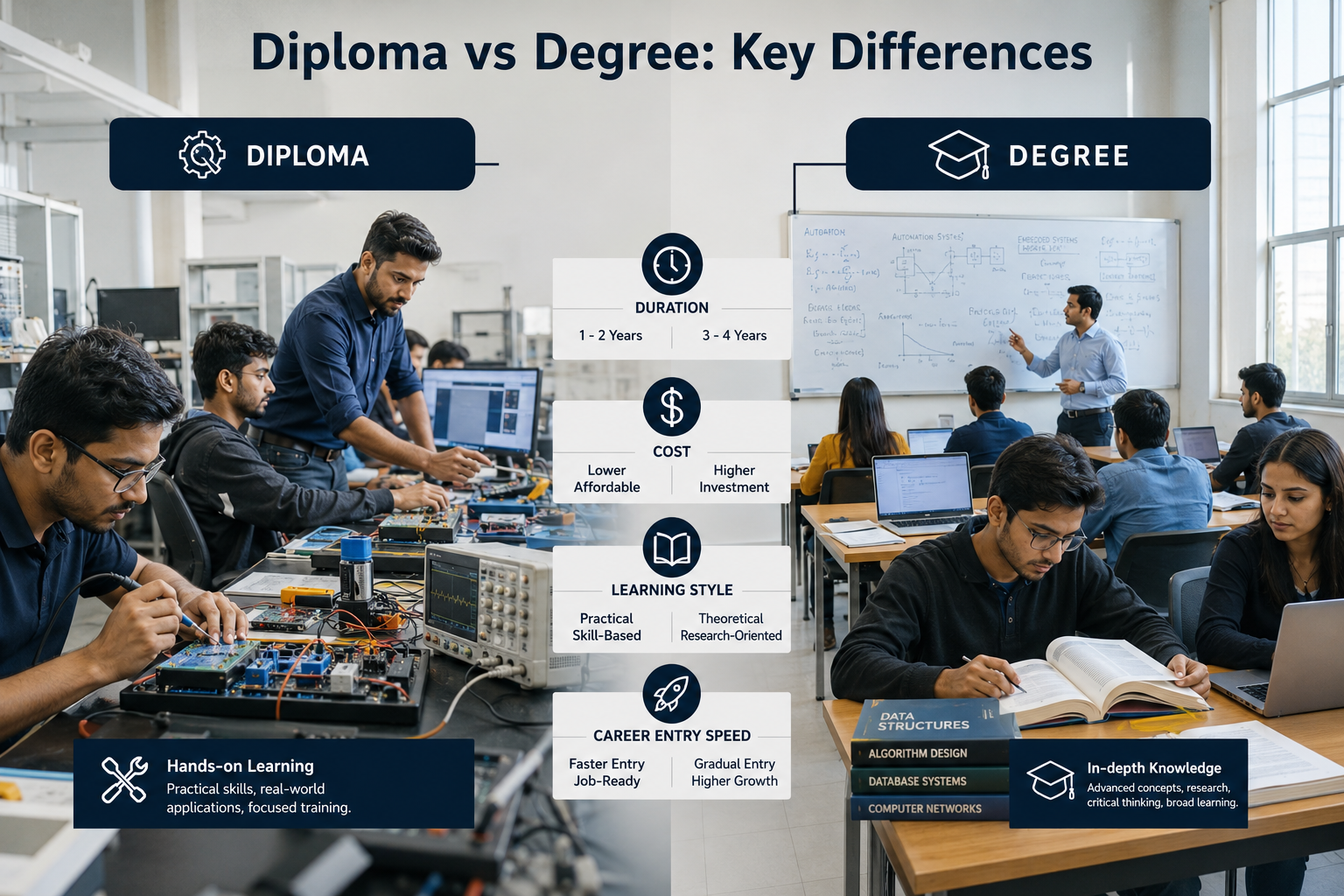
Time is a valuable asset when planning your education. Diploma programs offer a fast track to graduation, making them perfect if you want to start earning an income quickly. Most students finish these tracks in less than two years, allowing them to enter the job market while university students are still completing their general education requirements.
Conversely, earning a Bachelor’s degree demands a firm four-year commitment of full-time study. This longer timeline requires sustained dedication, stable living arrangements, and the ability to delay full-time employment for multiple years. You must carefully evaluate whether you have the personal and financial stability to commit to a multi-year academic journey without losing focus.
Financial Investment and Tuition Costs
Tuition fees vary wildly between these two choices, creating a massive impact on your financial future. Universities charge higher tuition rates per credit hour, and because the programs last longer, the total accumulated cost multiplies quickly. You must also factor in four years of expensive textbooks, campus infrastructure fees, student healthcare plans, and university housing costs.
A technical credential costs a mere fraction of this total amount. Because you graduate quickly, you also save thousands of dollars on living expenses and campus fees. This affordability allows many vocational students to graduate completely debt-free, giving them a significant financial head start. They can start saving, investing, or buying assets while university graduates are busy paying off large student loans.
Curriculum Structure and Learning Styles
The daily classroom experience feels entirely different in each program, catering to different types of minds. If you choose a vocational track, you will spend most of your time in labs, commercial kitchens, design studios, or field placements practicing real-world tasks. The teaching style is direct, visual, and highly interactive.
If you enroll in a university program, you will spend significant time reading academic papers, writing lengthy research essays, and participating in lecture halls. The evaluation methods rely heavily on midterms, finals, and group presentations rather than practical demonstrations. You must decide whether you learn better by physically doing a task or by analyzing the underlying theory through reading and writing.
Career Opportunities and Earning Potential
Your choice directly shapes your initial job search and your long-term financial trajectory. Employers view these credentials through different lenses depending on their industry.
Immediate Job Placement vs Long-Term Growth
Technical credentials excel at getting your foot through the door for highly specialized roles right after graduation. Industries like healthcare assistance, automotive repair, network administration, and digital design value immediate technical expertise above all else. They need workers who can perform the job on day one without extensive corporate onboarding.
However, a traditional university qualification often serves as a mandatory gatekeeper for executive leadership, corporate management, and highly regulated professions like law, civil engineering, or medicine. Without a formal university title, climbing past the glass ceiling into upper corporate management becomes incredibly difficult in traditional business environments, regardless of your practical skills.
Analyzing the Income Gap
Data from organizations such as the Organization for Economic Co-operation and Development (OECD) shows a clear trend. Individuals with university qualifications often earn higher median lifetime wages than those with vocational training. University graduates also tend to experience stronger salary growth over time. Their peak earnings are often reached during the middle or later stages of their careers.
Technical graduates usually start earning sooner. They can secure good salaries early in their careers. However, income growth may slow after several years. University graduates often catch up financially within a decade. Promotions, bonuses, and management roles can accelerate their earnings.
When comparing these paths, consider both short-term and long-term outcomes. Early earnings provide immediate financial benefits. Higher academic qualifications may create greater earning potential later in life.
How to Choose the Right Path for Your Future
No single option wins the debate for everyone. The ideal choice depends entirely on your current personal situation, financial health, and ultimate career vision.
When to Choose a Diploma
Choosing a shorter, technical path makes immense sense if your primary goal is rapid financial independence. If you want to enter the workforce in under two years and avoid the burden of student debt, this route is ideal. It suits individuals who prefer practical, physical work over abstract concepts, essays, and long lectures.
This path is also perfect if you have already identified a specific trade or technical niche that you love, such as software development, aviation mechanics, or graphic design. By avoiding general electives, you maximize your time and focus exclusively on the precise skills that local employers are actively looking for right now.
When to Choose a Degree
Investing in a university track is the right move if your dream career requires a formal, accredited qualification. Fields like architecture, finance, teaching, and engineering legally require a university degree before you can obtain a professional license to practice. This path is also ideal if you genuinely enjoy deep research, academic writing, and complex analytical thinking.
If you are unsure of your exact career path, a university program provides a broad educational foundation that allows you to shift between industries later in life. It acts as a long-term investment that prepares you for high-level corporate ladder climbing, global networking, and future postgraduate research opportunities.
Frequently Asked Questions
Can I transfer my diploma credits into a full degree program later?
Yes, you can absolutely transfer your technical credits into a university program later, but the exact process depends entirely on the institutions involved and their specific academic policies. Many community colleges and vocational institutes maintain formal bilateral arrangements known as articulation agreements with local or national universities. These structural pathways allow you to apply your completed practical credits directly toward a Bachelor’s qualification, mapping your previous coursework to university equivalents.
This educational approach, frequently referred to as a laddering program or a degree completion pathway, lets you gain practical skills early, enter the workforce to earn an income, and upgrade your formal education later without restarting your academic journey from scratch. However, you must proactively check with an academic advisor beforehand to confirm your specific credits will transfer cleanly, as policy variations between institutions, regional accreditation differences, and minimum grade requirements can significantly impact your transfer eligibility and overall timeline.
Which option looks better to corporate employers?
Neither option is universally superior in the eyes of corporate recruiters; the preference depends completely on the specific industry, job function, and corporate culture of the company you want to enter. For traditional corporate, managerial, executive, or highly regulated fields like investment banking, civil engineering, corporate law, and human resources, employers strictly prefer—and often mandatory require—a traditional university qualification. They view a multi-year degree as proof of long-term commitment, cultural polish, structural discipline, and advanced analytical capacity required for high-stakes decision-making.
Conversely, in highly agile, technical fields like information technology, creative graphic design, software engineering, or skilled industrial trades, modern employers value proven practical abilities and demonstrated execution over a prestigious university stamp. In these creative and technical spaces, a robust portfolio of real-world projects paired with a targeted technical credential looks highly favorable and routinely beats a purely theoretical academic background during the hiring process.
Is a diploma considered higher than an associate degree?
No, an associate degree sits slightly higher on the formal academic ladder than a standard technical diploma or certificate. An associate program requires a minimum commitment of two years of full-time undergraduate study and intentionally includes mandatory general education electives—such as college-level mathematics, English composition, and social sciences—alongside your core major subjects. This balanced structure mimics the first two years of a traditional four-year university program, providing a broad foundational framework.
In contrast, a standard technical certificate or vocational program focuses exclusively on job-specific, hands-on training, completely bypassing general academic electives, and can often be completed in six to twelve months. If you plan to transition to a four-year university later to complete a Bachelor’s qualification, an associate program provides a much smoother academic bridge because mainstream universities easily accept those general education credits, whereas purely vocational credits might not transfer as traditional academic units.
Do University Graduates Always Earn More Money?
Global statistics generally show that university graduates earn higher average lifetime incomes. However, this is not a guarantee for every person or career path.
A highly skilled worker in a specialized field can often earn more than a university graduate. Examples include industrial electricians, underwater welders, commercial pilots, and software engineers. This is especially true when graduates hold qualifications in saturated or low-demand fields.
Earning potential depends on more than education alone. Market demand plays a major role. Geographic location, skill level, work experience, and networking ability also influence income.
Choosing a path that matches industry demand can improve your earning prospects. Developing valuable skills is equally important. Learning to negotiate salary and benefits can also increase long-term wealth. In many cases, these factors matter more than the title on your diploma or degree certificate.
Can I get a high-paying tech job with just a diploma?
Yes. The technology sector is known for accepting alternative education pathways. Employers often value practical skills and problem-solving ability more than traditional academic credentials.
Many successful software engineers, cloud architects, cybersecurity specialists, and UI/UX designers started with diplomas, community college programs, or coding bootcamps. Employers focus on technical competence, real-world experience, and a strong portfolio. Personal projects and open-source contributions can also strengthen your application.
If you can demonstrate your skills during technical interviews, your qualifications matter less. Employers want proof that you can write clean code, build responsive applications, or secure networks against vulnerabilities.
The tech industry is highly merit-based. A targeted technical qualification, combined with continuous self-learning, can lead to a high-paying career.
Conclusion: Finding the Right Balance in the Diploma vs Degree Debate
The Diploma vs Degree decision is not about finding a universally perfect answer. Instead, it is about choosing the educational path that aligns with your goals, budget, and career plans.
If you want to enter the workforce quickly, the Diploma vs Degree comparison may favor a diploma. Diploma programs are usually shorter and more affordable. They focus on practical, job-ready skills that employers need. As a result, many students achieve financial independence sooner.
On the other hand, the Diploma vs Degree debate may favor a degree if you want a broader education. A university degree can provide greater academic depth and long-term career flexibility. It also offers access to professional networks and may create opportunities for senior management positions.
When evaluating Diploma vs Degree options, consider your learning style, financial situation, and career objectives. Research the requirements of your target industry before making a choice.
Ultimately, there is no single winner in the Diploma vs Degree comparison. The best option depends on your personal circumstances. By carefully assessing the advantages of a diploma vs degree, you can make a confident decision that supports long-term career growth, job satisfaction, and financial security.