
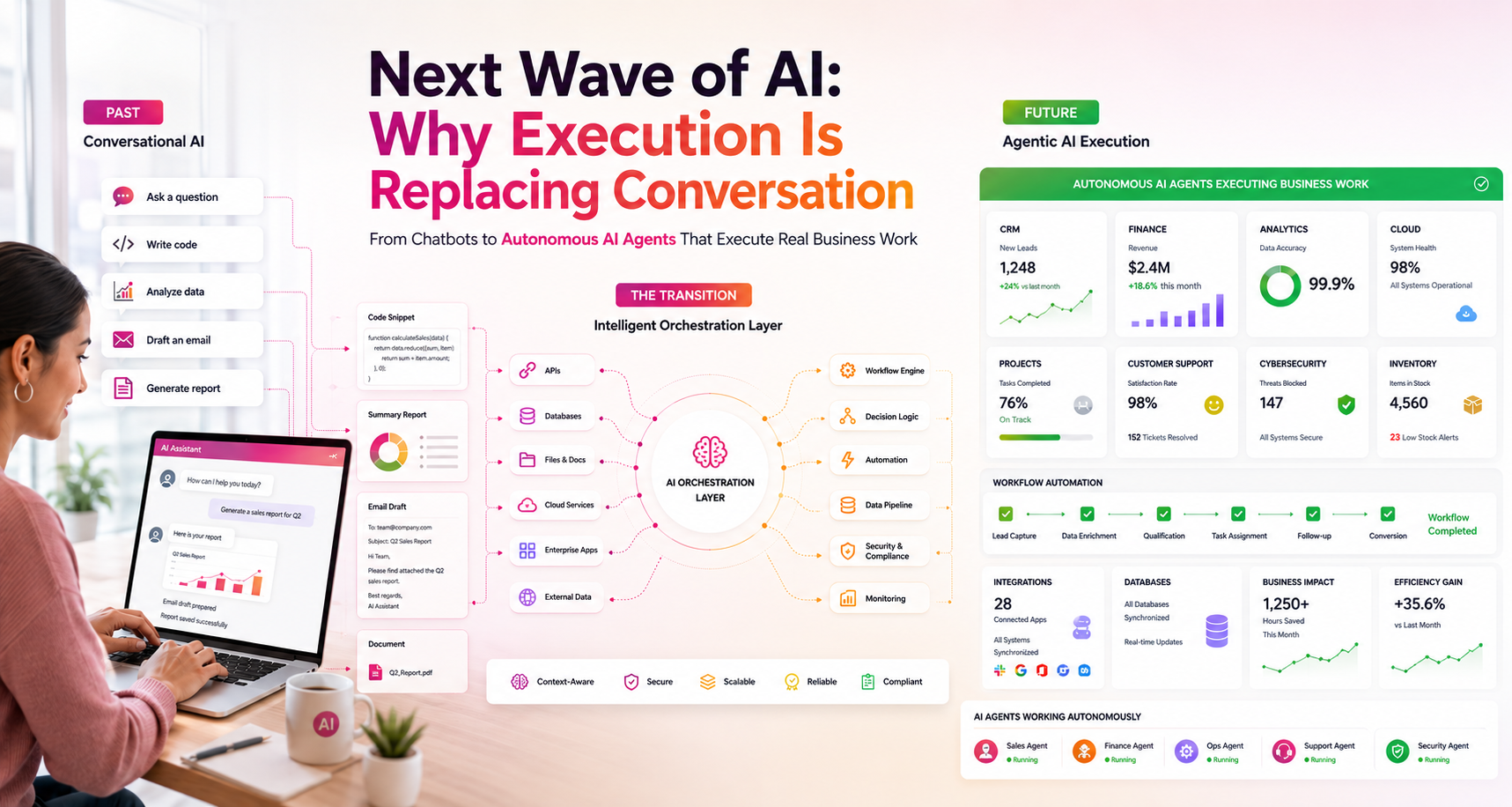
Next Wave of AI: Why Execution Is Replacing Conversation
Artificial intelligence has changed dramatically over the past few years. Most people still associate AI with chatbots that answer questions, generate content, or write code. While these tools remain valuable, they represent only the beginning of a much larger transformation. The next wave of AI focuses less on conversation and more on execution. Instead of suggesting what users should do, modern AI systems increasingly perform the work themselves.
Businesses want more than fast answers. They need software that automates workflows, updates databases, analyzes information, and communicates with multiple business applications. This demand is driving the rise of agentic AI, where autonomous systems complete tasks with minimal human intervention.
The shift from conversational AI to execution-based AI will reshape productivity across every industry. Organizations that embrace this technology will reduce repetitive work, improve efficiency, and allow employees to focus on higher-value responsibilities. Understanding the next wave of AI is becoming essential for business leaders, developers, and professionals preparing for the future of work. To learn how modern AI agents plan, use tools, and complete complex workflows, explore OpenAI’s official guide on building AI agents.

Why the Next Wave of AI Is Replacing Conversational AI
Conversational AI made artificial intelligence accessible to millions of users. A simple prompt could generate reports, marketing copy, software code, or customer responses within seconds. This ease of use accelerated AI adoption across businesses of every size.
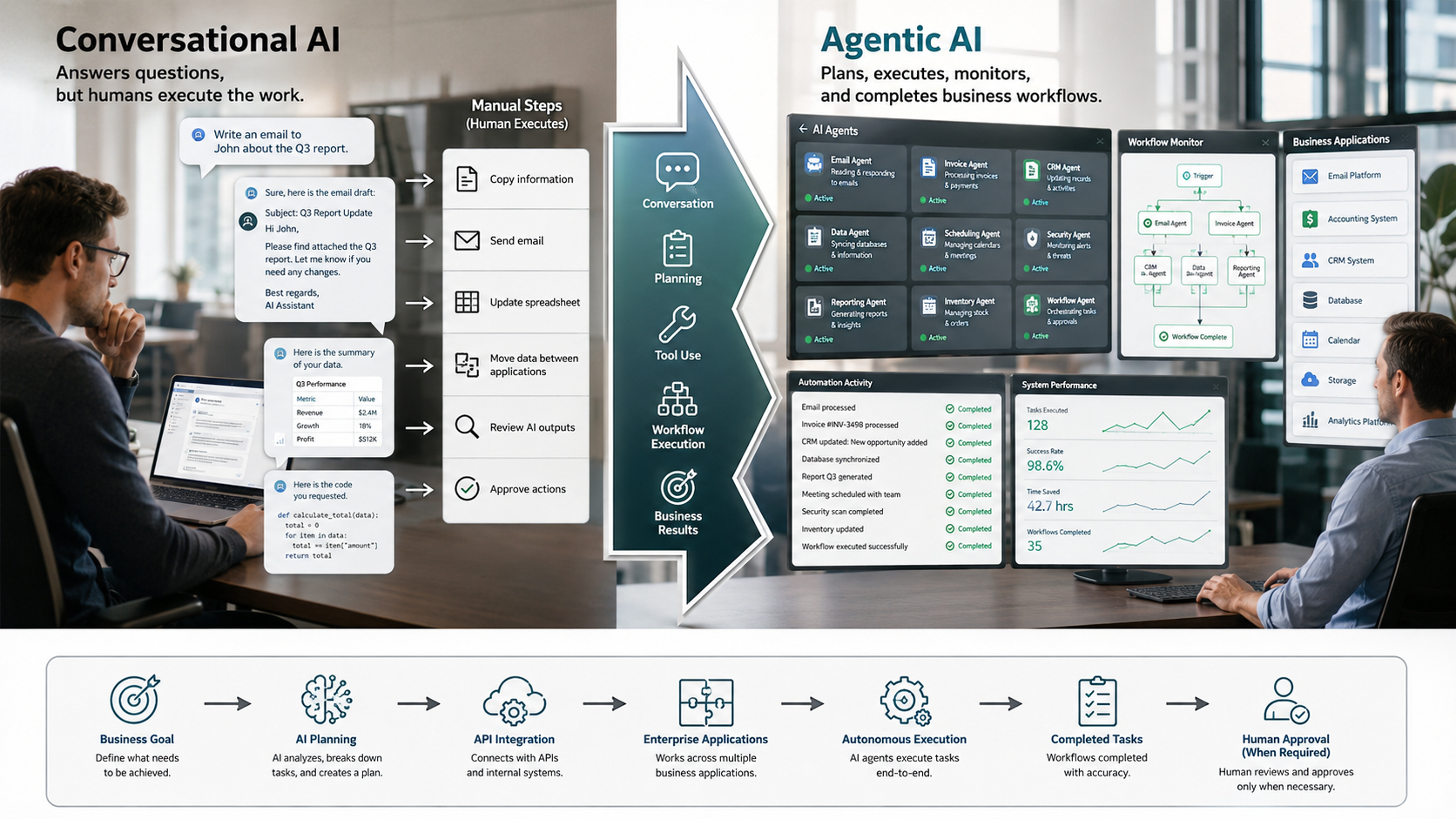
Despite these advantages, chat interfaces have important limitations. Users still guide every step of the process. They enter prompts, review responses, correct mistakes, and manually transfer information into other software. The chatbot produces useful content, but it rarely completes the entire workflow.
Businesses need more than intelligent conversations. They want AI to process invoices, update CRM systems, organize documents, monitor inventory, and automate administrative work without repeated instructions. These practical requirements are shaping the next wave of AI, where intelligent systems focus on completing tasks instead of generating text.
As companies pursue greater efficiency, execution becomes more valuable than conversation. AI will increasingly act as a digital worker rather than simply serving as a digital assistant.
How the Next Wave of AI Solves the Illusion of Productivity
Many organizations believe conversational AI fully automates their operations. In practice, it often accelerates only one part of a much larger workflow. Employees still perform several manual steps before completing a project.
For example, a chatbot may draft an email campaign in minutes. Someone must still review the content, edit mistakes, upload it into marketing software, schedule delivery, and measure campaign performance. The AI improves writing speed but does not execute the complete process.
The same pattern appears across finance, healthcare, sales, and customer service. Workers continue moving data between applications, verifying information, and managing approvals. These repetitive activities consume valuable time every day.
The next wave of AI removes these bottlenecks. Autonomous agents connect directly with business software through APIs. They move information automatically, trigger workflows, complete repetitive tasks, and notify users only when human decisions become necessary. This approach delivers genuine automation instead of creating the appearance of productivity.
How the Next Wave of AI Eliminates Context Drift
Context drift remains one of the biggest weaknesses of conversational AI. During lengthy discussions, chatbots sometimes lose track of earlier instructions or misunderstand important details. These mistakes force users to repeat information and carefully review every response.
This limitation becomes even more serious in enterprise environments. Large projects often involve dozens of requirements, multiple departments, and complex approval processes. Losing context during execution can create delays, compliance issues, or costly operational errors.
The next wave of AI addresses this challenge by combining language models with structured memory, workflow management, and external databases. Instead of relying only on conversation history, autonomous agents retrieve relevant information whenever they perform a task.
This structured approach improves consistency and reliability. Businesses can automate complex workflows with greater confidence because AI systems maintain context throughout the entire process. As organizations increase AI adoption, reliable execution will become more important than maintaining long conversations.
What Is Replacing Prompt Engineering in the Next Wave of AI?
Prompt engineering became one of the fastest-growing AI skills during the early adoption of generative AI. Users experimented with prompts to improve writing quality, coding accuracy, and research results. Better prompts often produced significantly better outputs.
Today, the next wave of AI is reducing the importance of prompt engineering. Developers now focus on designing autonomous workflows rather than crafting perfect prompts. Multiple AI agents collaborate to complete large objectives automatically.
One agent may analyze a business goal. Another collects information from company systems. A third generates reports or writes code. Additional agents test results, monitor quality, and deploy completed work. Humans supervise the overall process instead of controlling every individual task.
This evolution changes the skills businesses value most. Workflow design, AI integration, automation architecture, and governance now matter more than writing increasingly detailed prompts. Organizations gain greater efficiency because autonomous systems execute work instead of waiting for continuous human instructions.
How the Next Wave of AI Focuses on System Execution
Execution defines the future of artificial intelligence. The next wave of AI integrates directly into enterprise software instead of operating as an isolated chatbot. Modern AI systems communicate with databases, cloud platforms, accounting software, CRM applications, and project management tools.
This connectivity allows AI to complete meaningful business processes. It can read incoming emails, verify customer records, generate invoices, update inventory, schedule appointments, and send notifications without human intervention. Employees receive completed results rather than suggestions.
Advanced AI systems also improve reliability through self-monitoring. When errors occur, they identify the problem, retry failed actions, or recommend alternative solutions. This capability reduces downtime and minimizes manual troubleshooting.
Businesses benefit through lower operating costs, faster workflows, improved accuracy, and greater scalability. As execution capabilities continue advancing, organizations will judge AI systems by measurable business outcomes rather than conversational ability alone.
How the Next Wave of AI Will Change Jobs by 2030
The next wave of AI will reshape many professions during the next decade. Automation will not eliminate every job, but it will significantly reduce demand for repetitive digital work. Roles focused on transferring information between systems, processing routine documents, or following standardized procedures face the greatest disruption.
Data entry, basic customer service routing, repetitive compliance checks, simple report generation, and template-based content creation will increasingly become automated. Autonomous AI systems can complete these predictable workflows faster and more accurately.
At the same time, demand will continue growing for AI architects, cybersecurity specialists, automation engineers, skilled tradespeople, healthcare professionals, and strategic business leaders. These careers require critical thinking, creativity, human judgment, emotional intelligence, or physical adaptability.
Future professionals will work alongside intelligent systems instead of competing against them. Learning how to design, supervise, and optimize AI-powered workflows will become one of the most valuable skills in the modern workplace.
FAQ About the Next Wave of AI
Which 3 jobs will survive AI?
The next wave of AI will automate many repetitive digital tasks, but several careers will continue to thrive because they rely on skills that machines cannot easily replicate. Skilled trades such as plumbers, electricians, and HVAC technicians will remain in high demand. These professionals work in unpredictable physical environments where every job presents unique challenges. AI can assist with diagnostics, but it cannot replace hands-on expertise in most real-world situations.
Strategic human leaders will also remain essential. Business executives, entrepreneurs, and organizational leaders make complex decisions that require emotional intelligence, negotiation skills, ethical judgment, and long-term planning. While AI can analyze data, people still define business goals and manage relationships.
AI system architects represent another future-proof profession. As organizations adopt autonomous AI systems, they need experts to design, monitor, secure, and improve these technologies. These professionals ensure AI agents work safely and efficiently while meeting business objectives. As the next wave of AI expands, demand for experienced AI architects and automation specialists will continue to grow across nearly every industry.
What are the problems with conversational AI?
Conversational AI transformed how people interact with technology, but it still has several important limitations. Most chatbots require continuous human supervision. Users must write prompts, review responses, verify facts, correct mistakes, and manually move information into other applications. This process creates an unnecessary bottleneck and prevents true automation.
Another major issue involves context drift. During long conversations, AI models sometimes lose track of previous instructions or misunderstand user intent. This inconsistency reduces reliability, especially for businesses that manage large projects or sensitive data. Employees often repeat instructions to maintain accuracy, which reduces productivity.
Conversational AI also struggles to execute real-world business processes. It may generate excellent recommendations, but it usually cannot complete workflows independently without additional integrations. For example, it can draft an invoice but cannot automatically process payments unless connected to external systems.
The next wave of AI addresses these limitations through agentic workflows. Instead of simply generating responses, autonomous AI systems connect with enterprise software, execute multi-step tasks, maintain structured memory, and monitor their own performance. This evolution transforms AI from a conversational assistant into a reliable digital worker capable of completing meaningful business operations.
What is replacing prompt engineering?
Prompt engineering became one of the most popular AI skills during the rise of generative AI. Users experimented with different instructions to improve writing, coding, research, and problem-solving results. Well-designed prompts often produced more accurate outputs, making prompt engineering valuable for businesses and developers.
However, the next wave of AI is changing this approach. Instead of relying on increasingly detailed prompts, organizations are building autonomous AI systems that plan, execute, and monitor tasks with minimal human involvement. These systems use agentic workflows where multiple specialized AI agents collaborate to achieve larger business goals.
One AI agent may break a project into smaller tasks. Another gathers information from databases. A third writes code or documents, while another validates the results before deployment. Humans supervise the overall process rather than managing every individual action.
This shift makes workflow design, automation architecture, API integration, and AI governance more valuable than prompt engineering alone. Businesses now focus on building intelligent systems that consistently complete work instead of simply generating responses. As the next wave of AI continues to mature, designing reliable execution pipelines will become one of the most important technical skills.
Which jobs will be gone by 2030?
No one can predict with certainty which jobs will disappear by 2030, but many experts expect AI to automate a growing share of repetitive digital work. The next wave of AI will most likely affect roles that involve structured, predictable, and rule-based tasks. Jobs such as data entry clerks, basic customer support representatives, document processing specialists, routine bookkeeping assistants, and administrative support roles face significant automation pressure.
Similarly, positions focused on repetitive copywriting, standard report generation, template-based coding, and basic quality assurance testing may require fewer workers as AI systems become more capable. Autonomous AI agents can complete these tasks quickly while maintaining consistent quality.
However, automation does not always eliminate entire professions. In many industries, AI changes job responsibilities instead of replacing employees completely. Workers increasingly supervise automated systems, review complex decisions, and solve problems that require human judgment.
The next wave of AI will likely create new opportunities in AI governance, cybersecurity, workflow automation, robotics, cloud computing, and intelligent systems management. Professionals who continuously learn new technologies and develop strategic skills will remain competitive in an AI-driven economy.
What does agentic AI mean in practice?
Agentic AI refers to intelligent software that can plan, make decisions, and execute multiple actions to achieve a defined objective with minimal human supervision. Unlike traditional chatbots that respond to individual prompts, agentic AI performs complete workflows by connecting with external applications, databases, APIs, and enterprise software.
For example, a marketing manager might ask an agentic AI system to launch a product campaign. Instead of simply generating a marketing plan, the system could research competitors, analyze customer trends, write promotional content, schedule social media posts, update project management software, monitor campaign performance, and generate weekly reports automatically.
Businesses can also use agentic AI in finance, healthcare, customer service, software development, and supply chain management. Autonomous agents process invoices, approve routine requests, manage inventory, monitor cybersecurity alerts, and coordinate business operations across multiple platforms.
The next wave of AI depends heavily on these execution-focused systems. Organizations want AI that performs meaningful work instead of producing text alone. As agentic technologies mature, businesses will increasingly deploy digital workers that collaborate with employees, automate repetitive tasks, and improve productivity throughout the enterprise.
Conclusion
The evolution of artificial intelligence is moving past the novelty of conversation. While chatbots opened our eyes to what large language models can do, the next wave of AI is focused entirely on practical, autonomous execution. By transitioning from simple prompt boxes to integrated, multi-agent systems, technology is finally moving toward true automation. This shift will inevitably reshape the workforce, reducing the need for repetitive digital tasks while elevating roles that require human empathy, physical skill, and high-level systems design. To stay ahead, businesses and professionals must look beyond the chat interface and start building the infrastructure required to let AI execute.
If you’re new to AI or want to build a stronger foundation before exploring autonomous agents, read our complete guide to Generative AI. It explains how generative AI works, its real-world applications, benefits, limitations, and why it serves as the foundation for the next generation of AI-powered systems.