
What Is Generative AI? The Complete Guide for Beginners
Have you ever wondered what generative AI actually is? This powerful technology has become a major topic in recent years, transforming how people work, create, and solve problems. Although the technical language around AI can seem complicated, the basic idea is much easier to understand.
This complete beginner’s guide explains how generative AI systems create original content, explores real-world applications across different industries, and highlights the differences between traditional artificial intelligence and newer generative models.
According to research from McKinsey & Company, generative AI has the potential to create significant economic value worldwide. As a result, businesses are adopting these tools to improve efficiency, while creative professionals use them to develop new ideas and accelerate their workflows.
Learning about generative AI can provide a valuable advantage in today’s digital environment. Many modern software platforms now include AI-powered features. For example, email services can suggest replies, while search tools can summarize complex topics quickly.
By the end of this guide, you will understand what generative AI is, how it works, and why it has become such an important technology.
Understanding Generative AI in Simple Terms
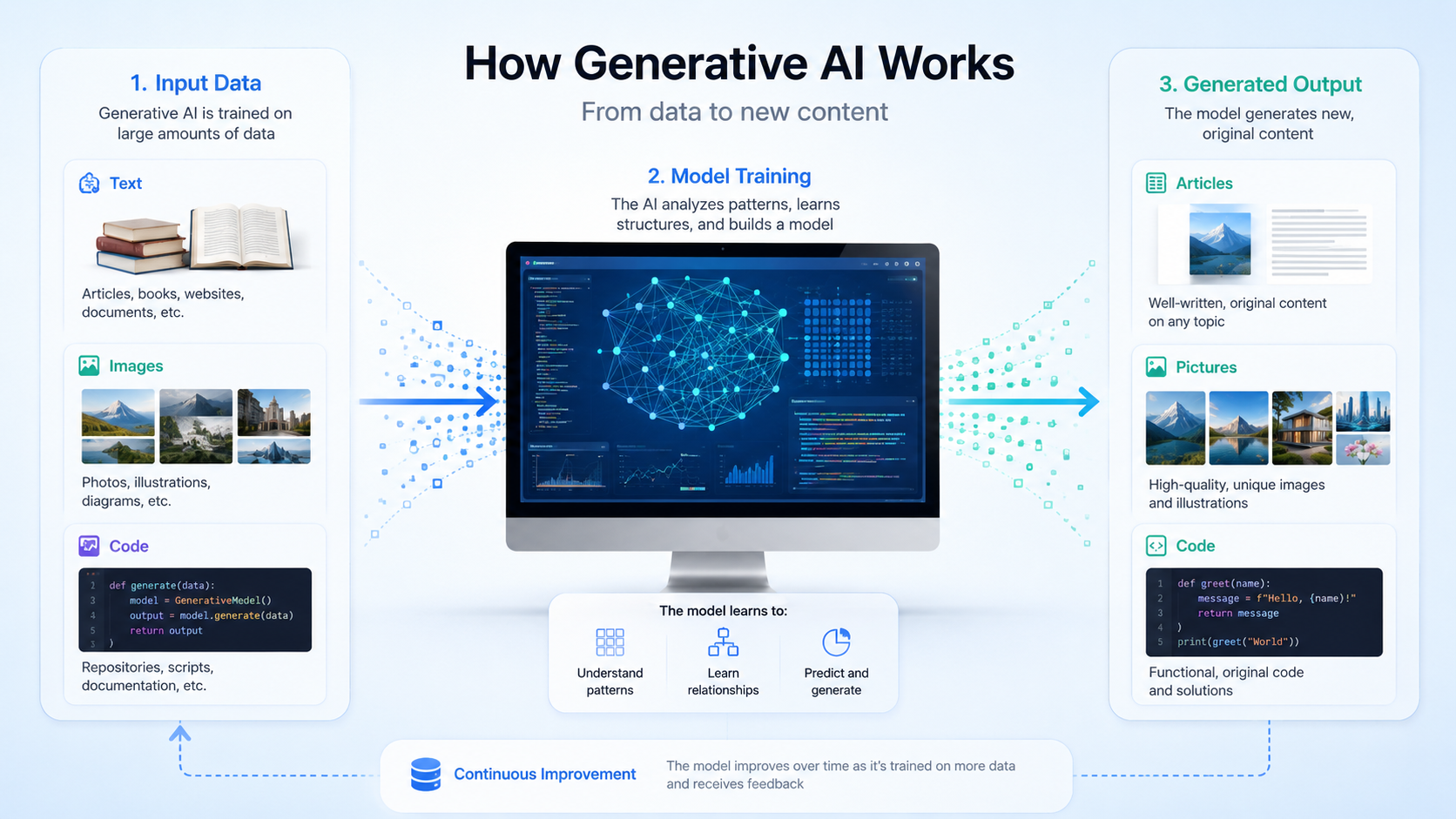

Many beginners find it difficult to define generative AI clearly. Simply put, generative AI is a type of artificial intelligence designed to create new content. Unlike traditional systems that mainly analyze existing information, these models can produce text, images, audio, video, and code.
You can think of it like a digital creative assistant. You provide a prompt or instruction, and the system generates a response based on what it has learned. Although the process behind the scenes is complex, using the technology is often as simple as typing a question into a chat box.
The system relies on advanced mathematical models and patterns learned from large amounts of data. During training, it studies examples of human language, artwork, and other digital content. Consequently, it learns how to produce responses that feel natural and useful.
This ability has changed how people approach creative work. Today, users can brainstorm ideas, draft documents, create visuals, and solve problems with the help of AI-powered tools.
The Core Concept Behind Generative AI
To understand how generative AI works, it helps to look at the technology behind it. These systems use artificial neural networks, which are computer models inspired by the structure of the human brain.
These networks process information through multiple layers. Each layer helps the system recognize different patterns and relationships within the data.
For example, an image-generation model may study millions of pictures to understand objects, colors, shapes, and styles. When you request a specific image, it does not simply copy an existing picture. Instead, it creates a new image based on the patterns it learned.
This process requires significant computing power. Companies use large-scale infrastructure to train and operate these systems. As they process more examples, the models become better at understanding language, visuals, and complex instructions.
Therefore, generative AI can produce everything from realistic images to written articles, computer code, and creative ideas.
How Generative Models Learn from Data
Data is the foundation of generative AI. Without high-quality training data, these systems cannot create useful results. Engineers train models using machine-learning techniques that allow computers to identify patterns automatically.
For example, if a model studies well-written articles, it learns common writing structures, vocabulary, and communication styles. Similarly, models trained on images learn visual patterns and artistic features.
The training process involves repeated testing and improvement. The system attempts a task, receives feedback, and adjusts its internal settings to improve future results.
Over time, this process helps the model become more accurate and versatile. As a result, generative AI systems can answer questions, assist with creative projects, and support many professional tasks across different industries.
The Difference Between AI and Generative AI
People often use these two terms interchangeably in daily conversation. However, they represent distinctly different concepts entirely. Traditional artificial intelligence acts as the broad umbrella category. It includes any machine designed to mimic human thinking or logic. Generative AI represents a smaller, specialized subcategory beneath that umbrella.
Traditional systems focus heavily on rules, analysis, and prediction. They look at data sets and make a firm decision. They do not create anything new during this process. For example, a standard spam filter uses traditional AI methods. It reads an email and categorizes it as safe or dangerous. It stops completely right there.
In contrast, the newer generation focuses strictly on creation. It takes the basic analysis a step further. Instead of just organizing data, it uses that data to build something fresh. This distinction remains crucial for business leaders today. Understanding the difference helps teams choose the right tool for the job. You use traditional methods to sort large amounts of information. You use generative methods to draft a brand-new corporate report.
Traditional Artificial Intelligence Explained
Traditional artificial intelligence has existed for several decades. It currently powers many applications we use every single day. These systems excel at recognizing patterns within firmly established boundaries. They follow strict rules set directly by human programmers. Therefore, they offer highly predictable and deeply reliable analytical results.
Consider the popular recommendation engine on Netflix. This system analyzes your entire viewing history carefully. It compares your unique habits to millions of other active users. Then, it predicts which movie you might enjoy watching next. This represents a classic, highly effective analytical approach. The system does not write or film a new movie for you.
Similarly, traditional methods power many medical diagnostic tools. A computer analyzes a patient’s X-ray image. It spots potential abnormalities based entirely on historical medical data. It immediately alerts the doctor to investigate the issue further. This technology saves lives by processing information faster than any human. However, it operates strictly within its designated analytical framework. It lacks the ability to generate original medical research on its own.
The Shift to Generative Capabilities
The technology industry recently experienced a massive architectural shift. Researchers discovered new ways to structure neural networks. They developed highly advanced transformer models. This breakthrough allowed computers to understand language context much better. Consequently, machines began creating content rather than just analyzing it.
This shift unlocked entirely new business opportunities worldwide. Suddenly, computers could write persuasive marketing emails independently. They could design beautiful website graphics from scratch. They could compose custom background music for corporate videos. This creative capability changed the entire software landscape forever. Companies rushed to integrate these features into their core products.
We now see a powerful blend of both technologies in modern software. A platform might use traditional methods to analyze quarterly sales data. Then, it uses generation tools to write a comprehensive summary report. This smart combination offers immense value to corporate teams. It actively automates tedious tasks from start to finish. Workers can focus on high-level strategy instead of manual data entry. This saves countless hours of expensive labor every single week.
Why is ChatGPT Called Generative AI?
ChatGPT stands as the absolute most famous example of this technology. But why exactly does it fit this specific category? The answer lies entirely in how the software formulates its responses. When you type a prompt, it does not fetch a pre-written answer. It generates a completely unique response word by single word.
The system calculates the most likely next word in a sentence. It bases this calculation on your prompt and its massive training data. Therefore, it creates genuinely original text every single time you use it. Even if two people ask the exact same question, they might receive completely different answers.
This unique creative mechanism strictly defines the generative category. ChatGPT produces new essays, creative poems, complex code, and meeting summaries. It actively builds new content rather than just retrieving old files. This fundamentally separates it from standard internet search engines. Search engines find existing web pages created by humans. ChatGPT writes a brand-new page just for you immediately. This impressive capability revolutionized how students and professionals approach detailed research.
The Role of Large Language Models
ChatGPT relies heavily on a specific technology called a Large Language Model. Industry experts often refer to this simply as an LLM. An LLM acts as the digital brain behind the chat interface. Developers build these models by feeding them billions of words. This intense process teaches the machine the subtle nuances of human communication.
The “large” aspect refers directly to the vast amount of training data. It also refers to the billions of parameters within the neural network. These parameters act very much like human mental connections. They help the system understand context, emotional tone, and user intent. When you ask a complex question, the LLM processes the meaning instantly.
According to a detailed report from Stanford University, these models demonstrate surprising reasoning abilities. Large language models can summarize dense academic papers and extract key insights efficiently. In addition, they are capable of translating foreign languages with a high degree of accuracy. Another impressive capability is their ability to adopt specific personas and communication styles during conversations. The LLM framework makes all of these generative tasks possible, and the technology continues to evolve at a rapid pace.
Conversational Content Generation
The true power of ChatGPT lies in its natural conversational design. Early AI tools required strict, complex programming languages. Users had to learn highly specific commands to get basic results. ChatGPT changed this frustrating dynamic completely. It allows everyday users to interact using natural, plain language.
You can converse with the machine exactly like a human assistant. If the initial output misses the mark, you simply ask for a revision. You might say, “Make it shorter,” or “Use a more professional tone.” The smart system remembers the previous context of the chat. It generates a fresh response incorporating your brand-new instructions perfectly.
This highly interactive process makes content creation incredibly efficient. It lowers the barrier to entry for ordinary, non-technical users. Anyone can generate high-quality text without holding specialized technical skills. This easy accessibility explains the massive global popularity of conversational interfaces. Millions of people use these helpful tools daily for brainstorming and drafting. It has fundamentally changed the nature of personal computing forever.
What is an Example of Generative AI in the Real World?
Understanding the underlying theory remains very helpful. However, seeing real-world examples makes the abstract concept tangible. We interact with these powerful tools across multiple different formats daily. The technology expands far beyond simple text-based chatbots now. It clearly encompasses visual arts, audio production, and advanced software development.
Many highly popular applications use this technology right now. You probably use some of them regularly without realizing it. Tech giants integrate these smart features directly into their core products. They fiercely want to make content creation faster for absolutely everyone. This seamless integration happens across smartphones, web browsers, and office software.
Let us explore the most common examples available today. These tools clearly showcase the incredible versatility of modern algorithms. They highlight exactly how different industries leverage the technology for specific needs. From marketing teams to freelance artists, everyone finds a unique use case. Understanding these diverse categories helps you identify new tools for your own workflow. It also shows the incredibly broad scope of the current software market.
Text and Writing Assistants
Text generators currently remain the most widely used category globally. These tools help busy professionals draft written content incredibly quickly. They excel dramatically at overcoming frustrating writer’s block. Users rely heavily on them for everything from emails to full-length articles.
Here are some highly popular text-based applications:
-
ChatGPT: The undisputed industry standard for conversational text generation.
-
Jasper: A tool specifically designed for corporate marketing teams and copywriters.
-
GrammarlyGO: A smart assistant that helps rewrite and perfectly improve existing text.
-
Claude: A highly capable model widely known for safe and highly detailed responses.
These modern platforms save businesses thousands of hours annually. A marketer can easily generate twenty headline ideas in seconds. A programmer can rapidly write complex code snippets instantly. A customer service agent can quickly draft polite responses to angry clients. The system simply handles the heavy lifting of initial drafting. Then, the human user edits and refines the final written product. This effective collaboration produces significantly better results than either could achieve alone.
Image and Art Generation
Visual content creation represents another massive leap forward recently. Image generators transform simple text descriptions into stunning digital artwork. You perfectly describe the visual scene you strongly want. The computer beautifully paints it instantly. This technology currently disrupts the graphic design industry profoundly.
Consider these incredibly powerful visual tools:
-
Midjourney: Widely known for producing highly artistic and incredibly photorealistic images.
-
DALL-E 3: Created directly by OpenAI, it integrates completely seamlessly with ChatGPT.
-
Adobe Firefly: Built specifically for professional designers with a heavy focus on commercial safety.
-
Stable Diffusion: A highly popular open-source model that smart developers can customize heavily.
An advertising agency frequently uses these tools to storyboard commercials. A fiction author easily generates concept art for a new fantasy novel. A web designer quickly creates unique background textures for a brand-new site. These advanced visual models perfectly understand lighting, image composition, and artistic styles. They can accurately mimic oil paintings, 3D renders, or simple pencil sketches. Users simply adjust their descriptive text prompts to change the visual outcome.
Audio and Music Creation
Audio generation currently represents a rapidly growing sector in the industry. These specific tools create highly realistic voices and totally original musical compositions. They learn directly from thousands of hours of public audio data. Consequently, they can easily produce high-fidelity sound tracks in mere seconds.
This exciting category includes several highly innovative applications:
-
ElevenLabs: Generates incredibly realistic human voiceovers from simple written text.
-
Suno: Creates full musical songs, complete with vocals and instruments, from a prompt.
-
Descript: Allows users to edit recorded podcast audio simply by typing new words.
-
Murf AI: Provides highly professional voice cloning for corporate slideshow presentations.
Video creators heavily use these tools to narrate long YouTube videos. Game developers rapidly generate dynamic background music for different video game levels. Small businesses frequently create professional radio commercials without hiring expensive voice actors. The technology handles regional accents, subtle emotions, and vocal pacing perfectly. It actively opens new creative avenues for people totally lacking traditional musical training. Anyone can now independently produce professional-grade audio content. This deeply democratizes the audio production process across the entire entertainment industry.
How Does Generative AI Impact Businesses Today?
The corporate business world is rapidly embracing generative AI at an unprecedented rate. Today, corporate leaders recognize the immense potential for major cost savings. Moreover, they clearly see significant opportunities for rapid product innovation. As a result, almost every corporate department can benefit from integrating intelligent tools into daily workflows. From human resources to software engineering, the business impact remains increasingly undeniable.
Furthermore, many modern companies use these advanced systems to automate repetitive tasks. Employees often spend countless hours summarizing meetings, organizing information, or formatting spreadsheets. However, intelligent software can now handle these routine responsibilities efficiently. Therefore, busy employees regain valuable time and can redirect their attention toward complex, strategic problem-solving. Consequently, this transformation improves both job satisfaction and overall company productivity.
In addition, generative AI helps democratize access to specialized skills. A small startup may not easily afford a full-time copywriter, designer, or marketing specialist. Nevertheless, affordable AI platforms allow smaller companies to access similar capabilities. Because of this, startups can compete more effectively with large global corporations. Ultimately, this technology creates a more balanced and competitive marketplace.
Improving Daily Productivity
Productivity improvements clearly stand out as one of the biggest advantages of generative AI. When used correctly, smart assistants help employees complete tasks much faster. Additionally, they reduce the time spent on repetitive administrative work. As a result, businesses can improve efficiency across entire organizations.
For example, consider the typical daily workflow of a busy sales representative. They must research prospects, prepare outreach emails, and update customer records. With AI assistance, the system can automate much of the research process. Furthermore, it can quickly create personalized emails based on customer information. Afterward, it can update databases following sales conversations. Therefore, the representative only needs to review and approve the final actions.
Research from the National Bureau of Economic Research suggests that AI assistants can significantly improve worker productivity. Notably, beginners often experience some of the greatest benefits because these tools help them complete tasks more effectively. Consequently, companies can reduce training time and minimize errors in routine documentation. Overall, this increase in operational efficiency can contribute to stronger business performance.
Enhancing Creative Innovation
Beyond productivity, generative AI also encourages creative innovation. Many professionals experience difficulties during early brainstorming stages. For instance, writers may struggle when facing a blank page. Fortunately, AI tools provide immediate ideas and suggestions that help overcome creative barriers.
Similarly, product design teams can use AI to explore new concepts quickly. For example, a sneaker company can ask an image generator to combine different styles and materials. Within minutes, the system can produce dozens of unique concepts. Although many ideas may not succeed, a few concepts may inspire highly valuable designs. After that, human experts can refine and improve the strongest ideas.
As a result, rapid digital prototyping is changing how companies develop products. Businesses can test ideas faster and with lower costs than ever before. If a concept fails, teams can quickly generate new alternatives. Therefore, this faster innovation cycle helps companies remain competitive in constantly changing industries.
Future Trends in Generative Technology
The technology behind generative AI continues to evolve at an incredible pace. Today’s limitations may become ordinary features tomorrow. As technology advances, experts expect several major changes in the coming years. In particular, the focus will shift from simple chat tools toward autonomous AI agents.
For example, future AI agents may not only answer questions but also complete complex tasks independently. A user could request a complete marketing campaign, and the system could research the market, create content, design advertisements, and manage campaigns. In other words, AI may soon handle entire workflows rather than individual tasks.
Additionally, video generation technology is expected to improve dramatically. Current systems still struggle with consistency and longer videos. However, future models may create realistic films from simple written instructions. Likewise, personalized AI tutors could adapt lessons according to individual learning styles. Therefore, the future of generative AI offers enormous possibilities for people and businesses willing to adapt.
Ethical Considerations and Challenges
Despite these benefits, generative AI also creates serious ethical challenges. For this reason, society must carefully address potential risks. Currently, major concerns include copyright issues, privacy problems, and misinformation.
Many AI models learn from large amounts of digital content. However, some creators argue that their work is used without proper permission. Consequently, artists and writers are demanding fair compensation and clearer regulations. Meanwhile, companies are also concerned about confidential information being exposed through AI systems.
Another major concern involves deepfakes and misinformation. Bad actors can use AI to create realistic fake images, videos, and voices. As a result, public trust and digital security may face serious threats. Therefore, technology companies must develop stronger detection methods and reliable systems for identifying AI-generated content.
Preparing for the Changing Workforce
The rapid adoption of AI worries many workers who fear job replacement. However, history shows that new technology often transforms jobs rather than completely removing them. Therefore, employees must focus on developing new skills.
Workers increasingly need abilities such as:
- Strategic problem-solving skills.
- Effective prompt engineering techniques.
- Strong data privacy awareness.
- Careful fact-checking and editing abilities.
Meanwhile, AI can handle repetitive tasks, while humans provide creativity, judgment, and emotional understanding. As a result, successful professionals will learn how to collaborate with intelligent systems.
Ultimately, AI should be viewed as a powerful assistant rather than simply a replacement. A worker who learns to use AI effectively may achieve far more than someone who refuses to adapt. Therefore, continuous learning and digital skill development will remain essential. Although machines can process information quickly, human empathy, critical thinking, and strategic decision-making remain extremely valuable.
Frequently Asked Questions
What Is Generative AI?
Generative AI is a type of artificial intelligence that creates new content. Unlike systems that only analyze information or organize data, it can produce text, images, music, audio, and other forms of digital content.
For example, you can ask a generative AI system to write a poem, create an image, or compose a song. It learns patterns from large collections of text, images, and other data. Then, when given a prompt, it generates content that matches the user’s request.
As a result, people can create professional-looking content much faster than before. Furthermore, this technology is changing how individuals and businesses approach creative work.
Why Is ChatGPT Called Generative AI?
ChatGPT is considered generative AI because it creates new text in response to user prompts. Instead of copying a prewritten answer, it generates responses based on patterns learned during training.
Additionally, using advanced machine-learning models, it predicts which words are most likely to come next in a sequence. Consequently, it can produce articles, code, emails, stories, and many other types of content.
Therefore, because it creates original responses rather than simply retrieving existing information, ChatGPT belongs to the category of generative AI.
What Is an Example of Generative AI?
Image-generation tools are a common example of generative AI. For instance, a user can enter a prompt such as, “Create a futuristic city at sunset,” and the system generates an original image based on that description.
Similarly, AI voice-generation tools can convert written text into realistic speech. Users simply enter text, and the software produces a spoken version in a natural-sounding voice.
As a result, these examples show how generative AI can create new content across text, images, audio, and other media formats.
What Is the Difference Between AI and Generative AI?
Artificial intelligence is a broad field that focuses on tasks such as analyzing data, recognizing patterns, making predictions, and automating decisions.
For instance, traditional AI may detect spam emails, recommend movies, or identify fraud in financial transactions. In these situations, the system mainly analyzes existing information.
In contrast, generative AI is a specialized branch of AI that focuses on creating new content. Rather than only examining data, it produces outputs such as articles, images, music, videos, and software code.
In short, traditional AI often analyzes and predicts, while generative AI creates.
Is Generative AI Safe for Business Use?
Generative AI can be safe for business use when organizations apply appropriate safeguards. For example, companies should use secure platforms, establish clear policies, and protect sensitive information.
Additionally, employees should avoid entering confidential customer data, proprietary business information, or private source code into public AI tools unless company policies allow it.
However, human review remains important. AI systems can occasionally generate inaccurate information or make reasoning mistakes. Therefore, organizations should verify important outputs before publishing or acting on them.
When used responsibly, generative AI can improve productivity while maintaining security and compliance standards.
How Does Generative AI Affect Search Engines?
Generative AI is changing how search engines deliver information. Traditionally, search engines returned lists of links that users needed to explore individually.
Today, many search platforms use generative AI to create summaries and direct answers based on information from multiple sources. As a result, users can often find information more quickly.
However, source links remain important. Users can still visit original websites to verify information, explore details, and gain additional context.
Ultimately, this combination of AI-generated summaries and source citations creates a faster and more efficient search experience.
Conclusion
Generative AI is transforming the way people create, communicate, and solve problems. Unlike traditional AI systems that primarily analyze data, generative AI can produce original content such as text, images, audio, and code.
As a result, it has become a valuable tool for individuals, businesses, and organizations across many industries. Tools such as ChatGPT, image generators, and AI-powered voice platforms demonstrate how practical and accessible this technology has become.
Furthermore, these tools can improve productivity, streamline workflows, and support creative projects. However, users should approach generative AI responsibly by verifying information, protecting sensitive data, and maintaining human oversight.
As the technology continues to evolve, its influence on education, business, marketing, software development, and digital content creation will likely expand. Therefore, learning how generative AI works and how to use it effectively is becoming an essential modern skill.
For a deeper understanding of the next evolution of AI systems, explore this beginner-friendly guide on Agentic AI and How It Works.