
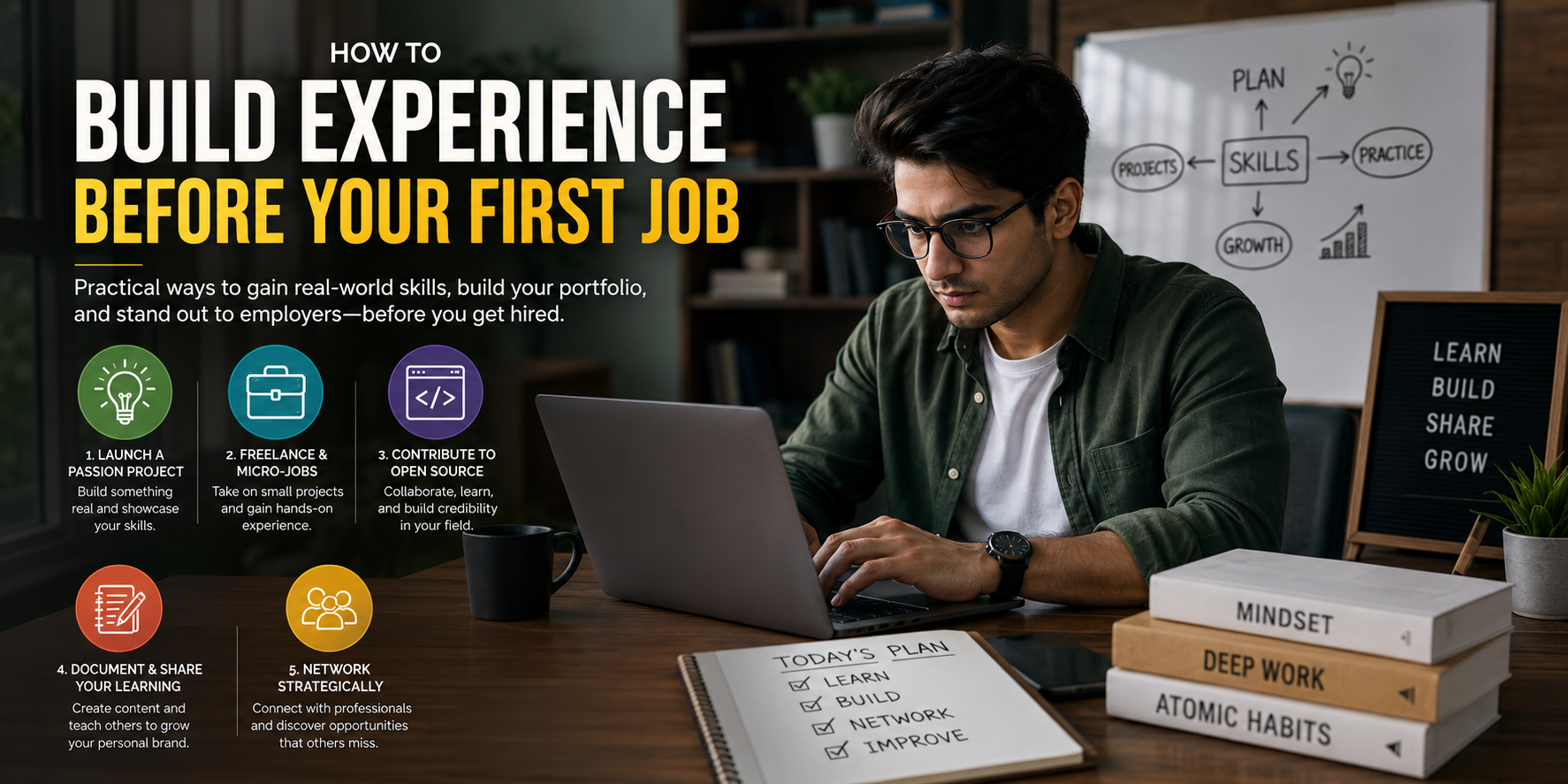
How to Build Experience Before Your First Job
Landing your entry-level role can feel like a classic catch-22 situation. Most employers want to hire people with practical skills, but you need a role to develop those skills in the first place. Fortunately, you can learn how to build experience before your first job by taking control of your own professional development. Platforms like Coursera offer accessible pathways to learn industry skills, proving that you do not need a corporate title to start growing your portfolio. Stepping into the professional arena requires initiative and a strategic mindset. Today, companies value tangible proof of ability over a simple list of university courses. By actively seeking out alternative ways to practice your craft, you close the gap between academic theory and real-world execution.
This guide breaks down actionable, proven strategies to stack your resume with meaningful projects. Whether you want to break into tech, marketing, finance, or design, these methods will help you catch a recruiter’s eye. We will explore freelancing, open-source contributions, passion projects, and strategic networking so you can kickstart your career with confidence. Taking the initiative early demonstrates high emotional intelligence, professional maturity, and dedication. These traits are highly attractive to modern hiring managers who look beyond traditional benchmarks. By applying the steps in this comprehensive article, you will transform yourself from a passive applicant into a proactive candidate. You will possess real assets that prove your capabilities instantly, giving you a competitive edge over your peers.
The Catch-22: Why Entry-Level Jobs Require Experience
The job market has shifted dramatically over the last decade, creating unique challenges for recent graduates and career changers. Today, “entry-level” rarely means “zero knowledge,” as companies try to reduce onboarding times. Employers face high training costs, so they prefer candidates who can hit the ground running immediately. Consequently, job descriptions often ask for one to two years of experience, even for junior roles. This reality can feel disheartening when you are searching for your initial break. However, understanding this systemic shift allows you to adjust your strategy to align with modern hiring preferences.
Instead of feeling frustrated by these steep requirements, you can view this landscape as an invitation to build experience before your first job. Employers do not just value formal corporate history; they value the practical application of skills to real-world problems. If you can prove you know how to build systems, manage budgets, or write compelling content, you bypass traditional gatekeepers. Taking charge of your own skill development shows immense leadership potential, which recruiters appreciate. You show that you are resourceful and capable of self-directed progress. This mindset shifts the dynamic from waiting for an opportunity to actively building one, allowing you to enter interviews with absolute confidence.
5 Practical Ways to Gain Industry Skills Independently
You do not need a boss to give you permission to start working on your professional development. By leveraging digital platforms and community resources, you can engineer your own career advancements independently. Here are five powerful methods to build professional capabilities on your own terms and establish your foundational expertise.


1. Launch a Dedicated Passion Project
A passion project is a self-directed venture that solves a specific problem while showcasing your deep technical abilities. For a software developer, this could be building a fully functional mobile application that fills a niche market gap. For a marketer, it might mean growing a niche Instagram page to ten thousand followers using advanced analytics tools. First, identify a real-world problem or a tool you wish existed in your daily life. Next, document the entire development journey, noting every roadblock, technical choice, and creative breakthrough you encounter. Finally, showcase the results clearly on your website, treating this project with the same respect as a corporate client asset. This process proves you have the grit to take an abstract idea from conception to execution.
2. Dive Into Freelancing and Micro-Internships
Freelancing platforms allow you to take on small, low-risk assignments that build immediate professional credibility. These micro-tasks provide immediate exposure to client communication, strict project deadlines, scope management, and professional constraints. Platforms like Upwork or Fiverr offer a massive global marketplace where you can bid on entry-level gigs tailored to your current skillset. Even small projects show recruiters that you understand the business dynamics of freelancing and client relations. You quickly learn how to handle revisions, negotiate pricing, deliver work under pressure, and manage expectations. Over time, these small contracts accumulate into a diverse portfolio that demonstrates clear adaptability and business acumen across multiple industries.
3. Contribute to Open-Source Initiatives
If you are entering the technology space, contributing to open-source software is an incredibly valuable strategy. When you submit code to public repositories, your work undergoes rigorous peer review by experienced global developers. This practice simulates a real software engineering environment, complete with version control systems like Git. It proves conclusively that you can collaborate with distributed teams, read complex existing codebases, and write clean documentation. Recruiters love open-source contributions because they provide public, verifiable proof of your technical skills and communication style. You can easily highlight these contributions on your resume, providing direct links to your accepted code pull requests.
4. Secure Volunteer Opportunities with Local Non-Profits
Charities and local non-profits frequently operate on shoestring budgets and welcome enthusiastic assistance. They desperately need help with web design, social media management, bookkeeping, fundraising outreach, or event coordination. Volunteering allows you to take on significant responsibilities that a corporate internship might deny a beginner. You gain genuine authority, execute strategy, and manage large initiatives while actively giving back to your community. This pathway provides you with tangible outcomes to talk about during your interview process, such as increasing donations or redesigning an outdated portal. Furthermore, it demonstrates excellent moral character and civic engagement, which align beautifully with corporate social responsibility values.
5. Build a Compelling Digital Portfolio
A digital portfolio acts as visual evidence of your capabilities, acting as a personal marketing hub. Instead of simply telling a hiring manager you can design websites or analyze data, you show them live links. Your digital portfolio should highlight your best work, detail your creative process, and outline the quantitative results achieved. Use case studies to explain the “why” behind your design or technical decisions, rather than just showing the end product. Make sure the site is easy to navigate, mobile-friendly, and contains clear contact paths for prospective employers. A polished portfolio immediately sets you apart from candidates who rely entirely on a standard text resume.
How to Format Unconventional Experience on Your Resume
Once you have gathered these real-world skills through independent channels, you must present them effectively on paper. Many candidates make the mistake of hiding their freelance work or volunteer projects at the bottom of the page. Instead, give these experiences the spotlight they deserve by treating them as legitimate professional milestones.
Treat Self-Directed Projects Like Employment
Structure your passion projects, open-source work, or freelance business exactly like a corporate job on your document. Use a professional title such as “Freelance Web Developer” or “Project Lead” to anchor the entry clearly. Include bullet points that focus on your achievements, the specific tools you used, and the measurable impact of your actions. Start each description with strong action verbs like “engineered,” “designed,” “led,” or “optimized” to convey authority. Whenever possible, include hard numbers, such as conversion rates or user metrics, to ground your work in reality. This presentation style signals to recruiters that your non-traditional experience carried real corporate weight and professional responsibility.
Emphasize Your Transferable Skills
Technical abilities are only half the battle when trying to catch the eye of a modern recruiter. Employers actively seek out soft skills like time management, communication, stakeholder collaboration, and problem-solving maturity. When describing your independent projects, highlight how you managed client feedback or overcame significant technical roadblocks on your own. Explain how you prioritized tasks when balancing multiple micro-internships or volunteer obligations alongside your academic schedule. Showing that you possess the emotional intelligence to navigate complex project lifecycles makes you a safer hire. It convinces managers that you will integrate seamlessly into their existing team dynamics without requiring constant supervision.
Networking Strategies to Get Your Foot in the Door
Sometimes, who you know accelerates your career faster than what you know, opening doors that seemed permanently shut. Building a professional network introduces you to hidden opportunities before they ever hit public job boards, giving you a distinct advantage.
Leverage LinkedIn Effectively
Optimize your LinkedIn profile to reflect your target industry by updating your headline, about section, and skills list. Share frequent updates about your passion projects, comment on insights from industry leaders, and connect with peers in your niche. When you reach out to professionals, ask for career advice rather than immediately asking for a job opening. Informational interviews are incredibly effective because they allow you to learn from experts without triggering their defensive gatekeeping instincts. Over time, these casual conversations can naturally evolve into mentorships or lead directly to internal job referrals. Consistency on the platform builds your personal brand, making you visible to recruiters searching for fresh talent.
Attend Industry Meetups and Webinars
Look for local meetups, community workshops, or global virtual conferences related to your chosen field of study. These events allow you to mingle with practicing professionals and hiring managers in an informal, low-pressure setting. Listen closely to their current industry challenges, ask insightful questions, and collect business cards or LinkedIn connections. Always follow up within twenty-four hours with a polite message thanking them for their time and referencing your conversation. Building these professional relationships outside of the standard application portal humanizes you, turning you into a memorable face rather than a resume. Networking is a long-term investment that builds social capital, which pays massive dividends throughout your career.
FAQs About Gaining Experience Before a Career Launch
Can I include self-taught skills on my resume if I want to build experience before your first job?
Yes, you can absolutely include self-taught skills on your resume when you aim to build experience before your first job, provided you back them up with proof. Do not just list tools like Python, Photoshop, or Google Analytics in a vacuum without context. Connect those skills directly to tangible, live projects you have built independently during your learning journey. If you taught yourself data analysis, write a detailed section about the specific public dataset you cleaned and visualized. This approach shifts the recruiter’s focus from theoretical knowledge to practical execution, proving you can deliver value immediately. Employers care far more about what you can build with a tool than the formal institution where you learned to use it. By framing self-taught skills through the lens of completed projects, you demonstrate immense initiative, resourcefulness, and discipline.
How do I find open-source projects to contribute to?
Finding open-source projects is simple if you utilize the right digital platforms and filtering tools available online. Websites like GitHub, Good First Issue, CodeTriage, and Up For Grabs aggregate software tasks specifically curated for industry beginners. Look for repository issues explicitly labeled “documentation,” “bug fix,” or “good first issue” to ease your way into the codebase safely. Read the project’s contribution guidelines and code of conduct carefully before submitting your first public pull request. Over time, you can take on more complex coding challenges, which will strengthen your public profile and impress engineering managers. Contributing consistently to a well-known project shows that you understand version control, team collaboration, and code review processes, which are critical junior developer skills.
Does volunteer work count as professional history?
Volunteer work definitely counts as professional history, especially if the underlying duties directly match your target career path. If you manage the accounting ledger, run social campaigns, or build websites for a local charity, that constitutes genuine experience. Write about your volunteer duties using active verbs, structured bullet points, and quantitative metrics to show professional impact. You can place this information directly in your main “Work Experience” section if you lack traditional corporate employment history. Recruiters respect the dedication, time management, and maturity it takes to apply your professional talents for a charitable cause without financial compensation. It proves you are driven by a desire to practice your craft and contribute meaningfully to complex organizational goals.
What should I do if my passion projects failed when trying to build experience before your first job?
A failed passion project is still an excellent talking point during an interview when you try to build experience before your first job, assuming you frame it correctly. In the professional world, experimentation often leads to dead ends, and modern employers deeply value resilience and adaptability. Focus your interview narrative on what the failure taught you, how you analyzed the data, and how you pivot successfully. Discuss the technical challenges you encountered, the troubleshooting steps you took, and what strategic changes you would implement next time. This level of honest self-reflection demonstrates high emotional intelligence, maturity, and a growth mindset, which are highly attractive traits. Hiring managers prefer an applicant who tried, failed, and learned over someone who never took a professional risk.
How long should a portfolio be for a beginner to build experience before your first job?
For an industry beginner trying to build experience before your first job, a digital portfolio should always prioritize high quality over sheer project quantity. Aim to showcase three to four comprehensive projects that demonstrate a diverse range of your technical and creative skills. Each case study should walk the reader through your initial goal, your thought process, the tools utilized, and the outcome. A concise portfolio with deep analysis is far more effective than a massive gallery of unexplained, shallow assignments. Make sure your navigation is intuitive, your design layout is clean, and your contact information is highly visible on every page. Quality case studies show employers how you think and solve problems, which is exactly what they evaluate when hiring entry-level talent.
Conclusion
Learning how to build experience before your first job requires you to step outside your comfort zone and create your own professional momentum. You do not need to wait for an official corporate job offer to begin your journey as a practitioner. By launching passion projects, contributing to open-source software, volunteering for non-profits, and freelancing, you create a robust portfolio that proves your worth. These self-directed efforts signal to hiring managers that you possess immense drive, raw curiosity, resourcefulness, and an excellent work ethic.
When you format these alternative experiences strategically on your resume and back them up with deliberate networking, you become a much more competitive candidate. Strong communication is also essential when presenting your skills to employers, so understanding the importance of jobs that require communication skills can help you position yourself for a wider range of career opportunities. By showcasing independent projects, volunteer work, and transferable abilities, you eliminate the entry-level experience barrier by demonstrating that you have already applied your skills in real-world situations. Take the first step today by choosing one small project or local non-profit to support. Over time, consistent effort will build a compelling professional narrative that helps launch your career successfully.