
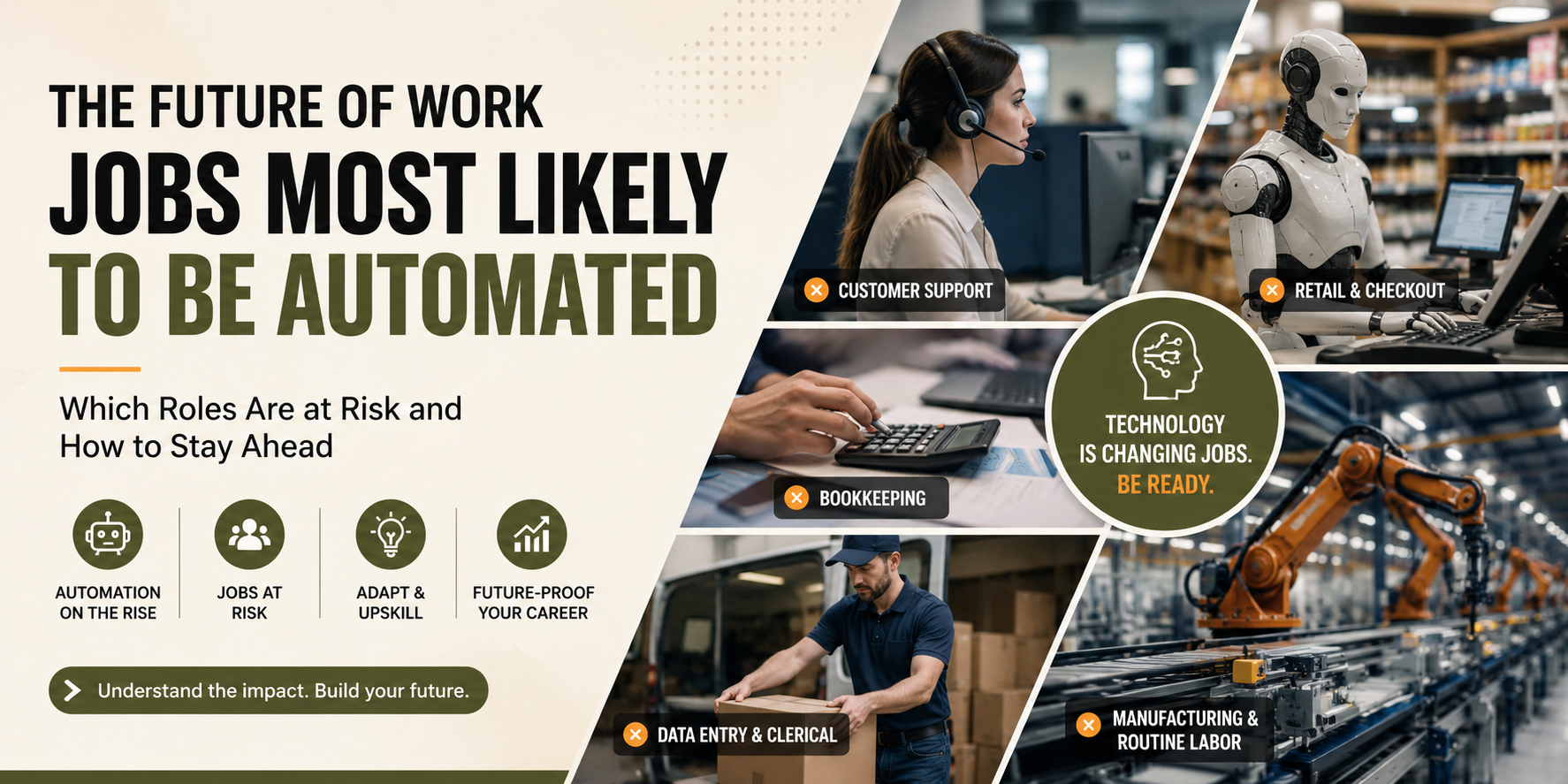
The Future of Work: Analyzing the Jobs Most Likely to Be Automated
The rapid rise of artificial intelligence and advanced robotics is reshaping the global employment landscape. As machine learning algorithms become more sophisticated, many professionals wonder which industries will experience the most significant changes. Understanding the jobs most likely to be automated helps workers, businesses, and educators adapt to this technological shift. According to recent research on global workforce trends published by the World Economic Forum, automation will transform millions of roles over the coming decade, making adaptability a crucial skill for the future.
This shifts the conversation from whether automation will happen to how fast it will occur. Routine, repetitive tasks are the primary targets for software algorithms and mechanical automation. However, this transition does not mean human labor will disappear entirely. Instead, roles are evolving rapidly, requiring a mix of technical knowledge and emotional intelligence. For a broader perspective on how AI is expected to reshape employment opportunities, read our article on how AI will create more jobs, according to Jeff Bezos. This article explores the sectors facing the highest risk of automation, identifies specific vulnerable roles, and provides actionable strategies for future-proofing your career. By understanding these shifts, professionals can make informed decisions about their career paths and skill development in the coming years.
Understanding Automation Risk Factors
Not all occupations face the same level of exposure to technological displacement. To evaluate the roles most susceptible to automation, researchers look at the nature of the daily tasks involved. Jobs that rely heavily on predictable, repetitive, and structured activities are highly vulnerable. Software excels at processing structured data, following fixed rules, and executing physical actions in controlled environments. Consequently, industries relying on manual data entry or predictable physical labor face swift transformation.
Conversely, roles requiring deep empathy, complex problem-solving, and creative thinking remain difficult to automate. Algorithms struggle with nuance, abstract strategy, and genuine human connection. Therefore, understanding these risk factors helps us predict which specific positions will see the highest levels of machine integration. The goal is to evaluate your daily activities to see if a machine can perform them faster and cheaper. This systematic analysis helps businesses optimize workflows while guiding employees toward higher-value skills that guarantee long-term employability in a tech-driven market.
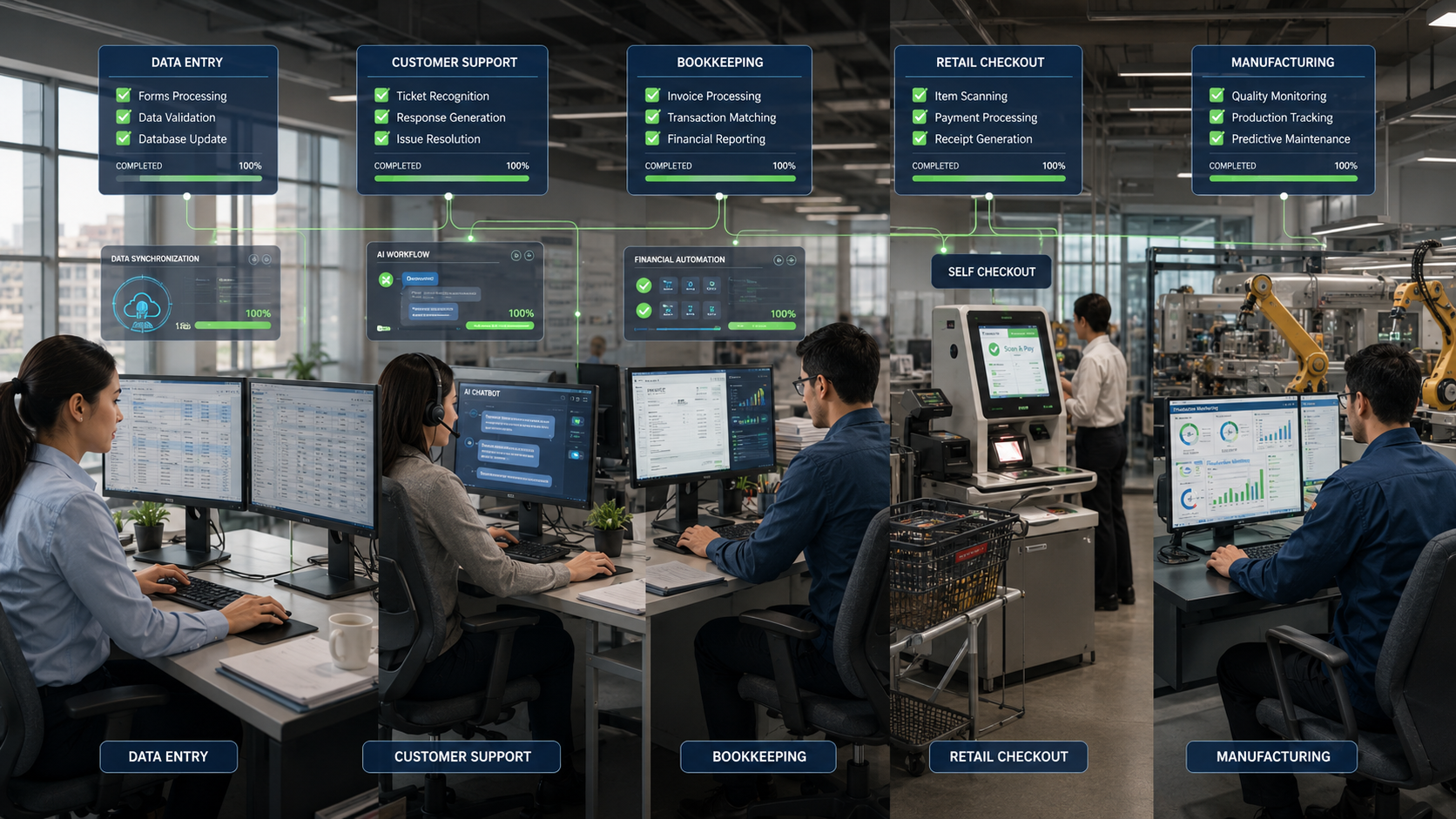

The Top Jobs Most Likely to Be Automated
1. Data Entry Clerks and Copy Officers
Data entry is one of the clearest examples of a routine administrative task. Algorithms can extract text, validate information, and update databases faster and more accurately than humans. Because this work follows strict rules, companies are rapidly deploying automation software to handle high-volume data processing. This shift leaves traditional data entry roles practically obsolete in modern corporate environments.
As optical character recognition and natural language processing advance, the need for manual transcription plummets. Companies find that automated systems reduce input errors significantly while operating continuously without fatigue. Consequently, professionals in these fields must quickly pivot toward data analysis or database management to maintain value. Focusing on how data is utilized, rather than how it is entered, is the key to remaining relevant as these clerical tasks disappear.
2. Routine Customer Support Representatives
Basic customer service roles are shifting toward conversational AI platforms. While complex issues still require human intervention, chatbots now handle routine inquiries such as tracking orders, processing returns, and resetting passwords with ease. This transition allows companies to scale customer support operations efficiently while significantly reducing overhead costs.
-
Tier 1 Support: Highly automated via natural language processing.
-
Tier 2 Support: Hybrid model where AI assists human agents.
-
Tier 3 Support: Fully human-led for nuanced or sensitive problems.
As these AI tools become more empathetic and context-aware, they manage increasingly complex customer journeys. Human agents are increasingly reserved for high-value clients or deeply sensitive escalations that require emotional intelligence. Therefore, support professionals should focus on mastering relationship management, advanced technical troubleshooting, and customer success strategies to thrive in this new hybrid support ecosystem.
3. Bookkeeping and Accounting Clerks
Modern financial software automatically categorizes expenses, reconciles bank statements, and generates balance sheets. Although strategic financial planning still depends on human expertise, financial software now automates the foundational task of recording transactions. As a result, businesses increasingly adopt cloud-based financial platforms that integrate directly with banking systems, reducing demand for traditional bookkeeping roles.
The automation of transactional accounting means that matching invoices and tracking receipts no longer require manual oversight. Instead, software flags discrepancies automatically, leaving humans to handle only the exceptions. Financial professionals must shift their focus from historical record-keeping to forward-looking advisory services. Understanding financial strategy, compliance, and corporate tax optimization will ensure that accounting experts remain indispensable trusted advisors to business leadership.
4. Retail Cashiers and Checkout Operators
Self-checkout kiosks and automated scanning systems are standard in retail environments worldwide. Furthermore, computer vision technology and mobile payment systems now allow for completely cashier-less stores. As grocery stores and retail chains optimize operational costs, the demand for manual cashiering continues to decrease rapidly across the industry.
The physical presence of a cashier is becoming a luxury or a niche branding choice rather than an operational necessity. Automated systems manage inventory and process payments simultaneously, streamlining the entire retail experience for consumers. Retail workers need to transition into roles that emphasize customer experience, visual merchandising, or localized store management. Specialized product knowledge and consultative selling are areas where human interaction still drives significant retail revenue.
5. Assembly Line and Factory Workers
Predictable physical labor has faced automation pressure for decades, but modern robotics accelerates this trend. Robotic arms equipped with advanced sensors can assemble, pack, and inspect goods with minimal human oversight. This shift significantly reduces manufacturing errors, increases production speeds, and lowers long-term operational costs for industrial facilities.
Modern smart factories utilize connected devices to monitor machine health and optimize output dynamically. Human workers on the factory floor are transitioning from manual assemblers to robotic technicians and maintenance overseers. Survival in the manufacturing sector requires technical training in machine programming, industrial safety, and systems diagnostics. The future factory worker is a highly skilled technician who manages the machines doing the heavy lifting.
Industries Leading the Automation Shift
Transportation and Logistics
The logistics sector is investing heavily in autonomous technology to streamline global supply chains. Automated guided vehicles already manage inventory inside modern warehouses, moving goods efficiently without human drivers. Additionally, long-haul autonomous trucking and delivery drones are moving closer to mainstream adoption, which will eventually reshape commercial driving roles.
The integration of smart logistics software optimizes delivery routes and manages fleet maintenance automatically. This reduces fuel consumption and minimizes delivery delays across the board. Workers in this sector must look toward supply chain management, logistics coordination, and fleet operations technology. Managing the complex networks that move goods globally remains a highly valued human skill that machines cannot easily coordinate alone.
Financial Services and Banking
Algorithmic trading and automated fraud detection systems handle massive transactional volumes in real time. Loan processing systems use predictive models to assess credit risk instantly, minimizing the need for manual underwriting. As a result, back-office banking roles are consolidating rapidly as institutions prioritize digital-first consumer experiences.
Personalized robo-advisors now manage investment portfolios for retail clients, minimizing the need for traditional wealth managers for standard accounts. To succeed in modern finance, professionals must focus on complex corporate deals, bespoke wealth management, and fintech innovation. Merging financial expertise with data science capabilities creates a highly resilient skill set that financial institutions will continue to seek out fiercely.
How to Future-Proof Your Career Against Automation
To remain resilient as the Jobs Most Likely to Be Automated continue to evolve, professionals must focus on developing skills that machines cannot easily replicate. Continuous learning and upskilling are no longer optional; they are essential strategies for long-term career stability. Individuals must learn to view technology as an enabling tool rather than a threat to their livelihood.
-
Develop Soft Skills: Focus on emotional intelligence, negotiation, leadership, and conflict resolution.
-
Learn to Work alongside AI: Master the tools transforming your industry rather than avoiding them.
-
Focus on Creativity: Engage in strategic planning, innovative design, and complex problem-solving.
-
Specialize in Niche Areas: Deep technical expertise in a specific field remains highly valuable.
Transitioning toward management, strategy, or creative direction can significantly lower your automation risk. Embracing technological tools allows you to offload routine tasks and focus on high-value, strategic work. The future belongs to professionals who can seamlessly blend human insight with machine output to deliver superior results.
Understanding the Broad Impact of Automation
When analyzing the jobs most likely to be automated, it becomes clear that artificial intelligence is changing the core expectations of the modern workforce. No industry is completely immune to change, and traditional pathways to corporate advancement are shifting. Software applications now write basic computer code, draft legal contracts, and generate initial marketing assets with remarkable speed. Consequently, professionals who previously thought their advanced degrees protected them from technological shifts must reevaluate their long-term career strategies.
The solution is not to resist these tools but to become an expert at utilizing them. Employees who learn how to prompt AI models, audit machine outputs, and integrate automated workflows into their businesses will become incredibly valuable. By focusing on systems architecture and operational oversight, you move away from executing individual tasks and move toward managing technological ecosystems. This tactical adjustment helps you increase your professional value alongside advancing computational power instead of letting automation replace your role.
The Strategic Path Forward for Businesses and Employees
Navigating a landscape shaped by the Jobs Most Likely to Be Automated requires a dual commitment from both organizational leaders and individual workers. Corporate entities must invest heavily in upskilling programs to transition vulnerable workers into collaborative corporate roles. This minimizes local economic disruptions while building a highly loyal, technologically fluent workforce capable of managing next-generation software platforms. Companies that ignore this responsibility risk facing massive talent shortages as traditional operational models become obsolete.
For the individual, maintaining career longevity requires an active commitment to continuous professional development. You must regularly evaluate your daily workflow to ensure you are contributing abstract value that algorithms cannot easily calculate. Cultivating strong industry networks, building cross-functional expertise, and volunteering for strategic corporate initiatives will solidify your position. The ultimate goal is to remain agile, highly adaptive, and constantly ready to pivot as software capabilities advance.
FAQ Section
What defines a job as highly automated?
Modern technology, software algorithms, and robotic systems make a job highly automated when they can perform its core operational tasks more cheaply, more quickly, and more accurately than a human worker. These vulnerable roles typically involve a high volume of predictable physical tasks, structured data processing, or repetitive administrative duties. These characteristics define many of the Jobs Most Likely to Be Automated. When a professional workflow follows a fixed set of unchanging rules, software developers can easily write code or train machine learning models to replicate the entire process from start to finish.
As a direct result of these engineering advancements, the necessity for human intervention drops significantly, completely transforming the role into a tech-driven operation managed by automated schedules rather than manual labor. Beyond simple repetition, automation readiness is also defined by how isolated a task is from chaotic real-world variables. If an industry operates within a highly controlled environment—such as a digitized spreadsheet or a fixed factory assembly line—it provides the perfect conditions for automation to thrive, scale, and permanently replace human labor.
Will AI completely replace human workers?
No, artificial intelligence will not completely replace human workers, but it will fundamentally change how we perform our daily professional duties across every major industry. While machines excel at processing massive datasets, recognizing complex patterns, and executing routine analytical tasks at lightning speed, they completely lack authentic empathy, intuition, and genuine creative thought.
Consequently, most global industries will see a massive transition toward highly collaborative, hybrid work environments. In this new ecosystem, AI platforms handle the repetitive, administrative, and data-heavy structural work, which effectively allows human professionals to focus their energy entirely on high-level strategic planning, unique creative expression, and critical interpersonal relationships that drive real business value.
Rather than a total replacement of the workforce, we are witnessing a shifting of responsibilities. Workers who learn to use AI as a supportive tool will replace those who refuse to adapt, making technological collaboration the true defining factor of professional success in the modern digital age.
Which industries are safest from automation?
Industries that depend on deep human relationships, complex emotional management, adaptive critical thinking, and advanced manual dexterity remain among the safest from automation. Healthcare professionals, primary school teachers, mental health therapists, specialized social workers, and creative professionals perform work that technology struggles to replicate. These vital fields demand strong situational awareness, non-routine decision-making, and genuine human interaction that software cannot truly simulate.
Because current machine learning models cannot truly replicate authentic human feelings, interpret subtle body language, or adapt to highly unpredictable emotional landscapes, these professions will remain firmly under human control for the foreseeable future. Additionally, trades that demand complex physical problem-solving in unstructured environments—like plumbing, electrical work, or emergency surgical operations—are incredibly difficult to automate because a pre-programmed machine or robot cannot easily navigate the unique physical anomalies encountered in daily real-world scenarios.
How can I find out if my job is at risk?
You can accurately assess your career risk level by carefully analyzing your daily task list and identifying highly repetitive structural patterns. If a significant portion of your daily professional responsibilities involves simple data entry, filling out standardized digital forms, processing transactions, or performing highly predictable physical actions, your role faces much higher exposure to modern automation tools.
Conversely, if your typical workday requires regular high-stakes negotiation, creative brainstorming, complex abstract troubleshooting, or managing diverse teams of people, your position is highly secure. These intricate tasks require advanced human cognition, emotional intelligence, and situational adaptability that current software applications simply cannot replicate.
The ultimate test is to evaluate whether your job depends on following a strict manual or interpreting unique, unpredictable human situations. The more your role requires original, non-linear decision-making, the less likely automated corporate systems will replace or optimize it.
Should I change careers if my role is vulnerable?
Not necessarily; changing your entire career path from scratch might be an extreme overreaction to shifting technological trends. Instead of completely abandoning your industry, look for immediate opportunities to pivot into higher-value, specialized areas within your current professional field. For example, if you currently work in basic accounting, you should focus less on manual ledger data entry and shift your focus toward forward-looking financial advising, corporate consulting, or strategic tax planning.
Upskilling in software management, system prompting, and advanced data analysis can also make you completely indispensable as a technical specialist who manages the new tools your company adopts. The goal is to move up the value chain toward tasks that require human judgment, leadership, and oversight. By actively transforming yourself into the person who audits, directs, and optimizes the automated systems, you ensure your professional longevity without needing to completely restart your career in an unfamiliar industry.
Conclusion: Embracing the Future of Work
The rise of artificial intelligence has sparked a new industrial revolution, pushing the Jobs Most Likely to Be Automated into the spotlight. Businesses now automate many routine roles in data entry, administrative support, retail, and manufacturing to improve efficiency. As a result, these positions rank among the Jobs Most Likely to Be Automated. However, this transformation does not eliminate human employment or opportunity. Throughout history, every major technological revolution has replaced specific tasks while creating new industries, generating wealth, and opening new career paths.
You can stay ahead by adapting proactively and committing to continuous professional growth. Develop uniquely human skills such as emotional intelligence, strategic problem-solving, leadership, and creative thinking to remain competitive as the number of Jobs Most Likely to Be Automated continues to grow. Professionals who embrace automation as a productivity tool rather than fear it can eliminate repetitive work and dedicate more time to high-value responsibilities. Stay curious, invest in lifelong learning, and keep up with trends related to the Jobs Most Likely to Be Automated so you can build a resilient, future-ready career alongside advancing technology.