
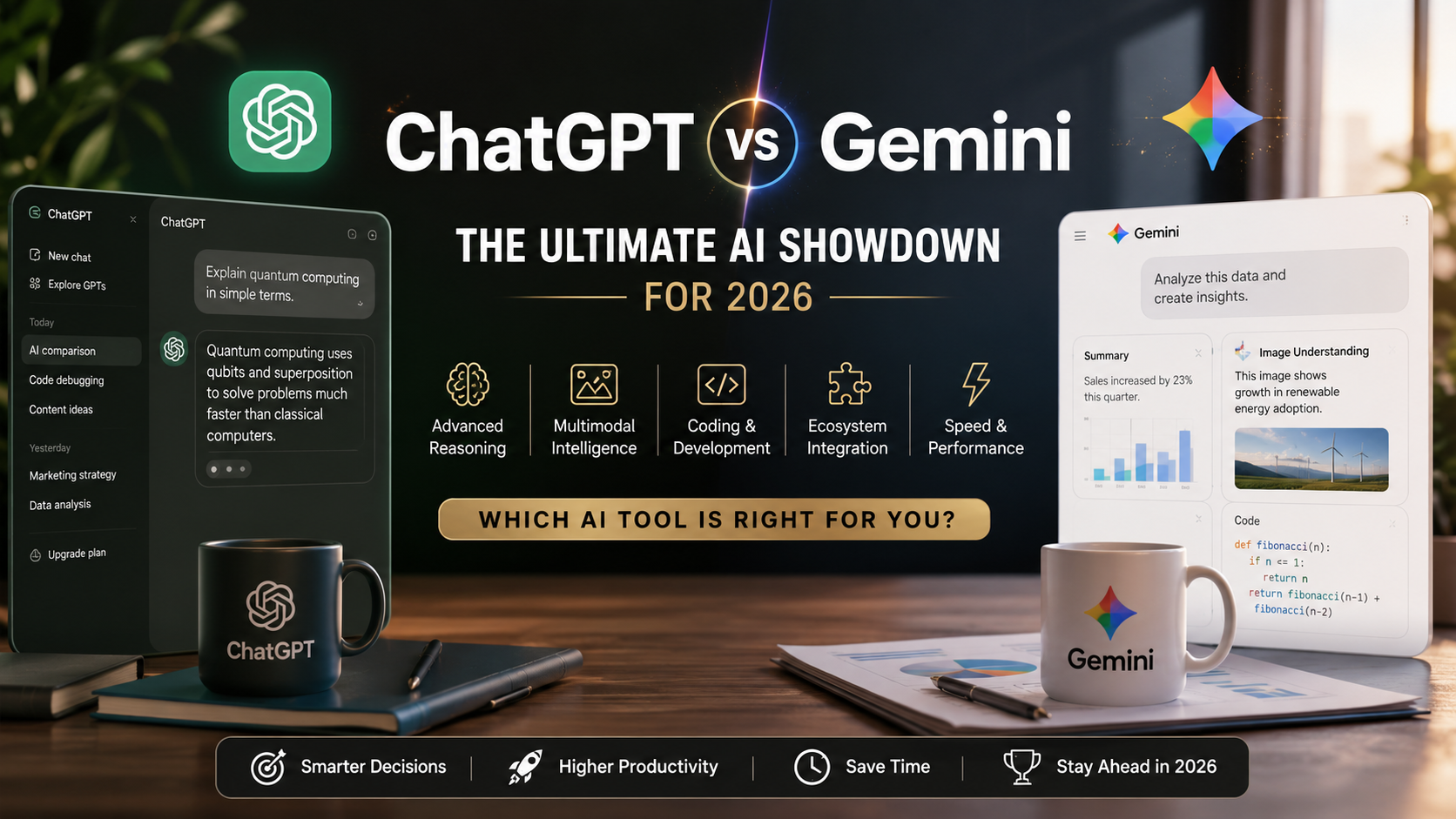
ChatGPT vs Gemini: The Ultimate AI Showdown for 2026
Choosing the right artificial intelligence tool used to be simple. However, the rapid evolution of large language models has turned it into a complex decision. When evaluating chatgpt vs gemini, users often find themselves torn between two distinct ecosystems. Each platform offers unique strengths for personal and professional productivity.
Whether you want to automate workflows or generate creative content, understanding these platforms is essential. You can track the latest model updates directly on the OpenAI Official Website. This resource showcases how these systems evolve over time to meet user needs.
This deep-dive analysis will move past the basic marketing hype. We will evaluate their reasoning capabilities, user interfaces, speed, and overall integration value. By the end of this guide, you will know exactly which platform deserves a spot in your daily tech stack.
Both tools have introduced groundbreaking updates recently. Because of this, a direct head-to-head comparison is vital for professionals. If you’re also exploring the latest AI-powered creative platforms, check out our best AI tools for image generation in 2026 guide to discover the top solutions for generating high-quality visuals. Using the right automated tools helps you stay competitive in a fast-moving market.
Understanding the Core Architecture: ChatGPT vs Gemini
To understand why these tools behave differently, we must look under the hood. ChatGPT is built on OpenAI’s generative pre-trained transformer models. These models excel at deep textual reasoning and nuanced conversation. OpenAI has historically prioritized conversational depth. This design makes the tool feel like a highly intellectual, collaborative peer.
The system relies on advanced reinforcement learning from human feedback. This training helps it grasp subtle emotional cues, humor, and complex creative guidelines. Other platforms sometimes miss these subtle nuances completely.
On the flip side, Google built Gemini as a native multimodal model. This means Gemini does not just translate images, audio, and video into text. Instead, it processes these distinct media types simultaneously.
Consequently, Google’s model behaves like a live research assistant. It is inherently wired to look at the world through multiple lenses at once. This structural design gives it an incredible advantage when handling complex multimedia tasks. Users can upload mixed media inputs without losing any contextual precision during processing.
Practical Performance: Comparing ChatGPT vs Gemini in Action

The real test of any AI utility lies in daily execution. When you throw complex, multi-step prompts at these platforms, their differences become visible. Writers, engineers, and researchers all report drastically different outcomes. Your results will depend on which machine you choose to deploy for your projects.
Text Generation and Creative Writing OpenAI Styles
For long-form writing, content strategy, and creative brainstorming, ChatGPT generally maintains an edge. It adapts beautifully to specific brand voices. It also maintains complex narrative threads over long sessions.
The system tends to write with a less formulaic structure. Writers often prefer it because it avoids clichés. The prose feels genuinely human. It can craft poetry, technical manuals, or engaging essays with equal skill. It matches whatever tone you request almost instantly.
The Gemini platform excels at structuring massive amounts of information rapidly. If you need a bulleted executive summary of a 50-page document, Gemini handles the task cleanly. It can also provide a quick breakdown of complex public data.
It writes in a crisp, journalistic style that feels highly professional. However, it is occasionally less varied in tone than its competitor. It is the ideal tool for corporate communication where clarity and speed are valued over stylistic flair.
Coding and Technical Logic Google Models
Software development is another major engineering battleground for these platforms. Developers often lean toward ChatGPT for writing complex code blocks. It is excellent for debugging intricate software architecture and explaining high-level computer science concepts. Its logic loops feel tight.
Furthermore, it consistently produces fewer hallucinations in syntax. The platform can systematically walk a developer through a broken script. It identifies the exact line causing the runtime error while suggesting robust alternatives.
However, Google’s model counters this with an incredibly massive context window. Because it can process huge amounts of data at once, your workflow changes. You can upload entire code repositories into the prompt window.
This capacity allows the system to analyze your whole project layout simultaneously. It spots cross-file dependencies and systemic structural bugs. Standard models with smaller windows would completely ignore or forget these details during longer conversational threads.
Ecosystem Integration: Google vs OpenAI Platforms
Your choice between these systems will likely depend on your current software tools. The value of an AI assistant multiplies dramatically when it connects seamlessly with your files. Good tools prevent manual copy-pasting by syncing with your communication channels and cloud storage.
Google has woven Gemini directly into Workspace apps like Docs, Gmail, Drive, and Sheets. If your daily workflow lives inside Google’s ecosystem, this is a massive time-saver. You can summarize your unread emails or pull data directly out of a spreadsheet via a sidebar chat.
Furthermore, Gemini leverages Google Search for real-time web grounding. This connection makes it exceptionally fast at fetching breaking news or live web links. It transforms your traditional cloud storage into an interactive, intelligent knowledge base.
OpenAI takes a platform-agnostic approach with its ecosystem. Instead of locking you into a single corporate suite, it offers a highly customizable environment. You can access this via the GPT Store.
Users can build or deploy specialized mini-apps designed for precise professional roles. These include custom SEO auditors, academic research assistants, or specific math tutors. This flexibility allows developers and businesses to create highly targeted workflows. They can connect to various external APIs easily, making it a very flexible engine for custom software development.
Turning Insights into Action: Reviewing ChatGPT vs Gemini Winners
Ultimately, selecting your primary assistant comes down to identifying your primary bottleneck. Neither tool is universally superior across every single metric. Instead, they serve different operational styles.
It is often wise to maintain access to both platforms. You can deploy each one strategically depending on the specific demands of your project. This balanced approach ensures you always have the right tool for the job.
-
Choose ChatGPT if: You prioritize deep intellectual reasoning. It is ideal if you need advanced coding assistance or require precise stylistic control over written content. It remains the premium choice for users who demand deep conversational intelligence and advanced problem-solving logic.
-
Choose Gemini if: You live inside Google Workspace daily. It is perfect if you need to process massive files or long videos in a single prompt. It also shines if you rely heavily on rapid, real-time web research and data aggregation. It stands out as the ultimate modern research station for high-velocity data processing.
Frequently Asked Questions
Which tool is better at research, ChatGPT or Gemini?
The Gemini platform generally holds the upper hand for rapid web research. This is because it connects natively to Google’s search index. It excels at finding real-time data, summarizing live news events, and citing recent web sources accurately.
The ChatGPT system is also highly capable at web browsing. However, it tends to prioritize deep analytical processing over sheer retrieval speed. If you need quick, up-to-the-minute facts, choose Gemini. If you need a deep, multi-perspective synthesis of an academic topic, ChatGPT often delivers a more nuanced response.
Gemini’s integration with live data allows it to build comprehensive bibliographies quickly. It fetches active hyperlinks and cross-references fresh articles from the web. This makes it a great asset for journalists or analysts who need to monitor fast-moving current events. It helps track corporate financial announcements as they break publicly, ensuring your reports remain perfectly accurate and timely.
Can both models process images and videos natively?
The Gemini model was built as a native multimodal platform. This means it handles images, audio, and video files with exceptional ease. You can upload a video file and ask it to find a specific timestamp. It can also summarize the spoken content directly for you.
The ChatGPT platform also possesses excellent multimodal capabilities through its advanced vision systems. This allows users to upload documents, charts, and photographs for deep analysis. However, ChatGPT handles video primarily through frame-by-frame extraction or text transcripts.
In contrast, Gemini treats video as a unified, continuous stream of input data. This allows Gemini to notice subtle visual movements or audio shifts across a long clip. Text-based conversion methods might overlook these details entirely. For users working heavily with mixed media, design files, or raw video footage, Gemini offers an integrated processing pipeline. This streamlines asset management and visual analysis without requiring external third-party conversion software tools.
Is ChatGPT safer to use than Gemini for sensitive data?
When discussing chatgpt vs gemini security, both companies maintain strict, enterprise-grade data privacy frameworks for their paid tiers. This ensures customer data is not used to train future public models. For free users, both platforms may log interactions for system improvements. You can manually opt out of this tracking in the settings menu.
Google aligns its safety protocols with its global cloud infrastructure standards. OpenAI complies with rigorous data security frameworks used across tech industries. Always check your organization’s internal compliance policies before uploading proprietary code or sensitive personal information into any public AI portal.
Paid corporate tiers, such as ChatGPT Enterprise or Gemini Advanced for Workspace, provide dedicated compliance certifications like SOC 2. This ensures your proprietary research, legal briefs, or medical records are completely isolated from public view. This level of enterprise security gives modern corporations the confidence to deploy automated workflows safely across sensitive financial and administrative departments.
Do these platforms offer free tiers for casual users?
Yes, both platforms offer robust free tiers that grant access to highly capable baseline models. The free version of ChatGPT gives you access to standard conversational models. It features occasional caps on advanced reasoning access during peak traffic hours.
Google’s free version of Gemini provides fast response times and seamless web search capabilities without cost. Both companies offer premium monthly subscriptions, usually priced around twenty dollars. These subscriptions unlock their absolute highest-performing models, larger context windows, priority server access, and advanced data analysis features.
Casual users can easily accomplish basic proofreading, email drafting, and general brainstorming using the free versions. They can do this without ever hitting restrictive paywalls. However, professionals who require heavy computational lifting, massive file uploads, or continuous API access will find that the paid tiers offer an immense return on investment. They significantly reduce your weekly operational overhead and save hours of manual labor.
Which assistant is better for learning to code?
The ChatGPT system is widely favored by software developers and students for learning how to program. It breaks down complex syntax errors clearly. It also provides well-commented code blocks and excels at step-by-step logic explanations.
The Gemini tool is also very capable at coding. It offers a distinct advantage when you need to upload large, pre-existing codebases or massive documentation files for context. For learning coding fundamentals and debugging specific script errors, ChatGPT remains the industry favorite. Meanwhile, Gemini shines at high-volume repository analysis.
ChatGPT feels like an algorithmic tutor that patiently explains why a specific function failed. This helps beginners build solid conceptual mental models of software design. Its code snippets are generally clean and ready to execute immediately. Gemini is ideal when you are joining a large, complex project. It helps you figure out how hundreds of pre-existing script files interact with one another across an enterprise network layout.
Conclusion
The ongoing development of chatgpt vs gemini shows that the AI landscape is shifting. The market is moving away from generalized text bots and toward highly specialized, integrated digital partners. OpenAI continues to push the boundaries of raw logical reasoning, deep creative writing, and custom agent development. Meanwhile, Google has leveraged its massive search infrastructure and workspace dominance. It turned its model into a speedy, context-rich powerhouse that can handle diverse file formats smoothly.
Instead of searching for a single winner, look closely at how you work. If you need a creative collaborator that can puzzle through complex technical problems, invest your time in ChatGPT. If you want an analytical assistant to sort through large volumes of mixed media, Gemini is tough to beat.
Try running your most frustrating weekly task through both platforms. This test will show which logic style fits your workflow best. Embracing these advanced automated utilities will undoubtedly give you a massive competitive advantage as digital workflows continue to accelerate globally.