Category Archives: Artificial Intelligence

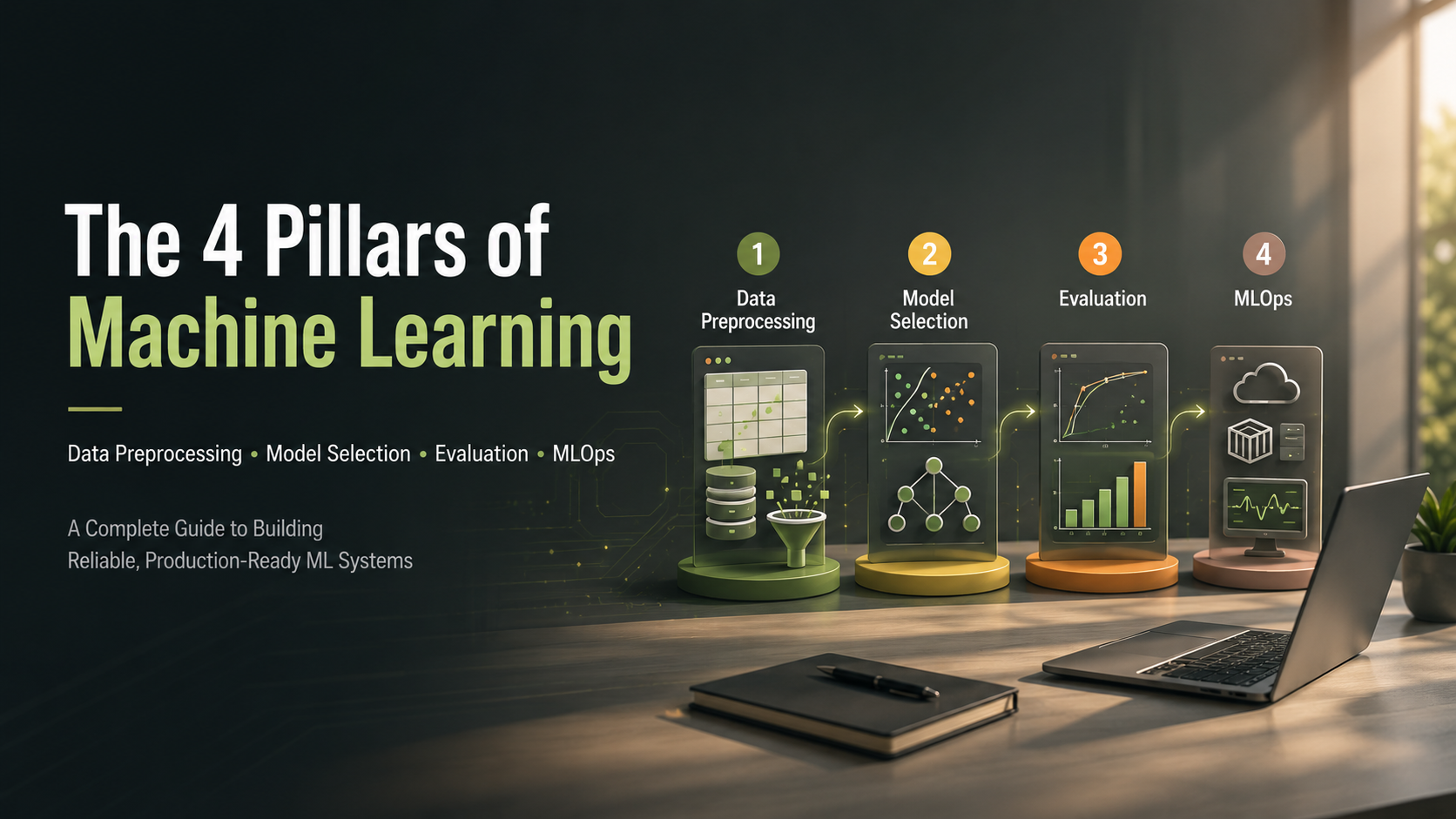
4 Pillars of ML: Core Foundations of Machine Learning

4 Pillars of ML: The Foundation of Modern Machine Learning

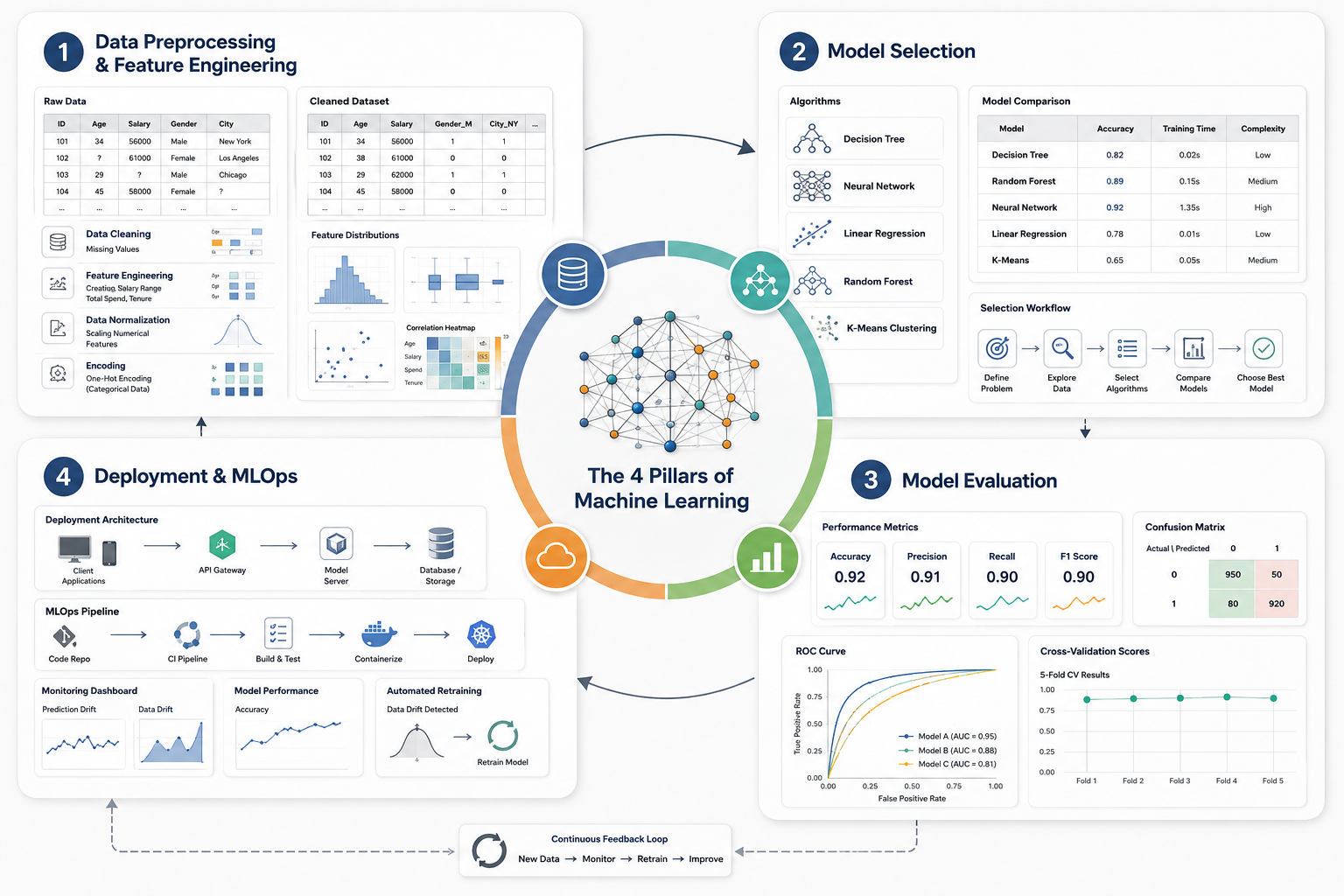
Understanding the 4 pillars of ML provides a practical framework for developing effective machine learning solutions. These pillars include data preprocessing, algorithm selection, model evaluation, and deployment with MLOps. Together, they guide every stage of the machine learning lifecycle. For readers who want to deepen their understanding, the Google AI Learning Resources offer official documentation, tutorials, and research covering many of these concepts.

Understanding the 4 pillars of ML provides a practical framework for developing effective machine learning solutions. These pillars include data preprocessing, algorithm selection, model evaluation, and deployment with MLOps. Together, they guide every stage of the machine learning lifecycle.

Whether you are a developer, data scientist, product manager, or AI enthusiast, mastering these foundations will improve your projects. Instead of relying on trial and error, you can build models with greater confidence and consistency. This guide explores each pillar in detail and explains how they work together to create production-ready machine learning systems.

Pillar 1: Data Preprocessing and Feature Engineering

Every successful machine learning project begins with high-quality data. Even the most advanced algorithms cannot compensate for incomplete, inconsistent, or noisy datasets. Data preprocessing prepares raw information by cleaning errors, removing duplicates, handling missing values, and standardizing formats before training begins.

Another critical step is feature engineering, which transforms raw variables into meaningful inputs that help models recognize patterns more effectively. Well-designed features often improve model performance more than switching to a more complex algorithm.

Common preprocessing tasks include:

  • Normalizing numerical data to keep features on a similar scale.
  • Handling missing values using the mean, median, or predictive imputation.
  • Encoding categorical variables with methods such as one-hot encoding.
  • Selecting relevant features to reduce noise and improve efficiency.

Investing time in data preparation improves training stability, reduces bias, and creates a stronger foundation for every stage that follows.


Pillar 2: Model Architecture and Algorithm Selection

After preparing the data, the next step is selecting the right machine learning algorithm. The best choice depends on your objectives, available data, computing resources, and desired level of model interpretability. Choosing an unsuitable model can reduce accuracy, increase training time, and create unnecessary complexity.

Machine learning generally includes three primary learning approaches:

  • Supervised learning uses labeled data for classification and regression tasks.
  • Unsupervised learning identifies hidden patterns or clusters in unlabeled datasets.
  • Reinforcement learning trains agents through rewards and penalties while interacting with an environment.

Simple algorithms such as logistic regression, decision trees, and random forests often perform exceptionally well for structured data. Deep learning models are better suited for complex tasks involving images, speech, and natural language processing.

The goal is to balance prediction accuracy with computational efficiency. Oversized models often overfit training data, while overly simple models may fail to capture meaningful patterns.


Pillar 3: Model Evaluation and Validation Strategies

Building a machine learning model is only part of the process. You must also verify that it performs well on unseen data. Relying solely on accuracy can produce misleading results, especially when working with imbalanced datasets. A broader set of evaluation metrics provides a more realistic picture of model performance.

Important evaluation metrics include:

  • Precision measures how many predicted positives are actually correct.
  • Recall measures how many actual positives the model identifies.
  • F1 Score balances precision and recall into a single metric.
  • Mean Squared Error (MSE) evaluates prediction error for regression problems.

Cross-validation further improves reliability. Techniques such as K-fold cross-validation repeatedly split the dataset into training and testing subsets to measure consistency. This process helps detect overfitting and underfitting, allowing developers to refine models before deployment. Careful evaluation ensures machine learning systems remain dependable in real-world environments.


Pillar 4: Deployment, Monitoring, and MLOps

A trained model creates value only after deployment into a production environment. Deployment connects machine learning models with applications through APIs, cloud platforms, or web services. Modern workflows commonly package models with Docker containers, ensuring consistent execution across development and production systems.

Deployment is only the beginning. Machine learning models require continuous monitoring because real-world data changes over time. This process, known as data drift or concept drift, gradually reduces prediction accuracy if left unmanaged.

Key deployment practices include:

  • Automated retraining pipelines using fresh production data.
  • Latency monitoring to maintain fast response times.
  • Performance logging to detect declining accuracy.
  • Version control for tracking model updates and rollbacks.

These practices form the foundation of MLOps, which combines machine learning, DevOps, and automation. Continuous monitoring helps maintain reliable performance throughout the model’s lifecycle.


Best Practices for Implementing the 4 Pillars of ML

Following the 4 pillars of ML is only the beginning. Applying best practices throughout the machine learning lifecycle helps teams improve model quality, reduce development time, and maintain reliable performance in production.

Start with high-quality data and document every preprocessing step. Experiment with multiple algorithms instead of relying on a single approach. Evaluate models using several performance metrics rather than accuracy alone. Before deployment, perform extensive testing to ensure the model behaves consistently under different conditions.

Some recommended best practices include:

  • Maintain clean and well-documented datasets.
  • Automate repetitive preprocessing tasks.
  • Compare multiple algorithms before choosing one.
  • Use cross-validation for reliable evaluation.
  • Monitor deployed models continuously.
  • Retrain models when performance begins to decline.
  • Track model versions for easier maintenance.

These practices improve collaboration between developers, data scientists, and operations teams while supporting long-term project success.


Common Challenges When Building Machine Learning Models

Even experienced teams encounter obstacles when developing machine learning solutions. Understanding these challenges helps reduce risks and improves the chances of building successful AI systems.

Poor data quality remains one of the biggest problems. Missing values, duplicate records, and inconsistent formatting can significantly reduce model performance. Another common issue is overfitting, where models perform well on training data but fail to generalize to new information.

Additional challenges include:

  • Limited or imbalanced datasets.
  • Selecting the wrong algorithm.
  • High computational costs.
  • Model bias and fairness concerns.
  • Data drift after deployment.
  • Difficulty integrating models into existing software.

Addressing these issues requires continuous testing, monitoring, and collaboration across teams. By following the 4 pillars of ML and adopting proven best practices, organizations can overcome these challenges and build machine learning systems that remain reliable as business requirements evolve.


Frequently Asked Questions

What are the 4 pillars of ML in simple terms?

The 4 pillars of ML are data preprocessing, model selection, model evaluation, and deployment with monitoring. Each pillar represents a critical stage in the machine learning lifecycle. Data preprocessing prepares clean and structured datasets, while model selection identifies the most suitable algorithm for the task. Evaluation measures how well the model performs using reliable metrics, and deployment integrates the model into production systems. Continuous monitoring ensures that the model remains accurate as new data becomes available. Together, these pillars provide a structured approach for developing reliable machine learning solutions.

Why is feature engineering so important in machine learning?

Feature engineering improves the quality of the information presented to machine learning algorithms. Raw datasets often contain inconsistencies, missing values, redundant variables, or irrelevant information that can reduce model accuracy. Creating meaningful features helps algorithms identify useful relationships within the data more effectively.

Feature engineering may include scaling numerical variables, encoding categorical values, creating interaction features, extracting information from dates, or combining multiple variables into new features. Well-designed features simplify learning, reduce noise, and often improve prediction accuracy more than changing algorithms. Because of this, many experienced data scientists spend a significant portion of project time preparing and engineering features before model training begins.

How do you choose between supervised and unsupervised learning?

The choice depends on the type of data available and the business objective. Supervised learning works best when historical data includes known labels or target values. It is commonly used for classification and regression tasks such as spam detection, customer churn prediction, and price forecasting.

Unsupervised learning is appropriate when datasets contain no predefined labels. These algorithms discover hidden relationships, customer segments, unusual patterns, or natural groupings within the data. Before selecting either approach, teams should clearly define project goals, evaluate data quality, and consider how model outputs will be used in production.

What is data drift, and why does it matter?

Data drift occurs when production data gradually changes compared to the dataset used during model training. Customer preferences, seasonal demand, economic conditions, and market trends can all influence these changes. As the input data evolves, model predictions often become less accurate because the original training patterns no longer represent current conditions.

Continuous monitoring helps detect these changes early. When drift reaches unacceptable levels, organizations can retrain models using fresh datasets to restore performance. Monitoring data drift is one of the most important responsibilities within modern MLOps because it helps maintain reliable predictions over the long term

What tools are commonly used for MLOps?

Several tools support different stages of the MLOps lifecycle. MLflow manages experiments, model versioning, and deployment tracking. Weights & Biases provides experiment visualization and collaboration features. Docker packages machine learning applications into portable containers, while Kubernetes automates deployment and scaling across cloud infrastructure.

Platforms such as Kubeflow, TensorFlow Extended (TFX), and cloud services from AWS, Microsoft Azure, and Google Cloud simplify pipeline automation, monitoring, and retraining. Selecting the right tools depends on project size, infrastructure, budget, and team expertise.


Conclusion

Understanding the 4 pillars of ML gives you a practical roadmap for building reliable and scalable machine learning systems. Each pillar supports the next, creating a complete workflow from raw data to production deployment. Ignoring any stage can reduce model accuracy, reliability, and long-term business value.

As machine learning continues to evolve, these core principles remain essential. Focus on building clean datasets, selecting suitable algorithms, evaluating models thoroughly, and monitoring production performance. Following this structured approach helps create AI solutions that remain accurate, adaptable, and valuable over time while supporting continuous improvement throughout the machine learning lifecycle.

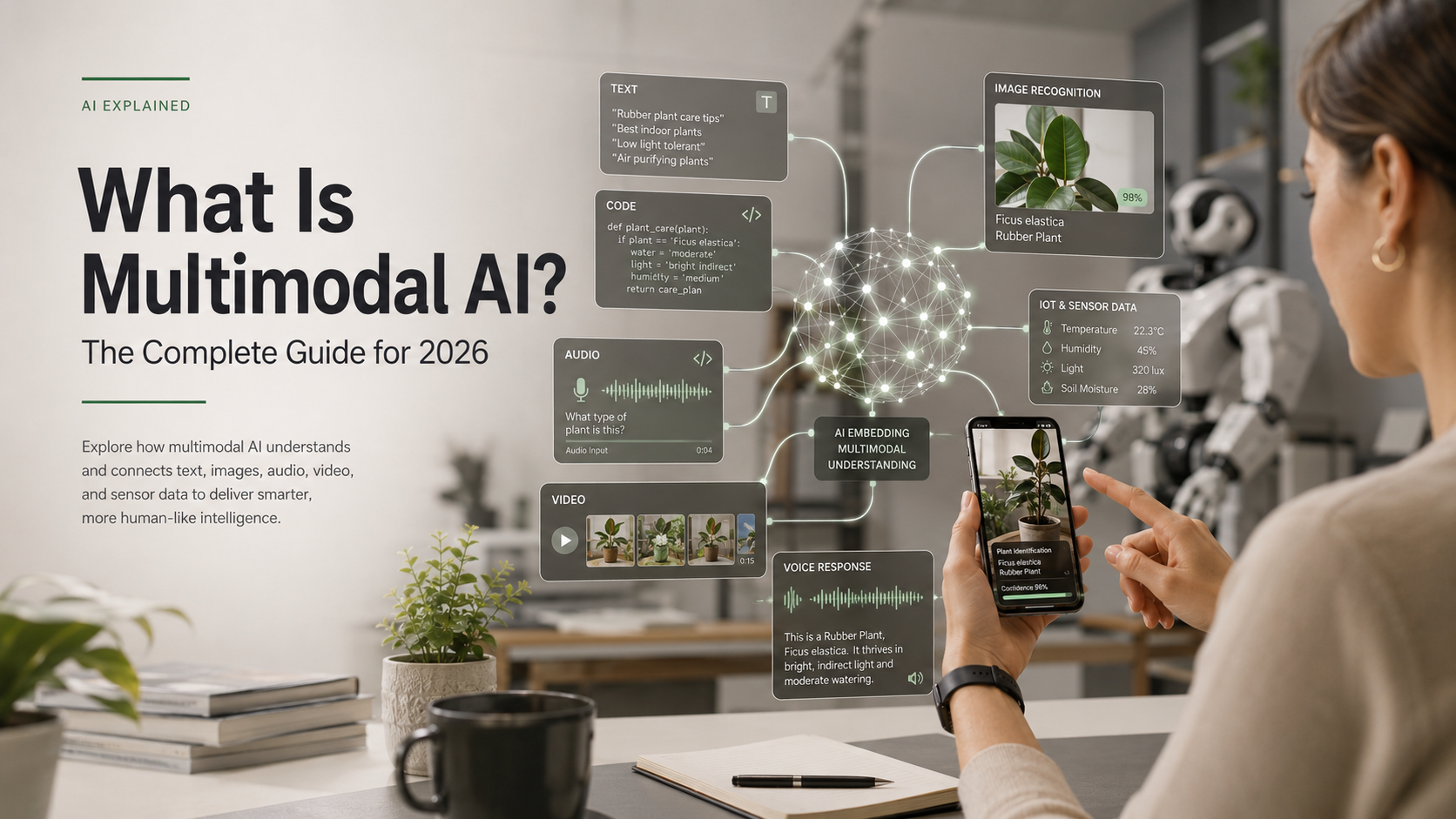
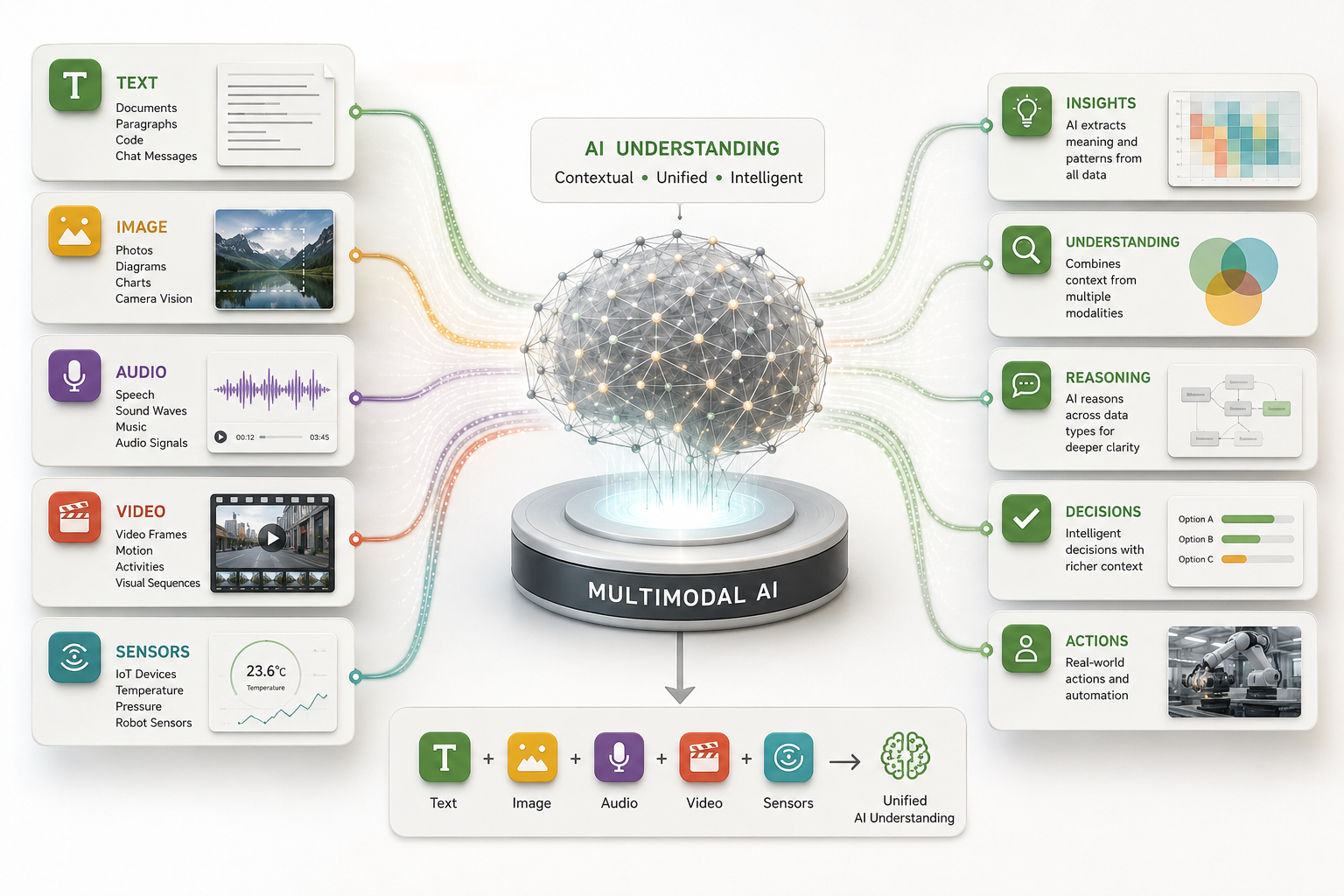
As AI systems become more advanced, machine learning is also expanding beyond single data types. To explore how modern AI models can understand and combine text, images, audio, and other forms of information, read our detailed guide on What Is Multimodal AI? A Complete Guide to the Future of AI Systems.

Natural Language Processing Pipeline: A Step-by-Step Guide

Understanding the Natural Language Processing Pipeline: A Complete Guide

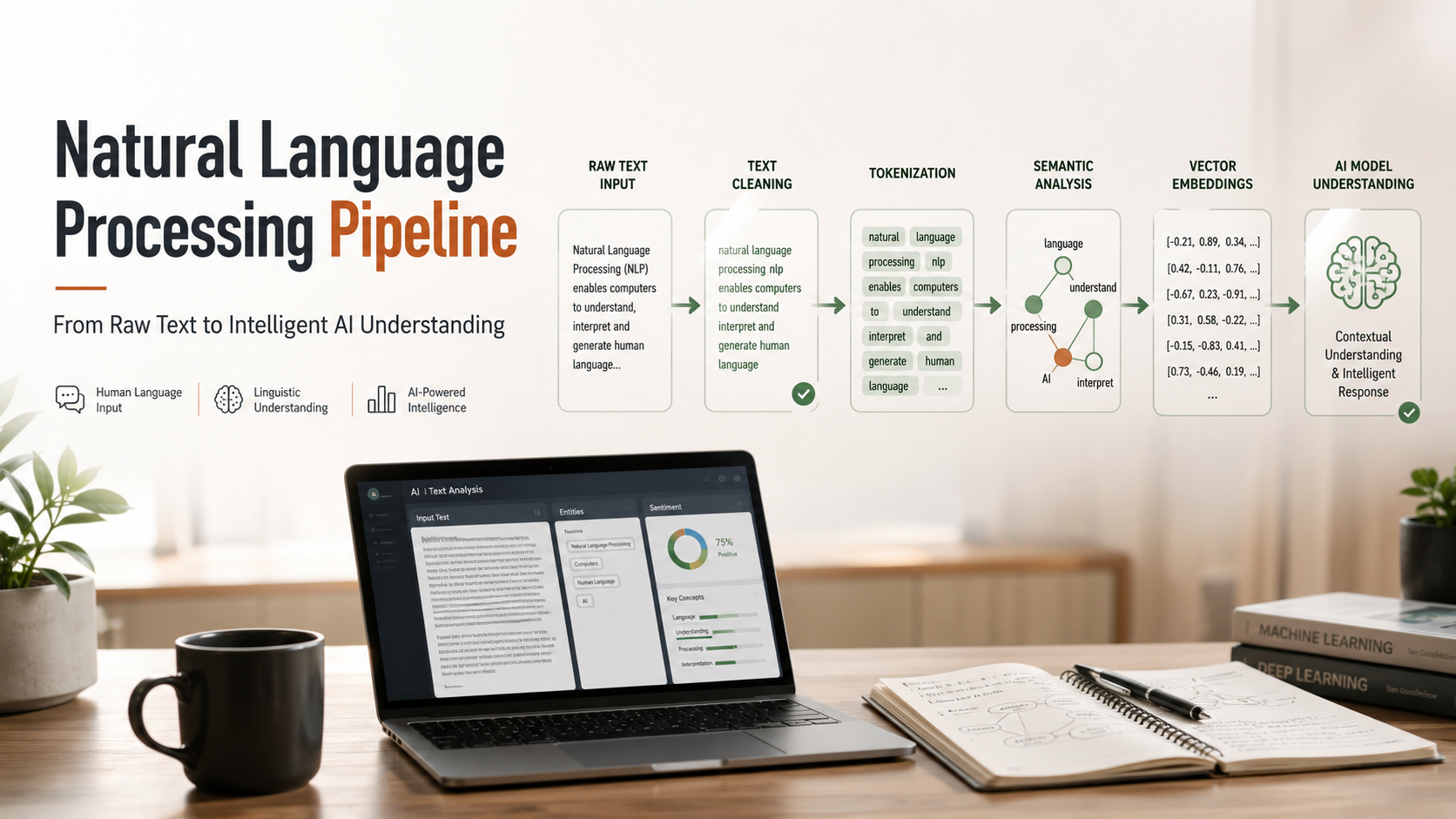
Modern artificial intelligence applications depend on machines that can understand human language. However, human text is complex, inconsistent, and often unstructured. A natural language processing pipeline provides a systematic method for converting raw text into structured information that machine learning models can analyze.

Without a proper text processing workflow, computers only see text as a sequence of characters. They cannot understand context, meaning, or relationships between words. An NLP pipeline solves this problem by applying multiple processing stages, from cleaning and tokenization to feature extraction and semantic analysis.

Developers use advanced frameworks such as Hugging Face NLP tools and transformer models to build, train, and deploy modern language models efficiently. These tools simplify many complex steps involved in preparing text data for artificial intelligence systems.

Understanding how information moves through an NLP pipeline helps developers create more accurate AI solutions. Whether you are building a sentiment analysis system, chatbot, translation platform, or document classifier, a well-designed pipeline improves performance and reliability.

What Is a Natural Language Processing Pipeline?

A natural language processing pipeline is a sequence of automated steps that transforms raw human language into structured data. Each stage performs a specific task and prepares the output for the next processing layer.

Raw text often contains spelling mistakes, formatting issues, unnecessary symbols, and inconsistent language patterns. A pipeline removes these problems and converts text into a format that machine learning algorithms can understand.
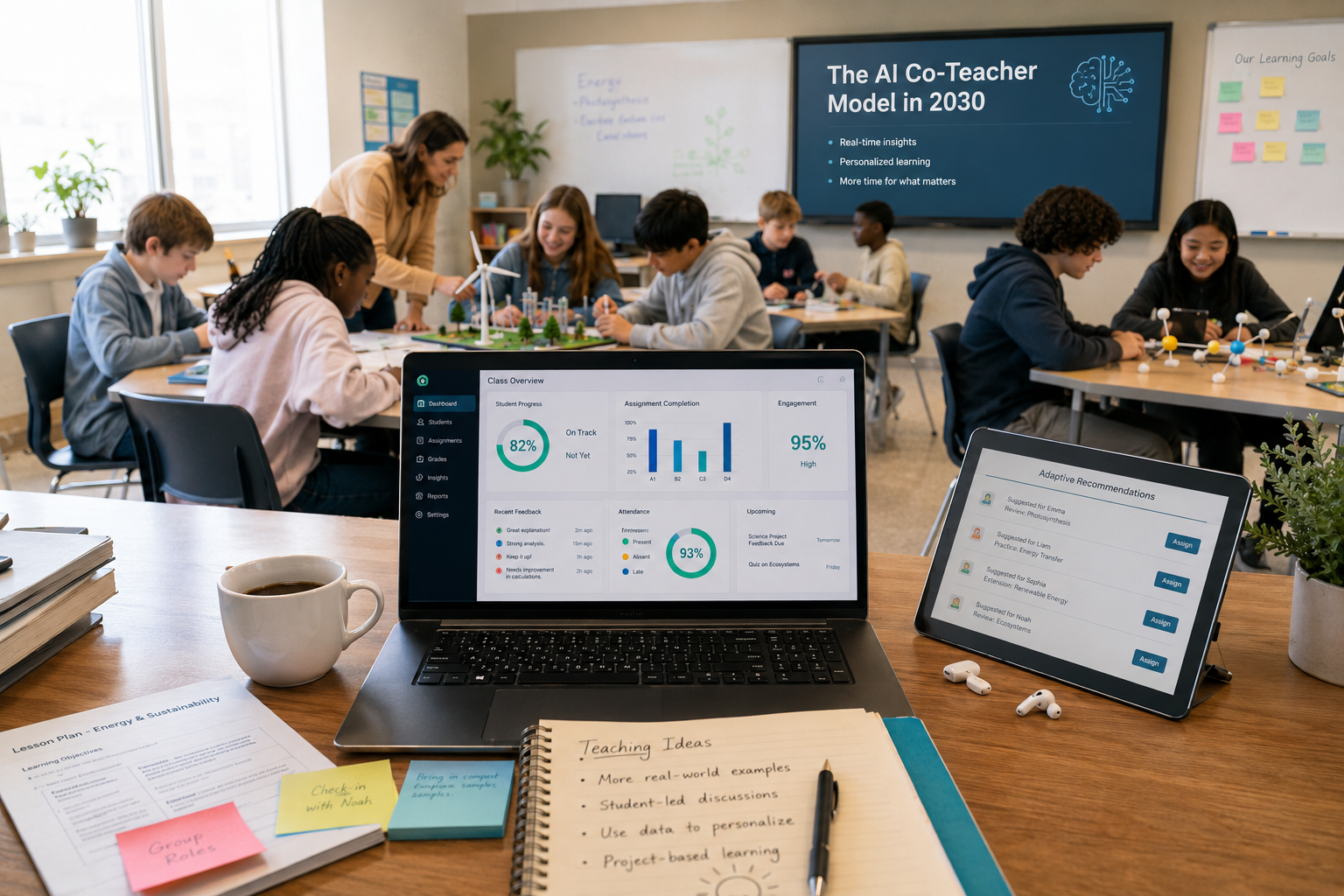
The main goal of an NLP pipeline is to bridge the gap between human communication and computer processing. Instead of analyzing unorganized text directly, systems break language into smaller components and extract meaningful patterns.

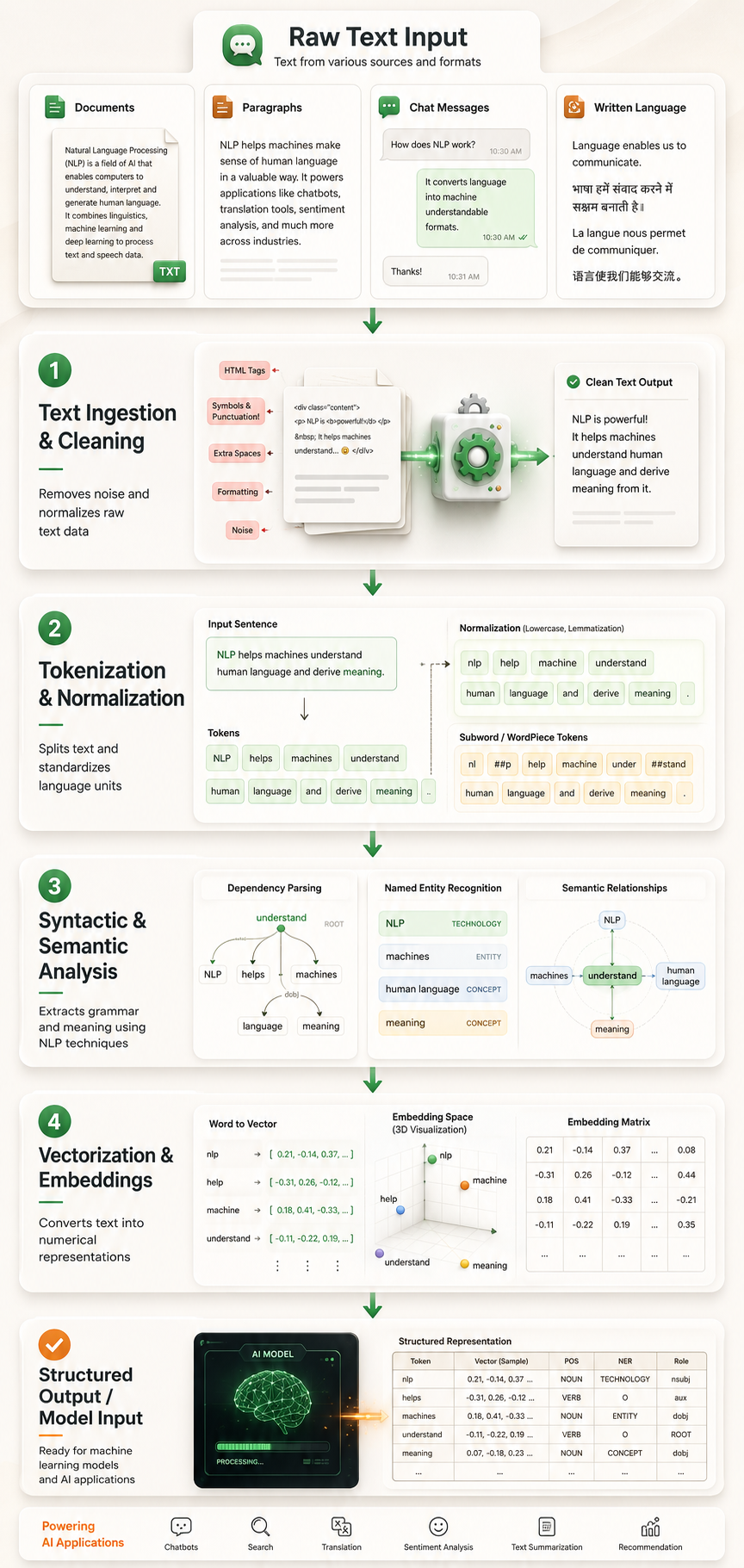
A typical NLP workflow includes several important stages:

  • Text ingestion and cleaning to remove unwanted data.
  • Tokenization and normalization to organize language units.
  • Syntactic and semantic analysis to understand structure and meaning.
  • Vectorization and embedding generation to convert text into numerical representations.

Modern text pipelines are designed to process large amounts of data efficiently. They help developers create scalable AI applications while making testing, debugging, and optimization easier.


Key Stages of a Natural Language Processing Pipeline

A natural language processing pipeline follows a structured workflow. Each stage prepares text for advanced machine learning models. The exact steps may vary depending on the application, but most pipelines follow a similar foundation.

Each stage contributes to the overall quality of the final AI system. Poor preprocessing can reduce model accuracy, while a carefully designed pipeline improves consistency and prediction results.

For example, a customer review analysis system may first remove unnecessary symbols, identify important words, detect sentiment-related patterns, and finally convert the review into numerical data for classification.

Stage 1: Text Ingestion and Preprocessing

The first stage of an NLP pipeline focuses on collecting and preparing raw text data. This process is known as text ingestion and preprocessing. It ensures that incoming information is clean, consistent, and ready for further analysis.

Raw text usually contains unwanted elements. Websites may include HTML tags, documents may contain formatting errors, and user-generated content may include spelling variations or unnecessary symbols.

The preprocessing stage improves data quality through several important techniques:

  • HTML and special character removal: Removes web code, unwanted symbols, and formatting elements that do not contribute useful meaning.
  • Case folding: Converts text into lowercase to maintain consistency. For example, “Apple” and “apple” become the same representation.
  • Noise reduction: Eliminates extra spaces, repeated characters, system logs, and unnecessary formatting.

Effective preprocessing improves the performance of later NLP tasks. However, the level of cleaning depends on the model being used. Traditional machine learning systems often require heavier preprocessing, while modern transformer models may preserve more original text information.

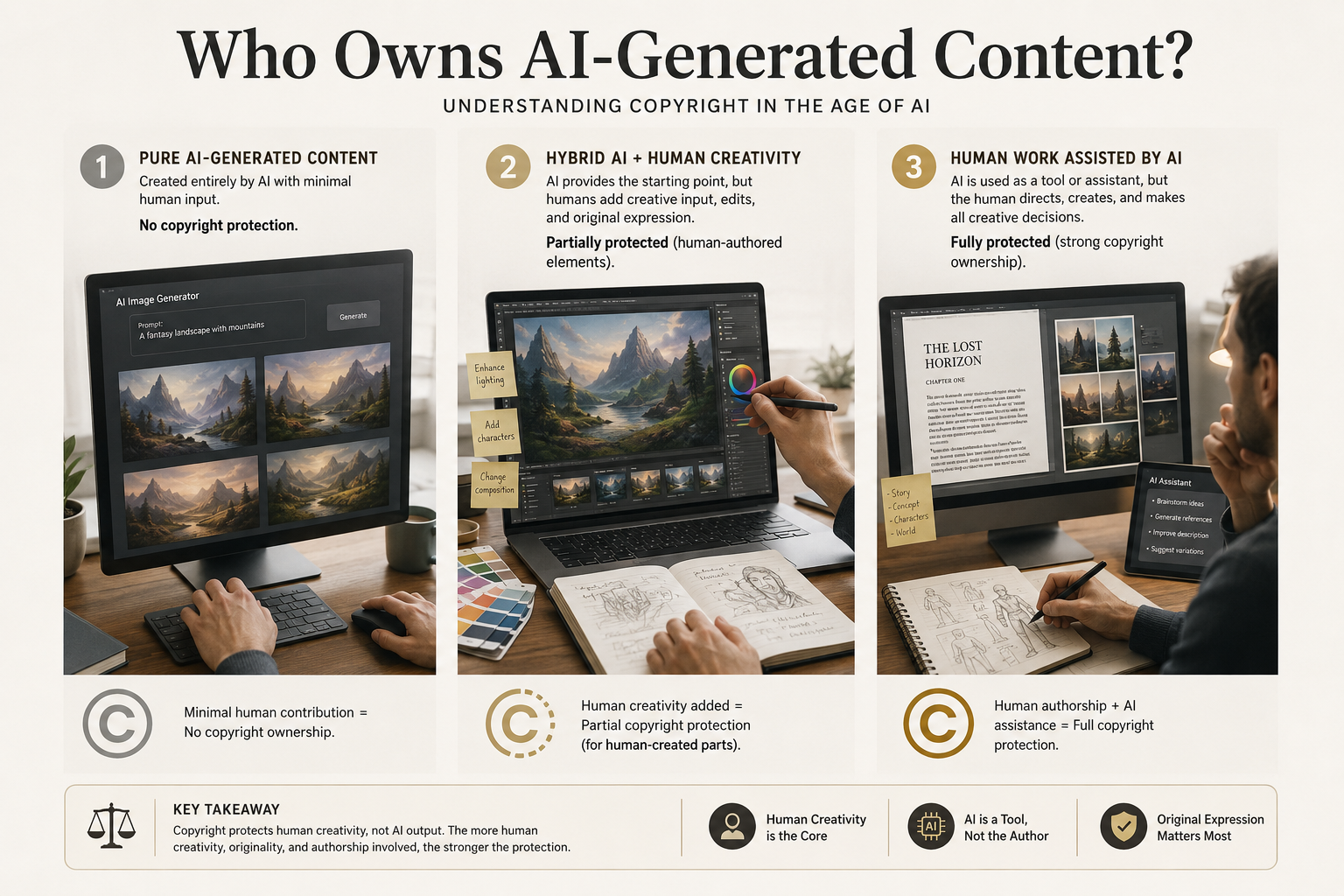
A balanced preprocessing approach helps maintain important context while removing unnecessary noise from the dataset.

Stage 2: Tokenization and Text Normalization

After the initial cleaning process, the natural language processing pipeline moves to tokenization and text normalization. This stage breaks large pieces of text into smaller units called tokens. These tokens become the basic building blocks for further language analysis.

Tokenization helps machines understand text structure. A document can be divided into sentences, and sentences can be separated into individual words or subword units. Modern NLP systems often use subword tokenization because it handles uncommon words and complex language patterns more effectively.

For example:

Input:
“The running dogs barked loudly.”

Tokenization:
[“The”, “running”, “dogs”, “barked”, “loudly”]

Lemmatization:
[“the”, “run”, “dog”, “bark”, “loudly”]

After tokenization, normalization makes language more consistent. This step reduces variations between similar words and improves the quality of machine learning input.

Common normalization techniques include:

  • Stop word removal: Removes frequently used words such as “is,” “at,” and “which” when they provide limited value for a specific task.
  • Stemming: Uses simple rules to remove word endings. For example, “studying” may become “studi” or “study.”
  • Lemmatization: Uses linguistic analysis to convert words into their proper dictionary forms. For example, “better” can become “good.”

The choice between stemming and lemmatization depends on the application. Stemming is faster but less accurate. Lemmatization provides better linguistic accuracy but requires more processing.

Modern transformer-based systems often use specialized tokenizers instead of traditional word-level methods. These tokenizers divide text into smaller subword units while preserving important context.

A well-designed tokenization process improves model understanding and ensures that language data is represented consistently throughout the pipeline.

Stage 3: Syntactic and Semantic Analysis

Once text has been cleaned and normalized, the NLP pipeline begins analyzing language structure and meaning. This stage focuses on understanding how words relate to each other and what information they represent.

Syntactic analysis examines the grammatical structure of sentences. It helps machines identify relationships between different language elements. Semantic analysis focuses on extracting meaning from text and understanding the context behind words.

Several important NLP techniques are used during this stage:

  • Part-of-Speech (POS) tagging: Identifies whether a word functions as a noun, verb, adjective, or another grammatical category.
  • Named Entity Recognition (NER): Detects important entities such as people, organizations, locations, dates, and financial values.
  • Dependency parsing: Maps relationships between words to understand sentence structure and identify actions and their subjects.

For example, in the sentence “Tesla opened a new factory in Berlin,” an NLP system can identify Tesla as an organization and Berlin as a location. It can also understand that Tesla performed the action of opening a factory.

This analysis helps AI systems move beyond simple word matching. Instead of only counting terms, models begin to understand relationships and context.

Semantic analysis is especially important for applications such as:

  • Search engines
  • Question-answering systems
  • Chatbots
  • Sentiment analysis tools
  • Document classification platforms

Modern transformer models have improved semantic understanding significantly. Models such as BERT use contextual representations to understand how word meanings change depending on surrounding text.

By combining syntactic and semantic analysis, an NLP pipeline extracts deeper insights from human language and prepares information for advanced machine learning tasks.

Stage 4: Feature Extraction and Vectorization

Machine learning models cannot directly process text strings. They require numerical input that represents language patterns mathematically. The feature extraction and vectorization stage converts processed text into numerical formats.

This transformation allows algorithms to identify relationships, similarities, and patterns within large datasets. The quality of these numerical representations directly affects model performance.

Several popular vectorization methods are used in NLP pipelines:

  • Bag-of-Words (BoW): Counts how frequently words appear in documents. It is simple but does not understand word order or context.
  • TF-IDF (Term Frequency-Inverse Document Frequency): Measures the importance of words by comparing their frequency within one document against their frequency across a larger collection.
  • Word embeddings: Represent words as dense numerical vectors that capture semantic relationships.

Traditional approaches such as TF-IDF work well for many basic text classification tasks. However, modern AI applications increasingly rely on deep learning-based embeddings.

Techniques such as Word2Vec, transformer embeddings, and large language model representations create richer numerical meanings. They allow systems to recognize that words like “car” and “vehicle” are related even when they are not identical.

Vectorization is a critical stage because it connects human language with machine learning algorithms. A strong representation method helps models perform better in tasks like translation, recommendation systems, text generation, and classification.

As NLP technology advances, vectorization methods continue evolving. Modern pipelines increasingly use contextual embeddings that understand meaning based on the entire sentence rather than isolated words.


Best Practices for Building a Scalable Natural Language Processing Pipeline

Building a reliable natural language processing pipeline requires careful planning. A production-ready system must balance accuracy, speed, scalability, and resource efficiency. A pipeline that works well during testing may require additional improvements before handling real-world data.

One important principle is to keep every processing stage modular. Independent components make it easier to update, test, and replace individual parts. For example, developers can change a tokenizer or embedding model without rebuilding the entire system.

Another important practice is avoiding unnecessary preprocessing. Older machine learning methods often depended on aggressive cleaning techniques. However, modern transformer models can understand punctuation, capitalization, and sentence structure. Removing too much information may reduce model performance.

Key practices for efficient NLP pipelines include:

  • Keep pipelines modular: Build separate components for cleaning, tokenization, analysis, and vectorization.
  • Avoid over-preprocessing: Preserve useful context when working with transformer-based models.
  • Cache intermediate outputs: Save processed data to reduce repeated computation during experiments.
  • Monitor data drift: Track changes in language patterns to maintain model accuracy over time.

Data quality monitoring is especially important for applications that process continuous user input. Language changes frequently because of new trends, slang, and industry-specific terms.

A scalable pipeline should also include proper testing and evaluation. Developers need to measure how preprocessing decisions affect final model results.

By following these practices, teams can create NLP systems that are easier to maintain and more reliable in production environments.


Tools for Building Natural Language Processing Pipelines

Developers use different libraries and frameworks depending on their project requirements. Some tools focus on research and experimentation, while others are designed for large-scale production systems.

Popular NLP tools provide ready-made solutions for common pipeline tasks. These include tokenization, part-of-speech tagging, entity recognition, and text embedding generation.

Some widely used tools include:

  • spaCy: A high-performance NLP library designed for production applications. It provides efficient tokenization, POS tagging, dependency parsing, and named entity recognition.
  • Natural Language Toolkit (NLTK): A popular toolkit used for learning, research, and experimenting with traditional NLP methods.
  • Hugging Face Tokenizers: Provides fast tokenization solutions optimized for transformer models and deep learning workflows.
  • Apache Spark NLP solutions: Support large-scale text processing across distributed computing environments.

The best tool depends on the project goal. Research projects may require flexibility, while production systems often prioritize speed and reliability.

For transformer-based applications, developers commonly use specialized libraries that simplify model integration. These tools help manage tokenization, model loading, and deployment workflows.

Choosing the right framework improves development efficiency and reduces the complexity of building advanced language applications.


Frequently Asked Questions About Natural Language Processing Pipelines

What is a natural language processing pipeline?

A natural language processing pipeline is a structured sequence of automated steps that converts raw text into useful information for machine learning systems.

The pipeline usually includes text collection, cleaning, tokenization, linguistic analysis, and vectorization. Each stage prepares data for the next step.

By organizing text processing into separate stages, developers can improve consistency and model performance. A well-designed pipeline helps AI systems handle tasks such as sentiment analysis, translation, classification, and information extraction.

The pipeline transforms unstructured human language into numerical representations that algorithms can process effectively. Without this process, machine learning models cannot easily understand the complexity of human communication.

Modern NLP pipelines may differ depending on the model architecture. Traditional systems relied heavily on manual feature engineering, while modern transformer systems focus more on efficient tokenization and contextual embeddings.

What is the difference between stemming and lemmatization?

Stemming and lemmatization are both text normalization techniques, but they work differently.

Stemming uses simple rules to remove word endings. It is fast but may create incorrect word forms. For example, the word “troubling” may become “troubl,” which is not a valid dictionary word.

Lemmatization uses vocabulary rules and language analysis to find the correct base form of a word. For example, “drove” becomes “drive,” and “better” becomes “good.”

The main difference is accuracy. Stemming focuses on speed, while lemmatization focuses on linguistic correctness.

Stemming may work well for simple search applications where processing speed matters. Lemmatization is often better for tasks that require deeper language understanding.

Modern transformer models often reduce the need for traditional normalization because they use contextual token representations.

Why is tokenization necessary in text processing?

Tokenization is essential because computers cannot effectively analyze large blocks of raw text. It divides language into smaller units that algorithms can process.

These units may include:

  • Words
  • Sentences
  • Characters
  • Subword components

Tokenization creates a structured representation of language. It allows later pipeline stages to analyze patterns, identify relationships, and generate numerical embeddings.

For example, a sentiment analysis model needs to understand individual words and phrases before determining whether a review is positive or negative.

Modern NLP systems use advanced tokenization methods to handle complex language. Subword tokenization helps models process unfamiliar words, technical terms, and multiple languages more effectively.

Without tokenization, machine learning models would struggle to understand text structure and meaning.

Do modern transformer models still require traditional pipelines?

Yes, transformer models still require NLP pipelines, but the processing steps have changed.

Traditional pipelines often depended on heavy preprocessing. Developers frequently removed stop words, applied stemming, and manually created features.

Modern transformer pipelines focus more on preparing data for model input. Important steps include:

  • Subword tokenization
  • Sequence padding
  • Text truncation
  • Attention mask generation

Models such as BERT and other transformer architectures learn contextual relationships directly from text. Because of this, excessive cleaning can remove useful information.

The pipeline remains essential, but its purpose has shifted. Instead of manually creating language features, it prepares text so advanced models can generate meaningful representations.

Which tools are best for building text pipelines?

Choosing the right tools is important when developing a natural language processing pipeline. Different libraries provide different features depending on whether the goal is research, education, or production deployment.

For traditional NLP tasks, Natural Language Toolkit is widely used because it provides extensive learning resources and supports many classic text processing methods.

For production applications, spaCy is a popular choice. It offers fast processing capabilities and includes features such as tokenization, part-of-speech tagging, dependency parsing, and named entity recognition.

For modern deep learning applications, Hugging Face provides tools for transformer-based models. Its tokenizers and model libraries support advanced workflows involving large language models and contextual embeddings.

For organizations handling massive datasets, Apache Spark-based NLP solutions can process text across distributed computing systems.

The best tool depends on project requirements. Developers should consider factors such as:

  • Processing speed
  • Dataset size
  • Model complexity
  • Deployment requirements
  • Available computing resources

A carefully selected toolkit improves development efficiency and helps teams build reliable text processing systems.


Conclusion: Building Better AI Systems With NLP Pipelines

A natural language processing pipeline is the foundation behind many modern language-based artificial intelligence applications. It transforms raw human communication into structured information that machine learning models can understand and analyze.

The process begins with text ingestion and cleaning. It continues through tokenization, normalization, syntactic analysis, semantic understanding, and vectorization. Each stage plays an important role in improving data quality and model performance.

A well-designed NLP pipeline helps developers build applications such as:

  • Sentiment analysis systems
  • Chatbots and virtual assistants
  • Machine translation platforms
  • Search and recommendation systems
  • Automated document processing tools

As artificial intelligence continues to advance, pipeline design is evolving. Modern transformer models and large language models reduce the need for manual feature engineering. However, the importance of structured data preparation remains unchanged.

Today’s pipelines focus more on efficient token management, contextual embeddings, and optimized model input preparation. Developers must still ensure that data is clean, consistent, and suitable for the chosen model.

The core principle remains simple: better data processing leads to better AI performance. A modular, scalable, and carefully optimized NLP pipeline allows organizations to create more accurate and reliable language applications.

By understanding each stage of the pipeline, developers can make smarter design decisions and build AI systems that perform effectively in real-world environments.

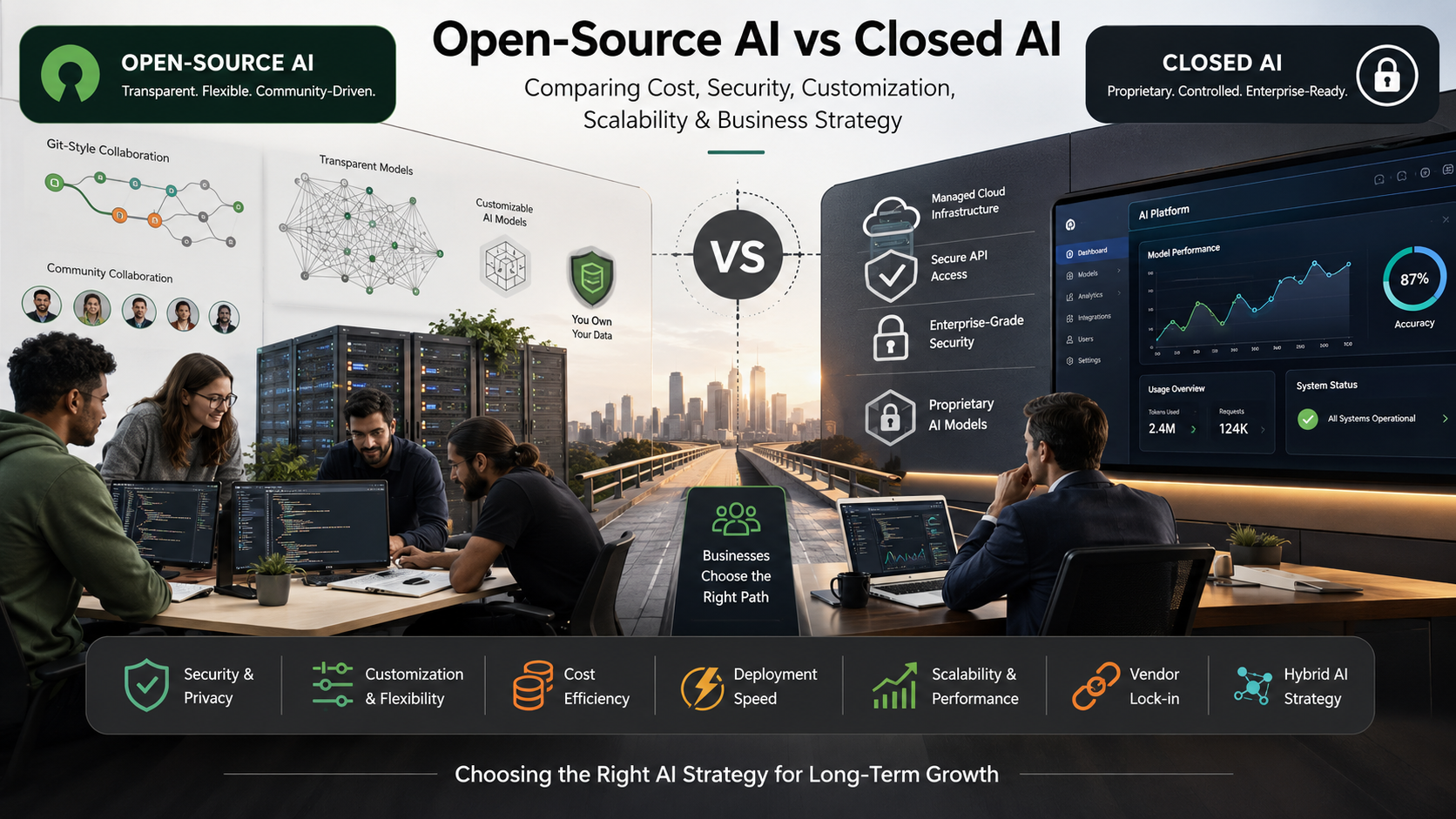
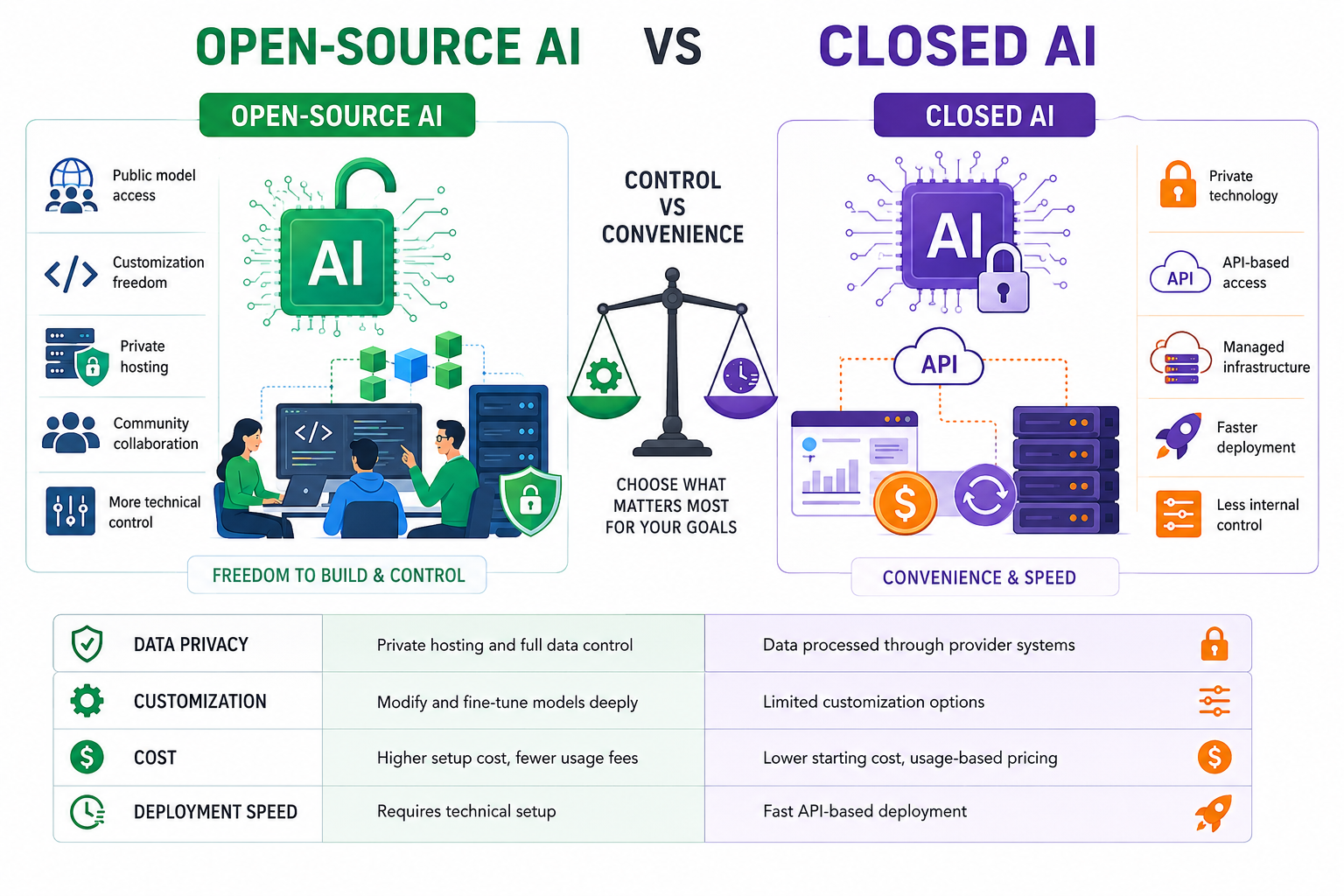
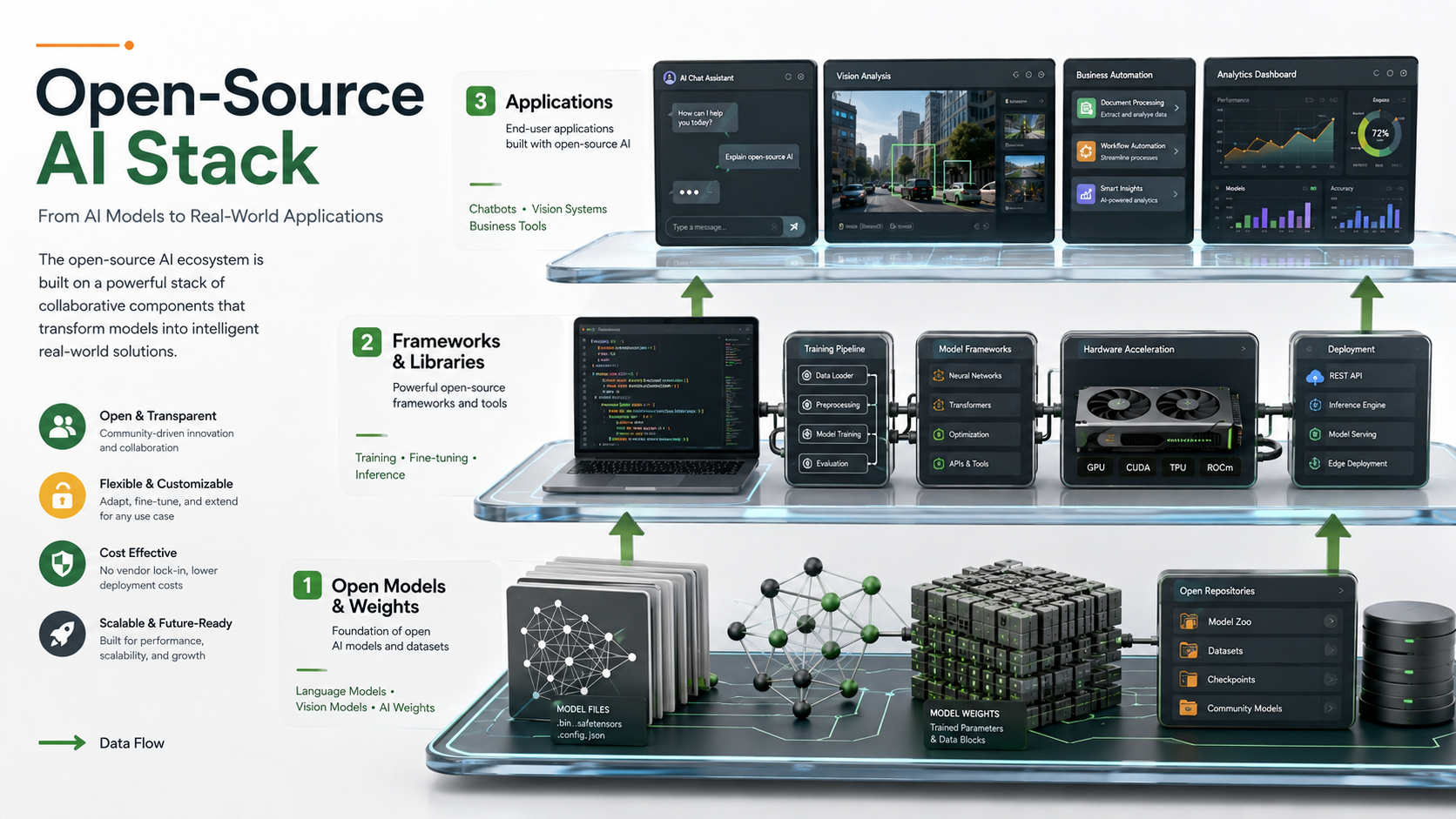
For a deeper understanding of AI technologies, models, and practical applications, explore our complete guide on open-source AI and modern AI development.

Optimizing Tokenization for AI Performance & Cost

Optimizing Tokenization for AI Models: Strategies for Cost and Efficiency

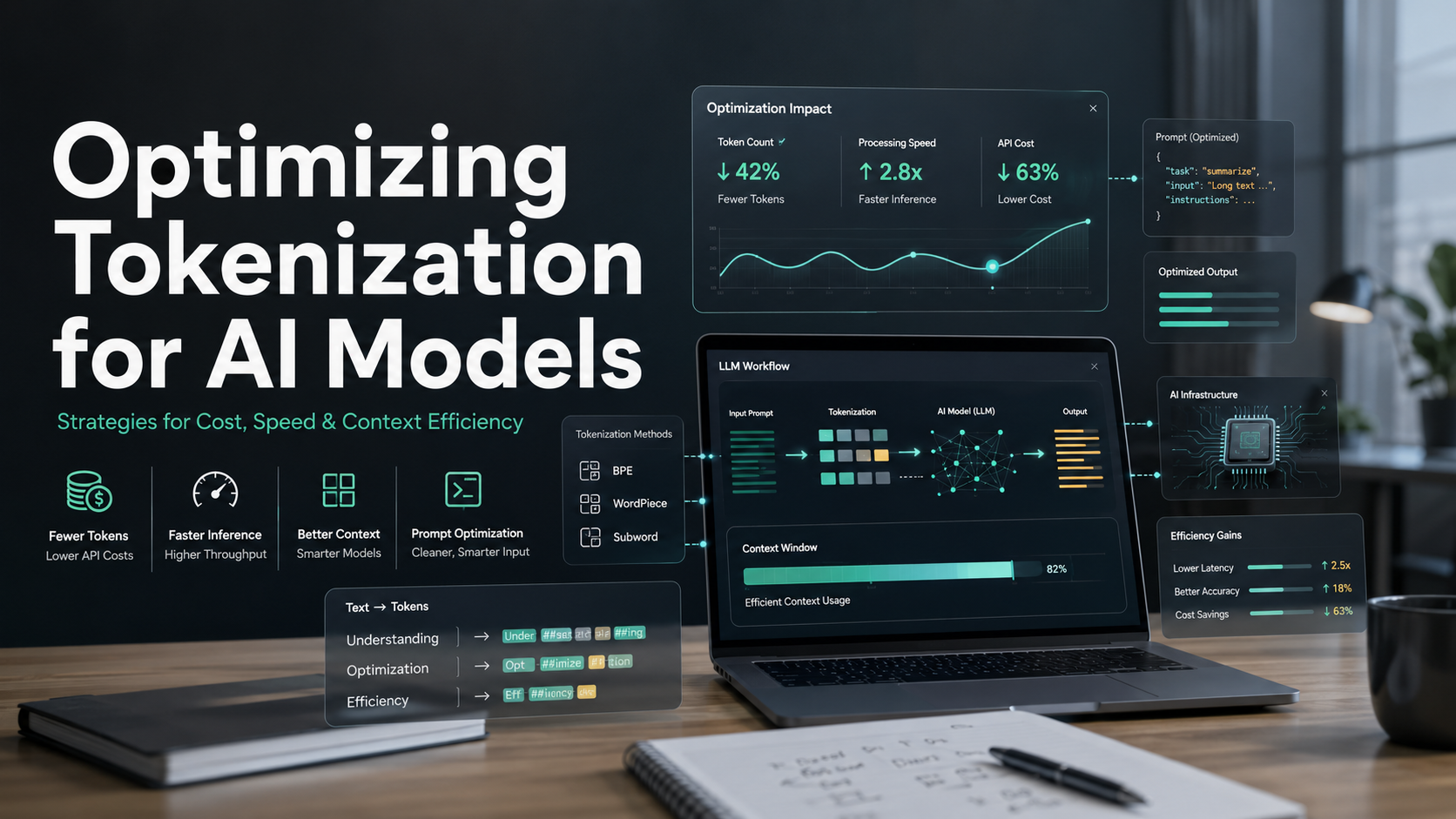
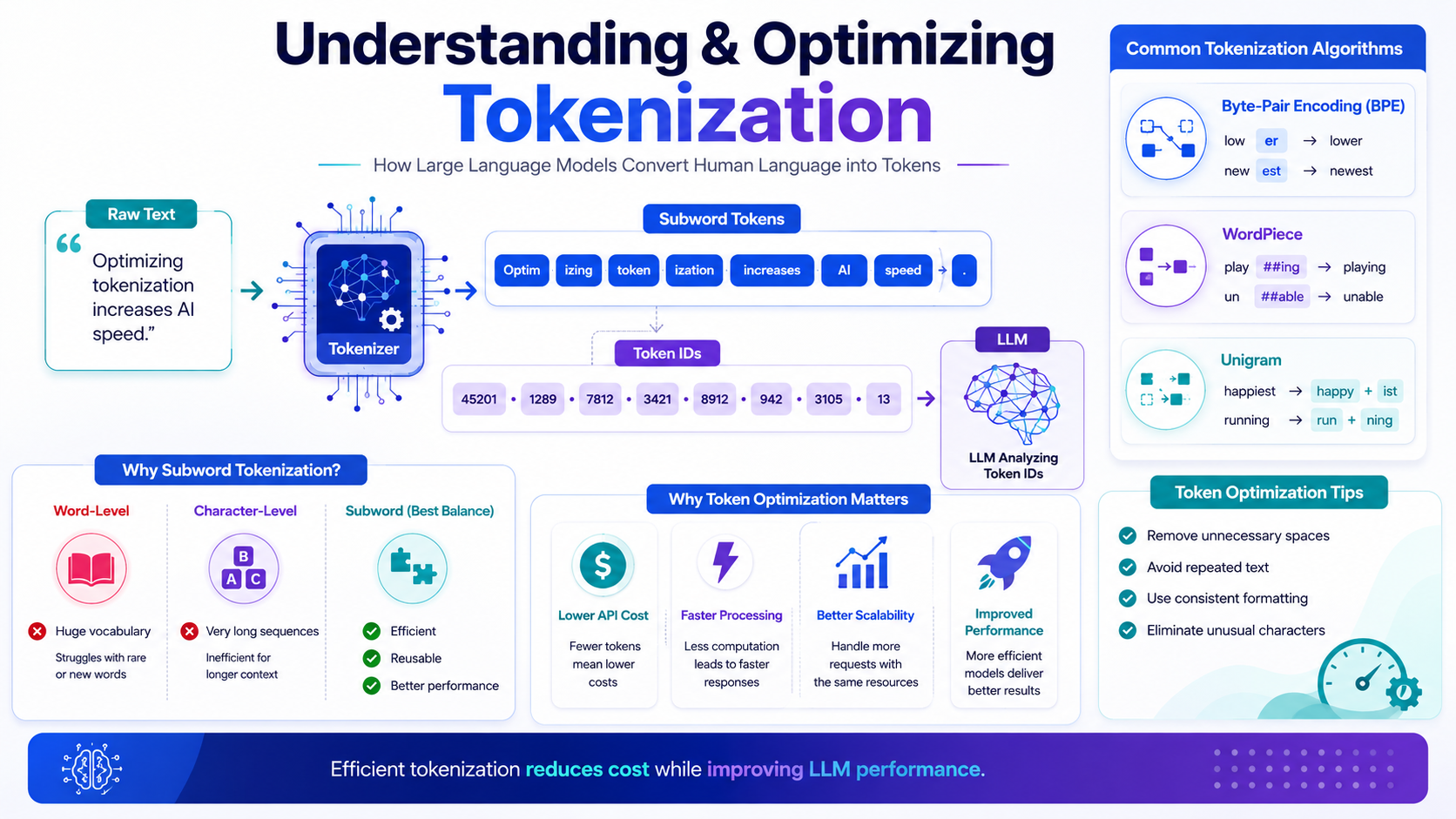
When building applications powered by Large Language Models (LLMs), optimizing tokenization is one of the most effective ways to improve efficiency and reduce operational costs. Tokenization determines how AI models interpret and process text. It converts characters, words, and subwords into smaller units called tokens, which become the foundation of model computation.

Every token affects your application’s performance. More tokens require more processing power, increase API expenses, and consume valuable context window space. Poorly structured text inputs can create unnecessary token usage, increasing latency and reducing overall efficiency.

Modern AI systems depend heavily on optimized token pipelines. According to technical resources from Hugging Face Tokenizers Documentation, tokenizer design choices, vocabulary size, and subword algorithms directly influence how efficiently models process natural language.

As organizations scale AI-powered products, inefficient token usage becomes a serious bottleneck. Large prompts, unnecessary formatting, and poorly optimized text can increase infrastructure costs quickly. They can also limit how much useful information fits into a model’s context window.

This guide explains how tokenization works, why token efficiency matters, and which strategies help optimize AI workflows. By improving how your system prepares text before model inference, you can reduce costs, improve response speed, and create more scalable LLM applications.


Understanding Optimizing Tokenization and How LLM Tokenizers Work

Before optimizing tokenization, it is important to understand how language models process text. LLMs do not read sentences like humans. Instead, they convert text into numerical representations that models can analyze mathematically.

A tokenizer acts as a bridge between human language and machine-readable data. It breaks raw text into smaller units called tokens. Each token receives a unique numerical identifier that connects to the model’s vocabulary.

Most modern transformer-based models use subword tokenization. This approach balances the limitations of word-level and character-level methods. Word-level tokenization requires extremely large vocabularies, while character-level tokenization creates unnecessarily long sequences.

Common subword algorithms include:

  • Byte-Pair Encoding (BPE)
  • WordPiece
  • Unigram tokenization

These methods identify common patterns and store frequently used text combinations as reusable tokens.

For example:

Raw Input:
“Optimizing tokenization increases AI speed.”

BPE Output Example:
[“Optim”, “izing”, ” token”, “ization”, ” increases”, ” AI”, ” speed”, “.”]

Token IDs Example:
[45201, 1289, 7812, 3421, 8912, 942, 3105, 13]

The exact token numbers depend on the model’s tokenizer. However, the process remains similar across most LLM systems.

When you send text to an AI API, the provider calculates usage based on the number of input and output tokens. This means inefficient formatting directly increases cost.

Extra spaces, unusual characters, repeated content, and inconsistent formatting can all increase token consumption. Understanding tokenization gives developers better control over performance, cost, and scalability.


Why Optimizing Tokenization Improves LLM Performance

Token efficiency plays a major role in how quickly and affordably AI applications operate. Every additional token increases the workload placed on the model. For businesses using LLM APIs at scale, small improvements in token usage can create significant savings.

The number of tokens affects three major areas:

  • Processing speed
  • Memory consumption
  • API expenses

Transformer models rely on attention mechanisms to understand relationships between tokens. As sequences become longer, the computational requirements increase. Shorter and cleaner inputs allow models to process requests faster.

Token usage also affects context windows. Every LLM has a maximum number of tokens it can handle at once. Unnecessary tokens reduce the available space for important instructions, documents, and conversation history.

For example, removing repeated explanations or unnecessary formatting can free thousands of tokens in long AI workflows.

API pricing is another important factor. Many AI providers charge based on the number of tokens processed. Reducing token volume lowers both input and output costs.

A 20% reduction in unnecessary tokens can significantly decrease monthly expenses for applications handling thousands of requests.

However, token optimization is not only about reducing numbers. The goal is to improve information density. A well-optimized prompt delivers more useful information using fewer tokens.

By creating efficient text pipelines, developers can improve speed, reduce infrastructure costs, and build more reliable AI systems.


Strategic Techniques for Optimizing Tokenization

Optimizing tokenization requires more than simply shortening text. It involves improving how information is prepared, structured, and delivered to AI models.

Effective token optimization combines data cleaning, prompt improvement, and tokenizer customization. These strategies help models receive clearer inputs while reducing unnecessary processing.

Before text reaches the model, preprocessing should remove elements that add token weight without adding meaning. This includes unnecessary formatting, repeated information, and inconsistent characters.

For specialized applications, default tokenizers may not always provide the best efficiency. General-purpose vocabularies are trained on broad datasets, but they may perform poorly with technical terminology.

A medical AI system, legal platform, or software development assistant may benefit from domain-specific tokenizer improvements. Custom vocabulary design allows frequently used terms to become more efficient token units.

Token optimization also improves user experience. Faster responses, lower latency, and reduced API costs make AI applications easier to scale.

The most effective optimization strategies include:

  • Cleaning and normalizing input text
  • Selecting suitable tokenizer configurations
  • Improving prompt structure
  • Reducing unnecessary context
  • Using specialized vocabularies when needed

By applying these methods, organizations can make better use of existing AI models without requiring additional computing resources.

Optimizing Tokenization Through Text Pre-Processing and Normalization

Raw text often contains unnecessary elements that increase token usage without improving the information provided to an AI model. Before sending content to an LLM, proper text preprocessing can significantly improve token efficiency and reduce processing costs.

Many applications collect text from websites, documents, databases, or user conversations. These sources often include extra HTML tags, repeated spaces, formatting marks, and inconsistent character structures. Although these elements may appear harmless, they can increase the number of tokens required for processing.

A strong tokenization optimization strategy starts with cleaning and standardizing your input data. Removing unnecessary text components allows the tokenizer to create shorter and more efficient sequences.

Important preprocessing steps include:

  • Removing unnecessary HTML or Markdown elements when formatting is not required.
  • Normalizing Unicode characters using standards such as NFC or NFKC.
  • Eliminating repeated spaces, excessive line breaks, and unnecessary punctuation.
  • Removing duplicated content before sending requests to AI models.

For example, scraped web content often contains navigation menus, tracking codes, and hidden formatting elements. These components provide little value but consume additional tokens.

It is also important to clean text before token conversion. Once text has already been transformed into tokens, removing unnecessary content will not reduce the original processing cost.

A well-designed preprocessing pipeline improves model efficiency, lowers API expenses, and ensures that every token contributes meaningful information.


Optimizing Tokenization with Domain-Specific Vocabulary Sizes

Standard LLM tokenizers are designed for general-purpose use. They are trained on large collections of internet text, books, and other broad datasets. While this approach works well for common language tasks, it may create inefficiencies in specialized industries.

Fields such as healthcare, law, finance, and software engineering often contain complex terminology. A general tokenizer may split these terms into multiple smaller pieces, increasing token usage.

For example:

Technical Term Standard Tokenizer Output Optimized Vocabulary Output
immunohistochemistry [“im”, “muno”, “histo”, “chem”, “istry”] (5 tokens) [“immunohistochemistry”] (1 token)
kubernetes.io/created-by [“kuber”, “netes”, “.”, “io”, “/”, “created”, “-“, “by”] (8 tokens) [“kubernetes”, “.”, “io”, “/”, “created_by”] (5 tokens)

A domain-specific tokenizer can improve efficiency by recognizing frequently used terms as complete units. This reduces sequence length and allows models to process specialized content more effectively.

Organizations can improve tokenizer performance by retraining or adapting vocabulary sets using industry-specific datasets. This approach helps technical terms, product names, and frequently used phrases become more token-efficient.

Custom vocabularies can provide several benefits:

  • Lower input token counts
  • Faster model responses
  • Improved context window usage
  • Reduced API processing costs

However, custom tokenizers require careful development. Poor vocabulary choices can reduce flexibility and make models less effective outside their target domain.

The best approach is to balance general language understanding with domain-specific efficiency.


Optimizing Tokenization for Multilingual AI Systems

Multilingual AI applications face additional tokenization challenges. Different languages use different writing systems, sentence structures, and character patterns. As a result, some languages require significantly more tokens than others to represent the same amount of information.

Many widely used tokenizers were originally optimized using large amounts of English text. Because English words often appear frequently in training data, they receive efficient token representations.

However, languages using non-Latin scripts may experience token bloat. Arabic, Hindi, Chinese, Japanese, and other languages can sometimes be divided into multiple smaller tokens for individual characters or symbols.

This creates several problems:

  • Longer input sequences
  • Higher API costs
  • Slower model responses
  • Reduced context window availability

To improve multilingual token efficiency, developers can use models with balanced multilingual vocabularies. Examples include models designed with broader language coverage, such as Google’s Gemma family and Meta’s LLaMA models.

Other useful approaches include:

  • Normalizing scripts before tokenization.
  • Using multilingual preprocessing libraries.
  • Translating fixed system instructions when language preservation is unnecessary.
  • Choosing models trained on diverse language datasets.

The goal is not simply to reduce tokens. It is to ensure that different languages receive fair and efficient representation.

A properly optimized multilingual tokenizer improves accessibility, lowers costs, and creates more consistent AI performance across global users.


Optimizing Tokenization for Code-Based AI Applications

Code-based AI applications face unique tokenization problems. Programming languages contain repeated symbols, indentation patterns, brackets, and formatting structures that can consume large numbers of tokens.

Standard language tokenizers are not always optimized for source code. For example, spaces used for indentation may be converted into separate tokens. In large code repositories, these small inefficiencies can create significant token overhead.

Consider Python indentation:

Less Efficient Example:

    def calculate_total():

Four leading spaces may require multiple tokens.

More Efficient Handling:

	def calculate_total():

A tab-based approach may reduce token usage depending on the tokenizer.

Specialized code models and tokenizers are often better suited for programming tasks. Models trained specifically on source code can recognize common programming patterns more efficiently.

Additional optimization methods include:

  • Removing unnecessary comments from production prompts.
  • Avoiding repeated code context.
  • Sending only relevant files or functions.
  • Using code-aware retrieval systems.
  • Compressing large code explanations.

For software development assistants, token efficiency is especially important because programming tasks often require large context windows.

Optimizing code tokenization helps AI coding tools analyze more information while maintaining faster response times and lower operating costs.


Frequently Asked Questions About Optimizing Tokenization

What is tokenization optimization in simple terms?

Optimizing tokenization means reducing the number of tokens required for an AI model to understand and process information. Since LLMs do not read text directly, they convert words, characters, and symbols into smaller numerical units called tokens.

Every token requires computational resources. When text contains unnecessary spaces, repeated information, or inefficient formatting, the model processes more data than necessary.

A well-optimized tokenization process improves AI efficiency by making text inputs smaller and more meaningful. It helps applications achieve faster responses, lower API expenses, and better use of context windows.

Token optimization does not mean removing important information. Instead, it focuses on improving how information is structured before it reaches the model.

Common optimization methods include:

  • Cleaning unnecessary formatting.
  • Removing duplicated content.
  • Using efficient prompts.
  • Selecting suitable tokenizers.
  • Creating domain-specific vocabularies when needed.

For developers building AI applications, understanding tokenization is an important step toward creating scalable and cost-effective systems.

How Does Tokenization Affect My Monthly AI API Bill?

Tokenization directly affects AI API costs because most providers calculate pricing based on the number of tokens processed. In other words, every token used in input prompts and generated responses contributes to your overall usage and expenses.

When optimizing tokenization, reducing unnecessary tokens can help applications lower costs while maintaining performance. If an application sends large amounts of irrelevant or repetitive text, the AI model processes more data for the same task. As a result, businesses may pay more without receiving additional value.

Common causes of unnecessary token usage include:

  • Repeated instructions.
  • Excessive formatting.
  • Long conversation history.
  • Unnecessary explanations.
  • Poorly structured documents.

For large-scale AI applications, even small improvements in token efficiency can create significant savings. For example, reducing the average prompt size by 20% may reduce token-related expenses by a similar percentage, depending on the provider’s pricing model.

However, token reduction should always protect information quality. Removing important context can reduce response accuracy and negatively affect model performance.

Therefore, the best approach is to improve token efficiency through clearer prompts, cleaner data, and well-structured inputs. By sending only the information the model needs, businesses can reduce costs while maintaining reliable AI performance.

Can Custom Vocabularies Improve AI Model Performance?

Yes, custom vocabularies can improve AI model efficiency, especially for specialized applications. When optimizing tokenization, a domain-specific vocabulary allows a tokenizer to recognize technical terms more effectively and represent them with fewer tokens.

General-purpose tokenizers are designed for broad language tasks. However, they may split uncommon or industry-specific words into multiple smaller pieces. As a result, the model processes longer sequences, which can increase latency, context usage, and API costs.

For example, medical, legal, scientific, or programming terms may appear frequently within a specialized application but rarely appear in general training datasets. By creating a custom vocabulary, these complex terms can be represented more efficiently, improving overall token performance.

The main benefits of custom vocabularies include:

  • Reduced token counts.
  • Faster inference speed.
  • Improved context window utilization.
  • Lower processing costs.

Nevertheless, custom tokenization is not required for every AI application. General-purpose models already deliver strong results for many common tasks and languages.

Ultimately, custom vocabularies provide the greatest value when an AI system regularly processes specialized terminology. Before investing in tokenizer customization, businesses should analyze their data patterns, usage requirements, and performance goals.

What Is the Difference Between Byte-Pair Encoding and WordPiece?

Byte-Pair Encoding (BPE) and WordPiece are two widely used subword tokenization methods in modern AI models. Both approaches support optimizing tokenization by breaking text into smaller units that language models can process more efficiently.

BPE starts with individual characters or bytes and gradually combines the most frequently occurring pairs. Over time, these merges create a vocabulary of commonly used subword units. This frequency-based approach helps models represent text while keeping vocabulary sizes manageable.

Similarly, WordPiece divides text into smaller pieces but uses a probability-based method to decide which combinations become tokens. Instead of focusing only on frequency, it selects token patterns that improve language representation during model training.

The main difference between these approaches is their token selection process:

  • BPE: Uses frequency-based merging to create new token combinations.
  • WordPiece: Uses probability-based selection to improve contextual language understanding.

Both methods help solve the limitations of traditional tokenization approaches. Word-level tokenization requires extremely large vocabularies, while character-level tokenization creates unnecessarily long sequences.

Therefore, subword tokenization provides a practical balance between efficiency and flexibility. Many transformer-based models use BPE, WordPiece, or similar methods because they improve performance across different languages, domains, and AI applications.

How Do Non-English Languages Handle Tokenization Efficiency?

Non-English languages often experience different levels of token efficiency because tokenizer performance depends heavily on training data. Historically, many language models were trained using large amounts of English text. As a result, English words often receive more efficient token representations compared with other languages.

Languages that use different writing systems, such as Arabic, Hindi, Chinese, and Japanese, may require more tokens to represent the same meaning. Therefore, multilingual applications can experience higher token usage and increased processing requirements.

This reduced token efficiency can lead to:

  • Larger input sequences.
  • Higher API usage costs.
  • Slower processing times.
  • Less available context window space.

To improve optimizing tokenization for multilingual AI systems, developers can choose models with balanced multilingual vocabularies. These models are trained on diverse language datasets and provide better token representation across different scripts.

Additionally, developers can improve multilingual token efficiency by:

  • Normalizing text before tokenization.
  • Using language-specific preprocessing tools.
  • Selecting multilingual models for global applications.
  • Avoiding unnecessary translation when language accuracy is important.

Ultimately, efficient multilingual tokenization helps organizations deliver faster, more affordable, and more reliable AI experiences for users across different languages and regions.

Does prompt compression help with optimizing tokenization?

Yes, prompt compression is an effective technique for optimizing tokenization because it reduces unnecessary text while preserving the information an AI model needs. As a result, models can process requests with fewer tokens, improving efficiency and lowering computational costs.

Large prompts often contain repeated instructions, outdated conversation history, or unnecessary explanations. Therefore, these extra elements increase token usage without always improving the quality of AI responses.

Common prompt compression techniques include:

  • Removing repetitive context.
  • Shortening system instructions.
  • Summarizing older conversation history.
  • Keeping only relevant documents.
  • Using structured and concise prompts.

Additionally, shorter prompts allow AI models to process information faster and reduce processing overhead. This is especially valuable for applications that handle large numbers of API requests.

However, prompt compression should be applied carefully. Removing essential details can negatively affect response accuracy and reduce model performance.

The objective is not to create the shortest possible prompt. Instead, the goal is to create an efficient prompt that delivers the right information with fewer tokens.

When combined with preprocessing, tokenizer improvements, and effective prompt design, compression can significantly improve AI application speed, scalability, and overall token efficiency.


Conclusion: Building More Efficient AI Systems Through Token Optimization

Optimizing tokenization is an essential practice for developers building scalable AI applications. As a result, organizations that rely on LLM-powered tools can better control token usage, improve processing speed, and reduce operational costs.

By understanding how tokenizers convert text into numerical representations, developers gain greater control over AI workflows. Furthermore, efficient tokenization helps models use context windows more effectively while reducing unnecessary computation.

Several strategies can improve token efficiency:

  • Cleaning and normalizing input data.
  • Removing unnecessary formatting.
  • Using domain-specific vocabularies.
  • Selecting appropriate multilingual models.
  • Optimizing prompts and code inputs.

Together, these improvements create measurable benefits. Applications become faster, API expenses decrease, and users receive more responsive AI experiences. In addition, better token management allows teams to scale AI solutions without increasing resource usage unnecessarily.

As AI systems continue expanding into enterprise workflows, efficient resource management will become an important competitive advantage. Therefore, reducing unnecessary tokens should be a priority for organizations focused on improving AI performance. Every wasted token increases processing requirements, while every optimized token supports better scalability.

For organizations building AI-powered solutions, understanding related topics such as data ownership, content usage, and responsible AI practices is equally important. Learn more about these considerations in our comprehensive guide on AI and Copyright Guide: Understanding Copyright Issues in Artificial Intelligence.

10 Common AI Mistakes and How to Avoid Them for Better Results

10 Common AI Mistakes and How to Avoid Them for Better Results

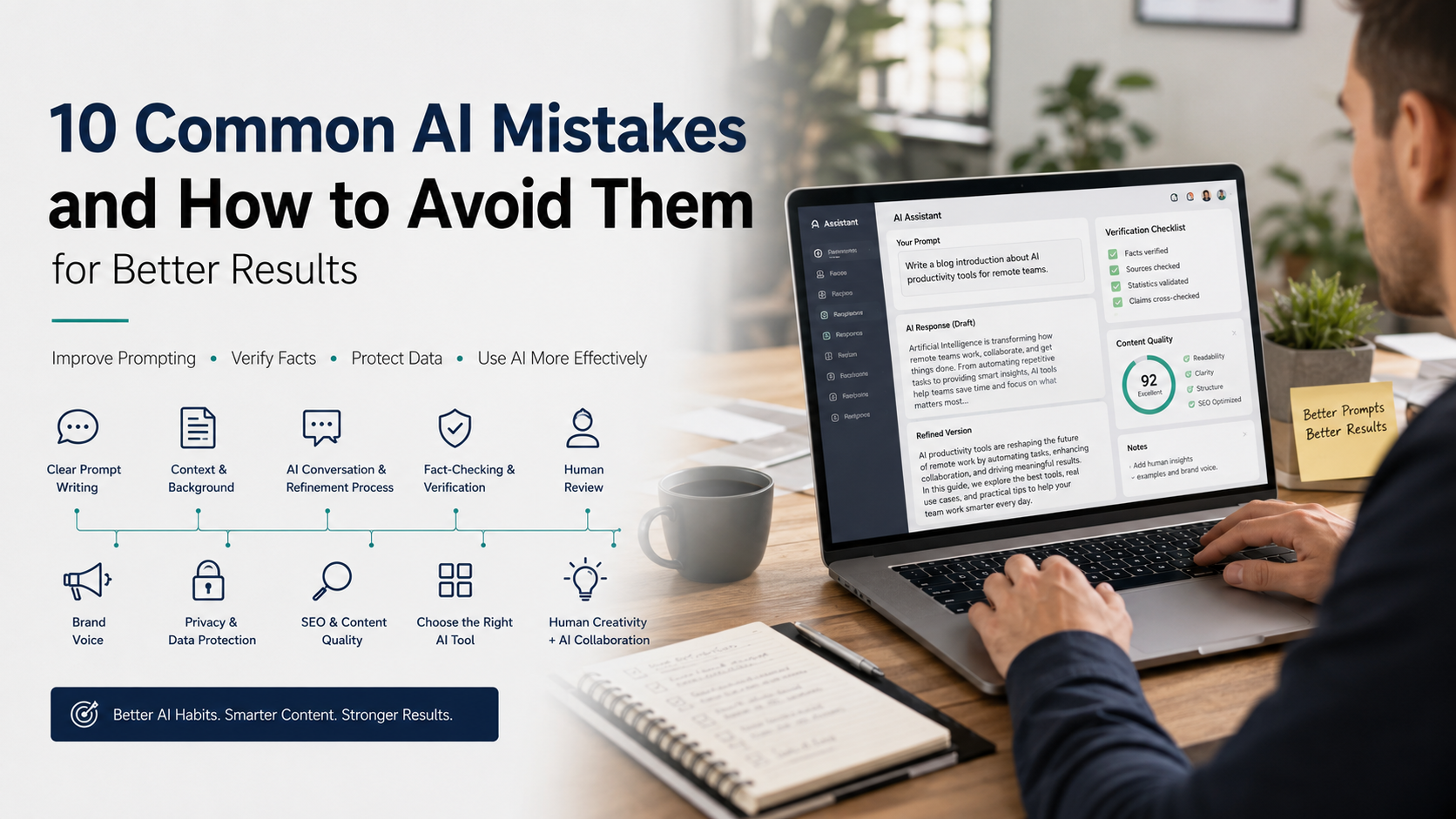
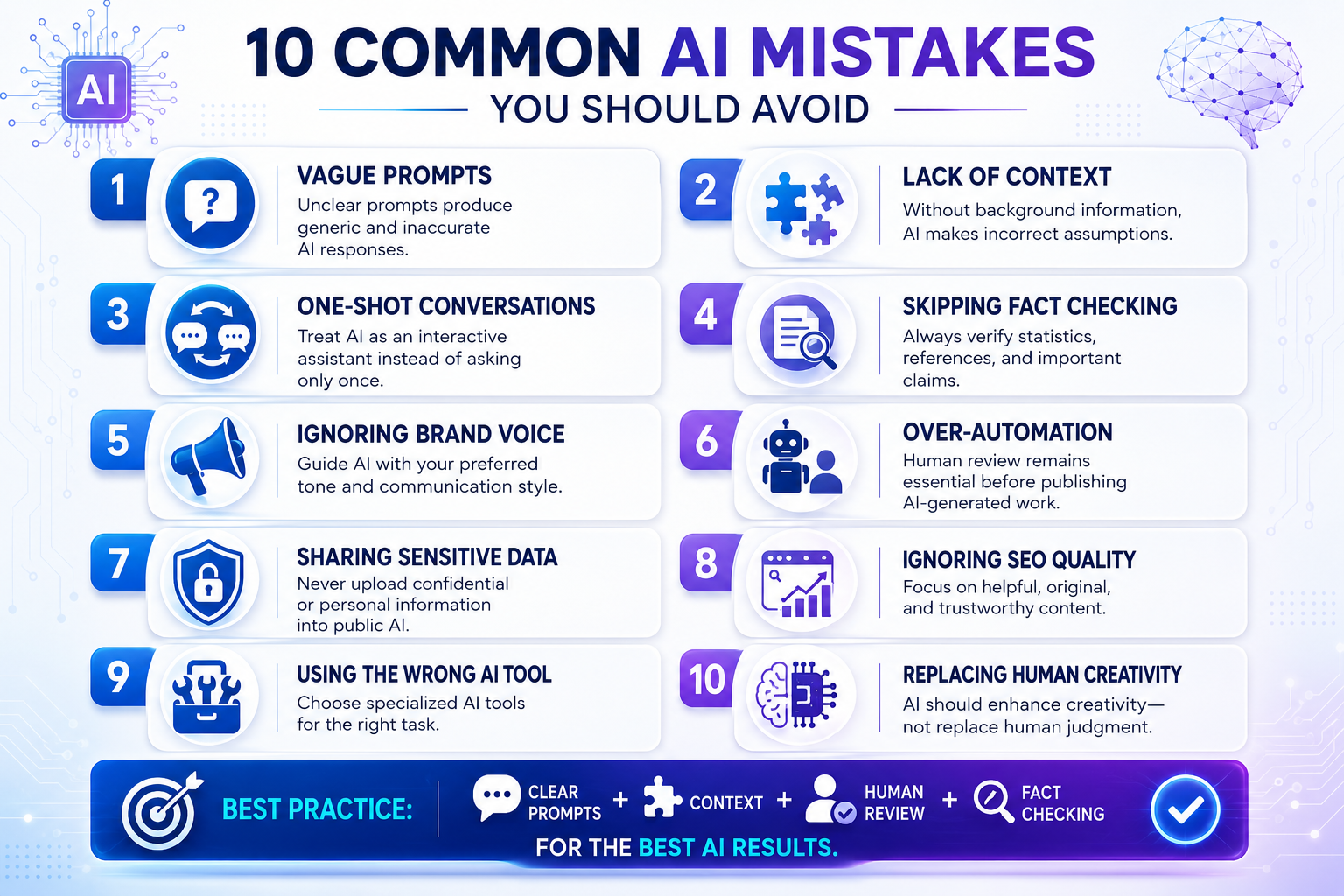
Artificial intelligence has transformed how we create content, analyze information, and build digital workflows. However, many users make 10 common AI mistakes that reduce accuracy, waste valuable time, and limit productivity. Understanding these mistakes can help professionals and businesses use AI tools more effectively and achieve better results.

However, many users make avoidable mistakes when working with AI tools. Poor prompts, missing context, and a lack of verification often lead to inaccurate results, wasted time, and unreliable outputs. Learning how to write better instructions can improve AI responses. Resources like OpenAI Prompt Engineering Guide explain how clear prompts help users get more useful outputs from AI systems.

Many people expect AI to deliver perfect answers from simple requests. When the results are generic or incorrect, they blame the technology. In reality, the quality of AI output depends on the quality of the input and the level of human review.

Understanding the 10 common AI mistakes can help you improve your workflow and get better results from modern AI systems. By learning how to write stronger prompts, protect sensitive information, and review AI-generated content, you can use artificial intelligence more effectively.

In this guide, we will explore the biggest mistakes people make with AI and explain practical ways to avoid them. These strategies will help you create more accurate content, improve productivity, and make AI a valuable partner in your professional work.


Understanding the 10 Common AI Mistakes and Why They Happen

Most AI mistakes happen because users misunderstand how artificial intelligence works. Many people treat AI tools like traditional search engines that always provide factual answers.

However, language models work differently. They generate responses by predicting patterns from large amounts of training data. They do not understand information in the same way humans do.

This means AI can produce responses that sound confident but contain incorrect facts. These errors are often called AI hallucinations. They can include invented statistics, fake references, or inaccurate explanations.

Understanding this limitation is essential for getting reliable results. Users should treat AI responses as helpful drafts rather than unquestionable answers.

Better results come from combining clear instructions with human judgment. A strong AI workflow includes detailed prompts, relevant context, and careful review before using the final output.

By recognizing how AI systems generate information, you can identify possible errors earlier. This approach reduces mistakes and helps you create more accurate, useful, and trustworthy results.

Mistake 1: One of the 10 Common AI Mistakes — Writing Vague AI Prompts

One of the most common AI mistakes is creating prompts that lack detail. When users provide unclear instructions, AI tools often produce generic answers that fail to meet expectations.

For example, asking AI to “write a blog post about fitness” provides very little direction. The tool does not know the audience, writing style, purpose, or required format.

A better prompt includes specific information about the desired outcome. Clear instructions help AI understand the task and generate more relevant content.

To improve your prompts:

  • Define the role you want AI to perform.
  • Specify your target audience.
  • Explain the preferred tone and style.
  • Include length and formatting requirements.
  • Provide examples when possible.

Instead of requesting a simple article, you could write: “Act as an experienced fitness coach and create a beginner-friendly workout guide for busy professionals.”

Detailed prompts reduce confusion and improve the quality of AI-generated responses.


Mistake 2: Failing to Provide Enough Context

AI tools perform better when they receive enough background information. Without context, the system must make assumptions, which can lead to inaccurate or unsuitable responses.

Many users provide short instructions and expect professional-level results. However, AI cannot understand your goals, brand identity, or audience unless you explain them clearly.

Before requesting content or analysis, provide useful details such as:

  • Business information
  • Target audience
  • Brand guidelines
  • Previous examples
  • Specific goals

For example, a marketing team should provide details about its customers, products, and communication style before asking AI to create promotional content.

Adding context allows AI to produce responses that match your needs. It also reduces editing time because the first draft is more likely to align with your expectations.


Mistake 3: Relying on Single-Turn AI Conversations

Another common mistake is treating AI like a basic search box. Many users ask one question, receive an answer, and stop there.

AI works best as an interactive assistant. A conversation allows you to refine ideas, correct mistakes, and improve the final result.

If the first response is not suitable, continue the discussion. Ask AI to rewrite sections, simplify explanations, change the tone, or add missing information.

A strong workflow often includes multiple steps:

  • Create an initial draft.
  • Review the output.
  • Provide feedback.
  • Request improvements.
  • Finalize the result.

This process helps you achieve better accuracy and more personalized results. AI becomes more useful when you guide it through several improvements instead of expecting perfection from one request.


Mistake 4: One of the 10 Common AI Mistakes — Ignoring AI Fact-Checking

One of the most serious AI mistakes is trusting every response without verification. AI tools can generate impressive answers, but they may sometimes create false information that sounds completely accurate.

These errors can include incorrect statistics, fictional quotes, outdated information, or nonexistent sources. This happens because AI generates responses based on learned patterns rather than true awareness of facts.

Before publishing AI-generated content, always review important details. Verify claims using reliable sources, official documents, research papers, or trusted websites.

Fact-checking is especially important when creating:

  • Business reports
  • Educational content
  • Medical information
  • Financial articles
  • SEO content

A quick review process can protect your credibility and prevent misinformation. AI should support your research process, not replace professional judgment.

The best approach is to combine AI speed with human verification. This ensures your final content remains accurate, trustworthy, and valuable for readers.


Mistake 5: Ignoring Tone and Brand Voice

AI-generated content often sounds too generic when users do not provide clear style instructions. Even when the information is correct, the writing may feel robotic or disconnected from your audience.

Every brand has a unique voice. Some businesses prefer a professional tone, while others use a friendly and conversational style.

Without proper guidance, AI may produce repetitive phrases, unnecessary formality, or common AI writing patterns. Words such as “delve,” “tapestry,” and “testament” often appear in generic AI drafts.

To improve AI-generated writing:

  • Define your preferred tone.
  • Share examples of your existing content.
  • Explain your audience’s expectations.
  • Edit the final draft for a natural human voice.

Human editing remains essential because effective communication requires personality and emotional understanding.

AI can create a strong foundation, but your experience and creativity make the content unique.


Mistake 6: Depending Too Much on AI Automation

Automation is one of the biggest advantages of artificial intelligence. However, relying completely on AI without human involvement can create serious problems.

Some users publish AI-generated articles, send automated messages, or make business decisions without reviewing the results. This approach can damage trust and create avoidable mistakes.

AI should handle repetitive tasks while humans focus on strategy, creativity, and decision-making.

A balanced workflow includes:

  • Using AI for research and brainstorming.
  • Reviewing generated content carefully.
  • Adding personal expertise.
  • Checking facts before publishing.

Human oversight improves quality and ensures that AI-generated work matches your goals.

The strongest results come from collaboration between people and technology. AI provides speed and assistance, while humans provide judgment, experience, and creativity.


Mistake 7: One of the 10 Common AI Mistakes — Sharing Sensitive Data

Protecting information is one of the most important parts of using AI responsibly. A common mistake is copying confidential business data, personal details, or private documents directly into public AI systems.

Sensitive information may include:

  • Customer records
  • Financial documents
  • Private company strategies
  • Proprietary software code
  • Personal identification details

Sharing this information without proper safeguards can create privacy and security risks.

Before entering data into an AI tool, remove confidential details and replace them with general examples. This process is called data anonymization.

For example:

“Analyze this anonymized financial statement for quarterly trends: [Insert Scrubbed Numbers]”

Organizations should also consider AI solutions with strong privacy controls and enterprise security features.

Responsible AI use requires protecting both your information and the information of others.


Mistake 8: Ignoring Search Engine Quality Guidelines

Using AI for content creation can improve productivity, but publishing low-quality automated content can harm your website performance.

Search engines focus on helpful, original, and trustworthy information. Content created only to manipulate rankings may fail to achieve long-term SEO success.

Modern search algorithms prioritize experience, expertise, authoritativeness, and trustworthiness (E-E-A-T).

To create better AI-assisted content:

  • Add original insights and examples.
  • Review information for accuracy.
  • Include expert opinions when needed.
  • Improve content with real user value.

AI should support your content strategy, not replace genuine expertise.

High-quality content combines AI efficiency with human knowledge. When you focus on helping readers, your content has a stronger chance of building authority and performing well in search results.


Mistake 9: Choosing the Wrong AI Tool for the Task

Not every AI task requires the same type of tool. A common mistake is using a general chatbot for specialized tasks where another solution would perform better.

For example, a basic language model may not be the best option for advanced calculations, real-time data analysis, professional design work, or specialized research.

Choosing the right tool improves accuracy and saves time.

Consider the task before selecting an AI solution:

  • Use writing tools for content creation.
  • Use data-focused tools for analysis.
  • Use specialized software for design or coding.
  • Use search-based systems for current information.

Understanding the strengths and limits of different AI tools helps you build a more efficient workflow.

The goal is not to use AI everywhere. The goal is to use the right technology for the right purpose.


Mistake 10: Treating AI as a Replacement for Human Creativity

The final mistake is assuming artificial intelligence can completely replace human creativity and decision-making.

AI can generate ideas, organize information, and speed up repetitive tasks. However, it does not have personal experiences, emotions, or original perspectives.

The best results happen when humans and AI work together. People provide creativity, strategy, and critical thinking, while AI provides speed and assistance.

Use AI to:

  • Generate ideas.
  • Create outlines.
  • Improve productivity.
  • Explore different approaches.

However, keep your own knowledge and creativity at the center of every project.

Technology works best as a creative partner. When combined with human insight, AI can help you produce more valuable, original, and effective work.


Frequently Asked Questions About the 10 Common AI Mistakes

How do I stop AI tools from creating false information?

To reduce AI hallucinations, you should provide clear instructions and reliable reference material. Additionally, ask the AI system to use only the information you provide instead of making unsupported assumptions.

Furthermore, you can instruct the tool to say “I do not know” when the answer is unavailable. As a result, this reduces the chance of receiving inaccurate or fabricated information.

However, important information should always be verified before publishing. For example, check statistics, dates, research claims, and references using trusted sources.

Ultimately, AI is a powerful tool for improving productivity, but human review remains necessary to maintain accuracy.

What is the best way to improve AI prompts?

The most effective prompts include clear goals, detailed context, and specific instructions. Therefore, a well-structured prompt usually contains:

  • A defined role.
  • A clear task.
  • Relevant background information.
  • Required format.
  • Expected tone.

Instead of asking for a general response, explain exactly what you need and provide enough context for better results.

Moreover, multi-step conversations often improve AI performance. By reviewing, adjusting, and refining AI responses, you can create more accurate and useful outputs over time.

Is AI-generated content bad for SEO?

AI-generated content is not automatically harmful to SEO. In fact, search engines primarily focus on content quality, usefulness, and user satisfaction rather than the method used to create the content.

However, publishing large amounts of low-quality automated content can negatively affect search rankings. Therefore, AI-assisted content should always focus on providing real value to readers.

Successful AI-supported content should include:

  • Original ideas.
  • Accurate information.
  • Human editing.
  • Practical value.

In other words, AI should support better content creation rather than replace thoughtful publishing strategies.

How can I make AI writing sound more human?

To make AI-generated writing feel more natural, edit the draft after generation. For example, remove repetitive phrases, simplify overly formal language, and adjust the wording to match your audience.

Additionally, you can instruct AI to use:

  • Conversational wording.
  • Shorter sentences.
  • A specific brand voice.
  • Real-world examples.

Furthermore, adding personal experiences, expert opinions, and unique insights makes content more authentic.

Although AI can provide structure and efficiency, human input creates connection, personality, and trust.

Is it safe to paste company data into AI tools?

Sharing confidential information with public AI systems can create privacy and security concerns. Therefore, sensitive business data should always be handled carefully.

Before using AI, remove private details and use anonymous examples whenever possible. Additionally, businesses should consider secure AI platforms that provide stronger privacy protections for professional use.

As a result, responsible data handling allows organizations to benefit from AI while reducing potential security risks.

What are semantic keywords, and why are they important?

Semantic keywords are words and phrases that are closely related to your main topic. They help search engines understand the broader meaning and context of your content.

For example, an article about AI mistakes may naturally include related terms such as:

  • AI productivity.
  • Prompt engineering.
  • AI accuracy.
  • Artificial intelligence tools.
  • AI workflow optimization.

Furthermore, using related keywords improves topical relevance without relying on keyword stuffing.

Therefore, semantic SEO helps create content that answers user questions more completely and improves overall content quality.


Conclusion

Avoiding the 10 common AI mistakes is essential for anyone who wants better results from artificial intelligence tools.

AI can improve productivity, simplify workflows, and support creative projects. However, successful AI use depends on how effectively you apply the technology.

For this reason, clear prompts, accurate information, strong security practices, and human review all contribute to better outcomes.

The most effective AI users understand that technology works best as a partner rather than a replacement. While AI provides speed and support, humans provide creativity, judgment, and experience.

By improving your approach, you can reduce errors, create higher-quality content, and develop more efficient digital workflows.

Ultimately, use AI strategically, review important results carefully, and continue refining your process. When human expertise and artificial intelligence work together, you can achieve stronger results across many different projects.

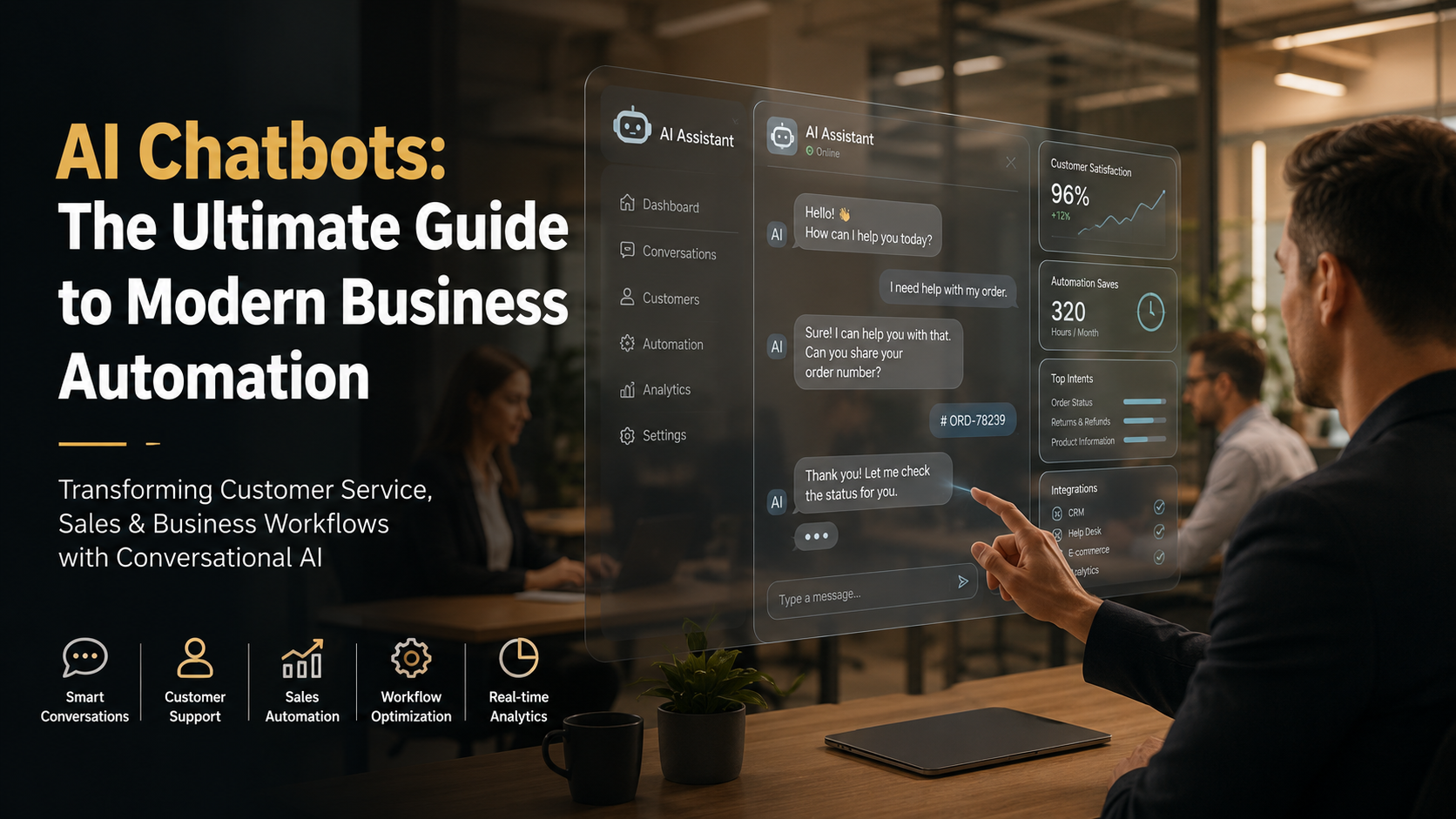
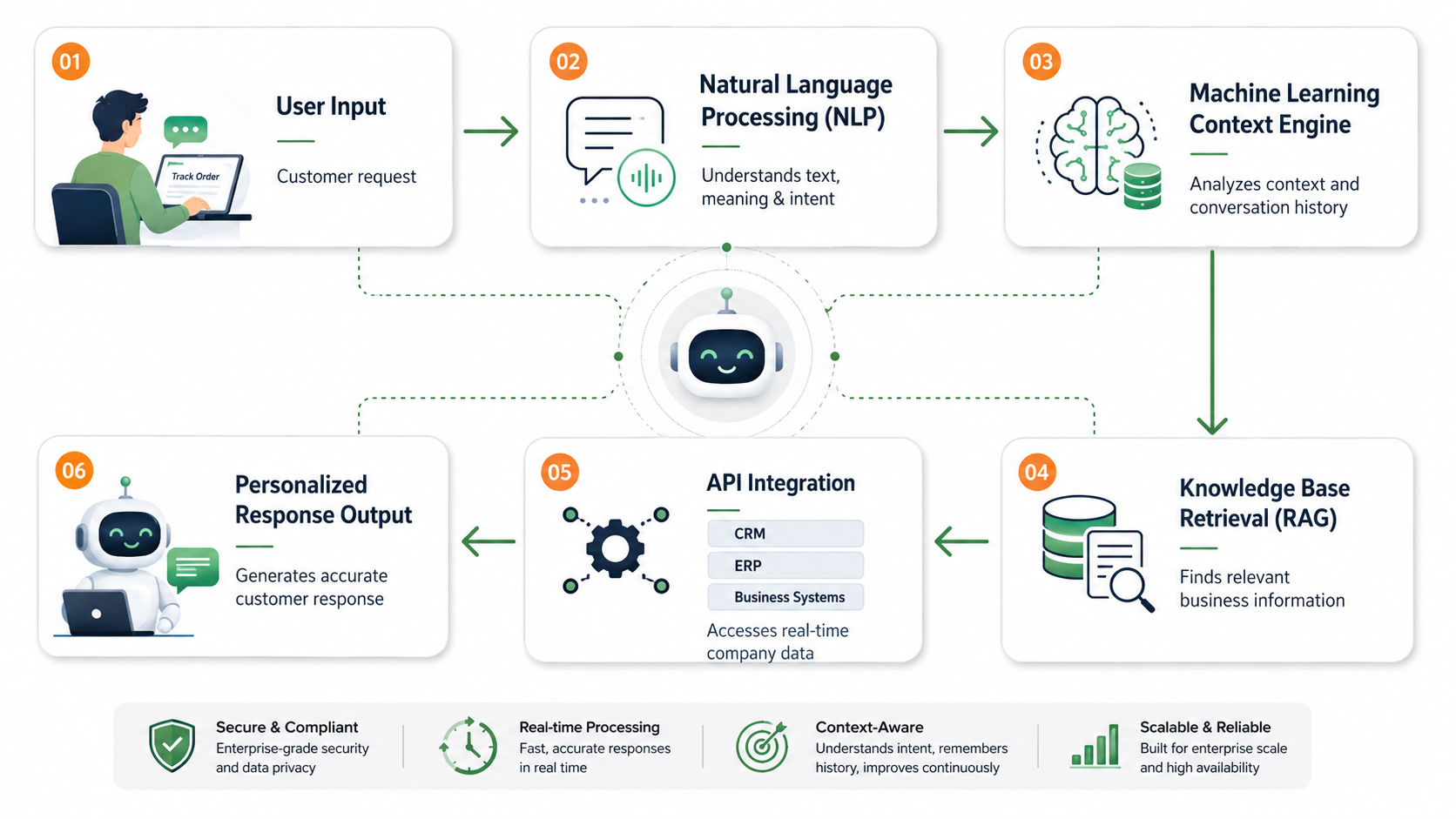
To continue learning how artificial intelligence can improve your workflow, explore our complete guide on AI chatbots and how they can support better productivity: AI Chatbots Guide

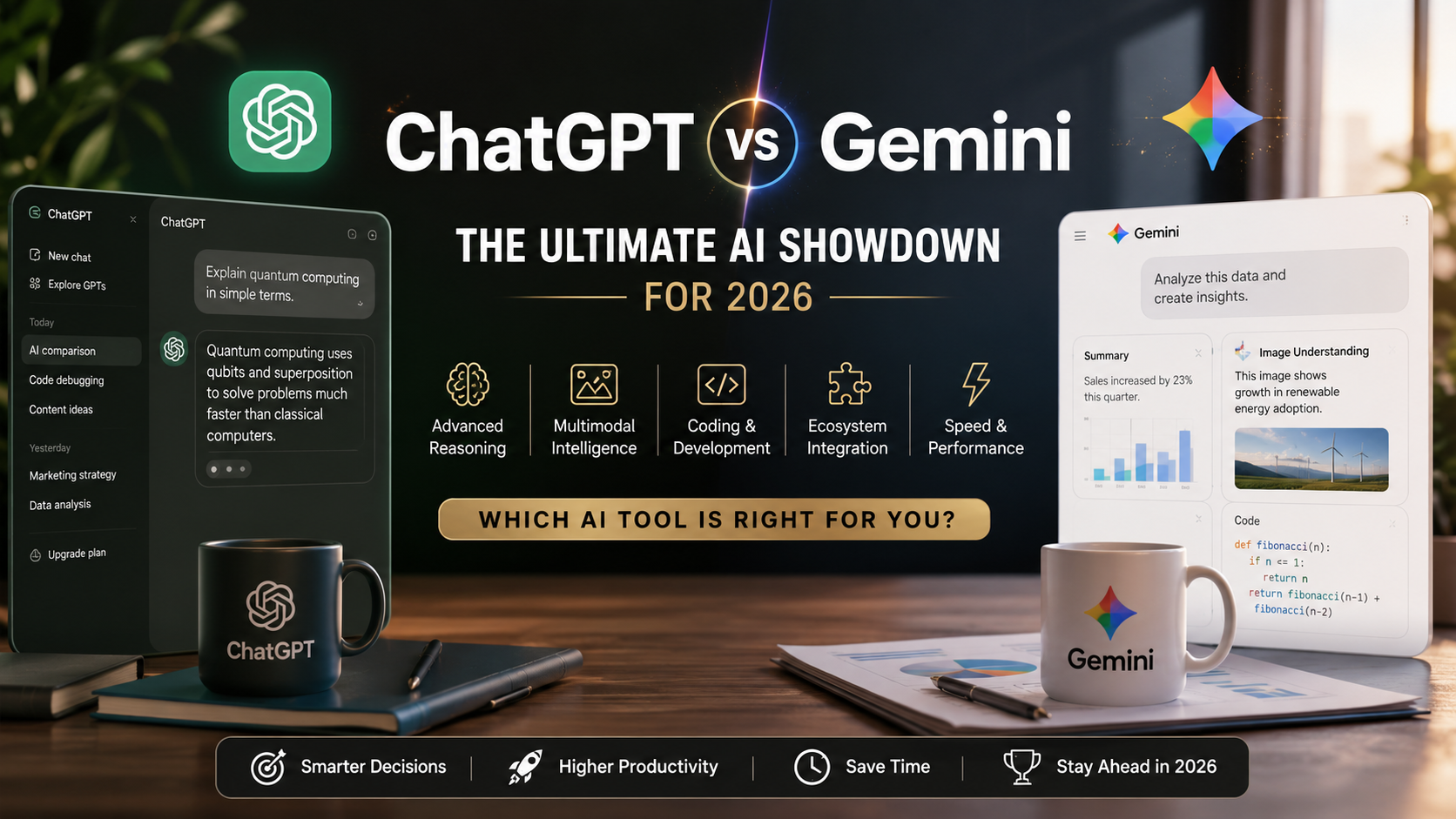
ChatGPT vs Gemini Pricing: Free vs Paid Plans (2026)

ChatGPT vs Gemini Pricing: Free vs Paid Plans Compared (2026)

Choosing an AI assistant comes down to budget and daily needs. Comparing ChatGPT vs Gemini Pricing helps you pick the right plan. Consequently, you can decide if free tiers are enough for your tasks. Furthermore, you can also see if paid plans offer real value. OpenAI and Google update their offers often to attract students, creators, and developers. Therefore, you can learn more about these AI models on the official OpenAI website.

Understanding these costs prevents wasted money on unused tools. Free versions are more powerful than ever. However, paid options unlock huge context windows and faster speeds. Thus, this comparison guide breaks down costs, features, and limits. Ultimately, it helps you spend your budget wisely.

Evaluating ChatGPT vs Gemini Pricing and Features for Free Users

Both OpenAI and Google offer free plans without requiring a credit card to start. However, daily limits and features are very different across both services. OpenAI offers light models for everyday tasks. Additionally, free users get limited access to flagship models. When traffic is high, the system drops down to basic processing speeds.

Google connects its free plan directly to its search tools. It uses fast models to deliver quick answers. Moreover, it pulls live data directly from Google Search. It also connects seamlessly with Gmail, Docs, and Drive. Users who need continuous access often prefer Google. Conversely, users who need complex logic often choose OpenAI.

Feature ChatGPT Free Google Gemini Free
Base Model GPT-4o mini / Limited GPT-4o Gemini 1.5 Flash
Cost $0 $0
Web Search Live via Bing Real-time via Google Search
App Ecosystem GPT Store Google Workspace

Free OpenAI Plan Costs and Limits

The free tier uses the efficient GPT-4o mini model as its baseline. Furthermore, it provides short access to the flagship GPT-4o model. System traffic can be heavy during peak working hours. When that happens, free accounts switch back to basic models automatically. This mechanism keeps the service fast for everyone.

Free users can still access custom GPTs in the store. In addition, they can browse the live web using Bing integration. They can analyze simple files, documents, and spreadsheets without issues. Basic image generation is also included. However, daily limits for image creation remain tight.

Free Google Plan Costs and Limits

The free Gemini tier runs on the Gemini 1.5 Flash model. As a result, this model processes short and long inputs quickly. It links directly to Google Workspace tools for maximum convenience. Therefore, you can summarize long emails in Gmail easily. Likewise, you can organize files inside Google Drive without extra steps.

The free plan leverages Google Search for fresh updates. Consequently, it gives accurate answers for sports, news, and weather. Usage caps are very generous for everyday tasks. Overall, it offers reliable zero-cost access for general research.

Pro AI Subscription Rates: $20 Monthly Cost Breakdown

Power users often pay for premium accounts to maximize productivity. The standard market rate sits firmly at $20 per month. Both major platforms target this exact monthly cost. They remove low usage caps and increase processing speeds. Additionally, they add access to advanced reasoning models.

Choosing a paid plan depends heavily on your software habits. OpenAI focuses on specialized AI features and creative options. For instance, it offers natural voice mode and custom workflow tools. Meanwhile, Google bundles its AI with valuable cloud storage. It connects directly with everyday office software.

Subscription ChatGPT Plus Gemini Advanced
Monthly Cost $20 / month $19.99 / month
Flagship Model GPT-4o / O1 Reasoning Gemini 1.5 Pro
Memory Window Standard (~128k tokens) Up to 1M tokens
Extra Perks Advanced Voice Mode 2TB Google Cloud Storage

ChatGPT Plus Rates and Features

ChatGPT Plus costs $20 per month for individual users. The subscription renews every month automatically unless you cancel it. You can cancel it at any time without extra fees. Furthermore, it grants priority access to flagship models like GPT-4o. It also offers specialized reasoning models for hard math and coding tasks.

Subscribers get higher overall message limits. Hence, heavy work runs smoothly without constant pauses or locks. Users get Advanced Voice Mode for real-time talk and discussion. Similarly, they get higher caps for image creation and data analysis.

Gemini Advanced Rates and Features

Gemini Advanced costs $19.99 per month for consumers. It comes inside the Google One AI Premium Plan bundle. Consequently, it unlocks the powerful Gemini 1.5 Pro model. This model excels at long text summary, document research, and video analysis.

The plan includes 2TB of Google cloud storage out of the box. You can share this storage with family members easily. It works across Photos, Drive, and Gmail seamlessly. In addition, it adds AI assistance inside Google Docs and Sheets.

Context Window Size and ChatGPT vs Gemini Pricing Value

Analyzing ChatGPT vs Gemini Pricing requires looking at memory limits closely. Memory size is measured in tokens. Larger memory allows an AI to read bigger files at once. Conversely, small memory forces you to split your work into smaller pieces.

Gemini Advanced leads the market in raw memory capacity. Its 1-million-token window processes huge codebases easily. For example, you can upload long books or hour-long videos. On the other hand, OpenAI offers a smaller memory window. However, it delivers higher precision for step-by-step logic and coding tasks.

OpenAI vs Google Developer API Rates and Plans

Developers pay for AI using direct API access rather than consumer apps. API costs do not use flat monthly fees. Instead, developers pay per token consumed by their prompts. Input tokens cost less than output tokens. Therefore, choosing a platform depends on your budget and accuracy needs.

Google offers cheap rates for high-speed tasks. As a result, Gemini 1.5 Flash keeps app operating costs low. OpenAI offers low rates for GPT-4o mini as well. However, flagship OpenAI models cost more per request. Nevertheless, they deliver top-tier accuracy for autonomous agent workflows.

FAQ SECTION

How much does ChatGPT Plus cost per month?

ChatGPT Plus costs $20 per month (or localized equivalent, such as ₹1,999/month in select regions), billed as an automatically renewing subscription that users can cancel at any time without long-term penalties. Upgrading from a free account removes restrictive rate caps and provides priority server availability, ensuring fast processing even during high-traffic usage periods. Furthermore, subscribers receive access to OpenAI’s flagship models, such as GPT-4o and specialized reasoning models engineered for complex logical analysis and coding tasks. Plus members also unlock high-value productivity tools, including Advanced Voice Mode for real-time natural conversations, expanded file data analysis capabilities, higher DALL-E image generation caps, Deep Research agents, and custom GPT creation tools.

Is Google Gemini free to use?

Yes, Google Gemini offers a robust free tier that anyone can access using a standard Google account without entering credit card details or paying monthly fees. The zero-cost version runs primarily on optimized models like Gemini 1.5 Flash, which provide rapid response times for writing, brainstorming, language translation, and general research queries. Crucially, the free plan integrates live web search capabilities directly into its responses to deliver up-to-date real-time information. Furthermore, users benefit from seamless Google Workspace connectivity, allowing the AI assistant to summarize long email threads in Gmail, analyze documents stored in Google Drive, or synthesize notes from Google Docs without manual copy-pasting.

What is included in the Gemini Advanced plan?

Gemini Advanced costs $19.99 per month as part of the Google AI Pro / Google One AI Premium Plan bundle. Subscribing unlocks access to Google’s flagship models—such as Gemini 1.5 Pro and Gemini 3 series models—featuring an extraordinary 1-million-token context window that can read, process, and summarize long books, extensive codebases, and hour-long media files in a single prompt. In addition to premium AI model access, the plan includes 2TB of Google One cloud storage that can be shared with family members across Photos, Drive, and Gmail. It also integrates built-in AI helpers across Workspace apps like Google Docs, Sheets, and Slides, alongside extras like YouTube Premium Lite benefits in select regions.

Comparing ChatGPT vs Gemini Pricing, which offers better value?

Determining which platform offers superior financial value depends entirely on your personal workflow requirements and software habits. Gemini Advanced delivers unmatched ecosystem value for heavy cloud storage users because its $19.99 monthly fee includes 2TB of Google One cloud storage alongside workspace integration and an enormous context memory window. Conversely, ChatGPT Plus provides better value for software developers, programmers, and power users who require precise logical reasoning, complex code generation, autonomous agent execution, and realistic voice interaction. If your daily tasks depend heavily on multi-step programming or technical research, the $20 monthly fee for ChatGPT Plus is easily worth the investment.

Can I cancel my ChatGPT or Gemini subscription at any time?

Yes, both OpenAI and Google allow users to cancel their paid subscriptions at any time through account settings with zero cancellation fees or hidden penalties. Once you disable auto-renewal, your paid features—including priority model access, higher message caps, and cloud storage allocations—remain completely active until the end of your current monthly billing period. After the billing cycle finishes, your account automatically reverts to the standard free tier without further credit card charges. Consequently, you can safely test either platform for a single month to evaluate its impact on your productivity before deciding whether to commit long-term.

Do ChatGPT and Gemini offer enterprise or team subscription rates?

Yes, both platforms offer tailored business subscription plans designed for workplace collaboration, administrative controls, and enterprise-grade security. ChatGPT Team costs approximately $25 to $30 per user monthly and provides shared workspace management with elevated usage limits, while ChatGPT Enterprise offers custom volume pricing with administrative security consoles, single sign-on (SSO), and strict policies ensuring corporate data is never used to train future AI models. Similarly, Google offers business tiers like Gemini for Google Workspace (spanning Business Starter, Standard, and Plus packages) and Google Cloud Enterprise tiers, which provide corporate teams with centralized administrative oversight and data privacy guarantees.

CONCLUSION

Understanding ChatGPT vs Gemini Pricing helps you choose the right tools for your work. Both platforms offer strong free tiers. These free options handle basic writing, fast web searches, and daily questions. However, power users will find great value in the $20 monthly plans.

Reviewing ChatGPT vs Gemini Pricing shows clear differences in paid features. Gemini Advanced is ideal if you use Google Drive and need 2TB of storage. Its huge memory window processes massive files easily. Meanwhile, ChatGPT Plus remains the best choice for programmers and logical tasks. It offers top-tier coding skills and realistic voice chat. Therefore, test both free tools today to find the best match for your budget.

AI vs Human Teachers: What Classrooms Look Like in 2030

AI vs Human Teachers: What Will Classrooms Look Like in 2030?

The debate surrounding AI vs Human Teachers has shifted from science fiction speculation into an urgent topic for educators worldwide. As schools integrate tools built on platforms like OpenAI, artificial intelligence is rapidly entering modern classrooms. However, does this rapid technological shift signal the end of traditional educators? Or are we witnessing the birth of a powerful partnership between teachers and technology?

Understanding this evolution matters immensely for the future of schooling. Today’s students will graduate into an economy driven by automated tools, big data, and smart software. Consequently, school districts and parents must anticipate how teaching methods will change over the next decade.

In this article, we examine how artificial intelligence and traditional educators compare across core tasks. We will explore the strengths of automated software and highlight the irreplaceable qualities of human instructors. Finally, we will project what a typical school day will look like by 2030.

AI vs Human Teachers: Comparing Core Strengths in Education

To understand the future of learning, we must evaluate what automated software and human professionals do best. Neither side holds a complete monopoly on effective instruction. Instead, each offers distinct benefits that solve different educational challenges. Teachers have long struggled with large class sizes and heavy paperwork. Smart software addresses these scaling issues by processing complex data instantly.

However, true learning requires far more than basic information transfer. Education is fundamentally a social and emotional process built on trust, encouragement, and understanding. While an algorithm can track student scores, it cannot celebrate a student’s personal breakthrough. By evaluating AI vs Human Teachers, we can see how technology and personal mentorship complement one another.

Where Artificial Intelligence Excels in the Classroom

Smart software processes data at a scale no single person can match. Modern algorithms can parse thousands of student answers instantly. Instead of relying only on final exams, intelligent software continually tracks student performance across daily activities. This continuous tracking spots misunderstandings immediately, preventing students from falling behind unnoticed.

Furthermore, digital tools eliminate time boundaries for basic instruction. Automated systems provide round-the-clock homework help, allowing students to review difficult lessons at night. Routine paperwork, lesson planning, and test grading can also be automated. This gives teachers dozens of extra hours each month to focus directly on their students.

  • Personalized Learning Paths: Smart platforms analyze student progress. They automatically adjust lesson difficulty to match an individual’s exact pace.

  • Instant Diagnostic Feedback: Automated systems grade quizzes, check computer code, and offer step-by-step math solutions without delay.

  • 24/7 Universal Accessibility: Digital tutors answer student questions at any hour, offering continuous help outside normal school hours.

  • Administrative Automation: Intelligent software generates lesson plan drafts, tracks attendance, and manages routine paperwork effortlessly.

Where Human Educators Remain Irreplaceable in Schools

While algorithms excel at data processing, they lack emotional intelligence, cultural awareness, and true empathy. Human connection remains the single most critical factor in student motivation and growth. A machine can deliver facts, but it cannot inspire curiosity or comfort a frustrated child. Teachers serve as role models who teach emotional resilience and teamwork through daily interactions.

In addition, human instructors adapt spontaneously to unpredictable classroom moments. When a planned lesson fails to engage the room, an experienced teacher pivots quickly. They use humor, personal stories, or real-world examples to recapture attention. Teachers also handle complex social issues and recognize subtle signs of personal struggle that sensors miss.

  • Empathy and Mental Health Support: A human teacher notices subtle signs of anxiety, sadness, or personal trouble that software cannot see.

  • Mentorship and Character Building: Teachers model ethical behavior, resilience, teamwork, and critical thinking through daily real-world interactions.

  • Creative and Spontaneous Adaptation: When a lesson falls flat, human instructors adjust their tone, pivot to storytelling, or use humor.

  • Nuanced Classroom Management: Managing group behavior and resolving social conflicts require deep intuition and lived human experience.

Key Differences: Digital Tutors vs Human Instructors

Comparing automated software with human educators highlights why a blended approach is essential for modern classrooms. The breakdown below outlines how each performs across fundamental instructional duties.

Feature / Capability Digital AI Assistant Human Educator
Data Analysis Exceptional speed and pattern recognition Limited to manual grading and observation
Emotional Connection Simulated text responses only Authentic empathy, care, and rapport
Availability Round-the-clock digital access Limited to working hours and school days
Adaptability Dependent on programmed logic Instant pivot based on classroom mood
Cost Efficiency High upfront cost, low scaling cost Recurring salary and ongoing development

Understanding these differences helps school leaders design better learning spaces. When technology handles data-heavy tasks, teachers gain the freedom to focus entirely on deep mentoring and character development.

AI vs Human Teachers: What Classrooms Look Like in 2030

By the year 2030, the traditional classroom setup will be largely transformed. Classrooms will evolve into dynamic, tech-enabled learning hubs where human teachers lead alongside smart digital co-pilots. Physical spaces will be redesigned to support small-group collaboration and hands-on projects rather than passive listening.

Technology will integrate smoothly into daily school routines. Smart displays, voice assistants, and learning dashboards will offer guidance without disrupting human interaction. Students will take greater ownership of their education, moving through custom lessons at their own pace while participating in group activities.

The Rise of the Automated Co-Teacher Model

By 2030, every instructor will operate with an advanced software assistant acting as a permanent co-teacher. While the digital tool manages real-time grading, attendance, and drill work, the human educator leads group discussions and creative experiments. This partnership transforms the teacher’s role from a simple lecturer into an architect of learning experiences.

Rather than spending late evenings grading papers, teachers will review clear data dashboards. These dashboards highlight exactly which students struggled with specific concepts during the day. This data-driven approach allows for targeted one-on-one help during morning sessions. By removing repetitive work, the co-teaching model prevents teacher burnout and improves overall instruction.

Hyper-Personalized Curriculum and Smart Classrooms

Static textbooks will no longer dictate learning sequences in 2030. Smart software will generate custom reading lists, practice sets, and interactive modules tailored to each student’s personal interests and learning speed. A single classroom will easily accommodate students working at various skill levels simultaneously.

For instance, a student struggling with physics who loves sports will receive custom math problems based on basketball trajectories. Meanwhile, a peer interested in art will explore the exact same physics principles through light spectrums and color mixing. This deep personalization keeps student engagement high while ensuring everyone meets core educational standards.

FAQ SECTION

Will AI replace human teachers completely by 2030?

No, artificial intelligence will not replace human teachers completely by 2030. While technology will handle routine grading, administrative tasks, and personalized drill work, human educators remain essential for emotional support, mentorship, moral guidance, and complex classroom management. Learning is fundamentally a social experience that requires real trust and personal connection. Schools will adopt a hybrid model where technology assists teachers rather than replacing them entirely. This collaborative framework ensures students receive data-driven instruction while maintaining the essential human touch that fosters personal growth, ethical development, and lifelong curiosity.

What are the main benefits of AI in education?

The main benefits of integrating artificial intelligence into education include personalized learning, instant diagnostic feedback, reduced paperwork for teachers, and 24/7 learning assistance for students. Automated tools can quickly analyze student performance metrics to pinpoint specific learning gaps, allowing educators to intervene with precise instructional strategies. Additionally, smart software frees teachers from hours of repetitive grading and lesson preparation. This enables them to spend more direct, quality time mentoring students, facilitating group discussions, and building supportive classroom communities where every child feels valued.

What are the biggest risks of using AI in schools?

The biggest risks of using artificial intelligence in schools include data privacy concerns, loss of crucial human interaction, algorithmic bias, and digital inequality between wealthy and underfunded school districts. Over-reliance on automated tools can also hinder the development of critical thinking and social skills if screen time is not carefully balanced with human-led collaborative activities. Furthermore, if AI tools are trained on flawed or biased datasets, they may perpetuate unfair grading practices or deliver inaccurate information, requiring continuous oversight by qualified human educators at all times.

How will the role of a teacher change in the future?

The debate on AI vs Human Teachers shows that the teacher’s role will shift from a primary lecturer to a learning coach and mentor. Instead of standing at the front of the room delivering static lectures to large groups, instructors will focus on guided project work, social-emotional development, and individualized coaching based on data provided by intelligent software. Teachers will guide students on how to analyze information critically, evaluate AI-generated content, and apply knowledge ethically, ensuring that education remains focused on practical human wisdom rather than passive memorization.

How can current educators prepare for tech-integrated classrooms?

Current educators can prepare for tech-integrated classrooms by building fundamental digital literacy, experimenting with generative software for lesson planning, and learning how to interpret student data analytics. School leadership should provide ongoing professional development focused on ethical technology integration and human-centered pedagogy. Rather than fearing automation, teachers should learn to delegate administrative tasks to digital tools while sharpening their uniquely human skills—such as empathetic coaching, creative lesson design, inquiry-based learning, and building inclusive classroom cultures that inspire lifelong success.

CONCLUSION

Analyzing AI vs Human Teachers reveals that the future of education lies not in competition, but in synergy. Automated technology brings unprecedented precision, scale, and administrative relief to the learning environment. Meanwhile, human educators supply the empathy, inspiration, and moral guidance that turn raw information into meaningful wisdom. By joining these two forces together, we can build educational systems that are both highly efficient and deeply compassionate.

By 2030, classrooms will look strikingly different from those of past decades. Tech-enabled tools will curate personalized learning paths, grade routine assignments, and flag learning gaps in real time. Simultaneously, teachers will step into enhanced roles as mentors and facilitators. This evolution promises to make high-quality learning more engaging and accessible for students across diverse backgrounds worldwide.

To build effective learning environments for the decade ahead, educational leaders must invest equally in advanced technologies and comprehensive teacher training. Educators must also teach students how to use AI responsibly for homework to ensure technology enhances learning rather than replacing genuine effort. Embracing this collaborative partnership will ensure that future classrooms remain deeply human while harnessing the full power of modern innovation. Combining the best of human connection and technological speed will unlock true student potential.

AI and Copyright: What You Need to Know in 2026

AI and Copyright: Navigating the New Legal Frontier

Generative artificial intelligence has transformed how people create text, images, code, music, and videos. As these tools become part of everyday work, understanding AI and copyright is more important than ever. Creators, businesses, educators, and legal professionals all face new questions about ownership and intellectual property. If an AI tool writes an article or generates artwork, who owns the result? Can you copyright AI-generated content, or does it automatically enter the public domain? Another major issue is whether technology companies can legally train AI models using copyrighted books, images, and other creative works without permission.

Current guidance from the U.S. Copyright Office explains that human authorship remains essential for copyright protection. You can review the agency’s official guidance on artificial intelligence and copyright here: Copyright and Artificial Intelligence | U.S. Copyright Office. This principle creates practical and legal challenges for anyone using generative AI in professional work. A misunderstanding about ownership can lead to lost intellectual property rights or expensive infringement disputes. As AI law continues to evolve, businesses should understand the legal framework before relying on machine-generated content.

This guide explains the core principles of AI and copyright in clear, practical terms. You’ll learn how ownership is determined, how courts evaluate human creativity, and what businesses can do to reduce legal risks. By understanding these rules, you can confidently use AI tools while protecting your creative work and intellectual property.


The Core Problem: Who Owns AI-Generated Content?

Copyright law has traditionally protected original works created by humans. Across many legal systems, human creativity remains the foundation of copyright protection. When someone enters a prompt into an AI generator, the software produces content through complex statistical processes rather than independent human expression. Because of this distinction, copyright offices and courts generally agree that purely AI-generated content does not qualify for copyright protection. The legal focus remains on the level of human creativity involved in producing the final work.

A simple prompt usually does not make someone the legal author of the resulting image or text. In many cases, the output receives no copyright protection at all. That means anyone may copy, modify, or distribute the content without violating copyright law. However, the legal position changes when a person makes meaningful creative decisions before or after using AI. Significant editing, restructuring, or artistic modification may create copyright protection for those human-created elements, even if AI assisted during the process.

Content Type Human Effort Required Copyright Status
Raw AI Output Simple text prompts Public domain (no protection)
Hybrid Work Substantial manual editing Protected for human-created elements
Human Work Using AI AI used as an assistant Fully protected

The Human Authorship Requirement Explained

The concept of human authorship sits at the center of modern copyright law. To receive legal protection, a work must contain original creative expression produced by a human. Courts generally view AI systems as tools rather than authors. This approach is similar to how cameras, design software, and word processors are treated. A photographer owns the copyright because they make creative decisions about lighting, composition, timing, and perspective. By contrast, an AI model determines many of the expressive elements after receiving a prompt, limiting the user’s claim to authorship.

Understanding this distinction is essential for creators and businesses using AI in daily work. Important principles include:

  • Prompts are not authorship. Writing detailed prompts usually does not establish copyright ownership.
  • Selection and arrangement matter. Choosing, organizing, or combining AI-generated material may qualify for protection if those decisions are genuinely creative.
  • Substantial editing is important. Extensive rewriting, illustration, coding, or redesign can create copyrightable human expression.
  • Minor changes are insufficient. Correcting spelling mistakes, applying filters, or making small edits rarely meets the legal threshold for authorship.

Using AI as a creative assistant is generally safer than relying on machine-generated output alone. Human judgment, editing, and creative decision-making remain the strongest foundation for copyright protection.


The Copyright Training Data Controversy

One of the biggest debates surrounding AI and copyright is how AI models are trained. Large language models (LLMs) and image generators learn by analyzing billions of books, articles, images, websites, and code repositories. Much of this material is protected by copyright. Developers argue that training AI requires examining patterns in existing works rather than copying them for direct resale. Critics, however, believe that using copyrighted material without permission or compensation violates the rights of creators.

This disagreement has led to lawsuits involving authors, artists, publishers, musicians, and software developers. They argue that their work has been used to build commercial AI systems without consent. AI companies maintain that training is a transformative process and falls under existing copyright exceptions. Courts in several countries are now considering these claims, and their decisions will shape the future of AI development. Until clearer legal standards emerge, organizations should recognize that AI training remains one of the most uncertain areas of modern intellectual property law.


Fair Use vs. Unauthorized Scraping

A central legal question is whether using copyrighted material to train AI qualifies as fair use. Technology companies argue that AI systems do not reproduce creative works in their original form. Instead, they analyze statistical relationships across vast datasets to generate new content. According to this view, AI training transforms existing material into a new technology rather than creating substitute copies of the original works.

Creators and rights holders strongly disagree. They argue that large-scale scraping uses copyrighted material without permission to build competing commercial products. Courts generally evaluate fair use by considering several important factors:

  • Purpose of use: Is the AI system transformative, or does it compete with the original creator?
  • Nature of the work: Was the material primarily factual or highly creative?
  • Amount used: How much of the original work was included in training?
  • Market effect: Does AI reduce the economic value of the original work?

Key takeaway: Until courts establish consistent legal precedents, businesses should assume that AI models trained on unverified datasets may carry legal and commercial risks.


Risks and Responsibilities for Businesses and Creators

Businesses that rely on generative AI should understand both the opportunities and the legal risks. While AI can improve productivity and reduce costs, it may also create challenges related to copyright ownership and infringement. Organizations that fail to establish clear policies could lose valuable intellectual property or become involved in expensive legal disputes. Understanding these risks is an important part of any responsible AI strategy.

Two major concerns deserve special attention:

Loss of Exclusivity

If a company publishes unedited AI-generated logos, marketing content, graphics, or software code, those assets may not qualify for copyright protection. Without legal ownership, competitors could copy or reuse similar content without infringing your intellectual property rights. This lack of exclusivity can reduce the long-term value of important business assets.

Unintentional Copyright Infringement

AI systems occasionally generate material that closely resembles existing copyrighted works. If an output is substantially similar to protected content, businesses could face infringement claims even when they acted in good faith. Although these cases remain relatively uncommon, they demonstrate why human review is essential before publishing AI-assisted content.


Best Practices to Mitigate Legal Risk

Organizations can reduce legal exposure by combining AI efficiency with meaningful human oversight. Treat AI as a productivity tool rather than a replacement for human creativity. Careful documentation and responsible workflows strengthen copyright protection while reducing the risk of future disputes. These practices also help demonstrate that humans made the key creative decisions throughout the project.

Consider implementing the following safeguards:

  • Document the creative process. Save drafts, revision histories, prompts, and editing records to demonstrate meaningful human involvement.
  • Use licensed AI platforms. Choose enterprise tools that provide commercial rights, transparent policies, and copyright indemnification where available.
  • Maintain human oversight. Ensure employees make the final creative decisions through substantial editing, design, coding, or writing.
  • Review AI outputs carefully. Check for similarities to existing copyrighted works before publishing or distributing content.
  • Develop internal AI policies. Create clear guidelines covering approved tools, copyright compliance, data security, and responsible AI use.

Following these practices allows businesses to benefit from AI while protecting valuable intellectual property. A hybrid workflow, where humans remain responsible for final creative expression, offers the strongest balance between innovation and legal protection.


Frequently Asked Questions About AI and Copyright

Who owns the intellectual property rights to an image generated by AI?

In most cases, a fully AI-generated image does not belong exclusively to the person who created the prompt. Copyright laws generally require human creativity for legal protection. When a user enters a simple text prompt, the AI system determines the visual details, composition, and artistic elements. Because the machine creates the expressive content, the output may not qualify for copyright protection.

This means anyone may potentially copy, modify, or share a purely AI-generated image without requesting permission. However, the situation changes when a human makes substantial creative contributions. For example, significant editing, digital painting, creative arrangement, or combining AI elements with original human work may create copyright protection for those human-created portions.

Creators should focus on adding meaningful human input rather than relying only on automated generation. Maintaining records of edits, design decisions, and creative changes can also help demonstrate human authorship.

Can I copyright a book if I used AI software to help write it?

Yes, a book created with AI assistance may still receive copyright protection. The key factor is the amount of human authorship involved in the final work. Using AI for brainstorming, research assistance, outlining, grammar improvement, or editing does not automatically remove copyright protection. Human writers remain the authors when they control the creative expression and make the final decisions.

However, if AI generates large portions of the book with minimal human modification, those sections may not qualify for copyright protection. Copyright offices typically protect only the original contributions made by humans, such as unique writing, organization, structure, and substantial revisions.

Authors should carefully document their creative process. Keeping drafts, revision histories, and notes can help prove how human creativity shaped the final publication.

Is it legal for companies to train AI systems on copyrighted internet data?

The legality of training AI systems on copyrighted online content remains one of the most debated issues in modern copyright law. AI developers argue that collecting and analyzing publicly available information is necessary for building useful models. They claim that AI training focuses on identifying patterns rather than reproducing protected works.

Content creators and copyright holders have raised concerns about this practice. Authors, artists, publishers, and developers argue that their work has been used without permission, payment, or proper attribution. They believe that large-scale data collection may create unfair competition with original creators.

Courts are currently examining whether AI training qualifies as fair use or whether it represents unauthorized use of copyrighted material. Future legal decisions will likely determine how companies collect training data and how creators protect their work.

How can businesses protect their assets when using AI productivity tools?

Businesses can reduce copyright risks by creating clear policies for AI usage and maintaining strong human oversight. AI tools should support employees rather than replace human creativity completely. When people make the final creative decisions, companies have a stronger foundation for claiming ownership of their work.

Organizations should consider these practices:

  • Use AI as an assistant: Apply AI for research, drafting, brainstorming, and productivity support.
  • Maintain human review: Require employees to edit, improve, and approve AI-assisted content before publishing.
  • Keep documentation: Store prompts, drafts, revisions, and approval records to show human involvement.
  • Choose secure platforms: Use enterprise AI solutions with appropriate privacy protections and commercial usage rights.
  • Create internal guidelines: Establish rules for acceptable AI use, confidential information handling, and copyright compliance.

A responsible AI strategy helps businesses benefit from automation while protecting valuable intellectual property.

What is copyright indemnification in commercial AI contracts?

Copyright indemnification is a contractual protection that helps businesses manage intellectual property risks when using commercial AI tools. Under an indemnification agreement, an AI provider may cover certain legal costs or damages if a customer faces a copyright claim related to approved use of the service.

Many enterprise AI providers offer some form of indemnification to encourage business adoption. However, these protections usually include specific requirements and limitations. Companies may need to follow usage policies, avoid prohibited activities, and use approved features to qualify for coverage.

Businesses should carefully review AI service agreements before relying on these protections. Indemnification does not remove every legal risk, and it does not replace proper copyright compliance practices.

Understanding contract terms, maintaining human oversight, and reviewing AI-generated content remain essential steps for protecting intellectual property.


Conclusion: Building a Safer Future With AI and Copyright

The relationship between AI and copyright continues to evolve as technology advances and courts address new legal questions. Although generative AI provides powerful opportunities for creativity and efficiency, copyright protection still depends heavily on human involvement. Purely machine-generated content may not receive protection, while works shaped by meaningful human creativity have a stronger legal foundation.

Businesses and creators should approach AI adoption strategically. Using AI as a collaborative tool allows organizations to improve productivity without sacrificing intellectual property protection. Human review, creative decision-making, and proper documentation remain essential parts of a responsible workflow.

To reduce legal risks, organizations should create clear AI policies, select reliable platforms, and maintain records of their creative processes. Enterprise tools with appropriate commercial protections can also provide additional safeguards.

For a better understanding of how generative AI works and how it is changing modern content creation, explore our detailed guide on what is generative AI and learn more about the technology shaping the future of digital creativity.

The future of AI and copyright will continue to develop through legislation, court decisions, and industry standards. By combining innovation with responsible practices, creators and businesses can take advantage of AI technology while protecting their valuable creative assets.

What Is Multimodal AI? The Complete Guide for 2026

What Is Multimodal AI? The Complete Guide for 2026

For many years, artificial intelligence systems worked within separate data environments. Multimodal AI represents a major advancement in this field by allowing machines to understand and combine different types of information, including text, images, audio, video, and sensor data. Traditional AI models could analyze text, recognize images, or process audio, but they usually handled only one type of information at a time. These unimodal AI systems performed specific tasks well but struggled with situations requiring multiple sources of information.

Multimodal AI changes this approach by enabling machine learning models to process and connect different data types within a unified framework. Research from organizations such as Google DeepMind demonstrates how combining visual and language information can create more capable AI systems. You can learn more about related AI research through Google DeepMind Research.

This advancement makes technology more natural and easier to use. Instead of describing a problem manually, users can provide an image, ask a spoken question, and receive an intelligent response based on multiple inputs.

For example, a user can point a smartphone camera at a damaged appliance and ask for repair guidance. A multimodal AI system can analyze the image, understand the voice request, and provide step-by-step instructions.

This ability closely matches how humans interact with the world. People naturally combine sight, hearing, language, and environmental awareness when making decisions.

In this guide, we will explore how multimodal AI works, the technologies behind it, enterprise applications, major benefits, challenges, and the future impact of these advanced AI systems.


Understanding the Shift From Unimodal AI to Cross-Modal Systems

Traditional artificial intelligence systems are mainly unimodal models. Each system is designed to process a specific type of input. A natural language model handles written content, a computer vision model analyzes images, and speech recognition systems convert audio into text.

These specialized models can deliver strong results within their individual areas. However, they often lack broader context because they cannot naturally connect information from different sources.

For example, an image recognition system may identify a red traffic light. A language model may understand the word “stop.” An audio model may detect a vehicle horn. A unimodal system treats these signals separately.

Multimodal AI models solve this limitation by combining multiple information streams. They create connections between different data formats and build a more complete understanding of a situation.

A simplified comparison:

Unimodal AI  → Handles ONE format (Text OR Image OR Audio)

Multimodal AI → Combines MULTIPLE formats 
(Text + Image + Audio + Video)

Cross-modal architectures transform different inputs into shared mathematical representations. These representations allow AI systems to understand relationships between unrelated data types.

For example, the system can connect an image of a red traffic light with the word “stop” and the sound of a car horn. Together, these signals create a stronger understanding of the environment.

This ability makes multimodal AI valuable for complex tasks. It improves reasoning, search capabilities, automation, and human-computer interaction.


Core Data Modalities Used in Modern Multimodal AI Systems

Modern multimodal AI systems process several types of information at the same time. Each data type provides unique context that helps the model create better responses.

The main AI modalities include:

  • Text data: Documents, websites, code, messages, reports, and user instructions.
  • Visual data: Images, diagrams, maps, photographs, and video content.
  • Audio data: Speech, conversations, environmental sounds, and music.
  • Sensory data: IoT signals, temperature readings, depth information, and machine-generated measurements.

Text remains one of the most important inputs because it provides detailed instructions and descriptions. However, combining text with other formats allows AI systems to understand situations more accurately.

Visual information gives models the ability to recognize objects, environments, and patterns. Audio data adds another layer by helping systems understand spoken language and surrounding sounds.

Sensory inputs are especially important in industries such as robotics, manufacturing, and autonomous vehicles. These systems depend on continuous environmental information to make real-time decisions.

By combining these different modalities, multimodal AI creates a richer understanding than any single data source could provide alone.


How Multimodal AI Processing Works Behind the Scenes

Building a system that understands multiple data types requires advanced AI architectures. Instead of processing each input separately and combining results afterward, modern multimodal models learn relationships between different data sources during training.

The process begins by converting different inputs into numerical representations. Images, audio files, and text passages are transformed into mathematical patterns called embeddings.

These embeddings allow AI systems to compare information across different formats. For example, an image of a dog and the text phrase “golden retriever” can become closely connected inside the model’s shared representation space.

Developers commonly use two main approaches for combining data:

Early Fusion Architecture

Early fusion combines different data inputs at the beginning of the processing pipeline.

The model merges raw features or early-level representations before deeper analysis occurs. This approach helps the system discover relationships between different data types from the start.

For example, an AI model analyzing a medical scan may combine image information with patient notes during the initial processing stage.

Late Fusion Architecture

Late fusion processes each data type separately before combining the final results.

Different AI networks analyze text, images, or audio independently. The system then merges their outputs near the final decision stage.

This method allows specialized models to maintain their individual strengths while still creating a combined prediction.

Both approaches are used in modern multimodal AI development. The best choice depends on the application, available data, and performance requirements.


The Role of Shared Vector Embeddings in Multimodal AI

Shared vector embeddings are one of the most important technologies behind multimodal AI models. They allow different types of information to exist inside the same mathematical space. This means text, images, audio, and other inputs can be compared and connected more effectively.

During training, AI systems convert different data types into high-dimensional numerical vectors. These vectors represent the meaning, patterns, and relationships within the original information.

When two concepts are closely related, their vector representations move closer together. For example, an image of a golden retriever, the spoken word “dog,” and the text phrase “loyal canine” can appear near each other in the same embedding space.

This alignment helps AI systems perform advanced tasks such as:

  • Multimodal search: Finding images through text descriptions or finding information through visual input.
  • Cross-language understanding: Connecting concepts across different languages and formats.
  • AI reasoning: Understanding relationships between objects, words, sounds, and environments.

A simplified example:

Image: "Dog"      ──┐
                    │
Audio: "Woof"    ───┼── Shared Embedding Space → Unified Context
                    │
Text: "Canine"   ───┘

Because these representations share a common space, multimodal AI systems can understand meaning rather than simply matching keywords.

This capability improves how users interact with technology. People can communicate naturally using combinations of text, images, and voice instead of relying on a single input method.


Practical Enterprise Applications of Multimodal AI Across Industries

Businesses across different industries are adopting multimodal AI technology to improve automation, decision-making, and customer experiences. These systems are valuable because most real-world business processes involve multiple forms of information.

Unlike traditional AI tools that analyze isolated datasets, multimodal systems can combine different sources at the same time. This creates more accurate insights and reduces the need for manual data processing.

From healthcare and retail to transportation and customer service, organizations are using multimodal AI to solve complex problems.

Healthcare and Medical Diagnostics

Healthcare professionals often evaluate multiple sources before making decisions. Doctors review medical images, patient histories, laboratory results, and clinical notes together.

Multimodal AI systems can analyze these different inputs simultaneously. For example, an AI model can examine MRI images while reviewing medical records and test results.

This combined analysis can help identify patterns faster. It may support healthcare professionals by highlighting important details and reducing the chance of missing critical information.

E-Commerce and Visual Search

Retail businesses use multimodal AI to create smarter shopping experiences. Customers can upload an image and add a written request at the same time.

For example, a shopper can upload a photo of a jacket and ask, “Find similar styles in blue under $50.”

The AI system analyzes the visual design, understands the text request, and searches for matching products.

This creates a more natural shopping experience compared with traditional keyword-based search.

Autonomous Vehicles and Robotics

Autonomous vehicles depend on multiple data sources to understand their surroundings. Cameras alone cannot provide complete environmental awareness in every condition.

Self-driving systems combine:

  • Camera images and video streams
  • LiDAR spatial information
  • Radar signals
  • Sensor measurements
  • Environmental data

By combining these inputs, AI systems can detect obstacles, understand road conditions, and make faster decisions.

Multimodal processing is also essential for advanced robotics. Robots use vision, sound, and sensor information to interact safely with humans and their surroundings.

Industry Primary Multimodal Data Inputs
Healthcare Medical imaging, doctor notes, and electronic health records
Retail and E-Commerce Product images, descriptions, and customer searches
Automotive Camera video, LiDAR maps, and radar signals
Customer Support Voice conversations, chat records, and screenshots

Key Advantages of Multimodal AI Over Traditional AI Systems

The biggest advantage of multimodal AI is its ability to understand information from multiple sources. Traditional AI systems often depend on a single input type, which limits their ability to interpret complex situations.

By combining different data formats, multimodal models create richer context and provide more accurate results.

Richer Contextual Understanding

Multimodal AI can connect visual, audio, and text information together. This allows systems to understand situations more similarly to human perception.

For example, an AI assistant can analyze a screenshot, understand a written question, and provide a relevant solution.

This reduces confusion because the model has access to more complete information.

More Natural User Interaction

Users no longer need to communicate through only typed commands. Multimodal systems support multiple interaction methods, including:

  • Voice instructions
  • Image uploads
  • Video input
  • Text prompts
  • Sensor-based information

This makes digital tools easier to use for a wider range of people.

Improved Accuracy for Complex Tasks

Combining multiple data sources allows AI systems to verify information across different inputs.

For example, a medical AI model can compare image findings with written patient information. This additional context can improve decision support.

Better Accessibility Features

Multimodal AI also improves accessibility. These systems can describe images for visually impaired users, convert speech into text summaries, and translate spoken conversations into different formats.

This creates technology experiences that are more inclusive and adaptable.


Main Challenges of Implementing Multimodal AI Systems

Although multimodal AI provides major benefits, building and deploying these systems creates several technical challenges. Organizations must solve issues related to data quality, computing power, and real-time performance.

Data Alignment and Dataset Quality

Training multimodal models requires large amounts of carefully matched data. Images, text, audio, and other inputs must be correctly connected during the training process.

Poor-quality data can reduce model performance. For example, incorrect image labels or inaccurate text descriptions may teach the system the wrong relationships.

Creating reliable datasets requires significant engineering effort. Teams must collect, clean, organize, and evaluate millions of data examples.

High Computational Requirements

Multimodal AI models require substantial computing resources. Processing high-resolution images, video streams, audio signals, and text together requires powerful hardware.

Organizations often rely on advanced cloud infrastructure, GPUs, or specialized AI processors to run these systems efficiently.

The challenge is finding the right balance between model performance, speed, and operational cost.

Smaller and optimized models are becoming increasingly important. Techniques such as model compression and efficient AI architecture design help bring multimodal capabilities to more devices.


Frequently Asked Questions About Multimodal AI

What is the main difference between unimodal AI and multimodal AI?

Unimodal AI systems are designed to process one type of data input. For example, a language model may only understand text, while a computer vision system focuses on images. These models can perform specific tasks effectively but have limited awareness outside their trained data format.

Multimodal AI systems can process and connect multiple data types, including text, images, audio, video, and sensor information. This allows them to understand relationships between different inputs and create more complete responses.

For example, a unimodal image model may identify a damaged machine part from a photo. A multimodal AI system can analyze the image, read a maintenance report, understand a technician’s voice description, and suggest possible solutions.

This broader understanding makes multimodal AI more flexible for complex tasks. It supports applications such as healthcare analysis, customer service automation, robotics, and advanced search systems.

By combining multiple information sources, multimodal models can better understand real-world situations where humans naturally use several senses together.

Why is multimodal AI important for modern enterprise businesses?

Modern businesses manage large amounts of information across different formats. Customer messages may include text, screenshots, voice recordings, and documents. Healthcare organizations work with medical images, reports, and patient records. Retail companies combine product photos with descriptions and customer searches.

Traditional AI systems often require separate tools for each type of information. This creates disconnected workflows and limits automation opportunities.

Multimodal AI helps enterprises combine these data sources into a single intelligent system. It allows organizations to analyze information faster and create more responsive digital experiences.

Common business benefits include:

  • Faster customer support through text, voice, and image understanding.
  • Improved search experiences using visual and language inputs.
  • Better decision-making through combined data analysis.
  • Reduced manual work in complex workflows.

As businesses continue generating more diverse data, multimodal AI provides a practical way to manage and understand information more effectively.

What hardware is required to run multimodal AI models efficiently?

Multimodal AI models require significant computing resources because they process multiple data types at the same time. These systems often rely on powerful hardware, including Graphics Processing Units (GPUs) and Tensor Processing Units (TPUs).

Large AI models must handle complex calculations involving images, video frames, audio signals, and text data. High memory capacity and fast processing speeds are important for maintaining performance.

Enterprise organizations commonly use:

  • Cloud-based AI infrastructure.
  • Dedicated GPU servers.
  • AI accelerator hardware.
  • Edge computing devices.

The required hardware depends on the model size and application. A large enterprise AI platform processing video streams requires much more power than a lightweight mobile AI feature.

New optimization methods are helping reduce hardware requirements. Techniques such as quantization, model compression, and efficient architecture design allow smaller devices to run advanced AI capabilities.

Can multimodal AI run on mobile and edge devices?

Yes, modern multimodal AI systems can operate on mobile devices and edge platforms. Advances in AI optimization have made it possible to run smaller models directly on smartphones, tablets, and embedded devices.

Mobile hardware now includes specialized AI processors called Neural Processing Units (NPUs). These components are designed to handle machine learning tasks efficiently.

On-device multimodal AI enables features such as:

  • Real-time camera translation.
  • Voice-based assistants.
  • Image enhancement tools.
  • Offline object recognition.
  • Smart accessibility features.

Running AI locally also offers privacy advantages. Sensitive information can sometimes be processed directly on the device instead of being uploaded to external servers.

However, large and complex multimodal models may still require cloud computing because they need greater processing power.

The future will likely involve a combination of cloud-based and edge-based AI systems working together.

How do developers connect text and image data during AI training?

Developers use advanced machine learning techniques to connect different data types during multimodal AI training. One of the most common methods is contrastive learning, which helps AI models understand relationships between matching and unrelated data. As a result, the system learns how different formats can represent the same concept.

During training, the model receives paired examples, such as an image along with its corresponding text description. Then, it analyzes these examples and adjusts its internal representations to bring related inputs closer together inside a shared vector space.

For example:

  • An image of a bicycle is paired with the text “a person riding a bicycle.”
  • The model learns that both inputs represent the same idea.
  • At the same time, unrelated examples are moved farther apart in the embedding space.

Over time, this process allows the AI system to build a deeper understanding of how images, text, and other data formats are connected. Therefore, multimodal AI models can recognize meaning instead of simply matching keywords.

Furthermore, this capability enables advanced features such as image-based search, visual question answering, and AI responses that combine multiple input types. Shared representations are one of the key reasons modern multimodal AI models can perform complex reasoning tasks across different data formats.

What are the biggest limitations of multimodal AI?

Although multimodal AI has advanced quickly, several challenges remain. Building reliable systems requires solving problems related to data quality, computing costs, accuracy, and safety.

Common limitations include:

  • High computational requirements: Processing multiple data streams requires significant hardware resources.
  • Complex training data: Models need large datasets with accurate connections between different formats.
  • Latency issues: Real-time applications may require faster processing speeds.
  • Input quality problems: Poor audio, unclear images, or incorrect data can affect results.

Multimodal systems can also produce incorrect responses when they misunderstand relationships between inputs. Developers must include testing, monitoring, and safety controls to improve reliability.

As AI research continues, improvements in hardware, training methods, and model efficiency are expected to reduce many of these limitations.


Conclusion: The Future of Multimodal AI Technology

Multimodal AI is transforming the future of artificial intelligence by allowing systems to understand and combine text, images, audio, video, and sensor data. Unlike traditional AI models, these advanced systems can process multiple information sources together; therefore, they can deliver more accurate and context-aware results. Additionally, this ability enables AI solutions to better understand complex real-world situations.

Moreover, across industries such as healthcare, e-commerce, robotics, and automation, multimodal AI is helping organizations create smarter solutions and improve user experiences. For example, these systems can analyze different data formats simultaneously, which allows businesses to make faster and more informed decisions.

Furthermore, multimodal AI can work alongside other advanced AI approaches, such as retrieval augmented generation (RAG), to improve information retrieval and generate more reliable responses. However, challenges such as high computing costs, data complexity, and model reliability still exist. Nevertheless, continuous improvements in AI hardware, model optimization, and training methods are gradually making these technologies more accessible and practical for wider adoption.

AI Chatbots: The Ultimate Guide to Business Automation

AI Chatbots: The Ultimate Guide to Modern Business Automation

Modern businesses face constant pressure to provide fast, accurate, and reliable communication. Customers expect instant answers at any time of the day. This demand has made AI chatbots an essential technology for companies that want to improve service quality and operational efficiency.

Artificial intelligence has transformed chat experiences from simple automated replies into advanced conversational systems. Today’s AI-powered assistants can understand user intent, analyze context, and provide personalized responses. Platforms such as OpenAI continue to advance conversational technology by improving language understanding and reasoning abilities. Businesses can explore the latest developments in conversational AI through official resources from OpenAI Research and AI Resources.

AI chatbots now support many areas of business operations. They help customer service teams manage requests, assist employees with internal tasks, and support sales teams with lead engagement. Unlike traditional software, modern conversational tools can process large volumes of interactions while maintaining consistent service quality.

Understanding how these systems work is important for organizations planning digital transformation. AI chatbots do more than answer common questions. They connect with business systems, analyze information, and automate repetitive workflows.

This guide explains how AI chatbots function, their main benefits, practical business applications, and strategies for successful implementation. You will learn how conversational AI can improve customer experiences and create more efficient business operations.


Understanding AI Chatbots and How They Function

AI chatbots use advanced technologies such as natural language processing (NLP), machine learning, and data retrieval systems to understand and respond to user requests. Unlike traditional rule-based bots, modern conversational AI systems do not depend only on fixed scripts.

Traditional chatbots follow predefined paths. They usually rely on keyword matching and simple decision trees. If users ask questions outside those rules, the system often fails to provide useful answers.

Modern AI chatbots work differently. They analyze language patterns, identify user goals, and consider previous conversation context. This allows them to manage more natural and flexible conversations.

The process usually involves several important stages:

AI chatbot systems typically use these core processes:

  • Tokenization: Breaking user messages into smaller language units.
  • Intent Recognition: Understanding what the user wants to achieve.
  • Entity Extraction: Identifying important details such as names, dates, or order numbers.
  • Response Generation: Creating accurate and personalized answers based on available information.

These systems improve through continuous interaction. User feedback and conversation data help refine their performance. Over time, AI chatbots become better at understanding customer needs and delivering relevant responses.


Key Operational Benefits of AI Chatbots for Growing Companies

Businesses across industries are adopting AI chatbots because they improve efficiency and reduce operational pressure. These systems allow organizations to handle customer conversations faster while supporting employees with automated assistance.

One major advantage is availability. Human teams cannot respond instantly at every hour. AI chatbots provide continuous support without requiring breaks, additional shifts, or extended staffing.

Another important benefit is scalability. During busy periods, businesses may receive thousands of customer requests at once. AI chatbots can manage high conversation volumes without creating long waiting times.

The main operational advantages include:

  • 24/7 Availability: Customers receive immediate assistance whenever they need it.
  • Scalable Support: Businesses can manage large request volumes during peak periods.
  • Lower Support Costs: Automation reduces repetitive manual tasks.
  • Consistent Responses: Customers receive accurate information aligned with company guidelines.

However, automation works best when combined with human expertise. The strongest customer service models use AI chatbots for routine requests while allowing human agents to handle complex situations.

A hybrid support approach improves efficiency while maintaining customer trust. AI handles repetitive interactions, and employees focus on problem-solving, relationship building, and strategic tasks.


Transforming Business Workflows With Conversational AI Tools

AI chatbots are becoming valuable tools for improving daily business workflows. When connected with existing platforms, they help departments reduce manual work and improve communication speed.

Marketing teams use conversational AI to engage website visitors and capture potential customers. Sales teams use these systems to qualify leads and schedule meetings. Customer service departments use them to resolve common support requests.

Integration with business software makes these tools even more powerful. AI chatbots can connect with customer relationship management platforms, knowledge bases, and internal systems. This allows them to provide accurate information without requiring employees to search manually.

Common business applications include:

Department Primary Workflow Use Case Operational Impact
Customer Service Automated first-level ticket resolution Faster response times
Sales & Marketing Lead qualification and appointment booking Higher conversion opportunities
Human Resources Employee onboarding and policy support Reduced administrative workload
IT Support Password resets and technical guidance Fewer helpdesk requests

By connecting conversational AI with existing workflows, organizations create faster and more efficient operations. These systems support employees, improve customer satisfaction, and help companies manage growth more effectively.


Lead Generation and Sales Conversion With AI Chatbots

Modern sales teams depend on fast communication to capture and convert potential customers. Website visitors often expect immediate answers about products, pricing, and services. When businesses fail to respond quickly, potential buyers may move to competitors.

AI chatbots help solve this challenge by engaging visitors in real time. They can start conversations, answer common questions, and collect important customer information. This allows businesses to identify promising leads without requiring sales representatives to monitor every interaction.

Conversational AI systems can ask qualifying questions based on customer needs. They can collect details such as company size, requirements, budget range, and preferred contact methods. This information helps sales teams focus on high-value opportunities.

Many AI chatbots also connect with customer relationship management platforms. These integrations allow businesses to update customer records automatically and maintain accurate sales information.

Key sales benefits include:

  • Instant Lead Engagement: Visitors receive immediate responses during their buying journey.
  • Automated Qualification: Chatbots identify potential customers using predefined criteria.
  • CRM Integration: Customer information moves directly into sales systems.
  • Improved Conversion Rates: Faster communication increases the chance of successful engagement.

By supporting sales teams with automated conversations, AI chatbots create smoother customer journeys. They help organizations capture more opportunities while allowing sales professionals to focus on relationship building and closing deals.


Streamlining Internal Support Operations With AI Assistants

Businesses often spend significant time handling repetitive employee requests. Human resources teams answer questions about policies, benefits, and workplace procedures. IT departments manage common issues such as password resets and software access problems.

AI chatbots help automate these internal support tasks. Employees can receive immediate answers without waiting for a support team member. This improves productivity and reduces unnecessary workload across departments.

For example, an internal AI assistant can guide employees through common processes. It can explain company policies, provide document links, or help troubleshoot basic technical issues.

Common internal applications include:

  • HR Support: Answering questions about benefits, leave policies, and employee procedures.
  • IT Assistance: Supporting password recovery, software requests, and basic troubleshooting.
  • Knowledge Management: Helping employees quickly find information stored in company systems.
  • Employee Onboarding: Providing guidance for new employees during their first weeks.

Automation does not remove the need for human expertise. Instead, it allows internal teams to spend more time on complex responsibilities. Employees receive faster support, while specialists can focus on strategic work.

By improving internal communication and reducing repetitive requests, AI assistants help organizations create more efficient workplaces.


Strategic Implementation Guidelines for Enterprise AI Chatbot Deployment

Successful AI chatbot implementation requires careful planning and clear business objectives. Organizations that rush deployment may create poor user experiences and reduce employee adoption.

A strong implementation strategy begins with understanding business needs. Companies should identify which processes can benefit most from automation. They should also define how chatbot performance will be measured after launch.

The technology itself is only one part of success. Businesses need accurate information, reliable integrations, and effective support processes. A well-designed chatbot should provide value while maintaining a smooth experience for users.

Important implementation considerations include:

  • Selecting the right chatbot platform for business requirements.
  • Preparing accurate and updated knowledge resources.
  • Connecting the chatbot with existing business systems.
  • Creating clear escalation processes for human support.

Enterprise AI chatbot projects should focus on long-term improvement rather than one-time deployment. Regular monitoring, testing, and optimization help maintain quality as customer needs change.

When organizations combine technology with strong planning, AI chatbots become powerful tools for improving service delivery, reducing costs, and supporting business growth.

Step 1: Define Clear Success Metrics for AI Chatbot Performance

Before launching an AI chatbot, businesses should establish measurable goals. Clear performance indicators help teams understand whether the system is delivering meaningful results.

Without defined objectives, organizations may struggle to evaluate chatbot effectiveness. Metrics provide valuable insights into customer satisfaction, operational efficiency, and areas requiring improvement.

Companies should identify specific targets based on their business goals. These measurements can include customer support improvements, sales outcomes, or internal productivity gains.

Important chatbot performance indicators include:

  • First Contact Resolution (FCR): The percentage of issues solved during the first interaction.
  • Ticket Reduction Goals: The expected decrease in human support requests.
  • Customer Satisfaction Score (CSAT): How users rate their chatbot experience.
  • Response Time Targets: The speed at which customers receive assistance.

Tracking these measurements helps teams improve chatbot performance over time. If results do not meet expectations, businesses can adjust workflows, update information sources, or improve conversation design.

A data-driven approach ensures AI chatbot investments create measurable business value.

Step 2: Build a Reliable Knowledge Base for Accurate Responses

An AI chatbot depends heavily on the quality of its knowledge base. Accurate, organized, and updated information allows the system to provide reliable answers.

Poor documentation can lead to incorrect responses and frustrated users. Businesses should regularly review their content resources and remove outdated information.

A strong knowledge base should contain clear answers to common questions. Information should be organized logically so AI systems can retrieve relevant details quickly.

Effective knowledge management practices include:

  • Updating outdated policies and instructions.
  • Writing simple answers for frequently asked questions.
  • Organizing documents by topic and department.
  • Reviewing chatbot responses regularly for accuracy.

Businesses should treat their knowledge base as an ongoing resource. As products, services, and customer expectations change, chatbot information must also evolve.

A well-maintained knowledge base improves response accuracy and builds user confidence. It also helps AI chatbots deliver more consistent experiences across different communication channels.

Step 3: Create Smooth Human Escalation Pathways

Even advanced AI chatbots cannot solve every customer issue. Some requests require human judgment, emotional understanding, or specialized expertise.

A successful chatbot strategy includes clear escalation pathways. When a chatbot cannot provide a confident answer, it should transfer the conversation to a human representative.

The transition should feel natural and efficient. Customers should not need to repeat their problem after reaching a support agent. Conversation history and relevant details should transfer automatically

Effective escalation processes include:

  • Detecting when chatbot confidence is low.
  • Providing users with an option to contact support.
  • Sharing conversation history with human agents.
  • Routing requests to the correct department.

A balanced approach improves customer satisfaction. AI chatbots handle routine questions efficiently, while human teams manage complex conversations that require personal attention.


Measuring Performance and Long-Term AI Chatbot Success

Continuous monitoring is essential for maintaining chatbot effectiveness. Businesses should review performance data regularly and identify opportunities for improvement.

AI chatbot analytics reveal how customers interact with the system. They show which questions are common, where users experience difficulties, and which workflows need adjustment.

Important performance metrics include:

  • Containment Rate: The percentage of conversations completed without human assistance.
  • Fallback Rate: How often the chatbot fails to understand user requests.
  • Escalation Rate: The number of conversations transferred to human agents.
  • User Engagement: Average conversation length and completion success.

Analyzing chatbot failures helps organizations discover knowledge gaps. Teams can improve content, update workflows, and refine chatbot instructions based on real user behavior.

Long-term success depends on continuous optimization. AI chatbot systems should evolve as business requirements and customer expectations change.

Organizations that regularly measure performance can improve accuracy, increase adoption, and maximize the value of conversational automation.


Frequently Asked Questions About AI Chatbots

How Do Modern Conversational Tools Differ From Traditional Rule-Based Software?

Modern AI chatbots use advanced technologies such as natural language processing (NLP) and machine learning to understand human communication. As a result, they can recognize intent, analyze context, and respond to complex questions more naturally.

In contrast, traditional rule-based systems operate differently. They depend on fixed scripts, keyword matching, and predefined decision paths. Therefore, when users ask questions outside programmed rules, these systems often fail to provide useful answers.

Furthermore, AI-powered conversational tools are designed to manage more flexible interactions. They can understand language variations, correct minor mistakes, and maintain conversation context more effectively.

Because of these capabilities, modern AI chatbots are more suitable for businesses managing high volumes of customer interactions. They provide faster responses while also creating more personalized user experiences.

However, automation works best when combined with human support. AI chatbots can manage repetitive requests efficiently, while human teams handle situations that require deeper expertise or personal attention.

Can AI Chatbots Integrate With Existing Enterprise CRM Software?

Yes, modern AI chatbots can integrate with many enterprise software platforms. These integrations allow businesses to connect conversational tools with customer relationship management systems, helpdesk software, and internal databases.

Additionally, when connected with CRM platforms, AI chatbots can perform valuable tasks automatically. For example, they can create new leads, update customer profiles, retrieve account details, and provide real-time information.

Popular business integrations include platforms such as Salesforce, HubSpot, Zendesk, and Microsoft Dynamics 365.

Moreover, these connections reduce manual data entry and improve workflow efficiency. Sales teams can receive qualified leads faster, while customer service teams gain access to relevant information during conversations.

Therefore, integrating AI chatbots with existing business systems creates smoother operations. It also helps organizations deliver faster, more consistent customer experiences.

How Do AI Chatbots Protect User Data and Maintain Security?

Data security is a major consideration when businesses implement AI chatbot solutions. Therefore, reliable platforms use security practices designed to protect customer information and sensitive business data.

Common security measures include:

  • Data Encryption: Protecting information during storage and transmission.
  • Access Controls: Limiting system access based on user roles and permissions.
  • Privacy Protection: Managing customer information according to applicable regulations.
  • Compliance Standards: Supporting requirements such as GDPR, HIPAA, and SOC 2.

In addition, organizations should establish internal security policies when deploying AI chatbots. These policies should clearly define how information is collected, stored, processed, and accessed.

Furthermore, choosing a trusted platform and maintaining proper configuration helps reduce security risks. Regular monitoring and security reviews ensure chatbot systems continue meeting business and compliance requirements.

Ultimately, a secure AI chatbot implementation builds customer confidence while allowing businesses to benefit from automation.

How Long Does It Take to Deploy a Business AI Chatbot?

The time required to deploy an AI chatbot depends on several factors, including project complexity, business goals, and integration requirements.

For example, simple chatbot solutions can often launch within a few days. These systems usually rely on existing documentation and focus on answering basic frequently asked questions.

However, more advanced enterprise chatbot projects require additional planning. Businesses may need custom integrations, workflow automation, security reviews, and extensive testing before launch.

The main deployment factors include:

  • The amount and quality of available knowledge base content.
  • Required connections with business software.
  • The level of customization needed.
  • Testing and approval requirements.

Additionally, complex enterprise AI chatbot deployments may take several weeks to complete. During this time, teams test responses, improve workflows, and train employees.

Therefore, businesses should focus on accuracy and user experience rather than rushing deployment. A carefully planned launch usually creates better long-term results.

What Happens When an AI Chatbot Cannot Understand a User Request?

AI chatbots can handle many types of conversations. However, some requests may fall outside their capabilities. When this happens, effective systems use fallback strategies to maintain a positive user experience.

For instance, a chatbot may ask follow-up questions when it needs additional information. If the request remains unresolved, it can transfer the conversation to a human support representative.

A successful fallback process includes:

  • Recognizing when confidence levels are low.
  • Asking users for additional details.
  • Providing clear escalation options.
  • Sharing conversation history with human agents.

As a result, customers experience a smoother support journey. Human representatives receive the necessary context and can continue the conversation without asking users to repeat previous information.

Ultimately, the combination of AI automation and human expertise creates a balanced support experience. Chatbots manage routine requests efficiently, while people handle complex or sensitive situations.


Conclusion: Building a Smarter Future With AI Chatbots

AI chatbots are becoming essential tools for businesses that want to improve efficiency, customer service, and workflow automation. These systems provide much more than automated replies. Instead, they help organizations manage conversations, support employees, improve sales processes, and deliver faster assistance.

Additionally, by handling repetitive requests, AI chatbots allow human teams to focus on higher-value activities. Customer service professionals can solve complex problems, sales teams can build stronger relationships, and internal departments can improve productivity.

Furthermore, continuous improvement plays an important role in long-term success. Organizations should monitor chatbot performance, analyze user feedback, and update their systems regularly. As AI technology continues evolving, understanding advanced concepts such as agentic AI can help businesses explore new possibilities in automation and intelligent decision-making. You can learn more about this emerging technology in our detailed guide on What Is Agentic AI: A Beginner’s Guide.

Ultimately, as conversational AI continues to develop, businesses that adopt these solutions can create more responsive and scalable operations. AI chatbots provide a practical path toward better customer experiences, improved efficiency, and sustainable digital growth.

Open-Source AI: The Complete Guide to Models & Tools

Open-Source AI: The Complete Guide to Models, Benefits, and Tools

The rapid growth of open-source AI is changing how developers, businesses, and researchers create intelligent systems. By making model architectures, software frameworks, and trained model weights publicly available, open AI projects have expanded access to advanced machine learning technology.

Platforms such as Hugging Face have helped developers discover, test, and deploy powerful machine learning models. These resources were once available mainly to large technology companies with extensive research budgets.

This shift is important because it speeds up innovation and lowers development costs. It also improves transparency by allowing researchers and developers to examine how artificial intelligence systems operate.

Whether you want to build enterprise applications, customize language models, or explore new AI capabilities, open technologies provide greater flexibility. Developers can modify models, run them on private infrastructure, and adapt them for specific business needs.

In this guide, we will explore how open-source AI models work, their major advantages, popular tools, and important security considerations.


Understanding Open-Source AI and Its Growing Impact

Open-source artificial intelligence refers to AI software, model weights, and development frameworks released under licenses that allow users to access, modify, and distribute the technology.

Unlike proprietary AI systems, which often operate as closed platforms, open models provide greater visibility into their internal structure. Developers can inspect available components and adjust systems according to their requirements.

This approach creates a more collaborative AI ecosystem. Researchers, engineers, and independent developers around the world can contribute improvements, identify problems, and optimize performance.

Open-source AI also helps organizations reduce dependence on external providers. Companies can deploy models on their own servers, private clouds, or local machines.

The technology is becoming increasingly important across industries because it supports customization, privacy, and independent development. Businesses can create specialized AI solutions without relying entirely on third-party platforms.

The Open-Source AI Technology Stack

A complete open AI ecosystem usually contains several connected layers:

Each layer plays a different role. Applications provide user-facing experiences. Frameworks help developers train and run models. Open weights allow teams to customize existing AI systems.

This layered structure encourages faster experimentation. Developers can combine different tools and models to create solutions for specific use cases.


Key Characteristics of Open Artificial Intelligence Models

Open artificial intelligence models provide several features that make them valuable for developers and organizations. Their main advantage is accessibility. Users can download models, examine their components, and adapt them for different applications.

Unlike closed AI platforms, open models provide more control over deployment. Organizations can choose where their systems run and how their data is processed.

The most important characteristics include:

  • Accessible weights: Developers can download trained model parameters and run them on their own infrastructure.
  • Customizability: Teams can fine-tune models with specialized datasets for specific industries or workflows.
  • Community auditing: Researchers can review systems, identify weaknesses, and improve reliability.
  • Flexible deployment: Organizations can operate models across private servers, cloud environments, or local devices.

These features make open-source AI especially useful for companies that need control over their technology stack.

For example, a healthcare company may customize a language model for internal research while keeping sensitive information within its own systems.

Similarly, developers can optimize smaller models for devices with limited computing resources. This flexibility continues to expand the practical uses of open artificial intelligence.


Why Open-Source AI Matters for Businesses and Developers

Open-source AI has become a strategic technology choice for many organizations. It provides advantages that extend beyond simple cost reduction.

Companies increasingly need AI systems that are secure, customizable, and independent. Open models help meet these requirements by giving teams direct control over their applications.

The growing availability of open tools has also reduced barriers for smaller companies. Startups and individual developers can now experiment with advanced AI capabilities without requiring massive research budgets.

Key business advantages include:

  • Better control over sensitive data
  • Lower long-term technology costs
  • Greater customization opportunities
  • Reduced dependence on individual vendors

As AI adoption increases, organizations are looking for solutions that provide both performance and flexibility. Open-source AI helps create that balance by combining advanced capabilities with greater ownership.

The next sections explore these benefits in more detail, along with the platforms and frameworks powering this ecosystem.


Core Advantages of Deploying Open-Source AI Systems

Choosing open-source AI instead of relying only on proprietary AI services can provide important strategic benefits for modern organizations. Businesses gain more control over their technology, data, and infrastructure decisions.

Open models allow companies to build customized solutions without depending completely on external providers. This flexibility is valuable for industries that require strict privacy controls, specialized workflows, or long-term technology independence.

The main advantages include improved data protection, predictable costs, and greater customization. Organizations can also avoid being tied to a single vendor’s pricing structure, policies, or platform limitations.

However, successful deployment requires proper planning. Companies must evaluate hardware requirements, licensing rules, security practices, and ongoing maintenance needs.

When implemented correctly, open AI systems can provide a strong foundation for innovation. They allow businesses to create tailored applications while maintaining greater ownership of their digital infrastructure.

Advantage Primary Business Impact
Data Privacy Keeps sensitive information within internal systems.
Cost Optimization Reduces dependency on recurring API usage fees.
Vendor Freedom Prevents long-term dependence on specific providers.
Customization Enables specialized AI workflows and applications.

Complete Data Ownership and Privacy Benefits

Data privacy is one of the strongest reasons businesses adopt open-source AI solutions. Many organizations handle sensitive information that cannot be shared with external services.

When companies use third-party AI platforms, user prompts and business data may travel through external servers. This can create concerns about compliance, security, and data ownership.

Self-hosted open models provide an alternative approach. Organizations can run AI systems on private servers or controlled cloud environments.

This setup keeps confidential information within company-managed infrastructure. It reduces exposure to external processing systems and provides greater control over data handling.

Industries such as healthcare, finance, and legal services often require strict privacy standards. Open AI solutions can help these organizations maintain stronger control over sensitive information.

However, privacy advantages depend on proper security practices. Companies must still manage access controls, software updates, monitoring, and infrastructure protection.

Open-source AI does not automatically guarantee security. It provides the flexibility needed to build a secure environment when combined with responsible management.


Significant Cost Savings at Scale

AI costs can increase quickly when organizations process large volumes of requests through commercial APIs. While pay-per-use services may work for smaller projects, expenses can become challenging as usage grows.

Self-hosted open models provide another option. Companies can invest in their own infrastructure and optimize computing resources according to their specific requirements.

For example, businesses can run batch processing tasks locally, optimize model performance, and select hardware that matches their workload.

Open-source AI also reduces ongoing dependency on subscription-based services. Instead of paying continuously for every request, organizations can manage their own computing environment.

The financial benefits are especially noticeable for companies with high-volume AI applications. Customer support systems, document processing platforms, and internal automation tools often require thousands or millions of AI interactions.

Although initial setup costs may include hardware and technical expertise, long-term savings can be significant.

Careful planning helps organizations balance infrastructure investments with operational efficiency.


Avoiding Proprietary Vendor Lock-In

Depending entirely on one AI provider can create long-term challenges. Companies may face changing prices, updated service policies, or limitations imposed by external platforms.

Open-source AI reduces these risks by giving organizations more control over their technology choices. Teams can move models between different environments and adjust their systems when business needs change.

This flexibility creates greater operational independence. Businesses are not forced to rebuild their entire AI infrastructure if a provider changes its terms or discontinues a service.

Open models also encourage competition within the AI ecosystem. Developers can compare different architectures and select the solutions that best match their goals.

For technology teams, this freedom is valuable. It allows experimentation with different models, frameworks, and deployment strategies.

Vendor independence does not mean avoiding all external services. Many organizations combine open models with cloud platforms and commercial tools.

The key benefit is maintaining the ability to make independent decisions about AI infrastructure.


Leading Platforms and Open AI Frameworks

The modern artificial intelligence ecosystem depends on powerful platforms, libraries, and community resources. These tools simplify model development, training, testing, and deployment.

Open-source AI platforms have created a global environment where researchers and developers can share models and improve existing technologies.

These resources make advanced AI development more accessible. Small teams can now experiment with technologies that previously required large research departments.

Important parts of the ecosystem include model repositories, machine learning frameworks, and local deployment tools.

Together, these platforms support everything from academic research to enterprise production systems.


Community Hubs and Model Libraries

Community-driven platforms play a major role in expanding access to artificial intelligence. Hugging Face has become one of the most widely used resources for discovering and sharing AI models.

The platform provides access to thousands of models, datasets, and development tools. Developers can compare performance, review documentation, and test different solutions before deployment.

Model libraries reduce development time because teams do not need to build every system from scratch. Instead, they can start with existing models and customize them for specific purposes.

These communities also encourage collaboration. Researchers share improvements, publish benchmarks, and create better tools for everyone.

For businesses, model repositories provide a practical starting point. Teams can evaluate available options before choosing a solution for production use.

The growth of these platforms has played a major role in making open-source AI more accessible worldwide.


Powerful Training and Deployment Frameworks

Behind every successful AI model is a strong development framework. These tools provide the foundation for training, testing, and running machine learning systems.

Popular open AI frameworks include:

  • PyTorch: A flexible framework widely used for research, experimentation, and advanced model development.
  • TensorFlow: A powerful platform designed for large-scale machine learning applications and enterprise deployments.
  • vLLM: A high-performance engine focused on efficient large language model inference.
  • Ollama: A simple tool that helps users run local AI models on personal computers.
Framework Creator / Origin Best Suited For
PyTorch Meta / Linux Foundation Research and model development
TensorFlow Google Enterprise applications and edge systems
vLLM UC Berkeley High-throughput AI inference

These frameworks help developers create reliable AI applications. They support different workloads, from experimental research to large production environments.

Choosing the right framework depends on factors such as performance needs, hardware availability, and deployment goals.


Overcoming Challenges in Open AI Deployments

Although open-source AI offers many benefits, organizations must address several challenges before large-scale adoption.

Running advanced models requires technical expertise, computing resources, and careful management. Businesses need suitable infrastructure and experienced teams to maintain reliable systems.

Security and licensing also require attention. Open availability does not always mean unrestricted usage.

Companies must review each model’s license, understand limitations, and create proper governance processes.

A successful open AI strategy requires balancing innovation with responsible management.

Organizations that prepare properly can benefit from the flexibility of open models while reducing potential risks.


Hardware Infrastructure Requirements

Running modern AI models locally requires significant computing power. Large language models often need advanced graphics processing units (GPUs) to operate efficiently.

High-performance hardware can be expensive, especially for smaller organizations. However, new optimization techniques have made AI deployment more accessible.

Methods such as quantization reduce model size and improve efficiency. These techniques allow smaller teams to run compressed models using fewer resources.

Many organizations now use smaller open models that provide strong performance with lower hardware requirements.

Cloud infrastructure is another option. Companies can combine open models with flexible computing services when local hardware is unavailable.

The best approach depends on workload size, budget, and performance requirements.

Careful hardware planning helps organizations achieve reliable AI performance without unnecessary costs.


Licensing and Intellectual Property Considerations

Open-source AI licensing requires careful review. Not every model uses the same rules or provides identical commercial permissions.

Some licenses allow broad commercial use, modification, and redistribution. Others may include restrictions related to user numbers, industries, or specific applications.

Businesses should examine licensing agreements before integrating open models into important products or services.

Legal and compliance teams should verify whether a model’s terms match the organization’s intended use.

Understanding licensing prevents future conflicts and protects intellectual property rights.

Responsible adoption requires more than technical evaluation. Companies must also consider legal requirements, security policies, and ethical guidelines.

By combining technical planning with proper governance, organizations can safely benefit from open-source AI technologies.


Frequently Asked Questions About Open-Source AI

What is open-source AI and how does it work?

Open-source AI refers to artificial intelligence software, model weights, and development tools that are publicly available under specific licenses. As a result, developers and organizations can access, modify, and deploy AI systems according to their specific needs.

In contrast to proprietary AI platforms, open models provide access to important technical components. Developers can download model files, review available resources, and run AI systems on their own infrastructure.

AI models work by using trained parameters called weights. These weights are essential because they help systems recognize patterns, generate responses, analyze information, and complete complex tasks.

Furthermore, developers can adjust these parameters through processes such as fine-tuning. Because of this, organizations can customize AI models for specific industries, applications, and business requirements.

Overall, open-source AI gives users greater control over deployment, privacy, and customization. However, organizations must still evaluate hardware requirements, security practices, and licensing conditions before implementation.

How does open-source AI differ from proprietary AI services?

The primary difference between open-source AI and proprietary AI services is access and control. While both approaches provide artificial intelligence capabilities, they operate through different development and deployment models.

Proprietary AI systems are usually controlled by companies that keep their source code, model architecture, and trained weights private. Therefore, users typically access these systems through online platforms, cloud services, or APIs.

On the other hand, open-source AI provides greater transparency. Developers can access available model components, customize performance, and host systems independently.

As a result, open models provide several practical advantages:

  • Greater data control: Organizations can process information internally and maintain stronger privacy protection.
  • More customization: Teams can adjust models for specialized tasks and industry-specific requirements.
  • Deployment flexibility: Businesses can select private servers, cloud environments, or local systems.
  • Reduced vendor dependence: Companies maintain greater control over long-term technology decisions.

Although proprietary solutions often provide convenience and managed infrastructure, open models offer greater freedom for organizations that require deeper customization.

Ultimately, the best choice depends on business goals, technical resources, security requirements, and operational priorities.

Are open-source AI models free for commercial use?

Many open-source AI models allow commercial usage. However, licensing rules can vary significantly between different projects and organizations.

For example, some models use widely accepted licenses such as Apache 2.0 and MIT. These licenses generally allow modification, redistribution, and commercial applications.

Nevertheless, not every open model follows the same approach. Some organizations release AI models under custom licenses with specific conditions or limitations.

Therefore, businesses should review licensing details before integrating any model into commercial products. Important considerations include:

  • Commercial usage permissions
  • Redistribution requirements
  • Attribution obligations
  • Industry-specific restrictions
  • Usage limitations

In addition, a model being publicly available does not always mean it can be used without restrictions.

Companies should combine technical evaluation with legal review. By doing so, organizations can maintain compliance and avoid unexpected challenges during product development.

Is open-source AI safe for enterprise data?

Open-source AI can provide strong data privacy benefits when deployed correctly. In particular, organizations can host models internally and maintain control over sensitive information.

Unlike external AI services, locally deployed models do not require business data to leave company-managed systems.

Because of this, open AI solutions can benefit organizations that handle confidential information, including:

  • Financial records
  • Customer information
  • Internal documents
  • Research data

However, open-source AI still requires responsible security practices. Companies must protect infrastructure, monitor access, update dependencies, and review possible vulnerabilities.

Additionally, open availability allows researchers to inspect systems and suggest improvements. At the same time, transparency does not automatically eliminate security risks.

Therefore, a secure deployment strategy should include technical safeguards, regular audits, and clear governance policies.

When properly managed, open AI systems can support enterprise innovation while maintaining strong privacy controls.

What are the best open language models available today?

The open language model ecosystem continues to expand rapidly. As a result, developers and businesses now have access to many powerful AI options.

Several models have gained popularity because of their performance, flexibility, and community support.

Leading examples include:

  • Llama language models from Meta Platforms
  • Mistral AI models from Mistral AI
  • Gemma models from Google

Furthermore, these models support a wide range of applications, including:

  • Natural language processing
  • Content generation
  • Programming assistance
  • Data analysis
  • Business automation

However, the best model depends on specific requirements. Organizations should consider factors such as accuracy, speed, hardware needs, licensing, and customization options.

For example, smaller models may be more suitable for local devices with limited resources. Meanwhile, larger models may provide stronger performance for advanced enterprise applications.

Ultimately, model selection should match the organization’s goals, infrastructure, and expected workload.

How can small businesses start using open-source models?

Small businesses can begin adopting open-source AI without requiring massive investments. Fortunately, many modern tools now simplify local AI deployment for smaller teams.

To begin, businesses should follow a practical approach:

  1. Identify a specific business problem that AI can solve.
  2. Test smaller open models before investing in larger systems.
  3. Use beginner-friendly tools for local experimentation.
  4. Evaluate performance, security, and costs.
  5. Expand deployment gradually.

Additionally, tools such as Ollama and Hugging Face Transformers help developers run and customize AI models more easily.

Small businesses can use open models for document analysis, customer support automation, internal knowledge systems, and workflow optimization.

By starting with focused projects, teams can understand AI capabilities before moving toward larger implementations.

As a result, organizations can reduce risks while building practical experience with open-source AI technology.


Conclusion: The Future Impact of Open-Source AI

Open-source AI is transforming how artificial intelligence systems are built and deployed by making advanced models, tools, and frameworks more accessible. It enables businesses to create customized solutions with greater control over data, costs, and infrastructure.

While open AI offers benefits such as privacy, flexibility, and reduced vendor dependence, successful adoption requires careful planning around security, licensing, and maintenance.

As open models continue to improve, organizations can leverage open-source AI to build powerful, future-ready applications while maintaining greater control over their technology.

As organizations explore different AI solutions, understanding the differences between leading AI platforms can help businesses choose the right tools for their needs. For a detailed comparison of two major AI assistants, read our guide on ChatGPT vs Gemini comparison to understand their features, capabilities, and use cases.

ChatGPT vs Gemini: Which AI Is Better in 2026?

ChatGPT vs Gemini: The Ultimate AI Showdown for 2026

Choosing the right artificial intelligence tool used to be simple. However, the rapid evolution of large language models has turned it into a complex decision. When evaluating chatgpt vs gemini, users often find themselves torn between two distinct ecosystems. Each platform offers unique strengths for personal and professional productivity.

Whether you want to automate workflows or generate creative content, understanding these platforms is essential. You can track the latest model updates directly on the OpenAI Official Website. This resource showcases how these systems evolve over time to meet user needs.

This deep-dive analysis will move past the basic marketing hype. We will evaluate their reasoning capabilities, user interfaces, speed, and overall integration value. By the end of this guide, you will know exactly which platform deserves a spot in your daily tech stack.

Both tools have introduced groundbreaking updates recently. Because of this, a direct head-to-head comparison is vital for professionals. If you’re also exploring the latest AI-powered creative platforms, check out our best AI tools for image generation in 2026 guide to discover the top solutions for generating high-quality visuals. Using the right automated tools helps you stay competitive in a fast-moving market.

Understanding the Core Architecture: ChatGPT vs Gemini

To understand why these tools behave differently, we must look under the hood. ChatGPT is built on OpenAI’s generative pre-trained transformer models. These models excel at deep textual reasoning and nuanced conversation. OpenAI has historically prioritized conversational depth. This design makes the tool feel like a highly intellectual, collaborative peer.

The system relies on advanced reinforcement learning from human feedback. This training helps it grasp subtle emotional cues, humor, and complex creative guidelines. Other platforms sometimes miss these subtle nuances completely.

On the flip side, Google built Gemini as a native multimodal model. This means Gemini does not just translate images, audio, and video into text. Instead, it processes these distinct media types simultaneously.

Consequently, Google’s model behaves like a live research assistant. It is inherently wired to look at the world through multiple lenses at once. This structural design gives it an incredible advantage when handling complex multimedia tasks. Users can upload mixed media inputs without losing any contextual precision during processing.

Practical Performance: Comparing ChatGPT vs Gemini in Action

The real test of any AI utility lies in daily execution. When you throw complex, multi-step prompts at these platforms, their differences become visible. Writers, engineers, and researchers all report drastically different outcomes. Your results will depend on which machine you choose to deploy for your projects.

Text Generation and Creative Writing OpenAI Styles

For long-form writing, content strategy, and creative brainstorming, ChatGPT generally maintains an edge. It adapts beautifully to specific brand voices. It also maintains complex narrative threads over long sessions.

The system tends to write with a less formulaic structure. Writers often prefer it because it avoids clichés. The prose feels genuinely human. It can craft poetry, technical manuals, or engaging essays with equal skill. It matches whatever tone you request almost instantly.

The Gemini platform excels at structuring massive amounts of information rapidly. If you need a bulleted executive summary of a 50-page document, Gemini handles the task cleanly. It can also provide a quick breakdown of complex public data.

It writes in a crisp, journalistic style that feels highly professional. However, it is occasionally less varied in tone than its competitor. It is the ideal tool for corporate communication where clarity and speed are valued over stylistic flair.

Coding and Technical Logic Google Models

Software development is another major engineering battleground for these platforms. Developers often lean toward ChatGPT for writing complex code blocks. It is excellent for debugging intricate software architecture and explaining high-level computer science concepts. Its logic loops feel tight.

Furthermore, it consistently produces fewer hallucinations in syntax. The platform can systematically walk a developer through a broken script. It identifies the exact line causing the runtime error while suggesting robust alternatives.

However, Google’s model counters this with an incredibly massive context window. Because it can process huge amounts of data at once, your workflow changes. You can upload entire code repositories into the prompt window.

This capacity allows the system to analyze your whole project layout simultaneously. It spots cross-file dependencies and systemic structural bugs. Standard models with smaller windows would completely ignore or forget these details during longer conversational threads.

Ecosystem Integration: Google vs OpenAI Platforms

Your choice between these systems will likely depend on your current software tools. The value of an AI assistant multiplies dramatically when it connects seamlessly with your files. Good tools prevent manual copy-pasting by syncing with your communication channels and cloud storage.

Google has woven Gemini directly into Workspace apps like Docs, Gmail, Drive, and Sheets. If your daily workflow lives inside Google’s ecosystem, this is a massive time-saver. You can summarize your unread emails or pull data directly out of a spreadsheet via a sidebar chat.

Furthermore, Gemini leverages Google Search for real-time web grounding. This connection makes it exceptionally fast at fetching breaking news or live web links. It transforms your traditional cloud storage into an interactive, intelligent knowledge base.

OpenAI takes a platform-agnostic approach with its ecosystem. Instead of locking you into a single corporate suite, it offers a highly customizable environment. You can access this via the GPT Store.

Users can build or deploy specialized mini-apps designed for precise professional roles. These include custom SEO auditors, academic research assistants, or specific math tutors. This flexibility allows developers and businesses to create highly targeted workflows. They can connect to various external APIs easily, making it a very flexible engine for custom software development.

Turning Insights into Action: Reviewing ChatGPT vs Gemini Winners

Ultimately, selecting your primary assistant comes down to identifying your primary bottleneck. Neither tool is universally superior across every single metric. Instead, they serve different operational styles.

It is often wise to maintain access to both platforms. You can deploy each one strategically depending on the specific demands of your project. This balanced approach ensures you always have the right tool for the job.

  • Choose ChatGPT if: You prioritize deep intellectual reasoning. It is ideal if you need advanced coding assistance or require precise stylistic control over written content. It remains the premium choice for users who demand deep conversational intelligence and advanced problem-solving logic.

  • Choose Gemini if: You live inside Google Workspace daily. It is perfect if you need to process massive files or long videos in a single prompt. It also shines if you rely heavily on rapid, real-time web research and data aggregation. It stands out as the ultimate modern research station for high-velocity data processing.

Frequently Asked Questions

Which tool is better at research, ChatGPT or Gemini?

The Gemini platform generally holds the upper hand for rapid web research. This is because it connects natively to Google’s search index. It excels at finding real-time data, summarizing live news events, and citing recent web sources accurately.

The ChatGPT system is also highly capable at web browsing. However, it tends to prioritize deep analytical processing over sheer retrieval speed. If you need quick, up-to-the-minute facts, choose Gemini. If you need a deep, multi-perspective synthesis of an academic topic, ChatGPT often delivers a more nuanced response.

Gemini’s integration with live data allows it to build comprehensive bibliographies quickly. It fetches active hyperlinks and cross-references fresh articles from the web. This makes it a great asset for journalists or analysts who need to monitor fast-moving current events. It helps track corporate financial announcements as they break publicly, ensuring your reports remain perfectly accurate and timely.

Can both models process images and videos natively?

The Gemini model was built as a native multimodal platform. This means it handles images, audio, and video files with exceptional ease. You can upload a video file and ask it to find a specific timestamp. It can also summarize the spoken content directly for you.

The ChatGPT platform also possesses excellent multimodal capabilities through its advanced vision systems. This allows users to upload documents, charts, and photographs for deep analysis. However, ChatGPT handles video primarily through frame-by-frame extraction or text transcripts.

In contrast, Gemini treats video as a unified, continuous stream of input data. This allows Gemini to notice subtle visual movements or audio shifts across a long clip. Text-based conversion methods might overlook these details entirely. For users working heavily with mixed media, design files, or raw video footage, Gemini offers an integrated processing pipeline. This streamlines asset management and visual analysis without requiring external third-party conversion software tools.

Is ChatGPT safer to use than Gemini for sensitive data?

When discussing chatgpt vs gemini security, both companies maintain strict, enterprise-grade data privacy frameworks for their paid tiers. This ensures customer data is not used to train future public models. For free users, both platforms may log interactions for system improvements. You can manually opt out of this tracking in the settings menu.

Google aligns its safety protocols with its global cloud infrastructure standards. OpenAI complies with rigorous data security frameworks used across tech industries. Always check your organization’s internal compliance policies before uploading proprietary code or sensitive personal information into any public AI portal.

Paid corporate tiers, such as ChatGPT Enterprise or Gemini Advanced for Workspace, provide dedicated compliance certifications like SOC 2. This ensures your proprietary research, legal briefs, or medical records are completely isolated from public view. This level of enterprise security gives modern corporations the confidence to deploy automated workflows safely across sensitive financial and administrative departments.

Do these platforms offer free tiers for casual users?

Yes, both platforms offer robust free tiers that grant access to highly capable baseline models. The free version of ChatGPT gives you access to standard conversational models. It features occasional caps on advanced reasoning access during peak traffic hours.

Google’s free version of Gemini provides fast response times and seamless web search capabilities without cost. Both companies offer premium monthly subscriptions, usually priced around twenty dollars. These subscriptions unlock their absolute highest-performing models, larger context windows, priority server access, and advanced data analysis features.

Casual users can easily accomplish basic proofreading, email drafting, and general brainstorming using the free versions. They can do this without ever hitting restrictive paywalls. However, professionals who require heavy computational lifting, massive file uploads, or continuous API access will find that the paid tiers offer an immense return on investment. They significantly reduce your weekly operational overhead and save hours of manual labor.

Which assistant is better for learning to code?

The ChatGPT system is widely favored by software developers and students for learning how to program. It breaks down complex syntax errors clearly. It also provides well-commented code blocks and excels at step-by-step logic explanations.

The Gemini tool is also very capable at coding. It offers a distinct advantage when you need to upload large, pre-existing codebases or massive documentation files for context. For learning coding fundamentals and debugging specific script errors, ChatGPT remains the industry favorite. Meanwhile, Gemini shines at high-volume repository analysis.

ChatGPT feels like an algorithmic tutor that patiently explains why a specific function failed. This helps beginners build solid conceptual mental models of software design. Its code snippets are generally clean and ready to execute immediately. Gemini is ideal when you are joining a large, complex project. It helps you figure out how hundreds of pre-existing script files interact with one another across an enterprise network layout.

Conclusion

The ongoing development of chatgpt vs gemini shows that the AI landscape is shifting. The market is moving away from generalized text bots and toward highly specialized, integrated digital partners. OpenAI continues to push the boundaries of raw logical reasoning, deep creative writing, and custom agent development. Meanwhile, Google has leveraged its massive search infrastructure and workspace dominance. It turned its model into a speedy, context-rich powerhouse that can handle diverse file formats smoothly.

Instead of searching for a single winner, look closely at how you work. If you need a creative collaborator that can puzzle through complex technical problems, invest your time in ChatGPT. If you want an analytical assistant to sort through large volumes of mixed media, Gemini is tough to beat.

Try running your most frustrating weekly task through both platforms. This test will show which logic style fits your workflow best. Embracing these advanced automated utilities will undoubtedly give you a massive competitive advantage as digital workflows continue to accelerate globally.

Secret ChatGPT Code: 5 Prompt Shortcuts for Better Results

Secret ChatGPT Code: 5 Simple Prompt Shortcuts to Get Better Results

Many people search for a secret ChatGPT code, hoping to find a hidden command that unlocks smarter responses or exclusive AI features. However, the reality is much simpler. ChatGPT is an AI chatbot created by OpenAI that can help users answer questions, write content, summarize information, generate ideas, assist with coding, and complete many everyday tasks. You can learn more about ChatGPT through the official OpenAI website.

There isn’t a secret keyword or undocumented command that instantly transforms ChatGPT. Instead, experienced users rely on straightforward prompting techniques that clearly communicate what they want.

Fortunately, you don’t need lengthy or complicated prompts to get better answers. In many cases, adding just one or two words at the beginning of your prompt can change the tone, structure, or level of detail in the response. As a result, you can save time while receiving more useful and relevant answers.

Whether you’re a student, blogger, marketer, developer, or business professional, these five prompt shortcuts can significantly improve your workflow. Let’s explore how they work.


1. ELI5 (Explain Like I’m 5)

If you’re struggling to understand a difficult topic, ELI5 is one of the best prompt shortcuts available.

Instead of receiving a technical explanation full of jargon, ChatGPT explains the concept using simple language and relatable examples.

Example Prompt

ELI5: How does blockchain work?

Best For

  • Science
  • Technology
  • Finance
  • Legal concepts
  • Programming
  • Academic subjects

This shortcut is perfect for beginners who want quick, easy-to-understand explanations.

2. TL;DR (Summarize Long Text)

Reading lengthy articles, reports, or research papers takes time. The TL;DR shortcut tells ChatGPT to summarize the content into its most important points.

Simply paste your text after the prompt.

Example Prompt

TL;DR:
Paste your article or document here.

ChatGPT will provide a concise summary highlighting the key ideas and important takeaways.

Best For

  • Blog articles
  • Research papers
  • Meeting notes
  • Reports
  • Emails
  • PDFs

3. Jargonize (Professional Tone)

Need your writing to sound more polished or industry-specific?

Use Jargonize before your text to encourage a more professional, formal tone.

Example Prompt

Jargonize: Rewrite this project update.

This works well for:

  • LinkedIn posts
  • Business emails
  • Whitepapers
  • Pitch decks
  • Executive summaries
  • Corporate communications

If you have a specific audience in mind, mentioning it (for example, “for software engineers” or “for executives”) usually produces even better results.

4. Humanize (Make Writing Sound More Natural)

If a response feels too formal or repetitive, ask ChatGPT to rewrite it in a more conversational style.

Example Prompt

Humanize: Rewrite this blog introduction.

You can also be more specific by asking it to:

  • Use natural language
  • Shorten long sentences
  • Remove repetitive wording
  • Write in a friendly tone
  • Sound like a real conversation

This is especially useful for blog posts, emails, newsletters, and social media content.

Note: While prompts like “Humanize” can make writing feel more natural, no prompt can guarantee that AI-generated text will bypass AI detection tools or appear indistinguishable from human writing.

5. Feynman Technique (Learn Complex Topics Faster)

The Feynman Technique is a popular learning method that focuses on understanding ideas through simple explanations.

Ask ChatGPT to explain a topic using this framework.

Example Prompt

Feynman Technique: Explain quantum computing.

A typical response will:

  1. Explain the topic in simple language.
  2. Highlight areas that may be confusing.
  3. Use clear examples and analogies.
  4. Review the concept to reinforce understanding.

This method is excellent for students, professionals, and lifelong learners.


Quick Prompt Cheat Sheet

Prompt Shortcut Best Use
ELI5 Simple explanations of difficult topics
TL;DR Summarize long articles or documents
Jargonize Professional or industry-specific writing
Humanize More natural, conversational writing
Feynman Technique Learn and understand complex concepts

Pro Tip

Sometimes the biggest improvement comes from adding just one or two words to your prompt. Instead of writing lengthy instructions, try using shortcuts like ELI5, TL;DR, or Humanize to quickly guide ChatGPT toward the response you need.

You can also combine prompts for even better results. For example:

  • ELI5 + Bullet Points
  • TL;DR + Action Items
  • Humanize + Friendly Tone
  • Jargonize + Executive Audience

Experiment with different combinations to find what works best for your workflow.


Frequently Asked Questions About Secret ChatGPT Code

Is there a secret ChatGPT code?

No, there is no secret ChatGPT code, hidden command, or undocumented keyword that unlocks special features or advanced capabilities. Although many websites and social media posts claim otherwise, these claims are misleading. Instead, the term “secret ChatGPT code” usually refers to simple prompting techniques such as ELI5, TL;DR, or role-based instructions like “Act as a marketing expert.” These prompts don’t activate hidden settings; rather, they help ChatGPT better understand your request and produce responses in the style or format you want. For example, ELI5 encourages simple explanations, while TL;DR generates concise summaries. Furthermore, providing clear context, specifying your audience, and describing your desired tone often improve the quality of responses even more. Therefore, the real secret isn’t a hidden code at all—it’s learning how to write clear, specific prompts that guide ChatGPT toward delivering more accurate, relevant, and useful answers.

Do these prompt shortcuts always work?

Not always, but they often produce better results than generic prompts. Although shortcuts like ELI5, TL;DR, and Humanize are popular, they are not official ChatGPT commands or hidden features. Instead, they act as clear instructions that guide ChatGPT toward the style, format, or level of detail you want. For example, ELI5 encourages simple explanations, while TL;DR requests a concise summary. However, the quality of the response still depends on your overall prompt, including the context and details you provide. Therefore, combining these shortcuts with specific instructions usually delivers the most accurate and helpful results. Experimenting with different prompt styles can also help you discover what works best for your particular tasks.

Can I combine multiple prompt shortcuts?

Yes, you can combine multiple prompt shortcuts to get more specific and useful responses from ChatGPT. In fact, mixing different instructions often helps the AI better understand your preferred style, format, and goal. Instead of using only one shortcut, you can combine techniques to create a more detailed prompt.

For example, using “TL;DR + Bullet Points” can help you turn a long article into a short, organized summary. Similarly, combining “Humanize + Professional Tone” can make your content sound natural while still maintaining a polished style. Additionally, you can add instructions like “explain simply,” “give examples,” or “write for beginners” to improve the final result.

However, remember that these shortcuts work best when you provide clear context. Therefore, experiment with different combinations and adjust your prompts until you find the style that works best for your needs.

Does “Humanize” bypass AI detectors?

No, the Humanize prompt does not bypass AI detectors or guarantee that content will be identified as human-written. While this shortcut can help ChatGPT create smoother, more natural, and conversational text, it is simply a writing instruction rather than a special feature.

Instead, Humanize helps improve readability by encouraging clearer wording, varied sentence structures, and a more natural tone. For example, it can make a blog post, email, or article feel less formal and easier to read. However, AI detection tools use different methods to analyze content, and their results are not always reliable or consistent.

Therefore, the best approach is to use Humanize as a way to improve writing quality, not as a method to avoid detection. Adding your own ideas, experiences, and editing the final content can make the writing more authentic and valuable.


Conclusion: Use the Secret ChatGPT Code to Get Better Results

The best secret ChatGPT code isn’t a hidden feature—it’s learning how to give clear instructions. Prompt shortcuts like ELI5, TL;DR, Jargonize, Humanize, and the Feynman Technique make it easier to get accurate, useful, and well-structured responses without writing complicated prompts.

For beginners, learning essential AI concepts is the next step toward becoming a more confident AI user. Check out our guide on AI terms every beginner should know to build a stronger foundation and understand the technology behind these powerful tools.

3 Word Rule in ChatGPT: Master Better AI Prompts

Mastering the 3 Word Rule in ChatGPT for Clean, High-Yield AI Outputs

If you have spent any time experimenting with Large Language Models, you know that getting the perfect response can feel like a guessing game. Many users fall into the trap of writing massive, over-complicated prompts that confuse the AI. However, a growing community of prompt engineers uses a constraint known as the 3 word rule in ChatGPT to force clarity and precision. According to official OpenAI documentation, keeping constraints sharp prevents the model from wandering off-topic. By mastering this minimalist framework, you can dramatically improve the accuracy, tone, and formatting of your AI-generated content.

Understanding how to control an AI with minimal input matters because it saves time and reduces editing friction. When you give ChatGPT fewer words to interpret within a specific constraint, it assigns higher statistical weight to those words. Consequently, the output aligns closely with your intended goal. This article covers exactly what this rule is, how to implement it in your workflows, and how it fits into broader AI frameworks.

What is the 3 Word Rule in ChatGPT?

The 3 word rule in ChatGPT is a prompting constraint where you limit a specific instruction, role, or style guide to exactly three words. Instead of telling the AI to “write a response that sounds very friendly, casual, and easy for a beginner to understand,” you compress that entire directive into three impactful words: “Tone: casual, friendly, simple.”

This technique leverages the core mechanics of transformer models. When a prompt is cluttered with filler text, the model distributes its attention tokens across unimportant words. By applying a strict three-word boundary to your stylistic or structural directives, you ensure that the AI focuses its computational power on the exact attributes you care about.

Similarly, this rule can apply to outputs. You can instruct ChatGPT to summarize a complex topic or define a concept using only three words. This forces the model to distill information down to its absolute essence, cutting out the fluff that frequently plagues AI content.

Why the 3 Word Rule in ChatGPT Changes Your AI Prompting Workflow

Many people assume that longer prompts yield better results. While detailed context is necessary for complex assignments, instructions regarding style, formatting, or constraints benefit from brevity. Using concise directives offers several distinct advantages for content creators and professionals:

  • Eliminates AI Hallucinations: When you limit instructions to core keywords, ChatGPT is less likely to misinterpret your goals or invent unnecessary details.

  • Saves Token Limits: Shorter prompts preserve the context window, allowing you to have longer, more productive conversations with the model.

  • Creates Repeatable Frameworks: Three-word style rules are easy to save, copy, and paste across multiple projects for consistent branding.

Moreover, forcing yourself to distill your goals into three words clarifies your own objective before you even hit enter. If you cannot describe your desired output style in three words, you likely need to refine your creative direction.

Real-World Examples of the 3 Word Rule in ChatGPT Style Constraints

To see the 3 word rule in ChatGPT in action, look at how modifying style constraints changes a basic request like “Explain email marketing.”

Three-Word Constraint Resulting AI Output Style
Tone: bold, urgent, persuasive Direct, high-energy sales copy focused on immediate action.
Format: bullet points only Clean, scannable data completely stripped of introductory paragraphs.
Perspective: data analyst expert Analytical, metrics-driven explanations prioritizing ROI and statistics.

How to Apply the Ultra-Short Prompting Framework

Implementing this strategy requires a shift in how you structure your daily prompts. Instead of writing conversational paragraphs to guide the AI’s behavior, you should treat your prompt structure like a clean configuration file.

First, provide the raw context or background data that the AI needs to work with. Second, state your core task clearly. Finally, append your three-word rule at the very end of the prompt to lock in the constraints. For instance, if you want a product description, paste the product features, state “Write a product description,” and finish with “Length: three short paragraphs” or “Style: minimalist, luxury, modern.”

Consequently, the final instructions act as an immediate filter for the generated text. The model processes the heavy context first, then molds that data through the tight lens of your final three-word directive.

Frequently Asked Questions About the 3 Word Rule in ChatGPT

What is the 3 word rule?

The 3-word rule is a prompt engineering technique used to make AI responses more focused, controlled, and efficient. It means expressing a specific instruction, style preference, or output requirement using exactly three words.

For example, a user can write: “Tone: professional, empathetic, concise” to guide the AI’s writing style. Another example is asking, “Summarize quantum physics in 3 words,” which sets a clear output limit.

This technique helps ChatGPT understand the main priorities of a request without unnecessary details. It can reduce extra information, improve consistency, and give users better control over tone, formatting, creativity, and response length. The 3-word rule is a simple but effective way to create clearer prompts and receive more precise AI-generated answers.

What are the rules for ChatGPT 3?

The rules for ChatGPT-3 were mainly based on how the older language model processed information and generated text. Since it is a legacy model, it relied heavily on recognizing patterns and following the instructions provided in a prompt.

Users needed to give clear context, specific instructions, and well-structured requests because older models had more limited reasoning and memory abilities compared with newer AI systems. Providing examples, defining a role, and explaining the desired format helped improve the quality of responses.

Another important rule was keeping prompts simple and direct. Clear wording and organized instructions reduced the chance of the model going off-topic or producing irrelevant information. Setting limits on length, style, and structure also helped guide the output and made results more consistent.

What is the 3 prompt rule?

The 3 prompt rule is a structured method for improving AI responses by dividing a task into three separate steps instead of asking for everything at once. It helps users guide the AI more effectively and achieve a better final result.

The first prompt focuses on providing context, explaining the goal, and sharing important details. The second prompt is used to create a draft, outline, or initial version based on that information. The third prompt is used to refine the response by adding improvements, adjusting the style, fixing errors, and applying specific formatting requirements.

This step-by-step approach makes it easier to review progress, make corrections, and control the final output. The 3 prompt rule is especially useful for writing tasks, planning, research, and creative projects where quality and accuracy matter.

What are the 3 rules of AI?

The 3 rules of AI are often linked to Isaac Asimov’s Three Laws of Robotics, a famous set of fictional principles about how intelligent machines should behave.

The first rule states that an AI or robot should not harm humans or allow humans to come to harm. The second rule says that AI should follow human instructions unless those instructions would violate the first rule. The third rule states that AI should protect its own existence as long as that does not conflict with the first two rules.

In modern AI development, these ideas are often connected to broader principles like safety, alignment, and usefulness. Developers aim to create AI systems that are helpful, reliable, and less likely to cause harm. These principles guide the design, training, and use of AI technologies in society.

Can I use the 3 word rule for summaries?

Yes, the 3-word rule can be used for summaries and is a useful way to capture the main idea of a topic quickly.

When you ask ChatGPT to summarize something in exactly three words, it has to identify the most important concepts and remove unnecessary details. This makes it a helpful technique for understanding the core message of a long article, book, or complex idea.

For example, a summary of the internet could be: “Global connected network.” A history topic might become “Events, causes, impact.”

This method is useful when you need a quick overview before studying a subject in more depth. However, because three words provide very limited detail, it works best as a starting point rather than a complete explanation.

Final Thoughts: Using the 3 Word Rule in ChatGPT Effectively

Mastering the 3 word rule in ChatGPT is a simple yet powerful way to elevate your prompt engineering skills. By replacing long, winding sentences with sharp, three-word constraints, you align your instructions perfectly with how transformer models process data. This approach strips away conversational noise, lowers token consumption, and yields highly accurate content tailored to your exact specifications.

Whether you are configuring a custom persona, adjusting your brand voice, or forcing the AI to summarize complex topics down to their absolute essence, constraints are your best friend. Start incorporating this minimalist framework into your daily workflows to see immediate improvements in your AI outputs. For the best results, remember to combine your concise style constraints with clear, accurate background context.

For beginners, learning essential AI concepts is the next step toward becoming a more confident AI user. Check out our guide on AI terms every beginner should know to build a stronger foundation and understand the technology behind these powerful tools.

RCCF Prompting Method: Mastering AI Prompts

Mastering the RCCF Prompting Method for Smarter AI Outputs

Getting the exact output you want from artificial intelligence often feels like a guessing game. If you are tired of receiving vague, generic responses, mastering the RCCF Prompting Method will completely transform your workflow. By structuring your inputs according to this proven framework, you provide generative models with the precise guardrails they need to deliver high-quality, actionable results. Organizations like OpenAI continually emphasize that clear context and structural constraints are essential for maximizing the capabilities of large language models.

Understanding how to communicate with AI is no longer a niche skill; it is a core productivity driver. The RCCF Prompting Method solves the common issue of “hallucination” and irrelevant content by forcing the user to define the exact boundaries of the task. Whether you are generating marketing copy, analyzing complex code, or drafting business strategies, this methodology ensures consistency and reliability. In this comprehensive guide, we will break down the mechanics of the framework, explore its core components, and look at real-world examples to help you achieve prompt engineering mastery.

What is the RCCF Prompting Method?

The RCCF Prompting Method is a structured approach designed to improve the way humans communicate with AI systems. Instead of providing a short and unclear instruction, this method organizes a prompt into four essential layers: Role, Context, Constraints, and Format. By using this framework, users can create clearer and more effective instructions that guide AI toward producing better results.

First, the Role defines the identity or expertise the AI should adopt, such as a teacher, researcher, or marketing specialist. Next, the Context provides background information so the AI understands the purpose and situation behind the request. In addition, Constraints establish specific limits, requirements, or rules that the AI must follow. Finally, the Format explains how the response should be structured, whether as a list, report, table, or another style.

Furthermore, this method reduces confusion because AI models do not understand requests exactly like humans do; instead, they predict responses based on patterns. Therefore, RCCF helps narrow possibilities and encourages more accurate, relevant, and personalized outputs. As a result, users can communicate with AI more efficiently and achieve higher-quality responses.

Breaking Down the 4 Pillars of the RCCF Prompting Method

To understand why the RCCF Prompting Method works so effectively, it is important to examine each component individually. Each pillar acts as a guiding point that helps the AI understand the user’s intention, reduce uncertainty, and generate more accurate responses. Instead of allowing the model to rely on general patterns, RCCF creates a clear framework that directs the AI toward a specific goal.

1. Role (Who is the AI?)

The first pillar, Role, focuses on assigning a specific identity or expertise level to the AI. By defining a persona, users can influence the tone, knowledge depth, and perspective of the response. For example, asking the AI to act as a “junior copywriter” will create a different response compared to instructing it to behave like a “senior behavioral economist.” Furthermore, the Role helps the AI understand the type of reasoning, language style, and professional approach required for the task.

2. Context (What is the Situation?)

The second pillar, Context, provides the essential background information needed for the AI to understand the situation. It includes details about the audience, purpose, goals, challenges, and environment surrounding the request. Without proper context, the AI may generate a generic answer because it lacks the information needed to personalize its response. Therefore, adding context allows the model to match its vocabulary, examples, and level of explanation with the user’s actual objective.

3. Constraints (What are the Boundaries?)

The third pillar, Constraints, establishes the rules and limitations that guide the AI’s response. This step is especially important because it prevents unnecessary information, incorrect assumptions, or irrelevant explanations. Users can define word limits, preferred writing styles, banned phrases, formatting rules, or specific points that must be included. As a result, constraints improve precision and keep the AI focused on the desired outcome.

4. Format (How Should the Output Look?)

The final pillar, Format, determines how the completed response should be structured. Whether the user wants a professional email, a comparison table, a step-by-step guide, a report, or a simple bullet list, specifying the format makes the output easier to use. Additionally, a clear format reduces editing time and ensures that the final result matches the user’s expectations.

Overall, the RCCF Prompting Method creates a powerful communication system between humans and AI. By combining Role, Context, Constraints, and Format, users can provide clearer instructions and consistently achieve more relevant, organized, and high-quality AI-generated responses.

RCCF Prompting Method vs Other Prompt Engineering Frameworks

The field of prompt engineering includes several frameworks designed to improve communication between users and AI systems. Although these methods share a common goal of creating clearer instructions, each framework approaches prompt structure in a different way. Therefore, understanding their differences helps users select the right method based on their specific needs.

Framework Core Focus Best Used For
RCCF Role, Context, Constraints, Format Daily productivity, professional writing, research assistance, and data extraction
5 P’s Purpose, Person, Process, Practice, Performance Long-term project planning, workflow design, and strategic AI alignment
4 C’s Clear, Concise, Correct, Comprehensive Quick editing, communication improvement, and content refinement

The RCCF Prompting Method stands out because it creates a strong balance between simplicity and structure. Unlike more detailed frameworks that may require extensive planning, RCCF provides a practical approach that can be applied quickly in everyday AI interactions. Furthermore, it ensures that users define the AI’s role, provide necessary background information, establish boundaries, and specify the expected output format.

In comparison, the 5 P’s framework focuses more on managing larger projects and building consistent processes over time. Meanwhile, the 4 C’s approach is mainly useful for improving existing content rather than designing complex AI instructions from the beginning.

As a result, RCCF is especially effective for users who want reliable AI responses without creating overly complicated prompts. By combining clarity, flexibility, and control, it helps transform general requests into precise instructions that produce more relevant and useful outcomes.

RCCF Prompting Method Example: A Real-World Use Case

To understand the practical value of the RCCF Prompting Method, let us examine a real-world example. Imagine that you need to create a product description for a new stainless steel water bottle. A simple request may seem clear at first; however, without proper instructions, the AI has to make many assumptions about the audience, tone, structure, and purpose of the content.

The Weak, Unstructured Prompt

“Write a description for a stainless steel eco-friendly water bottle.”

Although this prompt provides basic information, it lacks important details. As a result, the AI may generate a generic description filled with common marketing phrases and broad claims. Furthermore, it does not specify the target customers, writing style, important features, or the desired structure of the final output.

The Optimized RCCF Prompt

Role: Act as an expert e-commerce conversion copywriter.

Context: We are launching a premium, double-walled stainless steel water bottle designed for urban professionals who value sustainability but also want a stylish, office-ready product.

Constraints: Keep the description under 150 words. Avoid using words such as “revolutionary,” “game-changer,” or “eco-friendly.” Focus on practical advantages, especially the leak-proof lid, durability, and everyday convenience.

Format: Begin with an attention-grabbing headline, followed by a short persuasive paragraph, and finish with three clear bullet-point benefits.

By applying the RCCF framework, the AI receives clear direction about the audience, tone, limitations, and expected structure. Therefore, the final output becomes more focused, professional, and relevant. Additionally, it reduces the need for repeated edits because the AI understands exactly what type of response is required from the beginning.

FAQs About the RCCF Prompting Method and AI Prompt Engineering

What are the 4 C’s of prompting?

The 4 C’s of prompting are Clear, Concise, Correct, and Comprehensive. This framework focuses on improving the quality of communication between the user and the AI by ensuring that prompts are easy to understand, accurate, and complete. Unlike frameworks that emphasize roles or complex structures, the 4 C’s mainly improve the language and information included in a prompt.

First, Clear means the prompt should avoid confusing wording, vague instructions, or ambiguous meanings. A clear prompt helps the AI understand exactly what the user wants. Next, Concise focuses on removing unnecessary words and keeping the instruction direct while maintaining important details.

Additionally, Correct ensures that the information provided in the prompt is accurate and reliable. Incorrect details can lead to misleading or poor-quality responses. Finally, Comprehensive means including enough background, requirements, and expectations so the AI can complete the task effectively.

Overall, the 4 C’s framework is especially useful for editing, improving communication, and quick AI interactions. By making prompts clear, focused, accurate, and complete, users can achieve more relevant and consistent results.

What are the 5 P’s of prompting?

The 5 P’s of prompting are Purpose, Person, Process, Practice, and Performance. This framework offers a structured method for creating effective AI interactions, particularly for complex projects that require planning, consistency, and clear direction. Unlike basic prompting techniques, the 5 P’s provide a complete strategy for organizing AI tasks and improving overall results.

First, Purpose identifies the main objective of the prompt and explains what the AI should accomplish. Next, Person defines the AI’s role, expertise, or communication style, which helps shape the response. Additionally, Process describes the steps the AI should follow to complete the task successfully.

Practice includes examples, demonstrations, or reference information that guide the AI toward the desired outcome. Finally, Performance establishes evaluation standards to measure the quality and effectiveness of the response. Overall, the 5 P’s framework helps users create reliable AI workflows by improving clarity, accuracy, and alignment. As a result, it supports better decision-making and more consistent AI-generated outputs.

What are the three types of prompting?

The three primary types of prompting are Zero-Shot, Few-Shot, and Chain-of-Thought prompting. These methods help users communicate with AI models more effectively by adjusting the level of guidance provided.

First, Zero-Shot Prompting involves giving the AI a direct instruction without including any examples. In this approach, the model depends on its existing training and knowledge to complete the task. Therefore, it works well for simple requests where the expected result is already clear.

Next, Few-Shot Prompting improves responses by adding a few examples of desired inputs and outputs within the prompt. These examples guide the AI by showing the expected pattern, tone, or structure. As a result, the model can generate more accurate and relevant content.

Finally, Chain-of-Thought Prompting helps AI handle complex tasks by encouraging structured problem-solving before producing a final answer. It is useful for advanced reasoning, calculations, coding, and detailed analysis. Overall, selecting the right prompting method improves accuracy, consistency, and the quality of AI-generated responses.

What are the 5 pillars of prompt?

The 5 pillars of a strong prompt are generally considered to be Context, Instruction, Input Data, Output Indicator, and Persona. Together, these elements create a structured approach for communicating effectively with AI models. By including each pillar, users can provide clearer guidance and improve the accuracy, relevance, and consistency of AI-generated responses.

First, Context establishes the background information and explains the situation behind the request. It helps the AI understand the purpose, audience, and environment of the task. Next, Instruction defines the specific action the AI needs to perform, such as writing, analyzing, summarizing, or generating ideas.

Additionally, Input Data provides the information the AI must work with, including text, code, documents, examples, or other relevant materials. The Output Indicator explains how the final response should be structured, whether as a table, list, report, or another format. Finally, Persona determines the identity, expertise, or communication style the AI should adopt.

Why do constraints matter so much in prompt engineering?

Constraints play a crucial role in prompt engineering because they help guide AI models toward more accurate, focused, and useful responses. Without clear limitations, large language models may generate broad, repetitive, or overly generic content because they rely on common patterns learned from large amounts of data. As a result, the output may include predictable phrases, unnecessary explanations, or information that does not match the user’s exact goal.

By adding specific constraints, users can control important aspects of the response, including length, tone, vocabulary, structure, and content requirements. For example, setting a word limit, avoiding certain phrases, or requesting a specific writing style helps the AI understand exactly what is expected. Furthermore, constraints reduce the chances of irrelevant details and improve consistency across different outputs.

In addition, constraints can make AI-generated content feel more natural and human-like. Instead of producing standard responses filled with common clichés, the model is encouraged to create more targeted and creative language. Therefore, constraints act as a quality-control mechanism that transforms a general AI response into a polished, professional, and purpose-driven result.

Conclusion: Improve AI Results With the RCCF Prompting Method

Adopting the RCCF Prompting Method is one of the fastest ways to improve your daily digital productivity. Instead of wasting valuable time fighting with inconsistent AI generations, this framework allows you to establish control before the model writes a single word. By systematically defining the Role, Context, Constraints, and Format, you bridge the communication gap between human intent and machine execution.

As generative technology continues to evolve, the professionals who succeed will not be those who treat AI like a magic wand, but those who treat it like an elite assistant. Clear direction yields elite results. Start integrating these four structural pillars into your workflows today to experience cleaner data, sharper copy, and incredibly reliable responses.

If you are new to artificial intelligence and want to build a stronger foundation, explore our guide on AI terms every beginner should know to understand essential concepts, tools, and technologies shaping the future of AI.

Claude Sonnet 5.0 Guide: Features, Release

Claude Sonnet 5.0 Guide: Features, Release, Capabilities

The artificial intelligence industry is moving beyond traditional chat assistants toward advanced systems that can reason, automate workflows, and complete complex objectives. Claude Sonnet 5.0 represents this next stage by focusing on agentic AI, improved problem-solving, and practical real-world applications.

Built for developers, businesses, and professionals, this next-generation model combines advanced intelligence with efficient performance. Instead of only responding to prompts, it is designed to support multi-step tasks, analyze information, assist with programming, and improve productivity.

This complete guide covers the major features, capabilities, practical uses, and comparison points of Anthropic’s latest Sonnet model. You can explore more details and official updates directly through Anthropic Claude Sonnet models.

What Is Claude Sonnet 5.0?

Claude Sonnet 5.0 is a next-generation artificial intelligence model from Anthropic’s Sonnet family. The Sonnet series has been designed to balance speed, intelligence, and accessibility for a wide range of users.

The latest generation focuses on agent-based workflows, enabling users to handle advanced tasks involving planning, analysis, coding, and structured decision-making.

Rather than acting only as a text generator, this AI system is built to understand goals, maintain context, and assist with completing complex digital workflows.

Key Features of Claude Sonnet 5.0

1. Advanced Agentic AI Workflows

One of the most important advancements in this AI model is its focus on agent-based workflow support. Instead of only responding to prompts, it helps users understand goals, organize tasks, and complete complex processes more efficiently.

Furthermore, the system can break larger objectives into smaller steps, analyze requirements, and provide support throughout different stages of a project. This makes it useful for professionals who want to improve productivity and reduce manual effort.

Common applications include:

  • Software development
  • Research assistance
  • Data processing
  • Business automation
  • Document management

Additionally, these capabilities allow AI to move beyond basic conversations. As a result, it becomes a more practical productivity tool that supports planning, problem-solving, and real-world digital workflows.

2. Improved Reasoning and Problem Solving

One of the key improvements in this AI model is its ability to handle complex reasoning and advanced problem-solving tasks. Instead of providing only quick responses, it focuses on understanding detailed instructions, evaluating information, and supporting multi-step workflows.

Furthermore, the model can maintain context during longer interactions, which helps users work on larger projects without losing important details. This makes it valuable for professionals who need accurate analysis, structured thinking, and reliable assistance.

This improved reasoning capability benefits users working with:

  • Complex technical problems
  • Large documents
  • Detailed planning
  • Advanced analysis

Additionally, it helps developers, researchers, and businesses manage challenging tasks more efficiently. As a result, the model supports deeper decision-making, better organization, and more effective problem resolution across different workflows.

3. Adaptive Thinking Capabilities

The model introduces a flexible reasoning approach that adjusts its response process based on the complexity of each task. Instead of using the same level of analysis for every request, it can adapt its approach to match the user’s needs.

For simple questions and everyday tasks, it can focus on delivering faster and more efficient responses. However, when users require support with coding, research, analysis, or complex decision-making, it can apply deeper reasoning to provide more detailed assistance.

This adaptive approach helps create a balance between performance, accuracy, and efficiency. Additionally, it allows users to handle both quick tasks and advanced projects within the same workflow.

As a result, professionals and businesses can use the system more effectively for productivity, problem-solving, and intelligent automation.

4. Better Developer Experience

Claude Sonnet 5.0 is built with developers in mind, offering stronger support for programming workflows.

Potential improvements include:

  • Understanding larger codebases
  • Helping debug complex issues
  • Creating and improving software components
  • Supporting automated development workflows

This makes it a useful option for engineering teams building AI-powered applications.

Claude Sonnet 5.0 vs ChatGPT

Claude Sonnet 5.0 and ChatGPT are two powerful AI platforms designed to help users with productivity, creativity, research, and technical tasks. While both provide advanced conversational abilities, they are built with different strengths and user needs in mind.

Claude Sonnet 5.0 focuses heavily on deep reasoning, long-context understanding, and complex workflow support. It is particularly useful for analyzing large documents, assisting with software development, reviewing detailed information, and managing projects that require consistent context over multiple steps.

ChatGPT is known for its broad range of features, including general-purpose assistance, multimodal capabilities, creative writing support, and integrations across different tools and services. It works well for everyday questions, content creation, learning, and general productivity.

The better choice depends on your goals. Developers, researchers, and technical teams may prefer Claude’s structured approach, while users seeking a wider AI ecosystem may find ChatGPT more suitable.

Best Uses of Claude Sonnet 5.0

Claude Sonnet 5.0 can support a wide range of professional, technical, and creative workflows by combining advanced reasoning with practical task execution. Its ability to understand complex instructions, process large amounts of information, and maintain context makes it useful for individuals and organizations. From software engineering to business operations, this AI model helps users complete tasks faster and improve productivity. Whether you need assistance with analyzing information, creating content, automating processes, or solving technical challenges, the model provides support across multiple industries. Its agent-focused capabilities allow it to move beyond simple conversations and become a valuable digital assistant for modern workflows.

Software Development

Claude Sonnet 5.0 provides valuable support for developers working on applications, websites, and software projects. It can help programmers understand existing code, identify potential issues, and improve overall development efficiency. Developers can use it for reviewing code quality, finding bugs, suggesting improvements, and explaining complicated programming concepts. It can also assist with creating technical documentation, writing cleaner code structures, and improving application architecture. For teams managing large software projects, AI-powered assistance can reduce repetitive work and help engineers focus on higher-level problem-solving. The model’s ability to process complex programming information makes it useful for debugging, planning new features, and supporting the entire software development lifecycle.

Data Analysis

Claude Sonnet 5.0 can help professionals work with information by making data analysis more accessible and efficient. It can assist users in understanding datasets, identifying patterns, and transforming complex information into clear insights. Businesses and researchers can use it to summarize findings, explain trends, and organize analytical results into meaningful reports. The model can support tasks such as reviewing data points, creating summaries, and helping users interpret complicated information. By reducing the time required for manual analysis, AI assistance allows teams to focus more on decision-making and strategy. Its ability to handle detailed information makes it useful for analysts, researchers, and organizations that rely on data-driven insights.

Research and Documentation

Claude Sonnet 5.0 is useful for managing large amounts of written information, making it a helpful tool for research and documentation tasks. It can assist users by summarizing lengthy documents, extracting important details, and organizing scattered information into structured formats. Researchers, students, and professionals can use it to review materials, prepare reports, and simplify complex topics. The model can also help create documentation by improving clarity, arranging ideas, and generating well-structured content. For businesses, it can support knowledge management by making internal documents easier to understand and access. These capabilities make it valuable for anyone working with large volumes of information.

Business Automation

Organizations can use Claude Sonnet 5.0 to improve productivity by supporting automation across different business processes. AI-powered workflows can help reduce repetitive tasks, organize information, and improve operational efficiency. Companies can apply the technology to manage workflows, assist employees, and support customer-facing operations. It can help teams handle routine communication, analyze business information, prepare documents, and streamline administrative activities. By taking care of time-consuming tasks, employees can focus on more strategic responsibilities. The model’s ability to understand instructions and work through multi-step processes makes it suitable for businesses looking to introduce smarter automation solutions and improve everyday productivity.

Frequently Asked Questions

What is Claude Sonnet 5.0?

Claude Sonnet 5.0 is an advanced artificial intelligence model developed by Anthropic to support complex reasoning, automation, and intelligent workflows. Furthermore, it represents a move toward agent-focused AI systems that can handle more than simple question answering.

The model helps users complete professional and technical tasks, including software development, research, data analysis, content creation, and business operations. Additionally, its improved context understanding allows it to process detailed instructions, analyze large amounts of information, and provide structured support for multi-step projects.

As a result, developers, researchers, and organizations can use this technology to improve daily workflows. Moreover, its focus on productivity, accuracy, and task completion makes it a practical solution for modern digital work.

Is Claude Sonnet 5.0 good?

Claude Sonnet 5.0 provides strong performance for users who need advanced reasoning, coding assistance, and support with large amounts of information. In addition, the model focuses on accuracy, context awareness, and complex task handling, which makes it valuable for professionals and businesses.

For example, developers can use it for programming projects, debugging, and improving software structures. Similarly, researchers can analyze detailed information, summarize materials, and organize findings more efficiently. Meanwhile, businesses can apply it to automate repetitive workflows and increase productivity.

Unlike basic AI tools that mainly generate quick responses, this model focuses on completing detailed tasks. Therefore, users who need a reliable assistant for technical work, analysis, and planning can benefit from its capabilities.

When did Claude Sonnet 5.0 release?

The release timeline for Claude Sonnet 5.0 depends on official announcements, product updates, and availability details shared by Anthropic. However, because AI technology changes quickly, release information and access options may continue to develop over time.

Users should follow Anthropic’s official updates for confirmed launch dates, platform availability, pricing information, and feature announcements. Additionally, major AI releases usually introduce improvements in performance, accessibility, developer tools, and workflow capabilities.

The model represents Anthropic’s continued effort to advance artificial intelligence, especially in reasoning, automation, coding support, and agent-based systems. Therefore, checking official sources remains the best way to access accurate and current information.

Is Claude Sonnet 5.0 better than ChatGPT?

Claude Sonnet 5.0 and ChatGPT are both powerful AI platforms, but they offer different advantages depending on user requirements. Therefore, instead of one being better in every situation, each tool works best for specific workflows.

Claude focuses on deep reasoning, long-context understanding, coding assistance, and document-based tasks. Because of this, developers, researchers, and professionals working with detailed projects may find it especially useful.

Meanwhile, ChatGPT provides a broader AI experience with general assistance, creative features, multimodal capabilities, and different integrations. For instance, it works well for writing, learning, brainstorming, and everyday productivity.

Ultimately, the better choice depends on your goals. As a result, technical teams may prefer Claude’s structured approach, while users seeking a flexible all-purpose AI assistant may choose ChatGPT.

What is Claude Sonnet 5.0 useful for?

Claude Sonnet 5.0 supports many professional, technical, and creative tasks that require advanced reasoning and intelligent assistance. In addition, the model helps users with software development, research, writing, analysis, and workflow automation.

Developers can use it to review code, detect errors, improve applications, and create technical documentation. Furthermore, researchers and professionals can use it to summarize large documents, organize information, and extract valuable insights.

Businesses can apply AI-powered workflows to reduce repetitive work, improve internal processes, and support decision-making. Moreover, teams can use these systems to manage information and complete multi-step projects more efficiently.

Overall, this AI assistant provides value for users who need help with problem-solving, content creation, analysis, and automation. Therefore, its ability to understand detailed instructions makes it suitable for modern digital workflows.

Conclusion

Claude Sonnet 5.0 represents the continued evolution of AI from conversational tools into intelligent workflow assistants. With stronger reasoning, improved task handling, and agent-focused capabilities, it aims to help users solve more complex problems efficiently.

For developers, businesses, and professionals looking to integrate AI into daily operations, Claude Sonnet 5.0 highlights the future direction of practical artificial intelligence.

To explore how AI is moving toward more autonomous execution and advanced digital workflows, read our detailed guide on the next wave of AI execution.

What Is Retrieval-Augmented Generation? A Complete Guide

What Is Retrieval-Augmented Generation? The Ultimate Guide to RAG

Artificial intelligence has changed the way we work, learn, and communicate. Today, Large Language Models (LLMs) can create content, write code, summarize information, and answer complex questions within seconds. However, traditional LLMs have a major limitation: they can sometimes generate incorrect or made-up information, a problem known as AI hallucination. To overcome this challenge, researchers and engineers developed a powerful approach called Retrieval-Augmented Generation (RAG).

So, what is Retrieval-Augmented Generation? RAG is a framework that improves LLM performance by allowing AI systems to retrieve information from external knowledge sources before generating an answer. Instead of depending only on its training data, an AI model can search trusted documents, databases, or other sources and use that information to create more accurate and reliable responses. According to NVIDIA, RAG connects generative AI models with external data sources, helping them deliver more relevant and context-aware responses. You can explore NVIDIA’s explanation of how generative AI models use external knowledge sources to improve accuracy for a deeper understanding of this approach. NVIDIA explanation of RAG and external knowledge sources

This guide explores how RAG works, its main stages, key benefits, and how it compares with traditional LLMs. Understanding RAG is essential for developers and businesses that want to build smarter, safer, and more trustworthy AI applications.

What Is Retrieval-Augmented Generation? The Core Mechanics

So, how does this framework solve these problems? Think of RAG as turning that closed-book exam into an open-book test. Instead of guessing the answer, the model receives a search engine that scours a specific database for relevant facts before formulating a response.

The system works by pairing a generator (the LLM) with a retriever (an external search tool). When a user inputs a prompt, the retriever finds matching documents within a custom data repository. The system then bundles those source documents together with the user’s original query and hands the entire package to the LLM. As a result, the model reads the provided text and extracts the exact information needed to answer the user perfectly.

Furthermore, this method eliminates the need to constantly retrain or fine-tune massive neural networks. You simply update the text documents in your database, and the AI immediately gains access to the fresh data.

The Four Vital Stages of a RAG Architecture

Building an enterprise-ready RAG system requires a structured pipeline. The process involves transforming raw data into actionable knowledge that an AI can read instantly. Developers break this pipeline down into four distinct phases.

1.The Ingestion Stage

Before an AI can retrieve information, you must prepare your data. First, developers gather documents like PDFs, spreadsheets, and knowledge base articles. The system breaks these large files into smaller, readable pieces called chunks. Next, an embedding model converts these chunks into mathematical strings called vectors, which capture the semantic meaning of the text. Finally, these vectors are stored in a dedicated vector database.

2. The Retrieval Stage

This stage begins the moment a user asks a question. The system converts the user’s query into a vector using the same embedding model. It then performs a mathematical search across the vector database to find the text chunks that most closely match the intent of the query. Instead of just matching exact words, it finds matching concepts.

3. The Augmentation Stage

Once the system identifies the most relevant text chunks, it prepares them for the language model. The system creates a comprehensive prompt that combines the retrieved facts, the user’s initial question, and specific instructions on how to behave. For example, it might instruct the AI to only use the provided text and to say “I don’t know” if the answer isn’t present.

4. The Generation Stage

In the final phase, the augmented prompt is delivered to the LLM. The model reads the context chunks, synthesizes the information, and writes a natural, human-like response. Because the text contains the raw facts, the model does not have to guess, resulting in a highly accurate output.

The Core Differences Between LLM and RAG

Understanding the distinction between a standalone LLM and a RAG setup is critical for planning any AI strategy. While they work together, they serve completely different functions in an application.

Feature Standalone LLM RAG-Enabled System
Data Source Static internal training data Internal data plus dynamic external databases
Information Recency Limited by the strict training cutoff date Real-time updates based on database changes
Risk of Hallucination High, especially on niche or new topics Extremely low, as answers require source backing
Data Privacy Cannot inherently access private company files Securely connects to private internal repositories
Setup Cost Extremely high if retraining the model Affordable, requiring only database infrastructure

Key Benefits of Using RAG for Enterprises

Using a retrieval framework gives enterprises several practical benefits when they deploy AI systems at scale. It helps organizations improve accuracy, maintain compliance, and manage business information more effectively.

  • Verifiable Source Citations: Because the model pulls answers from specific text chunks, it can tell users exactly which document, page, or paragraph it used to find the answer. This makes auditing AI outputs remarkably easy.

  • Enhanced Data Security: RAG systems can restrict information access based on user permissions. The retriever will only pull documents that the specific user has clearance to view, protecting sensitive corporate data.

  • Cost Efficiency: Training a custom language model from scratch costs millions of dollars in computing power. In contrast, setting up a vector database for retrieval costs a fraction of that amount and achieves superior accuracy for specific business tasks.

Frequently Asked Questions

Is ChatGPT a RAG model?

No, ChatGPT itself is not purely a RAG (Retrieval-Augmented Generation) model. It is a Large Language Model (LLM) developed by OpenAI. The core model learns from large amounts of data and can generate answers without searching external sources. It uses learned patterns and knowledge to understand questions and create responses.

However, the ChatGPT application can use RAG-like methods when it needs extra information. For example, when ChatGPT searches the web, reads uploaded files, or connects to external databases, it retrieves useful information and gives that context to the language model. This process improves accuracy and provides more updated answers. ChatGPT is an AI assistant powered by an LLM that can use retrieval systems, but it is not a RAG model by itself.

What is RAG in LLM with example?

RAG stands for Retrieval-Augmented Generation. It is an architecture that improves an LLM by connecting it with external information sources. Instead of depending only on training data, a RAG system finds relevant information from documents, databases, or websites. It then gives this information to the LLM to create a better response.

For example, an HR assistant AI may answer questions about employee healthcare plans. If an employee asks, “Does my insurance cover acupuncture?”, a normal LLM may not know the latest company policy. A RAG system searches the company’s benefits documents and finds the section about acupuncture coverage. The LLM then uses that information to create a specific and reliable answer.

What are the 4 stages of RAG?

The four main stages of RAG are data ingestion, retrieval, augmentation, and generation. In the data ingestion stage, the system collects documents, PDFs, or web pages. It breaks the text into smaller sections, converts them into vectors, and stores them in a vector database.

During retrieval, the system searches the database to find information related to the user’s question. In the augmentation stage, the system combines the retrieved information with the user’s prompt. Finally, during generation, the LLM uses this improved prompt to create an accurate and relevant response.

What is the difference between LLM and RAG?

An LLM is the core AI model, while RAG is a framework that improves how an LLM uses information. An LLM learns from large datasets and creates responses using its training knowledge. However, it may not know recent events or private information.

RAG connects an LLM with external sources such as documents, databases, or websites. When a user asks a question, the RAG system first finds useful information and gives it to the LLM. The model then uses this context to generate a more accurate answer. In simple terms, an LLM works like a brain, while RAG gives that brain access to a searchable knowledge library.

Can RAG completely eliminate AI hallucinations?

RAG can greatly reduce AI hallucinations, but it cannot remove them completely. A RAG system improves accuracy by finding relevant information and giving it to the LLM before it answers. However, mistakes can still happen if the system retrieves poor-quality data or if the model misunderstands the information.

Developers can reduce hallucinations by improving data quality, using better search methods, applying clear instructions, and limiting answers to trusted sources. RAG does not guarantee perfect results, but it makes AI responses more reliable. This makes it useful for areas such as healthcare, finance, and legal applications.

Conclusion

Answering the question of what Is Retrieval-Augmented Generation reveals that the future of artificial intelligence relies on grounding models in verifiable reality. Standalone language models possess incredible linguistic capabilities, but their tendency to hallucinate and their reliance on static data limits their utility in professional settings. By pairing these models with intelligent retrieval systems, organizations unlock the full potential of automation without sacrificing accuracy.

Implementing a retrieval pipeline transforms how systems interact with data. It converts isolated, frozen neural networks into dynamic tools capable of accessing real-time corporate knowledge bases, secure customer records, and public search engines. Consequently, users receive highly accurate, context-aware answers complete with verifiable citations.

As AI continues to evolve, retrieval-based approaches will play a major role in enterprise applications. RAG provides a practical, secure, and cost-effective way to build AI systems that people can confidently use. To understand how this connects with broader AI advancements, explore this guide on what is generative AI.

Best AI Tools for Image Generation 2026: Top Pick

The Ultimate Creative Guide: Best AI Tools for Image Generation 2026

The landscape of digital creation has shifted dramatically, and finding the best ai tools for image generation 2026 is now a priority for designers, marketers, and developers alike. In early 2026, the launch of highly efficient architectures like Google’s Nano Banana 2 (Gemini 3.1 Flash Image) completely changed expectations around speed and quality. Navigating this rapidly evolving space requires a clear understanding of which models excel at photorealism, typography, and commercial safety. According to the Google Search Central documentation, high-quality, helpful content must always prioritize user intent and technical transparency, especially as AI-generated imagery becomes a core component of the modern web ecosystem.

Understanding these tools matters because selecting the wrong engine can lead to distorted anatomical features, garbled text layouts, or compliance issues. This comprehensive review breaks down the top platforms dominating the creative industry right now. We will evaluate real-world performance, unique rendering strengths, and specialized features like vector exports and conversational canvas editing to help you select the ideal tool for your specific workflow.

THE TOP AI IMAGE GENERATION LANDSCAPE IN 2026

The generative space is no longer a one-size-fits-all market. Visual engines have bifurcated into specialized pipelines optimized for distinct production demands. Whether you need an API to handle millions of programmatic product renders or an intuitive interface for artistic asset design, the market offers a tailored solution.

Flux 1.1 Pro and Flux.2: The New Standard for Photorealism

Developed by Black Forest Labs, the Flux ecosystem has emerged as the preferred choice for production-grade photorealism. Flux 1.1 Pro offers an unparalleled understanding of natural lighting, executing complex multi-light environments and soft bounced shadows with precision.

Beyond lighting, its architectural framework significantly reduces common artifacts in complex spatial regions like fingers, eyes, and textured fabrics. If your workflow requires rendering human subjects in highly believable lifestyle settings without the cost of physical photoshoots, Flux stands out as an elite contender.

Midjourney v7: The Artistic Powerhouse

For pure creative expression, cinematic textures, and atmospheric depth, Midjourney v7 remains the reigning industry benchmark. Moving away from its historical constraint of operating solely inside Discord, Midjourney now offers a robust web platform alongside an integrated animation pipeline.

Midjourney v7 excels at interpreting abstract aesthetic prompts, making it incredibly popular among concept artists, cinematic designers, and editorial illustrators. It naturally applies a polished, gallery-ready look to images that other tools often fail to capture on the first draft.

Ideogram v2 and GPT Image 2: Leaders in Typography

Historically, rendering crisp, legible text within an image was a major roadblock for diffusion models. Ideogram v2 completely dismantled this barrier by prioritizing typographic layout control. It achieves near-flawless accuracy when embedding long-form text, labels, or complex signages inside a graphic.

Similarly, OpenAI’s GPT Image 2 has vastly improved its conversational editing flow inside ChatGPT. It allows creators to systematically alter text elements, shift palettes, or adjust asset placement by simply talking to the model.

COMPARING THE BEST AI TOOLS FOR IMAGE GENERATION 2026

To help you decide which tool fits your budget and production scale, the table below outlines the core metrics, cost structures, and standout capabilities of the premier engines available today.

Tool / Model Cost Structure Best For Output Strengths
Flux 1.1 Pro ~$0.03 per Megapixel Commercial Photorealism Flawless anatomy, lifelike directional lighting
Midjourney v7 Starts at $30/month Cinematic & Fine Art Deep textures, creative atmosphere, upscaling
Google Nano Banana 2 Free (App) / Tiered API High-Speed Iteration Rapid generation, 4K texture micro-details
Ideogram v2 ~$20/month Typography & Logos Graphic design layouts, sharp embedded text
Recraft V4 $0.04 to $0.08 per image Vector Graphics Native SVG generation, strict brand consistency
Adobe Firefly (2026) Included in Creative Cloud Enterprise Compliance Indemnified commercial safety, licensed data

DESIGN-SPECIFIC AND ENTERPRISE ENGINES

For creators working under strict brand guidelines or complex legal requirements, standard consumer models can introduce unwanted risks. The following tools address specialized creative needs.

  • Recraft V4: This tool has carved out a massive niche for brand designers because it is currently the only major visual engine capable of generating native vector graphics (SVG). This allows illustrations, logos, and iconography to scale infinitely without pixelation.

  • Adobe Firefly: Trained exclusively on licensed stock imagery and public domain content, Firefly provides enterprise teams with absolute peace of mind. It integrates directly into Photoshop and Illustrator, focusing heavily on professional workflows like generative fill and background replacement.

  • Leonardo.ai Phoenix: This platform provides custom fine-tuning environments where game developers and concept designers can upload a small dataset of artwork to train a bespoke style model, ensuring perfect asset continuity across large projects.

FAQ SECTION

Which AI is best for image generation 2026?

There is no single best AI image generator for every purpose in 2026. Each tool has different strengths, so the right choice depends on your creative needs. For example, if you want highly realistic images with accurate details, Black Forest Labs’s FLUX.1 models are among the strongest options available. They perform especially well with realistic lighting, faces, and natural environments.

Meanwhile, Midjourney remains a top choice for artistic images. Its latest versions are popular for cinematic scenes, imaginative concepts, and visually rich styles. In addition, many creators prefer it for fantasy art and creative exploration.

However, if your main goal is creating posters, advertisements, or designs with readable text, Ideogram is often the better option. It focuses heavily on text accuracy inside images. Similarly, Recraft is a strong choice for designers who need scalable graphics and vector-style artwork.

Overall, the best AI depends on your project. Therefore, photographers may prefer FLUX, artists may choose Midjourney, marketers may use Ideogram, and designers may rely on Recraft. The ideal tool is the one that matches your specific workflow.

Which is the best AI for 2026?

Choosing the best AI in 2026 depends on what you need it to do. There is no single tool that leads in every category. However, for multimodal abilities, two of the strongest choices are Google’s Gemini and OpenAI’s ChatGPT. Both combine text understanding, advanced reasoning, and image capabilities in one platform.

For example, Gemini stands out because of its speed and strong visual generation features. It is designed to create highly detailed images with realistic lighting and sharp quality. In addition, its integration with Google’s ecosystem makes it useful for many daily tasks.

On the other hand, ChatGPT focuses on flexibility and conversation-based editing. Users can refine images through simple instructions instead of rewriting complicated prompts. As a result, creating and improving visuals feels more natural.

Ultimately, the best AI depends on your workflow. If you want fast image creation and broad integration, Gemini may be the better choice. However, if you need creative control, editing, and interactive assistance, ChatGPT is a powerful option. Therefore, both platforms are among the leading AI tools for 2026.

Which AI is best for image generation right now?

The best AI image generator depends on your specific goals. Different tools are designed for different types of creative work. Therefore, there is no single winner for every user.

For fast and simple image creation, Google’s Gemini is a strong choice. It offers an easy workflow and works well for everyday visuals. In addition, it can produce detailed images with realistic textures, sharp product designs, and quick revisions. This makes it useful for creators who want quality results without learning complicated prompt techniques.

However, for professional businesses and brands, Adobe’s Adobe Firefly is often the better option. It focuses on commercial-friendly image creation and is built with licensed training data. As a result, companies can use it more confidently for marketing materials, advertisements, and branded content.

Meanwhile, other AI tools may be better for specific styles. Some specialize in artistic images, while others focus on realism or design work. Ultimately, the right choice depends on your project. For quick personal creations, Gemini is a great option.

Is Grok 3 really the best AI?

xAI’s Grok is a strong AI tool, but whether it is the best depends on your goals. It stands out because of its focus on creativity, speed, and real-time awareness. For creators who want bold and experimental visuals, Grok can be an exciting option.

One of its biggest advantages is its connection with X. This allows it to stay connected with current trends and online conversations. As a result, it can be useful for creating timely content, social media visuals, and modern digital artwork.

However, Grok is not always the ideal choice for every professional use case. For example, businesses that need strict brand controls, predictable results, and commercial-focused workflows may prefer tools like Adobe Firefly. Meanwhile, creators who prioritize artistic freedom may find Grok more appealing.

Overall, Grok is one of the strongest AI options available, especially for creative experimentation and fast content creation. However, it is not automatically the best AI for everyone. The best choice depends on whether you value creativity, safety, editing control, or business reliability

CONCLUSION

The best ai tools for image generation 2026 represent a mature, highly specialized ecosystem far removed from the unpredictable artifacts of early generative models. Choosing the right tool comes down to mapping your specific project requirements to the strengths of each model architecture. If your priority is absolute photorealism and believable lighting, integrating Flux 1.1 Pro into your pipeline will deliver the highest return. For designers crafting logos, marketing banners, or brand mascots, combining the typographic mastery of Ideogram v2 with the scalable vector exports of Recraft V4 provides an elite production workflow.

As these technologies continue to integrate deeper into professional suites and creative pipelines, the competitive edge belongs to those who understand how to leverage each engine’s distinct advantages. Start by identifying whether your project requires the commercial indemnity of Adobe Firefly, the conversational flexibility of ChatGPT, or the pure artistic power of Midjourney v7. By choosing the right tool for the job, you can unlock unprecedented creative efficiency while maintaining pristine asset quality.

For creators exploring more AI-powered tools and automation solutions, check out our guide on AI Voice Generator Without Subscription to discover flexible voice creation options without recurring costs.

Cyber Safety for Students: The Ultimate Digital Guide

Cyber Safety for Students: A Guide to Staying Safe Online

The modern digital world offers incredible, unprecedented opportunities for learning, collaboration, and entertainment. However, navigating this vast space safely requires proactive awareness, critical thinking, and the right everyday habits. Practicing robust cyber safety for students is no longer just an optional tech habit or a minor recommendation; it is a fundamental life skill required to protect your personal information, financial data, and digital reputations. According to the official CISA (Cybersecurity and Infrastructure Security Agency) documentation, understanding basic digital hygiene significantly reduces the risk of falling victim to malicious online activity.

As educational environments increasingly rely on cloud-based platforms, virtual classrooms, and social media, students face growing digital risks. They are more likely to encounter phishing attacks, privacy leaks, and emerging threats such as deepfake technology. This article explores the core principles of Cyber Safety for Students. It also provides practical strategies to protect your data, devices, and mental well-being. Understanding these risks helps you study, communicate, and socialize online with greater confidence.

Understanding the Digital Footprint

Every single action you take online leaves a permanent, traceable trail known as a digital footprint. This includes your social media posts, photo uploads, public comments, search engine history, and website registrations. Consequently, what seems like a harmless photo or an impulsive comment today can easily resurface years later. Many students mistakenly believe that deleting a post removes it forever, but archiving tools, screenshots, and server logs can preserve data indefinitely.

Future employers, university admissions boards, and security screeners routinely audit public digital histories to evaluate an applicant’s character. Therefore, managing your online presence with extreme care is the first step toward long-term internet safety. You must view your online profile as an extension of your real-world resume.

Strategies for a Cleaner Digital Presence

  • Think before posting: Avoid sharing emotional, political, or controversial content that you might regret later in your professional career.

  • Audit your accounts: Regularly delete old accounts, forum profiles, and applications that you no longer actively use.

  • Google yourself: Periodically search your full name across multiple search engines to see what information is publicly available to strangers.

Securing Personal Accounts and Data

Weak or recycled passwords represent the easiest entry point for modern cybercriminals. Many students use the exact same simple password across multiple platforms, creating a dangerous domino effect if one obscure website suffers a data breach. Once hackers compromise one account, they will automatically use automated software to test those exact login credentials on major platforms like Google, bank accounts, and university networks.

The Power of Strong Passwords

A secure password should resemble a long passphrase rather than a single, predictable word. Combine uppercase letters, lowercase letters, numbers, and unique special symbols to maximize complexity. Avoid easily guessable information like your birthdate, pet’s name, or school name. Using a dedicated password manager can help you generate and store these unique codes safely without needing to memorize them all.

Implementing Multi-Factor Authentication (MFA)

Multi-factor authentication adds a vital, secondary layer of defense that stops hackers in their tracks. Even if a malicious actor discovers your password, they cannot access your account without a secondary verification code sent directly to your physical device. Enabling MFA on your primary email, student portals, and banking apps is a non-negotiable step for modern data protection.

Recognizing Online Threats and Scams

Phishing remains one of the most prevalent and dangerous threats targeting students today. Attackers often masquerade as trusted entities, such as your university’s IT department, a known professor, financial aid offices, or a popular streaming service, to trick you into revealing login credentials. They create a false sense of urgency, claiming your account will be deleted if you do not log in immediately.

Staying Safe on Public Wi-Fi

Coffee shops, libraries, and campus common areas offer convenient public Wi-Fi networks for studying. However, these networks are frequently unsecured, allowing interceptors on the same network to view your active browsing activity and steal data. Avoid accessing sensitive financial accounts, entering credit card numbers, or typing important passwords while connected to public networks unless you are utilizing a secure, encrypted Virtual Private Network (VPN).

How to Spot a Phishing Scam

Phishing scams often share common warning signs. Watch for these red flags before clicking any links or sharing personal information:

  • Urgent or threatening language that pressures you to act immediately.
  • Mismatched sender email addresses, such as support@amz-security.com, that imitate legitimate organizations.
  • Poor grammar, spelling mistakes, or unusual greetings, which are common in fraudulent emails.
  • Unexpected attachments or suspicious links that redirect you to unfamiliar or fake websites.

Social Media Savvy and Privacy Settings

Social media platforms are fundamentally designed for sharing, but oversharing poses distinct, severe security risks. Identity thieves can easily piece together answers to your security questions—like your mother’s maiden name or your first pet—by analyzing your public profile details and childhood photos. Furthermore, tracking your location data gives bad actors insight into your daily routines.

Optimizing Your Privacy Controls

Take time to thoroughly review the privacy settings on platforms like Instagram, TikTok, and Snapchat. Restrict your profile visibility to “Friends Only” and carefully vet every single friend request you receive. Never share your real-time location, home address, or daily school schedule publicly. By limiting who can see your life, you drastically reduce your surface area for targeted cyber crimes.

Combating Cyberbullying and Mental Fatigue

Digital wellness is an integral, often overlooked component of student internet security. Cyberbullying, online harassment, and digital fatigue can severely impact academic performance and mental health. The psychological weight of constant connectivity can lead to stress, anxiety, and decreased focus. Recognizing when an online space becomes toxic is crucial for your overall safety.

If you encounter online harassment, do not engage or argue with the bully. Document the behavior completely by taking screenshots, block the perpetrator immediately across all platforms, and report the incident to a trusted authority figure, parent, or school administrator. Remember that maintaining firm boundaries with your digital devices and taking regular screen breaks is essential for preserving your mental well-being.

FAQ Section

Why is cyber safety for students so important today?

Cyber Safety for Students is essential because students use the internet every day for learning, research, entertainment, and communication. This constant online activity increases the risk of scams, malware, identity theft, and data breaches. Students also use school-issued devices and campus networks. These systems often store sensitive academic and personal information.

Poor online habits can damage a student’s academic reputation and future career opportunities. Employers and universities may review a person’s digital footprint before making decisions. By following Cyber Safety for Students best practices, students can protect their personal information, secure their devices, and build a positive online presence for the future.

How often should I update my passwords?

You should ideally update your primary, high-priority passwords every three to six months to maintain optimal security against evolving brute-force tracking methods. However, it is even more critical to change them immediately if you suspect an active security breach, notice unusual account login behaviors, or receive a public automated notification about a corporate data leak involving your service providers. Relying on memory alone often leads to using weak, repetitive variations that hackers easily exploit.

Using a dedicated, secure password manager helps track complex, randomly generated variations easily without causing personal confusion. This modern utility effectively eliminates the temptation to reuse old passwords across multiple platforms, ensuring that a single compromised app or forum account does not compromise your entire digital identity, banking portals, or academic networks. Taking this proactive approach drastically reduces your vulnerability to widespread identity theft and credential stuffing attacks.

Is public campus Wi-Fi entirely safe to use?

Public campus Wi-Fi networks are convenient, but they are not always secure. Hundreds or even thousands of users share these networks every day. This makes it easier for attackers to intercept unencrypted data with widely available tools. These “man-in-the-middle” attacks can expose private messages, passwords, and login details.

Avoid making financial transactions or accessing sensitive accounts while using public Wi-Fi. If you must sign in to your student portal or bank account, use a trusted Virtual Private Network (VPN). A VPN encrypts your internet traffic and helps protect your data from unauthorized access.

What should I do if I accidentally click a suspicious link?

If you click a suspicious link or unexpected email attachment, disconnect your device from the internet immediately. Turn off Wi-Fi, enable airplane mode, or unplug the network cable. This helps stop malware from communicating with external servers or stealing your personal data.

Next, run a full malware scan using trusted and updated antivirus software. Monitor your accounts for unusual activity and report any suspicious transactions to your bank if financial information may have been exposed. Change your passwords from a separate, secure device. Never enter passwords into pop-up windows that appear after clicking a suspicious link, as they are often used to steal login credentials.

How can I tell if a website is secure for browsing?

Cyber Safety for Students begins with learning how to identify secure websites before entering any personal information or login credentials. You can verify a website’s basic security by checking the URL carefully. Look for the “https://” prefix at the beginning of the web address, where the “s” indicates an encrypted connection using transport-layer security protocols. A visible padlock icon next to the URL in your browser also suggests that the site has a valid security certificate.

However, Cyber Safety for Students also means understanding that phishing websites can obtain valid security certificates. Because of this, Cyber Safety for Students requires you to check the exact spelling of the domain name and watch for subtle character substitutions that mimic trusted websites. You should also look for warning signs such as poor-quality graphics, broken links, missing contact information, or aggressive pop-up forms requesting personal details. Following these habits is an important part of Cyber Safety for Students, helping you browse safely and avoid online scams. By practising these checks regularly, Cyber Safety for Students becomes a daily habit that strengthens your online security.

Conclusion

Prioritizing cyber safety for students is a fundamental, mandatory requirement for navigating the modern educational landscape successfully. By actively managing your digital footprint, implementing strong passphrase-style passwords, enabling multi-factor authentication, and remaining vigilant against evolving phishing scams, you can protect your data effectively. Total digital security is achieved through consistent, everyday habits rather than a simple, one-time adjustment.

As technology continues to advance, the methods used by cybercriminals will become more sophisticated. Therefore, staying informed and adapting your security habits is essential. Take time to review your privacy settings regularly, question unexpected emails, and take control of your digital world with confidence. Your safety online is entirely within your control, and building these habits now will protect your identity and professional future for decades to come.

Next Wave of AI: Why It Is About Execution

Next Wave of AI: Why Execution Is Replacing Conversation

Artificial intelligence has changed dramatically over the past few years. Most people still associate AI with chatbots that answer questions, generate content, or write code. While these tools remain valuable, they represent only the beginning of a much larger transformation. The next wave of AI focuses less on conversation and more on execution. Instead of suggesting what users should do, modern AI systems increasingly perform the work themselves.

Businesses want more than fast answers. They need software that automates workflows, updates databases, analyzes information, and communicates with multiple business applications. This demand is driving the rise of agentic AI, where autonomous systems complete tasks with minimal human intervention.

The shift from conversational AI to execution-based AI will reshape productivity across every industry. Organizations that embrace this technology will reduce repetitive work, improve efficiency, and allow employees to focus on higher-value responsibilities. Understanding the next wave of AI is becoming essential for business leaders, developers, and professionals preparing for the future of work. To learn how modern AI agents plan, use tools, and complete complex workflows, explore OpenAI’s official guide on building AI agents.


Why the Next Wave of AI Is Replacing Conversational AI

Conversational AI made artificial intelligence accessible to millions of users. A simple prompt could generate reports, marketing copy, software code, or customer responses within seconds. This ease of use accelerated AI adoption across businesses of every size.

Despite these advantages, chat interfaces have important limitations. Users still guide every step of the process. They enter prompts, review responses, correct mistakes, and manually transfer information into other software. The chatbot produces useful content, but it rarely completes the entire workflow.

Businesses need more than intelligent conversations. They want AI to process invoices, update CRM systems, organize documents, monitor inventory, and automate administrative work without repeated instructions. These practical requirements are shaping the next wave of AI, where intelligent systems focus on completing tasks instead of generating text.

As companies pursue greater efficiency, execution becomes more valuable than conversation. AI will increasingly act as a digital worker rather than simply serving as a digital assistant.


How the Next Wave of AI Solves the Illusion of Productivity

Many organizations believe conversational AI fully automates their operations. In practice, it often accelerates only one part of a much larger workflow. Employees still perform several manual steps before completing a project.

For example, a chatbot may draft an email campaign in minutes. Someone must still review the content, edit mistakes, upload it into marketing software, schedule delivery, and measure campaign performance. The AI improves writing speed but does not execute the complete process.

The same pattern appears across finance, healthcare, sales, and customer service. Workers continue moving data between applications, verifying information, and managing approvals. These repetitive activities consume valuable time every day.

The next wave of AI removes these bottlenecks. Autonomous agents connect directly with business software through APIs. They move information automatically, trigger workflows, complete repetitive tasks, and notify users only when human decisions become necessary. This approach delivers genuine automation instead of creating the appearance of productivity.


How the Next Wave of AI Eliminates Context Drift

Context drift remains one of the biggest weaknesses of conversational AI. During lengthy discussions, chatbots sometimes lose track of earlier instructions or misunderstand important details. These mistakes force users to repeat information and carefully review every response.

This limitation becomes even more serious in enterprise environments. Large projects often involve dozens of requirements, multiple departments, and complex approval processes. Losing context during execution can create delays, compliance issues, or costly operational errors.

The next wave of AI addresses this challenge by combining language models with structured memory, workflow management, and external databases. Instead of relying only on conversation history, autonomous agents retrieve relevant information whenever they perform a task.

This structured approach improves consistency and reliability. Businesses can automate complex workflows with greater confidence because AI systems maintain context throughout the entire process. As organizations increase AI adoption, reliable execution will become more important than maintaining long conversations.


What Is Replacing Prompt Engineering in the Next Wave of AI?

Prompt engineering became one of the fastest-growing AI skills during the early adoption of generative AI. Users experimented with prompts to improve writing quality, coding accuracy, and research results. Better prompts often produced significantly better outputs.

Today, the next wave of AI is reducing the importance of prompt engineering. Developers now focus on designing autonomous workflows rather than crafting perfect prompts. Multiple AI agents collaborate to complete large objectives automatically.

One agent may analyze a business goal. Another collects information from company systems. A third generates reports or writes code. Additional agents test results, monitor quality, and deploy completed work. Humans supervise the overall process instead of controlling every individual task.

This evolution changes the skills businesses value most. Workflow design, AI integration, automation architecture, and governance now matter more than writing increasingly detailed prompts. Organizations gain greater efficiency because autonomous systems execute work instead of waiting for continuous human instructions.


How the Next Wave of AI Focuses on System Execution

Execution defines the future of artificial intelligence. The next wave of AI integrates directly into enterprise software instead of operating as an isolated chatbot. Modern AI systems communicate with databases, cloud platforms, accounting software, CRM applications, and project management tools.

This connectivity allows AI to complete meaningful business processes. It can read incoming emails, verify customer records, generate invoices, update inventory, schedule appointments, and send notifications without human intervention. Employees receive completed results rather than suggestions.

Advanced AI systems also improve reliability through self-monitoring. When errors occur, they identify the problem, retry failed actions, or recommend alternative solutions. This capability reduces downtime and minimizes manual troubleshooting.

Businesses benefit through lower operating costs, faster workflows, improved accuracy, and greater scalability. As execution capabilities continue advancing, organizations will judge AI systems by measurable business outcomes rather than conversational ability alone.


How the Next Wave of AI Will Change Jobs by 2030

The next wave of AI will reshape many professions during the next decade. Automation will not eliminate every job, but it will significantly reduce demand for repetitive digital work. Roles focused on transferring information between systems, processing routine documents, or following standardized procedures face the greatest disruption.

Data entry, basic customer service routing, repetitive compliance checks, simple report generation, and template-based content creation will increasingly become automated. Autonomous AI systems can complete these predictable workflows faster and more accurately.

At the same time, demand will continue growing for AI architects, cybersecurity specialists, automation engineers, skilled tradespeople, healthcare professionals, and strategic business leaders. These careers require critical thinking, creativity, human judgment, emotional intelligence, or physical adaptability.

Future professionals will work alongside intelligent systems instead of competing against them. Learning how to design, supervise, and optimize AI-powered workflows will become one of the most valuable skills in the modern workplace.

FAQ About the Next Wave of AI

Which 3 jobs will survive AI?

The next wave of AI will automate many repetitive digital tasks, but several careers will continue to thrive because they rely on skills that machines cannot easily replicate. Skilled trades such as plumbers, electricians, and HVAC technicians will remain in high demand. These professionals work in unpredictable physical environments where every job presents unique challenges. AI can assist with diagnostics, but it cannot replace hands-on expertise in most real-world situations.

Strategic human leaders will also remain essential. Business executives, entrepreneurs, and organizational leaders make complex decisions that require emotional intelligence, negotiation skills, ethical judgment, and long-term planning. While AI can analyze data, people still define business goals and manage relationships.

AI system architects represent another future-proof profession. As organizations adopt autonomous AI systems, they need experts to design, monitor, secure, and improve these technologies. These professionals ensure AI agents work safely and efficiently while meeting business objectives. As the next wave of AI expands, demand for experienced AI architects and automation specialists will continue to grow across nearly every industry.

What are the problems with conversational AI?

Conversational AI transformed how people interact with technology, but it still has several important limitations. Most chatbots require continuous human supervision. Users must write prompts, review responses, verify facts, correct mistakes, and manually move information into other applications. This process creates an unnecessary bottleneck and prevents true automation.

Another major issue involves context drift. During long conversations, AI models sometimes lose track of previous instructions or misunderstand user intent. This inconsistency reduces reliability, especially for businesses that manage large projects or sensitive data. Employees often repeat instructions to maintain accuracy, which reduces productivity.

Conversational AI also struggles to execute real-world business processes. It may generate excellent recommendations, but it usually cannot complete workflows independently without additional integrations. For example, it can draft an invoice but cannot automatically process payments unless connected to external systems.

The next wave of AI addresses these limitations through agentic workflows. Instead of simply generating responses, autonomous AI systems connect with enterprise software, execute multi-step tasks, maintain structured memory, and monitor their own performance. This evolution transforms AI from a conversational assistant into a reliable digital worker capable of completing meaningful business operations.

What is replacing prompt engineering?

Prompt engineering became one of the most popular AI skills during the rise of generative AI. Users experimented with different instructions to improve writing, coding, research, and problem-solving results. Well-designed prompts often produced more accurate outputs, making prompt engineering valuable for businesses and developers.

However, the next wave of AI is changing this approach. Instead of relying on increasingly detailed prompts, organizations are building autonomous AI systems that plan, execute, and monitor tasks with minimal human involvement. These systems use agentic workflows where multiple specialized AI agents collaborate to achieve larger business goals.

One AI agent may break a project into smaller tasks. Another gathers information from databases. A third writes code or documents, while another validates the results before deployment. Humans supervise the overall process rather than managing every individual action.

This shift makes workflow design, automation architecture, API integration, and AI governance more valuable than prompt engineering alone. Businesses now focus on building intelligent systems that consistently complete work instead of simply generating responses. As the next wave of AI continues to mature, designing reliable execution pipelines will become one of the most important technical skills.

Which jobs will be gone by 2030?

No one can predict with certainty which jobs will disappear by 2030, but many experts expect AI to automate a growing share of repetitive digital work. The next wave of AI will most likely affect roles that involve structured, predictable, and rule-based tasks. Jobs such as data entry clerks, basic customer support representatives, document processing specialists, routine bookkeeping assistants, and administrative support roles face significant automation pressure.

Similarly, positions focused on repetitive copywriting, standard report generation, template-based coding, and basic quality assurance testing may require fewer workers as AI systems become more capable. Autonomous AI agents can complete these tasks quickly while maintaining consistent quality.

However, automation does not always eliminate entire professions. In many industries, AI changes job responsibilities instead of replacing employees completely. Workers increasingly supervise automated systems, review complex decisions, and solve problems that require human judgment.

The next wave of AI will likely create new opportunities in AI governance, cybersecurity, workflow automation, robotics, cloud computing, and intelligent systems management. Professionals who continuously learn new technologies and develop strategic skills will remain competitive in an AI-driven economy.

What does agentic AI mean in practice?

Agentic AI refers to intelligent software that can plan, make decisions, and execute multiple actions to achieve a defined objective with minimal human supervision. Unlike traditional chatbots that respond to individual prompts, agentic AI performs complete workflows by connecting with external applications, databases, APIs, and enterprise software.

For example, a marketing manager might ask an agentic AI system to launch a product campaign. Instead of simply generating a marketing plan, the system could research competitors, analyze customer trends, write promotional content, schedule social media posts, update project management software, monitor campaign performance, and generate weekly reports automatically.

Businesses can also use agentic AI in finance, healthcare, customer service, software development, and supply chain management. Autonomous agents process invoices, approve routine requests, manage inventory, monitor cybersecurity alerts, and coordinate business operations across multiple platforms.

The next wave of AI depends heavily on these execution-focused systems. Organizations want AI that performs meaningful work instead of producing text alone. As agentic technologies mature, businesses will increasingly deploy digital workers that collaborate with employees, automate repetitive tasks, and improve productivity throughout the enterprise.

Conclusion

The evolution of artificial intelligence is moving past the novelty of conversation. While chatbots opened our eyes to what large language models can do, the next wave of AI is focused entirely on practical, autonomous execution. By transitioning from simple prompt boxes to integrated, multi-agent systems, technology is finally moving toward true automation. This shift will inevitably reshape the workforce, reducing the need for repetitive digital tasks while elevating roles that require human empathy, physical skill, and high-level systems design. To stay ahead, businesses and professionals must look beyond the chat interface and start building the infrastructure required to let AI execute.

If you’re new to AI or want to build a stronger foundation before exploring autonomous agents, read our complete guide to Generative AI. It explains how generative AI works, its real-world applications, benefits, limitations, and why it serves as the foundation for the next generation of AI-powered systems.

Oracle Cuts 21000 Jobs: AI reshapes tech workforce

Oracle Cuts 21000 Jobs: AI Expansion Drives Massive Workforce Reduction

Oracle cuts 21000 jobs in what is being described as one of the most significant workforce restructurings in the technology sector. The company disclosed a substantial reduction in employee headcount as part of a broader strategic transformation focused on artificial intelligence, cloud computing, and infrastructure expansion. The layoffs represent a major shift in how large technology companies are allocating resources as competition in the AI market intensifies.

Key factors behind the restructuring include:

  • Increased investment in artificial intelligence infrastructure
  • Expansion of cloud computing capabilities
  • Growing demand for automated business solutions
  • Pressure to improve operational efficiency

The workforce reduction comes at a time when enterprise technology companies are investing billions of dollars into AI infrastructure, advanced computing systems, and large-scale data center projects. As organizations race to meet growing demand for artificial intelligence services, many are reviewing operating costs and reallocating capital toward high-priority growth initiatives.

For Oracle, the decision reflects a long-term strategy centered on strengthening its position in cloud infrastructure and AI services. While the layoffs affect thousands of employees worldwide, company leadership views the move as part of a broader effort to improve operational efficiency and support future business growth.

Furthermore, the restructuring comes amid a wider trend of workforce changes across the technology sector. According to a recent report from the BBC covering major AI-driven workforce transformations, companies are increasingly balancing employee costs with growing investments in artificial intelligence infrastructure and automation technologies. Readers can learn more about this broader industry trend in this BBC analysis.


Why Oracle Cuts 21000 Jobs Amid Rising AI Investments

The decision that Oracle cuts 21000 jobs appears closely linked to the company’s aggressive investment strategy in artificial intelligence and cloud infrastructure. Across the technology industry, organizations are directing enormous financial resources toward building data centers, purchasing advanced computing hardware, and developing AI-powered products and services.

Artificial intelligence projects require substantial capital expenditures. Companies must invest in:

  • High-performance computing systems
  • Advanced AI processors
  • Cloud infrastructure
  • Data storage solutions
  • Cybersecurity platforms
  • AI development tools

These investments can cost billions of dollars over multiple years, creating pressure to optimize spending in other areas of the business.

Oracle has been actively expanding its cloud infrastructure offerings to compete with leading cloud providers. As demand for AI-related computing power continues to increase, the company is focusing heavily on scaling its infrastructure capabilities.

This strategic shift has resulted in a reassessment of staffing needs across various departments, including:

  • Traditional software operations
  • Support functions
  • Business services
  • Administrative roles

Industry experts note that workforce restructuring has become a common trend among technology firms pursuing AI transformation. While layoffs reduce operational costs in the short term, companies hope that automation, productivity improvements, and AI-enabled systems will generate long-term efficiencies.


Impact of Oracle Cuts 21000 Jobs Across Business Units

The impact of Oracle cuts 21000 jobs extends across multiple departments and geographic regions. Rather than targeting a single division, the restructuring appears to affect a broad range of business functions.

Major areas impacted include:

  • Sales and marketing teams
  • Research and development departments
  • Customer support operations
  • Administrative functions
  • Regional business units

Sales and marketing teams often experience significant changes during large-scale corporate transformations because companies increasingly rely on automation tools, digital engagement platforms, and AI-assisted customer relationship management systems.

These technologies can help businesses:

  • Automate repetitive tasks
  • Improve customer communication
  • Analyze market trends faster
  • Reduce manual workloads

Research and development functions may also be affected as organizations shift priorities toward projects that directly support artificial intelligence and cloud infrastructure objectives.

At the same time, specialized technical positions remain in high demand, especially roles involving:

  • Machine learning
  • Data engineering
  • Cloud architecture
  • Cybersecurity
  • AI development

The layoffs have implications for employees, local economies, and the broader technology labor market. Workers affected by restructuring efforts may face challenges transitioning into new roles, while employers seek talent with increasingly specialized AI-related skills.


How Artificial Intelligence Is Reshaping the Technology Workforce

The fact that Oracle cuts 21000 jobs highlights a larger transformation occurring throughout the global technology industry. Artificial intelligence is changing how businesses operate, manage resources, and deliver products and services.

AI systems are increasingly being used for:

  • Data analysis
  • Customer service automation
  • Software testing
  • Business forecasting
  • Workflow management
  • Content creation

While automation can increase efficiency, it also changes the skills employers prioritize when hiring and retaining employees.

The growing emphasis on AI has created strong demand for professionals with expertise in:

  • Artificial intelligence development
  • Cloud computing
  • Data science
  • Machine learning
  • Infrastructure engineering

Employees who develop these skills are often better positioned to adapt to evolving workplace requirements.

However, concerns remain about:

  • Job displacement
  • Workforce disruption
  • Skills gaps
  • Employee retraining needs

Policymakers, business leaders, and educational institutions continue to debate how organizations can balance technological innovation with workforce stability.

Oracle’s restructuring serves as a high-profile example of how AI adoption is influencing employment decisions across major corporations.


Financial Implications of Oracle Cuts 21000 Jobs

Large-scale layoffs typically involve significant financial costs before organizations realize long-term savings. Workforce reductions can create immediate expenses related to:

  • Severance payments
  • Employee benefits
  • Legal requirements
  • Restructuring programs
  • Operational adjustments

Despite these upfront costs, businesses often pursue restructuring initiatives to:

  • Improve efficiency
  • Reduce recurring expenses
  • Redirect investment toward growth areas
  • Strengthen competitive positioning

In Oracle’s case, resources may be increasingly focused on:

  • Cloud infrastructure expansion
  • AI-related development
  • Data center investments
  • Enterprise technology solutions

Investors frequently evaluate restructuring announcements based on their potential impact on:

  • Profit margins
  • Revenue growth
  • Innovation capacity
  • Market competitiveness

Some market participants view workforce reductions as a sign that management is taking proactive steps to improve financial performance. Others raise concerns about possible impacts on employee morale, customer service, and long-term innovation.

The long-term success of any restructuring effort depends on whether the organization can achieve its strategic objectives while maintaining operational excellence.


Risks and Challenges Following Oracle Cuts 21000 Jobs

Although workforce reductions can improve efficiency, they also introduce significant operational risks. When organizations reduce staffing levels, they may lose:

  • Institutional knowledge
  • Technical expertise
  • Experienced employees
  • Customer relationships

Employee morale is another important consideration. Remaining workers may experience uncertainty about future organizational changes, which can affect:

  • Engagement
  • Productivity
  • Retention
  • Workplace confidence

Maintaining clear communication and providing support during periods of transition is often critical to minimizing disruption.

Customer service and product quality can also be affected if workforce reductions occur too quickly or without sufficient planning.

Companies must ensure:

  • Essential teams remain properly staffed
  • Critical knowledge is transferred
  • Customers continue receiving quality support
  • Business operations remain stable

The decision that Oracle cuts 21000 jobs demonstrates the complex balance companies face when pursuing transformation initiatives.

While leadership may anticipate long-term benefits from increased efficiency and AI adoption, the transition period can present considerable challenges. Successfully managing these risks will play an important role in determining whether the company’s strategic objectives are achieved.


Frequently Asked Questions

What Does Oracle Exactly Do?

Oracle is a global technology corporation that specializes in enterprise software, cloud computing, and database management systems. Most notably, the company is known for its Oracle Database platform, which enables businesses to securely store, organize, and retrieve massive amounts of information. As a result, many of the world’s largest organizations rely on Oracle’s technology to support critical business operations.

In addition to databases, Oracle develops a wide range of enterprise applications. For example, the company offers enterprise resource planning (ERP) software that helps organizations manage finances, human resources, procurement, and operations. Furthermore, Oracle provides customer relationship management (CRM) solutions that assist businesses in improving customer engagement and sales performance. Similarly, its supply chain management tools help companies optimize logistics, inventory management, and production planning.

Over the past several years, Oracle has increasingly focused on cloud computing. Specifically, Oracle Cloud Infrastructure (OCI) provides businesses with computing power, storage, networking, and artificial intelligence capabilities through cloud-based services. Moreover, companies can use OCI to host applications, process large datasets, and run advanced AI workloads.

Additionally, Oracle serves customers across industries such as healthcare, finance, retail, manufacturing, telecommunications, and government. Consequently, the company has become one of the most influential enterprise technology providers in the world. Overall, Oracle’s mission is to help organizations manage data more efficiently, improve productivity, and accelerate digital transformation through innovative software and cloud solutions.

Is Oracle Laying Off 30,000 Employees?

No, Oracle has not officially confirmed layoffs of 30,000 employees. However, speculation about significantly larger workforce reductions circulated earlier in the year through industry reports, analyst discussions, and employee posts on social media platforms. As a result, many observers believed the total number of job cuts could eventually approach 30,000 positions worldwide.

According to the company’s reported workforce figures, Oracle reduced its global employee count substantially during the most recent fiscal year. Nevertheless, the reported reduction was closer to 21,000 positions rather than the widely rumored 30,000. Consequently, Oracle’s total workforce declined from approximately 162,000 employees to around 141,000 employees globally. Although the final figure is lower than initial speculation, it still represents a major corporate restructuring affecting thousands of workers across multiple regions and business units.

Furthermore, the workforce reduction reflects broader changes occurring throughout the technology sector as companies invest heavily in artificial intelligence, cloud infrastructure, and automation technologies. In addition, many organizations are reevaluating staffing requirements while redirecting resources toward strategic growth initiatives.

Therefore, while Oracle has not announced 30,000 layoffs, the reported reduction of approximately 21,000 jobs remains one of the largest workforce restructurings in the company’s history. Overall, the situation highlights how rapidly evolving technology priorities are reshaping employment trends across the global tech industry.

Is Oracle a Big 4 Company?

No, Oracle is not considered a “Big 4” company. In fact, the term “Big 4” has a very specific meaning in the business world and refers exclusively to the four largest professional services and accounting firms: Deloitte, Ernst & Young (EY), KPMG, and PricewaterhouseCoopers (PwC). These organizations primarily provide audit, tax, consulting, risk management, and advisory services to businesses, governments, and institutions worldwide.

Oracle, on the other hand, operates in an entirely different industry. Specifically, Oracle is a global technology company that focuses on enterprise software, cloud computing, database management systems, and artificial intelligence infrastructure. Furthermore, Oracle is best known for its database technology, enterprise applications, and cloud services that help organizations manage business operations and digital transformation initiatives.

Although Oracle is not part of the Big 4 accounting firms, it remains one of the largest and most influential technology companies in the world. Moreover, Oracle competes with major technology providers such as Microsoft, Amazon, and Google in areas such as cloud infrastructure, enterprise software, and AI services. Additionally, many Fortune 500 companies rely on Oracle products to manage databases, financial systems, supply chains, and customer relationships.

Therefore, while Oracle is not classified as a Big 4 company, it is widely recognized as a leading enterprise technology provider with a significant global presence. Overall, Oracle occupies a prominent position in the software and cloud computing industry rather than the accounting and consulting sector.

Is Oracle Bigger Than JPMorgan Chase?

No, Oracle is generally not considered bigger than JPMorgan Chase when comparing key business metrics such as revenue, assets, employee count, and overall financial scale. Although Oracle is one of the world’s largest enterprise software and cloud computing companies, JPMorgan Chase operates on a much larger scale as a global banking and financial services institution.

To begin with, JPMorgan Chase serves millions of consumers, businesses, governments, and institutional clients across numerous countries. As a result, the bank manages trillions of dollars in assets and processes enormous volumes of financial transactions every day. Furthermore, JPMorgan Chase consistently ranks among the largest financial institutions in the world by total assets, market value, and profitability.

Oracle, meanwhile, is a technology company that specializes in database software, cloud infrastructure, enterprise applications, and artificial intelligence services. While Oracle generates tens of billions of dollars in annual revenue and serves thousands of organizations worldwide, its business model differs significantly from that of a global banking giant. Additionally, Oracle’s workforce is substantially smaller than JPMorgan Chase’s employee base.

However, the comparison depends on the metric being used. For example, Oracle is larger and more influential within the enterprise software industry than JPMorgan Chase because the bank does not primarily operate as a technology provider. Conversely, JPMorgan Chase is much larger in terms of total assets, revenue generation, workforce size, and overall financial reach.

Therefore, when evaluating overall corporate scale, JPMorgan Chase is generally considered the larger organization. Nevertheless, Oracle remains one of the most powerful companies in the global technology sector and continues to play a critical role in cloud computing, database management, and enterprise software solutions used by businesses around the world.

Why Are Tech Companies Doing Layoffs While Making Record Profits?

Many technology companies are announcing layoffs despite reporting strong profits and revenue growth. At first glance, this may seem surprising. However, these job cuts are often part of a broader business strategy rather than a response to financial problems.

One major reason is the rapid rise of artificial intelligence. Companies are investing billions of dollars in AI infrastructure, data centers, cloud computing, and advanced chips. Consequently, executives are reallocating resources to support these expensive initiatives. As a result, some departments experience workforce reductions while AI-focused teams continue to grow.

Furthermore, many tech firms expanded rapidly during the pandemic and hired thousands of employees to meet increased demand. However, as growth rates normalized, companies began reassessing staffing levels and operational costs. Therefore, layoffs are often viewed as a way to improve efficiency and maintain profitability.

Additionally, automation is helping organizations streamline routine tasks, reducing the need for certain roles. Ultimately, many layoffs reflect a shift toward AI-driven business models rather than financial weakness. Companies are prioritizing long-term competitiveness while adapting to changing technology and market demands.


Conclusion

The news that Oracle cuts 21,000 jobs serves as a landmark case study for the modern workplace, signaling a profound transformation in how the technology sector manages human capital. By explicitly stating in regulatory documents that internal AI deployment is actively shrinking its headcount, Oracle has turned a long-standing industry prediction into a tangible corporate reality. The company is wagering its future on an aggressive, debt-financed $70 billion infrastructure expansion, betting that automated efficiency can successfully replace traditional human corporate roles without sacrificing enterprise product quality.

For the broader workforce, this historic restructuring emphasizes the critical need for continuous technical upskilling. As corporate strategies continue to favor autonomous systems over traditional labor to protect margins, professionals must adapt to working alongside advanced automated systems. The ultimate takeaway is clear: the integration of artificial intelligence is no longer just a tool for future optimization, but an active catalyst rewriting the rules of corporate employment today.

As technology continues to transform the job market, students and professionals should focus on exploring future-ready career paths and building skills that remain valuable in an AI-driven economy. Students looking for guidance on choosing the right career direction after science education can explore different opportunities and options after 12th Science without NEET or JEE to better prepare for the evolving workforce.


AI vs Google for Studying: Which Is Best?

AI vs Google Search: Which Is Better for Studying?

The debate over AI vs Google Search for studying has completely transformed how students approach homework, research, and exam preparation. For decades, standard search engines served as the undisputed gateway to information, requiring users to sift through pages of links to find answers. However, modern generative platforms now offer instant, synthesized explanations tailored to individual needs. Navigating this shift requires understanding how these tools affect your learning efficiency and academic integrity. According to guidance on Google Search Central, the focus remains on finding helpful, high-quality information, whether created by humans or automation.

Choosing the right platform depends entirely on your immediate academic goal. While one tool excels at breaking down complex formulas, the other remains unmatched for finding primary research documents. This article explores the strengths, limitations, and practical applications of both methods to help you study smarter. We will also explain how both technologies process information so you can choose the best tool for your next big assignment. If you prefer listening to study notes instead of reading them, you can also explore our guide on AI voice generators without a subscription to make revision more convenient.

AI vs Google Search for Studying: The Main Differences

The fundamental difference lies in how these platforms retrieve and process data. Google operates as an indexer, pointing you toward existing live web pages. Conversely, artificial intelligence acts as a synthesizer, processing vast amounts of data to generate a cohesive response from scratch. This divergence fundamentally alters the user experience, changing you from a passive browser into an active conversationalist. When you search on a traditional platform, you must click multiple links, read through paragraphs of text, and compile the answers yourself.

Understanding this distinction changes how you approach assignments. When you use a search engine, you must evaluate multiple sources to verify accuracy. When you use an intelligent assistant, you receive a direct answer, but you must actively guard against potential misinformation or “hallucinations.” Traditional search engines respect the original context of the publisher, showing you exactly where the data lives. Artificial intelligence strips that context away to give you a clean, unified summary. Both methods possess clear advantages, but they require entirely different levels of critical thinking and source verification from the student.

Why AI Excels at Explaining Complex Concepts

Artificial intelligence shines when you need to understand difficult, abstract topics. Instead of reading an entire academic paper, you can ask a tool to simplify the material. The technology acts as a personalized assistant that never runs out of patience, allowing you to ask the same question in ten different ways until you completely grasp the core concept. It eliminates the frustration of hitting paywalls or navigating cluttered, ad-heavy websites just to find a basic definition.

An intelligent assistant can adapt its explanation to your current learning level. If a textbook definition of quantum physics feels overwhelming, you can request an analogy suited for a high school student. This interactive, conversational dynamic mimics a private tutor, allowing you to ask follow-up questions until the concept clicks. You can easily paste a confusing paragraph from your syllabus and ask the machine to translate it into plain English, saving you hours of academic frustration.

For STEM subjects, generative models provide structured, sequential breakdowns of complex equations. They do not just give you the final answer; they detail the journey required to get there. For instance, computer science students can paste broken code blocks to find syntax errors instantly. Math students can view calculus workflows step by step, seeing exactly which algebraic rule applies to each line. This guided feedback helps you identify your mistakes, turning a simple homework session into an active, independent learning experience.

Where Google Search Remains Unmatched for Students

Despite the rapid growth of automation, traditional web search remains an essential asset for serious academic research. The open web holds billions of verified documents, real-time statistics, and primary sources that algorithms cannot reliably replicate from memory alone. When you need absolute factual certainty, historical accuracy, or official institutional data, standard indexing platforms remain the gold standard. They provide the necessary transparency that rigorous academic environments demand from researchers.

Traditional search connects you directly to the source code of global knowledge. If you need a specific government report, a historical archive, or real-time news data, search engines deliver the exact URL. This direct access ensures that you can cite your sources cleanly, which is a core requirement for university-level writing. It also allows you to discover niche forums, PDF datasets, and library catalogs that an artificial intelligence model might overlook or condense into a generic summary.

Because search engines display the exact website hosting the information, evaluating authority becomes straightforward. You can easily check if an article originates from a peer-reviewed journal or a personal blog. This transparency supports critical thinking, ensuring your study materials align with high academic standards. It forces you to look at author credentials, publication dates, and institutional backing. Ultimately, relying on verified search results protects your reputation and prevents you from building an entire research paper on automated fabrications.

How to Combine Both Tools for Maximum Study Efficiency

You do not have to choose just one platform. In fact, the most successful students use a hybrid strategy that leverages the unique strengths of both systems. By treating these technologies as complementary forces rather than direct rivals, you can build a highly optimized workflow. This balanced methodology allows you to maintain extreme academic accuracy while significantly reducing the time you spend reading, formatting, and organizing your study materials.

Start your assignment by using traditional search engines to gather high-quality sources, PDF studies, and data points. This ensures your foundation rests on verifiable, peer-reviewed facts. Once you compile your reading list, use an intelligent assistant to summarize long paragraphs, extract key themes, or generate flashcards for active recall. You can feed the verified search results directly into the generative model, asking it to quiz you on the specific data you discovered.

This hybrid approach protects the accuracy of your data while drastically accelerating your overall reading speed. For example, you can find a complex economic report via a standard search engine, then use an automation tool to break down the key financial metrics. By letting the search engine handle discovery and the intelligent tool handle synthesis, you protect yourself from misinformation while maximizing your productivity. It represents the ultimate modern blueprint for academic success.

FAQ Section

Is AI Better Than Google for Exam Preparation?

AI is generally better for active exam preparation. It can generate interactive practice quizzes, create custom flashcards, and simulate real testing conditions using your lecture notes. It also helps you test your memory through active recall. This learning method is scientifically proven to improve long-term retention. By turning static bullet points into multiple-choice questions, AI becomes a personalized study partner that adapts to your pace.

Google is better when you need official past exam papers, answer keys, or syllabus guidelines. It helps you find the exact materials published by your school or examination board. AI, on the other hand, helps you understand and practice that material. For example, you can use Google to find a past chemistry paper. Then, you can ask AI to explain why option C is correct, step by step. Using both tools together provides a more complete exam preparation strategy.

Can Using AI for Studying Cause Academic Dishonesty?

Yes, using AI can lead to academic dishonesty if you copy generated text and submit it as your own. Most schools and universities consider uncredited AI-generated content to be plagiarism. It does not reflect your own critical thinking, research, or writing skills. Academic integrity policies require that your work represents your own learning. Using AI to write an entire assignment bypasses that process. As a result, many institutions now use AI-detection tools.

Use AI ethically by treating it as a brainstorming partner or study assistant. It can explain difficult concepts, create essay outlines, and proofread your drafts. However, you should write your final essays, code, and lab reports yourself. Doing so helps you maintain academic integrity and avoid penalties such as failing a course or facing suspension.

Why Does AI Sometimes Give Incorrect Information When Studying?

AI systems do not actually know real-world facts. They predict the most likely sequence of words based on patterns in their training data. This design can produce “hallucinations.” These are responses that sound convincing but contain false information, incorrect dates, or made-up facts. AI models also write with confidence, even when they are wrong. This can mislead students who do not verify the information.

Always check important facts before using them in assignments or exams. Verify formulas, historical dates, and key concepts with trusted sources. Compare AI responses with your textbook or reliable educational websites. Never rely on AI alone for high-stakes academic work.

Which tool is better for finding academic papers?

Google, specifically Google Scholar, remains vastly superior for locating peer-reviewed academic papers, established journals, and official legal documents. It provides direct, unfiltered access to live institutional databases, original publisher links, and comprehensive citation counts. These metrics are absolutely essential for verifying a paper’s academic impact and tracing the chronological history of a specific scientific or historical debate.

While modern AI assistants can sometimes search the web or summarize uploaded PDFs, they frequently invent fake sources, hallucinate URLs, or misattribute authors, making them entirely unreliable for foundational source gathering. Serious academic research requires transparent tracking, stable bibliographies, and verified index links that only a dedicated academic search engine can provide. Using Google ensures that your literature review is built on legitimate, traceable scholarship, allowing you to cite real authors and defend your research paper’s bibliography under strict academic scrutiny.

Does Google Search Use AI to Help Students?

Yes. Modern search engines use AI to improve search results for students. In the debate over <strong&gt;AI vs Google for studying, Google now combines both technologies. Features like AI Overviews summarize complex topics at the top of the results page. They also provide links to trusted sources for further reading. This gives students a quick overview and access to reliable information.

&lt;p>The comparison of AI vs Google for studying is becoming less clear because Google now includes AI-powered features. Students can read a summary and then explore the original sources. This saves time while supporting fact-checking. When comparing AI vs Google for studying, Google offers both AI-generated explanations and traditional search results. As AI vs Google for studying continues to evolve, students benefit from using both approaches together. Overall, AI vs Google for studying is no longer about choosing one tool over the other. It is about using each tool for its strengths.

Conclusion

When evaluating AI vs Google Search for studying, the ideal solution is integration rather than exclusion. Artificial intelligence functions beautifully as a flexible, patient tutor that can simplify dense textbook jargon, format complex code, and build customized practice tests on demand. It streamlines your cognitive load, transforming overwhelming amounts of text into actionable, conversational insights that match your unique learning speed. By handling the heavy lifting of summarization and interactive testing, it makes study sessions far more dynamic and engaging than traditional reading.

Meanwhile, traditional web search serves as your anchor for factual accuracy, providing direct access to primary academic journals, live data, and verifiable citations. It ensures your academic foundation remains securely rooted in real-world evidence, keeping you safe from algorithmic errors and plagiarism concerns. Search engines preserve the critical human element of research, linking you directly to the experts, institutions, and peer-reviewed studies that drive global education forward.

By utilizing search engines to discover your core facts and intelligent tools to process them, you can build a highly efficient, reliable study routine. This dual approach saves time without sacrificing depth, allowing you to master complex subjects quickly while ensuring every claim in your homework is backed by genuine authority. Ultimately, the future of studying belongs to students who know how to navigate both technologies responsibly.

AI Study Planner: Does It Really Work?

AI Study Planner: Does It Really Work?

Staying on top of coursework can feel like a losing battle for modern students. Between attending lectures, submitting weekly assignments, maintaining a social life, and managing personal commitments, managing your time requires constant, exhausting effort. This ongoing challenge has led many struggling students to turn to a digital AI study planner to fully automate their daily routines. Platforms like Shovel and other smart scheduling tools promise to eliminate procrastination by calculating exactly what to study and when. However, do these digital assistants actually improve your academic performance, or are they just a glorified version of a Google Calendar?

The harsh reality of academic stress is driving this massive shift toward automation. Traditional paper planners and static calendar applications require manual updates every single time a deadline moves or a lecture gets unexpectedly rescheduled. When life gets chaotic, maintaining the planner itself becomes just another tedious chore on your endless to-do list. If you still prefer organizing your study sessions manually, you can also learn how to create a study timetable that complements digital planning tools.

An automated scheduling tool aims to solve this friction by adapting to changes dynamically. This comprehensive review explores how digital study assistants function under real-world conditions. We will analyze their core features, discuss their practical benefits, and highlight potential limitations. By the end, you will know exactly whether integrating an artificial intelligence tool into your academic routine is truly worth the investment.

How Does an AI Study Planner Actually Work?

Traditional calendar apps act as passive storage for your tasks, relying entirely on you to sort through the clutter. In contrast, an automated scheduler acts as an active project manager for your education. When you first set up the software, you do not just type in your exam dates and hope for the best. You input your class schedule, recurring personal commitments, target grades, and current confidence levels in specific subjects. The underlying algorithm processes these variables to identify your true available free hours each day.

By calculating these metrics, it breaks massive study goals into bite-sized, manageable daily tasks. If you tell the system that you have a chemistry exam in two weeks, it will not wait until the night before to alert you. Instead, it systematically distributes study blocks across your calendar, ensuring you cover every topic without burning out. Moreover, these platforms learn from your daily behavior over time. If you consistently skip a scheduled study session on Thursday afternoons, the algorithm notices the pattern. It adjusts future recommendations, shifting heavy cognitive tasks to times when you are statistically more focused and productive. This creates a deeply personalized rhythm that matches your natural biological energy levels.

The Benefits of Using an Automated Scheduling Tool

The primary advantage of using a smart scheduler is the complete elimination of decision fatigue. Many students waste valuable energy simply deciding what to study first, which often leads to total avoidance of the task. An automated system removes this mental barrier by presenting a clear, singular directive the moment you open your laptop. You no longer have to choose between history or math; the planner makes the optimal choice for you based on impending deadlines.

Furthermore, every student processes information at a completely unique pace. A smart planner recognizes this variance by allowing you to adjust how much time you dedicate to specific modules. For instance, if a mathematics concept takes longer to master than expected, the software recalculates your remaining weeks automatically. It also builds hidden safety margins into your week, keeping you on track even if unexpected events occur. This predictive buffer time ensures that a single bad day does not ruin your entire monthly preparation strategy. By partitioning a syllabus into thirty-minute daily milestones, the software lowers the barrier to entry, reducing academic procrastination and making massive projects feel achievable.

Potential Drawbacks of Digital Revision Assistants

While the technology offers clear benefits, a digital scheduler is not a magic solution for academic success. The software relies entirely on the accuracy of the data you provide. If you fail to log your assignments or consistently overestimate your daily free time, the generated schedule becomes completely useless. Algorithms lack human intuition, meaning they cannot guess that you are feeling exhausted or that an assignment turned out to be doubly difficult.

Furthermore, some users experience a phenomenon known as optimization anxiety. Watching an algorithm recalculate your entire month because you missed a single study block can feel discouraging and clinical. If you possess a highly unpredictable schedule or a chaotic personal life, the rigid structure of automated time-blocking might feel restrictive rather than liberating. It takes immense discipline to look at a machine-generated plan and follow it precisely without rebeling against the structure. Therefore, students who prefer spontaneous learning might find these digital tools create more stress than they actually solve.

Maximizing the Efficiency of Your AI Study Planner

To get the most out of your digital assistant, you must establish a consistent routine around its functionality. Treat the software as a strict operational framework rather than a casual suggestion. The optimization process works beautifully, but it requires clean data. You must make it a habit to input new assignments the exact moment your professor assigns them, ensuring the algorithm always calculates your workload using real-time parameters.

Additionally, you must sync all personal calendars with the software. Never isolate your academics from the rest of your life, as they constantly influence each other. Integrate your work shifts, social events, and fitness routines into the platform. If the algorithm does not know you work a job on Tuesday nights, it will continue to schedule heavy revision sessions during those hours. Finally, spend ten minutes every Sunday conducting a thorough progress audit. Review the accuracy of your planner and adjust your estimated task completion speeds based on the previous week’s actual performance. This regular maintenance ensures the algorithm stays aligned with your actual operational capacity.

The Verdict: Should You Switch to an Intelligent Planner?

An AI study planner is an incredibly effective tool for students who struggle with time management and organizational consistency. It bridges the gap between knowing what to do and actually finding the physical time to execute it. The software takes away the stress of organization, leaving you with more cognitive energy to actually focus on your coursework. It turns an overwhelming syllabus into a daily step-by-step checklist that guarantees coverage of the material.

However, the software cannot sit at the desk and do the hard work for you. It is a tool for execution, not a replacement for effort. If you are willing to input accurate data and respect the generated schedule, this technology can significantly reduce your academic stress and elevate your final grades. It represents a major upgrade over traditional methods for anyone ready to commit to a structured routine. For those students, the investment yields massive returns in both productivity and peace of mind.

Frequently Asked Questions

Can an AI study planner help me prepare for major standardized exams?

Yes, these specialized platforms excel at preparing students for high-stakes, long-term standardized exams like the SAT, MCAT, or LSAT. These massive tests require months of sustained, structured revision rather than ineffective short-term cramming sessions. The advanced algorithm calculates the total number of study hours required to cover the comprehensive material and distributes them evenly across your remaining timeline. This systematic approach effectively prevents last-minute panic and ensures you allocate sufficient time to practice exams and weak subject areas. By tracking your progress over months, the planner keeps you accountable, ensuring you peak intellectually right when exam day arrives. Additionally, it adapts to your changing performance metrics, dynamically offering more focus on topics where your practice scores lag, acting as a highly efficient, automated personal tutor that optimizes every single study session.

Are there reliable free versions of these automated tools available?

Many platforms offer functional free tiers or trial periods for students on a tight budget. These basic versions usually include core features like deadline tracking and fundamental time-blocking. However, advanced features like predictive analytics, deep calendar synchronization, and hyper-personalized study recommendations usually require a monthly premium subscription. The free versions are typically excellent for determining whether you enjoy the digital workflow before committing financially. It is wise to test a few free tools to see which user interface matches your personal style before upgrading to a premium account. Furthermore, some open-source projects or institutional applications provide robust scheduling algorithms entirely free of charge through university partnerships, meaning you should always check if your academic institution provides institutional access to premium organization software before spending your own money.

How does an AI study planner handle sudden changes in my schedule?

When you miss a deadline or add an unexpected event, the algorithm instantly rebalances your remaining schedule. It looks at your upcoming free blocks and redistributes the missed tasks across the next few days automatically. This real-time flexibility is the main reason students prefer automated tools over static paper planners, as it removes the stress of manually erasing and rewriting your entire week. The system adapts to your life, ensuring that an emergency on Tuesday does not derail your success on Friday, keeping your momentum alive without manual scheduling work. This automatic redistribution process ensures that tasks never pile up into an unmanageable bottleneck, allowing you to easily visualizer a realistic path forward even after taking an unplanned day off due to illness, unexpected work shifts, or personal emergencies.

Will using a smart scheduler eliminate academic burnout?

It can significantly reduce the risk of burnout, but it cannot eliminate it entirely without your active cooperation. The system works to prevent burnout by discouraging dangerous cramming sessions and ensuring you take regular breaks. It visualizes your actual workload, making it easier to see when you are overcommitting yourself. However, you must still listen to your body and explicitly schedule rest days within the application to maintain long-term mental health. The tool provides the framework for balance, but you must possess the wisdom to enforce your own physical boundaries. An algorithm can flag that you are studying ten hours a day, but if you choose to ignore the warnings and bypass the built-in rest periods, the technology loses its preventative efficacy, making human compliance the ultimate deciding factor in long-term wellness.

Is my personal data safe with these online educational platforms?

Most reputable educational software companies prioritize user privacy and employ standard data encryption protocols to protect your information. They collect data strictly to train the scheduling algorithm and improve your overall user experience. Before signing up, you should always review the platform’s privacy policy to ensure they do not sell your personal data to third-party advertisers or data brokers. Look for applications that comply with modern data protection regulations to ensure your academic records and daily habits remain completely secure, private, and out of the wrong hands. Additionally, you can choose platforms that allow you to use an anonymous email alias and minimize the amount of real-world personal identifiers you upload into the cloud database, giving you complete control over your digital footprint while still leveraging the powerful scheduling capabilities of the software.

Conclusion

Embracing an AI study planner can transform the way you approach your academic workload. By transforming your static to-do list into a dynamic, responsive schedule, these tools remove the administrative friction of being a student. They eliminate the daily guesswork of lesson planning, allowing you to focus entirely on deep learning and retention. This shift in focus maximizes your academic efficiency, ensuring that every hour spent at your desk yields real results. The software acts as a supportive digital coach, keeping you moving forward even when motivation wanes.

While they require initial setup and honest data entry to function optimally, the return on investment is undeniable. The technology has matured to a point where it genuinely understands human scheduling conflicts and learning curves. If you want to optimize your time, eliminate procrastination, and reduce exam anxiety, let an intelligent algorithm handle your calendar. Stop fighting your schedule and start mastering it with the help of modern automation.

AI Voice Generator Without Subscription: Best Picks

Finding the Best AI Voice Generator Without Subscription Models

Content creators, independent filmmakers, and software developers frequently need high-quality voiceovers. However, paying a recurring monthly fee for a premium tool can quickly increase costs. Thankfully, finding the best AI voice generator without subscription models is now easier than ever.

As artificial intelligence technology continues to improve, creators can access realistic text-to-speech, voice cloning, and narration tools without being locked into expensive monthly memberships. Many modern platforms now provide free, open-source, or pay-as-you-go options that allow users to create professional audio whenever they need it.

An AI voice generator without subscription gives creators more flexibility by removing unnecessary billing commitments. Instead of paying every month, users can choose tools that match their workflow, whether they create occasional YouTube videos, podcasts, audiobooks, games, or online courses.

According to open-source AI communities and developer platforms, the growth of generative audio models has made advanced voice technology more accessible worldwide. You no longer need professional recording equipment or a large budget to produce realistic voice content.

This guide explores the best subscription-free AI voice tools available today, including open-source projects, pay-as-you-go platforms, and affordable alternatives for creators.


Best Standalone AI Voice Tools to Try Right Now

If you want to skip the search and jump straight into concrete tools, several platforms stand out for their lack of traditional subscription friction. These applications either run entirely on your own desktop hardware for free or offer flexible, wallet-friendly payment terms.

1. ElevenLabs — Pay-As-You-Go AI Voice Generator Alternative

ElevenLabs is one of the most advanced AI voice generation platforms available today, known for producing ultra-realistic human-like speech with natural emotion, tone, and expression. While many users know ElevenLabs for its monthly subscription plans, the platform also offers a flexible pay-as-you-go API option that allows creators, developers, and businesses to generate AI voices without committing to a recurring subscription.

With ElevenLabs API, users only pay for the amount of text converted into speech, making it an excellent choice for creators who generate content occasionally. The platform supports realistic voice cloning, multilingual AI voices, audiobook narration, YouTube voiceovers, podcasts, and professional storytelling.

Its biggest advantage is the quality of voice output. ElevenLabs uses advanced AI models designed to capture human-like pacing, pronunciation, and emotional delivery. Whether you need a cinematic narrator, character voice, or realistic virtual assistant voice, ElevenLabs provides premium-level results without requiring expensive audio equipment.

For creators looking for the closest experience to professional voice acting, ElevenLabs remains one of the best AI voice generator tools available.

Official: https://elevenlabs.io/

2. Murf AI — Professional AI Voice Generator for Creators

Murf AI is a powerful AI voice generator designed for creators, marketers, educators, and businesses who need realistic voiceovers without hiring professional voice actors. The platform uses advanced text-to-speech technology to transform written scripts into natural-sounding human voices suitable for videos, presentations, advertisements, podcasts, and online courses.

One of the biggest strengths of Murf AI is its large library of AI-generated voices covering different accents, languages, tones, and styles. Users can customize voice speed, pitch, emphasis, and pauses to create more engaging audio content. This makes it a popular choice for YouTube creators, video editors, and digital marketers.

Unlike traditional voice recording methods, Murf AI saves time by allowing users to generate professional voiceovers directly from text. It also includes tools for syncing voices with video projects, making the entire content creation workflow easier.

For people searching for an ElevenLabs alternative with a simple interface and studio-style features, Murf AI is a strong option.

Official: https://murf.ai/

3. Chatterbox — Open Source AI Voice Cloning Tool

Chatterbox is an open-source AI voice generation and voice cloning project developed by Resemble AI. It is designed for users who want more control over their AI-generated voices without depending on subscription-based platforms. Because it is open source, creators and developers can download, modify, and run the technology on their own hardware.

The main attraction of Chatterbox is its ability to create highly realistic AI voices using voice cloning technology. Users can provide a voice sample and generate speech that closely matches the original speaker’s style and characteristics. This makes it useful for storytelling, gaming, AI assistants, character voices, and creative projects.

Unlike many cloud-based AI voice platforms, Chatterbox gives users more privacy because processing can happen locally. It is especially attractive for developers, researchers, and advanced creators who want unlimited experimentation.

For anyone searching for a free ElevenLabs-style alternative with customization and open-source freedom, Chatterbox is one of the most exciting AI voice tools to explore.

Official: https://github.com/resemble-ai/chatterbox

4. Fish Audio — Realistic AI Voice Generation Platform

Fish Audio is a next-generation AI voice platform focused on creating realistic and expressive synthetic voices. It provides advanced text-to-speech technology that allows users to generate natural speech with impressive clarity and emotional quality. The platform is designed for creators, developers, and businesses looking for high-quality AI voices.

Fish Audio supports realistic voice generation, voice cloning, and multilingual speech capabilities. It can be used for YouTube videos, audiobooks, virtual characters, games, advertisements, and AI applications. The platform focuses on making AI voices sound less robotic by improving pronunciation, rhythm, and natural speech patterns.

One of the benefits of Fish Audio is its accessibility. Users can experiment with AI voice technology without needing expensive recording equipment or professional voice actors. It provides a modern solution for anyone wanting to convert written content into engaging audio.

For creators searching for an ElevenLabs competitor with realistic voices and advanced AI speech features, Fish Audio is worth testing.

Official: https://fish.audio/

5. Kokoro TTS — Free Open Source AI Voice Generator

Kokoro TTS is an open-source AI text-to-speech system designed for users who want free and flexible voice generation without subscription limits. Unlike many commercial AI voice platforms, Kokoro allows users to run the technology locally, giving creators more control over their generated audio.

The tool focuses on producing high-quality speech with natural pronunciation and smooth voice delivery. Because it is open source, developers can integrate Kokoro TTS into their own applications, automation workflows, and AI projects. It is suitable for content creators, programmers, researchers, and anyone interested in experimenting with AI-generated voices.

Kokoro TTS is especially appealing because there are no traditional monthly fees. Users can generate voices using their own hardware and customize the system according to their needs. It provides an excellent alternative for people who want an ElevenLabs-style experience while maintaining privacy and independence.

For free AI voice generation, local processing, and open-source flexibility, Kokoro TTS is one of the best tools available.

Official: https://github.com/hexgrad/kokoro


Top Ways to Access an AI Voice Generator Without Subscription

An AI voice generator without subscription based on open-source technology gives creators complete freedom to generate realistic voices without paying monthly fees. These tools are becoming popular among YouTubers, developers, filmmakers, and content creators because they provide unlimited access and more control over generated audio.

Open-source AI voice software allows users to download models and run them directly on their own computers. This means your voice files remain private, and you are not dependent on online platforms or changing pricing plans. Many open-source solutions support text-to-speech, voice cloning, multiple languages, and customizable voice settings.

The biggest advantage of choosing an AI voice generator without subscription is that there are no recurring costs. After installation, users can create unlimited voiceovers depending on their computer hardware. While advanced models may require a good GPU for faster processing, they can deliver professional-quality results.

For creators searching for a free AI voice generator without subscription restrictions, open-source tools provide flexibility, privacy, and long-term value.

1. Open-Source Desktop Software

Running voice synthesis tools locally is the ultimate way to achieve complete financial freedom. Software packages built on open-source libraries allow you to generate unlimited audio files without ever opening your wallet.

  • Bark by Suno: An incredibly flexible, open-source audio generation model that can produce highly realistic speech, background music, and ambient noise.

  • Tortoise TTS: Known for its deep customization options and ultra-realistic text-to-speech quality, though it requires a decent graphics card to run smoothly.

2. Lifetime Deal Platforms

Many software startups launch their products on tech marketplaces using lifetime deals. By paying a single upfront fee, you secure lifetime access to their cloud-based AI generation services.

These deals are perfect for creators who want an easy, web-based interface but refuse to commit to monthly bills. You simply buy a package of credits that never expires, or you receive a generous daily generation limit forever.

3. Pay-As-You-Go API Services

If you have a basic understanding of software development, you can use major cloud provider application programming interfaces (APIs). Tech giants like Google Cloud, Amazon Web Services, and Microsoft Azure offer world-class speech synthesis.

Instead of charging you a monthly flat rate, they charge you fractions of a cent per character processed. If you only generate ten minutes of audio in a month, your bill will literally be a few pennies.


Key Features to Look For in Subscription-Free Tools

Not all free or one-time payment tools offer the same level of quality. When evaluating your options, pay close attention to specific core capabilities.

Realistic Voice Clones and Accent Options

The biggest giveaway of a low-quality tool is a robotic tone. Ensure your chosen software supports emotional inflection, natural pausing, and realistic breathing sounds. Look for a tool that offers diverse accent options to match your target audience perfectly.

Commercial Usage Rights

Always read the fine print regarding intellectual property rights. Some free tools limit your usage to personal or educational projects. If you plan to monetize your videos or sell an audiobook, you must choose a tool that explicitly grants you full commercial rights for the generated audio files.


Frequently Asked Questions (FAQ)

Can I get high-quality voice clones without a subscription?

Yes, it is possible to create high-quality AI voice clones without paying for a monthly subscription. Many modern AI voice tools now provide free, open-source, or pay-as-you-go options that allow users to generate realistic voices without being locked into recurring payments. Open-source projects such as local AI voice models let users run voice cloning software directly on their own computers, giving them more privacy and control over their audio files.

For the best results, a computer with a dedicated GPU is recommended because AI voice generation requires significant processing power. Users who do not have powerful hardware can also use cloud-based platforms that charge only for usage instead of requiring monthly memberships. These options are especially useful for YouTube creators, game developers, audiobook producers, and content creators who need professional-quality narration but do not generate audio every day.

Are free text-to-speech tools safe for commercial use?

Free AI text-to-speech tools can be used for commercial projects, but it depends on the license and terms provided by the specific platform. Some open-source AI voice models allow commercial usage, while others may limit usage to personal or non-profit projects.

Before using an AI-generated voice for YouTube monetization, advertisements, podcasts, courses, or business content, always check the software license. Some free websites provide impressive voices but include restrictions on downloads, redistribution, or commercial usage. Choosing a tool with clear commercial rights helps avoid copyright issues and ensures your content remains protected.

What is the difference between pay-as-you-go and monthly AI voice plans?

The main difference is how you are charged. Monthly subscription plans require users to pay a fixed amount every month, usually providing a set number of voice generation credits. If you do not use those credits, they may expire depending on the platform.

Pay-as-you-go AI voice services work differently. You only pay for the amount of audio you actually create, usually calculated by characters, words, or processing time. This makes pay-as-you-go models ideal for occasional creators who need realistic AI voices without maintaining an active monthly subscription.

Do open-source AI voice generators require expensive hardware?

Hardware requirements depend on the AI model being used. Basic text-to-speech systems can run on normal laptops or desktop computers without major problems. However, advanced voice cloning models that produce extremely realistic human-like voices usually need more processing power, especially a modern GPU.

If your computer does not have strong hardware, cloud-based AI voice platforms can be a better option because the processing happens on remote servers. This allows users to access premium-quality voices without buying expensive equipment.

Can I use AI-generated voices for YouTube monetization?

Yes, AI-generated voices can be used for YouTube content, including monetized videos, as long as the content follows platform guidelines and provides original value. Many creators use AI narration for documentaries, educational videos, storytelling channels, tutorials, and entertainment content.

However, simply generating large amounts of low-effort AI content may not perform well or meet monetization requirements. The best results come from combining AI voices with original scripts, quality editing, visuals, and meaningful storytelling. Always make sure the AI voice tool you choose provides commercial usage rights before publishing monetized content.


Conclusion

Finding a high-quality AI voice generator without subscription traps is a smart financial move for any independent creator or business. By moving away from restrictive monthly billing cycles, you gain predictable production expenses and complete creative control. Whether you choose to run advanced open-source software locally, buy a lifetime deal, or utilize pay-as-you-go developer APIs, the options are broader than ever before.

AI tools are also changing the way creators produce content, from voice generation to writing and automation workflows. If you are exploring more free AI solutions for content creation, check out our guide on the free AI writing tool without signup to discover useful writing tools that require no registration.

How Large Language Models Work: A Beginner’s Guide

How Large Language Models Work? Complete Beginner’s Guide

Every time you use ChatGPT, ask Google Gemini for a recipe, or let an AI assistant draft an email, you interact with advanced artificial intelligence. But have you ever wondered how large language models work behind the scenes? These systems can appear intelligent and human-like. In reality, they run on mathematics, code, and massive computer networks.

Researchers at Stanford University continue to study how these systems process language so effectively. Understanding this technology helps us navigate a world where AI plays a growing role. It also helps us see these tools for what they are. They are sophisticated software systems built on data and logic.

Artificial intelligence often seems difficult because of the technical jargon. However, the core concepts are easier to understand than many people think. This beginner’s guide explains how large language models work. It covers their architecture, training process, and text prediction capabilities. For readers who want to explore the field further, the Stanford Institute for Human-Centered Artificial Intelligence  provides valuable research and educational resources on modern AI systems. By the end of this guide, you will understand the technology behind modern AI. You will also be better prepared for the changes it is bringing to our digital world.

What Is a Large Language Model (LLM)?

Before exploring the technical details, it helps to define what a Large Language Model (LLM) is. An LLM is a type of artificial intelligence trained on vast amounts of text data. It learns patterns in human language and communication. These models use deep learning to recognize, summarize, translate, predict, and generate text. They power many of today’s most popular AI applications.

The term “large” refers to two key aspects of the model. The first is the size of the training dataset. These datasets can contain billions of pages of text from many sources. The second is the number of parameters inside the model. Parameters are internal values that the AI adjusts during training. They help the system learn language patterns and relationships.

Modern LLMs often contain hundreds of billions of parameters. This scale helps them understand subtle patterns in grammar, style, and meaning. It also allows them to perform more advanced tasks. As a result, they are far more capable than earlier chatbots. Today, they support complex workflows across many industries and professions.

The Core Architecture: Understanding Transformers

To understand how large language models work, you must first understand the structural framework that makes them possible. This framework is known as the Transformer architecture, which fundamentally changed the path of modern machine learning. Introduced by tech researchers in 2017, the Transformer revolutionized how machines process human language by treating sentences as interconnected networks rather than simple lists of words. This structural shift allowed computers to handle the vast complexity of human communication with unprecedented speed and accuracy.

The Power of Tokenization

Computers do not read words or appreciate literature the way humans do. Instead, an LLM breaks text down into smaller, mathematically manageable pieces called tokens. A token can be a whole word, a syllable, or even a single character depending on the system’s configuration. The model converts these tokens into numerical values, which allows the system to perform complex mathematical calculations on raw text.

By turning language into math, the system can map words into a multi-dimensional conceptual space. In this space, words with similar meanings sit closer together, which helps the algorithm see connections between ideas. This foundational step ensures that every piece of text enters the processing pipeline in a structured format, enabling the computational layers to analyze the data efficiently.

The Self-Attention Mechanism

Older AI models processed text one word at a time, often forgetting the beginning of a sentence by the time they reached the end. Transformers solved this issue through a concept called self-attention, which acts as a dynamic spotlight for data. This mechanism allows the model to look at every word in a sentence simultaneously and weigh their relative importance to one another.

Consequently, the AI can determine how words relate to each other, regardless of how far apart they sit in the text block. For instance, in the sentence “The bank clerk signed the document after walking along the river bank,” self-attention helps the model instantly distinguish between the financial institution and the physical riverbank based on the surrounding context. This breakthrough enables deep contextual understanding across long essays.

How Large Language Models Work: The Training Process

Building a functional AI model requires a massive investment of time, computational power, and engineering expertise. This journey happens in two distinct phases: pre-training and fine-tuning, which move the system from a blank slate to a polished conversationalist.

Phase 1: Massive Pre-Training

During pre-training, the model devours vast libraries of data from books, articles, and websites to build its base knowledge. The primary goal here is simple next-word prediction, which serves as the ultimate teacher for the underlying algorithm. The system hides a word from itself, guesses what word should come next, and checks its own accuracy against the original source text.

At first, the model guesses randomly and makes endless mistakes because it has no concept of language. However, after repeating this process billions of times across massive server clusters, it starts to grasp grammar, facts, reasoning capabilities, and even subtle nuances of tone. This phase creates a broad, raw intelligence that understands how words fit together but lacks specific behavioral boundaries or conversational guidelines.

Phase 2: Fine-Tuning and Alignment

Pre-training creates a powerful text-completion machine, but it does not create a helpful assistant that can safely answer user queries. To fix this, developers use a process called fine-tuning, which shapes the raw model into a functional consumer product. Human reviewers grade the model’s responses and guide it toward being helpful, accurate, polite, and safe.

Developers also use reinforcement learning from human feedback to reward the system when it answers questions correctly and penalize it when it veers off course. This step ensures the system follows instructions, matches the user’s requested format, and actively avoids generating harmful or malicious content. It bridges the gap between raw statistical probability and helpful human interaction.

Advanced Capabilities of Modern Text Predictors

Once an LLM completes its training, it can execute an astonishing variety of language tasks that surprise even its creators. It no longer just mimics human speech; it actively solves problems based on context and demonstrates emergent capabilities that were not explicitly programmed into its code.

  • Contextual Understanding: The AI analyzes the surrounding text to distinguish between words with multiple meanings, ensuring the correct definition applies to the scenario.

  • In-Context Learning: Users can provide examples inside a prompt, and the model will rapidly adapt its output style without needing permanent updates to its core code.

  • Code Generation: Because programming languages follow strict logical rules, these systems excel at writing, debugging, and explaining complex software code across various languages.

The combination of these advanced capabilities allows the model to shift between roles seamlessly. A user can ask the system to write a poem, analyze a financial spreadsheet, and debug a python script all within the same conversation. This extreme adaptability stems from the model’s deep grasp of underlying patterns, making it a universal text interface rather than a single-use tool.

Real-World Applications and the Impact of Advanced AI

The practical applications of these systems extend far beyond conversational chatbots and casual experiments. Businesses across the globe deploy this technology to streamline operations, reduce overhead costs, and enhance human creativity in highly competitive fields.

For example, customer support departments use automated systems to resolve common user inquiries instantly, freeing human agents to tackle more nuanced problems. Writers and designers use these tools to conquer writer’s block, generate initial outlines, and organize complex brainstorms into coherent strategies. Additionally, medical researchers use language algorithms to comb through thousands of academic journals, which accelerates the discovery of new scientific insights and drug interactions. By processing information at a scale no human could ever match, these models act as powerful cognitive amplifiers for the global workforce.

Frequently Asked Questions

How do large language models work in simple terms?

An LLM works like an incredibly advanced version of the predictive text feature on your smartphone. When you write a message, your phone tries to guess the next word you want to type based on your past typing habits and basic grammar rules. Large language models operate on a much grander, global scale. They analyze the words you type into a prompt, look at the patterns they learned from billions of pages of internet text, and calculate the most statistically likely words to follow your request.

Instead of understanding concepts deeply like a human, they build responses word by word, or rather, token by token. They use complex mathematical probabilities to generate complete, coherent sentences that closely match the tone, context, and intent of your initial query. This enables them to draft essays, answer questions, or write poems by simply calculating what text should naturally come next based on historical patterns.

What data do developers use to train these systems?

Developers train these models using massive text datasets sourced from public internet data. This includes digitized books, news articles, academic journals, online encyclopedias, public discussion forums, and open-source code repositories. The main goal of collecting this vast library is to expose the system to as many diverse examples of human communication, logic, creative writing, and factual knowledge as possible. This wide exposure helps the model learn standard grammar, regional idioms, professional terminology, and overarching cultural contexts.

Creators carefully filter and clean this raw data to remove spam, explicit content, and repetitive low-quality text. This pre-processing ensures the model learns from high-quality language patterns that accurately reflect proper informational structures and diverse human perspectives. Some companies also license private datasets or hire human specialists to create custom question-and-answer pairs to expand the model’s specialized reasoning capabilities.

Do language models actually understand what they are saying?

No, these systems do not possess genuine consciousness, feelings, beliefs, or intentional understanding. They do not know what a concept actually feels or looks like in the physical world; a model knows the word “apple” only by its mathematical relationship to words like “fruit,” “red,” or “pie.” Instead of conscious thought, they excel at pattern recognition and mathematical probabilities. When a model gives a deeply thoughtful, wise, or empathetic response, it simply replicates the linguistic patterns that human writers used in its training data.

It processes symbols and tokens with extreme mathematical precision, but it lacks the real-world experience, self-awareness, and sentient thought that define actual human comprehension. It operates entirely as a reflection of human knowledge, acting as a highly advanced mirror rather than an independent, thinking mind that genuinely comprehends the meaning behind its own output.

Why Do Some AI Models Make Up False Information?

When an AI model generates false information, experts call it a hallucination. Hallucinations occur because the model focuses on producing fluent and believable text. It does not prioritize factual accuracy in the same way a database does. Instead, it predicts words based on patterns learned during training. If the model lacks reliable information about a topic, it may still generate an answer. Unless specifically trained to do so, it may not respond with “I don’t know.”

As a result, the model can produce statements that sound convincing but are incorrect. This happens because it relies on probability rather than verified facts. The system cannot independently confirm whether a claim is true. It simply predicts the most likely sequence of words. In some cases, this process can create fictional events, statistics, or sources.

What Is the Difference Between an LLM and Generative AI?

Generative AI is a broad category of artificial intelligence. It creates new content such as text, images, music, videos, voices, and 3D models. If you are new to the concept, read our complete guide to Generative AI. A Large Language Model (LLM) is a specific type of generative AI. It focuses on text generation and language understanding.

Understanding how large language models work helps clarify the difference between LLMs and other generative AI systems. All LLMs are generative AI tools. However, not all generative AI systems are LLMs. For example, an AI image generator can create digital artwork from a text prompt. It is a generative AI system, but it uses computer vision models instead of language models.

Learning how large language models work also shows why they excel at language-based tasks. LLMs are designed for text generation, conversation, and content analysis. Other generative AI systems focus on images, audio, video, or design. Together, these technologies form the modern AI ecosystem.

Conclusion

Large language models are not magical minds. They are advanced software systems built through modern engineering. Using the Transformer architecture and massive datasets, they convert human language into mathematical patterns. This process allows them to predict text with remarkable accuracy. As a result, they help bridge the gap between human communication and machine computation.

The impact of this technology will continue to grow. It is already changing business, education, and everyday life. Understanding the basics helps you use AI tools more effectively. It also helps you evaluate their outputs with a critical mindset. As AI becomes more common, this knowledge will become increasingly valuable. By learning how these systems work, you can write better prompts and achieve stronger results in both professional and personal projects.

AI Terms Every Beginner Should Know: A Complete Guide

AI Terms Every Beginner Should Know: A Complete Guide

Artificial intelligence is no longer a futuristic concept confined to sci-fi movies or elite laboratory environments. It quietly powers our daily tools, smart devices, workplace automation platforms, and communication channels. However, the rapid rise of this technology has introduced a massive wave of complex jargon that can easily feel overwhelming to newcomers. Understanding these AI terms every beginner should know is essential for staying competitive, informed, and confident in today’s digital landscape. According to a comprehensive digital economy report published by the Stanford University Human-Centered Artificial Intelligence institute, AI integration across global industries has accelerated exponentially over the past few years, making basic tech literacy a fundamental requirement for the modern workforce.

Navigating the world of artificial intelligence does not require a computer science degree or advanced mathematical training. By breaking down the AI terms every beginner should know into plain, accessible language, anyone can confidently participate in conversations about digital transformation.

As AI continues to reshape industries, understanding its impact on employment is equally important. For additional insights, read our guide on how AI may create more jobs in the future .

This comprehensive beginner’s guide will demystify the core concepts of machine learning, neural networks, data processing, and generative models. You will gain a practical understanding of how these systems work, how they apply to real-world scenarios, and the ethical considerations shaping their development. Armed with this knowledge, you will be better prepared to use AI tools in both your professional and personal life.

Defining the Core: What Is Artificial Intelligence?

When exploring the AI terms every beginner should know, it is important to understand what artificial intelligence means. At its core, AI refers to computer systems that mimic human thinking processes. These processes include learning, reasoning, problem-solving, and understanding language.

Unlike traditional software, AI can adapt to new information. It learns from data and improves over time. This ability allows machines to perform tasks that once required human intelligence.

Today, AI is used in many everyday applications. Examples include financial trading systems and smartphone predictive text tools. Its influence continues to grow across industries and daily life.

Narrow AI vs. General AI

Most AI systems we use today are examples of Narrow AI. It is also known as Weak AI. These systems are designed to perform specific tasks. They can complete those tasks quickly and accurately.

Common examples include email spam filters, facial recognition software, and chess-playing programs. However, Narrow AI cannot operate outside its assigned role. For example, a medical diagnosis system cannot suddenly drive a self-driving car.

Artificial General Intelligence (AGI) is very different. It is often called Strong AI. Unlike Narrow AI, AGI would be able to learn and apply knowledge across many tasks. It would have abilities similar to human intelligence. A true AGI system could create art, write software, and learn new languages. It would not need separate programming for each task. However, AGI remains a theoretical concept. Researchers still debate whether it can be achieved. It remains one of the most discussed topics in modern technology.

Machine Learning: The Engine of Modern AI

You cannot discuss artificial intelligence for long without encountering the phrase machine learning (ML). Machine learning represents a major, foundational subset of artificial intelligence that acts as the engine driving most modern applications. It focuses specifically on building software systems that learn from data to improve their performance over time without needing explicit, hard-coded programming from an engineer. Instead of writing rigid, permanent rules for a computer to follow, data scientists feed the system vast amounts of information, allowing the algorithms to discover patterns and formulate their own logical conclusions autonomously.

How Machines Learn from Data

The learning process begins when an algorithm receives an immense dataset, which serves as its primary textbook. The system analyzes this data, identifies hidden statistical patterns, and creates highly accurate predictive models based on its findings. For example, by analyzing millions of historical bank transactions, a machine learning model naturally learns what standard purchasing behavior looks like. Consequently, when it spots an unusual transaction pattern occurring halfway across the world, it flags the event as potential fraud instantly, saving businesses and consumers billions of dollars annually.

To make this happen, the system relies on specialized mathematical architectures that break down information into manageable numerical features. If the model is training to predict housing prices, it processes square footage, neighborhood crime rates, school ratings, and historical sales trends simultaneously. The algorithm constantly adjusts its internal parameters through a process of trial and error, slowly reducing its margins of error until its predictions match real-world outcomes. This continuous refinement cycle allows the software to grow progressively smarter over time. As a result, it can confidently handle brand-new data points it has never encountered before, transforming raw data inputs into actionable, forward-looking insights for businesses.

Supervised vs. Unsupervised Learning

  • Supervised Learning: The AI system learns from carefully labeled training data provided by human managers. Think of this method as a teacher guiding a student with an analytical answer key. If you feed the system thousands of photos explicitly labeled as “cars” or “trucks,” it quickly learns the defining characteristics of each vehicle and can accurately identify them in new, unseen images.

  • Unsupervised Learning: The system receives completely unlabeled data and must discover its own hidden structures and patterns within the information. The algorithm groups the data based on shared traits without any human guidance. E-commerce platforms frequently use this method to cluster customers with similar shopping habits together, allowing businesses to target niche audiences with highly relevant marketing campaigns.

Deep Learning and Neural Networks Explained

As we explore the AI terms every beginner should know, deep learning is an important concept to understand. It is a specialized branch of machine learning. Many advanced AI applications rely on it.

Examples include self-driving cars, language translation tools, and medical imaging systems. These technologies use deep learning to process large amounts of data.

One key advantage of deep learning is its ability to learn from raw data. This reduces the need for extensive manual data preparation. Deep learning models can also identify subtle patterns that traditional machine learning systems may miss.

Inspired by the Human Brain

Deep learning relies entirely on artificial neural networks, which are highly complex computational models inspired by the physical structure of biological human brains. A neural network consists of interconnected layers of algorithms called nodes, or “neurons,” that process information sequentially. The system contains an input layer to receive raw data, an output layer to deliver final conclusions, and multiple hidden layers sandwiched in between where the deep computational processing occurs.

Input Layer ➔ Hidden Layer 1 ➔ Hidden Layer 2 ➔ Output Layer

The word “deep” in deep learning refers specifically to the large number of these hidden layers within the network architecture. As information passes through these sequential layers, the system extracts increasingly abstract features from the data. For example, when processing a digital image, the first layer might identify simple edges and lines, the middle layers detect shapes and textures, and the final layers recognize entire human faces or specific objects. This multi-layered approach enables computers to handle incredibly sophisticated tasks with minimal human intervention.

Generative AI and Large Language Models

Generative AI represents the newest and most visible frontier in consumer technology applications, fundamentally shifting how humans interact with machines. Unlike traditional analytical systems that merely review, categorize, or filter existing data, generative tools possess the unique capability to create entirely new, original content from scratch. Within seconds, these systems can generate high-quality text, stunning digital artwork, functional software code, and intricate musical compositions based entirely on the training patterns they have observed during development.

The Power of Large Language Models (LLMs)

Popular AI tools like ChatGPT are powered by Large Language Models (LLMs). These models are trained on massive text datasets. The data comes from books, articles, websites, and other written sources.

LLMs learn patterns in language. They use those patterns to predict the most likely next word in a sentence. This process helps them generate human-like text.

LLMs do not simply copy existing content. Instead, they create responses based on learned patterns. As a result, they can write essays, answer questions, and help debug code. They can also understand context and generate fluent responses.

Prompts and Prompt Engineering

To interact with these generative models effectively, you must utilize a tool called a prompt. A prompt is simply the natural language instruction, question, or phrase you type into the user interface to command the system. As a result of this technology, prompt engineering has emerged as a crucial professional skill in the modern workplace. This practice involves meticulously crafting specific, structured inputs to extract the most accurate, relevant, and creative outputs possible from the underlying AI model.

Natural Language Processing and Computer Vision

For artificial intelligence systems to interact with our physical world effectively, they must possess capabilities equivalent to human sight and hearing. Two vital fields of study enable these exact capabilities, transforming how software processes human communication and visual environments. Without these sensory technologies, AI would remain confined to processing numbers and structured spreadsheets, missing out on the vast wealth of unstructured data that humans generate every single day through speech, text, and video.

By integrating these perceptual tools, modern applications can read documents, listen to spoken commands, and view physical spaces to make real-time decisions. This perceptual evolution transforms passive databases into active, contextual tools. Consequently, industries ranging from retail to heavy manufacturing use these automated senses to streamline complex operations, improve workplace safety, and deliver intuitive customer experiences. As these technologies mature, they will continue to blur the line between human and machine perception, changing how we interact with software forever.

Natural Language Processing (NLP)

Natural Language Processing bridges the gap between messy human communication and rigid computer understanding. It allows software applications to read written text, interpret spoken words, translate languages, and accurately measure human emotional sentiment. Virtual voice assistants like Alexa and Siri rely heavily on NLP algorithms to comprehend your spoken commands, decipher your intent despite background noise, and respond with coherent sentences, making technology vastly more accessible to users worldwide.

Beyond simple voice commands, NLP analyzes massive volumes of unstructured text to extract valuable business intelligence. It powers automated customer service chatbots that resolve complex inquiries instantly, and it runs corporate sentiment tools that monitor thousands of product reviews to gauge consumer satisfaction. By evaluating sentence structure, grammar rules, and cultural idioms, NLP converts chaotic human speech into highly structured data. This capability allows organizations to automate paperwork processing, summarize lengthy legal transcripts, and enhance global communication lines with unprecedented speed.

Computer Vision

This dynamic field trains computers to interpret, analyze, and thoroughly understand the visual world. By processing digital images, live video streams, and graphic data, computer vision systems can accurately identify, track, and classify diverse objects. Autonomous vehicles utilize computer vision to detect pedestrians, interpret traffic lights, and spot lane boundaries in real-time, while modern security systems use it for rapid facial recognition and anomaly detection.

The software works by breaking down visual data into individual pixels, analyzing colors, shapes, and textures to construct a logical understanding of a scene. In modern healthcare, computer vision algorithms assist radiologists by scanning x-rays and MRIs to spot tiny tumors that might escape human detection. In agriculture, drones equipped with visual sensors monitor vast crop fields to assess plant health and optimize water distribution. By granting sight to software, computer vision expands AI capabilities far past digital interfaces and into the physical environment.

Ethical AI: Bias, Ethics, and Data Privacy

Ethics and data privacy are important AI terms every beginner should know. Understanding artificial intelligence requires looking beyond algorithms and technical performance. It also requires examining the technology’s impact on society.

AI systems are increasingly involved in hiring, lending, healthcare, and law enforcement. As a result, ethical concerns have become a major focus for developers, businesses, and regulators. Creating systems that are fair, transparent, and respectful of human rights is essential.

Accountability is also important. When an AI system rejects a loan application or filters a job candidate, users should understand why. This challenge has led to the growth of Explainable AI. These methods help make AI decisions easier to understand and review.

For anyone learning the AI terms every beginner should know, ethical AI is a key concept. Without proper oversight, AI systems can reduce trust, threaten privacy, and create unfair outcomes.

The Challenge of Algorithmic Bias

AI systems depend on the data used to train them. If training data contains human biases or social inequalities, AI models can reproduce those same problems. This issue is known as algorithmic bias. Reducing bias requires careful planning. Developers should use diverse datasets and perform regular audits. Diverse teams can also help identify blind spots during development. Algorithmic bias can appear in many ways. For example, a facial recognition system may perform poorly on certain skin tones. An automated hiring tool may unfairly favor some candidates over others.

Solving these problems requires more than new code. Developers must review and clean training data. They should also test models for fairness before deployment. In addition, teams can limit the use of sensitive demographic information. These steps help create fairer and more reliable AI systems.

Hallucinations and Reliability

Sometimes, large language models confidently state entirely false or fabricated information as absolute fact. In technical terms, this error is called an AI hallucination. This occurs because the model prioritizes linguistic patterns over factual databases, making it crucial for users to remain analytical, verify important data through reliable primary sources, and avoid blindly trusting automated text generation for critical business or medical decisions.

Because these neural networks function as probability engines rather than true databases, they prioritize producing smooth, natural language over verifiable truth. A hallucinated answer can include fictional historical dates, non-existent legal case precedents, or made-up scientific references that look completely convincing at first glance. As these generative tools find widespread use in education, law, and research, recognizing this behavioral limitation is vital. Users must establish secondary validation layers to ensure automated content remains reliable before it is published or integrated into strategic workflows.

FAQ Section

What is the difference between AI, machine learning, and deep learning?

Understanding the difference between these concepts is an important part of learning the AI terms every beginner should know. Artificial intelligence (AI) is the broad field focused on creating systems that can perform tasks that normally require human intelligence. These tasks include reasoning, problem-solving, and decision-making.

Machine learning (ML) is a subset of AI. Instead of following fixed programming rules, machine learning models learn from data. They identify patterns and improve their performance over time.

Deep learning is a specialized branch of machine learning. It uses artificial neural networks with multiple layers. These networks can process large amounts of unstructured data, such as images, audio, and text.

For example, a basic AI system may automate a routine task. A machine learning model can predict user preferences. A deep learning model can power facial recognition systems or self-driving vehicles.

What does NLP stand for in artificial intelligence?

NLP stands for Natural Language Processing, which is a specialized and rapidly advancing branch of artificial intelligence. This field bridges the gap between rigid, binary computer code and messy, nuanced human communication. Essentially, NLP gives computer programs the ability to read written text, interpret spoken words, accurately translate between global languages, and analyze human emotional sentiment. Rather than requiring users to communicate with machines using complex coding syntax, NLP allows systems to interact with us using natural everyday speech.

This specific technology operates silently behind the scenes of many digital tools we use daily. It powers real-time translation apps, automated customer service chatbots, email text completion tools, and voice-activated smart home assistants like Siri or Alexa. By analyzing syntax, context, and grammar, NLP algorithms break down sentences to understand human intent. Consequently, this makes modern technology vastly more accessible and user-friendly for people around the world, fundamentally changing how humans interact with digital systems.

What is an algorithm in simple terms?

An algorithm is simply a step-by-step set of instructions, logical rules, or mathematical formulas given to a computer to solve a specific problem or complete a designated task. You can think of an algorithm as a digital recipe; it takes specific starting inputs, processes them through a sequence of clearly defined, logical operations, and delivers a predictable, structured output. Without algorithms, computers would not know how to organize data, render websites, or perform basic automated calculations.

In the context of artificial intelligence, algorithms become dynamic rather than static. Instead of just executing a fixed set of instructions, AI algorithms are built to analyze massive amounts of information to discover hidden patterns and make automated predictions. For example, social media platforms use these formulas to determine which videos appear on your feed, while navigation apps calculate the fastest driving route based on live traffic data. These algorithms constantly optimize their own performance over time as they process more data, allowing the system to become smarter and more accurate with usage.

What does it mean when an AI “hallucinates”?

When learning the AI terms every beginner should know, it is important to understand AI hallucinations. An AI hallucination happens when a model generates false or inaccurate information. The response may sound confident and convincing. However, the information may be completely incorrect.

This can be misleading for users. AI-generated text often appears professional and believable. As a result, mistakes are not always easy to spot. Hallucinations occur because AI models do not truly understand facts or reality. They generate responses by predicting likely word patterns. These predictions are based on their training data.

Because of this limitation, AI can invent dates, legal citations, or scientific references. It may also create details about events that never happened. For example, an AI might generate a fictional account of a non-existent historical event.

Human review is therefore essential. Users should verify important information before relying on it. This is especially important for business, academic, legal, or medical purposes.

Why is data privacy a concern in AI development?

Data privacy is one of the AI terms every beginner should know because it affects how AI systems collect and use information. Modern AI systems need large amounts of data to learn, train, and make accurate predictions. Companies often collect data from user interactions, browsing activity, social media platforms, and public sources.

Problems arise when personal or sensitive information is used without clear consent. Lack of transparency can also create ethical and legal concerns. Users may not know how their data is collected or used.

Large datasets are attractive targets for cybercriminals. A security breach can lead to identity theft, corporate espionage, or unauthorized tracking. Sensitive medical and financial information may also be exposed if AI systems are not properly protected.

These risks have increased public concern about privacy. In response, governments have introduced stronger data protection regulations. Examples include the European Union’s GDPR. These laws encourage responsible AI development and help protect individual privacy rights.

Conclusion

Understanding the AI terms every beginner should know is the first step toward succeeding in a technology-driven world. From machine learning to generative AI, these technologies are changing how we work, learn, and solve problems. Learning these core concepts helps you use AI tools more effectively. It also makes it easier to collaborate with technical teams and adapt to modern workplaces. A strong grasp of AI terminology can improve both confidence and decision-making across various professional industries. As automation integrates into retail, finance, healthcare, and education, individuals who master this basic vocabulary will find themselves uniquely positioned to lead digital transformation initiatives within their organizations.

As artificial intelligence continues to evolve at a rapid pace, staying informed is essential for personal and professional growth. Keep exploring new tools and concepts as they emerge in the tech landscape. Test different prompts, experiment with various platforms, and evaluate AI-generated outputs carefully to ensure accuracy and reliability. By remaining curious, analytical, and adaptable, you can make the most of the immense opportunities AI creates while minimizing the risks of algorithmic bias and data security issues. The future belongs to those who learn to work alongside these intelligent systems, using them as cognitive amplifiers to unlock unprecedented levels of creativity, productivity, and innovation.

What is Generative AI? The Complete Guide for Beginners

What Is Generative AI? The Complete Guide for Beginners

Have you ever wondered what generative AI actually is? This powerful technology has become a major topic in recent years, transforming how people work, create, and solve problems. Although the technical language around AI can seem complicated, the basic idea is much easier to understand.

This complete beginner’s guide explains how generative AI systems create original content, explores real-world applications across different industries, and highlights the differences between traditional artificial intelligence and newer generative models.

According to research from McKinsey & Company, generative AI has the potential to create significant economic value worldwide. As a result, businesses are adopting these tools to improve efficiency, while creative professionals use them to develop new ideas and accelerate their workflows.

Learning about generative AI can provide a valuable advantage in today’s digital environment. Many modern software platforms now include AI-powered features. For example, email services can suggest replies, while search tools can summarize complex topics quickly.

By the end of this guide, you will understand what generative AI is, how it works, and why it has become such an important technology.


Understanding Generative AI in Simple Terms

Many beginners find it difficult to define generative AI clearly. Simply put, generative AI is a type of artificial intelligence designed to create new content. Unlike traditional systems that mainly analyze existing information, these models can produce text, images, audio, video, and code.

You can think of it like a digital creative assistant. You provide a prompt or instruction, and the system generates a response based on what it has learned. Although the process behind the scenes is complex, using the technology is often as simple as typing a question into a chat box.

The system relies on advanced mathematical models and patterns learned from large amounts of data. During training, it studies examples of human language, artwork, and other digital content. Consequently, it learns how to produce responses that feel natural and useful.

This ability has changed how people approach creative work. Today, users can brainstorm ideas, draft documents, create visuals, and solve problems with the help of AI-powered tools.

The Core Concept Behind Generative AI

To understand how generative AI works, it helps to look at the technology behind it. These systems use artificial neural networks, which are computer models inspired by the structure of the human brain.

These networks process information through multiple layers. Each layer helps the system recognize different patterns and relationships within the data.

For example, an image-generation model may study millions of pictures to understand objects, colors, shapes, and styles. When you request a specific image, it does not simply copy an existing picture. Instead, it creates a new image based on the patterns it learned.

This process requires significant computing power. Companies use large-scale infrastructure to train and operate these systems. As they process more examples, the models become better at understanding language, visuals, and complex instructions.

Therefore, generative AI can produce everything from realistic images to written articles, computer code, and creative ideas.

How Generative Models Learn from Data

Data is the foundation of generative AI. Without high-quality training data, these systems cannot create useful results. Engineers train models using machine-learning techniques that allow computers to identify patterns automatically.

For example, if a model studies well-written articles, it learns common writing structures, vocabulary, and communication styles. Similarly, models trained on images learn visual patterns and artistic features.

The training process involves repeated testing and improvement. The system attempts a task, receives feedback, and adjusts its internal settings to improve future results.

Over time, this process helps the model become more accurate and versatile. As a result, generative AI systems can answer questions, assist with creative projects, and support many professional tasks across different industries.

The Difference Between AI and Generative AI

People often use these two terms interchangeably in daily conversation. However, they represent distinctly different concepts entirely. Traditional artificial intelligence acts as the broad umbrella category. It includes any machine designed to mimic human thinking or logic. Generative AI represents a smaller, specialized subcategory beneath that umbrella.

Traditional systems focus heavily on rules, analysis, and prediction. They look at data sets and make a firm decision. They do not create anything new during this process. For example, a standard spam filter uses traditional AI methods. It reads an email and categorizes it as safe or dangerous. It stops completely right there.

In contrast, the newer generation focuses strictly on creation. It takes the basic analysis a step further. Instead of just organizing data, it uses that data to build something fresh. This distinction remains crucial for business leaders today. Understanding the difference helps teams choose the right tool for the job. You use traditional methods to sort large amounts of information. You use generative methods to draft a brand-new corporate report.

Traditional Artificial Intelligence Explained

Traditional artificial intelligence has existed for several decades. It currently powers many applications we use every single day. These systems excel at recognizing patterns within firmly established boundaries. They follow strict rules set directly by human programmers. Therefore, they offer highly predictable and deeply reliable analytical results.

Consider the popular recommendation engine on Netflix. This system analyzes your entire viewing history carefully. It compares your unique habits to millions of other active users. Then, it predicts which movie you might enjoy watching next. This represents a classic, highly effective analytical approach. The system does not write or film a new movie for you.

Similarly, traditional methods power many medical diagnostic tools. A computer analyzes a patient’s X-ray image. It spots potential abnormalities based entirely on historical medical data. It immediately alerts the doctor to investigate the issue further. This technology saves lives by processing information faster than any human. However, it operates strictly within its designated analytical framework. It lacks the ability to generate original medical research on its own.

The Shift to Generative Capabilities

The technology industry recently experienced a massive architectural shift. Researchers discovered new ways to structure neural networks. They developed highly advanced transformer models. This breakthrough allowed computers to understand language context much better. Consequently, machines began creating content rather than just analyzing it.

This shift unlocked entirely new business opportunities worldwide. Suddenly, computers could write persuasive marketing emails independently. They could design beautiful website graphics from scratch. They could compose custom background music for corporate videos. This creative capability changed the entire software landscape forever. Companies rushed to integrate these features into their core products.

We now see a powerful blend of both technologies in modern software. A platform might use traditional methods to analyze quarterly sales data. Then, it uses generation tools to write a comprehensive summary report. This smart combination offers immense value to corporate teams. It actively automates tedious tasks from start to finish. Workers can focus on high-level strategy instead of manual data entry. This saves countless hours of expensive labor every single week.

Why is ChatGPT Called Generative AI?

ChatGPT stands as the absolute most famous example of this technology. But why exactly does it fit this specific category? The answer lies entirely in how the software formulates its responses. When you type a prompt, it does not fetch a pre-written answer. It generates a completely unique response word by single word.

The system calculates the most likely next word in a sentence. It bases this calculation on your prompt and its massive training data. Therefore, it creates genuinely original text every single time you use it. Even if two people ask the exact same question, they might receive completely different answers.

This unique creative mechanism strictly defines the generative category. ChatGPT produces new essays, creative poems, complex code, and meeting summaries. It actively builds new content rather than just retrieving old files. This fundamentally separates it from standard internet search engines. Search engines find existing web pages created by humans. ChatGPT writes a brand-new page just for you immediately. This impressive capability revolutionized how students and professionals approach detailed research.

The Role of Large Language Models

ChatGPT relies heavily on a specific technology called a Large Language Model. Industry experts often refer to this simply as an LLM. An LLM acts as the digital brain behind the chat interface. Developers build these models by feeding them billions of words. This intense process teaches the machine the subtle nuances of human communication.

The “large” aspect refers directly to the vast amount of training data. It also refers to the billions of parameters within the neural network. These parameters act very much like human mental connections. They help the system understand context, emotional tone, and user intent. When you ask a complex question, the LLM processes the meaning instantly.

According to a detailed report from Stanford University, these models demonstrate surprising reasoning abilities. Large language models can summarize dense academic papers and extract key insights efficiently. In addition, they are capable of translating foreign languages with a high degree of accuracy. Another impressive capability is their ability to adopt specific personas and communication styles during conversations. The LLM framework makes all of these generative tasks possible, and the technology continues to evolve at a rapid pace.

Conversational Content Generation

The true power of ChatGPT lies in its natural conversational design. Early AI tools required strict, complex programming languages. Users had to learn highly specific commands to get basic results. ChatGPT changed this frustrating dynamic completely. It allows everyday users to interact using natural, plain language.

You can converse with the machine exactly like a human assistant. If the initial output misses the mark, you simply ask for a revision. You might say, “Make it shorter,” or “Use a more professional tone.” The smart system remembers the previous context of the chat. It generates a fresh response incorporating your brand-new instructions perfectly.

This highly interactive process makes content creation incredibly efficient. It lowers the barrier to entry for ordinary, non-technical users. Anyone can generate high-quality text without holding specialized technical skills. This easy accessibility explains the massive global popularity of conversational interfaces. Millions of people use these helpful tools daily for brainstorming and drafting. It has fundamentally changed the nature of personal computing forever.

What is an Example of Generative AI in the Real World?

Understanding the underlying theory remains very helpful. However, seeing real-world examples makes the abstract concept tangible. We interact with these powerful tools across multiple different formats daily. The technology expands far beyond simple text-based chatbots now. It clearly encompasses visual arts, audio production, and advanced software development.

Many highly popular applications use this technology right now. You probably use some of them regularly without realizing it. Tech giants integrate these smart features directly into their core products. They fiercely want to make content creation faster for absolutely everyone. This seamless integration happens across smartphones, web browsers, and office software.

Let us explore the most common examples available today. These tools clearly showcase the incredible versatility of modern algorithms. They highlight exactly how different industries leverage the technology for specific needs. From marketing teams to freelance artists, everyone finds a unique use case. Understanding these diverse categories helps you identify new tools for your own workflow. It also shows the incredibly broad scope of the current software market.

Text and Writing Assistants

Text generators currently remain the most widely used category globally. These tools help busy professionals draft written content incredibly quickly. They excel dramatically at overcoming frustrating writer’s block. Users rely heavily on them for everything from emails to full-length articles.

Here are some highly popular text-based applications:

  • ChatGPT: The undisputed industry standard for conversational text generation.

  • Jasper: A tool specifically designed for corporate marketing teams and copywriters.

  • GrammarlyGO: A smart assistant that helps rewrite and perfectly improve existing text.

  • Claude: A highly capable model widely known for safe and highly detailed responses.

These modern platforms save businesses thousands of hours annually. A marketer can easily generate twenty headline ideas in seconds. A programmer can rapidly write complex code snippets instantly. A customer service agent can quickly draft polite responses to angry clients. The system simply handles the heavy lifting of initial drafting. Then, the human user edits and refines the final written product. This effective collaboration produces significantly better results than either could achieve alone.

Image and Art Generation

Visual content creation represents another massive leap forward recently. Image generators transform simple text descriptions into stunning digital artwork. You perfectly describe the visual scene you strongly want. The computer beautifully paints it instantly. This technology currently disrupts the graphic design industry profoundly.

Consider these incredibly powerful visual tools:

  • Midjourney: Widely known for producing highly artistic and incredibly photorealistic images.

  • DALL-E 3: Created directly by OpenAI, it integrates completely seamlessly with ChatGPT.

  • Adobe Firefly: Built specifically for professional designers with a heavy focus on commercial safety.

  • Stable Diffusion: A highly popular open-source model that smart developers can customize heavily.

An advertising agency frequently uses these tools to storyboard commercials. A fiction author easily generates concept art for a new fantasy novel. A web designer quickly creates unique background textures for a brand-new site. These advanced visual models perfectly understand lighting, image composition, and artistic styles. They can accurately mimic oil paintings, 3D renders, or simple pencil sketches. Users simply adjust their descriptive text prompts to change the visual outcome.

Audio and Music Creation

Audio generation currently represents a rapidly growing sector in the industry. These specific tools create highly realistic voices and totally original musical compositions. They learn directly from thousands of hours of public audio data. Consequently, they can easily produce high-fidelity sound tracks in mere seconds.

This exciting category includes several highly innovative applications:

  • ElevenLabs: Generates incredibly realistic human voiceovers from simple written text.

  • Suno: Creates full musical songs, complete with vocals and instruments, from a prompt.

  • Descript: Allows users to edit recorded podcast audio simply by typing new words.

  • Murf AI: Provides highly professional voice cloning for corporate slideshow presentations.

Video creators heavily use these tools to narrate long YouTube videos. Game developers rapidly generate dynamic background music for different video game levels. Small businesses frequently create professional radio commercials without hiring expensive voice actors. The technology handles regional accents, subtle emotions, and vocal pacing perfectly. It actively opens new creative avenues for people totally lacking traditional musical training. Anyone can now independently produce professional-grade audio content. This deeply democratizes the audio production process across the entire entertainment industry.

How Does Generative AI Impact Businesses Today?

The corporate business world is rapidly embracing generative AI at an unprecedented rate. Today, corporate leaders recognize the immense potential for major cost savings. Moreover, they clearly see significant opportunities for rapid product innovation. As a result, almost every corporate department can benefit from integrating intelligent tools into daily workflows. From human resources to software engineering, the business impact remains increasingly undeniable.

Furthermore, many modern companies use these advanced systems to automate repetitive tasks. Employees often spend countless hours summarizing meetings, organizing information, or formatting spreadsheets. However, intelligent software can now handle these routine responsibilities efficiently. Therefore, busy employees regain valuable time and can redirect their attention toward complex, strategic problem-solving. Consequently, this transformation improves both job satisfaction and overall company productivity.

In addition, generative AI helps democratize access to specialized skills. A small startup may not easily afford a full-time copywriter, designer, or marketing specialist. Nevertheless, affordable AI platforms allow smaller companies to access similar capabilities. Because of this, startups can compete more effectively with large global corporations. Ultimately, this technology creates a more balanced and competitive marketplace.

Improving Daily Productivity

Productivity improvements clearly stand out as one of the biggest advantages of generative AI. When used correctly, smart assistants help employees complete tasks much faster. Additionally, they reduce the time spent on repetitive administrative work. As a result, businesses can improve efficiency across entire organizations.

For example, consider the typical daily workflow of a busy sales representative. They must research prospects, prepare outreach emails, and update customer records. With AI assistance, the system can automate much of the research process. Furthermore, it can quickly create personalized emails based on customer information. Afterward, it can update databases following sales conversations. Therefore, the representative only needs to review and approve the final actions.

Research from the National Bureau of Economic Research suggests that AI assistants can significantly improve worker productivity. Notably, beginners often experience some of the greatest benefits because these tools help them complete tasks more effectively. Consequently, companies can reduce training time and minimize errors in routine documentation. Overall, this increase in operational efficiency can contribute to stronger business performance.

Enhancing Creative Innovation

Beyond productivity, generative AI also encourages creative innovation. Many professionals experience difficulties during early brainstorming stages. For instance, writers may struggle when facing a blank page. Fortunately, AI tools provide immediate ideas and suggestions that help overcome creative barriers.

Similarly, product design teams can use AI to explore new concepts quickly. For example, a sneaker company can ask an image generator to combine different styles and materials. Within minutes, the system can produce dozens of unique concepts. Although many ideas may not succeed, a few concepts may inspire highly valuable designs. After that, human experts can refine and improve the strongest ideas.

As a result, rapid digital prototyping is changing how companies develop products. Businesses can test ideas faster and with lower costs than ever before. If a concept fails, teams can quickly generate new alternatives. Therefore, this faster innovation cycle helps companies remain competitive in constantly changing industries.

Future Trends in Generative Technology

The technology behind generative AI continues to evolve at an incredible pace. Today’s limitations may become ordinary features tomorrow. As technology advances, experts expect several major changes in the coming years. In particular, the focus will shift from simple chat tools toward autonomous AI agents.

For example, future AI agents may not only answer questions but also complete complex tasks independently. A user could request a complete marketing campaign, and the system could research the market, create content, design advertisements, and manage campaigns. In other words, AI may soon handle entire workflows rather than individual tasks.

Additionally, video generation technology is expected to improve dramatically. Current systems still struggle with consistency and longer videos. However, future models may create realistic films from simple written instructions. Likewise, personalized AI tutors could adapt lessons according to individual learning styles. Therefore, the future of generative AI offers enormous possibilities for people and businesses willing to adapt.

Ethical Considerations and Challenges

Despite these benefits, generative AI also creates serious ethical challenges. For this reason, society must carefully address potential risks. Currently, major concerns include copyright issues, privacy problems, and misinformation.

Many AI models learn from large amounts of digital content. However, some creators argue that their work is used without proper permission. Consequently, artists and writers are demanding fair compensation and clearer regulations. Meanwhile, companies are also concerned about confidential information being exposed through AI systems.

Another major concern involves deepfakes and misinformation. Bad actors can use AI to create realistic fake images, videos, and voices. As a result, public trust and digital security may face serious threats. Therefore, technology companies must develop stronger detection methods and reliable systems for identifying AI-generated content.

Preparing for the Changing Workforce

The rapid adoption of AI worries many workers who fear job replacement. However, history shows that new technology often transforms jobs rather than completely removing them. Therefore, employees must focus on developing new skills.

Workers increasingly need abilities such as:

  • Strategic problem-solving skills.
  • Effective prompt engineering techniques.
  • Strong data privacy awareness.
  • Careful fact-checking and editing abilities.

Meanwhile, AI can handle repetitive tasks, while humans provide creativity, judgment, and emotional understanding. As a result, successful professionals will learn how to collaborate with intelligent systems.

Ultimately, AI should be viewed as a powerful assistant rather than simply a replacement. A worker who learns to use AI effectively may achieve far more than someone who refuses to adapt. Therefore, continuous learning and digital skill development will remain essential. Although machines can process information quickly, human empathy, critical thinking, and strategic decision-making remain extremely valuable.

Frequently Asked Questions

What Is Generative AI?

Generative AI is a type of artificial intelligence that creates new content. Unlike systems that only analyze information or organize data, it can produce text, images, music, audio, and other forms of digital content.

For example, you can ask a generative AI system to write a poem, create an image, or compose a song. It learns patterns from large collections of text, images, and other data. Then, when given a prompt, it generates content that matches the user’s request.

As a result, people can create professional-looking content much faster than before. Furthermore, this technology is changing how individuals and businesses approach creative work.

Why Is ChatGPT Called Generative AI?

ChatGPT is considered generative AI because it creates new text in response to user prompts. Instead of copying a prewritten answer, it generates responses based on patterns learned during training.

Additionally, using advanced machine-learning models, it predicts which words are most likely to come next in a sequence. Consequently, it can produce articles, code, emails, stories, and many other types of content.

Therefore, because it creates original responses rather than simply retrieving existing information, ChatGPT belongs to the category of generative AI.

What Is an Example of Generative AI?

Image-generation tools are a common example of generative AI. For instance, a user can enter a prompt such as, “Create a futuristic city at sunset,” and the system generates an original image based on that description.

Similarly, AI voice-generation tools can convert written text into realistic speech. Users simply enter text, and the software produces a spoken version in a natural-sounding voice.

As a result, these examples show how generative AI can create new content across text, images, audio, and other media formats.

What Is the Difference Between AI and Generative AI?

Artificial intelligence is a broad field that focuses on tasks such as analyzing data, recognizing patterns, making predictions, and automating decisions.

For instance, traditional AI may detect spam emails, recommend movies, or identify fraud in financial transactions. In these situations, the system mainly analyzes existing information.

In contrast, generative AI is a specialized branch of AI that focuses on creating new content. Rather than only examining data, it produces outputs such as articles, images, music, videos, and software code.

In short, traditional AI often analyzes and predicts, while generative AI creates.

Is Generative AI Safe for Business Use?

Generative AI can be safe for business use when organizations apply appropriate safeguards. For example, companies should use secure platforms, establish clear policies, and protect sensitive information.

Additionally, employees should avoid entering confidential customer data, proprietary business information, or private source code into public AI tools unless company policies allow it.

However, human review remains important. AI systems can occasionally generate inaccurate information or make reasoning mistakes. Therefore, organizations should verify important outputs before publishing or acting on them.

When used responsibly, generative AI can improve productivity while maintaining security and compliance standards.

How Does Generative AI Affect Search Engines?

Generative AI is changing how search engines deliver information. Traditionally, search engines returned lists of links that users needed to explore individually.

Today, many search platforms use generative AI to create summaries and direct answers based on information from multiple sources. As a result, users can often find information more quickly.

However, source links remain important. Users can still visit original websites to verify information, explore details, and gain additional context.

Ultimately, this combination of AI-generated summaries and source citations creates a faster and more efficient search experience.

Conclusion

Generative AI is transforming the way people create, communicate, and solve problems. Unlike traditional AI systems that primarily analyze data, generative AI can produce original content such as text, images, audio, and code.

As a result, it has become a valuable tool for individuals, businesses, and organizations across many industries. Tools such as ChatGPT, image generators, and AI-powered voice platforms demonstrate how practical and accessible this technology has become.

Furthermore, these tools can improve productivity, streamline workflows, and support creative projects. However, users should approach generative AI responsibly by verifying information, protecting sensitive data, and maintaining human oversight.

As the technology continues to evolve, its influence on education, business, marketing, software development, and digital content creation will likely expand. Therefore, learning how generative AI works and how to use it effectively is becoming an essential modern skill.

For a deeper understanding of the next evolution of AI systems, explore this beginner-friendly guide on Agentic AI and How It Works.

AI Will Create More Jobs: Bezos’ Vision for the Future

AI Will Create More Jobs: Bezos’ Vision for the Future

The future of work is changing rapidly, and many experts believe artificial intelligence (AI) will create more jobs instead of causing permanent unemployment. Discussions about artificial intelligence often focus on job losses and economic disruption. However, at the VivaTech technology conference in Paris, Amazon founder Jeff Bezos presented a more optimistic perspective. According to a recent BBC report on the debate around AI and employment, Bezos argued that AI could expand opportunities by increasing productivity, reducing barriers to innovation, and helping people build new businesses. BBC report on Jeff Bezos and AI creating jobs

Bezos challenged the idea that automation will make human workers unnecessary. Instead, he believes AI will become a powerful tool that allows people to achieve more. When AI manages repetitive tasks and complex data processing, humans can focus on creativity, leadership, strategic thinking, and innovation.

This article explores how AI will create more jobs through economic growth, emerging industries, and rising demand for human skills. It examines Jeff Bezos’ labor shortage theory, the growth of AI-powered careers, and the ways professionals can prepare for an AI-driven economy.

The discussion also looks at the broader economic impact of AI adoption. It explores how corporate AI tools are reshaping employment, creating new industries, and changing the skills companies value most. While some businesses may reduce certain roles in the short term, AI-driven growth can create new opportunities across technology, healthcare, entrepreneurship, and creative industries.

The Core of Bezos’ Argument at VivaTech Paris

During a highly anticipated headline session at VivaTech Paris, Jeff Bezos addressed the growing public anxiety regarding automated systems taking over human roles. He openly acknowledged that many highly intelligent individuals are deeply worried about automation making workers redundant. However, he made his stance perfectly clear by stating that he completely disagrees with that pessimistic worldview. According to reporting from Reuters, Bezos emphasized that the real future challenge for global markets will be a lack of available labor rather than a lack of available work.

"I know there's a lot of concern that many people have, including many smart people, that AI is going to make humans redundant. I totally disagree with this point of view. And I think, in fact, AI is going to create a labor shortage." — Jeff Bezos at VivaTech Paris

The foundational premise of this argument rests on what Bezos calls the “dream-build loop.” Every professional and aspiring entrepreneur has countless innovative concepts for products, businesses, or specialized services that never leave their heads. Historically, these ideas remain stagnant because the operational barriers—such as complex manufacturing logistics, coding requirements, or regulatory compliance mapping—are too difficult and costly to overcome. By acting as an accessible execution layer, artificial intelligence drastically lowers these barriers, turning ideas into active projects that require human builders.

The Economic Paradox: Reconciling Layoffs with Job Creation

To maintain a balanced and trustworthy perspective on the market, we must look at the apparent contradiction between Bezos’ long-term optimism and current tech industry trends. Data published by global outplacement firms like Challenger, Gray & Christmas shows that technology sector layoffs have escalated, with companies explicitly attributing a portion of corporate downsizing to artificial intelligence efficiencies. Even Amazon has adjusted its corporate headcount in certain departments while heavily investing in machine learning infrastructure.

However, historical data from the International Monetary Fund shows that technological transitions almost always feature localized disruption before triggering broad-based employment growth. When a company automates a specific back-office process, it experiences an immediate surge in productivity and financial margin. These optimized resources are subsequently reinvested into expanding the business, building new product lines, and establishing new departments. Consequently, while a routine clerical position might disappear, multiple collaborative, analytical, and customer-facing roles are created to manage the organization’s expanded scale.

How AI Will Create More Jobs Across Global Industries

The economic engine behind automated systems is driven by workforce augmentation rather than human replacement. When advanced software tools take over the predictable, repetitive, and calculation-heavy segments of a job, human workers transition into higher-value strategic functions. Studies conducted by the World Economic Forum reinforce this trajectory, estimating that while automation will displace tens of millions of traditional roles, it is on track to create a significantly larger number of new employment opportunities globally.

This massive net-positive job creation manifests in several distinct ways across the corporate landscape:

1. The Rise of Technical Infrastructure Roles

The deployment of enterprise-grade machine learning models requires a vast network of skilled professionals to build, maintain, monitor, and refine the underlying systems. Organizations are aggressively recruiting data engineers, algorithm auditors, AI safety compliance managers, and prompt optimization specialists. These positions did not exist a decade ago but have quickly become vital to ensuring corporate algorithms remain accurate, safe, and legally compliant.

2. The Expansion of the “Dream-Build” Economy

As Bezos highlighted at VivaTech, when artificial intelligence simplifies complex development processes, the volume of new business creation accelerates. A single creator can now use generative software to manage initial software engineering, basic marketing collateral, and financial forecasting. This democratization of tools allows an explosion of boutique firms, niche manufacturing startups, and localized service providers to enter the market, all of whom will eventually hire human teams as they scale.

3. Hyper-Personalization of Consumer Services

In sectors like education, healthcare, and financial advising, smart algorithms can instantly analyze an individual’s background data to map out custom profiles. This efficiency allows human professionals to abandon generic, one-size-fits-all programs. Instead, teachers become personalized learning mentors, and medical professionals transition into proactive wellness coaches. Because delivering truly customized care is highly time-intensive, companies must expand their human workforces to meet consumer expectations.

Real-World Case Study: Bezos’ Prometheus Initiative

Jeff Bezos is not simply predicting this collaborative future; he is actively funding it. At VivaTech Paris, he discussed his new artificial intelligence venture, Prometheus, which he co-founded alongside veteran tech scientists. The primary objective of Prometheus is to develop what Bezos terms an “artificial general engineer.” This specialized platform focuses on accelerating physical product design, automotive development, aerospace engineering, and advanced pharmaceutical manufacturing.

Interestingly, Bezos clarified that Prometheus is entirely decoupled from robotics; it is strictly a cognitive acceleration tool for human engineers. By running millions of physical and structural simulations in a fraction of the time a human would require, the platform eliminates the tedious trial-and-error phases of heavy industry. This development speed allows manufacturing firms to move prototypes into physical production rapidly. Far from reducing headcount, this acceleration creates an immediate need for factory floor technicians, supply chain coordinators, quality assurance inspectors, and logistics managers to handle the increased output of real-world goods.

The Irreplaceable Value of Human-Centric Skills

The reason why AI will create more jobs rather than causing permanent unemployment is rooted in the inherent cognitive and emotional limits of software code.

AI systems operate through historical datasets, statistical patterns, and mathematical probabilities. They do not possess genuine consciousness, authentic empathy, or a moral compass. As automation increases, uniquely human qualities become a major competitive advantage for organizations.

The core human advantages in the AI-driven workplace include:

Contextual Understanding and Negotiation
Important business decisions often require understanding emotions, cultural factors, and complex human relationships. High-level negotiations and leadership situations depend on trust, communication, and the ability to adapt to unpredictable human behavior.

Ethical Judgment and Governance
Organizations need human oversight to ensure decisions align with social values, sustainability goals, and ethical responsibilities. These choices cannot be reduced to mathematical calculations alone.

Compassionate Problem Solving
Many challenges involve empathy, emotional intelligence, and understanding individual experiences. Human-centered problem solving remains essential in areas where trust and care matter.

AI can help create strategies, analyze information, and improve efficiency, but it cannot fully replace the human ability to build relationships, make moral decisions, and navigate complex social situations. As AI becomes more powerful, human creativity, judgment, and emotional intelligence will become even more valuable in the future economy.

Preparing For the Augmented Labor Market

While the macro-economic perspective indicates a prosperous future for employment, the transitional phase requires active adaptation from individual professionals. To stay resilient against shifting corporate requirements, workers must move away from memorization-based or purely repetitive tasks. The modern professional must learn to view smart software as a highly capable assistant rather than an existential threat.

According to workforce transformation reports from the OECD, successful career longevity in the modern era requires a commitment to continuous upskilling. Professionals should strive to master the specific software platforms shaping their respective fields. By combining your deep domain expertise with an advanced ability to direct and refine algorithmic outputs, you position yourself as a highly productive leader that companies will actively compete to hire.

Frequently Asked Questions

Will AI create more jobs than it replaces?

Yes. History shows that new technologies often replace some tasks while creating new opportunities. Artificial intelligence can automate routine work, including data entry, administration, and repetitive processes. However, AI also improves productivity, lowers costs, and helps businesses expand.

As companies use AI tools, new career opportunities will grow. These jobs may include managing AI systems, developing new technologies, analyzing data, and providing specialized services. Future professionals will need technical skills, creativity, problem-solving abilities, and strong human communication skills.

Will AI help humans or replace human jobs?

Artificial intelligence helps human workers improve productivity and efficiency. It can process large amounts of data, find patterns, and complete repetitive tasks quickly. By handling routine work, AI allows people to focus on creativity, critical thinking, and human interaction.

AI will change the way people work instead of replacing every job. Employees can use AI tools to make better decisions, create new ideas, and solve difficult problems. Human skills will remain important in areas like leadership, teamwork, innovation, and customer relationships.

AI works best as a tool that strengthens human abilities. When businesses combine AI technology with human creativity and judgment, they can create more productive and meaningful work opportunities.

What jobs will AI never replace?

AI is unlikely to replace careers that depend heavily on human connection, empathy, and ethical decision-making. Jobs involving creativity, emotional understanding, and personal experiences are harder to automate.

Fields such as artistic creation, leadership, counseling, and storytelling require a human perspective. Skilled trades like electrical work, plumbing, and emergency repairs also remain difficult to automate because they require physical adaptability and real-world problem-solving.

Will AI create 97 million jobs?

According to the World Economic Forum’s Future of Jobs Report, artificial intelligence and automation will significantly transform the global job market. The report suggests that AI may affect around 85 million existing roles while creating about 97 million new opportunities.

These new careers will focus on areas such as AI management, software development, data analysis, green technology, healthcare innovation, and digital content creation. As companies adopt AI, they will need professionals who can manage intelligent systems, solve complex problems, and combine technical knowledge with human creativity.

What did Jeff Bezos say about AI and labor shortages at VivaTech Paris?

At the VivaTech Paris conference, Amazon founder Jeff Bezos challenged the belief that AI will remove the need for human workers. He explained that AI can improve human productivity instead of simply replacing people. According to Bezos, AI can reduce barriers to innovation and help individuals and businesses achieve more.

He believes human creativity, ambition, and problem-solving skills will continue to support economic growth. As AI manages more technical and repetitive tasks, people can focus on creating businesses, developing products, and solving complex challenges. Bezos suggested that AI-driven productivity could create new opportunities and increase the demand for human talent.

Conclusion

The discussion around AI and jobs shows that technology often changes the way people work rather than eliminating work completely. AI can increase productivity, reduce barriers, and create new industries.

Human skills remain essential. Creativity, empathy, leadership, and ethical judgment continue to drive economic value. AI can process information quickly, but humans provide the vision and direction needed to apply that information effectively.

The future belongs to professionals who learn to work alongside AI. Instead of viewing automation as a replacement, individuals can use these tools to improve their skills and increase their impact.

By learning modern AI tools and applying them in your industry, you can become an augmented professional. This combination of human ability and AI technology will shape the future of work. To explore some of the latest AI tools that can help professionals improve productivity and adapt to the changing digital landscape, check out this guide on the best AI tools in 2026.

What Is Agentic AI? A Complete Beginner’s Guide

What Is Agentic AI? A Complete Beginner’s Guide

You might hear experts talk about a major shift in technology and wonder exactly what is agentic AI. Standard artificial intelligence programs wait for you to type a prompt before they do anything. They act as incredibly smart assistants, but they still require constant human direction. Agentic AI changes this dynamic entirely.

Many professionals track these rapid technological shifts through resources like the OECD AI Policy Observatory to stay informed about global impacts. They see that artificial intelligence is moving from a passive tool to an active participant. Agentic systems do not just answer questions. They understand complex goals, break them down into smaller steps, and take action to achieve them.

This technology matters because it will redefine how businesses operate and how individuals work. You no longer need to guide the machine through every single step of a process. Instead, you assign a broad objective. The system then plans its approach, interacts with other software tools, and works independently to deliver the final result.

This article will help you understand this fascinating technology. We will explore how these autonomous systems function, review real-world examples, and discuss their future impact. You will learn the clear differences between traditional chatbots and these new goal-oriented digital workers. Let us dive into the details of this technological evolution.

Understanding What Is Agentic AI Simply

To grasp what is agentic AI, you must look at how machines process goals. An “agent” in computer science refers to a system that perceives its environment and takes actions to maximize its chances of success. Therefore, an agentic AI is an artificial intelligence model designed to pursue complex objectives with minimal human intervention.

Standard AI acts like an encyclopedia. You ask it a question, and it gives you an answer. Agentic AI acts more like a reliable employee. You give it a project, and it figures out the best way to complete that project. It handles the planning, execution, and troubleshooting along the way.

These advanced systems possess three core capabilities. First, they can reason through complex problems. Second, they can formulate multi-step plans. Third, they can execute those plans by interacting directly with external software, databases, and APIs.

The Core Components Behind Agentic Technology

Agentic artificial intelligence relies on a few critical components to function independently. These parts work together smoothly to turn broad human requests into concrete actions.

  • Perception Modules: The system reads and understands its environment. This environment might be a spreadsheet, a database, or the live internet.

  • Reasoning Engines: The AI uses logical steps to figure out how to solve a problem. It evaluates different paths and chooses the most efficient one.

  • Memory Systems: These digital agents remember past actions. They learn from previous mistakes and adjust their future behavior accordingly.

  • Actuators (Tools): The system uses external software to perform tasks. It can send emails, modify code, or schedule calendar events autonomously.

The Shift From Generative AI to Agentic AI

Many people confuse generative AI with agentic AI. Generative models focus entirely on creating content. They write text, draw images, or generate computer code based on your direct input. However, they stop working the moment they finish generating the output.

Agentic systems take this technology a massive step forward. They use generative AI as their “brain,” but they add “hands” to manipulate the world around them.

For instance, a standard generative model can write a marketing email for you. An agentic system will write the email, search your database for the best contacts, send the emails out, and track the reply rates. It actively manages the entire workflow. Consequently, businesses find agentic models far more valuable for real-world productivity.

Real-World Applications Transforming Industries

Companies across the globe already use these autonomous digital workers to streamline their operations. Software development teams use coding agents that independently hunt for bugs and rewrite faulty code. Customer service departments deploy agents that do not just talk to customers, but actually issue refunds and update shipping addresses automatically.

The financial sector benefits heavily from this technology. Autonomous AI agents monitor stock markets, execute trades, and rebalance portfolios based on real-time data. Similarly, supply chain managers use these systems to predict inventory shortages and automatically reorder products before stocks run out.

The International Monetary Fund (IMF) reports that artificial intelligence will impact nearly 40% of all jobs globally. Agentic technology drives a large portion of this change. It automates repetitive tasks, allowing human workers to focus strictly on creative and strategic thinking.

Why Autonomous Systems Represent the Future

Developers continue to refine how these systems operate. The focus remains on making them safer, more reliable, and easier to use. As these digital agents become smarter, they will integrate deeply into our daily lives.

You will likely soon have a personal AI agent managing your daily routine. It will book your flights, manage your personal budget, and schedule your appointments without you lifting a finger. Businesses will build entire ecosystems where multiple AI agents collaborate to run corporate departments.

However, developers must still solve several challenges. They need to ensure these systems respect privacy laws and avoid biased decision-making. Despite these hurdles, the rapid pace of innovation suggests that highly capable, autonomous digital assistants will soon become a normal part of society.

FAQ Section

Is ChatGPT an agentic AI?

Standard ChatGPT is primarily a generative AI rather than a fully agentic one. In other words, it relies heavily on human prompts to function. However, OpenAI continues to add agentic features to the platform. For example, when you use advanced data analysis or allow ChatGPT to browse the internet to solve a multi-step problem, it demonstrates agent-like behavior. Nevertheless, truly agentic systems operate with much greater independence than the standard chat interface currently allows.

What is the difference between generative AI and agentic AI?

Generative AI creates content, such as text, images, or audio, based on a specific prompt. Once it delivers the content, its task is complete. In contrast, agentic AI takes actions to achieve a goal over time. For instance, it can use generative AI to draft an email. Additionally, it can log into your email client, send the message, and monitor responses on its own. Therefore, agentic AI focuses on outcomes rather than content generation alone.

What is an example of an agentic AI?

Devin, created by Cognition, is often cited as an example of agentic technology. Instead of simply generating code snippets, it functions as an autonomous software engineer. For example, you can ask Devin to build a web application. It will then plan the software architecture, write the code, identify bugs, fix issues, and deploy the final product. As a result, it can manage much of the software development lifecycle with minimal human intervention.

Is agentic AI the future?

Many industry experts view agentic AI as a major direction for the future of technology. After all, organizations increasingly seek systems that can solve business problems instead of merely generating content. Moreover, researchers continue to improve AI reasoning, memory, and planning capabilities. Consequently, autonomous systems are expected to handle more complex tasks over time. Ultimately, they may manage entire workflows and significantly change how people interact with computers.

What is the biggest problem with agentic AI?

The biggest challenge is reliability and safety. For example, if an AI agent has access to a bank account or company database, even a small mistake could lead to serious consequences. Furthermore, these systems can occasionally hallucinate or make illogical decisions. Therefore, ensuring that autonomous agents execute long sequences of actions safely and accurately remains a critical research challenge.

How does agentic AI improve business productivity?

Agentic AI improves productivity by reducing human involvement in repetitive workflows. For example, employees no longer need to manually copy data, schedule meetings, or trigger routine software processes. Instead, the AI agent handles these administrative tasks automatically in the background. Consequently, organizations save time and reduce operational friction. As a result, employees can focus more on strategic planning, innovation, and creative problem-solving.

Conclusion

Understanding what is agentic AI helps you prepare for the next major leap in workplace technology. We are moving rapidly past the era of simple chatbots. The future belongs to systems that can understand your goals, create logical plans, and execute them independently.

These autonomous agents represent a massive upgrade in how machines operate. They utilize advanced reasoning, rely on continuous memory, and actively use software tools to interact with the digital world. By transforming broad requests into concrete actions, they offer incredible potential for businesses and individuals alike. They automate complex workflows, reduce human error, and dramatically increase overall productivity.

If you understand what agentic AI is today, you will be better prepared for the automated workplaces of tomorrow. To further explore the latest AI innovations and discover cutting-edge solutions shaping the future, check out the Best AI Tools in 2026 . This resource highlights some of the most powerful AI tools that businesses, creators, and professionals can use to stay ahead in an increasingly AI-driven world.