
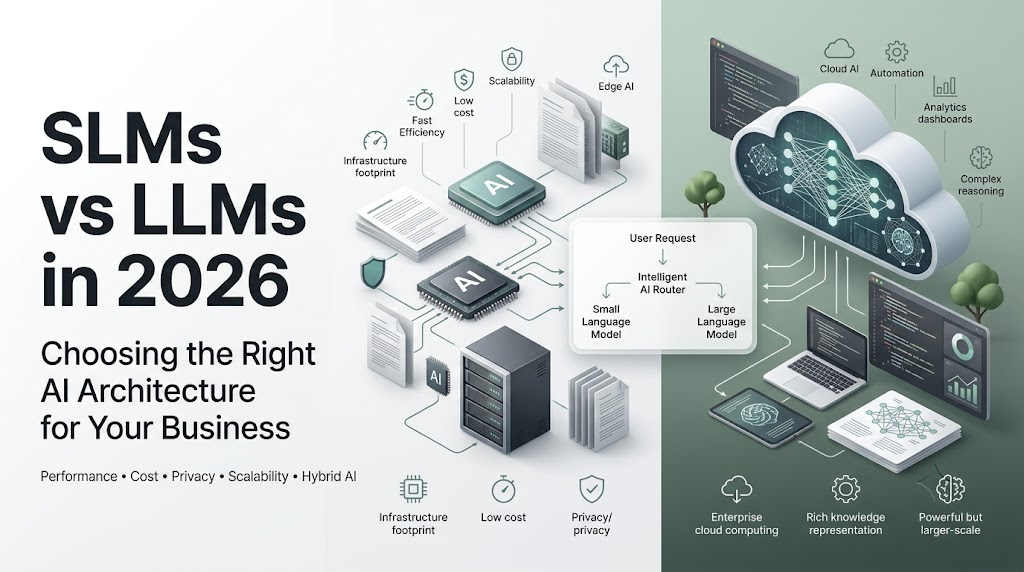
SLMs vs LLMs in 2026: Choosing the Right AI Architecture for Your Business
The discussion around SLMs vs LLMs in 2026 has become one of the most important decisions for businesses adopting artificial intelligence. Organizations are no longer choosing AI models based only on size. Instead, they are evaluating performance, cost, privacy, and scalability to determine the best architecture for each workflow.
A large language model can handle complex reasoning and unpredictable requests. However, using it for every business process can create unnecessary expenses. Many enterprise tasks do not require billions of parameters or massive cloud infrastructure.
Instead, organizations are adopting a more balanced approach. They combine Small Language Models (SLMs) for focused workflows with Large Language Models (LLMs) for advanced reasoning tasks.
Recent developments in open-source AI research have accelerated this shift. Platforms such as Hugging Face have helped developers access optimized models that deliver strong performance with lower resource requirements.
Modern AI strategies are no longer about choosing the biggest model available. They are about creating efficient systems that match the model to the business requirement.
This guide explains the key differences between SLMs and LLMs, their advantages, limitations, and how enterprises can build a cost-effective AI infrastructure in 2026.
Understanding the Core Differences Between SLMs vs LLMs in 2026
The main difference between SLMs vs LLMs in 2026 is not only parameter size. The real distinction comes from their purpose, training approach, deployment strategy, and business applications.
SLMs are built for efficiency and specialization. They are designed to perform specific tasks with speed and consistency. LLMs focus on flexibility and broad knowledge. They can handle a wider range of instructions and complex user interactions.
In 2026, enterprises are looking beyond model size. They are considering factors such as inference cost, response speed, privacy requirements, and operational complexity.
A smaller model may deliver better results than a larger model when the task is clearly defined. For example, a company may achieve higher accuracy with a fine-tuned SLM for document classification than with a general-purpose LLM.
The choice between SLMs and LLMs depends on business goals. Companies should evaluate whether they need specialized automation or broad problem-solving capabilities.
Small Language Models (SLMs) in SLMs vs LLMs in 2026: Efficient AI Systems for Enterprise Use
Small Language Models generally contain fewer parameters than large-scale AI systems. In the SLMs vs LLMs in 2026 comparison, SLMs stand out because they provide efficient performance with lower infrastructure requirements.
Many SLMs range from hundreds of millions to several billion parameters. Some advanced compact models reach around 10–20 billion parameters while still maintaining efficient deployment.
These models are designed for targeted business applications. They perform especially well when trained or fine-tuned on specific company data.
Common enterprise uses for SLMs include:
- Customer support classification
- Document processing
- Data extraction
- Internal search assistance
- Sentiment analysis
- Edge AI applications
The biggest advantage of SLMs is efficiency. They require less computing power and can often run on local infrastructure. This reduces operating costs and improves response times.
Businesses also benefit from stronger privacy control. Since SLMs can run on private servers or devices, sensitive information does not always need to be transferred to external cloud platforms.
For companies managing large volumes of repetitive tasks, SLMs provide a practical AI solution. They deliver reliable performance without the cost and complexity of larger models.
Large Language Models (LLMs) in SLMs vs LLMs in 2026: Powering Advanced AI Applications
Large Language Models remain a major part of the SLMs vs LLMs in 2026 discussion because they provide unmatched flexibility and reasoning capabilities.
LLMs are designed for broad capabilities. They are trained on massive datasets and contain billions of parameters. Some modern systems scale to hundreds of billions or more.
LLMs are effective because they can understand complex instructions, generate creative content, and solve problems across multiple domains.
Enterprise applications for LLMs include:
- Advanced research assistance
- Software development support
- Strategic analysis
- Complex customer interactions
- Creative content generation
- Multi-step reasoning tasks
Their flexibility makes them valuable for situations where the outcome is difficult to predict. Unlike specialized SLMs, LLMs can adapt to new topics without additional training.
However, this flexibility comes with higher costs. Large models require more computing resources, increased infrastructure investment, and stronger security management.
For businesses that need advanced reasoning and broad AI capabilities, LLMs remain essential. They provide the intelligence required for complex and open-ended workflows.
Why Small Language Models Win in the SLMs vs LLMs in 2026 Cost and Latency Comparison
When comparing SLMs vs LLMs in 2026, cost efficiency has become one of the biggest deciding factors for enterprises. Large models deliver impressive capabilities, but running them for every task can create unnecessary infrastructure expenses.
Many business workflows are repetitive and predictable. Tasks such as document classification, information extraction, and customer query routing do not always require a massive AI system.
For these use cases, Small Language Models provide faster and more affordable performance. Their smaller architecture requires fewer computing resources, which reduces both deployment and inference costs.
A company processing millions of daily requests can save significant resources by using an optimized SLM instead of sending every request to a large cloud-based model.
The difference becomes especially important at enterprise scale. Even small improvements in inference efficiency can reduce operational expenses over time.
Modern AI strategies focus on using resources intelligently. Businesses are moving toward specialized models that deliver the required performance without unnecessary computational overhead.
SLMs vs LLMs in 2026: Lower Infrastructure Costs and Easier Fine-Tuning
One of the strongest advantages of SLMs is their lower operating cost. Smaller models need less memory, fewer processing resources, and less expensive hardware compared with large-scale AI systems.
A fine-tuned SLM can often handle specific business tasks at a fraction of the cost of a larger model. This makes AI adoption more accessible for companies with limited budgets.
Fine-tuning has also become easier in recent years. Improved training methods allow organizations to customize smaller models using proprietary data without requiring massive machine learning investments.
Businesses can now adapt compact models for specific requirements, including:
- Internal knowledge assistants
- Industry-specific document analysis
- Customer support automation
- Workflow classification systems
- Data processing applications
This approach creates a better balance between performance and affordability.
Instead of investing heavily in a single large AI model, enterprises can build a collection of specialized models that work together efficiently.
SLMs vs LLMs in 2026: Faster Response Times for Real-Time AI Applications
Latency is another important factor in the SLMs vs LLMs comparison. Smaller models process information faster because they require fewer computational operations.
This speed advantage is valuable for applications where users expect immediate responses.
Examples include:
- Mobile AI assistants
- Smart devices
- Real-time customer support
- Industrial monitoring systems
- Offline business applications
A delayed response can negatively affect user experience. SLMs help organizations create faster AI interactions while reducing dependence on expensive cloud processing.
For edge computing environments, smaller models are especially useful. They can operate directly on local devices with limited hardware capabilities.
This makes SLMs an important part of the future AI ecosystem. They allow businesses to deploy intelligent features closer to users while maintaining strong performance.
SLMs vs LLMs in 2026: Improving Data Privacy Through Edge AI Deployment
Data privacy has become a major concern for organizations adopting artificial intelligence. Companies often process sensitive information, including customer records, financial documents, and internal business data.
Using external AI services can create challenges around compliance, data ownership, and security management. This is where Small Language Models provide a significant advantage.
Because SLMs require fewer resources, they can run directly on private servers, company networks, or edge devices. This allows businesses to keep sensitive information within their own infrastructure.
Local AI deployment reduces the need to transfer confidential data to third-party platforms. It also gives organizations greater control over how information is processed and stored.
For industries with strict regulations, this capability is especially valuable.
Examples include:
- Healthcare organizations managing patient information
- Financial institutions handling private transactions
- Legal firms processing confidential documents
- Government agencies protecting sensitive records
Benefits of Running AI Models Locally
Deploying SLMs locally provides several security and operational benefits:
- Improved data control: Information remains inside company-managed systems.
- Better compliance support: Organizations can meet regional privacy requirements more easily.
- Reduced cloud dependency: Businesses avoid sending every request to external providers.
- Offline capabilities: AI tools can continue working without constant internet access.
Local deployment also improves customization. Companies can adapt models specifically for their workflows while maintaining control over their data environment.
As privacy regulations continue to expand, secure AI deployment will become a key competitive advantage.
For many organizations, the future of enterprise AI will not depend only on model intelligence. It will also depend on where and how those models operate.
SLMs vs LLMs in 2026: When Large Language Models Remain Essential
Although SLMs are becoming more powerful, Large Language Models remain essential for advanced AI applications. Their biggest strength is flexibility.
LLMs are designed to handle complex, unpredictable requests. They can analyze large amounts of information, understand context, and generate detailed responses across many domains.
A specialized SLM may outperform an LLM on a narrow task. However, an LLM is often the better choice when a company needs broad problem-solving ability.
Modern enterprises continue using LLMs for tasks that require deeper reasoning and creativity.
These applications include:
- Complex business analysis
- Advanced software development
- Strategic planning
- Research assistance
- Long-form content generation
- Multi-step problem solving
Large models are valuable because they can connect ideas from different areas of knowledge. They are not limited to one specific workflow.
For example, a company may use an LLM to analyze market trends, create business strategies, or assist developers with complex technical challenges.
SLMs vs LLMs in 2026: Why Enterprises Still Need Large Language Models
The growth of SLMs does not mean LLMs are becoming irrelevant. Instead, both technologies are becoming complementary.
LLMs provide the intelligence needed for situations where the answer cannot be easily predicted. They are especially useful when users require flexible conversations and advanced reasoning.
The best AI architecture in 2026 is not about replacing one model with another. It is about selecting the right tool for each business requirement.
Enterprises that understand this balance can achieve better performance, lower costs, and stronger AI scalability.
SLMs vs LLMs in 2026: Implementing a Hybrid AI Routing Strategy
The future of enterprise AI will not be defined by choosing only SLMs or LLMs. Instead, successful organizations are adopting hybrid AI architectures that combine both technologies.
A hybrid approach allows businesses to use each model where it performs best. Small Language Models handle repetitive and predictable tasks, while Large Language Models manage complex reasoning and advanced requests.
This strategy improves efficiency without sacrificing intelligence. Companies can reduce unnecessary cloud expenses while still accessing powerful AI capabilities when needed.
A hybrid system usually includes an intelligent routing layer. This component analyzes each user request and decides which model should process it.
Simple tasks can be handled by a fast local SLM. More complex requests can be transferred to a larger cloud-based LLM.
This creates a smarter AI infrastructure that balances:
- Performance
- Cost efficiency
- Data privacy
- Scalability
- User experience
Instead of depending on one universal model, businesses create flexible AI ecosystems that adapt to different workloads.
SLMs vs LLMs in 2026: How Intelligent Model Routing Works
A hybrid AI system typically follows a simple workflow:
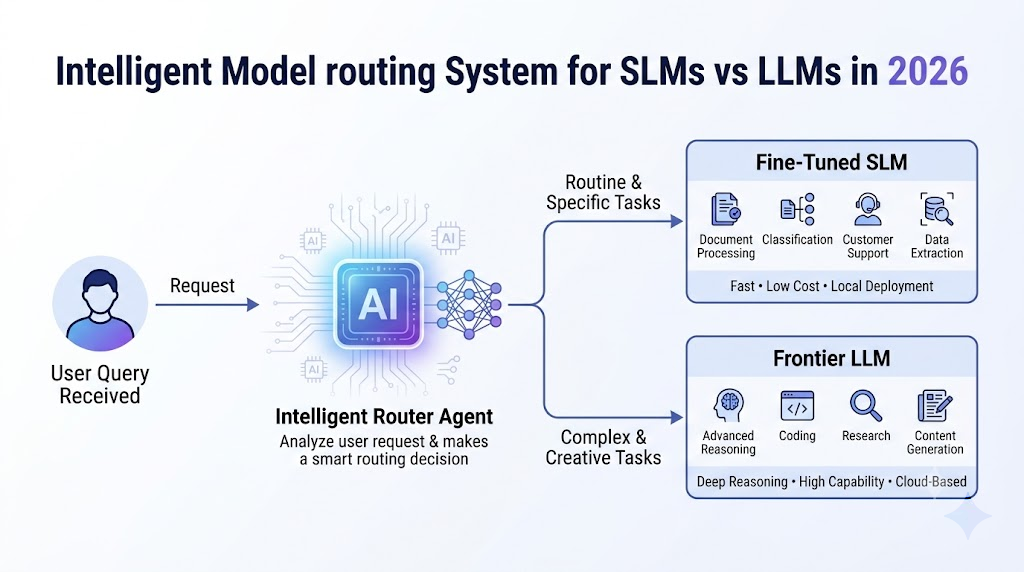
The routing system evaluates the complexity of each request before selecting a model.
For example:
An SLM may handle:
- Email classification
- Document tagging
- Customer support routing
- Basic data extraction
- Sentiment analysis
An LLM may handle:
- Complex research questions
- Strategic recommendations
- Advanced coding assistance
- Creative content generation
- Multi-step reasoning tasks
This approach prevents businesses from overusing expensive AI resources. It also improves response times by keeping simple requests with smaller models.
In 2026, hybrid AI architecture is becoming one of the most practical approaches for enterprise automation.
SLMs vs LLMs in 2026: Enterprise Comparison Table
| Feature | Small Language Models (SLMs) | Large Language Models (LLMs) |
|---|---|---|
| Primary purpose | Specialized business workflows | General-purpose intelligence |
| Model size | Millions to billions of parameters | Billions to trillions of parameters |
| Cost | Lower training and inference expenses | Higher infrastructure costs |
| Speed | Faster response times | Slower due to larger computation needs |
| Deployment | Local servers, devices, private clouds | Mostly cloud-based environments |
| Privacy | Stronger local data control | Requires careful data management |
| Customization | Easier fine-tuning for specific tasks | More complex customization |
| Reasoning ability | Limited compared with larger models | Strong advanced reasoning capabilities |
| Best use cases | Automation, classification, extraction | Research, coding, strategy, creativity |
The comparison shows that neither model category is universally better. The right choice depends on the business objective.
Companies should evaluate their AI requirements before selecting a model. A healthcare company processing patient documents may prioritize privacy and efficiency with an SLM.
A software company developing advanced AI assistants may require the broader capabilities of an LLM.
The most effective enterprise AI strategies will combine both approaches.
Frequently Asked Questions About SLMs vs LLMs in 2026
What Is the Difference Between SLMs and LLMs?
Small Language Models (SLMs) and Large Language Models (LLMs) are both artificial intelligence systems designed to understand and generate human-like text. However, their architecture, purpose, and deployment methods are significantly different.
First, Small Language Models (SLMs) are compact AI models created for focused tasks. They usually contain fewer parameters and require less computing power. As a result, businesses can deploy them on local servers, personal computers, or edge devices with fewer infrastructure requirements. Additionally, SLMs are especially useful for workflows that involve repetitive actions, structured data processing, classification, and domain-specific automation.
On the other hand, Large Language Models (LLMs) are much larger AI systems trained on massive datasets. They contain billions or even trillions of parameters, which allows them to handle complex instructions, creative tasks, advanced reasoning, and diverse conversations. Furthermore, LLMs are designed to provide general-purpose intelligence across many industries and use cases.
Therefore, the key difference between SLMs and LLMs is not only their size. Instead, it is their intended purpose. SLMs prioritize efficiency, speed, privacy, and specialization, whereas LLMs prioritize flexibility, broad knowledge, and advanced problem-solving capabilities.
Ultimately, businesses should select the right model based on their specific requirements. Companies handling repetitive workflows may benefit from SLMs, while organizations needing advanced reasoning, creativity, and broader AI capabilities may require LLMs.
How Much Cheaper Is an SLM Compared With an LLM?
The cost difference between Small Language Models and Large Language Models depends on several factors, including model size, infrastructure requirements, deployment method, and workload volume. Generally, however, SLMs are much more affordable because they require fewer computing resources.
For example, Large Language Models often need powerful GPUs, extensive cloud infrastructure, and significant energy consumption. Consequently, these requirements increase both operational and maintenance costs, especially when businesses process millions of AI requests every month.
In contrast, SLMs reduce these expenses because they are smaller and more efficient. They require less memory, lower processing power, and smaller storage capacity. Therefore, organizations can deploy them more easily across enterprise environments.
The main cost advantages of SLMs include:
- Lower hardware requirements: Smaller models can operate on less expensive systems.
- Reduced cloud expenses: Businesses can minimize dependency on costly AI APIs.
- Faster inference speed: Less computation leads to quicker responses.
- Lower maintenance costs: Smaller systems are easier to manage.
Moreover, for high-volume enterprise applications such as document processing, customer support classification, and internal automation, SLMs can provide significant savings over time. As a result, many organizations now use SLMs for routine tasks while reserving expensive LLM resources for complex requests.
Can an SLM Outperform an LLM?
Yes, a Small Language Model can outperform a Large Language Model when it is designed and optimized for a specific task. Although LLMs have greater general knowledge and reasoning abilities, they are not always the most efficient choice for specialized workflows.
For instance, an SLM trained or fine-tuned on industry-specific data can achieve excellent accuracy in a narrow domain. A healthcare organization may create an SLM specifically for extracting information from medical documents. In this situation, the specialized model may deliver better results than a general-purpose LLM because it is optimized for one specific workflow.
Similarly, businesses can use specialized SLMs for applications such as:
- Customer support categorization
- Legal document analysis
- Product recommendation systems
- Sentiment detection
- Data extraction
However, LLMs remain stronger for tasks that require broad understanding, creativity, and complex reasoning. For example, they are better suited for strategic analysis, software development assistance, research, and open-ended conversations.
Ultimately, the decision between an SLM and an LLM depends on the objective. A smaller model can be the better option when accuracy, speed, cost, and specialization matter more than general intelligence.
Do SLMs Require an Internet Connection?
No, many Small Language Models can operate without an active internet connection. In fact, this offline capability is one of the biggest advantages of SLMs compared with larger cloud-based AI systems.
Because SLMs require fewer computational resources, organizations can deploy them directly on local devices, private servers, company networks, and edge computing environments. As a result, businesses can process information without sending sensitive data to external cloud platforms.
Additionally, offline deployment provides several important benefits:
- Improved privacy protection: Sensitive business information stays within controlled systems.
- Reduced cloud dependency: Companies can avoid relying entirely on external AI providers.
- Faster response times: Local processing reduces network delays.
- Greater operational control: Businesses manage their own AI infrastructure.
Furthermore, this capability is especially valuable for industries with strict data protection requirements, including healthcare, finance, government, and legal services.
Although some advanced AI applications still require cloud-based LLMs, SLMs provide an effective solution for organizations that need secure, reliable, and independent AI systems.
As edge computing continues to expand, offline AI deployment will become increasingly important for businesses seeking more control over their data and technology infrastructure.
What Are Some Popular Examples of SLMs?
Several Small Language Models have gained attention because they provide strong performance while requiring fewer resources than traditional large-scale AI systems. In recent years, these models have helped make advanced AI more accessible for developers, businesses, and researchers.
Some popular examples of SLMs include:
- Microsoft Phi models: Compact AI models designed to deliver efficient reasoning and language capabilities with smaller architectures.
- Google Gemma models: Lightweight open models developed for flexible AI applications and efficient deployment.
- Mistral 7B models: Smaller language models known for strong performance compared with their size.
- Other optimized open-source models: Many organizations are developing specialized compact models for industry-specific applications.
Moreover, these models demonstrate that AI performance does not always depend on having the largest possible architecture. Instead, with proper training, fine-tuning, and optimization, smaller models can deliver excellent results for targeted business needs.
Therefore, the future of AI will likely involve a combination of SLMs and LLMs, where each model type is used according to its strengths.
Conclusion: Building the Right AI Strategy with SLMs and LLMs
The discussion around SLMs vs LLMs in 2026 represents a major shift in enterprise AI thinking.
Businesses are moving away from the idea that the largest model is always the best solution. Instead, they are focusing on efficiency, security, and practical results.
Small Language Models provide affordable, fast, and privacy-friendly AI solutions for specialized workflows. They are ideal for repetitive tasks, local deployment, and high-volume automation.
Large Language Models continue to provide unmatched flexibility for complex reasoning, creativity, and advanced problem-solving.
As artificial intelligence continues evolving, businesses must also understand how AI systems influence digital content, communication, and online experiences. Exploring topics such as how AI detects patterns in human-generated content and creative writing can help organizations better understand the relationship between artificial intelligence and content generation.
In 2026 and beyond, successful AI adoption will depend on choosing the right model for the right task. The future belongs to organizations that build intelligent, flexible, and efficient AI systems.