
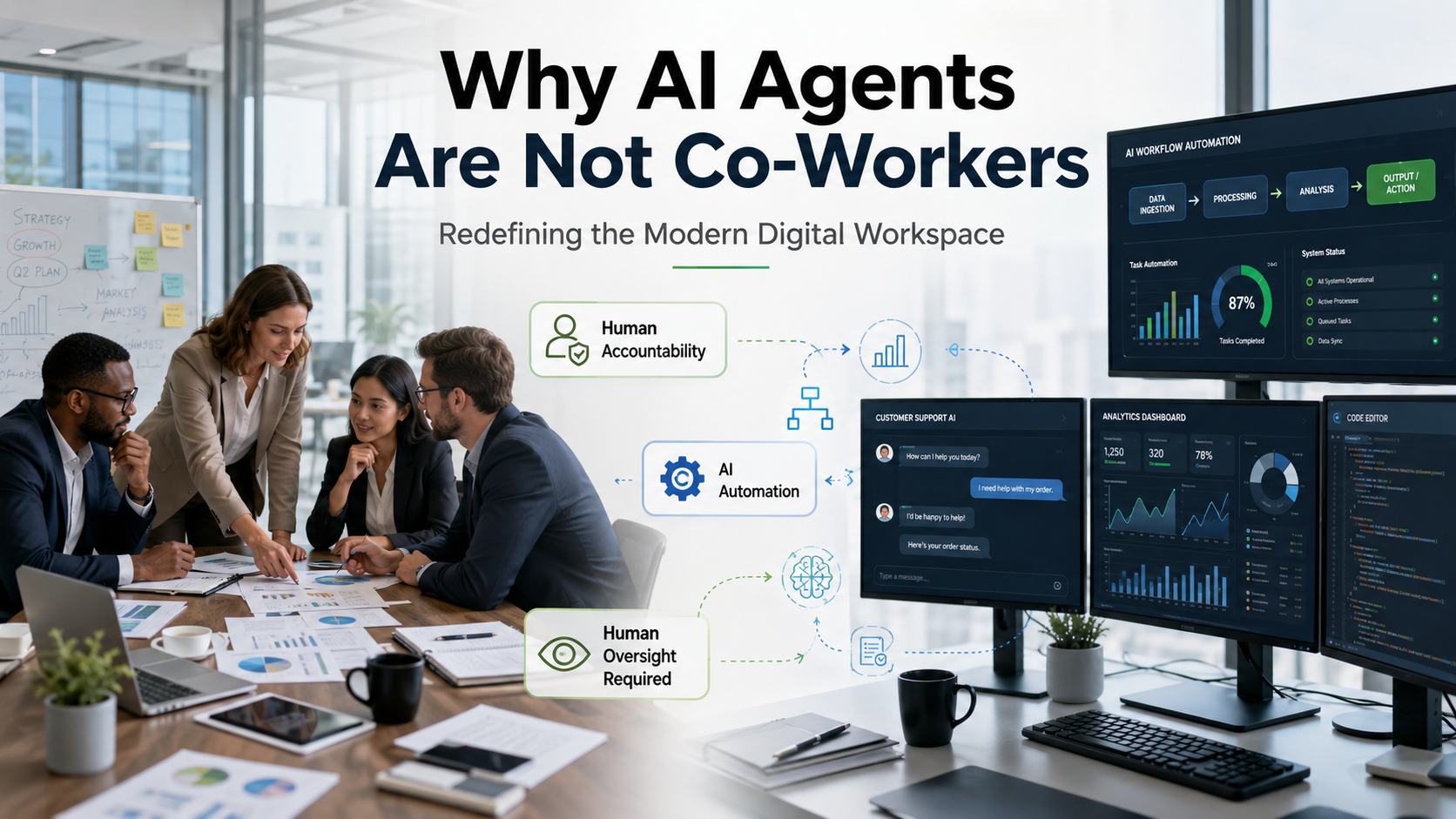
Why AI Agents Are Not Co-Workers: Redefining the Modern Digital Workspace
The rapid rise of autonomous digital systems has changed how businesses manage daily operations. Companies now rely on advanced software to automate research, content creation, coding, customer support, and data analysis. As adoption grows, a misleading idea has become increasingly common. Many people describe these tools as digital colleagues or teammates. In reality, AI agents are not co-workers. They are software systems designed to complete specific tasks under human supervision.
Confusing software with employees creates unrealistic expectations. It also weakens accountability and encourages people to overestimate what machine learning models can actually do. A digital system cannot share responsibility, exercise judgment, or understand workplace relationships like a human professional.
For organizations looking to adopt AI responsibly, the NIST AI Risk Management Framework provides practical guidance on governing AI systems, managing risks, and ensuring human oversight throughout the AI lifecycle.
Understanding this distinction helps organizations build safer and more productive workflows. This article explains why AI agents are not co-workers, explores the risks of anthropomorphizing software, compares automated systems with human employees, and outlines practical ways to manage AI responsibly in the modern workplace.
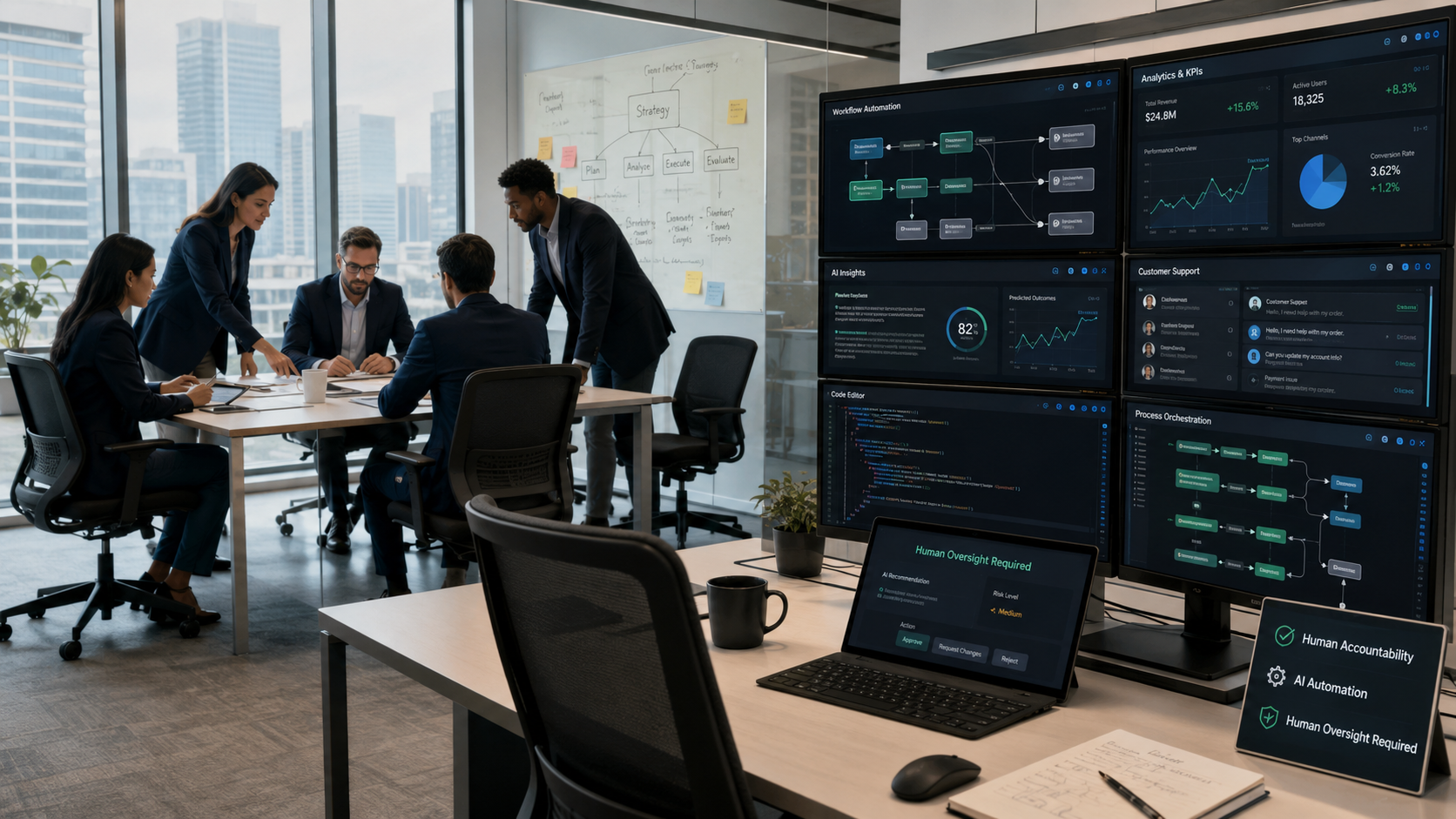

The Myth of the Digital Colleague: Why AI Agents Are Not Co-Workers
Marketing campaigns often describe AI-powered software using human language. Companies talk about “hiring” an AI assistant or “onboarding” a digital teammate. While these phrases make the technology feel approachable, they also create confusion. The software performs tasks, but it does not become part of the workforce in the same way people do.
An autonomous digital assistant operates through statistical models, algorithms, and pattern recognition. It receives inputs, processes information, and generates outputs based on training data and user instructions. It has no ambitions, personal experiences, workplace loyalty, or professional judgment.
Recognizing that AI agents are not co-workers helps organizations set realistic expectations. Employees remain responsible for planning, reviewing, and approving every important outcome. Viewing AI as software rather than a colleague encourages stronger oversight, better decision-making, and healthier workplace communication.
Why AI Agents Are Not Co-Workers: The Core Differences
Human professionals and automated systems serve very different purposes. Employees contribute judgment, accountability, creativity, and emotional awareness. AI systems excel at processing information, identifying patterns, and completing repetitive work quickly. These strengths complement each other but are never interchangeable.
The biggest difference lies in responsibility. Humans remain accountable for every business decision, regardless of how much automation supports the process. AI cannot accept legal responsibility or explain its reasoning like an employee during a business review.
Another important distinction is adaptability. Human employees can respond to unexpected situations by applying experience, ethical reasoning, and common sense. They can negotiate with clients, resolve workplace conflicts, and make informed decisions when information is incomplete. In contrast, AI generates responses based on patterns in data and user prompts. It cannot independently evaluate changing circumstances or exercise genuine judgment beyond the information it has been trained on.
Organizations should also recognize that software lacks genuine understanding. It predicts likely outputs rather than thinking independently. This distinction becomes especially important when businesses automate critical tasks involving customers, finances, healthcare, or legal decisions. Understanding these differences allows teams to use automation effectively while maintaining appropriate human oversight and professional accountability.
AI Agents Are Not Co-Workers Because They Lack Accountability
When a human employee makes a mistake, they accept responsibility for the outcome. They explain the issue, communicate with affected stakeholders, and adjust future decisions to avoid repeating the error. Accountability is a defining characteristic of professional work.
An automated system cannot accept responsibility for anything it produces. If software generates incorrect financial forecasts, inaccurate reports, or flawed programming code, the responsibility belongs entirely to the people who selected, configured, and supervised the system.
Unlike employees, software cannot face disciplinary action, legal liability, or ethical consequences. It simply processes data according to its programming. For that reason, organizations should never delegate accountability to AI. Human professionals must always remain responsible for reviewing outputs and approving final decisions before implementation.
Human Context vs. AI Agents: Why They Are Not Co-Workers
Successful workplace collaboration depends on much more than technical knowledge. Employees understand body language, organizational culture, customer emotions, and changing business priorities. They recognize subtle signals during conversations and adapt their communication to sensitive situations.
Automated systems process information mathematically. They identify patterns within data but do not experience emotions or understand social relationships. Although AI can generate polite responses, it does not genuinely understand frustration, trust, urgency, or empathy.
This difference becomes critical during negotiations, crisis management, leadership decisions, and customer interactions. Human judgment provides context that algorithms cannot truly possess. AI supports decision-making with information, but people remain responsible for interpreting that information within the broader business environment.
| Human Co-Workers | AI Automated Systems |
|---|---|
| Accept legal and ethical responsibility for outcomes. | Operate strictly as software without legal or personal accountability. |
| Understand emotions, workplace culture, and social context. | Process structured and unstructured data using mathematical models. |
| Innovate through experience, intuition, and collaboration. | Generate outputs based on statistical probabilities and learned patterns. |
Why Treating AI Agents as Co-Workers Creates Business Risks
Giving software human qualities may seem harmless, but it creates practical business risks. Employees may begin trusting automated outputs too easily or assume the system understands situations beyond its actual capabilities. This mindset reduces healthy skepticism and weakens quality control.
Organizations perform better when AI is treated as an advanced productivity tool instead of a teammate. Maintaining this perspective encourages careful review, stronger governance, and better security practices. It also reminds employees that automation supports human expertise rather than replacing professional judgment.
Several operational problems become more likely when businesses treat AI as a colleague instead of software:
- Over-reliance on outputs: Employees may accept generated information without sufficient verification.
- Weaker training practices: Teams may focus on “communicating” with AI instead of learning prompt design, validation, and review techniques.
- Security risks: Staff may share confidential information because interactions feel conversational rather than technical.
- Reduced accountability: Responsibility becomes blurred when people mistakenly believe software shares ownership of decisions.
Recognizing these risks helps organizations establish safer workflows while maintaining appropriate human oversight.
Managing AI Agents as Software, Not Co-Workers
Organizations gain the greatest value from automation when they manage AI like any other business software. The objective is not to build digital coworkers. Instead, it is to improve efficiency while keeping humans responsible for important decisions and final approvals.
Managers should establish clear governance policies before deploying AI across departments. Every automated workflow should include defined review processes, approval checkpoints, and documented responsibilities. Human experts must verify generated content, code, financial analyses, and customer communications before they reach production.
Businesses should also invest in workforce development. Employees benefit from learning prompt engineering, data validation, AI governance, and risk management. These skills help teams use automation effectively without becoming overly dependent on machine-generated outputs. Treating AI as software instead of a colleague creates stronger accountability, improves quality assurance, and supports sustainable digital transformation.
Frequently Asked Questions
Are AI agents capable of replacing human jobs completely?
No. AI agents are not designed to replace human professionals completely. Their primary purpose is to automate repetitive, structured, and time-consuming tasks that follow clear patterns. They perform well in areas such as data entry, scheduling, document drafting, customer support, research assistance, and basic data analysis. By handling routine work, AI helps employees save time and improve productivity.
However, AI cannot replace uniquely human abilities. Critical thinking, ethical decision-making, leadership, creativity, emotional intelligence, and relationship building still require human judgment and experience. AI also lacks accountability and cannot understand complex social or business contexts the way people do. For these reasons, most organizations use AI to augment human capabilities rather than replace their workforce. The most successful businesses combine AI’s speed and efficiency with human expertise, allowing employees to focus on innovation, strategic planning, problem-solving, and meaningful customer interactions.
How should managers introduce autonomous tools to their teams?
Managers should introduce autonomous tools as advanced productivity software rather than digital teammates or replacements for employees. During implementation, they should clearly explain the tool’s purpose, capabilities, limitations, and the specific tasks it is designed to support. Team members also need to understand where human review is required and which decisions must always remain under human control. Setting these expectations early helps prevent unrealistic assumptions about what AI can achieve.
Training should focus on practical skills such as writing effective prompts, verifying outputs, protecting sensitive data, and identifying potential errors or biases. Managers should also establish clear policies for quality assurance and accountability. Employees must understand that they remain fully responsible for reviewing and approving any AI-generated work before it is used. This approach builds trust, strengthens oversight, reduces operational risks, and encourages the responsible adoption of AI across the organization.
Why is it a problem to call an AI agent a co-worker?
Calling an AI agent a co-worker creates a misleading impression that it possesses human qualities such as accountability, independent judgment, emotional awareness, and professional responsibility. In reality, AI agents are not co-workers. They are software tools that generate outputs based on data, algorithms, and statistical patterns rather than genuine understanding or experience. When employees begin viewing AI as a colleague, they may place too much trust in its responses and reduce the level of critical review applied to its work. This can allow factual errors, biased outputs, security risks, or poor decisions to pass into production without proper verification. Human professionals remain legally, ethically, and operationally responsible for every decision made within an organization. Treating AI as software instead of a teammate reinforces accountability, encourages careful quality control, and helps businesses use automation safely and effectively while maintaining high professional standards.
Can an automated system learn office culture over time?
An automated system can analyze communication styles, company documents, emails, policies, and writing patterns to imitate the language and tone commonly used within an organization. Over time, it may generate responses that appear consistent with internal communication standards and brand guidelines. This ability can help produce content that aligns with established formats and workflows, making interactions seem more natural and consistent.
However, AI cannot genuinely learn or experience office culture in the way human employees do. It does not understand workplace relationships, shared history, organizational values, team dynamics, or employee morale. Its responses are based on pattern recognition and statistical predictions rather than personal experience or social awareness. While AI can mimic the appearance of cultural understanding, it cannot participate in workplace culture or develop meaningful professional relationships. Human employees remain essential for collaboration, leadership, empathy, and making context-aware decisions that require genuine understanding.
What is the correct way to measure the ROI of automated tools?
The return on investment (ROI) of automated tools should be measured using software performance metrics rather than employee performance indicators. The goal is to evaluate how effectively the technology improves business processes and operational efficiency. Organizations should track measurable outcomes such as processing speed, time saved on repetitive tasks, error reduction, cost savings, workflow efficiency, and overall productivity improvements. Additional metrics, including response times, system accuracy, and resource utilization, can also provide valuable insights into the tool’s performance. Comparing these results before and after implementation helps businesses determine whether the investment is delivering meaningful value. At the same time, avoid using human-focused measures such as leadership ability, teamwork, creativity, or professional development when evaluating AI systems. These qualities belong to employees, not software. Measuring AI with the right performance indicators ensures more accurate ROI assessments and supports informed decisions about future automation investments.
Conclusion
Modern organizations benefit greatly from automation, but success depends on using the technology appropriately. The phrase AI agents are not co-workers reminds businesses that these systems remain sophisticated software tools rather than human colleagues. They process information efficiently, automate repetitive work, and improve operational productivity, but they do not replace human judgment or accountability.
Removing human characteristics from AI leads to clearer expectations and stronger governance. Employees remain responsible for reviewing outputs, making ethical decisions, and ensuring quality across every workflow. This approach reduces unnecessary risk while improving trust in automated systems.
The ultimate purpose of AI is not to create an artificial workforce. It is to strengthen the capabilities of the people already working within an organization. Treat software like software, invest in human expertise, and use automation to eliminate repetitive tasks so your team can focus on innovation, strategic thinking, and meaningful business growth.
To better understand how AI-powered conversational tools fit into modern business workflows, read our comprehensive guide on AI chatbots .