
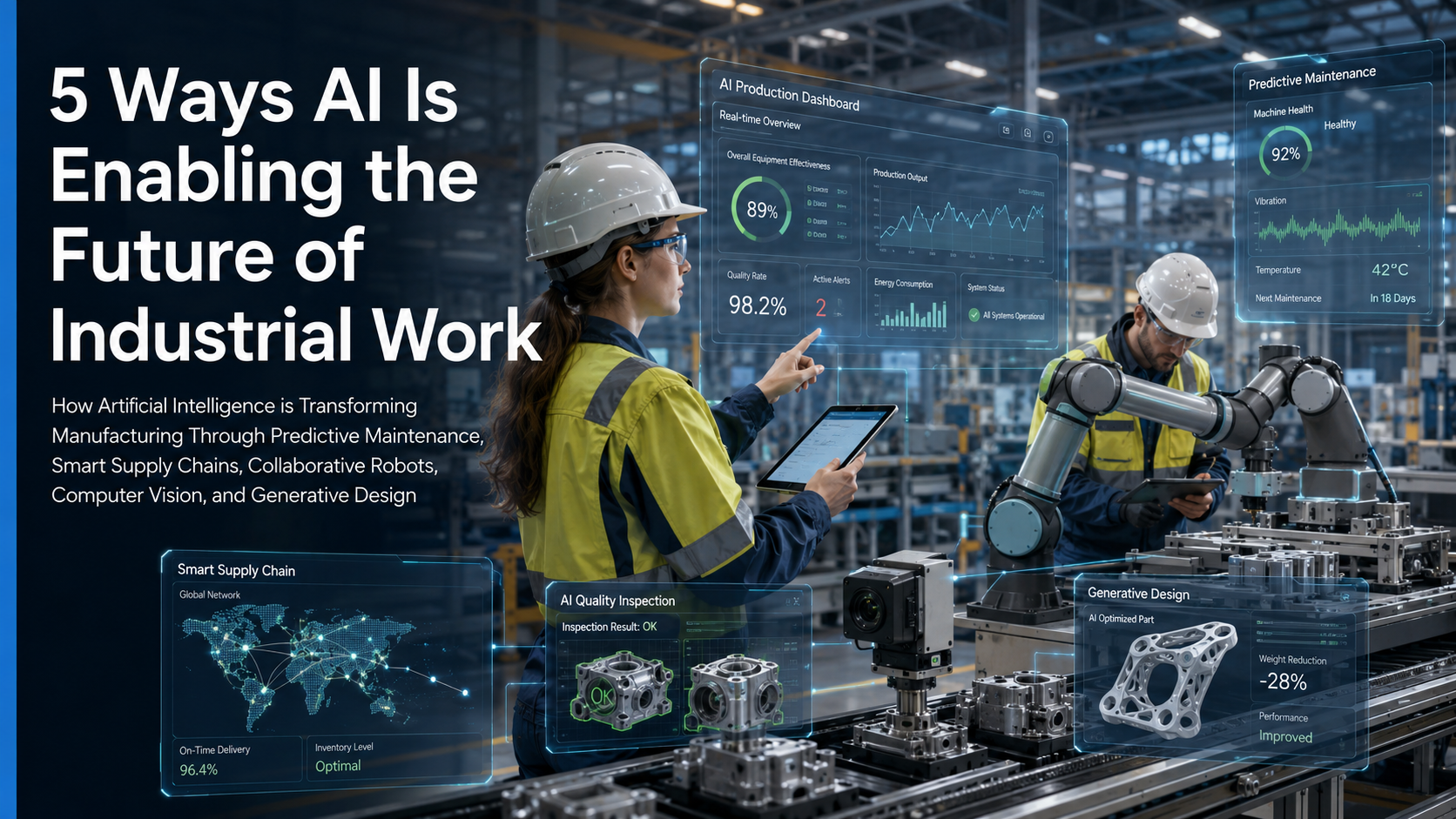
5 Ways AI Is Enabling the Future of Industrial Work
The manufacturing industry is entering a new era driven by artificial intelligence, automation, and connected technologies. As factories become smarter, businesses are rethinking how machines, workers, and data interact. Understanding the future of industrial work is now essential for companies that want to improve productivity and remain competitive.
Advancements in machine learning, robotics, and industrial analytics are changing daily operations. Modern factories are no longer focused only on faster production. They are becoming more intelligent, flexible, and safer environments where humans and machines work together.
Research from the National Institute of Standards and Technology (NIST) highlights how artificial intelligence and machine learning are enabling smarter manufacturing through advanced analytics, robotics, digital systems, and connected industrial technologies. This shift shows that AI adoption is becoming a major part of modern manufacturing strategies.
However, AI is not designed to eliminate human workers. Instead, it enhances human abilities by handling repetitive tasks, reducing workplace risks, and improving decision-making. Workers can focus more on creativity, problem-solving, and managing advanced systems.
This article explores five important ways artificial intelligence is transforming industrial environments. From predictive maintenance to smarter workplace safety, AI is helping manufacturers build more efficient and resilient operations.
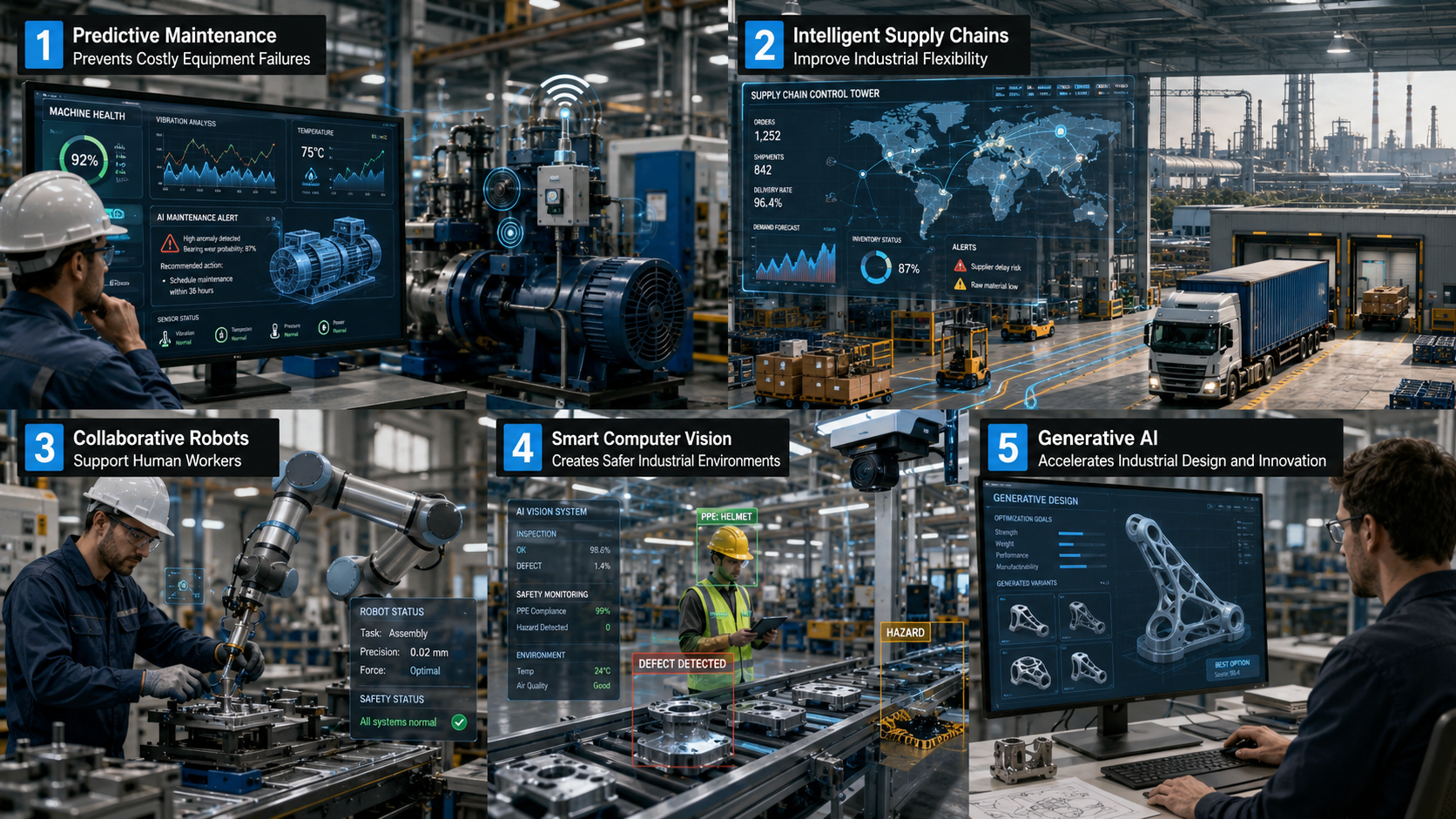

1.Predictive Maintenance Prevents Costly Equipment Failures
Unexpected equipment failures can create major financial losses for manufacturers. In traditional factories, maintenance teams often repaired machines only after a breakdown occurred. Some companies also followed fixed maintenance schedules that replaced parts before they were actually worn out.
AI has changed this approach through predictive maintenance. Instead of reacting to failures, manufacturers can now predict problems before they happen.
Connected Internet of Things (IoT) sensors collect continuous information from industrial equipment. These sensors monitor important signals, including:
- Machine vibration levels
- Operating temperatures
- Sound patterns
- Energy consumption changes
AI systems analyze this data and identify unusual patterns that may indicate future failures. For example, a small vibration change in a motor could signal a developing mechanical issue.
When AI detects a potential problem, it alerts maintenance teams before serious damage occurs. Engineers can then schedule repairs during planned downtime instead of dealing with emergency shutdowns.
This approach improves equipment reliability, extends machine lifespan, and reduces unnecessary maintenance costs. As factories become more connected, predictive maintenance will remain one of the most important technologies shaping the future of industrial work.
2.Intelligent Supply Chains Improve Industrial Flexibility
Modern supply chains face constant challenges. Material shortages, transportation delays, weather events, and changing customer demand can quickly disrupt production schedules.
AI helps manufacturers respond faster by analyzing large amounts of real-time information. These systems evaluate market trends, logistics data, supplier performance, and external risks.
With AI-powered supply chain management, companies can make more accurate decisions and avoid costly disruptions.
Key capabilities include:
- Demand forecasting: AI predicts future material requirements and customer needs.
- Dynamic routing: Smart systems adjust delivery routes based on traffic, weather, and delays.
- Inventory optimization: AI helps maintain the right stock levels while reducing storage costs.
These technologies create more adaptable manufacturing networks. Companies can react quickly when conditions change and maintain smoother production operations.
As global industries become more interconnected, intelligent supply chains will play a critical role in creating flexible and reliable factories. AI allows manufacturers to move from reactive planning to proactive decision-making.
3.Collaborative Robots Support Human Workers
The traditional image of industrial robots operating behind protective barriers is changing. Today, collaborative robots, often called cobots, are designed to work alongside human employees.
Unlike traditional robots that perform isolated tasks, cobots use advanced sensors and AI systems to interact safely with people. They assist workers with repetitive, physically demanding, or hazardous activities.
A typical human-robot partnership looks like this:
Human Worker: Problem-solving, decision-making, and precision tasks
↔
AI Cobot: Heavy lifting, repetitive movements, and consistent operations
↕
Real-Time Sensor Feedback
Cobots can detect nearby movement and respond instantly. If a worker enters a restricted area, the robot can slow down or stop to prevent injury.
This collaboration allows employees to focus on higher-value responsibilities while machines handle physically exhausting work. It also improves workplace efficiency without removing the importance of human skills.
As automation continues to advance, human-machine collaboration will become a defining feature of the future of industrial work.
4.Smart Computer Vision Creates Safer Industrial Environments
Workplace safety has always been a major priority in manufacturing. However, traditional safety inspections often depend on manual supervision. This approach can miss hazards because people cannot monitor every area of a large industrial facility at all times.
AI-powered computer vision systems provide continuous monitoring across factory floors. These systems use cameras, sensors, and machine learning algorithms to identify unsafe conditions in real time.
AI vision technology can detect:
- Missing personal protective equipment (PPE)
- Unsafe worker movements
- Blocked emergency exits
- Spilled liquids or dangerous obstacles
- Restricted area violations
When the system identifies a potential risk, it immediately sends alerts to supervisors. This allows teams to respond before accidents occur.
Beyond improving safety, computer vision also helps companies maintain compliance with workplace regulations. Managers gain better visibility into daily operations and can use collected data to improve safety procedures.
By combining human oversight with AI monitoring, factories can create safer environments without slowing production. This balance between technology and human expertise is becoming an important part of the future of industrial work.
5.Generative AI Accelerates Industrial Design and Innovation
Artificial intelligence is transforming more than factory operations. It is also changing how engineers design products, machinery, and manufacturing systems.
One of the most important developments is generative design. This technology uses AI algorithms to create optimized designs based on specific requirements.
Engineers provide key parameters, such as:
- Weight limitations
- Material preferences
- Strength requirements
- Manufacturing restrictions
- Budget targets
The AI system then evaluates thousands of possible designs within minutes. It identifies solutions that may be difficult for human designers to discover manually.
Many AI-generated designs use advanced structures inspired by nature. These designs can reduce material usage while improving strength and durability.
For manufacturers, this creates several advantages. Companies can develop lighter components, reduce production waste, and speed up product development.
Generative AI also supports faster innovation because engineers can test more ideas in less time. Instead of replacing human creativity, AI expands what engineers can achieve.
As industrial companies adopt more intelligent design tools, AI will continue shaping a more efficient and innovative manufacturing future.
Frequently Asked Questions
How does AI improve safety in the future of industrial work?
AI improves workplace safety by providing constant monitoring and faster hazard detection. Traditional safety methods depend heavily on human observation, which can sometimes miss risks in busy industrial environments.
AI-powered computer vision systems continuously analyze factory conditions. They can identify whether workers are wearing required protective equipment, such as helmets and safety vests. They can also detect hazards like spills, blocked pathways, or unsafe machine interactions.
Collaborative robots improve safety in another way. These machines use sensors to recognize nearby workers. If someone moves too close, the robot can slow down or stop automatically.
By combining automated monitoring with safer machine operation, AI helps reduce workplace accidents. It allows employees to work in environments that are more secure, predictable, and efficient.
The goal is not to remove people from industrial settings. Instead, AI helps create workplaces where humans and technology can operate together safely.
Will AI completely replace human workers in factories?
No, AI is unlikely to completely replace human workers in factories. Instead, it is changing the type of work people perform.
Machines are highly effective at repetitive, physically demanding, and dangerous tasks. AI systems can handle data analysis, automated inspections, and routine operations with high speed and accuracy.
Human workers remain essential because they provide creativity, judgment, communication, and problem-solving abilities. These skills are especially important when handling unexpected challenges or improving production processes.
The future of industrial work will focus on human-AI collaboration. Workers will increasingly manage intelligent systems, analyze information, and make strategic decisions.
Companies will also need to invest in training programs. Employees must develop digital skills to operate advanced equipment and work effectively with AI technologies.
Rather than removing human roles, AI is creating opportunities for workers to move into more advanced and valuable positions.
What is predictive maintenance in smart manufacturing?
Predictive maintenance is an AI-driven approach that helps manufacturers repair equipment before failures happen.
Traditional maintenance often followed fixed schedules or waited until machines stopped working. Predictive maintenance uses real-time data to identify possible problems earlier.
Industrial IoT sensors collect information about equipment performance. They track factors such as temperature, vibration, pressure, and sound. AI algorithms analyze this information and detect unusual patterns.
When the system identifies signs of possible failure, it alerts maintenance teams. Engineers can then repair the equipment during scheduled downtime.
This approach offers several benefits:
- Fewer unexpected breakdowns
- Lower repair expenses
- Longer equipment lifespan
- More reliable production schedules
Predictive maintenance is becoming a foundation of smart manufacturing. It helps factories operate more efficiently while reducing unnecessary costs.
As industrial systems become more connected, AI-based maintenance strategies will play a larger role in the future of manufacturing.
What challenges do companies face when adopting industrial AI?
Although AI provides many benefits, companies may face challenges during implementation. One major obstacle is the cost of upgrading existing systems.
Many factories still rely on older equipment that was not designed for digital connectivity. Connecting these machines to modern AI platforms may require significant investment.
Another challenge is the workforce skills gap. Employees need training to understand AI tools, analyze data, and manage advanced robotics.
Companies may also face concerns related to cybersecurity and data protection. Connected industrial systems require strong security measures to prevent unauthorized access.
Successful AI adoption requires careful planning. Businesses must evaluate their current infrastructure, train employees, and introduce technology gradually.
Organizations that address these challenges can achieve long-term benefits. With the right strategy, industrial AI can improve efficiency, safety, and competitiveness.
How does generative design benefit industrial manufacturing?
Generative design helps manufacturers create better products by using AI to explore multiple design possibilities quickly.
Engineers provide specific requirements, including weight limits, materials, strength levels, and production goals. The AI system then generates and evaluates many possible solutions.
This process helps identify designs that may not be obvious through traditional methods. Some AI-created structures use less material while maintaining strong performance.
Benefits of generative design include:
- Reduced material waste
- Faster product development
- Improved component performance
- More innovative engineering solutions
Manufacturers can create lighter and stronger parts while reducing development time. This is especially valuable in industries where efficiency and performance are critical.
Generative design does not replace engineers. Instead, it gives them powerful tools to explore new ideas and make better decisions.
As AI technology improves, generative design will continue supporting innovation across modern industrial environments.
Conclusion: AI Is Defining the Future of Industrial Work
The future of industrial work is already taking shape across factories and manufacturing facilities worldwide. Artificial intelligence is becoming a central technology behind this transformation by improving productivity, safety, and operational decision-making.
From predictive maintenance to intelligent supply chains, AI helps companies reduce downtime and respond faster to changing conditions. Smart computer vision systems create safer workplaces, while collaborative robots allow humans and machines to work together more effectively.
Generative AI and advanced design tools are also changing how manufacturers develop products. Engineers can now explore more possibilities, reduce waste, and create stronger, more efficient components. Understanding how AI processes and manages information, including concepts such as AI tokenization techniques, can help businesses better understand the technologies powering modern industrial systems.
However, the success of industrial AI depends on collaboration between technology and people. Human skills such as creativity, problem-solving, and strategic thinking remain essential.
Companies that invest in AI adoption, workforce training, and modern infrastructure will be better prepared for future challenges. The goal is not simply automation. It is creating smarter industrial environments where technology supports human potential.
As industries continue evolving, AI will remain a major force behind the next generation of manufacturing. Businesses that embrace these innovations today will be positioned to lead the global industrial marketplace tomorrow.