
AI Chatbots: The Ultimate Guide to Modern Business Automation
Modern businesses face constant pressure to provide fast, accurate, and reliable communication. Customers expect instant answers at any time of the day. This demand has made AI chatbots an essential technology for companies that want to improve service quality and operational efficiency.
Artificial intelligence has transformed chat experiences from simple automated replies into advanced conversational systems. Today’s AI-powered assistants can understand user intent, analyze context, and provide personalized responses. Platforms such as OpenAI continue to advance conversational technology by improving language understanding and reasoning abilities. Businesses can explore the latest developments in conversational AI through official resources from OpenAI Research and AI Resources.
AI chatbots now support many areas of business operations. They help customer service teams manage requests, assist employees with internal tasks, and support sales teams with lead engagement. Unlike traditional software, modern conversational tools can process large volumes of interactions while maintaining consistent service quality.
Understanding how these systems work is important for organizations planning digital transformation. AI chatbots do more than answer common questions. They connect with business systems, analyze information, and automate repetitive workflows.
This guide explains how AI chatbots function, their main benefits, practical business applications, and strategies for successful implementation. You will learn how conversational AI can improve customer experiences and create more efficient business operations.
Understanding AI Chatbots and How They Function
AI chatbots use advanced technologies such as natural language processing (NLP), machine learning, and data retrieval systems to understand and respond to user requests. Unlike traditional rule-based bots, modern conversational AI systems do not depend only on fixed scripts.
Traditional chatbots follow predefined paths. They usually rely on keyword matching and simple decision trees. If users ask questions outside those rules, the system often fails to provide useful answers.
Modern AI chatbots work differently. They analyze language patterns, identify user goals, and consider previous conversation context. This allows them to manage more natural and flexible conversations.
The process usually involves several important stages:
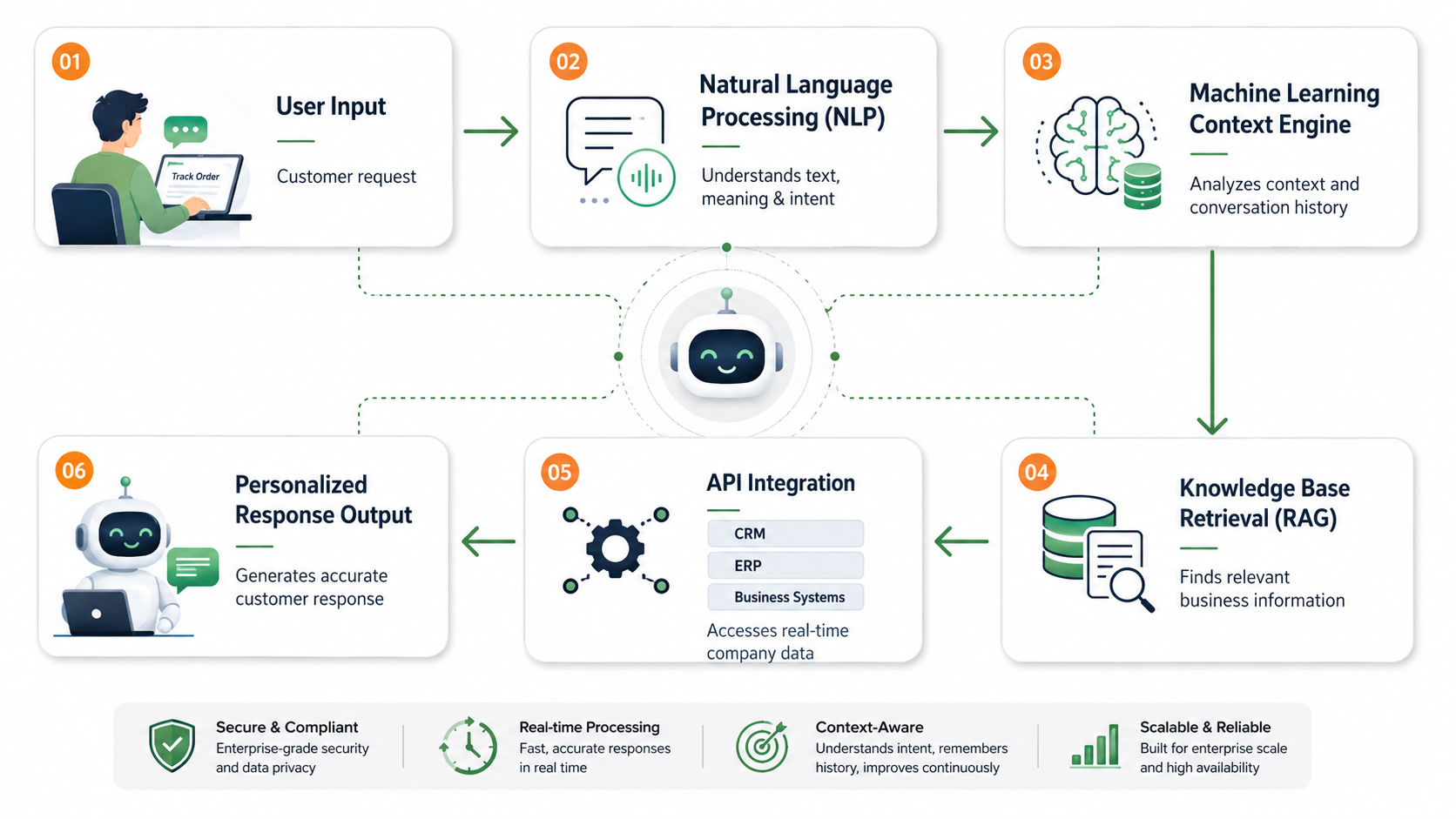

AI chatbot systems typically use these core processes:
- Tokenization: Breaking user messages into smaller language units.
- Intent Recognition: Understanding what the user wants to achieve.
- Entity Extraction: Identifying important details such as names, dates, or order numbers.
- Response Generation: Creating accurate and personalized answers based on available information.
These systems improve through continuous interaction. User feedback and conversation data help refine their performance. Over time, AI chatbots become better at understanding customer needs and delivering relevant responses.
Key Operational Benefits of AI Chatbots for Growing Companies
Businesses across industries are adopting AI chatbots because they improve efficiency and reduce operational pressure. These systems allow organizations to handle customer conversations faster while supporting employees with automated assistance.
One major advantage is availability. Human teams cannot respond instantly at every hour. AI chatbots provide continuous support without requiring breaks, additional shifts, or extended staffing.
Another important benefit is scalability. During busy periods, businesses may receive thousands of customer requests at once. AI chatbots can manage high conversation volumes without creating long waiting times.
The main operational advantages include:
- 24/7 Availability: Customers receive immediate assistance whenever they need it.
- Scalable Support: Businesses can manage large request volumes during peak periods.
- Lower Support Costs: Automation reduces repetitive manual tasks.
- Consistent Responses: Customers receive accurate information aligned with company guidelines.
However, automation works best when combined with human expertise. The strongest customer service models use AI chatbots for routine requests while allowing human agents to handle complex situations.
A hybrid support approach improves efficiency while maintaining customer trust. AI handles repetitive interactions, and employees focus on problem-solving, relationship building, and strategic tasks.
Transforming Business Workflows With Conversational AI Tools
AI chatbots are becoming valuable tools for improving daily business workflows. When connected with existing platforms, they help departments reduce manual work and improve communication speed.
Marketing teams use conversational AI to engage website visitors and capture potential customers. Sales teams use these systems to qualify leads and schedule meetings. Customer service departments use them to resolve common support requests.
Integration with business software makes these tools even more powerful. AI chatbots can connect with customer relationship management platforms, knowledge bases, and internal systems. This allows them to provide accurate information without requiring employees to search manually.
Common business applications include:
| Department | Primary Workflow Use Case | Operational Impact |
|---|---|---|
| Customer Service | Automated first-level ticket resolution | Faster response times |
| Sales & Marketing | Lead qualification and appointment booking | Higher conversion opportunities |
| Human Resources | Employee onboarding and policy support | Reduced administrative workload |
| IT Support | Password resets and technical guidance | Fewer helpdesk requests |
By connecting conversational AI with existing workflows, organizations create faster and more efficient operations. These systems support employees, improve customer satisfaction, and help companies manage growth more effectively.
Lead Generation and Sales Conversion With AI Chatbots
Modern sales teams depend on fast communication to capture and convert potential customers. Website visitors often expect immediate answers about products, pricing, and services. When businesses fail to respond quickly, potential buyers may move to competitors.
AI chatbots help solve this challenge by engaging visitors in real time. They can start conversations, answer common questions, and collect important customer information. This allows businesses to identify promising leads without requiring sales representatives to monitor every interaction.
Conversational AI systems can ask qualifying questions based on customer needs. They can collect details such as company size, requirements, budget range, and preferred contact methods. This information helps sales teams focus on high-value opportunities.
Many AI chatbots also connect with customer relationship management platforms. These integrations allow businesses to update customer records automatically and maintain accurate sales information.
Key sales benefits include:
- Instant Lead Engagement: Visitors receive immediate responses during their buying journey.
- Automated Qualification: Chatbots identify potential customers using predefined criteria.
- CRM Integration: Customer information moves directly into sales systems.
- Improved Conversion Rates: Faster communication increases the chance of successful engagement.
By supporting sales teams with automated conversations, AI chatbots create smoother customer journeys. They help organizations capture more opportunities while allowing sales professionals to focus on relationship building and closing deals.
Streamlining Internal Support Operations With AI Assistants
Businesses often spend significant time handling repetitive employee requests. Human resources teams answer questions about policies, benefits, and workplace procedures. IT departments manage common issues such as password resets and software access problems.
AI chatbots help automate these internal support tasks. Employees can receive immediate answers without waiting for a support team member. This improves productivity and reduces unnecessary workload across departments.
For example, an internal AI assistant can guide employees through common processes. It can explain company policies, provide document links, or help troubleshoot basic technical issues.
Common internal applications include:
- HR Support: Answering questions about benefits, leave policies, and employee procedures.
- IT Assistance: Supporting password recovery, software requests, and basic troubleshooting.
- Knowledge Management: Helping employees quickly find information stored in company systems.
- Employee Onboarding: Providing guidance for new employees during their first weeks.
Automation does not remove the need for human expertise. Instead, it allows internal teams to spend more time on complex responsibilities. Employees receive faster support, while specialists can focus on strategic work.
By improving internal communication and reducing repetitive requests, AI assistants help organizations create more efficient workplaces.
Strategic Implementation Guidelines for Enterprise AI Chatbot Deployment
Successful AI chatbot implementation requires careful planning and clear business objectives. Organizations that rush deployment may create poor user experiences and reduce employee adoption.
A strong implementation strategy begins with understanding business needs. Companies should identify which processes can benefit most from automation. They should also define how chatbot performance will be measured after launch.
The technology itself is only one part of success. Businesses need accurate information, reliable integrations, and effective support processes. A well-designed chatbot should provide value while maintaining a smooth experience for users.
Important implementation considerations include:
- Selecting the right chatbot platform for business requirements.
- Preparing accurate and updated knowledge resources.
- Connecting the chatbot with existing business systems.
- Creating clear escalation processes for human support.
Enterprise AI chatbot projects should focus on long-term improvement rather than one-time deployment. Regular monitoring, testing, and optimization help maintain quality as customer needs change.
When organizations combine technology with strong planning, AI chatbots become powerful tools for improving service delivery, reducing costs, and supporting business growth.
Step 1: Define Clear Success Metrics for AI Chatbot Performance
Before launching an AI chatbot, businesses should establish measurable goals. Clear performance indicators help teams understand whether the system is delivering meaningful results.
Without defined objectives, organizations may struggle to evaluate chatbot effectiveness. Metrics provide valuable insights into customer satisfaction, operational efficiency, and areas requiring improvement.
Companies should identify specific targets based on their business goals. These measurements can include customer support improvements, sales outcomes, or internal productivity gains.
Important chatbot performance indicators include:
- First Contact Resolution (FCR): The percentage of issues solved during the first interaction.
- Ticket Reduction Goals: The expected decrease in human support requests.
- Customer Satisfaction Score (CSAT): How users rate their chatbot experience.
- Response Time Targets: The speed at which customers receive assistance.
Tracking these measurements helps teams improve chatbot performance over time. If results do not meet expectations, businesses can adjust workflows, update information sources, or improve conversation design.
A data-driven approach ensures AI chatbot investments create measurable business value.
Step 2: Build a Reliable Knowledge Base for Accurate Responses
An AI chatbot depends heavily on the quality of its knowledge base. Accurate, organized, and updated information allows the system to provide reliable answers.
Poor documentation can lead to incorrect responses and frustrated users. Businesses should regularly review their content resources and remove outdated information.
A strong knowledge base should contain clear answers to common questions. Information should be organized logically so AI systems can retrieve relevant details quickly.
Effective knowledge management practices include:
- Updating outdated policies and instructions.
- Writing simple answers for frequently asked questions.
- Organizing documents by topic and department.
- Reviewing chatbot responses regularly for accuracy.
Businesses should treat their knowledge base as an ongoing resource. As products, services, and customer expectations change, chatbot information must also evolve.
A well-maintained knowledge base improves response accuracy and builds user confidence. It also helps AI chatbots deliver more consistent experiences across different communication channels.
Step 3: Create Smooth Human Escalation Pathways
Even advanced AI chatbots cannot solve every customer issue. Some requests require human judgment, emotional understanding, or specialized expertise.
A successful chatbot strategy includes clear escalation pathways. When a chatbot cannot provide a confident answer, it should transfer the conversation to a human representative.
The transition should feel natural and efficient. Customers should not need to repeat their problem after reaching a support agent. Conversation history and relevant details should transfer automatically
Effective escalation processes include:
- Detecting when chatbot confidence is low.
- Providing users with an option to contact support.
- Sharing conversation history with human agents.
- Routing requests to the correct department.
A balanced approach improves customer satisfaction. AI chatbots handle routine questions efficiently, while human teams manage complex conversations that require personal attention.
Measuring Performance and Long-Term AI Chatbot Success
Continuous monitoring is essential for maintaining chatbot effectiveness. Businesses should review performance data regularly and identify opportunities for improvement.
AI chatbot analytics reveal how customers interact with the system. They show which questions are common, where users experience difficulties, and which workflows need adjustment.
Important performance metrics include:
- Containment Rate: The percentage of conversations completed without human assistance.
- Fallback Rate: How often the chatbot fails to understand user requests.
- Escalation Rate: The number of conversations transferred to human agents.
- User Engagement: Average conversation length and completion success.
Analyzing chatbot failures helps organizations discover knowledge gaps. Teams can improve content, update workflows, and refine chatbot instructions based on real user behavior.
Long-term success depends on continuous optimization. AI chatbot systems should evolve as business requirements and customer expectations change.
Organizations that regularly measure performance can improve accuracy, increase adoption, and maximize the value of conversational automation.
Frequently Asked Questions About AI Chatbots
How Do Modern Conversational Tools Differ From Traditional Rule-Based Software?
Modern AI chatbots use advanced technologies such as natural language processing (NLP) and machine learning to understand human communication. As a result, they can recognize intent, analyze context, and respond to complex questions more naturally.
In contrast, traditional rule-based systems operate differently. They depend on fixed scripts, keyword matching, and predefined decision paths. Therefore, when users ask questions outside programmed rules, these systems often fail to provide useful answers.
Furthermore, AI-powered conversational tools are designed to manage more flexible interactions. They can understand language variations, correct minor mistakes, and maintain conversation context more effectively.
Because of these capabilities, modern AI chatbots are more suitable for businesses managing high volumes of customer interactions. They provide faster responses while also creating more personalized user experiences.
However, automation works best when combined with human support. AI chatbots can manage repetitive requests efficiently, while human teams handle situations that require deeper expertise or personal attention.
Can AI Chatbots Integrate With Existing Enterprise CRM Software?
Yes, modern AI chatbots can integrate with many enterprise software platforms. These integrations allow businesses to connect conversational tools with customer relationship management systems, helpdesk software, and internal databases.
Additionally, when connected with CRM platforms, AI chatbots can perform valuable tasks automatically. For example, they can create new leads, update customer profiles, retrieve account details, and provide real-time information.
Popular business integrations include platforms such as Salesforce, HubSpot, Zendesk, and Microsoft Dynamics 365.
Moreover, these connections reduce manual data entry and improve workflow efficiency. Sales teams can receive qualified leads faster, while customer service teams gain access to relevant information during conversations.
Therefore, integrating AI chatbots with existing business systems creates smoother operations. It also helps organizations deliver faster, more consistent customer experiences.
How Do AI Chatbots Protect User Data and Maintain Security?
Data security is a major consideration when businesses implement AI chatbot solutions. Therefore, reliable platforms use security practices designed to protect customer information and sensitive business data.
Common security measures include:
- Data Encryption: Protecting information during storage and transmission.
- Access Controls: Limiting system access based on user roles and permissions.
- Privacy Protection: Managing customer information according to applicable regulations.
- Compliance Standards: Supporting requirements such as GDPR, HIPAA, and SOC 2.
In addition, organizations should establish internal security policies when deploying AI chatbots. These policies should clearly define how information is collected, stored, processed, and accessed.
Furthermore, choosing a trusted platform and maintaining proper configuration helps reduce security risks. Regular monitoring and security reviews ensure chatbot systems continue meeting business and compliance requirements.
Ultimately, a secure AI chatbot implementation builds customer confidence while allowing businesses to benefit from automation.
How Long Does It Take to Deploy a Business AI Chatbot?
The time required to deploy an AI chatbot depends on several factors, including project complexity, business goals, and integration requirements.
For example, simple chatbot solutions can often launch within a few days. These systems usually rely on existing documentation and focus on answering basic frequently asked questions.
However, more advanced enterprise chatbot projects require additional planning. Businesses may need custom integrations, workflow automation, security reviews, and extensive testing before launch.
The main deployment factors include:
- The amount and quality of available knowledge base content.
- Required connections with business software.
- The level of customization needed.
- Testing and approval requirements.
Additionally, complex enterprise AI chatbot deployments may take several weeks to complete. During this time, teams test responses, improve workflows, and train employees.
Therefore, businesses should focus on accuracy and user experience rather than rushing deployment. A carefully planned launch usually creates better long-term results.
What Happens When an AI Chatbot Cannot Understand a User Request?
AI chatbots can handle many types of conversations. However, some requests may fall outside their capabilities. When this happens, effective systems use fallback strategies to maintain a positive user experience.
For instance, a chatbot may ask follow-up questions when it needs additional information. If the request remains unresolved, it can transfer the conversation to a human support representative.
A successful fallback process includes:
- Recognizing when confidence levels are low.
- Asking users for additional details.
- Providing clear escalation options.
- Sharing conversation history with human agents.
As a result, customers experience a smoother support journey. Human representatives receive the necessary context and can continue the conversation without asking users to repeat previous information.
Ultimately, the combination of AI automation and human expertise creates a balanced support experience. Chatbots manage routine requests efficiently, while people handle complex or sensitive situations.
Conclusion: Building a Smarter Future With AI Chatbots
AI chatbots are becoming essential tools for businesses that want to improve efficiency, customer service, and workflow automation. These systems provide much more than automated replies. Instead, they help organizations manage conversations, support employees, improve sales processes, and deliver faster assistance.
Additionally, by handling repetitive requests, AI chatbots allow human teams to focus on higher-value activities. Customer service professionals can solve complex problems, sales teams can build stronger relationships, and internal departments can improve productivity.
Furthermore, continuous improvement plays an important role in long-term success. Organizations should monitor chatbot performance, analyze user feedback, and update their systems regularly. As AI technology continues evolving, understanding advanced concepts such as agentic AI can help businesses explore new possibilities in automation and intelligent decision-making. You can learn more about this emerging technology in our detailed guide on What Is Agentic AI: A Beginner’s Guide.
Ultimately, as conversational AI continues to develop, businesses that adopt these solutions can create more responsive and scalable operations. AI chatbots provide a practical path toward better customer experiences, improved efficiency, and sustainable digital growth.