
AI and Copyright: Navigating the New Legal Frontier
Generative artificial intelligence has transformed how people create text, images, code, music, and videos. As these tools become part of everyday work, understanding AI and copyright is more important than ever. Creators, businesses, educators, and legal professionals all face new questions about ownership and intellectual property. If an AI tool writes an article or generates artwork, who owns the result? Can you copyright AI-generated content, or does it automatically enter the public domain? Another major issue is whether technology companies can legally train AI models using copyrighted books, images, and other creative works without permission.
Current guidance from the U.S. Copyright Office explains that human authorship remains essential for copyright protection. You can review the agency’s official guidance on artificial intelligence and copyright here: Copyright and Artificial Intelligence | U.S. Copyright Office. This principle creates practical and legal challenges for anyone using generative AI in professional work. A misunderstanding about ownership can lead to lost intellectual property rights or expensive infringement disputes. As AI law continues to evolve, businesses should understand the legal framework before relying on machine-generated content.
This guide explains the core principles of AI and copyright in clear, practical terms. You’ll learn how ownership is determined, how courts evaluate human creativity, and what businesses can do to reduce legal risks. By understanding these rules, you can confidently use AI tools while protecting your creative work and intellectual property.
The Core Problem: Who Owns AI-Generated Content?
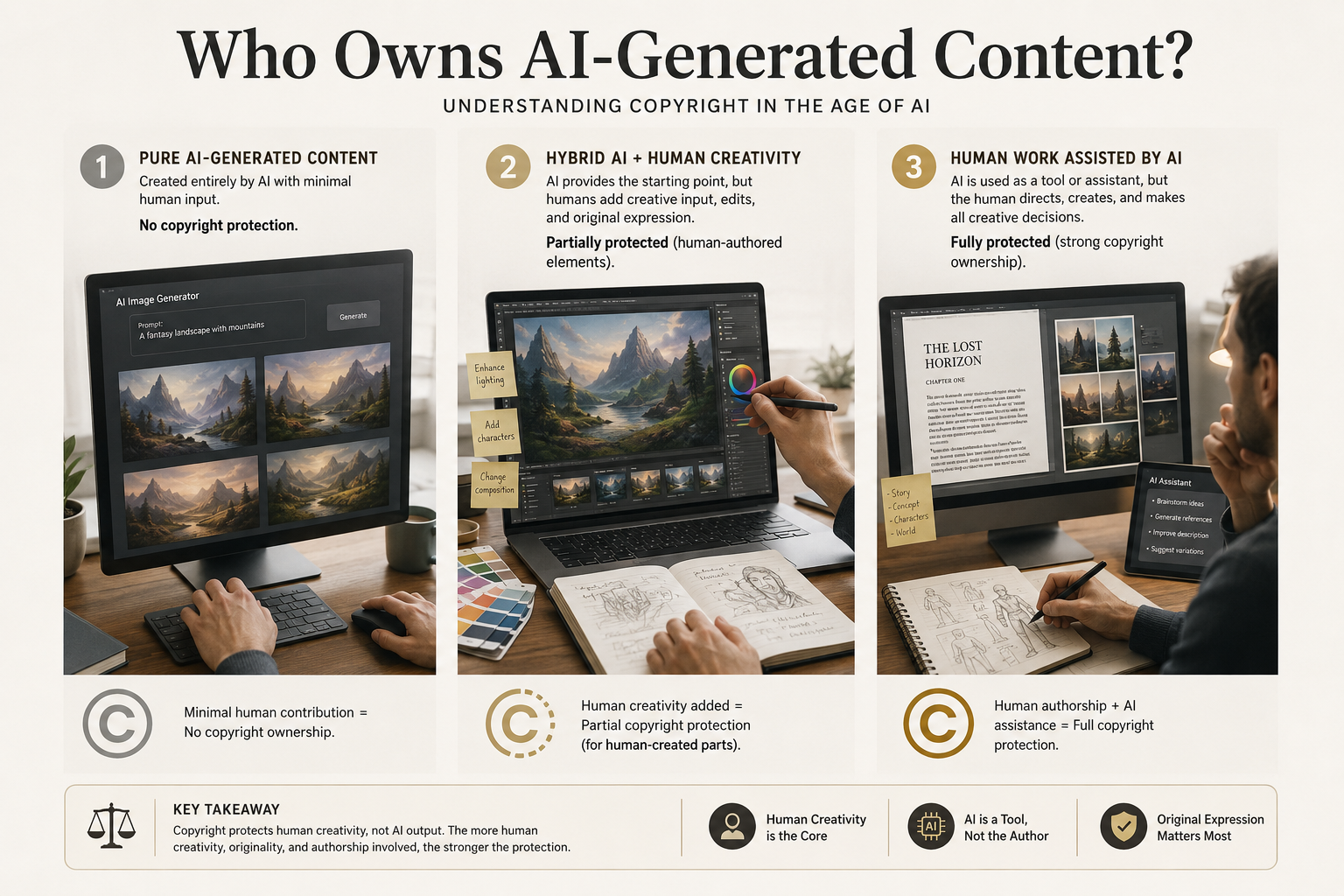

Copyright law has traditionally protected original works created by humans. Across many legal systems, human creativity remains the foundation of copyright protection. When someone enters a prompt into an AI generator, the software produces content through complex statistical processes rather than independent human expression. Because of this distinction, copyright offices and courts generally agree that purely AI-generated content does not qualify for copyright protection. The legal focus remains on the level of human creativity involved in producing the final work.
A simple prompt usually does not make someone the legal author of the resulting image or text. In many cases, the output receives no copyright protection at all. That means anyone may copy, modify, or distribute the content without violating copyright law. However, the legal position changes when a person makes meaningful creative decisions before or after using AI. Significant editing, restructuring, or artistic modification may create copyright protection for those human-created elements, even if AI assisted during the process.
| Content Type | Human Effort Required | Copyright Status |
|---|---|---|
| Raw AI Output | Simple text prompts | Public domain (no protection) |
| Hybrid Work | Substantial manual editing | Protected for human-created elements |
| Human Work Using AI | AI used as an assistant | Fully protected |
The Human Authorship Requirement Explained
The concept of human authorship sits at the center of modern copyright law. To receive legal protection, a work must contain original creative expression produced by a human. Courts generally view AI systems as tools rather than authors. This approach is similar to how cameras, design software, and word processors are treated. A photographer owns the copyright because they make creative decisions about lighting, composition, timing, and perspective. By contrast, an AI model determines many of the expressive elements after receiving a prompt, limiting the user’s claim to authorship.
Understanding this distinction is essential for creators and businesses using AI in daily work. Important principles include:
- Prompts are not authorship. Writing detailed prompts usually does not establish copyright ownership.
- Selection and arrangement matter. Choosing, organizing, or combining AI-generated material may qualify for protection if those decisions are genuinely creative.
- Substantial editing is important. Extensive rewriting, illustration, coding, or redesign can create copyrightable human expression.
- Minor changes are insufficient. Correcting spelling mistakes, applying filters, or making small edits rarely meets the legal threshold for authorship.
Using AI as a creative assistant is generally safer than relying on machine-generated output alone. Human judgment, editing, and creative decision-making remain the strongest foundation for copyright protection.
The Copyright Training Data Controversy
One of the biggest debates surrounding AI and copyright is how AI models are trained. Large language models (LLMs) and image generators learn by analyzing billions of books, articles, images, websites, and code repositories. Much of this material is protected by copyright. Developers argue that training AI requires examining patterns in existing works rather than copying them for direct resale. Critics, however, believe that using copyrighted material without permission or compensation violates the rights of creators.
This disagreement has led to lawsuits involving authors, artists, publishers, musicians, and software developers. They argue that their work has been used to build commercial AI systems without consent. AI companies maintain that training is a transformative process and falls under existing copyright exceptions. Courts in several countries are now considering these claims, and their decisions will shape the future of AI development. Until clearer legal standards emerge, organizations should recognize that AI training remains one of the most uncertain areas of modern intellectual property law.
Fair Use vs. Unauthorized Scraping
A central legal question is whether using copyrighted material to train AI qualifies as fair use. Technology companies argue that AI systems do not reproduce creative works in their original form. Instead, they analyze statistical relationships across vast datasets to generate new content. According to this view, AI training transforms existing material into a new technology rather than creating substitute copies of the original works.
Creators and rights holders strongly disagree. They argue that large-scale scraping uses copyrighted material without permission to build competing commercial products. Courts generally evaluate fair use by considering several important factors:
- Purpose of use: Is the AI system transformative, or does it compete with the original creator?
- Nature of the work: Was the material primarily factual or highly creative?
- Amount used: How much of the original work was included in training?
- Market effect: Does AI reduce the economic value of the original work?
Key takeaway: Until courts establish consistent legal precedents, businesses should assume that AI models trained on unverified datasets may carry legal and commercial risks.
Risks and Responsibilities for Businesses and Creators
Businesses that rely on generative AI should understand both the opportunities and the legal risks. While AI can improve productivity and reduce costs, it may also create challenges related to copyright ownership and infringement. Organizations that fail to establish clear policies could lose valuable intellectual property or become involved in expensive legal disputes. Understanding these risks is an important part of any responsible AI strategy.
Two major concerns deserve special attention:
Loss of Exclusivity
If a company publishes unedited AI-generated logos, marketing content, graphics, or software code, those assets may not qualify for copyright protection. Without legal ownership, competitors could copy or reuse similar content without infringing your intellectual property rights. This lack of exclusivity can reduce the long-term value of important business assets.
Unintentional Copyright Infringement
AI systems occasionally generate material that closely resembles existing copyrighted works. If an output is substantially similar to protected content, businesses could face infringement claims even when they acted in good faith. Although these cases remain relatively uncommon, they demonstrate why human review is essential before publishing AI-assisted content.
Best Practices to Mitigate Legal Risk
Organizations can reduce legal exposure by combining AI efficiency with meaningful human oversight. Treat AI as a productivity tool rather than a replacement for human creativity. Careful documentation and responsible workflows strengthen copyright protection while reducing the risk of future disputes. These practices also help demonstrate that humans made the key creative decisions throughout the project.
Consider implementing the following safeguards:
- Document the creative process. Save drafts, revision histories, prompts, and editing records to demonstrate meaningful human involvement.
- Use licensed AI platforms. Choose enterprise tools that provide commercial rights, transparent policies, and copyright indemnification where available.
- Maintain human oversight. Ensure employees make the final creative decisions through substantial editing, design, coding, or writing.
- Review AI outputs carefully. Check for similarities to existing copyrighted works before publishing or distributing content.
- Develop internal AI policies. Create clear guidelines covering approved tools, copyright compliance, data security, and responsible AI use.
Following these practices allows businesses to benefit from AI while protecting valuable intellectual property. A hybrid workflow, where humans remain responsible for final creative expression, offers the strongest balance between innovation and legal protection.
Frequently Asked Questions About AI and Copyright
Who owns the intellectual property rights to an image generated by AI?
In most cases, a fully AI-generated image does not belong exclusively to the person who created the prompt. Copyright laws generally require human creativity for legal protection. When a user enters a simple text prompt, the AI system determines the visual details, composition, and artistic elements. Because the machine creates the expressive content, the output may not qualify for copyright protection.
This means anyone may potentially copy, modify, or share a purely AI-generated image without requesting permission. However, the situation changes when a human makes substantial creative contributions. For example, significant editing, digital painting, creative arrangement, or combining AI elements with original human work may create copyright protection for those human-created portions.
Creators should focus on adding meaningful human input rather than relying only on automated generation. Maintaining records of edits, design decisions, and creative changes can also help demonstrate human authorship.
Can I copyright a book if I used AI software to help write it?
Yes, a book created with AI assistance may still receive copyright protection. The key factor is the amount of human authorship involved in the final work. Using AI for brainstorming, research assistance, outlining, grammar improvement, or editing does not automatically remove copyright protection. Human writers remain the authors when they control the creative expression and make the final decisions.
However, if AI generates large portions of the book with minimal human modification, those sections may not qualify for copyright protection. Copyright offices typically protect only the original contributions made by humans, such as unique writing, organization, structure, and substantial revisions.
Authors should carefully document their creative process. Keeping drafts, revision histories, and notes can help prove how human creativity shaped the final publication.
Is it legal for companies to train AI systems on copyrighted internet data?
The legality of training AI systems on copyrighted online content remains one of the most debated issues in modern copyright law. AI developers argue that collecting and analyzing publicly available information is necessary for building useful models. They claim that AI training focuses on identifying patterns rather than reproducing protected works.
Content creators and copyright holders have raised concerns about this practice. Authors, artists, publishers, and developers argue that their work has been used without permission, payment, or proper attribution. They believe that large-scale data collection may create unfair competition with original creators.
Courts are currently examining whether AI training qualifies as fair use or whether it represents unauthorized use of copyrighted material. Future legal decisions will likely determine how companies collect training data and how creators protect their work.
How can businesses protect their assets when using AI productivity tools?
Businesses can reduce copyright risks by creating clear policies for AI usage and maintaining strong human oversight. AI tools should support employees rather than replace human creativity completely. When people make the final creative decisions, companies have a stronger foundation for claiming ownership of their work.
Organizations should consider these practices:
- Use AI as an assistant: Apply AI for research, drafting, brainstorming, and productivity support.
- Maintain human review: Require employees to edit, improve, and approve AI-assisted content before publishing.
- Keep documentation: Store prompts, drafts, revisions, and approval records to show human involvement.
- Choose secure platforms: Use enterprise AI solutions with appropriate privacy protections and commercial usage rights.
- Create internal guidelines: Establish rules for acceptable AI use, confidential information handling, and copyright compliance.
A responsible AI strategy helps businesses benefit from automation while protecting valuable intellectual property.
What is copyright indemnification in commercial AI contracts?
Copyright indemnification is a contractual protection that helps businesses manage intellectual property risks when using commercial AI tools. Under an indemnification agreement, an AI provider may cover certain legal costs or damages if a customer faces a copyright claim related to approved use of the service.
Many enterprise AI providers offer some form of indemnification to encourage business adoption. However, these protections usually include specific requirements and limitations. Companies may need to follow usage policies, avoid prohibited activities, and use approved features to qualify for coverage.
Businesses should carefully review AI service agreements before relying on these protections. Indemnification does not remove every legal risk, and it does not replace proper copyright compliance practices.
Understanding contract terms, maintaining human oversight, and reviewing AI-generated content remain essential steps for protecting intellectual property.
Conclusion: Building a Safer Future With AI and Copyright
The relationship between AI and copyright continues to evolve as technology advances and courts address new legal questions. Although generative AI provides powerful opportunities for creativity and efficiency, copyright protection still depends heavily on human involvement. Purely machine-generated content may not receive protection, while works shaped by meaningful human creativity have a stronger legal foundation.
Businesses and creators should approach AI adoption strategically. Using AI as a collaborative tool allows organizations to improve productivity without sacrificing intellectual property protection. Human review, creative decision-making, and proper documentation remain essential parts of a responsible workflow.
To reduce legal risks, organizations should create clear AI policies, select reliable platforms, and maintain records of their creative processes. Enterprise tools with appropriate commercial protections can also provide additional safeguards.
For a better understanding of how generative AI works and how it is changing modern content creation, explore our detailed guide on what is generative AI and learn more about the technology shaping the future of digital creativity.
The future of AI and copyright will continue to develop through legislation, court decisions, and industry standards. By combining innovation with responsible practices, creators and businesses can take advantage of AI technology while protecting their valuable creative assets.