
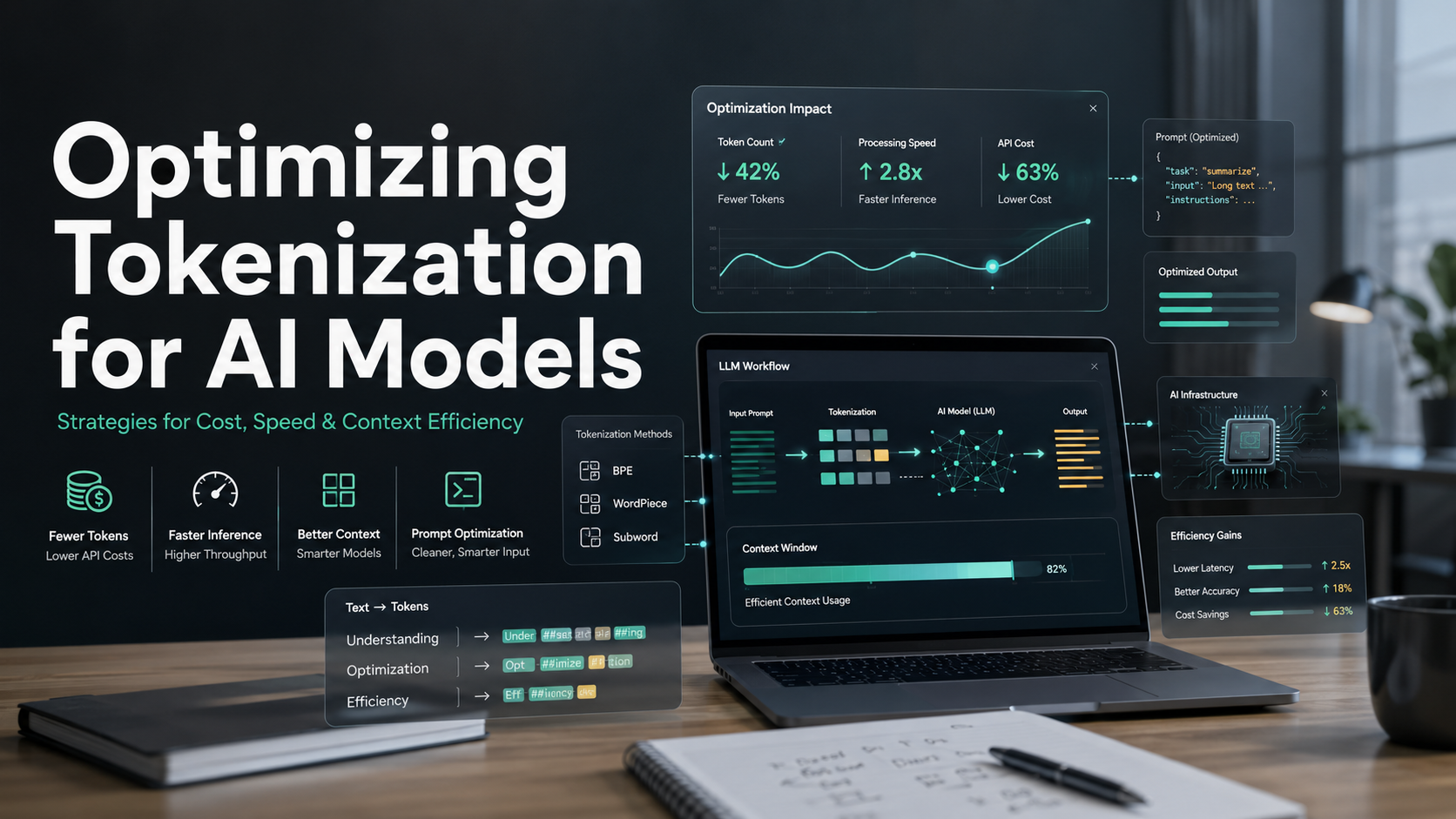
Optimizing Tokenization for AI Models: Strategies for Cost and Efficiency
When building applications powered by Large Language Models (LLMs), optimizing tokenization is one of the most effective ways to improve efficiency and reduce operational costs. Tokenization determines how AI models interpret and process text. It converts characters, words, and subwords into smaller units called tokens, which become the foundation of model computation.
Every token affects your application’s performance. More tokens require more processing power, increase API expenses, and consume valuable context window space. Poorly structured text inputs can create unnecessary token usage, increasing latency and reducing overall efficiency.
Modern AI systems depend heavily on optimized token pipelines. According to technical resources from Hugging Face Tokenizers Documentation, tokenizer design choices, vocabulary size, and subword algorithms directly influence how efficiently models process natural language.
As organizations scale AI-powered products, inefficient token usage becomes a serious bottleneck. Large prompts, unnecessary formatting, and poorly optimized text can increase infrastructure costs quickly. They can also limit how much useful information fits into a model’s context window.
This guide explains how tokenization works, why token efficiency matters, and which strategies help optimize AI workflows. By improving how your system prepares text before model inference, you can reduce costs, improve response speed, and create more scalable LLM applications.
Understanding Optimizing Tokenization and How LLM Tokenizers Work
Before optimizing tokenization, it is important to understand how language models process text. LLMs do not read sentences like humans. Instead, they convert text into numerical representations that models can analyze mathematically.
A tokenizer acts as a bridge between human language and machine-readable data. It breaks raw text into smaller units called tokens. Each token receives a unique numerical identifier that connects to the model’s vocabulary.
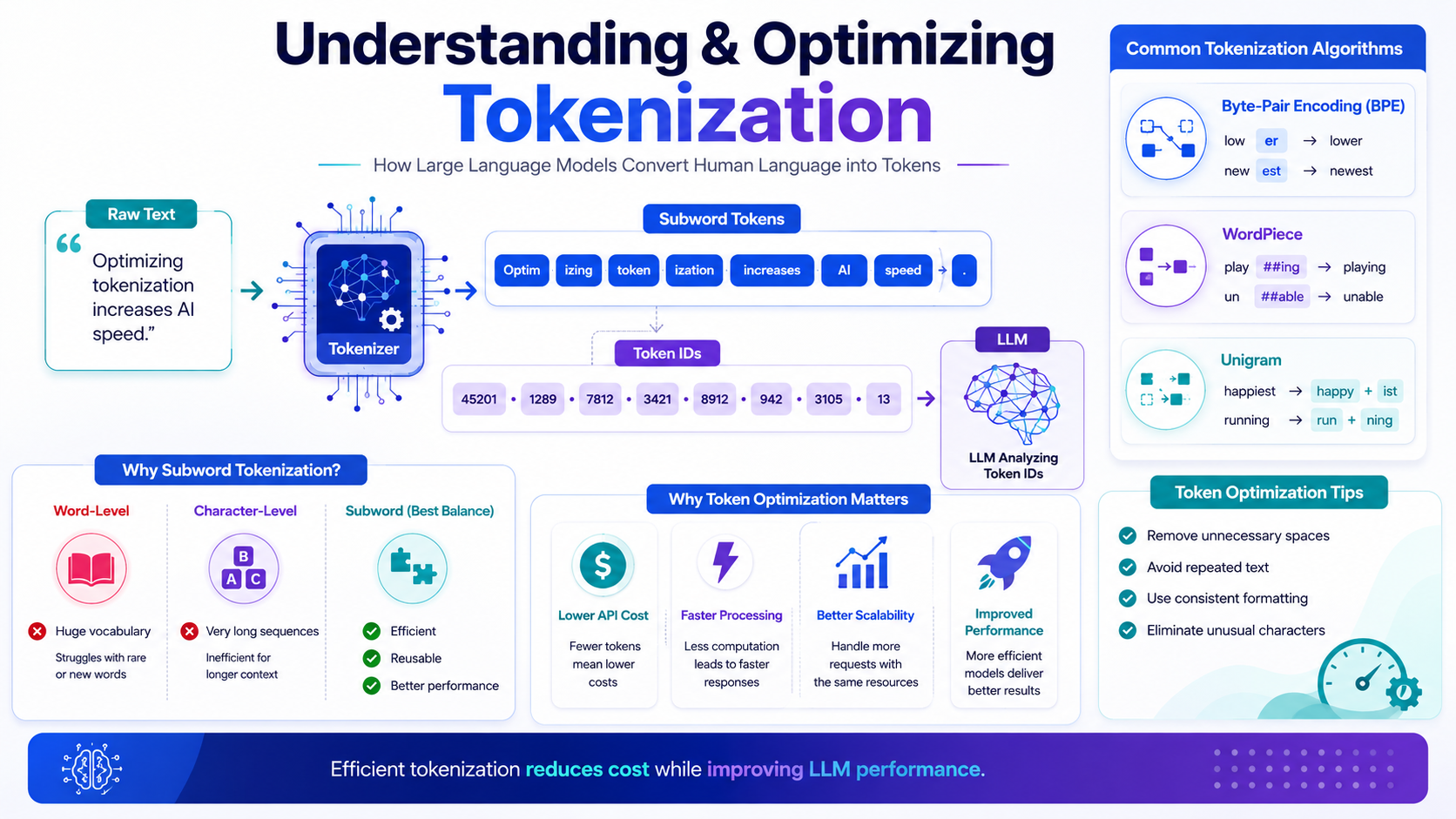
Most modern transformer-based models use subword tokenization. This approach balances the limitations of word-level and character-level methods. Word-level tokenization requires extremely large vocabularies, while character-level tokenization creates unnecessarily long sequences.
Common subword algorithms include:
- Byte-Pair Encoding (BPE)
- WordPiece
- Unigram tokenization
These methods identify common patterns and store frequently used text combinations as reusable tokens.
For example:
Raw Input:
“Optimizing tokenization increases AI speed.”
BPE Output Example:
[“Optim”, “izing”, ” token”, “ization”, ” increases”, ” AI”, ” speed”, “.”]
Token IDs Example:
[45201, 1289, 7812, 3421, 8912, 942, 3105, 13]
The exact token numbers depend on the model’s tokenizer. However, the process remains similar across most LLM systems.
When you send text to an AI API, the provider calculates usage based on the number of input and output tokens. This means inefficient formatting directly increases cost.
Extra spaces, unusual characters, repeated content, and inconsistent formatting can all increase token consumption. Understanding tokenization gives developers better control over performance, cost, and scalability.

Why Optimizing Tokenization Improves LLM Performance
Token efficiency plays a major role in how quickly and affordably AI applications operate. Every additional token increases the workload placed on the model. For businesses using LLM APIs at scale, small improvements in token usage can create significant savings.
The number of tokens affects three major areas:
- Processing speed
- Memory consumption
- API expenses
Transformer models rely on attention mechanisms to understand relationships between tokens. As sequences become longer, the computational requirements increase. Shorter and cleaner inputs allow models to process requests faster.
Token usage also affects context windows. Every LLM has a maximum number of tokens it can handle at once. Unnecessary tokens reduce the available space for important instructions, documents, and conversation history.
For example, removing repeated explanations or unnecessary formatting can free thousands of tokens in long AI workflows.
API pricing is another important factor. Many AI providers charge based on the number of tokens processed. Reducing token volume lowers both input and output costs.
A 20% reduction in unnecessary tokens can significantly decrease monthly expenses for applications handling thousands of requests.
However, token optimization is not only about reducing numbers. The goal is to improve information density. A well-optimized prompt delivers more useful information using fewer tokens.
By creating efficient text pipelines, developers can improve speed, reduce infrastructure costs, and build more reliable AI systems.
Strategic Techniques for Optimizing Tokenization
Optimizing tokenization requires more than simply shortening text. It involves improving how information is prepared, structured, and delivered to AI models.
Effective token optimization combines data cleaning, prompt improvement, and tokenizer customization. These strategies help models receive clearer inputs while reducing unnecessary processing.
Before text reaches the model, preprocessing should remove elements that add token weight without adding meaning. This includes unnecessary formatting, repeated information, and inconsistent characters.
For specialized applications, default tokenizers may not always provide the best efficiency. General-purpose vocabularies are trained on broad datasets, but they may perform poorly with technical terminology.
A medical AI system, legal platform, or software development assistant may benefit from domain-specific tokenizer improvements. Custom vocabulary design allows frequently used terms to become more efficient token units.
Token optimization also improves user experience. Faster responses, lower latency, and reduced API costs make AI applications easier to scale.
The most effective optimization strategies include:
- Cleaning and normalizing input text
- Selecting suitable tokenizer configurations
- Improving prompt structure
- Reducing unnecessary context
- Using specialized vocabularies when needed
By applying these methods, organizations can make better use of existing AI models without requiring additional computing resources.
Optimizing Tokenization Through Text Pre-Processing and Normalization
Raw text often contains unnecessary elements that increase token usage without improving the information provided to an AI model. Before sending content to an LLM, proper text preprocessing can significantly improve token efficiency and reduce processing costs.
Many applications collect text from websites, documents, databases, or user conversations. These sources often include extra HTML tags, repeated spaces, formatting marks, and inconsistent character structures. Although these elements may appear harmless, they can increase the number of tokens required for processing.
A strong tokenization optimization strategy starts with cleaning and standardizing your input data. Removing unnecessary text components allows the tokenizer to create shorter and more efficient sequences.
Important preprocessing steps include:
- Removing unnecessary HTML or Markdown elements when formatting is not required.
- Normalizing Unicode characters using standards such as NFC or NFKC.
- Eliminating repeated spaces, excessive line breaks, and unnecessary punctuation.
- Removing duplicated content before sending requests to AI models.
For example, scraped web content often contains navigation menus, tracking codes, and hidden formatting elements. These components provide little value but consume additional tokens.
It is also important to clean text before token conversion. Once text has already been transformed into tokens, removing unnecessary content will not reduce the original processing cost.
A well-designed preprocessing pipeline improves model efficiency, lowers API expenses, and ensures that every token contributes meaningful information.
Optimizing Tokenization with Domain-Specific Vocabulary Sizes
Standard LLM tokenizers are designed for general-purpose use. They are trained on large collections of internet text, books, and other broad datasets. While this approach works well for common language tasks, it may create inefficiencies in specialized industries.
Fields such as healthcare, law, finance, and software engineering often contain complex terminology. A general tokenizer may split these terms into multiple smaller pieces, increasing token usage.
For example:
| Technical Term | Standard Tokenizer Output | Optimized Vocabulary Output |
|---|---|---|
| immunohistochemistry | [“im”, “muno”, “histo”, “chem”, “istry”] (5 tokens) | [“immunohistochemistry”] (1 token) |
| kubernetes.io/created-by | [“kuber”, “netes”, “.”, “io”, “/”, “created”, “-“, “by”] (8 tokens) | [“kubernetes”, “.”, “io”, “/”, “created_by”] (5 tokens) |
A domain-specific tokenizer can improve efficiency by recognizing frequently used terms as complete units. This reduces sequence length and allows models to process specialized content more effectively.
Organizations can improve tokenizer performance by retraining or adapting vocabulary sets using industry-specific datasets. This approach helps technical terms, product names, and frequently used phrases become more token-efficient.
Custom vocabularies can provide several benefits:
- Lower input token counts
- Faster model responses
- Improved context window usage
- Reduced API processing costs
However, custom tokenizers require careful development. Poor vocabulary choices can reduce flexibility and make models less effective outside their target domain.
The best approach is to balance general language understanding with domain-specific efficiency.
Optimizing Tokenization for Multilingual AI Systems
Multilingual AI applications face additional tokenization challenges. Different languages use different writing systems, sentence structures, and character patterns. As a result, some languages require significantly more tokens than others to represent the same amount of information.
Many widely used tokenizers were originally optimized using large amounts of English text. Because English words often appear frequently in training data, they receive efficient token representations.
However, languages using non-Latin scripts may experience token bloat. Arabic, Hindi, Chinese, Japanese, and other languages can sometimes be divided into multiple smaller tokens for individual characters or symbols.
This creates several problems:
- Longer input sequences
- Higher API costs
- Slower model responses
- Reduced context window availability
To improve multilingual token efficiency, developers can use models with balanced multilingual vocabularies. Examples include models designed with broader language coverage, such as Google’s Gemma family and Meta’s LLaMA models.
Other useful approaches include:
- Normalizing scripts before tokenization.
- Using multilingual preprocessing libraries.
- Translating fixed system instructions when language preservation is unnecessary.
- Choosing models trained on diverse language datasets.
The goal is not simply to reduce tokens. It is to ensure that different languages receive fair and efficient representation.
A properly optimized multilingual tokenizer improves accessibility, lowers costs, and creates more consistent AI performance across global users.
Optimizing Tokenization for Code-Based AI Applications
Code-based AI applications face unique tokenization problems. Programming languages contain repeated symbols, indentation patterns, brackets, and formatting structures that can consume large numbers of tokens.
Standard language tokenizers are not always optimized for source code. For example, spaces used for indentation may be converted into separate tokens. In large code repositories, these small inefficiencies can create significant token overhead.
Consider Python indentation:
Less Efficient Example:
def calculate_total():Four leading spaces may require multiple tokens.
More Efficient Handling:
def calculate_total():A tab-based approach may reduce token usage depending on the tokenizer.
Specialized code models and tokenizers are often better suited for programming tasks. Models trained specifically on source code can recognize common programming patterns more efficiently.
Additional optimization methods include:
- Removing unnecessary comments from production prompts.
- Avoiding repeated code context.
- Sending only relevant files or functions.
- Using code-aware retrieval systems.
- Compressing large code explanations.
For software development assistants, token efficiency is especially important because programming tasks often require large context windows.
Optimizing code tokenization helps AI coding tools analyze more information while maintaining faster response times and lower operating costs.