
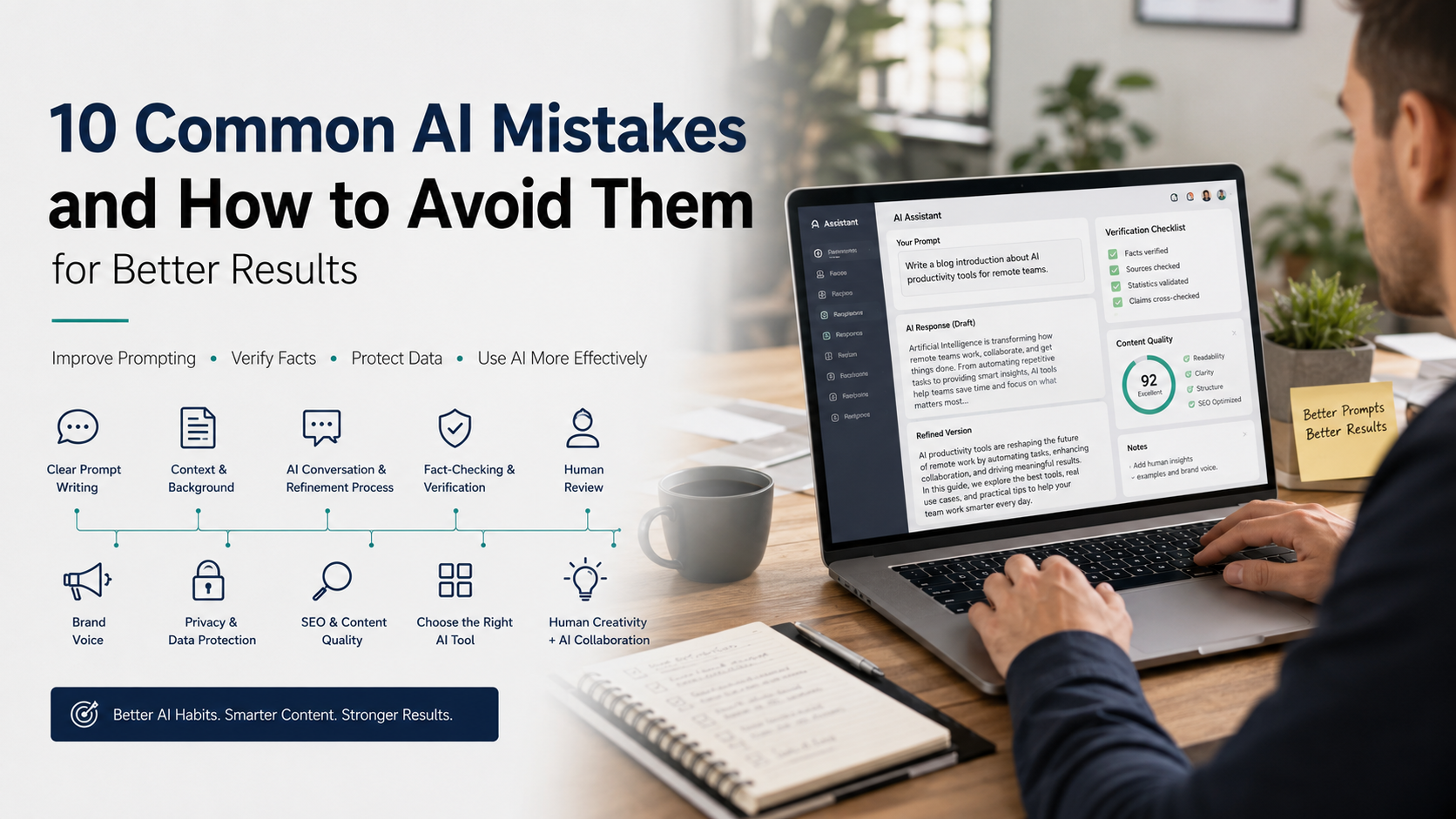
10 Common AI Mistakes and How to Avoid Them for Better Results
Artificial intelligence has transformed how we create content, analyze information, and build digital workflows. However, many users make 10 common AI mistakes that reduce accuracy, waste valuable time, and limit productivity. Understanding these mistakes can help professionals and businesses use AI tools more effectively and achieve better results.
However, many users make avoidable mistakes when working with AI tools. Poor prompts, missing context, and a lack of verification often lead to inaccurate results, wasted time, and unreliable outputs. Learning how to write better instructions can improve AI responses. Resources like OpenAI Prompt Engineering Guide explain how clear prompts help users get more useful outputs from AI systems.
Many people expect AI to deliver perfect answers from simple requests. When the results are generic or incorrect, they blame the technology. In reality, the quality of AI output depends on the quality of the input and the level of human review.
Understanding the 10 common AI mistakes can help you improve your workflow and get better results from modern AI systems. By learning how to write stronger prompts, protect sensitive information, and review AI-generated content, you can use artificial intelligence more effectively.
In this guide, we will explore the biggest mistakes people make with AI and explain practical ways to avoid them. These strategies will help you create more accurate content, improve productivity, and make AI a valuable partner in your professional work.
Understanding the 10 Common AI Mistakes and Why They Happen
Most AI mistakes happen because users misunderstand how artificial intelligence works. Many people treat AI tools like traditional search engines that always provide factual answers.
However, language models work differently. They generate responses by predicting patterns from large amounts of training data. They do not understand information in the same way humans do.
This means AI can produce responses that sound confident but contain incorrect facts. These errors are often called AI hallucinations. They can include invented statistics, fake references, or inaccurate explanations.
Understanding this limitation is essential for getting reliable results. Users should treat AI responses as helpful drafts rather than unquestionable answers.
Better results come from combining clear instructions with human judgment. A strong AI workflow includes detailed prompts, relevant context, and careful review before using the final output.
By recognizing how AI systems generate information, you can identify possible errors earlier. This approach reduces mistakes and helps you create more accurate, useful, and trustworthy results.
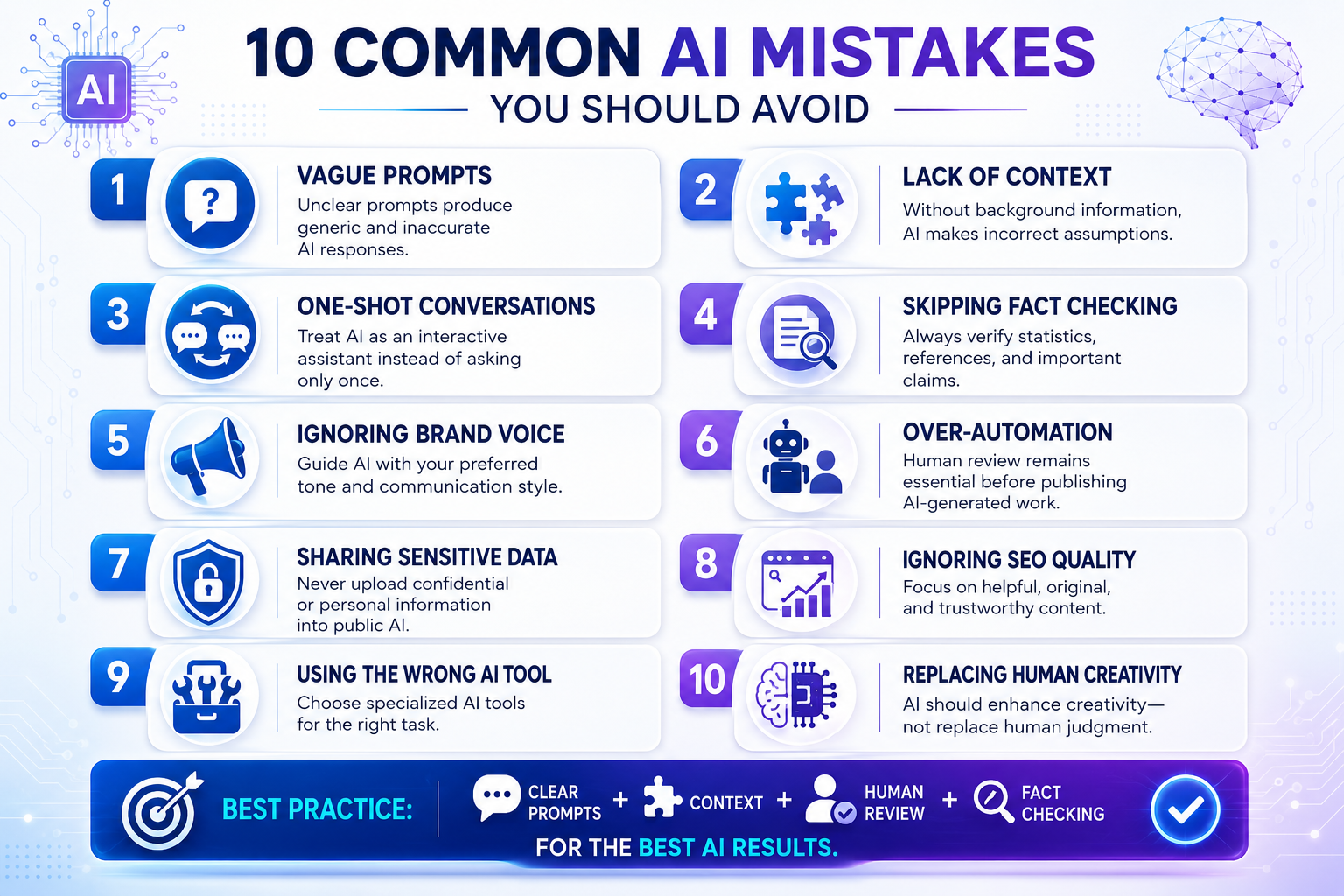

Mistake 1: One of the 10 Common AI Mistakes — Writing Vague AI Prompts
One of the most common AI mistakes is creating prompts that lack detail. When users provide unclear instructions, AI tools often produce generic answers that fail to meet expectations.
For example, asking AI to “write a blog post about fitness” provides very little direction. The tool does not know the audience, writing style, purpose, or required format.
A better prompt includes specific information about the desired outcome. Clear instructions help AI understand the task and generate more relevant content.
To improve your prompts:
- Define the role you want AI to perform.
- Specify your target audience.
- Explain the preferred tone and style.
- Include length and formatting requirements.
- Provide examples when possible.
Instead of requesting a simple article, you could write: “Act as an experienced fitness coach and create a beginner-friendly workout guide for busy professionals.”
Detailed prompts reduce confusion and improve the quality of AI-generated responses.
Mistake 2: Failing to Provide Enough Context
AI tools perform better when they receive enough background information. Without context, the system must make assumptions, which can lead to inaccurate or unsuitable responses.
Many users provide short instructions and expect professional-level results. However, AI cannot understand your goals, brand identity, or audience unless you explain them clearly.
Before requesting content or analysis, provide useful details such as:
- Business information
- Target audience
- Brand guidelines
- Previous examples
- Specific goals
For example, a marketing team should provide details about its customers, products, and communication style before asking AI to create promotional content.
Adding context allows AI to produce responses that match your needs. It also reduces editing time because the first draft is more likely to align with your expectations.
Mistake 3: Relying on Single-Turn AI Conversations
Another common mistake is treating AI like a basic search box. Many users ask one question, receive an answer, and stop there.
AI works best as an interactive assistant. A conversation allows you to refine ideas, correct mistakes, and improve the final result.
If the first response is not suitable, continue the discussion. Ask AI to rewrite sections, simplify explanations, change the tone, or add missing information.
A strong workflow often includes multiple steps:
- Create an initial draft.
- Review the output.
- Provide feedback.
- Request improvements.
- Finalize the result.
This process helps you achieve better accuracy and more personalized results. AI becomes more useful when you guide it through several improvements instead of expecting perfection from one request.
Mistake 4: One of the 10 Common AI Mistakes — Ignoring AI Fact-Checking
One of the most serious AI mistakes is trusting every response without verification. AI tools can generate impressive answers, but they may sometimes create false information that sounds completely accurate.
These errors can include incorrect statistics, fictional quotes, outdated information, or nonexistent sources. This happens because AI generates responses based on learned patterns rather than true awareness of facts.
Before publishing AI-generated content, always review important details. Verify claims using reliable sources, official documents, research papers, or trusted websites.
Fact-checking is especially important when creating:
- Business reports
- Educational content
- Medical information
- Financial articles
- SEO content
A quick review process can protect your credibility and prevent misinformation. AI should support your research process, not replace professional judgment.
The best approach is to combine AI speed with human verification. This ensures your final content remains accurate, trustworthy, and valuable for readers.
Mistake 5: Ignoring Tone and Brand Voice
AI-generated content often sounds too generic when users do not provide clear style instructions. Even when the information is correct, the writing may feel robotic or disconnected from your audience.
Every brand has a unique voice. Some businesses prefer a professional tone, while others use a friendly and conversational style.
Without proper guidance, AI may produce repetitive phrases, unnecessary formality, or common AI writing patterns. Words such as “delve,” “tapestry,” and “testament” often appear in generic AI drafts.
To improve AI-generated writing:
- Define your preferred tone.
- Share examples of your existing content.
- Explain your audience’s expectations.
- Edit the final draft for a natural human voice.
Human editing remains essential because effective communication requires personality and emotional understanding.
AI can create a strong foundation, but your experience and creativity make the content unique.
Mistake 6: Depending Too Much on AI Automation
Automation is one of the biggest advantages of artificial intelligence. However, relying completely on AI without human involvement can create serious problems.
Some users publish AI-generated articles, send automated messages, or make business decisions without reviewing the results. This approach can damage trust and create avoidable mistakes.
AI should handle repetitive tasks while humans focus on strategy, creativity, and decision-making.
A balanced workflow includes:
- Using AI for research and brainstorming.
- Reviewing generated content carefully.
- Adding personal expertise.
- Checking facts before publishing.
Human oversight improves quality and ensures that AI-generated work matches your goals.
The strongest results come from collaboration between people and technology. AI provides speed and assistance, while humans provide judgment, experience, and creativity.
Mistake 7: One of the 10 Common AI Mistakes — Sharing Sensitive Data
Protecting information is one of the most important parts of using AI responsibly. A common mistake is copying confidential business data, personal details, or private documents directly into public AI systems.
Sensitive information may include:
- Customer records
- Financial documents
- Private company strategies
- Proprietary software code
- Personal identification details
Sharing this information without proper safeguards can create privacy and security risks.
Before entering data into an AI tool, remove confidential details and replace them with general examples. This process is called data anonymization.
For example:
“Analyze this anonymized financial statement for quarterly trends: [Insert Scrubbed Numbers]”
Organizations should also consider AI solutions with strong privacy controls and enterprise security features.
Responsible AI use requires protecting both your information and the information of others.
Mistake 8: Ignoring Search Engine Quality Guidelines
Using AI for content creation can improve productivity, but publishing low-quality automated content can harm your website performance.
Search engines focus on helpful, original, and trustworthy information. Content created only to manipulate rankings may fail to achieve long-term SEO success.
Modern search algorithms prioritize experience, expertise, authoritativeness, and trustworthiness (E-E-A-T).
To create better AI-assisted content:
- Add original insights and examples.
- Review information for accuracy.
- Include expert opinions when needed.
- Improve content with real user value.
AI should support your content strategy, not replace genuine expertise.
High-quality content combines AI efficiency with human knowledge. When you focus on helping readers, your content has a stronger chance of building authority and performing well in search results.
Mistake 9: Choosing the Wrong AI Tool for the Task
Not every AI task requires the same type of tool. A common mistake is using a general chatbot for specialized tasks where another solution would perform better.
For example, a basic language model may not be the best option for advanced calculations, real-time data analysis, professional design work, or specialized research.
Choosing the right tool improves accuracy and saves time.
Consider the task before selecting an AI solution:
- Use writing tools for content creation.
- Use data-focused tools for analysis.
- Use specialized software for design or coding.
- Use search-based systems for current information.
Understanding the strengths and limits of different AI tools helps you build a more efficient workflow.
The goal is not to use AI everywhere. The goal is to use the right technology for the right purpose.
Mistake 10: Treating AI as a Replacement for Human Creativity
The final mistake is assuming artificial intelligence can completely replace human creativity and decision-making.
AI can generate ideas, organize information, and speed up repetitive tasks. However, it does not have personal experiences, emotions, or original perspectives.
The best results happen when humans and AI work together. People provide creativity, strategy, and critical thinking, while AI provides speed and assistance.
Use AI to:
- Generate ideas.
- Create outlines.
- Improve productivity.
- Explore different approaches.
However, keep your own knowledge and creativity at the center of every project.
Technology works best as a creative partner. When combined with human insight, AI can help you produce more valuable, original, and effective work.
Frequently Asked Questions About the 10 Common AI Mistakes
How do I stop AI tools from creating false information?
To reduce AI hallucinations, you should provide clear instructions and reliable reference material. Additionally, ask the AI system to use only the information you provide instead of making unsupported assumptions.
Furthermore, you can instruct the tool to say “I do not know” when the answer is unavailable. As a result, this reduces the chance of receiving inaccurate or fabricated information.
However, important information should always be verified before publishing. For example, check statistics, dates, research claims, and references using trusted sources.
Ultimately, AI is a powerful tool for improving productivity, but human review remains necessary to maintain accuracy.
What is the best way to improve AI prompts?
The most effective prompts include clear goals, detailed context, and specific instructions. Therefore, a well-structured prompt usually contains:
- A defined role.
- A clear task.
- Relevant background information.
- Required format.
- Expected tone.
Instead of asking for a general response, explain exactly what you need and provide enough context for better results.
Moreover, multi-step conversations often improve AI performance. By reviewing, adjusting, and refining AI responses, you can create more accurate and useful outputs over time.
Is AI-generated content bad for SEO?
AI-generated content is not automatically harmful to SEO. In fact, search engines primarily focus on content quality, usefulness, and user satisfaction rather than the method used to create the content.
However, publishing large amounts of low-quality automated content can negatively affect search rankings. Therefore, AI-assisted content should always focus on providing real value to readers.
Successful AI-supported content should include:
- Original ideas.
- Accurate information.
- Human editing.
- Practical value.
In other words, AI should support better content creation rather than replace thoughtful publishing strategies.
How can I make AI writing sound more human?
To make AI-generated writing feel more natural, edit the draft after generation. For example, remove repetitive phrases, simplify overly formal language, and adjust the wording to match your audience.
Additionally, you can instruct AI to use:
- Conversational wording.
- Shorter sentences.
- A specific brand voice.
- Real-world examples.
Furthermore, adding personal experiences, expert opinions, and unique insights makes content more authentic.
Although AI can provide structure and efficiency, human input creates connection, personality, and trust.
Is it safe to paste company data into AI tools?
Sharing confidential information with public AI systems can create privacy and security concerns. Therefore, sensitive business data should always be handled carefully.
Before using AI, remove private details and use anonymous examples whenever possible. Additionally, businesses should consider secure AI platforms that provide stronger privacy protections for professional use.
As a result, responsible data handling allows organizations to benefit from AI while reducing potential security risks.
What are semantic keywords, and why are they important?
Semantic keywords are words and phrases that are closely related to your main topic. They help search engines understand the broader meaning and context of your content.
For example, an article about AI mistakes may naturally include related terms such as:
- AI productivity.
- Prompt engineering.
- AI accuracy.
- Artificial intelligence tools.
- AI workflow optimization.
Furthermore, using related keywords improves topical relevance without relying on keyword stuffing.
Therefore, semantic SEO helps create content that answers user questions more completely and improves overall content quality.
Conclusion
Avoiding the 10 common AI mistakes is essential for anyone who wants better results from artificial intelligence tools.
AI can improve productivity, simplify workflows, and support creative projects. However, successful AI use depends on how effectively you apply the technology.
For this reason, clear prompts, accurate information, strong security practices, and human review all contribute to better outcomes.
The most effective AI users understand that technology works best as a partner rather than a replacement. While AI provides speed and support, humans provide creativity, judgment, and experience.
By improving your approach, you can reduce errors, create higher-quality content, and develop more efficient digital workflows.
Ultimately, use AI strategically, review important results carefully, and continue refining your process. When human expertise and artificial intelligence work together, you can achieve stronger results across many different projects.
To continue learning how artificial intelligence can improve your workflow, explore our complete guide on AI chatbots and how they can support better productivity: AI Chatbots Guide