
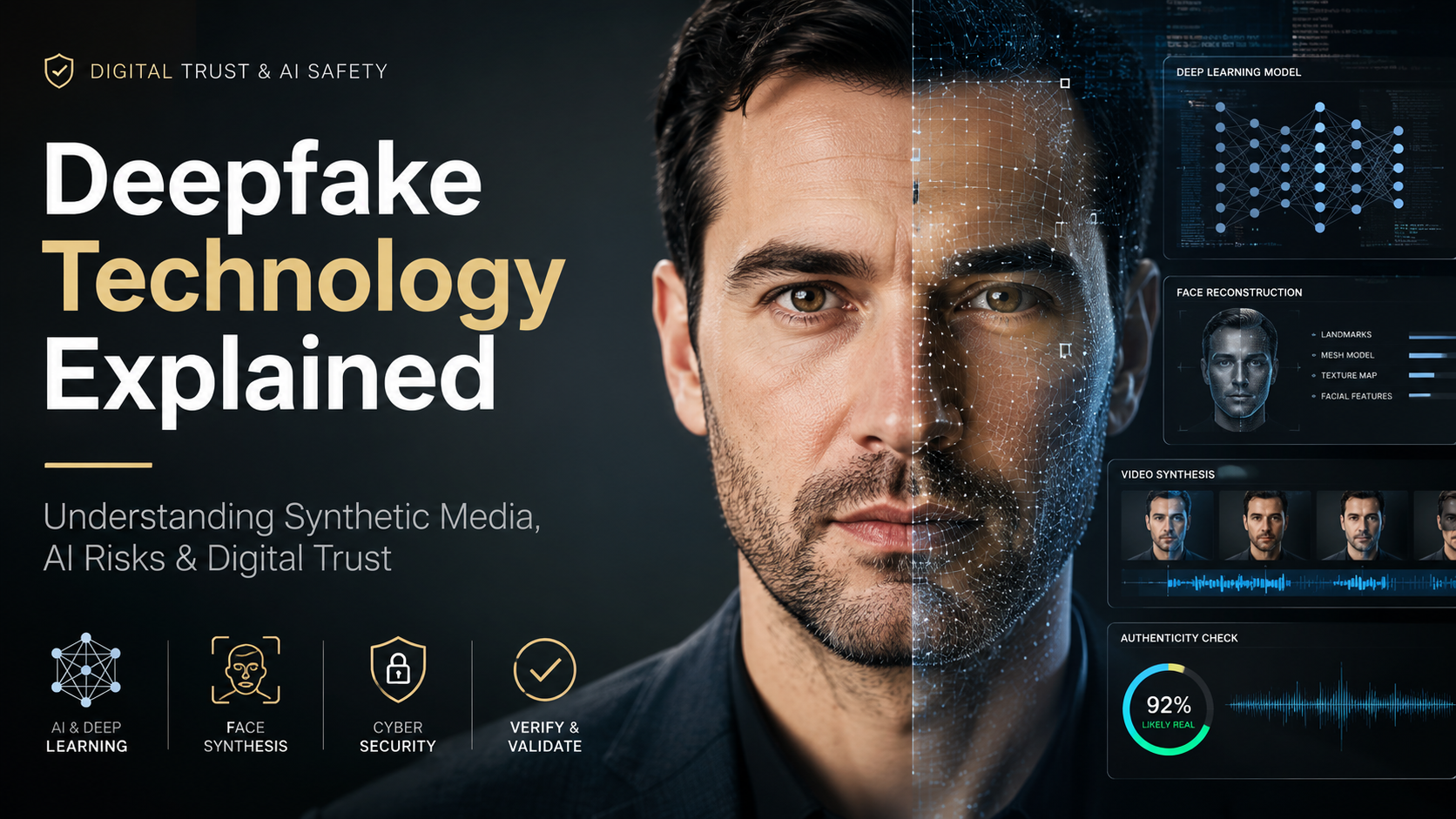
Deepfake Technology Explained: Understanding Synthetic Media
The digital landscape is rapidly changing with the rise of synthetic media, and deepfake technology is one of the most significant developments in artificial intelligence. A complete deepfake technology explained guide helps users understand how AI-generated videos, images, and audio are created and why they matter. As artificial intelligence continues to evolve, organizations such as IBM Artificial Intelligence Overview are exploring how AI can be developed and used responsibly across different industries.
Deepfakes use advanced artificial intelligence (AI) and deep learning algorithms to manipulate or generate digital content that appears realistic but may not represent a real event. This technology can change a person’s face, replicate their voice, or create completely artificial scenes.
While deepfakes have creative applications in entertainment, education, and accessibility, they also create serious concerns related to misinformation, cybersecurity, privacy, and digital trust.
As AI tools become more powerful and accessible, learning how deepfakes work and how to identify them has become an essential digital skill.
What Is a Deepfake?
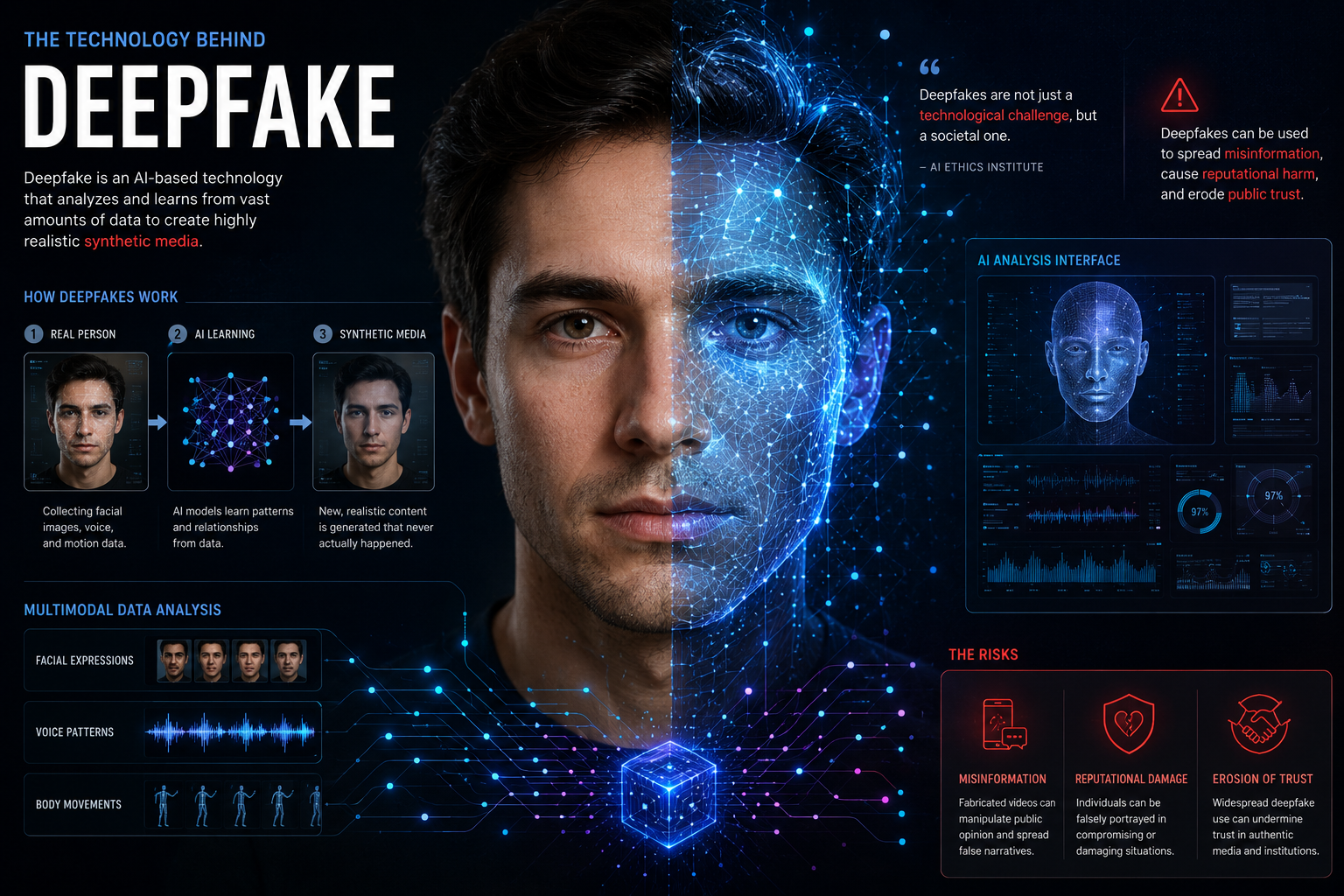

A deepfake is a form of synthetic media created using artificial intelligence to replace or modify a person’s appearance, voice, or actions in digital content.
The term “deepfake” comes from two words:
- Deep – referring to deep learning, a type of machine learning based on neural networks.
- Fake – meaning digitally altered or artificially created content.
Unlike traditional video editing methods that require manual changes, deepfake technology automatically studies large amounts of data and learns human features such as facial expressions, speech patterns, and body movements.
This allows AI systems to create realistic-looking videos and audio recordings that can be difficult to distinguish from genuine content.
How Deepfake Technology Works
Deepfake creation depends on powerful artificial intelligence models trained using large datasets of images, videos, or audio recordings.
The system learns:
- Facial structure
- Eye movement
- Expressions
- Voice characteristics
- Speaking style
- Body gestures
After training, the AI can generate or modify media by applying learned characteristics to another person or scene.
The two major technologies behind deepfakes are:
1. Autoencoders
Autoencoders are neural networks that learn how to compress and reconstruct information.
A typical deepfake system uses:
Encoder
The encoder analyzes an image and reduces it into important features such as:
- Face shape
- Expression
- Position
- Movement patterns
Decoder
The decoder reconstructs the face using the learned information.
For face swapping, the system trains on two individuals and transfers the facial features of one person onto another person’s video.
2. Generative Adversarial Networks (GANs)
Generative Adversarial Networks (GANs) are another important technology used for creating realistic synthetic media.
A GAN contains two competing networks:
Generator
The generator creates artificial images or videos and tries to make them appear real.
Discriminator
The discriminator checks whether the content is genuine or fake.
The two systems continuously compete:
- The discriminator improves at detecting fake content.
- The generator improves at creating realistic content.
Over time, this process produces highly convincing synthetic media.
Why Has Deepfake Technology Become Popular?
Deepfake tools were originally limited to research laboratories because they required:
- Expensive hardware
- Advanced programming skills
- Large computing resources
However, recent advances in AI, cloud computing, and open-source software have made these tools widely available.
Today, many users can create AI-generated content using consumer-level computers and online platforms.
This accessibility has created both exciting opportunities and new digital risks.
Applications of Deepfake Technology
Deepfake technology is considered a dual-use technology, meaning it can be used for both positive and harmful purposes.
Positive Uses of Deepfakes
1. Film and Entertainment
The entertainment industry uses synthetic media for:
- Digital character creation
- Actor de-aging
- Voice restoration
- Visual effects
- Film production improvements
This can reduce production costs and make creative storytelling easier.
2. Education and Training
Educational institutions can use AI-generated simulations to create:
- Interactive historical lessons
- Virtual instructors
- Realistic training environments
For example, students can experience historical events through digitally recreated scenarios.
3. Accessibility Technology
AI-generated voices can support people who have lost their ability to speak due to illness or injury.
Voice cloning technology may help create personalized communication tools.
Risks and Challenges of Deepfake Technology
Although deepfakes offer innovation, they also introduce serious problems.
1. Fake News and Misinformation
Deepfake videos can be used to create false statements from public figures or manipulate public opinion.
This can impact:
- Elections
- Social trust
- Public safety
- Journalism
2. Cybersecurity Threats
Criminals can use AI-generated voices or videos for:
- Identity theft
- Social engineering attacks
- Financial fraud
For example, a fake voice message may imitate a company executive and request unauthorized payments.
3. Privacy Violations
One of the most harmful uses of deepfakes is creating non-consensual manipulated content.
This can damage reputations and violate personal privacy.
How to Detect a Deepfake?
As deepfake technology continues to advance, identifying manipulated content has become more difficult. However, many AI-generated videos and audio files still contain subtle signs that can help reveal whether they are authentic or altered. By carefully examining visual and audio details, users can improve their ability to recognize synthetic media.
Visual Signs of a Deepfake
Unnatural Facial Movements
One of the most common indicators of a deepfake is unusual facial behavior. For example, pay attention to:
- Strange or unnatural facial expressions
- Irregular eye movements
- Abnormal blinking patterns
- Stiff or unrealistic facial reactions
Additionally, older deepfake models often struggle to recreate natural eye movement and emotional expressions, making these areas easier to notice.
Lighting and Shadow Inconsistencies
Another important sign is incorrect lighting. A genuine video usually has consistent lighting across the entire scene. Check whether:
- Shadows match the surrounding environment
- Skin tones remain consistent
- Face lighting matches the background
If the face appears brighter, darker, or differently colored than the rest of the image, it may indicate AI manipulation.
Face and Body Distortions
Deepfake software may create blending errors around important areas. Therefore, inspect:
- Face edges
- Jawline
- Hair boundaries
- Neck and body transitions
Blurry areas, unnatural textures, or sudden changes in appearance may suggest that the content has been edited.
Audio Warning Signs
Deepfakes are not limited to video; AI-generated voices can also be difficult to identify. When listening to audio, look for:
- Robotic or unnatural voices
- Strange pauses between words
- Unusual pronunciation
- Poor lip synchronization
- Sudden changes in background noise
Moreover, AI-generated speech may sound realistic but often lacks the natural rhythm, emotion, and variation found in human conversations.
Additional Verification Methods
Finally, combine visual and audio checks with technology-based verification methods. Reverse image searches, metadata analysis, and AI detection tools can help confirm whether a file is original or manipulated. Although no single method is perfect, using multiple checks provides a stronger way to identify deepfake content.
FAQ SECTION
What is the technology behind deepfakes?
Deepfake technology is powered mainly by advanced artificial intelligence techniques, especially deep learning algorithms such as Autoencoders and Generative Adversarial Networks (GANs). These systems first analyze thousands of images, videos, or audio samples of a target individual. During this process, the AI learns important details, including facial features, expressions, voice patterns, and natural movements. Furthermore, Autoencoders help compress and rebuild digital information, while GANs improve realism by allowing one network to create content and another to detect errors. As a result, the generated media becomes increasingly convincing over time. After the training phase is complete, the model can replace faces, imitate voices, or create entirely new footage. Additionally, modern deepfake tools can produce realistic synthetic content faster than traditional editing methods. However, these capabilities also create challenges because they can be misused for misinformation, fraud, and privacy violations.
Is DeepFake illegal in India?
Deepfake technology itself is not completely illegal in India; however, creating or sharing harmful deepfake content can lead to legal consequences. Currently, India does not have a single law specifically designed only for deepfakes. Instead, authorities rely on existing laws to address misuse of synthetic media.
The Information Technology Act, 2000 includes provisions that may apply to deepfake-related crimes, such as digital fraud, identity misuse, privacy violations, and publishing inappropriate content. For example, Sections 66D, 66E, and 67 deal with offenses involving cheating through digital methods, capturing or sharing private images without consent, and transmitting obscene material.
Additionally, the Bharatiya Nyaya Sanhita (BNS) contains provisions related to crimes such as forgery, defamation, and criminal intimidation, which may apply when deepfakes are used to harm someone.
Can ChatGPT detect deepfakes?
No, ChatGPT cannot directly detect deepfakes. ChatGPT is primarily a text-based artificial intelligence model designed to understand questions, analyze information, and generate written responses. However, it does not work like specialized digital forensic software that examines video frames, audio signals, or hidden file data to confirm whether media has been manipulated.
In addition, detecting deepfakes requires advanced technologies such as computer vision models, audio analysis systems, and AI-powered forensic tools. These solutions examine details like facial movements, lighting inconsistencies, voice patterns, metadata, and unusual pixel changes.
For example, a deepfake detection system may identify unnatural blinking, poor lip synchronization, or artificial voice patterns that are difficult for humans to notice. Therefore, while ChatGPT can help explain deepfake concepts, discuss possible warning signs, or guide users on verification methods, dedicated detection tools are needed to accurately analyze synthetic images, videos, and audio files.
What is the concept of deep fake?
The concept of deepfake involves using artificial intelligence and deep learning techniques to create or modify digital content, including videos, images, and audio recordings, so they appear authentic even though they may be artificially generated. The term “deepfake” is a combination of “deep learning” and “fake,” referring to the AI methods used to produce realistic synthetic media.
Essentially, deepfake technology allows computers to study a person’s facial features, voice patterns, expressions, and movements before recreating or replacing them in digital files. As a result, it can be used to swap faces, imitate voices, or change actions without traditional manual editing.
Unlike older editing methods that required extensive human effort, deepfake systems automate the process using neural networks. Furthermore, these tools can generate highly realistic content within a short time. However, while deepfakes have useful applications in entertainment, education, and accessibility, they can also create risks such as misinformation, fraud, and privacy violations when misused.
How can I detect a deepfake?
Detecting a deepfake requires careful observation because AI-generated content is becoming increasingly realistic. However, many synthetic videos and audio files still contain small inconsistencies that can reveal manipulation.
First, examine the visual details of the content. Look for signs such as unnatural blinking, unusual facial movements, inconsistent skin textures, or strange changes in facial expressions. Additionally, check whether the lighting and shadows on the person’s face match the surrounding environment. Blurry edges around the face, jawline, or hair may also indicate that a face has been digitally altered.
Moreover, audio can provide important clues. Listen for robotic voices, unnatural pauses, unusual pronunciation, or poor synchronization between speech and lip movements.
Finally, verification tools can help confirm whether media is authentic. Reverse image search, metadata analysis, and AI-based detection software can trace original sources and identify possible manipulation.
CONCLUSION
Deepfake technology represents a major turning point in our digital ecosystem. As generative artificial intelligence models improve, separating authentic human expression from synthetic fabrications will become increasingly difficult. Understanding the neural networks, autoencoders, and training frameworks that power these files helps users approach online media with healthy skepticism. To better understand the AI models behind synthetic content creation, readers can also explore this detailed guide on Generative Adversarial Networks (GANs) Explained.
Securing our digital spaces requires a multi-layered strategy. This includes stronger legal frameworks, automated detection software, improved cybersecurity practices, and public media literacy programs. By staying informed and using practical verification habits, we can enjoy the creative benefits of synthetic media while protecting ourselves from its risks.