
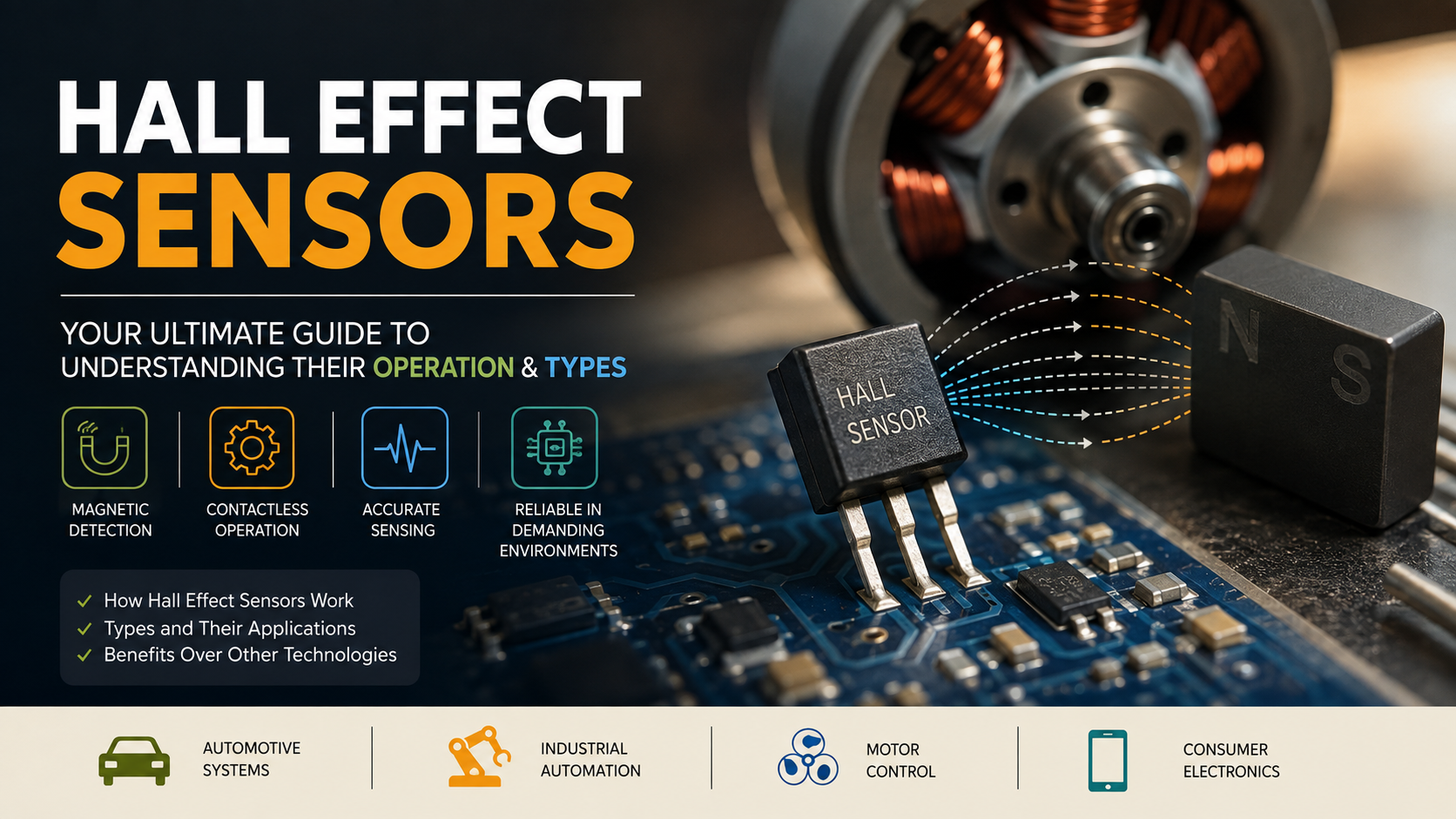
Hall Effect Sensors: Your Ultimate Guide to Understanding Their Operation and Types
Modern electronics depend on accurate position, speed, and current detection. A Hall effect sensor is a key component in many of these systems. Engineers use Hall sensors in automotive systems, industrial equipment, consumer electronics, and motor controls.
Understanding how these sensors work can help engineers and hobbyists build reliable feedback systems. It also makes magnetic sensing easier to understand and apply. This guide explains the Hall effect in simple terms and explores the main types of Hall effect sensors.
You will also learn why these sensors carry their unusual name. We will cover their operating principle, common applications, and differences from other sensor technologies. Whether you are designing a tachometer or studying circuit design, these basics provide a useful foundation.
Hall effect sensors offer contactless measurement, which reduces mechanical wear. Their solid-state design also supports reliable operation in many demanding environments. For deeper technical documentation regarding magnetic sensing technologies, you can consult the National Institute of Standards and Technology website for foundational physics references Let us explore the principles behind these versatile magnetic sensors.
What is the Hall effect sensor?
A Hall effect sensor is a solid-state device that detects magnetic fields and converts them into an electrical signal. Engineers use these sensors for contactless position, speed, proximity, and current sensing applications. Since they have no moving parts, they can provide reliable operation with minimal mechanical wear.
Inside the sensor, an electrical current flows through a semiconductor element. When a magnetic field acts perpendicular to the current, it pushes moving charge carriers sideways. This creates a small voltage across the sensing element. The resulting voltage is called the Hall voltage.
Depending on its design, a Hall sensor can provide either an analog or digital output. Linear sensors produce a variable output, while digital sensors switch between defined states. This makes Hall effect sensors useful in motors, automotive systems, industrial controls, and electronic devices.
Core Operating Mechanism
The operating principle of a Hall effect sensor depends on the Lorentz force acting on moving charge carriers. When current flows through the semiconductor, an external magnetic field deflects the charge carriers toward one side.
This movement creates an uneven charge distribution across the sensing element. As a result, a measurable voltage develops across the material. This voltage changes according to the applied magnetic field.
The sensor’s internal circuitry can then amplify and process this signal. Depending on the sensor type, the processed signal can provide continuous magnetic-field information or trigger a digital switching response.
This simple physical principle allows Hall sensors to detect magnetic changes without direct physical contact. It is the foundation behind many modern magnetic sensing applications.
What is the Hall effect in simple terms?
In simple terms, the Hall effect occurs when a magnetic field pushes moving electrical charges sideways inside a conductor or semiconductor. This sideways movement creates a small voltage across the material.
Imagine water flowing through a pipe while a strong crosswind pushes the water toward one wall. The water would become more concentrated along that side. A similar process occurs when electrons move through a semiconductor while a magnetic field acts across their path.
The magnetic field causes the moving charge carriers to shift toward one side. This creates a difference in electrical charge between opposite edges of the material. The resulting voltage can then be measured by an electronic circuit.
This principle allows a Hall effect sensor to detect the presence, strength, or movement of a magnetic field. It can therefore identify changes in position or rotation without physical contact.
That contactless operation makes Hall sensors valuable in motors, switches, automotive systems, and many other electronic applications.
That contactless operation makes Hall sensors valuable in motors, switches, automotive systems, and many other electronic applications. Similar contactless detection can also use optical technology; for example, Why Do Optical Computer Mice Always Use Red Lights? explains how light-based sensing works in modern electronic devices.
Visualizing Electron Deflection
Think of electrons as runners moving along a straight track. A magnetic field acts like a strong sideways wind that pushes the runners toward one edge.
As more electrons move toward that side, an electrical imbalance develops. This imbalance creates the Hall voltage that the sensor’s circuitry can measure.
The stronger the magnetic influence, the greater the effect can become within the sensor’s operating range. Electronic circuits can use this changing signal to determine magnetic position, movement, or field strength.
This simple example shows why Hall effect sensors can detect magnetic changes without touching the moving object. The sensing process depends on the interaction between electrical current and a magnetic field rather than mechanical contact.
Why is it called a Hall effect sensor?
The device is called a Hall effect sensor because it operates using the physical phenomenon discovered by American physicist Edwin Hall in 1879. Hall identified the effect while studying how magnetic fields influence electrical currents.
During his experiments, Hall found that a magnetic field could create a measurable voltage across a current-carrying conductor. The voltage appeared perpendicular to both the direction of current and the applied magnetic field.
Scientists later named this phenomenon the Hall effect in recognition of Hall’s discovery. Advances in semiconductor technology eventually made it possible to use this principle in compact electronic sensing devices.
Modern Hall sensors use semiconductor materials and integrated circuits rather than the experimental materials used in Hall’s original work. However, the fundamental physical principle remains the same.
Today, these sensors bring a discovery from nineteenth-century physics into modern applications. They are now widely used for magnetic position detection, speed measurement, current sensing, and motor control.
Edwin Hall’s Historical Discovery
Edwin Hall made his discovery in 1879 while conducting experiments at Johns Hopkins University. He used a thin strip of gold foil to investigate the effect of magnetic fields on electrical currents.
His experiments showed that a magnetic field could produce a voltage across the conductor. This voltage was related to the movement of electrical charge through the material.
Hall’s discovery became an important development in the study of electromagnetism. It later helped scientists better understand how magnetic fields interact with moving charge carriers.
Modern semiconductor Hall sensors are far smaller and more sophisticated than Hall’s original experimental setup. They combine a sensing element with electronic circuitry inside a compact package.
Although the technology has advanced significantly, today’s sensors still rely on the same basic physical effect Hall identified more than a century ago. His discovery therefore remains an important foundation for modern magnetic sensing technology.
What are the common Hall effect sensors?
Common Hall effect sensors are classified mainly according to their output behavior and magnetic switching characteristics. The most common types include linear sensors, unipolar switches, bipolar latches, and omnipolar switches.
Linear Hall sensors produce an analog output that changes with the strength of the applied magnetic field. They are useful for applications that require continuous magnetic measurements, such as current and position sensing.
Unipolar Hall switches respond primarily to one magnetic pole and switch when the field reaches a specified threshold. Bipolar Hall latches respond to changes between magnetic poles and are often used for rotational sensing.
Omnipolar Hall switches can respond to either magnetic pole. This makes them useful when the application does not depend on a specific magnetic polarity.
Engineers also choose between surface-mount and through-hole packages. The best option depends on sensitivity, output type, operating temperature, response time, and application requirements.
Output Configuration Options
Engineers select a Hall sensor according to the type of output their system requires. Linear sensors provide a continuously changing voltage that represents variations in magnetic field strength.
These sensors are useful when a circuit needs more information than a simple on-or-off signal. Common applications include current measurement, magnetic position sensing, and field monitoring.
Digital Hall sensors provide a switching output instead. They use internal circuitry to compare the detected magnetic field with predefined operating thresholds.
- Unipolar switches respond mainly to one magnetic pole.
- Bipolar latches respond to changes in magnetic polarity.
- Omnipolar switches can respond to either magnetic pole.
Bipolar latches are particularly useful in rotating systems. For example, they can detect alternating magnetic poles on a rotating shaft.
The correct output configuration depends on the application. Engineers should also consider sensitivity, hysteresis, response time, supply voltage, package size, and operating temperature when selecting a Hall sensor.
What are five types of sensors?
Modern engineering uses many sensor technologies, with each type designed to measure a particular physical property. Five common categories include temperature sensors, pressure sensors, optical sensors, proximity sensors, and magnetic sensors.
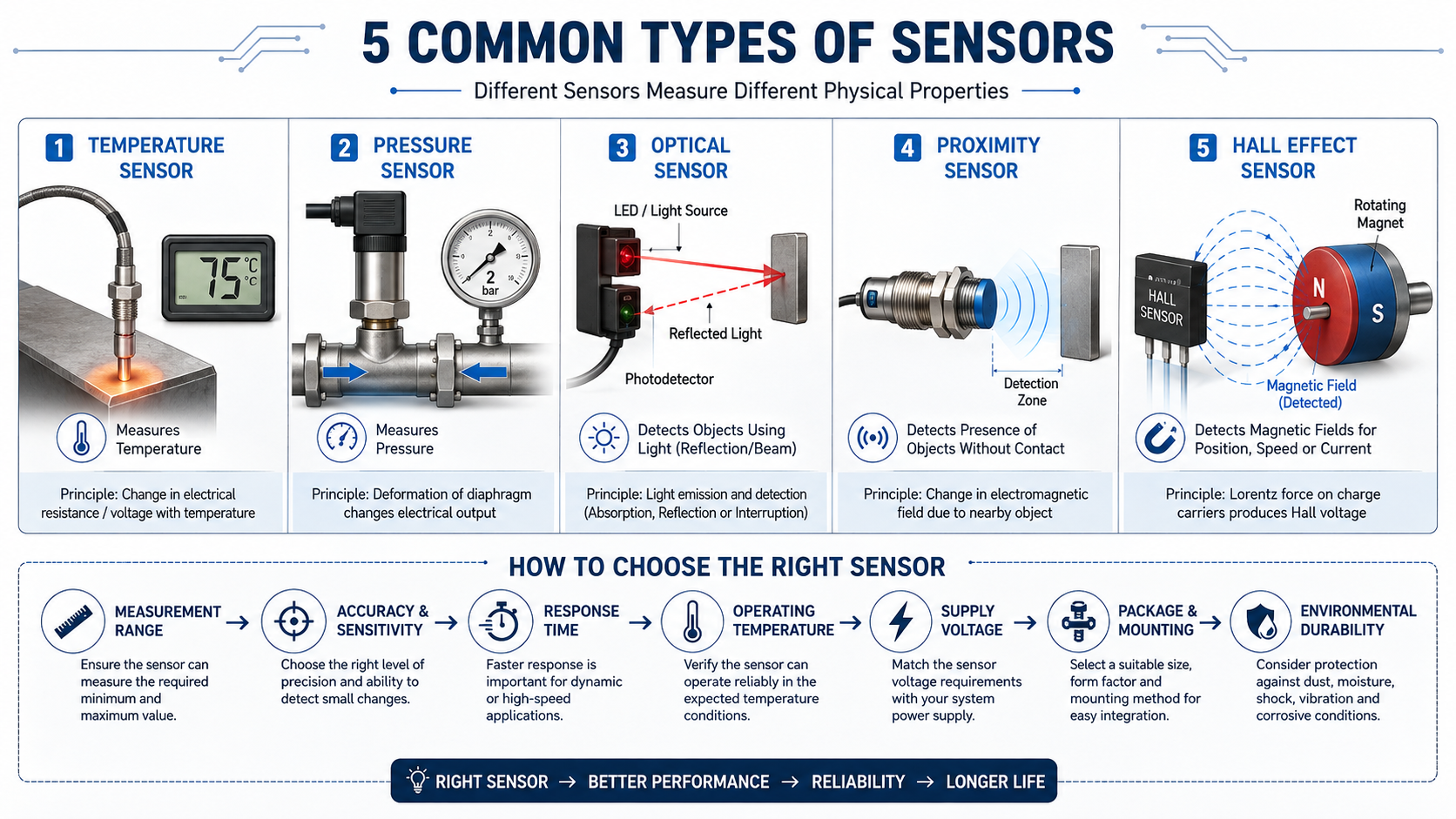

Temperature sensors measure changes in thermal conditions. Common examples include thermocouples and resistance temperature detectors. Engineers use them in industrial equipment, appliances, and environmental monitoring systems.
Pressure sensors measure the pressure of gases or liquids. They are widely used in automotive systems, industrial equipment, aerospace applications, and process-control systems.
Optical sensors use light to detect objects, movement, or changes in a target. They can support applications such as barcode reading, object detection, and rotational measurement. Modern devices increasingly combine optical and magnetic sensing technologies for different purposes, as explored in AI Camera Technology in Smartphones: The Complete Guide, which covers how camera-based sensing and image processing are used in electronic devices.
Proximity sensors detect nearby objects without physical contact. They may use inductive, capacitive, optical, or magnetic sensing principles.
Hall effect sensors are a type of magnetic sensor. They detect magnetic fields and can provide useful information about position, rotation, speed, or electrical current. These capabilities are especially relevant to robotics, where sensors help machines detect movement and position. For a broader look at this field, Humanoid Robot: Technology, Uses, and Future explores how sensing and other technologies are shaping modern robotic systems.
Selecting the Right Sensor
Selecting the right sensor depends on the physical property that needs to be measured. Engineers also consider the operating environment, required accuracy, response time, power consumption, and available budget.
For temperature measurements, a thermocouple or resistance temperature detector may be appropriate. Pressure applications require a sensor designed to withstand the expected pressure range.
Optical sensors work well when light-based detection is practical. Inductive proximity sensors are useful for detecting metal objects, while Hall sensors are ideal when magnetic detection is required. These technologies are also important in industrial automation, where sensors provide feedback for monitoring and controlling equipment. The broader role of automation in manufacturing is discussed in Future of Industrial Work: 5 Ways AI Is Transforming Factories.
Before choosing a component, engineers should review several important specifications:
- Measurement range
- Accuracy and sensitivity
- Response time
- Operating temperature
- Supply voltage
- Package and mounting requirements
- Environmental durability
Choosing a sensor based on these factors helps ensure reliable performance. The right technology should match both the measurement requirement and the conditions in which the sensor will operate.
Frequently Asked Questions
How does a Hall effect sensor differ from an inductive sensor?
A Hall effect sensor specifically requires a magnetic field to operate and can detect stationary magnets, whereas inductive sensors generate their own electromagnetic field to detect ferrous metals. Inductive sensors rely on eddy currents changing an internal coil’s inductance. This fundamental difference means Hall sensors excel at tracking permanent magnet positions, while inductive sensors detect raw metal objects without needing a pre-installed magnet.
Can a Hall effect sensor measure electrical current?
Yes, these sensors measure electrical current safely and efficiently by detecting the magnetic field generated around a current-carrying wire. Because the sensor does not touch the conductor electrically, it provides complete galvanic isolation. This contactless current sensing method prevents power loss and protects delicate measurement circuitry from high-voltage spikes, making it very popular in power supplies and electric vehicle motor controllers.
What causes a Hall effect sensor to fail?
Excessive heat, mechanical stress, voltage surges, and strong external magnetic interference can cause a Hall effect sensor to fail prematurely. Semiconductor materials are sensitive to thermal extremes outside their rated operating limits. Additionally, exposing the sensor to reverse voltage or electrical overstress can permanently damage the internal silicon circuitry, leading to erratic signal outputs or complete loss of sensor functionality.
Are Hall effect sensors digital or analog?
Hall effect sensors are available in both digital and analog configurations depending on how the internal signal conditioning circuitry processes the raw voltage. Analog or linear sensors output a continuous voltage proportional to magnetic field strength. Digital sensors include internal Schmitt trigger circuits that output clean high or low binary switching states when magnetic thresholds are successfully crossed by the target.
Conclusion
Mastering the fundamentals of the Hall effect sensor empowers you to design robust, contactless measurement systems across diverse engineering applications. Throughout this guide, we explored how these components work, the physics behind the Hall effect, the historical origins of the name, common sensor variations, and how they compare with other sensor types. By leveraging contactless magnetic detection, designers eliminate mechanical wear and tear, ensuring long-term reliability in harsh environments. We encourage you to apply these core insights to your next electronics project, whether you are building a custom motor controller or measuring rotational speed. Embracing these principles ensures optimal performance and innovative problem-solving in your future designs.