
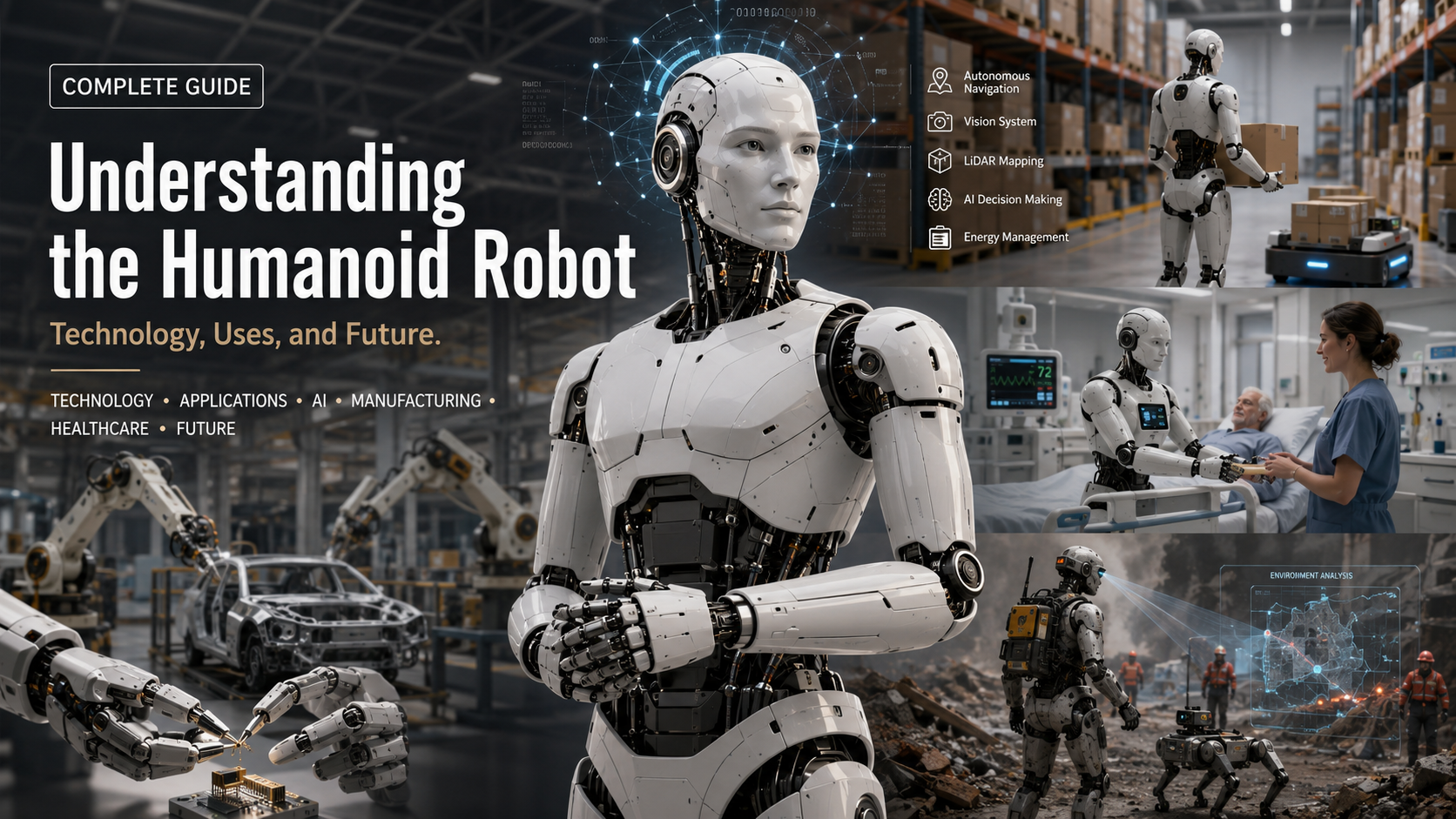
Understanding the Humanoid Robot: Technology, Uses, and Future
Artificial intelligence and advanced hardware are transforming ideas once limited to science fiction into real-world solutions. A humanoid robot is a machine designed to resemble the human body, with features such as a head, torso, arms, and legs.
Unlike traditional industrial robots that remain fixed in one location, humanoid machines can operate in environments created for humans. They can walk through buildings, climb stairs, open doors, move objects, and interact with existing workplace systems.
Companies such as Boston Dynamics continue to demonstrate how advanced robotic systems can move through complex environments with improved balance and agility. You can explore examples of advanced robotics and mobility research on the official Boston Dynamics website.
This technology matters because businesses do not need to rebuild their facilities for these machines. A human-shaped robot can use many existing tools, workspaces, and processes.
In this guide, we will explore how humanoid robots work, their main components, practical applications, benefits, challenges, and their future impact on industries worldwide.
What Is a Humanoid Robot?
A humanoid robot is an autonomous machine designed to resemble the human body and perform human-like tasks. It typically includes a head, arms, legs, and a body structure that allows movement through human environments.
These robots combine artificial intelligence, sensors, and mechanical systems to understand surroundings and complete tasks. They can walk, pick up objects, operate equipment, and communicate with people.
The main advantage of humanoid robots is their ability to work in spaces already designed for humans. They can navigate stairs, open doors, and use everyday tools without requiring major changes to existing environments.
Traditional robots often perform specific tasks in controlled areas. For example, factory robotic arms usually remain fixed in one location. Humanoid robots offer greater mobility and adaptability.

Core Mechanics and Artificial Intelligence
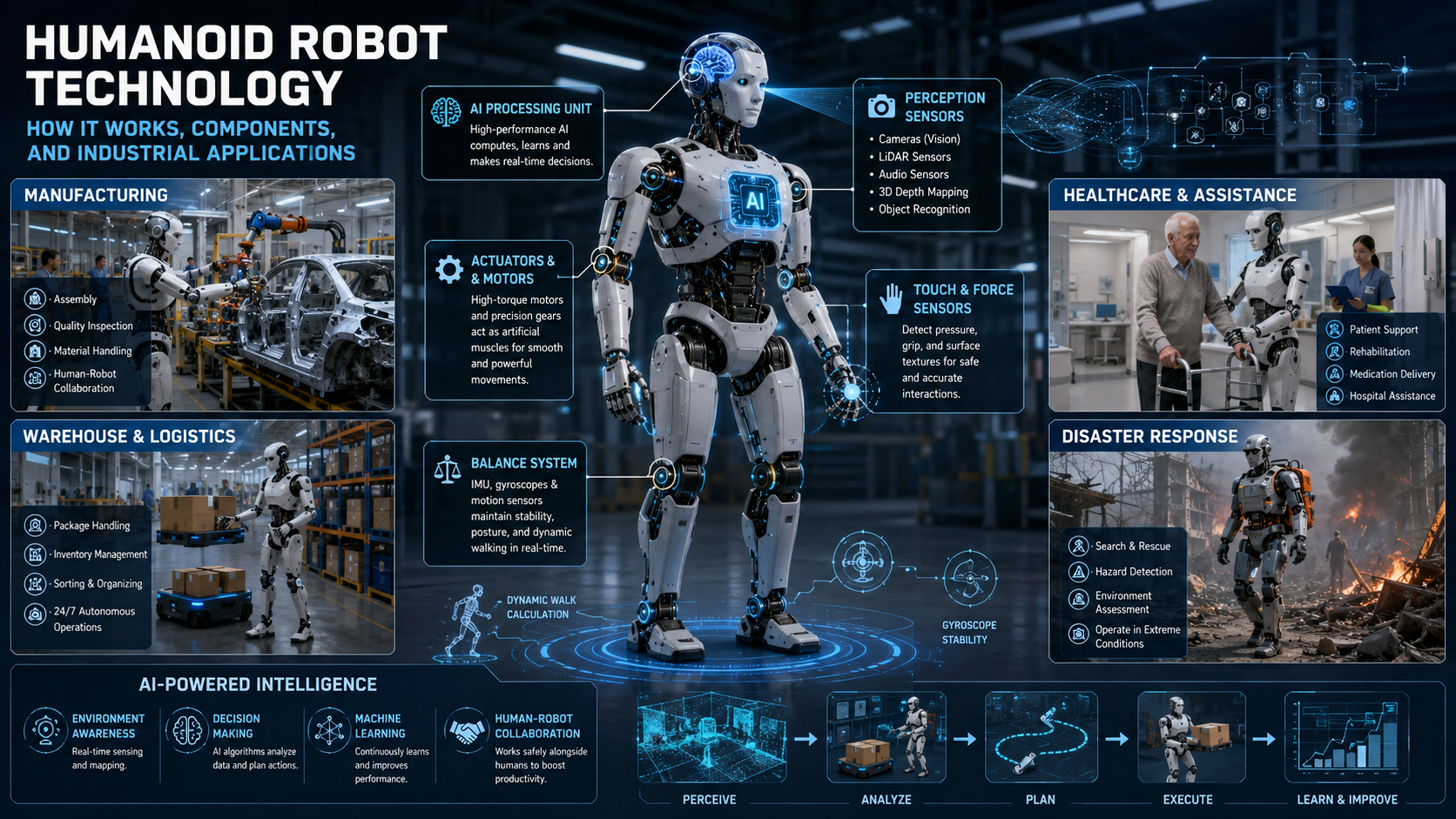
The technology behind humanoid robots combines mechanical engineering with advanced AI. Sensors collect information about the environment, while artificial intelligence helps the robot understand and respond.
Modern humanoid robots use:
- Computer vision to recognize objects and surroundings
- Neural networks to improve decision-making
- Actuators to create human-like movement
- Force sensors to interact safely with objects and people
Machine learning allows these robots to improve through experience. Over time, they can become better at completing tasks and adapting to new situations.
This combination of hardware and software makes humanoid robots more versatile than many traditional automation systems.
How Much Will a Humanoid Robot Cost?
The cost of a humanoid robot depends on its design, hardware, software, and intended purpose. Prices currently vary widely because the technology is still developing.
Basic research models used by universities and robotics developers may cost between $5,000 and $20,000. These systems are usually designed for learning, testing, and software development.
Advanced commercial humanoid robots built for factories, warehouses, and business applications can cost between $30,000 and more than $100,000. Their higher prices come from advanced sensors, powerful motors, artificial intelligence systems, and durable materials.
Many robotics companies believe future mass production could reduce prices significantly. Some industry leaders expect general-purpose humanoid robots to eventually reach the $20,000 to $30,000 price range.
Production Scale and Component Expenses
Building an affordable humanoid robot requires major improvements in manufacturing. Current systems depend on expensive components that increase production costs.
Important cost factors include:
- High-performance actuators for smooth movement
- Advanced cameras and sensors for environmental awareness
- Powerful batteries for extended operation
- Artificial intelligence systems for decision-making
Mass production could reduce these expenses. The automotive industry provides a similar example, where large-scale manufacturing lowered vehicle costs over time.
However, early customers will likely pay premium prices. Companies adopting humanoid robots today are mainly using them for research, testing, and specialized workplace tasks.
As production improves, humanoid robots may become more accessible for businesses and eventually consumers.
What Did Elon Musk Say About Humanoid Robots?
Elon Musk has described humanoid robots as one of the most important developments in future automation. He believes these machines could transform industries by handling repetitive, dangerous, and physically demanding work.
Musk has suggested that large-scale production could eventually make humanoid robots affordable. His long-term vision places the potential price around $20,000 to $30,000 for mass-produced models.
According to this vision, humanoid robots could become general-purpose workers. They may support factories, businesses, and households by completing tasks that currently require human labor.
Tesla has been developing its humanoid robot project, known as Optimus, and testing early versions in controlled environments. The goal is to create a robot capable of adapting to different workplace situations.
Long-Term Vision and Labor Integration
The broader idea behind humanoid robots is to shift repetitive physical work from humans to machines. This could improve productivity while allowing people to focus on creative and strategic activities.
Potential future applications include:
- Manufacturing assistance
- Warehouse operations
- Dangerous industrial tasks
- Household support
- Healthcare assistance
However, widespread adoption depends on several challenges. Robots must become safer, more reliable, and more affordable before they can become common in everyday life.
The future of humanoid robotics will likely involve gradual integration rather than immediate replacement of human workers.
Does India Have a Humanoid Robot?
India has made important progress in humanoid robotics through government research and private innovation. One of the country’s most recognized projects is Vyommitra, a humanoid robot developed by the Indian Space Research Organisation (ISRO).
Vyommitra was designed for uncrewed test missions connected with India’s Gaganyaan human spaceflight program. The robot acts as an artificial astronaut assistant and helps researchers study space conditions.
The name Vyommitra means “space friend.” The robot is designed to communicate, operate control systems, and monitor environmental conditions.
India’s growing robotics ecosystem also includes universities and startups working on automation, artificial intelligence, and service robots.
Space Exploration and Domestic Innovation
Vyommitra represents an important step in India’s space technology development. The humanoid robot is designed to support future human space missions by testing systems before astronauts travel.
Key capabilities include:
- Monitoring cabin conditions
- Operating selected controls
- Communicating with mission teams
- Supporting research in space environments
The project demonstrates how robotics can support exploration beyond Earth. It also highlights India’s increasing role in advanced automation and aerospace technology.
As robotics research expands, India is expected to develop more applications in manufacturing, healthcare, education, and other sectors.
Which Country Is No. 1 in Robotics?
Japan is widely considered the leading country in robotics because of its advanced technology, innovation, and decades of experience in robot development. The country has made significant contributions to industrial automation, humanoid robots, healthcare robots, and artificial intelligence-based systems. Japanese companies are among the world’s top manufacturers of industrial robots used in factories worldwide.
Japan’s success comes from strong research, skilled engineers, and early adoption of robotics in industries such as automotive, electronics, and manufacturing. However, China, South Korea, Germany, and the United States are also major players in the robotics industry. While China leads in robot adoption and manufacturing scale, the U.S. is highly influential in AI-powered robotics. Overall, Japan remains one of the most recognized leaders in global robotics innovation.
Frequently Asked Questions About Humanoid Robots
Can I Buy a Humanoid Robot for Personal Home Use Today?
Fully autonomous home humanoid robots are not yet widely available for regular consumers. Most existing models are designed for companies, research institutions, and universities.
Some developer-focused robots can be purchased for testing and education. However, they do not yet provide the complete household assistance shown in science fiction.
A practical home humanoid robot must overcome several challenges. These include affordability, safety, battery life, and reliable performance in unpredictable environments.
As technology improves, home robots may eventually help with cleaning, household tasks, elderly care, and personal assistance.
How Does a Bipedal Robot Balance While Walking?
Bipedal robots maintain balance through advanced control systems, sensors, and artificial intelligence algorithms. To achieve this, they continuously collect and process information about their position and movement.
For instance, gyroscopes and motion sensors measure changes in balance and orientation. Then, the robot’s computer analyzes this data and adjusts motor movements in the legs, knees, and ankles.
As a result, when the robot encounters uneven ground or an unexpected force, its control system quickly calculates corrections. These adjustments help the machine remain stable and avoid falling.
However, walking on two legs remains challenging because balance requires constant coordination. Therefore, engineers use machine learning and improved hardware to make robotic movement smoother, safer, and more reliable.
Where Are These Intelligent Machines Currently Being Used?
Humanoid robots are still developing; however, organizations are already testing and deploying them in several industries. Because of their ability to move through human environments, these machines are useful for workplaces where flexibility is important.
Currently, manufacturing plants are among the leading users of humanoid robotics. Companies are testing these machines for tasks such as moving components, supporting assembly lines, and handling repetitive work.
Similarly, logistics companies are exploring robotic workers for warehouses. Humanoid machines can assist with sorting packages, transporting materials, and loading goods.
In addition, research laboratories continue improving robotic intelligence, movement, and safety systems. At the same time, some organizations are studying their use in healthcare, retail, and emergency response.
As the technology advances, adoption is expected to expand. Eventually, future applications may include customer assistance, home support, and complex industrial operations.
Will Autonomous Human-Like Bots Replace Human Workers?
Humanoid robots are designed primarily to support human workers rather than completely replace them. Instead, their main purpose is to handle tasks that are repetitive, dangerous, or physically demanding.
For example, in workplaces, these machines can perform activities that may cause fatigue or injury over time. A robot could lift heavy materials in a warehouse, while human employees focus on planning, quality control, and system management.
At the same time, human skills such as creativity, decision-making, communication, and problem-solving remain difficult for machines to replicate. Therefore, future workplaces are likely to involve collaboration between humans and robots.
As a result, the growth of humanoid robotics may change the nature of many jobs. Workers may spend less time performing physically demanding tasks and more time managing advanced technologies.
Ultimately, the most successful approach will likely involve humans and robots working together to improve safety, productivity, and efficiency.
What Is the Average Cost of an Advanced Bipedal Machine?
The cost of a humanoid robot depends on its hardware, software capabilities, sensors, and level of intelligence. Currently, advanced models can range from approximately $50,000 to $150,000.
Because high-performance robots require expensive components, including specialized motors, artificial intelligence systems, cameras, and advanced computing hardware, early models remain costly.
However, manufacturers expect prices to decrease as production increases and technology improves. Over time, mass manufacturing can reduce component costs and make robots more accessible to businesses.
Additionally, companies developing commercial humanoid robots aim to create affordable systems for wider industrial use. Consequently, lower costs could allow smaller businesses to adopt robotic assistants in the future.
As the industry matures, pricing will likely become one of the key factors determining how quickly humanoid robots enter mainstream workplaces.
The Future of Humanoid Robot Technology
The development of the modern humanoid robot represents a major shift in automation and artificial intelligence. These machines combine advanced mechanics, sensors, and AI systems to perform tasks that once required human abilities.
Throughout this article, we explored how humanoid robots work, their industrial applications, benefits, and technical challenges. From manufacturing support to healthcare assistance, these machines are creating new possibilities across multiple sectors.
Challenges such as battery limitations, movement control, and complex hand coordination still need improvement. However, rapid progress in artificial intelligence and robotics engineering continues to solve many existing problems.
As technology advances and production costs decrease, humanoid robots may become a common part of modern workplaces. Businesses that understand this transition early will be better prepared for future automation opportunities.
The future of robotics will likely focus on collaboration. Human expertise combined with robotic efficiency can create safer workplaces, higher productivity, and new possibilities across industries.
To learn how artificial intelligence is transforming factories, workforce management, and smart manufacturing, read our guide on the future of industrial work with AI.