
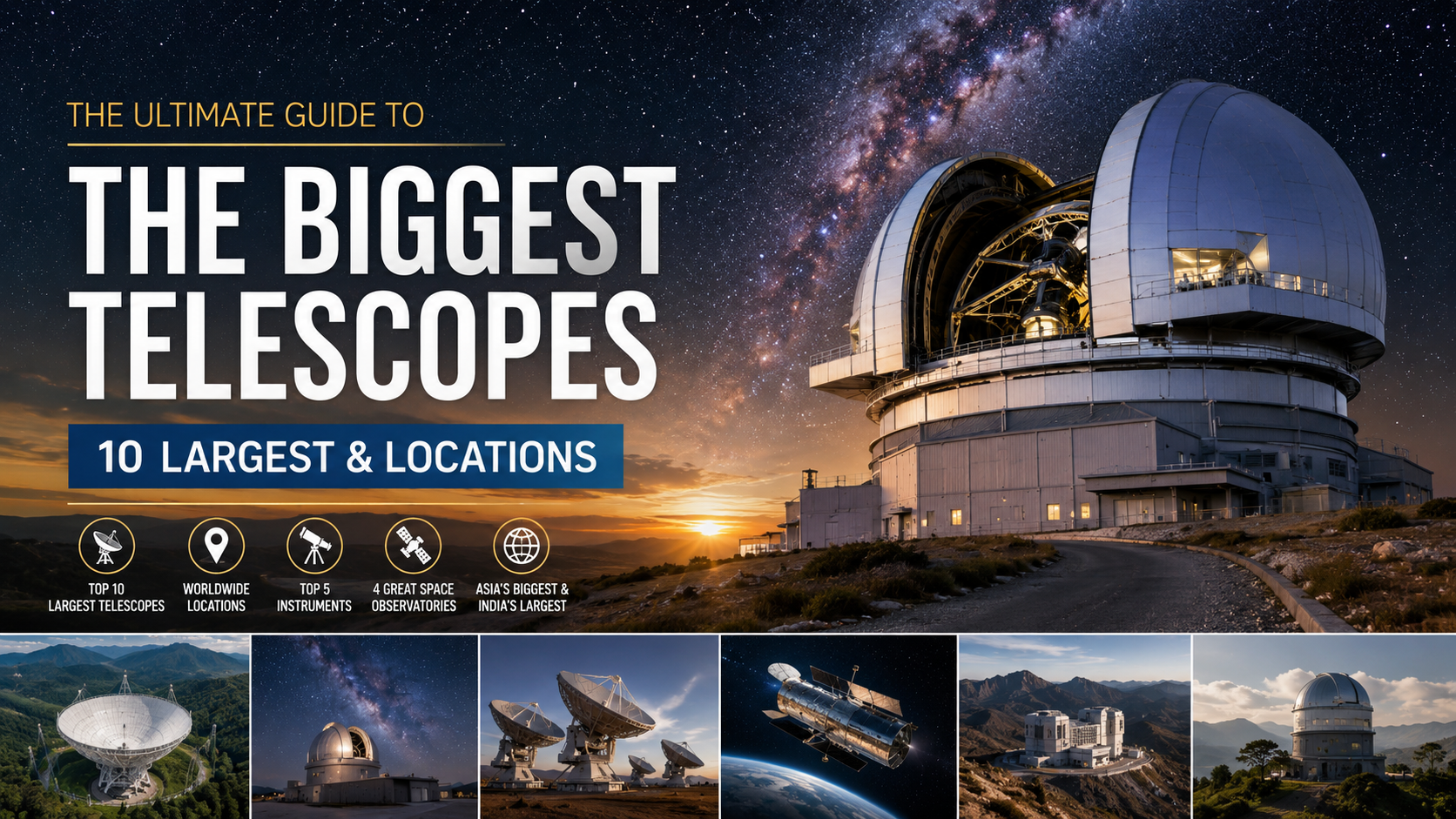
The Ultimate Guide to the Biggest Telescopes: 10 Largest and Locations
Exploring the universe requires incredible engineering, making the largest telescopes in the world essential instruments for modern astronomers. According to the NASA Science Mission Directorate, advanced ground-based and space observatories allow researchers to peer deep into cosmic history, study distant exoplanets, and understand black holes. If you have ever wondered about humanity’s greatest windows to the stars, this article provides clear answers. We will examine the top 10 largest telescopes globally, their precise geographic locations, the top five instruments, the four great space observatories, Asia’s biggest telescope, India’s largest facility, and the countries that host these massive engineering marvels. Whether you are an amateur stargazer or an astronomy enthusiast, understanding these mega-structures reveals how far technology has advanced. If you are choosing your first telescope for backyard observing, see our Best Beginner Telescopes: Handpicked for you. Let us dive into the details of these breathtaking cosmic windows.
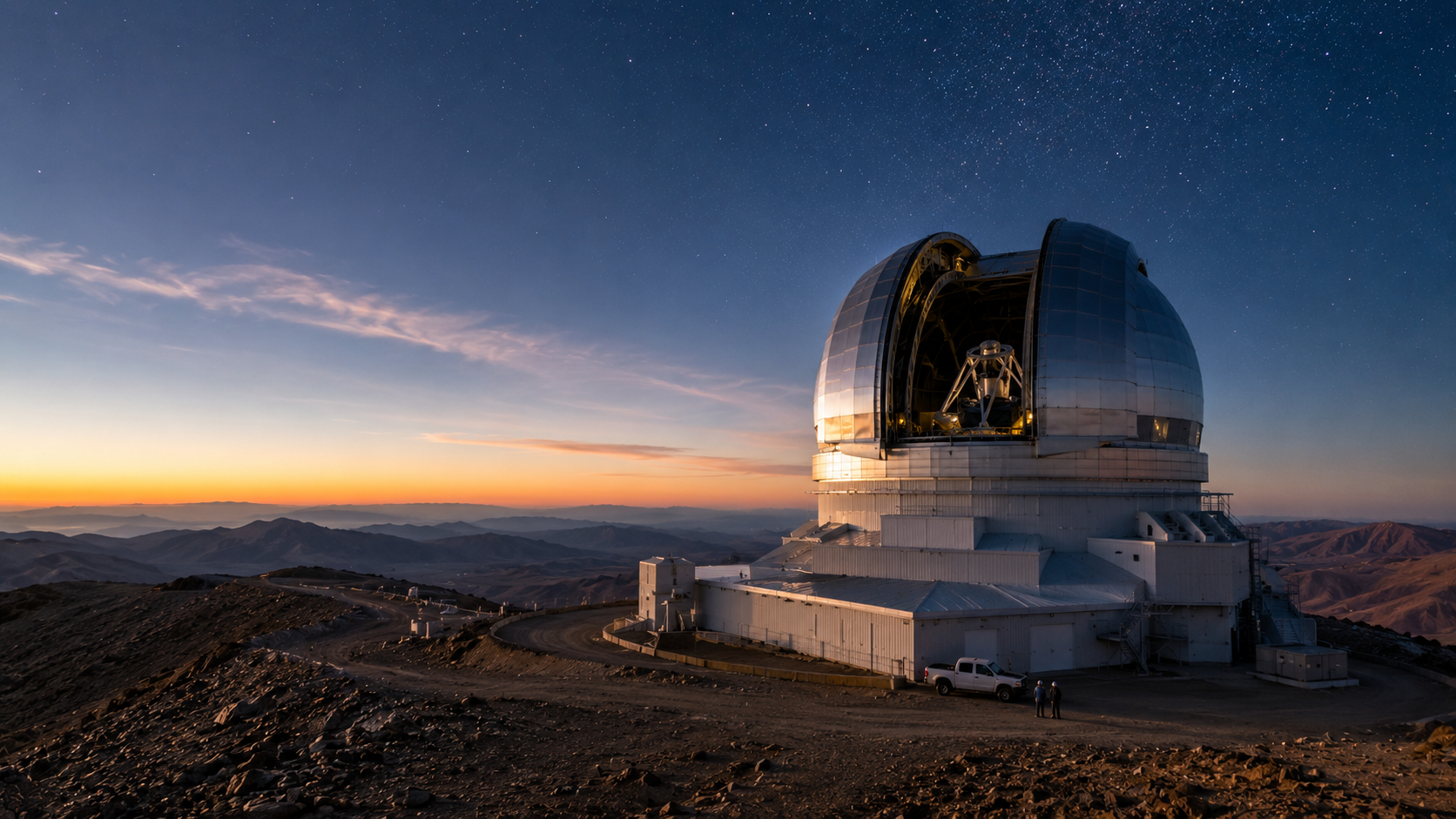

Top 10 Largest Telescopes in the World
The quest to capture faint light from distant galaxies has driven astronomers to build enormous observatories. The largest telescopes in the world use huge dishes, segmented mirrors, or large optical systems to collect more light and reveal distant cosmic objects. However, telescope size is not directly comparable across every type. Radio telescopes, optical telescopes, infrared telescopes, and space observatories use different designs and measurements.
Among the most significant facilities are China’s Five-hundred-meter Aperture Spherical Telescope (FAST), Spain’s Gran Telescopio Canarias (GTC), the twin Keck telescopes in Hawaii, and the Very Large Telescope (VLT) in Chile. FAST remains the world’s largest single-dish radio telescope, while GTC is the world’s largest single-aperture optical telescope.
Major ground-based observatories commonly use adaptive optics, active optics, segmented mirrors, and carefully engineered enclosures. Their remote locations also reduce atmospheric turbulence, moisture, and light pollution. These advantages allow astronomers to study galaxies, stars, exoplanets, black holes, and other distant objects with greater precision.
Key Engineering Features of Mega Telescopes
Constructing a giant telescope requires far more than installing a large mirror or dish. Engineers must keep the structure stable while allowing it to move with extreme precision. Even small mechanical errors can affect observations of distant astronomical objects.
Many large optical telescopes use segmented primary mirrors. These mirror segments work together as one reflective surface. Active optics systems continuously adjust their positions to compensate for gravity, temperature changes, and mechanical deformation.
Large observatories also require sophisticated thermal and environmental control. Enclosures help protect sensitive instruments from wind, dust, moisture, and rapid temperature changes. Telescope structures must remain stable throughout long observing sessions.
Radio telescopes face different engineering challenges. Their enormous dishes require strong support structures and precise surface control. They also need locations with low radio-frequency interference.
Other important technologies include:
- Adaptive optics to reduce atmospheric distortion.
- Active optics to maintain mirror alignment.
- Advanced detectors for different wavelengths.
- Computer-controlled tracking systems.
- Large enclosures designed around airflow and temperature stability.
These technologies allow modern telescopes to turn enormous physical size into useful scientific capability.
Where Are the Largest Telescopes in the World?
The largest telescopes in the world are usually located in regions with exceptional observing conditions. Optical and infrared observatories often sit on high mountains or dry plateaus. Examples include Chile’s Atacama Desert, Hawaii’s Mauna Kea, and the Canary Islands.
High-altitude locations place telescopes above part of Earth’s atmosphere. Dry conditions are especially valuable for infrared astronomy because water vapor absorbs some infrared wavelengths. Low humidity also improves overall atmospheric transparency.
Radio observatories follow different rules. They need locations with minimal human-made radio interference. FAST, for example, was built in a natural karst depression in Guizhou, China. This setting helps support the enormous dish while reducing interference from surrounding activity.
Remote locations also provide darker skies for optical astronomy. Fewer nearby cities mean less artificial light reaches the atmosphere. For a simple way to recreate a night-sky atmosphere indoors, see our Best Star Projectors: Make your Nights Amazing.
The location of a telescope therefore depends on more than elevation. Engineers and astronomers consider:
- Atmospheric stability.
- Humidity and water vapor.
- Cloud frequency.
- Light pollution.
- Radio-frequency interference.
- Wind and temperature conditions.
- Accessibility for maintenance.
Choosing the right site can be just as important as building a larger telescope.
Altitude and Atmospheric Clarity Benefits
High-altitude observatories have a major advantage because telescopes operate above a substantial portion of Earth’s atmosphere. The atmosphere can scatter, absorb, and distort incoming light before it reaches a telescope’s instruments.
Dry mountain and desert environments are particularly valuable. Low humidity reduces the amount of water vapor above an observatory. This is especially important for infrared observations because water vapor can absorb infrared radiation.
Atmospheric stability also matters. Turbulent air can make stars appear to shimmer and can blur fine details in astronomical images. Astronomers describe this effect through seeing, which measures atmospheric image distortion.
Excellent observatory sites therefore combine elevation with stable, dry conditions. Chile’s Atacama Desert, Hawaii, and the Canary Islands are well known for these characteristics.
However, altitude does not automatically guarantee perfect observations. Weather, wind, clouds, dust, and atmospheric turbulence can still affect observing time.
Modern observatories compensate further with adaptive optics and advanced image-processing techniques. These systems help recover sharper images from ground-based facilities.
The result is more efficient use of expensive observing time and better measurements of faint astronomical targets. The universe can also be surprisingly unsettling; for more fascinating cosmic facts, see Scary Universe Facts Which Will Blow Your Mind.
What Are the Top 5 Telescopes?
The answer depends on whether “top” means largest, most powerful, most scientifically influential, or best suited to a particular wavelength. A useful selection includes facilities that have transformed modern astronomy across different parts of the electromagnetic spectrum.
The James Webb Space Telescope (JWST) specializes in infrared observations from space. The Hubble Space Telescope has produced landmark observations across visible, ultraviolet, and near-infrared wavelengths. On Earth, the Keck Observatory provides powerful optical and infrared observations, while the Very Large Telescope (VLT) combines four 8.2-meter Unit Telescopes in Chile.
China’s FAST occupies a different category as a giant single-dish radio telescope. Its 500-meter structure allows astronomers to conduct sensitive radio observations of pulsars, hydrogen, and other cosmic phenomena.
These observatories are not directly ranked against one another. Each has different strengths, instruments, and scientific objectives. Together, they demonstrate how modern astronomy uses multiple facilities to investigate the universe from radio waves to infrared light.
Impact on Modern Exoplanet Research
Large telescopes have become essential tools for studying exoplanets, or planets orbiting stars beyond our Solar System. Their powerful instruments can detect small changes in starlight caused by planets passing in front of their host stars.
This technique is called the transit method. When a planet crosses its star, it blocks a tiny fraction of the star’s light. Repeated measurements can reveal the planet’s size and orbital period.
Spectroscopy and Atmospheric Analysis
Spectroscopy provides another important technique. Astronomers can analyze starlight that passes through an exoplanet’s atmosphere during a transit. Different gases leave characteristic signatures in the observed spectrum.
Researchers can therefore investigate atmospheric components such as water vapor, carbon dioxide, methane, and other molecules. However, detecting a molecule does not automatically prove that a planet supports life. Potential biosignatures require careful analysis and multiple lines of evidence. For a closer look at worlds that may have conditions suitable for life, read Exoplanets That Could Host Alien Life: Universe Facts.
Radial-Velocity and Future Discoveries
Large ground-based telescopes also help confirm planetary candidates and measure their masses through stellar radial-velocity observations.
As telescope technology improves, astronomers can study smaller planets around more distant stars. This research is helping scientists understand how planetary systems form and how common Earth-like environments might be. For more examples of unusual worlds, explore our Wildest Planets in the Milky Way: Universe Facts.
What Are the 4 Great Observatories?
The Great Observatories were four major NASA space telescopes designed to study different parts of the electromagnetic spectrum. The program included the Hubble Space Telescope, Compton Gamma Ray Observatory, Chandra X-ray Observatory, and Spitzer Space Telescope.
Hubble primarily transformed observations in visible and ultraviolet astronomy while also contributing important infrared data. Compton studied high-energy gamma rays and investigated some of the universe’s most energetic events. Chandra focused on X-rays, revealing extremely hot gas around black holes, neutron stars, and galaxy clusters. Spitzer explored infrared radiation and helped astronomers study cool dust, star formation, and distant galaxies.
The four missions were complementary rather than competing observatories. Earth’s atmosphere blocks or absorbs much of the ultraviolet, X-ray, gamma-ray, and infrared radiation reaching the planet.
Space-based telescopes can therefore observe wavelengths that ground-based instruments cannot access effectively.
The Great Observatories approach demonstrated the value of multi-wavelength astronomy. Combining observations from different parts of the spectrum gives scientists a more complete picture of complex astronomical objects and energetic cosmic events.
Synergies in Multi-Wavelength Astronomy
Multi-wavelength astronomy allows researchers to study the same cosmic object using different types of radiation. Each wavelength reveals different physical processes, so one observation rarely provides the complete picture.
For example, Chandra can detect extremely hot gas emitting X-rays around black holes and other energetic objects. Infrared observations from Spitzer revealed cooler dust and helped astronomers investigate regions hidden by visible-light observations.
Visible and ultraviolet observations add another layer of information. Hubble can reveal stars, nebulae, galaxies, and energetic processes that appear differently at other wavelengths.
Scientists compare these observations to build a broader understanding of an object’s temperature, composition, structure, and energy output. This approach is particularly valuable when studying supernova remnants, active galaxies, star-forming regions, and galaxy clusters.
Multi-wavelength observations can also reveal connections that would remain hidden in a single wavelength. A region that looks relatively dark in visible light may glow brightly in infrared or X-rays.
The Great Observatories therefore represented more than four separate missions. Together, they established a powerful framework for studying the universe through complementary observations across the electromagnetic spectrum.
Where Is Asia’s Biggest Telescope?
The phrase “Asia’s biggest telescope” depends on how telescope size is measured and which wavelength is considered. For optical astronomy, India’s 3.6-meter Devasthal Optical Telescope (DOT) is described by ARIES as the largest optical telescope in India, while its 2026 observatory material describes it as the largest optical telescope in Asia.
The telescope is located at Devasthal in Uttarakhand and operates at optical and near-infrared wavelengths. Its instruments support imaging and spectroscopy for several areas of astronomical research.
Asia also contains much larger radio facilities. China’s FAST has a 500-meter aperture and remains the world’s largest single-dish radio telescope. Its design and scientific role are very different from an optical telescope such as DOT.
This distinction matters because a radio telescope’s physical structure can be dramatically larger than an optical telescope’s mirror. Comparing them solely by diameter can therefore be misleading.
India also operates the Giant Metrewave Radio Telescope near Pune. The facility uses an array of steerable antennas for low-frequency radio astronomy.
Asia is consequently home to several major observatories, but their capabilities should be compared by wavelength, aperture, collecting area, and scientific purpose.
High-Altitude Advantages in Ladakh
High-altitude Himalayan locations can provide valuable conditions for astronomical observations. Ladakh is particularly attractive because its cold, dry environment can produce low atmospheric water vapor and relatively dark skies.
The Indian Astronomical Observatory at Hanle is operated by the Indian Institute of Astrophysics. Its location at roughly 4,500 meters above sea level places the observatory above a large portion of the atmosphere.
The dry environment is especially useful for infrared and submillimeter observations. Water vapor absorbs radiation at several wavelengths, so lower atmospheric moisture can improve observing conditions.
Ladakh also has relatively low population density compared with many urban regions. This reduces artificial light around observatories and helps optical astronomers observe faint objects.
However, the site should not be described as automatically equivalent to every major observatory in Chile or Hawaii. Astronomical site quality depends on several measurements, including atmospheric seeing, cloud cover, humidity, wind, and turbulence.
High altitude is therefore one advantage rather than a guarantee of superior performance.
Despite these limitations, Himalayan observatories provide valuable observing opportunities for Indian astronomy. They also support studies of transient objects, stars, galaxies, and other astronomical targets.
Largest Telescope in India
The 3.6-meter Devasthal Optical Telescope (DOT) is currently recognized by ARIES as the largest telescope in India for optical observations. It is located at Devasthal near Nainital, Uttarakhand, and was commissioned in 2016.
The telescope uses a modern optical design with a thin mirror and active optical technology. Its instruments support both imaging and spectroscopy across visible and near-infrared wavelengths.
India also operates important radio astronomy facilities. The Giant Metrewave Radio Telescope (GMRT) near Pune uses an array of 30 steerable antennas. Instead of relying on one enormous dish, the facility combines signals from multiple antennas to study low-frequency radio emissions.
These facilities give Indian astronomers access to different observational techniques. Researchers use them to study pulsars, galaxies, stellar objects, transient events, and other astronomical phenomena.
It is important to distinguish the largest optical telescope from the largest radio facility. Telescope size depends heavily on the wavelength being observed and the engineering design being used.
India’s observatory network therefore includes both large optical instruments and powerful radio arrays. Together, these facilities contribute to international astronomy projects and strengthen the country’s capabilities in observational astrophysics.
Contributions of the Giant Metrewave Radio Telescope
The Giant Metrewave Radio Telescope (GMRT) is one of India’s most important radio astronomy facilities. It is located near Khodad, close to Pune, Maharashtra, and consists of 30 fully steerable antennas.
The array operates across metre wavelengths. This makes it particularly useful for studying faint radio emissions from distant galaxies, pulsars, ionized gas, and other astronomical sources.
Unlike a single giant dish, GMRT works as an interferometric array. Signals from separate antennas can be combined to achieve high angular resolution. This approach allows astronomers to study radio sources with much greater detail than a single antenna could provide.
GMRT has supported research into pulsars, galaxies, the interstellar medium, and the early universe. Its low-frequency capabilities also make it valuable for investigating cosmic radio emission that can be difficult to observe with higher-frequency instruments.
The facility demonstrates that astronomical power does not always require one enormous mirror or dish. Carefully arranged arrays can provide impressive sensitivity and resolution.
GMRT has consequently become an important part of India’s radio astronomy infrastructure and has contributed to research involving international scientific collaborations.
World’s Largest Telescope: Which Country Has It?
There is no single answer to which country has the world’s largest telescope because telescope size varies by technology and wavelength. China currently hosts FAST, the world’s largest single-dish radio telescope, with a 500-meter aperture. This makes China the clear answer when discussing the largest operational single-dish radio telescope.
Optical astronomy has a different leader. Spain’s Gran Telescopio Canarias (GTC) has a 10.4-meter segmented primary mirror and is the world’s largest single-aperture optical telescope.
Chile is home to several of the world’s most powerful optical and infrared observatories. These include the Very Large Telescope and other major facilities located under the exceptionally dry skies of the Atacama region.
The United States also operates major telescopes, including the twin 10-meter Keck telescopes in Hawaii. Spain, South Africa, Australia, Japan, and other countries host additional large observatories.
Future projects will change the landscape again. ESO’s Extremely Large Telescope (ELT) in Chile is designed with a 39-meter segmented primary mirror and is expected to become the world’s largest optical and infrared telescope when operational.
The answer therefore depends on the telescope category rather than country alone.
Chile as the Global Capital of Astronomy
Chile has become one of the world’s most important locations for ground-based astronomy. Its northern regions contain extremely dry, high-altitude areas with exceptionally dark skies and favorable atmospheric conditions.
The Atacama Desert receives very little rainfall. This creates low humidity and limited cloud cover, which are valuable for optical and infrared astronomy. Several international observatories have therefore established facilities in the region.
Chile hosts ESO’s Very Large Telescope at Paranal, the Atacama Large Millimeter/submillimeter Array, and several other major astronomical facilities. The country is also the site of the future Extremely Large Telescope at Cerro Armazones.
The region’s conditions are not based on one factor alone. Astronomers consider atmospheric turbulence, water vapor, cloud coverage, wind, temperature, and light pollution when evaluating an observatory site.
Chile’s combination of geography, climate, and remote mountain locations has made it exceptionally attractive to international astronomical organizations.
As new facilities become operational, Chile is likely to remain central to optical, infrared, and submillimeter astronomy. Its observatories will help scientists investigate galaxies, exoplanets, black holes, stellar evolution, and the early universe.
FAQ SECTION
What is the difference between optical and radio telescopes?
Optical telescopes collect visible light using glass lenses or curved mirrors to form images of distant stars and galaxies. In contrast, radio telescopes use large metal parabolic dishes to capture invisible radio waves emitted by celestial bodies like pulsars, quasars, and cosmic microwave background radiation. Because radio waves have much longer wavelengths than light waves, radio telescopes must be built significantly larger to achieve comparable image sharpness and spatial resolution.
Why are telescopes built on mountains?
Telescopes are constructed on high-altitude mountains because the Earth’s atmosphere distorts and absorbs incoming starlight. Placing observatories above a major portion of the dense atmosphere reduces air turbulence, resulting in much sharper and clearer astronomical images. Furthermore, high mountain locations usually feature dry weather conditions with minimal cloud cover, ensuring maximum operational nights for researchers throughout the entire year.
How do astronomers look back in time?
Astronomers look back in time because light travels through space at a finite speed of approximately 300,000 kilometers per second. When light leaves a distant star or galaxy billions of light-years away, it takes billions of years to reach our instruments on Earth. Therefore, when powerful telescopes capture photons from deep space, scientists are literally viewing those celestial objects as they existed millions or billions of years ago in the past.
What is the James Webb Space Telescope?
The James Webb Space Telescope is a large, space-based infrared observatory launched to succeed the Hubble Space Telescope. Positioned far away from Earth at the second Lagrange point, it features a 6.5-meter golden primary mirror designed to study the formation of the first galaxies. Its advanced infrared capabilities allow scientists to peer through dense cosmic dust clouds and analyze the atmospheric composition of potentially habitable exoplanets orbiting nearby stars.
Conclusion
Exploring the universe through the largest telescopes in the world reveals the incredible scale of cosmos and human ingenuity. From the massive radio dishes nestled in China and India to the towering optical mirrors perched atop Chilean and Hawaiian mountains, these facilities expand our understanding of space daily. We examined the top ten instruments, key geographic locations, elite telescope groupings, and regional Asian milestones that drive modern research forward. By investing in these powerful technologies, humanity continues to answer profound questions about our place in the universe. We encourage readers to follow upcoming astronomical discoveries and explore public observatory data to stay connected with the wonders of space exploration.