

Data Centers and Crypto Mining: Infrastructure, Operations, and Key Differences
The connection between cloud infrastructure and digital assets has increased interest in data centers and crypto mining. Modern computing facilities consume large amounts of electricity as digital services continue to expand. The International Energy Agency (IEA) tracks this growing demand and reports that global data center electricity use reached about 415 TWh in 2024.
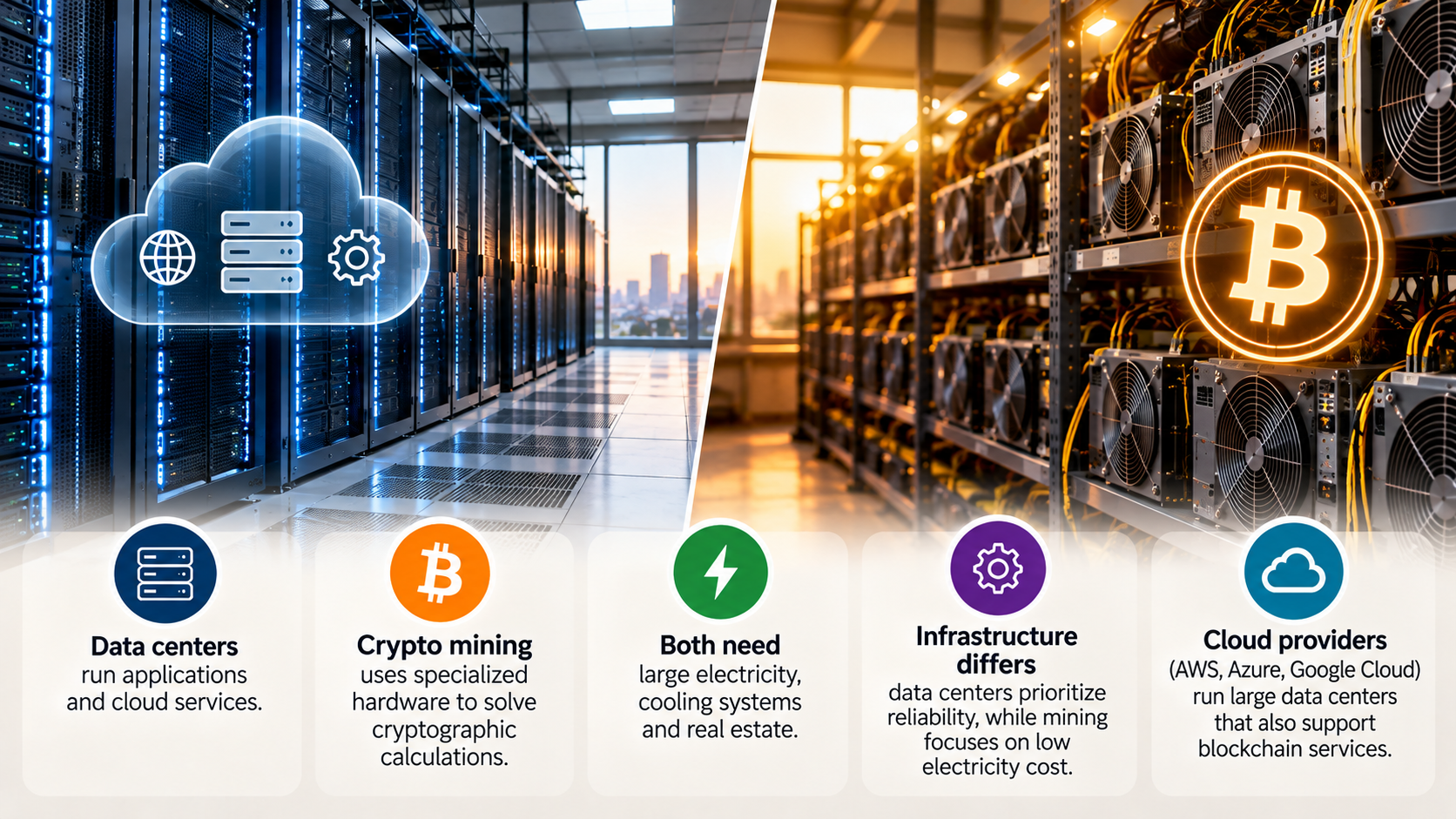
Both data centers and crypto mining facilities require substantial real estate, electricity, networking, and cooling systems. However, their hardware, business goals, and operating priorities differ. A conventional data center supports applications, storage, cloud services, and enterprise workloads. For a broader explanation of these facilities, see what a data center does and how it works. Crypto mining facilities focus mainly on performing large numbers of cryptographic calculations.
Understanding these differences helps explain how crypto mining infrastructure works alongside traditional IT environments. This guide examines whether data centers can host mining operations, how they connect to cryptocurrency networks, and how their infrastructure differs. It also looks at major cloud providers and the computing facilities associated with Elon Musk’s companies.
Can data centers be used for crypto mining?
Yes, data centers can host cryptocurrency mining equipment. However, conventional enterprise facilities are not always economical for this purpose. They often provide redundant power systems, advanced networking, sophisticated cooling, physical security, and high availability. Those features can increase operating costs beyond what many mining businesses can justify.
Crypto mining has a different economic model. Operators usually focus heavily on electricity prices, hardware efficiency, cooling capacity, and available power. Bitcoin mining, in particular, uses specialized ASIC hardware designed for hashing. Because mining revenue depends on factors such as Bitcoin price, network difficulty, and energy costs, controlling operating expenses is critical.
Some facilities can therefore support both mining and other computing workloads. In practice, dedicated mining sites are often designed around cheaper electricity and high power availability. Many also use flexible operations that allow miners to reduce consumption when electricity prices rise or grid conditions become difficult.
Power Density and Airflow Adaptations
Mining equipment can create substantial heat and power demand within a concentrated area. Consequently, facilities designed for conventional enterprise workloads may require modifications before hosting large mining fleets. Operators may need stronger electrical distribution, additional cooling capacity, and redesigned airflow.
The exact power density varies by hardware generation and facility design. Modern ASICs can consume several kilowatts per machine, while large mining deployments can require megawatts of total capacity. Therefore, simply placing mining machines into unused server racks is not always practical.
Cooling is especially important because mining hardware operates continuously. Operators may use enhanced air cooling, direct liquid cooling, or immersion systems. These approaches help manage heat while maintaining hardware performance.
Ultimately, power availability and cooling efficiency often matter more to mining operators than the redundancy expected in premium enterprise data centers. This difference strongly influences how mining facilities are designed.
Are data centers connected to cryptocurrency?
Yes, data centers play an important role in the broader cryptocurrency ecosystem. However, not every data center performs cryptocurrency mining. Many facilities support exchanges, blockchain infrastructure, wallets, analytics platforms, cloud applications, and other services connected to digital assets. The distinction between specialized AI facilities and storage-focused infrastructure is explored in AI data centers versus cloud storage data centers.
Blockchain networks depend on computers that communicate continuously with other participants. These systems may host nodes that maintain copies of blockchain data, verify transactions, or support applications built on blockchain networks. Cryptocurrency exchanges also depend on reliable infrastructure for trading, account management, market data, and transaction processing.
Cloud computing has expanded these capabilities further. Developers can rent computing, storage, databases, and networking resources instead of building their own physical infrastructure. For a deeper look at this model, see how cloud computing works. This makes it easier to deploy blockchain applications and Web3 services without owning a dedicated facility.
Data centers also support the security and availability requirements of financial technology platforms. Their infrastructure can include redundant power, network connectivity, physical security, monitoring, and backup systems. Therefore, cryptocurrency may depend on data centers even when mining itself happens somewhere else.
Securing Financial Ledger Integrity
Reliable infrastructure is important for organizations that operate cryptocurrency platforms. Exchanges, custodians, blockchain companies, and financial technology providers can use controlled data center environments to protect their systems.
These facilities may use restricted physical access, surveillance, environmental monitoring, network security, and backup power. Such measures help reduce the risk of service interruptions and unauthorized physical access.
However, a data center does not automatically guarantee blockchain security. Cryptocurrency systems also depend on software security, private-key management, network architecture, operational controls, and appropriate cybersecurity practices.
For this reason, data center security and blockchain security should be viewed as connected but separate responsibilities. A highly available facility can keep infrastructure running, but secure software and careful key management remain essential.
What is the difference between a data center and Bitcoin mining?
The biggest difference is their purpose. A conventional data center provides computing, storage, networking, and other IT services. It can support many different workloads and may serve multiple customers simultaneously. Its infrastructure is therefore designed for flexibility, reliability, security, and continuous service.
Bitcoin mining has a much narrower purpose. Miners use specialized application-specific integrated circuits (ASICs) to perform the hashing calculations required by the Bitcoin proof-of-work system. Their economic goal is to earn Bitcoin by contributing computational power to the network.
The infrastructure priorities also differ. Enterprise data centers often invest heavily in redundant power, networking, cooling, and backup systems. These features help protect customer workloads from interruptions. For organizations managing these expenses, enterprise software total cost of ownership can also be an important consideration. Mining operators, meanwhile, usually place greater emphasis on electricity cost, hardware efficiency, and the amount of computing power available.
Mining facilities can still use sophisticated infrastructure. However, mining facilities generally prioritize low computing costs over customer-facing service availability. This distinction explains why a mining site can look very different from a traditional enterprise data center.
Infrastructure Priorities and Uptime Standards
Enterprise data centers are designed to maintain service availability for critical workloads. Depending on the facility, operators may use redundant power feeds, UPS systems, backup generators, multiple network paths, and extensive monitoring.
Mining facilities typically have different priorities. A temporary shutdown can reduce mining revenue, but it does not necessarily cause permanent loss of customer data. As a result, some mining operators accept more operational flexibility in exchange for lower infrastructure costs.
Power curtailment is another important difference. Mining operators can sometimes reduce or stop their machines when electricity becomes expensive or when grid operators need additional capacity. This flexibility can help manage operating costs.
Therefore, uptime requirements are workload-dependent. It would be inaccurate to assume that every enterprise data center guarantees 99.999% availability or that every mining facility accepts frequent downtime. Facility design varies according to business requirements, contracts, hardware, and economics.
What are the big 3 data centers?
The phrase “Big Three” usually refers to the three leading public cloud providers: Amazon Web Services (AWS), Microsoft Azure, and Google Cloud. They operate large global infrastructure networks that include data centers, cloud regions, networking systems, and other computing resources.
These companies support a wide range of workloads. Customers use their platforms for application hosting, databases, storage, analytics, artificial intelligence, networking, and enterprise software. Their infrastructure differs from a single physical data center because each provider operates a large distributed ecosystem.
Cloud providers can also support blockchain-related workloads. Developers may use cloud infrastructure to run blockchain nodes, analytics systems, APIs, and decentralized applications. However, this does not mean that these providers primarily operate cryptocurrency mining facilities.
The distinction matters because cloud infrastructure and crypto mining infrastructure serve different business models. Public cloud providers sell computing and related services to customers. Mining operators generally deploy specialized hardware to perform hashing and generate cryptocurrency-related revenue.
Does Elon Musk own data centers?
Elon Musk is associated with major computing infrastructure through companies including xAI, Tesla, and X. However, it is more accurate to describe these companies as operating or using computing infrastructure rather than treating all of it as personally owned by Musk.
One prominent example is Colossus, xAI’s AI supercomputing facility in Memphis, Tennessee. xAI originally described Colossus as a system containing 100,000 NVIDIA Hopper GPUs. The company later reported that the cluster had been expanded to 200,000 GPUs and outlined a longer-term roadmap toward one million GPUs.
Colossus supports the training and development of AI systems such as Grok. Its infrastructure is therefore designed for high-performance AI computing rather than Bitcoin mining. The broader distinction between specialized AI infrastructure and other data center models is covered in AI data centers versus cloud storage data centers. xAI describes the Memphis facility as an AI supercomputing site built around large-scale GPU infrastructure.
Other Musk-associated companies also operate or use substantial computing infrastructure. Tesla relies on computing resources for areas such as vehicle data and AI development, while X requires infrastructure for its social platform.
The key distinction is simple: large computing capacity does not automatically mean crypto mining. AI clusters, cloud facilities, enterprise data centers, and mining sites can all consume substantial electricity while performing very different workloads.
Frequently Asked Questions
Can Bitcoin miners switch to hosting artificial intelligence workloads?
Bitcoin miners cannot easily pivot to AI hosting because their ASIC chips are hardwired exclusively for SHA-256 cryptographic hashing. Converting a mining warehouse into an AI data center requires replacing the entire hardware fleet with enterprise GPUs, upgrading networking cables to high-bandwidth fiber, and installing redundant backup systems.
Why do crypto miners build facilities in cold climates?
Miners choose cold locations like Iceland or the Scandinavian region to reduce operational cooling expenses. Because thousands of high-powered mining rigs generate intense heat, operators can use cold ambient air directly for ventilation, slashing overall power bills and significantly improving hardware operating efficiency.
How much electricity does an enterprise data center consume?
A standard enterprise data center consumes anywhere from 10 to 50 megawatts of electricity, whereas modern hyperscale facilities often require 100 megawatts or more. This continuous consumption provides enough power to support tens of thousands of homes, requiring direct connections to regional electrical substations.
Conclusion
The realms of data centers and crypto mining demonstrate how varied computing architectures serve completely different digital goals. Enterprise facilities build resilient, redundant ecosystems tailored for corporate applications, consumer cloud services, and blockchain software nodes that demand unbroken reliability. In contrast, cryptocurrency mining operations optimize every design choice around low-cost power procurement and maximum computational hash output.
As computing requirements expand with advancements in artificial intelligence and decentralized finance, the infrastructure supporting them continues to specialize. While both models consume substantial power resources, their hardware stacks, operational budgets, and service objectives remain distinct. Understanding these key operational differences allows businesses and investors to evaluate energy utilization, technical requirements, and capital deployment effectively. Evaluate your organizational processing demands carefully to select the right computing infrastructure for your projects.