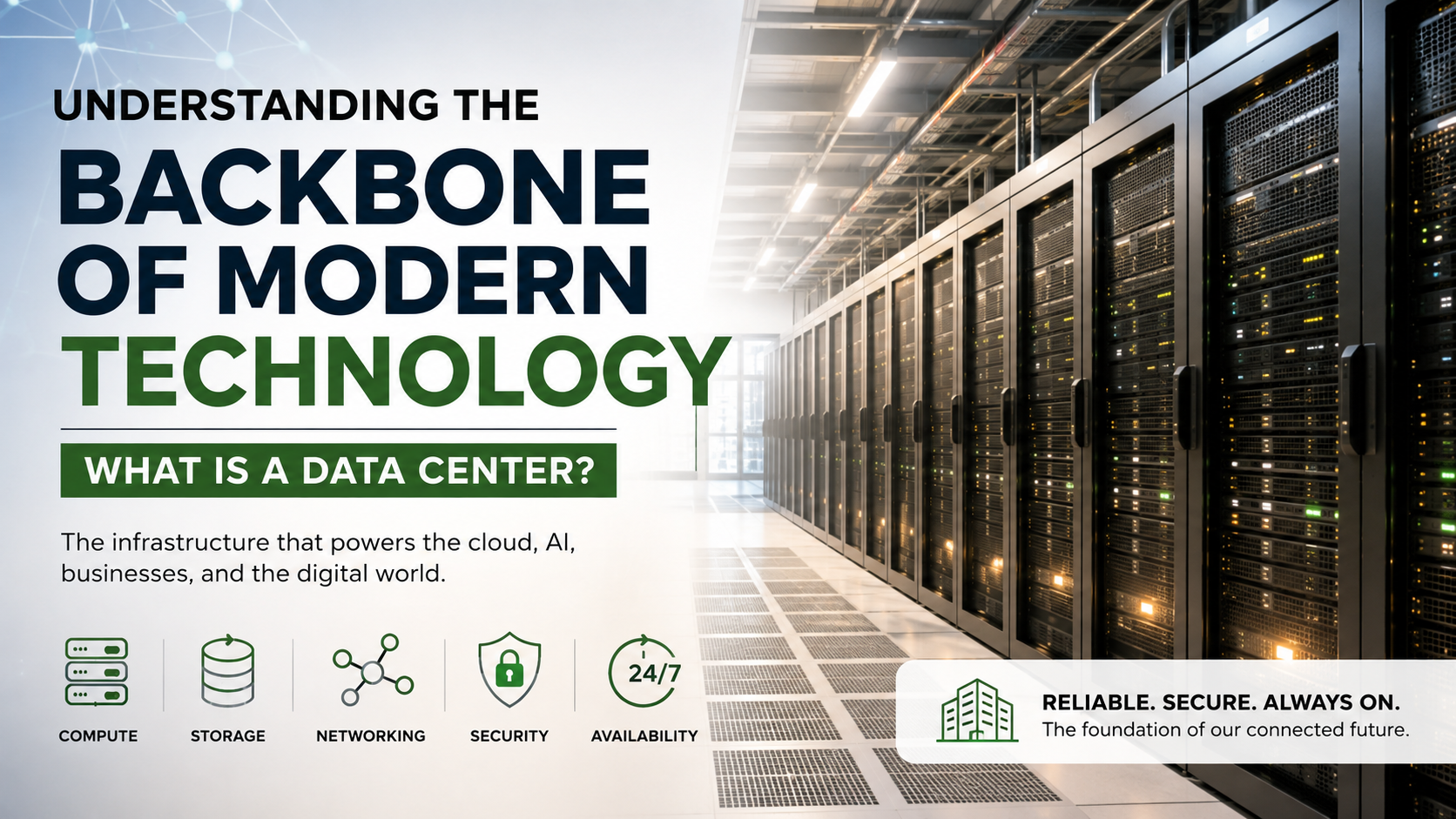
Understanding the Backbone of Modern Technology: What Is a Data Center?
A data center is the physical infrastructure behind many digital services we use every day. Streaming, email, cloud storage, online banking, and AI services all depend on these facilities. They house servers, storage systems, networking equipment, power systems, and cooling infrastructure.
These facilities process, store, and transmit enormous amounts of information. They also support enterprise applications, websites, databases, and cloud platforms. As demand for cloud computing and artificial intelligence grows, understanding the characteristics of big data is becoming increasingly important.
Modern facilities are designed for continuous operation. They use redundant power, cooling, networking, and security systems to reduce downtime. This reliability allows businesses to keep critical applications available around the clock.
The industry is also changing rapidly. Operators are investing in energy efficiency, renewable electricity, advanced cooling, and higher-density computing. These improvements aim to support growing digital demand while reducing environmental impacts. The International Energy Agency notes that data centers already represent a significant electricity load worldwide. According to the International Energy Agency, digital infrastructure demand continues to scale rapidly across global markets.
Understanding how a data center works helps explain the infrastructure supporting today’s connected economy.
What Exactly Does a Data Center Do?
A data center provides a secure physical environment for computing, storage, networking, and digital services. Organizations use these facilities to run applications, manage databases, host websites, and store business information, including the infrastructure behind AI data centers and cloud storage data centers.
When someone loads a website, the request travels through networks to computing infrastructure. Servers process the request and retrieve the required information. The response then travels back to the user’s device, often within milliseconds through real-time data streaming systems.
Data centers perform several essential functions:
- Compute: Servers process applications, transactions, AI workloads, and other tasks.
- Storage: Storage systems preserve databases, files, backups, and digital content.
- Networking: Switches and routers connect servers with users, businesses, and cloud platforms.
- Security: Physical and digital controls protect critical infrastructure and information.
- Availability: Redundant systems help services remain operational during equipment failures.
Facilities also manage heat, electricity, physical access, and equipment maintenance. Engineers monitor temperatures, power usage, network performance, and hardware health.
This combination of computing, storage, connectivity, and resilience makes the data center a foundation of modern digital infrastructure.
Core Processing and Hardware Management
Hardware management keeps thousands of servers, storage devices, and networking systems operating reliably. Data center technicians monitor equipment continuously and respond to performance or hardware problems.
Servers handle different workloads depending on their design and configuration. Some support websites and business applications. Others provide databases, cloud services, scientific computing, or AI processing.
Storage systems also require careful management. Facilities use different storage technologies to balance performance, capacity, reliability, and cost. Networking equipment connects these systems and moves data between users, servers, and external networks.
Maintenance teams regularly inspect hardware and replace failed components. They also install firmware and software updates when required. Monitoring tools help identify problems before they cause service interruptions.
Modern facilities increasingly use automation to manage routine operations. Sensors can track temperature, power consumption, airflow, and equipment status. Software can then alert technicians when readings move outside expected ranges.
This approach improves reliability while helping operators use computing resources efficiently. It also becomes increasingly important as agentic AI workloads and data engineering demands place greater demands on power and cooling systems.
Which Data Center Is the Largest in India?
Determining India’s largest data center depends on the metric used. Facility size, IT power capacity, rack capacity, and total campus capacity can produce different rankings.
Yotta NM1 in Navi Mumbai is widely identified by its operator as Asia’s largest Tier IV data center. Yotta lists the facility at about 820,000 square feet, with capacity for more than 7,000 racks. Its current published specifications include up to 52 MW of IT load.
The facility forms part of Yotta’s larger Navi Mumbai data center park. The broader campus is designed for significant future expansion. This makes the site important to India’s rapidly growing cloud and AI infrastructure market.
However, claims about India’s “largest” facility should specify the measurement used. New hyperscale projects and expansions can quickly change industry rankings. Microsoft also opened its largest India data center hub in Hyderabad in August 2026.
For this reason, Yotta NM1 is best described as one of India’s largest operational facilities, rather than treating “largest” as an absolute ranking across every possible measure.
Strategic Location and Power Infrastructure
Data center locations depend heavily on power availability, connectivity, land, and network latency. Navi Mumbai benefits from its proximity to Mumbai’s major commercial and technology ecosystem.
Strong connectivity is especially important for facilities serving cloud platforms and enterprise customers. Multiple network providers and fiber routes can improve resilience and reduce dependence on a single connection.
Power infrastructure is equally important. Data centers need reliable electricity around the clock. They typically use utility connections alongside UPS systems, batteries, generators, and other backup infrastructure.
Yotta describes NM1 as a carrier-neutral facility with direct access to major telecommunications providers, internet service providers, and cloud platforms. The facility is also designed for high availability and scalable computing requirements.
Location can also affect operating efficiency. Access to suitable land and electrical infrastructure can make future expansion easier.
For hyperscale and AI facilities, power planning has become even more important. High-density servers can require substantially more electricity and cooling capacity than traditional enterprise workloads. As a result, power availability is now a major factor in data center development.
What Is a Data Center and Why Are They Bad?
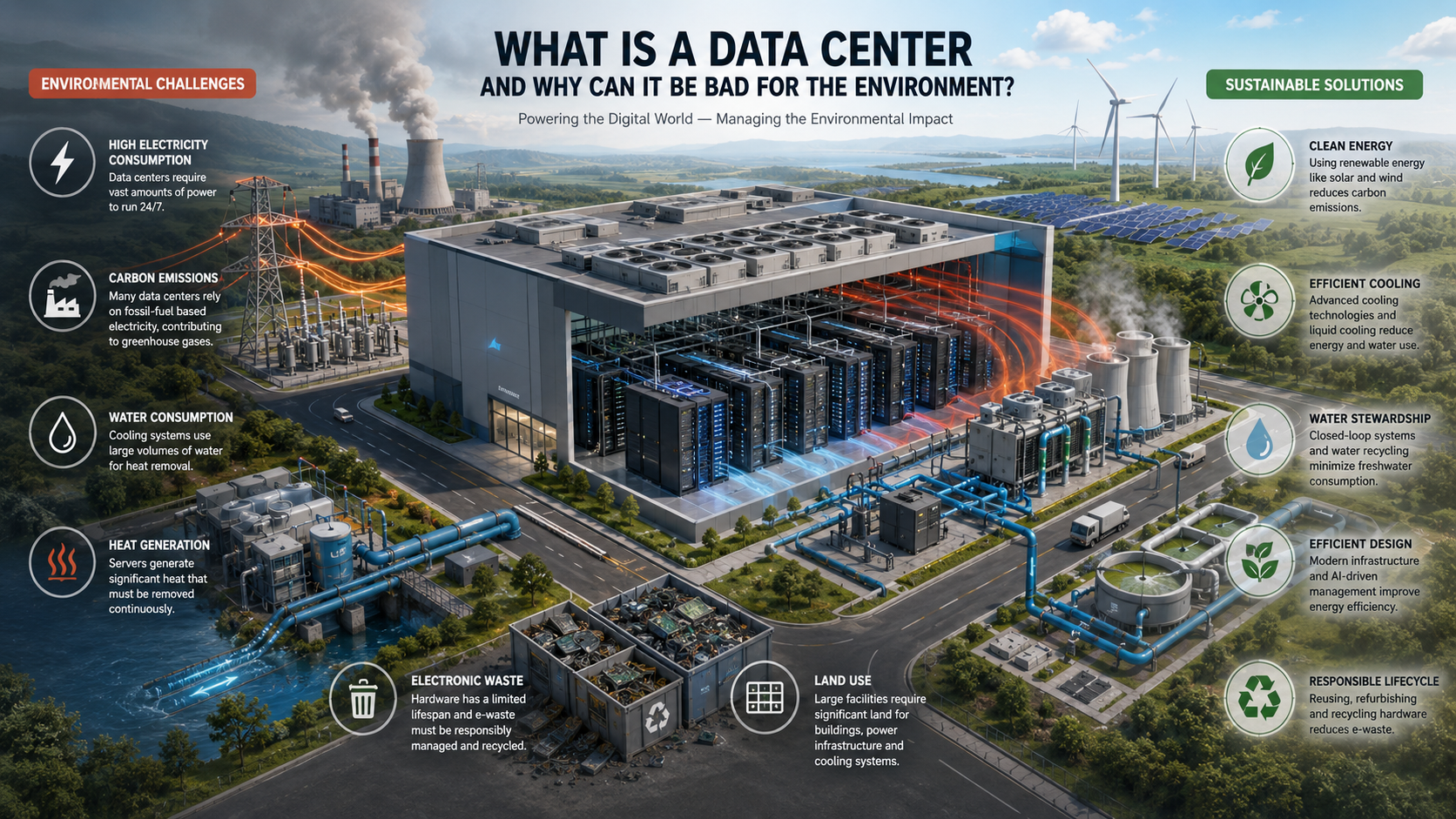
A data center is not inherently “bad.” It provides essential infrastructure for modern communication, business, entertainment, healthcare, finance, and cloud computing. However, large facilities can create significant environmental and resource challenges.
Electricity is one major concern. Servers, networking equipment, cooling systems, and other infrastructure consume substantial amounts of power. The environmental impact depends heavily on how that electricity is generated.
Water use is another concern, particularly at facilities that rely on evaporative cooling. However, consumption varies widely by climate, cooling technology, workload, and facility design. Recent research from Lawrence Berkeley National Laboratory found that data center water use can vary by more than 10,000-fold across workloads and operating conditions.
Other concerns include:
- Carbon emissions associated with electricity and construction.
- Water consumption from certain cooling systems.
- Electronic waste from equipment replacement and upgrades.
- Land use for large campuses and supporting infrastructure.
- Local grid pressure when facilities require very large power connections.
These challenges do not mean data centers should not exist. Instead, they highlight the need for efficient designs, cleaner electricity, responsible water management, better equipment recycling, and innovative sustainable data center technologies.
Environmental Impact and Energy Consumption
The environmental footprint of a data center depends on several interconnected factors. Energy efficiency, electricity sources, cooling systems, water availability, and equipment lifecycles all influence its impact.
The International Energy Agency estimates that global data centers consumed about 240–340 TWh of electricity in 2022. It also identifies water use and electronic waste as additional environmental concerns.
Operators are responding with several approaches. Renewable electricity can reduce emissions when it replaces more carbon-intensive generation. More efficient servers can also deliver greater computing output for the same energy input.
Cooling technology is another major area of innovation. Some facilities use outside air or highly efficient mechanical systems. Others are adopting direct-to-chip or other liquid-cooling technologies for dense AI hardware.
Water management also varies considerably. Some operators reduce freshwater demand through closed-loop systems, recycled water, or air-based cooling. Digital Realty reported that 75% of its sites operated without evaporative cooling in 2025.
The goal is not simply to build larger facilities. It is to increase computing capacity while using energy and resources more efficiently.
What Are the World’s Largest Data Centers?
The world’s largest data centers can be compared using several measurements. These include physical size, power capacity, rack capacity, and total campus scale.
Switch’s Citadel Campus in Northern Nevada is one of the best-known examples. Switch describes the Tahoe Reno campus as the world’s largest data center campus, with up to 7.2 million square feet of planned data center space and up to 650 MW of power.
Other major facilities and campuses exist across North America, Asia, and Europe. Some support cloud computing, while others serve hyperscale technology companies, telecommunications providers, governments, or large enterprises.
It is important to distinguish a data center building from a data center campus. A campus can contain multiple buildings and supporting infrastructure. This distinction explains why different sources sometimes identify different facilities as the world’s largest.
Modern mega-campuses are built to support huge computing workloads. They may include dedicated substations, backup generation, extensive fiber connectivity, advanced cooling systems, and large-scale security infrastructure.
As AI adoption accelerates, power density is becoming increasingly important. Future facilities may therefore be judged less by floor area and more by their ability to deliver efficient, reliable high-density computing.
Scale and Power Capacity Metrics
The scale of a modern data center is often measured through power capacity rather than floor space alone. Operators commonly discuss IT load in megawatts, rack capacity, and the amount of space available for computing equipment.
Power capacity indicates how much electricity can support the facility’s IT equipment. Rack capacity shows how many server racks the building can accommodate. Floor space provides another measure but does not necessarily indicate computing capability.
Large campuses may require dedicated electrical substations and extensive backup systems. These can include uninterruptible power supplies, batteries, generators, and multiple utility feeds.
Cooling capacity must also match electrical and computing requirements. Almost all electricity consumed by servers eventually becomes heat. That heat must be removed to maintain safe operating temperatures.
AI infrastructure is changing these requirements. Traditional server racks may operate at lower power densities than modern GPU systems. High-density AI racks can therefore require specialized cooling and stronger electrical infrastructure.
For operators, the objective is to balance power, cooling, connectivity, space, and reliability. A facility with a huge footprint is not necessarily more capable than a smaller facility with greater usable power density.
Who Is the Biggest Builder of Data Centers?
There is no single company that can accurately be called the world’s biggest data center builder. Different companies lead different parts of the market, including ownership, development, construction, and operation.
Digital Realty describes itself as the world’s largest data center owner, operator, and developer, with facilities across more than 55 metropolitan markets.
Equinix operates one of the world’s largest data center networks. Its current footprint includes hundreds of facilities across multiple continents.
Hyperscale technology companies also develop major facilities for their own platforms. These include Microsoft, Google, Amazon, and Meta. Their infrastructure supports cloud services, AI workloads, online platforms, and internal computing requirements.
Construction itself involves many additional specialists. Developers work with architects, engineering firms, contractors, electrical suppliers, cooling specialists, and equipment manufacturers.
This means the modern data center industry is built through a broad ecosystem rather than a single builder. The leading developers focus on scalable design, power availability, cooling, connectivity, security, and rapid deployment.
Hyperscale Construction and Engineering Expertise
Building a hyperscale facility requires careful coordination across architecture, electrical engineering, cooling, networking, and physical security.
The design must support large numbers of servers while maintaining reliable airflow and safe operating temperatures. Electrical systems must provide stable power and tolerate equipment failures without disrupting critical workloads.
Construction teams also plan around future expansion. Modular designs can allow operators to add computing capacity as customer demand increases. This approach can reduce construction delays and improve flexibility.
AI workloads add another layer of complexity. High-density GPU systems can require much more power and cooling than conventional enterprise servers. As a result, developers increasingly consider liquid cooling, higher rack densities, and stronger electrical distribution during the design stage.
Connectivity also shapes the facility. Multiple fiber routes and network providers can improve resilience and provide customers with better access to cloud and telecommunications services.
Physical security remains essential. Data centers may use controlled access, surveillance, perimeter protection, and strict visitor procedures.
Together, these engineering disciplines create facilities that can operate continuously while adapting to changing technology and workload requirements.
Frequently Asked Questions
How much water does a typical facility consume?
A medium-to-large facility can consume hundreds of thousands of gallons of water daily for evaporative cooling towers to maintain optimal operating temperatures. Operators are increasingly adopting closed-loop systems and recycled wastewater to drastically minimize this daily consumption.
What is a hyperscale facility?
A hyperscale facility is a massive data center designed to scale computing infrastructure efficiently, typically housing thousands of servers and spanning over 10,000 square feet. These installations are usually built and operated by major cloud service providers like Amazon, Google, or Microsoft.
Why are these facilities built in remote locations?
Many organizations build large server farms in rural or colder regions to take advantage of cheaper land, lower tax rates, and natural ambient cooling. Colder climates reduce the energy required to run mechanical air conditioning units throughout the year.
How do these facilities protect stored information?
Facilities employ multi-layered security protocols, including biometric access controls, 24/7 video surveillance, armed perimeter guards, and advanced cybersecurity firewalls. Redundant data backups and encryption ensure that stored information remains secure against both physical and digital threats.
CONCLUSION
Data centers serve as the vital operational heartbeat of the modern digital landscape, enabling global communication, enterprise computing, and cloud storage. Throughout this guide, we explored how a data center processes and stores information, examined the largest facilities in India and globally, evaluated their environmental challenges, and identified key industry builders. While their massive energy and water consumption present significant ecological hurdles, ongoing innovations in renewable energy and cooling technology continue to drive the industry toward sustainability. Recognizing the monumental role of these facilities helps clarify the infrastructure required to sustain our increasingly connected world. Readers are encouraged to explore how sustainable technology initiatives are actively reshaping the future of digital infrastructure development.