
Major Branches of Botany and Key Disciplines in Biological Sciences
Plant life supports nearly every ecosystem on Earth. Plant science therefore plays an important role in agriculture, medicine, environmental protection, and food security. Studying the branches of botany helps students understand how plants grow, reproduce, adapt, and interact with their surroundings.
Botany covers many areas, from the study of plant cells to the classification of entire plant groups. It also connects with genetics, ecology, microbiology, agriculture, and evolutionary biology. Organizations such as the Botanical Society of America highlight the importance of plant research in understanding biodiversity and environmental change.
The number and names of botanical branches can vary between textbooks and academic institutions. However, several core disciplines appear consistently in plant science education. This guide explains the five commonly taught branches of botany, 26 specialized botanical disciplines, seven broad branches of biology, and ten major areas of zoology.
What are the five branches of botany?
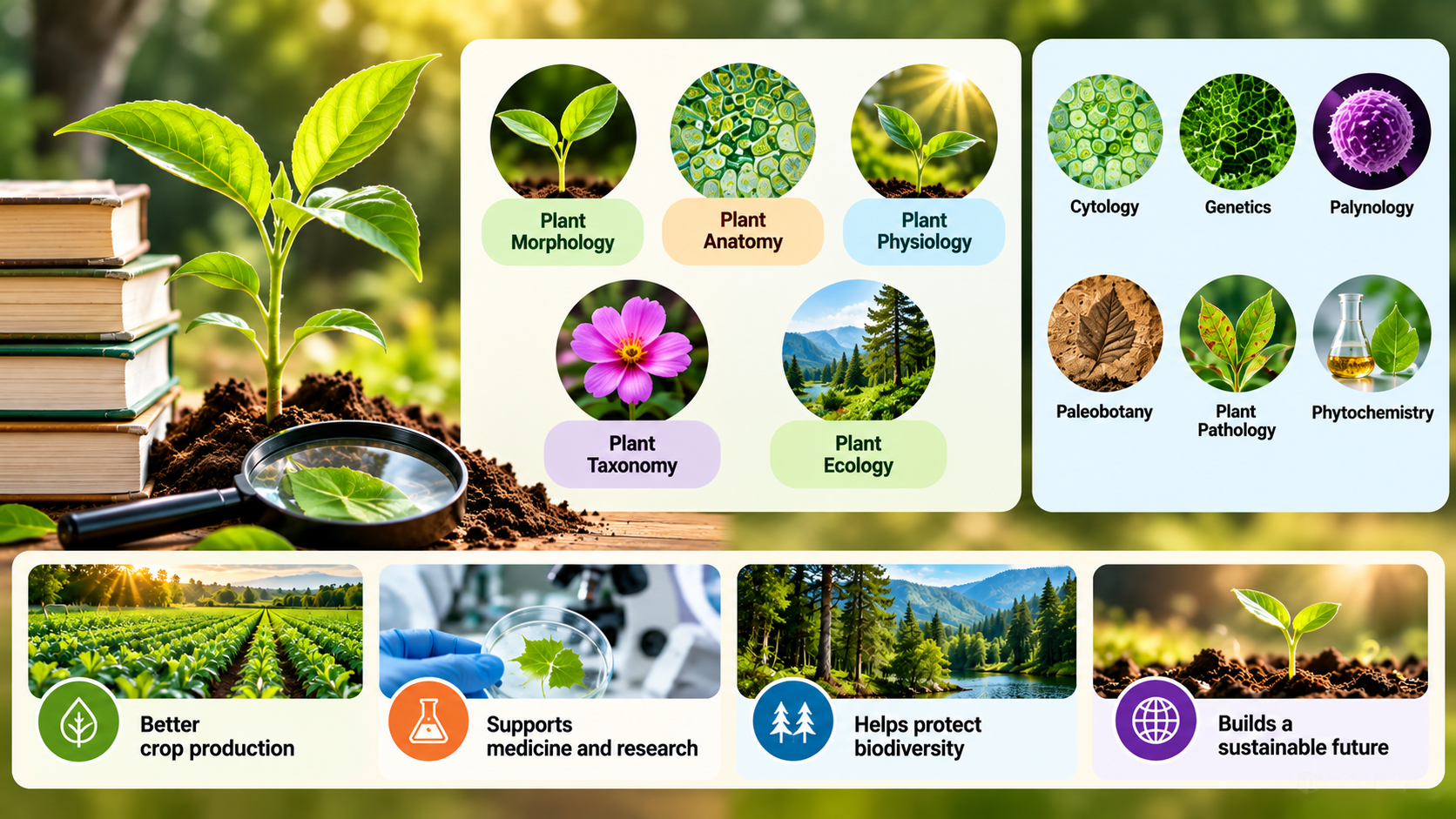
The five commonly taught branches of botany provide a useful foundation for understanding plant science. These areas are plant morphology, plant anatomy, plant physiology, plant taxonomy, and plant ecology. Each branch examines plants from a different scientific perspective.
Plant morphology studies the external form and structure of plants. It examines features such as roots, stems, leaves, flowers, and fruits.
Plant anatomy focuses on internal structures, including tissues and cells. In contrast, plant physiology examines processes such as photosynthesis, respiration, water movement, and nutrient use.
Through plant taxonomy, scientists identify, name, and classify plants according to their characteristics and relationships. Plant ecology, meanwhile, explores how plants interact with other organisms and environmental factors such as soil, water, temperature, and sunlight.
Together, these fields provide a foundation for studying plant growth, classification, reproduction, adaptation, and environmental relationships. They also support practical work in agriculture, horticulture, conservation, and plant research.
Real-World Applications of the Core Botanical Fields
The core branches of botany have practical applications across agriculture, medicine, horticulture, and environmental management. Scientists often combine several botanical disciplines when solving real-world problems.
For example, Plant physiology helps researchers understand how plants respond to drought, heat, nutrients, and water availability. This knowledge can support better irrigation practices and crop-management strategies. For practical examples of plants adapted to limited water, see the best drought-tolerant plants for hot climates. Plant anatomy can reveal structural changes caused by disease, nutrient deficiencies, or environmental stress.
Plant taxonomy is also important when identifying species. Accurate identification helps researchers distinguish useful plants from poisonous or closely related species. This is particularly relevant when studying plants used in medicine, agriculture, and conservation, including deadly plant toxins and poisonous species.
Plant ecology helps scientists understand how vegetation responds to changes in soil, climate, water, and surrounding organisms. Understanding these relationships also requires knowledge of the water cycle process and how water moves through natural systems. Meanwhile, morphology helps horticulturists recognize differences in plant structures and growth patterns.
These applications show why the branches of botany are not limited to classroom study. They provide scientific tools for improving crop production, protecting plant biodiversity, managing ecosystems, and understanding how plants respond to changing environmental conditions.
What are the 26 branches of botany?
Botany includes many specialized disciplines, and some educational sources group these areas into approximately 26 branches of botany. The exact number can vary because some fields overlap or are classified differently. Commonly listed disciplines include:
- Morphology
- Anatomy
- Cytology
- Histology
- Physiology
- Taxonomy
- Ecology
- Phytogeography
- Paleobotany
- Embryology
- Palynology
- Genetics
- Phytochemistry
- Plant Pathology
- Economic Botany
- Ethnobotany
- Agronomy
- Horticulture
- Forestry
- Algology (Phycology)
- Bryology
- Pteridology
- Dendrology
- Lichenology
- Mycology
- Pomology
These fields examine plants from different perspectives. Cytology studies plant cells, while histology examines tissues. Phytogeography focuses on the geographical distribution of plants. Paleobotany investigates ancient plant life through fossils.
Other disciplines have practical applications. Plant pathology studies plant diseases, while phytochemistry examines chemical compounds produced by plants. Ethnobotany explores relationships between people and plants. Agronomy focuses on crop production, while horticulture covers the cultivation of fruits, vegetables, flowers, and ornamental plants, which can also benefit from homemade insecticides for plants when managing common garden pests.
How Specialized Botanical Disciplines Drive Modern Industry
Specialized botanical disciplines contribute to agriculture, biotechnology, medicine, forestry, conservation, and environmental research. Moreover, their applications often overlap, allowing scientists from different fields to address complex problems involving ecosystems and biodiversity more effectively.
For example, plant genetics can help researchers identify traits associated with drought tolerance, disease resistance, or improved crop performance. Consequently, agronomists can apply this knowledge to crop-management systems. Similarly, plant pathology supports agriculture by identifying diseases and studying how pathogens affect crops.
Meanwhile, paleobotany can provide evidence about ancient vegetation and past environmental conditions. In addition, palynology, which studies pollen and spores, can contribute to research involving vegetation history and environmental change. Together, these fields help scientists better understand how plant communities have changed over time.
Furthermore, economic botany examines plants with commercial or practical value. At the same time, ethnobotany adds knowledge about how different communities traditionally use plants for food, materials, medicine, and other purposes. As a result, these disciplines can connect botanical research with practical applications and traditional knowledge.
Beyond these areas, other fields support specific industries. For instance, forestry contributes to sustainable forest management, while horticulture supports fruit, vegetable, ornamental, and nursery production. These plant-based approaches can also support natural cooling through strategically planted trees, especially in landscapes affected by heat. Likewise, phycology examines algae with applications in aquatic research and biotechnology.
Overall, these specialized branches demonstrate how botanical research extends beyond academic study. In turn, they help address challenges involving food production, biodiversity, natural resources, plant health, and sustainable development. Therefore, specialized botanical knowledge continues to support both scientific research and practical solutions across modern industries.
What are the 7 branches of biology?
There is no single universally accepted list of exactly seven branches of biology. However, many educational classifications identify zoology, botany, microbiology, genetics, ecology, evolutionary biology, and physiology as major areas of biological study.
Zoology focuses on animals and their structures, behavior, physiology, and evolution. Botany examines plants, including their structures, functions, classification, and relationships with their environments. Microbiology studies microscopic organisms and biological agents, including bacteria, fungi, protozoa, and viruses, although viruses are often treated separately because they are not universally considered living organisms.
Genetics investigates heredity, genes, DNA, and variation between organisms. Ecology examines interactions between organisms and their physical environments. Evolutionary biology studies changes in populations over generations, including adaptation, speciation, and common ancestry.
Physiology focuses on how living organisms and their parts function. These broad areas often overlap. For example, genetics contributes to evolutionary research, while ecology and physiology help explain how organisms survive in different environments.
Together, these disciplines provide different perspectives on life, from molecular processes to ecosystems and biological diversity.
What are the 10 main branches of zoology?
Zoology examines the animal kingdom through ten prominent, specialized sub-disciplines categorized by structural focus and taxonomic groupings. These ten branches include:
-
Invertebrate Zoology
-
Vertebrate Zoology
-
Entomology (insects)
-
Herpetology (amphibians and reptiles)
-
Ichthyology (fish)
-
Mammalogy (mammals)
-
Ornithology (birds)
-
Comparative Anatomy
-
Ethology (animal behavior)
-
Animal Physiology
Entomology assists agriculture by monitoring pollinators and pests, while ichthyology supports marine conservation and commercial fisheries. Ethology interprets social hierarchy and migration patterns under natural conditions. Meanwhile, comparative anatomy traces structural homologies across diverse species, revealing evolutionary lineages. These interconnected zoological fields provide complete assessments of animal health, wildlife biodiversity, and ecosystem dynamics.
FREQUENTLY ASKED QUESTIONS
Why is the study of botany important for environmental conservation?
Botany is essential for environmental conservation because plants form the foundation of terrestrial food webs, generate atmospheric oxygen, and stabilize regional soils. Moreover, by studying plant ecology and phytogeography, conservationists can identify fragile habitats, restore native plant species after environmental disasters, and preserve biodiversity corridors needed to sustain wildlife populations. As a result, botanical research plays an important role in protecting ecosystems and maintaining biodiversity.
How does ethnobotany help modern pharmaceutical research?
Ethnobotany examines how indigenous cultures have historically used native plants for medicine, food, and religious rites. In turn, pharmaceutical researchers can evaluate these traditional medicinal practices to identify promising plant species for laboratory analysis. Furthermore, this targeted approach can accelerate drug discovery by helping pharmacologists identify active biochemical compounds that may be useful for treating pain, infections, and chronic human illnesses.
What tools do modern botanists use to classify plant species?
Modern botanists use both microscopic physical analysis and high-throughput molecular tools to classify plants accurately. Traditionally, taxonomists relied on morphological inspections, dissecting microscopes, and pressed herbarium sheets. Today, however, contemporary plant scientists also use DNA sequencing, bioinformatics software, and phylogenetic modeling to map evolutionary relationships across diverse plant families. Consequently, combining traditional observations with molecular evidence allows researchers to classify plant species with greater accuracy.
CONCLUSION
Exploring the foundational branches of botany reveals how deeply plant science is connected to all life sciences. From the five traditional divisions of morphology, anatomy, physiology, taxonomy, and ecology to the broader spectrum of twenty-six specialized botanical sciences, each field answers vital questions about the living world. Furthermore, understanding the primary branches of general biology and zoology provides an essential holistic context, illustrating how flora, fauna, and microorganisms maintain dynamic balances within Earth’s ecosystems.
Applying this scientific knowledge allows educators, researchers, and hobbyists to approach environmental challenges with analytical clarity. Whether you are identifying local native flora, optimizing soil conditions for backyard gardening, or pursuing advanced academic research in plant genetics, these scientific divisions offer a reliable roadmap. By recognizing how individual plant processes support global food systems, medicine, and climate regulation, you can better appreciate, protect, and study our planet’s invaluable botanical heritage.