
What Is the 60-60 Rule for Using Headphones?
The 60-60 rule for headphones is a simple listening guideline designed to help reduce the risk of noise-induced hearing damage. It recommends keeping your volume below 60% and taking regular breaks from continuous listening.
However, listening to loud audio for long periods can increase the risk of noise-induced hearing loss (NIHL). The World Health Organization’s safe listening guidance recommends keeping personal-audio volume below 60% of maximum and taking regular breaks.
The 60-60 rule for headphones provides a simple way to reduce that risk. It encourages listeners to keep volume below 60% of maximum and take regular breaks.
The rule is useful, but it should not be treated as an exact medical limit. The actual sound reaching your ears depends on your device, headphones, recording, and surroundings.
For better protection, combine the 60-60 approach with measured sound levels, shorter exposure at higher volumes, and regular listening breaks.
What Is the 60-60 Rule for Using Headphones?
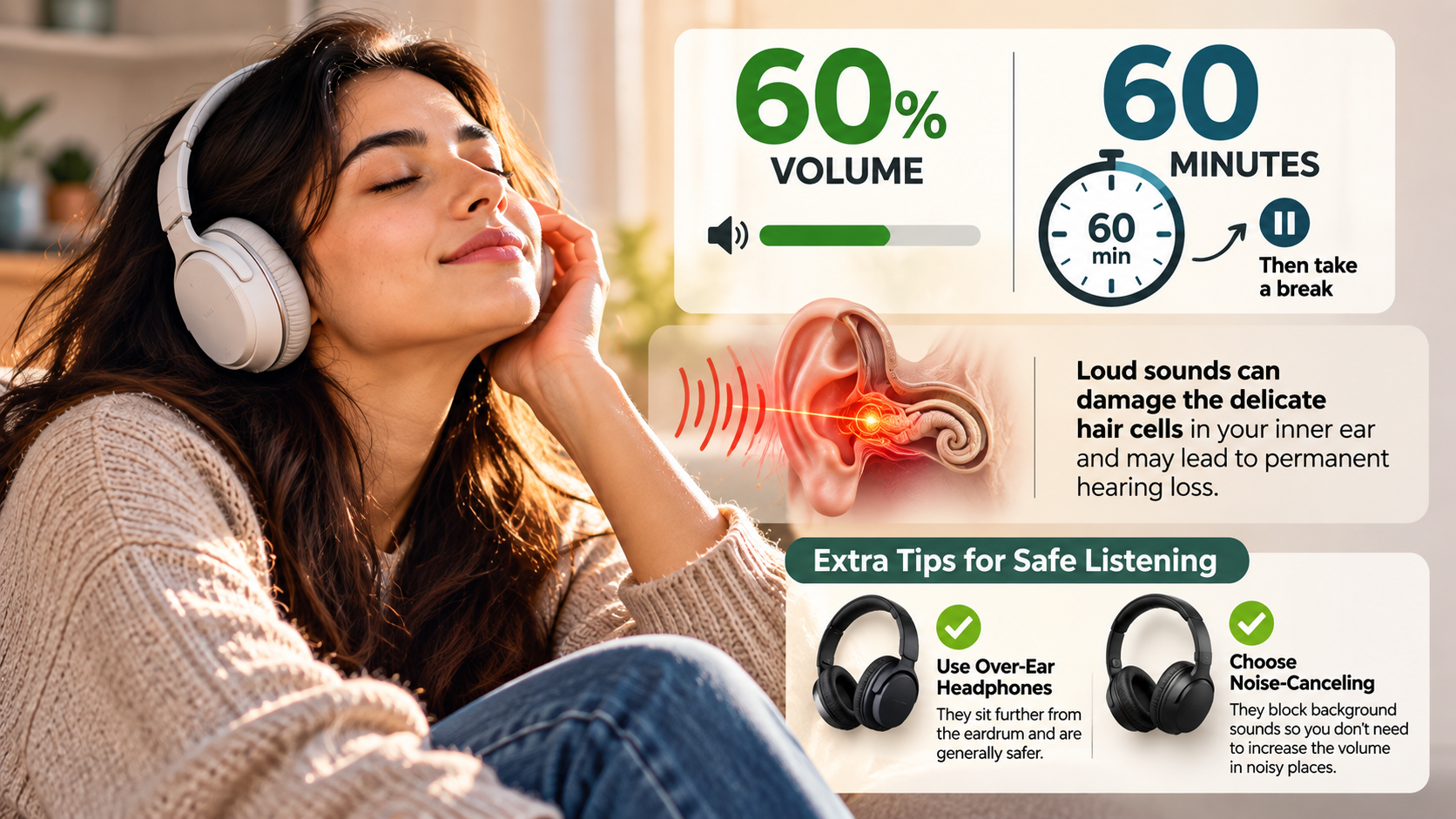
The 60-60 rule for headphones is a simple safe-listening guideline. It recommends keeping your personal-audio volume below 60% of maximum and taking regular breaks from continuous listening.
The World Health Organization recommends keeping personal-audio volume below 60% of maximum. It also advises staying below about 80 dB average when sound exposure can be measured.
The second “60” is commonly interpreted as limiting continuous listening sessions to about 60 minutes. After that, taking a quiet break can reduce continuous exposure. WHO recommends taking frequent breaks, although it does not prescribe a universal 10- or 15-minute break after every 60 minutes.
A practical approach is:
- Keep headphone volume below 60% of maximum.
- Avoid listening continuously for long periods.
- Take regular breaks in a quiet environment.
- Reduce volume further in quiet surroundings.
- Use noise-cancelling headphones when appropriate.
- Monitor sound exposure when your device provides that feature.
The key idea is simple: lower volume and shorter exposure reduce hearing risk.
Why Does the 60-60 Benchmark Help Protect Hearing?
Hearing risk depends mainly on sound level, listening duration, and repeated exposure. Louder sounds require less exposure time before they become potentially harmful.
Inside the cochlea, sensory hair cells help convert sound vibrations into signals that the brain can interpret. Repeated exposure to excessive sound can damage these cells and other structures involved in hearing. Permanent noise-induced hearing loss can result from repeated or prolonged exposure to loud sounds.
This is why volume and duration should be considered together. A moderately loud sound may be tolerated for much longer than a very loud sound.
The 60-60 approach provides an easy habit for people who do not regularly measure sound levels. However, 60% volume does not equal a fixed decibel level. Different headphones and devices can produce very different sound levels at the same volume setting.
WHO’s current guidance gives a more measurable benchmark. Adults can generally listen to 80 dB for up to 40 hours per week under its safe-listening framework. At higher levels, the available listening time falls quickly.
So, the 60-60 rule works best as a practical starting point, not as a guarantee of safe exposure.
Is 70 dB Safe for Your Ears?
A sound level around 70 dB is generally well below the WHO adult leisure-listening limit of 80 dB. WHO’s safe-listening framework allows up to 40 hours of exposure at 80 dB per week.
The risk still depends on how often and how long you encounter the sound. A single sound level does not tell the complete story.
For perspective, WHO lists normal conversation at roughly 60 dB. Its examples place heavy traffic inside a vehicle around 85 dB and a hair dryer around 100 dB. These figures are approximate because real-world sound levels vary.
| Sound level | Example | WHO weekly reference |
|---|---|---|
| 30–40 dB | Quiet room or library | Generally unlimited |
| 60 dB | Normal conversation | Generally unlimited |
| 70 dB | Moderate background sound | Well below 80 dB |
| 80 dB | Loud everyday sound | Up to 40 hours |
| 90 dB | Shouted conversation | About 4 hours |
| 100 dB | Hair dryer | About 20 minutes |
| 110 dB | Very loud sound | About 2.5 minutes |
The important point is that higher volume dramatically reduces safe listening time. WHO’s guidance shows that 90 dB allows far less weekly exposure than 80 dB.
What Is the 7-Day Limit for Headphones?
The so-called 7-day headphone limit refers to a weekly sound allowance. WHO and ITU’s safe-listening standard uses a cumulative exposure model rather than treating every listening session separately.
For adults, the WHO/ITU framework uses 80 dB for up to 40 hours per week. The exposure time decreases as sound levels rise. For example, WHO lists 83 dB for 20 hours, 86 dB for 10 hours, and 92 dB for 2.5 hours per week.
This approach is based on the relationship between sound intensity and exposure duration. With a 3 dB exchange rate, every 3 dB increase roughly halves the permitted exposure time.
NIOSH also uses a 3 dB exchange rate for occupational noise exposure. Its occupational recommendation is 85 dBA for an eight-hour workday, falling to four hours at 88 dBA and two hours at 91 dBA. However, NIOSH specifically notes that this workplace limit is not intended as a general environmental recommendation.
Modern devices can help users monitor sound exposure. Some devices can warn users or reduce volume automatically when exposure becomes excessive. These features are useful because they focus on total sound dose, not simply the device’s volume percentage.
How Many Hours a Day Is It Safe to Wear Headphones?
There is no universal number of hours that is safe for everyone. Hearing risk depends on sound level, exposure time, frequency, and individual circumstances.
For acoustic safety, WHO’s adult reference is more useful than a fixed daily headphone limit. It allows up to 40 hours per week at 80 dB. At 90 dB, that allowance falls to about four hours per week. At 100 dB, it falls to about 20 minutes per week.
Headphone comfort also matters. Wearing earbuds or headphones for long periods can cause discomfort even when the sound level itself is not excessive.
Potential problems include:
- Earwax buildup: In-ear devices can interfere with normal earwax movement.
- Moisture: Earbuds can create a warm, enclosed environment inside the ear canal.
- Pressure: Tight headphones can cause soreness around the ears or head.
- Temporary symptoms: Loud listening can cause muffled hearing or ringing.
A practical routine is to keep volume low, take regular breaks, and clean and maintain your headphones according to the manufacturer’s instructions. WHO also recommends taking frequent breaks from loud sounds.
If you experience persistent tinnitus, muffled hearing, or difficulty following conversations, consider getting your hearing checked by a qualified professional.
Why Are Gen Z Wearing Wired Headphones?
Wired headphones have become more visible among younger listeners, including some Gen Z users. The trend has both cultural and practical explanations, as explored in this guide to why Gen Z is using wired headphones.
One factor is nostalgia. Wired earbuds are associated with the aesthetics of the 2000s and early smartphone era. They can also work as a fashion accessory and create a recognizable retro appearance.
There are practical reasons, too. Wired headphones do not require a separate charging case or Bluetooth pairing. They can also be inexpensive to replace, which matters for people who frequently lose small earbuds.
Other advantages can include:
- No battery requirement: Traditional wired models work without charging.
- Simple connection: Plugging them in can be easier than pairing a wireless device.
- Low latency: A wired connection can reduce noticeable audio delay.
- Easy replacement: Basic wired earbuds are often inexpensive.
- Consistent availability: They remain useful when wireless batteries are depleted.
However, wired headphones are not automatically safer for hearing. Volume and exposure time still determine much of the hearing risk, regardless of whether the connection is wired or wireless. WHO recommends keeping personal-audio volume below 60% and monitoring sound exposure when possible.
The resurgence of wired audio is therefore better understood as a mix of style, simplicity, cost, and convenience rather than a hearing-health solution.
Conclusion
The 60-60 rule for headphones offers a simple way to build safer listening habits. Keeping the volume below 60% and taking regular breaks can help reduce prolonged exposure to loud sound.
However, volume percentage alone does not tell you the exact sound level reaching your ears. Different headphones and devices can produce different decibel levels at the same setting.
For better hearing protection, keep your listening volume comfortable, avoid long periods of loud audio, and use your device’s hearing-safety features when available. If you notice persistent ringing, muffled hearing, or difficulty understanding conversations, consider having your hearing checked.
Wired or wireless, headphones can be part of your daily routine without becoming a hearing risk. If you are comparing the two formats, this guide to wired vs wireless audio can help you understand their differences. The key is to control volume, limit exposure, and give your ears regular breaks.