Wired vs Wireless Audio: Which Option Is Right For You?
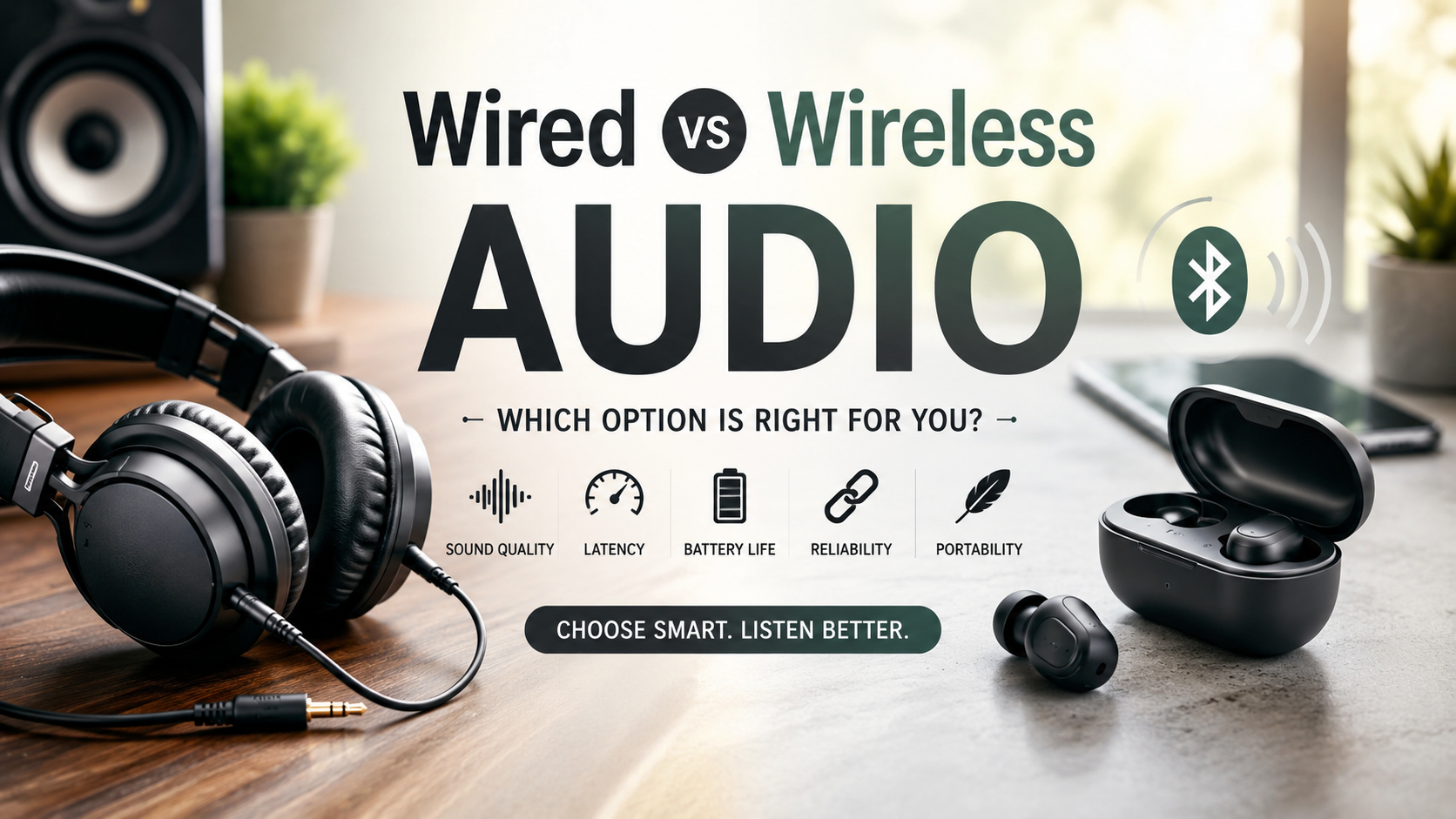
Choosing between wired vs wireless audio can feel difficult with new devices appearing constantly. Your ideal choice depends on how, where, and why you listen.
If you are comparing wired vs wireless audio for headphones, speakers, gaming, or everyday listening, each option has distinct advantages. Wired audio remains popular with audiophiles, musicians, gamers, and studio professionals. Wireless audio appeals to commuters and everyday listeners who value freedom and convenience.
According to Audio Engineering Society, acoustic fidelity remains a primary benchmark for critical listeners worldwide. By breaking down each specific question, you can easily determine which format fits your lifestyle, budget, and daily listening habits without any guesswork.
This guide compares both options across sound quality, latency, portability, speakers, health considerations, and current trends. It also explores why some younger listeners have returned to wired headphones.
The goal is simple: help you choose the audio setup that fits your lifestyle, priorities, and budget. Neither format is automatically better for everyone.
Is Wired Audio Better Than Wireless?
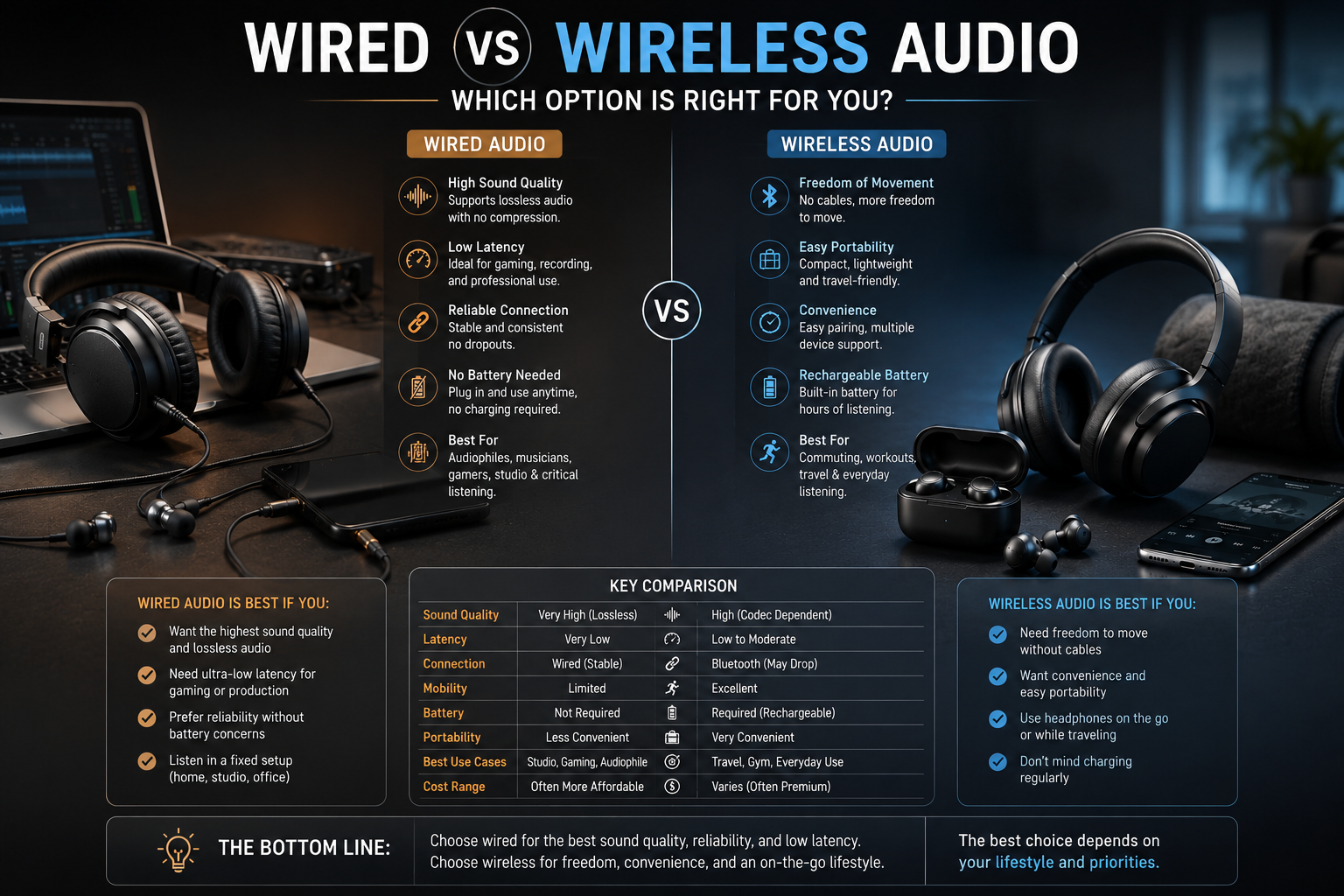
When comparing wired vs wireless audio, wired audio can offer important advantages for listeners who prioritize low latency, reliability, and lossless playback. A direct connection avoids the wireless codec and transmission stage used by Bluetooth audio. For a deeper look at how wireless listening technology has evolved, see spatial audio in headphones.
However, the claim that every wired connection is automatically uncompressed is too broad. USB-C and Lightning headphones can process digital audio before converting it for the drivers. Wireless systems also vary widely in codec quality and performance. Modern Bluetooth technologies can deliver excellent sound and significantly improve efficiency.
For critical listening, wired equipment still provides a straightforward signal path. It also removes battery concerns from passive wired headphones.
Your choice should therefore depend on the equipment and source. Consider these factors before deciding:
- Sound quality: Wired systems can support lossless playback without Bluetooth compression.
- Latency: Wired connections generally offer very low latency.
- Reliability: Passive headphones do not need charging.
- Convenience: Wireless headphones provide greater freedom of movement.
Uncompressed Signals and Low Latency
A wired connection can avoid the compression associated with conventional Bluetooth transmission. This can matter when you want to preserve a lossless audio signal from source to playback device.
Latency is another major advantage. Wired headphones typically respond quickly because they avoid wireless transmission and codec processing.
This benefit is especially useful for gaming, music production, and live monitoring. Small delays can become distracting when audio must match video or performance cues. For listeners interested in immersive sound, how 8D audio works also explains how spatial effects can change the listening experience.
Wireless audio has improved considerably, though. Bluetooth LE Audio uses the LC3 codec to balance quality, efficiency, and latency. Bluetooth technology continues to evolve, including work toward high-resolution and lossless audio.
For casual listening, these differences may be difficult to notice. For competitive gaming or professional work, latency can matter much more.
Why Are Gen Z Using Wired Headphones?
Wired headphones have returned as a visible part of Gen Z fashion and listening culture. The trend combines nostalgia, personal style, affordability, and practical benefits.
Many younger listeners associate wired earbuds with the early 2000s. Their simple design also fits the broader revival of retro technology and vintage-inspired fashion.
Practicality plays a role, too. Wired headphones do not require a separate charging routine. They can also be inexpensive to replace, which makes them attractive to students and budget-conscious listeners.
The trend does not mean Gen Z has abandoned wireless audio. Wireless earbuds remain popular because they are convenient and compact. Instead, wired headphones have become another way to express personal style.
For some users, the appeal comes from several simple benefits:
- No earbud battery to recharge
- No Bluetooth pairing process
- Easy plug-and-play use
- Lower replacement costs for basic models
- Retro styling and personal expression
The Appeal of Retro Aesthetics and Practicality
Nostalgia helps explain why wired earbuds have become fashionable again. Early-2000s technology has returned across clothing, music, photography, and personal accessories.
Wired headphones also offer practical advantages. You can connect them without opening a Bluetooth menu or checking an earbud’s remaining battery. Regardless of which type you choose, cleaning and maintaining your headphones can help keep them comfortable and performing properly.
That simplicity can be valuable during long commutes, school days, or travel. A basic wired model can also cost considerably less than premium wireless earbuds.
The physical cable has become part of the aesthetic. Some users intentionally choose colorful or distinctive designs to complement their outfits.
Still, convenience remains subjective. A cable can tangle, catch on clothing, or limit movement. Wireless earbuds solve those problems while introducing batteries and charging requirements.
The renewed interest in wired audio is therefore less about declaring one technology superior. It reflects a combination of fashion, nostalgia, affordability, and convenience.
Is It Better to Have Wired or Wireless Speakers?
The choice between wired and wireless speakers depends on your room, listening habits, and priorities. Wired speakers are often ideal for dedicated home audio systems.
A traditional wired setup provides a stable connection between the amplifier and speakers. It also avoids wireless network problems and reduces dependence on apps or wireless protocols.
Wireless speakers offer a different advantage: flexibility. Many models support Wi-Fi streaming, multi-room playback, and app-based controls. You can place them around your home without running long speaker cables. For listeners comparing streaming services, Spotify vs. Apple Music provides another useful perspective on the audio platforms available today.
Sound quality depends on the speaker itself, its placement, the room, and the source. A wired speaker is not automatically better than a wireless model.
For a permanent home theater or serious stereo system, wired speakers can provide greater setup flexibility and upgrade options. For casual listening, wireless speakers offer excellent convenience.
Consider your priorities:
- Choose wired speakers for dedicated systems, fixed installations, and maximum control.
- Choose wireless speakers for flexible placement and multi-room convenience.
- Choose a hybrid setup if you want both wired connections and wireless streaming.
Flexibility Versus Acoustic Performance
Wireless speakers excel when convenience matters most. Many models support multi-room audio and app-based controls. Some can also integrate with broader smart-home systems.
Wired bookshelf speakers remain attractive for listeners who want a traditional stereo setup. They allow you to choose separate amplifiers, sources, and speaker components.
However, the connection type does not determine sound quality by itself. Speaker design, room acoustics, amplification, placement, and digital processing all influence the final result.
Wireless systems can also deliver high-quality sound. Wi-Fi-based speakers can support high-resolution streaming without relying on Bluetooth’s typical bandwidth limitations.
For movie rooms and dedicated listening spaces, wired systems remain a strong choice. They provide predictable connections and make component upgrades easier.
For bedrooms, kitchens, offices, and multi-room listening, wireless speakers can be more practical. The best solution depends on whether you value acoustic control or everyday flexibility more.
Which Is Healthier, Wired or Wireless Earphones?
Health concerns about wireless earphones often focus on radiofrequency electromagnetic fields from Bluetooth transmission. Bluetooth uses non-ionizing radiofrequency energy at relatively low power.
Current evidence does not establish that low-level wireless exposure causes adverse health effects. The World Health Organization notes that research has not shown convincing evidence of harm from low-level RF exposure.
Wired earphones avoid Bluetooth radio transmission near the head. That can appeal to people who prefer to minimize wireless exposure, even though current evidence does not show that Bluetooth earphones create a proven health hazard.
Hearing safety is a more important everyday concern. Excessive volume and long listening sessions can contribute to hearing damage. If you use headphones for extended periods, how noise cancellation works is also worth understanding, particularly when considering how technology affects your listening experience.
Regardless of connection type, use moderate volume levels and take regular breaks. The safest choice is the one that helps you maintain healthy listening habits.
Minimizing Radiofrequency Exposure Daily
If you prefer to avoid Bluetooth radiofrequency transmission altogether, wired earphones provide a simple solution. Their connection does not require a Bluetooth wireless link.
However, choosing wired earphones should not create unnecessary fear about wireless models. Current evidence does not establish that typical low-level RF exposure from wireless technologies causes adverse health effects.
Your listening habits deserve greater attention. High volume remains a well-established risk for hearing damage, regardless of whether your headphones are wired or wireless.
For safer daily listening:
- Keep the volume moderate.
- Take regular listening breaks.
- Avoid maximum volume for extended periods.
- Use well-fitting headphones to reduce the need for excessive volume.
- Consider wired models if you prefer zero Bluetooth transmission.
In short, wired earphones eliminate Bluetooth exposure, but that does not make them automatically healthier overall. Volume, duration, and listening habits remain central to hearing health.
Why Do Celebrities Use Wired Earphones?
Photos of celebrities and public figures sometimes show them wearing wired earphones. This has helped make wired earbuds part of a broader retro fashion trend.
There is no single reason why a particular celebrity chooses wired audio. Personal preference, styling, availability, compatibility, and convenience can all influence the choice.
Wired earbuds also have a recognizable visual identity. Their simple cables can create a nostalgic look that fits current fashion trends.
The original claim that celebrities choose wired earphones mainly for security is too strong. A wired connection can avoid Bluetooth pairing, but it does not automatically make communications completely secure. Security depends on the entire device and communication system.
Reliability can still be a genuine benefit. Wired earphones do not depend on an earbud battery or Bluetooth pairing.
For public figures, performers, and everyday users, the choice may therefore come down to simple priorities:
- No charging requirement
- Fast plug-and-play connectivity
- Low latency
- Retro visual appeal
- Fewer wireless pairing steps
Security and Reliable Connectivity on Sets
Wired connections can reduce dependence on Bluetooth during calls, monitoring, and media playback. They also avoid common wireless issues such as pairing failures or connection drops.
However, it would be inaccurate to describe wired audio as completely secure. A cable removes one wireless transmission link, but it does not guarantee privacy or prevent other forms of interception.
For performers and production teams, low latency can be especially useful. Monitoring audio through a wired connection can help keep sound closely synchronized with live activity.
Wired headphones also remove battery anxiety. This can be useful during long shoots, rehearsals, travel days, or recording sessions.
The fashion factor should not be overlooked. Wired earbuds have become visually recognizable, especially as retro styles have returned.
Ultimately, celebrity headphone choices are difficult to generalize. Some people choose wired models for style and simplicity, while others prefer wireless devices for freedom of movement.
The same principle applies to everyday listeners: choose the format that best matches your needs rather than following a trend alone.
FAQ: Wired vs Wireless Audio
Do wired headphones require any special software or drivers to work properly?
Wired headphones generally require zero software installation or firmware updates to function. You simply plug the standard 3.5mm jack, Lightning, or USB-C connector directly into your audio source device. This plug-and-play simplicity ensures universal compatibility across smartphones, laptops, and older legacy hardware without frustrating configuration steps.
Does Bluetooth audio quality match the performance of wired connections?
Standard Bluetooth compression degrades fine audio details, though modern high-resolution codecs bridge this gap significantly. While premium wireless headphones sound remarkably clear for casual streaming, wired connections still deliver superior dynamic range and lossless fidelity. For those comparing popular streaming options, YouTube Premium vs. Spotify Premium offers another useful comparison of audio-focused services. Audiophiles seeking absolute perfection typically stick with traditional cables for critical listening sessions.
Can wireless speakers experience interference from household Wi-Fi networks?
Wireless speakers operating on crowded Wi-Fi or Bluetooth frequencies can occasionally experience dropouts or audio stuttering. Microwaves, thick concrete walls, and neighboring routers often cause signal interference in modern homes. Wired speaker setups bypass these environmental obstacles completely, ensuring stable, uninterrupted audio performance throughout your listening space.
Are wireless earphones safe to wear for extended periods daily?
Wireless earphones are widely considered safe for daily use under standard regulatory guidelines. They emit extremely low levels of non-ionizing Bluetooth radiation well below harmful thresholds. However, experts strongly recommend taking regular listening breaks and keeping volume levels moderate to prevent noise-induced hearing loss over time.
Conclusion
The choice between wired vs wireless audio ultimately depends on your priorities. Neither format is universally better.
Wired audio remains appealing for listeners who value low latency, reliable connections, and lossless playback. It also removes battery concerns from passive headphones.
Wireless audio offers unmatched freedom of movement. Modern Bluetooth technologies continue to improve sound quality, efficiency, and functionality.
For speakers, wired systems suit dedicated installations and component-based setups. Wireless speakers work well for flexible placement and multi-room listening.
Health concerns should also be kept in perspective. Current evidence does not establish that typical low-level wireless RF exposure causes adverse health effects. Hearing safety depends more directly on volume and listening duration.
Choose wired audio if you prioritize simplicity and consistent performance. Choose wireless audio if convenience and mobility matter more. For many listeners, using both formats is the most practical solution.