
MBA MTech MCA: The Complete Beginner’s Guide
Choosing the right postgraduate program can dramatically shape your entire career trajectory. If you are struggling to decide between an MBA vs MTech vs MCA, you are certainly not alone. Thousands of young graduates face this exact complex crossroads every single year. The ultimate decision often boils down to your long-term career goals, natural technical interests, and leadership ambitions.
According to comprehensive data published by the World Bank on tertiary education, obtaining an advanced academic degree significantly increases your lifelong earning potential. It also provides excellent job security in a rapidly evolving global market. This highlights the absolute vital importance of making a highly informed choice about your higher education. You must choose a path that perfectly matches your skills.
Each of these three distinct postgraduate degrees opens completely different professional doors. A Master of Business Administration (MBA) expertly prepares you for corporate leadership and complex organizational management. A Master of Technology (MTech) dives incredibly deep into core engineering principles and specialized technical research. Meanwhile, a Master of Computer Applications (MCA) focuses heavily on modern software development and applied computer science.
In this comprehensive guide, we will thoroughly break down everything you need to know about MBA vs MTech vs MCA. We will explore the curriculum differences, expected salaries, career growth potential, and industry opportunities associated with each path. If you are concerned about managing the cost of higher education, you may also find our guide on scholarships and financial aid for students helpful.
By the end of this article, you will have a clear, actionable roadmap to choose the educational and career path that best aligns with your goals. Let us dive directly into the details.
Decoding the MBA vs MTech vs MCA Dilemma
To make the right choice, you must first deeply understand the fundamental purpose of each postgraduate degree. These degrees cater to entirely different skill sets, daily work routines, and long-term career ambitions. Many students make the critical mistake of choosing a program based solely on current market trends. However, industry trends change rapidly. Your natural aptitude remains constant.
The core dilemma often stems from a lack of clarity regarding daily job responsibilities. Do you want to build digital products, design physical systems, or manage groups of people? Each degree provides a distinct, highly specialized professional toolkit. An MBA sharpens your public communication, strategic planning, and financial acumen. An MTech sharpens your critical analytical, mathematical, and specialized engineering skills. Meanwhile, an MCA sharpens your pure logical thinking and coding proficiency.
Furthermore, the modern corporate landscape strictly requires a healthy mix of these unique talents. Companies need brilliant engineers to build the physical product. They need talented software developers to code the user interface. Finally, they need persuasive managers to sell the grand vision. By understanding exactly where you fit into this commercial ecosystem, you can confidently resolve this common educational dilemma.
The MBA Path: Business and Leadership
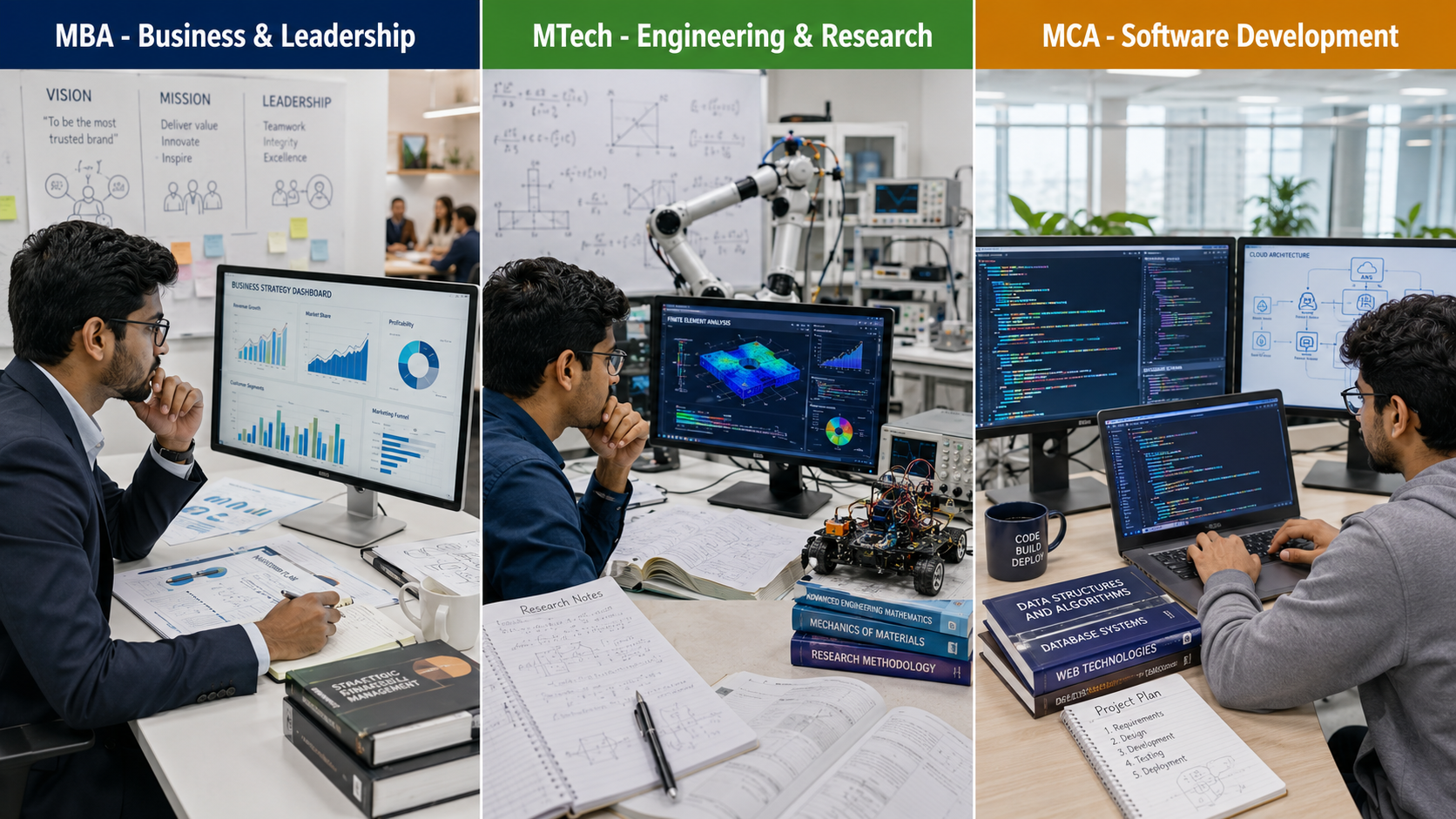
An MBA focuses entirely on modern business management, strategic thinking, and corporate leadership. It teaches you exactly how to run a company efficiently and profitably. Students learn absolutely essential core business concepts. These critical subjects include marketing, human resources, financial accounting, and global operations management. This specific degree is absolutely perfect if you want to climb the corporate ladder quickly.
You do not need a strict technical background to pursue an MBA. Graduates from arts, commerce, and science streams can easily apply and succeed. This broad academic accessibility makes it a highly versatile and massively popular degree globally. Furthermore, an MBA offers incredible, life-changing professional networking opportunities. During your intensive studies, you will frequently interact with future founders, visionary CEOs, and wealthy venture capitalists.
Most top-tier MBA programs rely heavily on the rigorous case-study method. This challenging approach forces you to solve real-world business problems under intense time pressure. You learn exactly how to manage public crises, negotiate massive deals, and motivate large teams. Ultimately, an MBA actively transforms you from an individual contributor into a decisive, visionary organizational leader.
The MTech Path: Deep Engineering
An MTech represents a highly specialized, incredibly rigorous engineering degree. Universities design this program specifically for students who already hold a BTech or BE degree. This intense academic program dives deep into core technical subjects and complex mathematical models. You can choose to specialize in incredibly advanced, futuristic fields. These exciting specializations include Artificial Intelligence, Structural Engineering, Thermal Dynamics, or VLSI circuit design.
The standard MTech curriculum involves extremely heavy academic research. Students must complete complex thesis work and proudly publish technical research papers. It remains the absolute best choice if you desperately want to become a recognized technical subject matter expert. Many successful MTech graduates go on to work in highly innovative Research and Development (R&D) laboratories.
Others actively pursue a prestigious Ph.D. and enthusiastically enter the respected academic teaching world. The daily coursework demands extreme personal dedication and a strong grasp of foundational physics and mathematics. You will certainly spend countless late hours in quiet laboratories testing novel hypotheses. Therefore, you should only choose this specific path if you genuinely love engineering and strongly wish to push the boundaries of modern science.
The MCA Path: Software Development
An MCA perfectly bridges the gap between basic academic science and the massive commercial IT industry. It focuses heavily on practical software development and complex corporate database management. During this dynamic program, you will thoroughly learn multiple modern programming languages. These vital languages include Java, Python, C++, and advanced modern web technologies.
This particular degree is absolutely perfect for students who passionately want to build software but completely lack a formal engineering background. Graduates holding a Bachelor of Computer Applications (BCA) or a B.Sc. typically pursue this direct educational route. Massive technology companies hire talented MCA graduates for technical roles absolutely identical to computer science engineers. You can easily become a highly paid full-stack developer, software engineer, or technical systems analyst.
The core coursework emphasizes heavy hands-on coding, efficient algorithm design, and modern software lifecycle management. You will build actual functioning software projects and thoroughly learn agile development methodologies. Unlike the heavy theoretical academic research found in an MTech, an MCA focuses strictly on practical applied technology. It prepares you entirely for immediate, highly lucrative employment in the fast-paced, ever-growing commercial software sector.
Career Paths and Earning Potential
Your future salary and daily job responsibilities depend heavily on the specific master’s degree you eventually choose. Before actively committing to an expensive program, you must carefully evaluate the current global job market. The modern economy heavily rewards highly skilled professionals, but basic compensation structures vary widely. Business managers, technical researchers, and software coders experience very different financial salary growth trajectories.
In general, top management salaries scale exponentially as you quickly reach high executive levels. Engineering and software salaries start very high but may eventually plateau unless you actively transition into technical leadership roles. Furthermore, your exact geographic location and the prestigious reputation of your university play massive roles in determining your initial starting pay.
Top-tier educational institutions easily attract premier global companies offering massive financial signing bonuses. Mid-tier public colleges provide stable, respectable starting salaries that naturally grow steadily with practical experience. Let us now deeply explore the typical distinct career trajectories, expected long-term job security, and specific financial rewards for each of these three distinct educational paths.
Opportunities After an MBA
MBA graduates often easily secure incredibly lucrative roles across various massive global industries. They typically work passionately as Product Managers, Management Consultants, or Corporate Financial Analysts. Top management consulting firms like McKinsey and major global investment banks actively hire them. Massive tech giants like Google and Amazon also heavily recruit sharp MBA talent to lead complex digital product teams.
The lifelong earning potential remains virtually limitless in the fast-paced private corporate sector. Your annual salary directly reflects your unique ability to generate revenue or successfully streamline business operations. Moreover, an MBA accurately teaches you exactly how to scale a small regional business into a massive global enterprise.
Consequently, many bright management graduates eventually launch their own highly successful startup companies. They deeply understand how to secure venture capital, aggressively market products, and manage daily cash flow effectively. Even during tough economic downturns, panicked companies desperately need capable leaders to safely navigate financial crises. Therefore, a top-tier MBA essentially provides incredibly strong job security, high social prestige, and rapid long-term career advancement.
Opportunities After an MTech
MTech graduates easily find incredibly stable, highly respected roles in both the private and public employment sectors. They primarily work quietly as Principal Engineers, R&D Scientists, or Senior Technical Architects. Core traditional engineering companies heavily value this specialized, incredibly deep degree immensely. The initial starting salary remains very competitive, and the lifelong job security is exceptionally high.
Highly technical experts frankly face significantly less career risk during unexpected global economic downturns. Global manufacturing, modern automotive, and massive tech companies always desperately need specialized technical engineers. These dedicated professionals carefully build and reliably maintain vital core technological infrastructure. Additionally, an MTech easily opens doors to highly lucrative government sector jobs and major public sector undertakings (PSUs).
Many top graduates secure incredible roles in national space agencies, secret defense research organizations, and public energy departments. If you personally prefer the quiet academic route, an MTech perfectly serves as the essential stepping stone to a university professorship. You can happily teach young undergraduate students while actively conducting fully funded scientific research. Ultimately, an MTech guarantees a highly respected, intellectually fulfilling, and extremely financially secure career.
Opportunities After an MCA
MCA graduates thrive almost exclusively within the absolutely booming global IT industry. They work primarily as Senior Software Engineers, Enterprise Cloud Architects, and Corporate Database Administrators. Massive multinational IT giants aggressively recruit fresh MCA talent every single academic year. Rapidly growing startup companies also love hiring young MCA graduates for their highly practical, hands-on daily coding skills.
The initial starting salaries in commercial software remain genuinely excellent worldwide. As you quickly gain practical, real-world programming experience, your salary rapidly matches that of elite computer science engineers. Furthermore, the modern commercial software industry expands consistently and massively every single year. Every single modern business now absolutely requires an interactive online presence, custom internal software, and robust corporate cybersecurity.
This massive universal demand directly ensures fantastic, incredibly long-term job security for smart MCA degree holders. Additionally, the modern software sector confidently offers incredible daily workplace flexibility. Many lucky MCA graduates currently enjoy full-time remote work options, highly flexible hours, and amazing global freelance opportunities. If you master the absolute right modern programming languages, major companies worldwide will fiercely compete to hire you.
How to Make Your Final Choice in the MBA vs MTech vs MCA Debate
Choosing between MBA vs MTech vs MCA requires honest self-reflection and a clear understanding of your long-term career goals. While comparing MBA vs MTech vs MCA, start by identifying the type of work that genuinely interests you.
If you enjoy coding, software development, and solving logical problems, MCA can be an excellent choice. When evaluating MBA vs MTech vs MCA, MCA is often preferred by students who want to build careers in software engineering, application development, and IT services.
If you are passionate about engineering, research, innovation, or developing advanced technical solutions, MTech may be the better option. In the MBA vs MTech vs MCA comparison, MTech is best suited for students who want to deepen their technical expertise and pursue specialized engineering roles.
If you are interested in business management, leadership, marketing, finance, consulting, or entrepreneurship, an MBA may be the right path. The MBA vs MTech vs MCA decision often favors MBA for individuals who want managerial responsibilities and faster progression into leadership positions.
Another important factor in the MBA vs MTech vs MCA comparison is eligibility. MTech programs generally require an engineering degree. MBA programs accept graduates from most academic disciplines, while MCA programs usually require mathematics at the school or undergraduate level. Before making your final MBA vs MTech vs MCA decision, carefully review the eligibility requirements, curriculum, placement records, and career opportunities offered by your target institutions.
FAQ Section
Can I do an MBA after completing an MCA or MTech?
Yes, absolutely. Many successful technical professionals pursue an MBA after completely finishing an MCA or MTech. This specific dual-degree combination proves highly valuable in the modern corporate world. Your initial technical degree gives you incredibly deep domain knowledge. The MBA actively provides the essential leadership skills needed to effectively manage large technical teams. Global companies absolutely love hiring these rare “techno-managers.” They can effortlessly understand complex software code and easily explain it to non-technical business clients.
Which degree offers the highest starting salary?
Generally, a prestigious MBA from a top-tier global business school offers the absolute highest initial starting salary. Elite management consultants and sharp investment bankers earn premium financial compensation packages immediately. However, an MTech or MCA from a highly premier technical institute can also easily yield massive starting salaries. Top global tech companies pay genius software engineers and senior R&D scientists exceptionally well. Ultimately, your pure personal skills matter significantly more than the specific written degree.
Is an MCA equal to a BTech or MTech degree?
An MCA generally acts exactly equivalent to a standard BTech in Computer Science when actively applying for corporate software jobs. Both excellent degrees properly prepare you for lucrative roles like Software Developer or IT Systems Analyst. However, an MCA proudly represents a master’s degree, while a standard BTech strictly remains a bachelor’s degree. An MTech confidently represents a massive academic step above both in terms of strict, highly rigorous technical specialization.
Do I need a strong technical background to pursue an MBA?
No, you absolutely do not need a deep technical background to successfully pursue an MBA. Motivated students from general commerce, traditional arts, broad humanities, and basic science backgrounds regularly enroll in top MBA programs. The core curriculum covers fundamental, highly practical business concepts like corporate finance, digital marketing, and strategic human resources. These specific subjects certainly do not require any prior engineering knowledge at all. Your uniquely diverse undergraduate background can actually provide a massive competitive advantage during complex case studies.
Is an MTech harder to complete than an MCA?
The relative difficulty of any academic degree completely depends entirely on your unique personal interests. If you deeply love advanced mathematics and core physical engineering concepts, you might actually find an MTech highly enjoyable. However, academic experts generally consider an MTech significantly more academically rigorous. It strictly involves writing a massive master’s thesis and independently conducting highly original scientific research. An MCA strongly focuses much more on practical, applied programming. If you genuinely enjoy simply writing code, you will likely find an MCA much easier.
How much does an MBA cost compared to an MTech or MCA?
Premier MBA programs usually cost significantly more money than standard MTech or MCA programs. Top private business schools aggressively charge massive premium tuition fees strictly due to their incredible networking value and incredibly high placement salaries. Standard MTech and MCA programs, especially at respected government-funded universities, remain much more financially affordable for average students. You should always carefully calculate your precise expected return on investment (ROI) before officially taking a massive educational loan for any of these specific degrees.
Conclusion
Choosing correctly between an MBA vs MTech vs MCA absolutely represents a massive, highly consequential life decision. There is strictly no single perfect or “best” master’s degree out there in the world. The absolute right choice completely depends entirely on your unique personal strengths, specific educational background, and massive long-term career ambitions.
If you truly want to boldly lead diverse teams, confidently drive high-level corporate business strategy, and rapidly climb the global corporate ladder, an MBA confidently stands as your absolute best option. It provides unmatched networking power and a virtually limitless financial salary ceiling. If you remain deeply passionate about core traditional engineering, advanced scientific research, and complex technical innovation, an MTech will certainly serve you perfectly. It powerfully empowers you to successfully become a genuinely respected technical subject matter expert.
Conversely, if you strongly desire to write brilliant modern code, independently build amazing software applications, and actively thrive in the massively booming global IT sector, an MCA strongly provides the absolutely ideal professional launchpad. Take the highly necessary time to thoroughly evaluate your long-term personal goals today. Strongly consider the massive financial investment actively required for each specific academic program. Look extremely closely at the detailed syllabus of your desired target universities to quickly see which specific subjects truly excite you the absolute most. By clearly understanding the unique, highly powerful advantages of each specific degree, you can easily make a highly informed, highly confident decision.