
Understanding Large Language Models: A Comprehensive Guide to Modern AI
Large Language Models have transformed how people interact with technology. As a result, they now support content creation, data analysis, coding, research, and many other tasks. These systems learn patterns from large datasets and generate language based on those patterns.
For beginners and professionals alike, understanding Large Language Models is increasingly important. It helps explain how tools such as ChatGPT, Claude, Gemini, and Llama work.
In this guide, we answer five important questions about LLMs. First, you will learn what an LLM is and how ChatGPT fits into the field. Next, we will compare LLMs, GPT models, and artificial intelligence.
You will also discover leading LLM examples, common applications, and important limitations. Finally, the FAQ covers training, new information, hallucinations, and business security.
Is ChatGPT an LLM?
ChatGPT is a conversational AI application that uses GPT-family language models. Those models, in turn, are examples of Large Language Models. ChatGPT uses the underlying model as an interactive assistant that can follow instructions and maintain a conversation.
First, an LLM learns patterns from large amounts of training data. It can then predict and generate likely sequences of tokens. Understanding tokenization for AI performance and cost helps explain how these sequences are represented and processed. As a result, it can answer questions, summarize text, translate languages, write code, and create content.
In addition, modern language models use transformer-based architectures. These architectures use self-attention to identify relationships between tokens. Therefore, models can process context across long passages more effectively. This language processing also connects to the broader Natural Language Processing pipeline used by AI systems.
ChatGPT also includes additional training and product-level systems around the underlying models. Together, these systems help improve instruction following, safety, and usability.
The Role of Conversational Fine-Tuning
Fine-tuning helps turn a general language model into a more useful assistant. For example, developers can use supervised examples and preference-based training to improve responses.
Furthermore, human feedback can help models produce more helpful and safer outputs. Other techniques can also improve instruction following and reduce undesirable behavior.
However, an LLM and a chatbot are not always the same thing. An LLM is the underlying technology. By contrast, a conversational application uses that technology with additional software, training, and controls.
What Is the Difference Between LLM and GPT?
The terms LLM and GPT describe related but different concepts. LLM stands for Large Language Model. In general, it is a broad category of models designed to process and generate human language.
GPT stands for Generative Pre-trained Transformer. It refers to a family of transformer-based language models developed by OpenAI. Therefore, GPT models belong to the broader LLM category.
To make the distinction clearer, think of LLM as a category of vehicles. GPT is then one particular vehicle family within that category.
Meanwhile, other organizations develop their own LLM families. Examples include Claude, Gemini, Llama, Qwen, and Mistral models. These models may differ in their training methods, architectures, data strategies, and deployment approaches.
In short, every GPT model is an LLM, but not every LLM is GPT. This distinction is useful when comparing AI language models and their capabilities.
Architectural Origins of GPT
GPT models use the transformer architecture. Importantly, transformers became influential because self-attention allows models to evaluate relationships between tokens efficiently.
Instead of processing language only as a strict sequence, attention lets a model weigh relevant parts of the surrounding context. As a result, this approach can improve language understanding and generation.
The original transformer architecture was introduced by researchers at Google and the University of Toronto. Later, GPT applied the architecture to large-scale language modeling.
Since then, modern models have developed far beyond early GPT systems. They may include multimodal capabilities, reasoning techniques, tool use, and larger context windows.
What Are the Top 10 LLM Models?
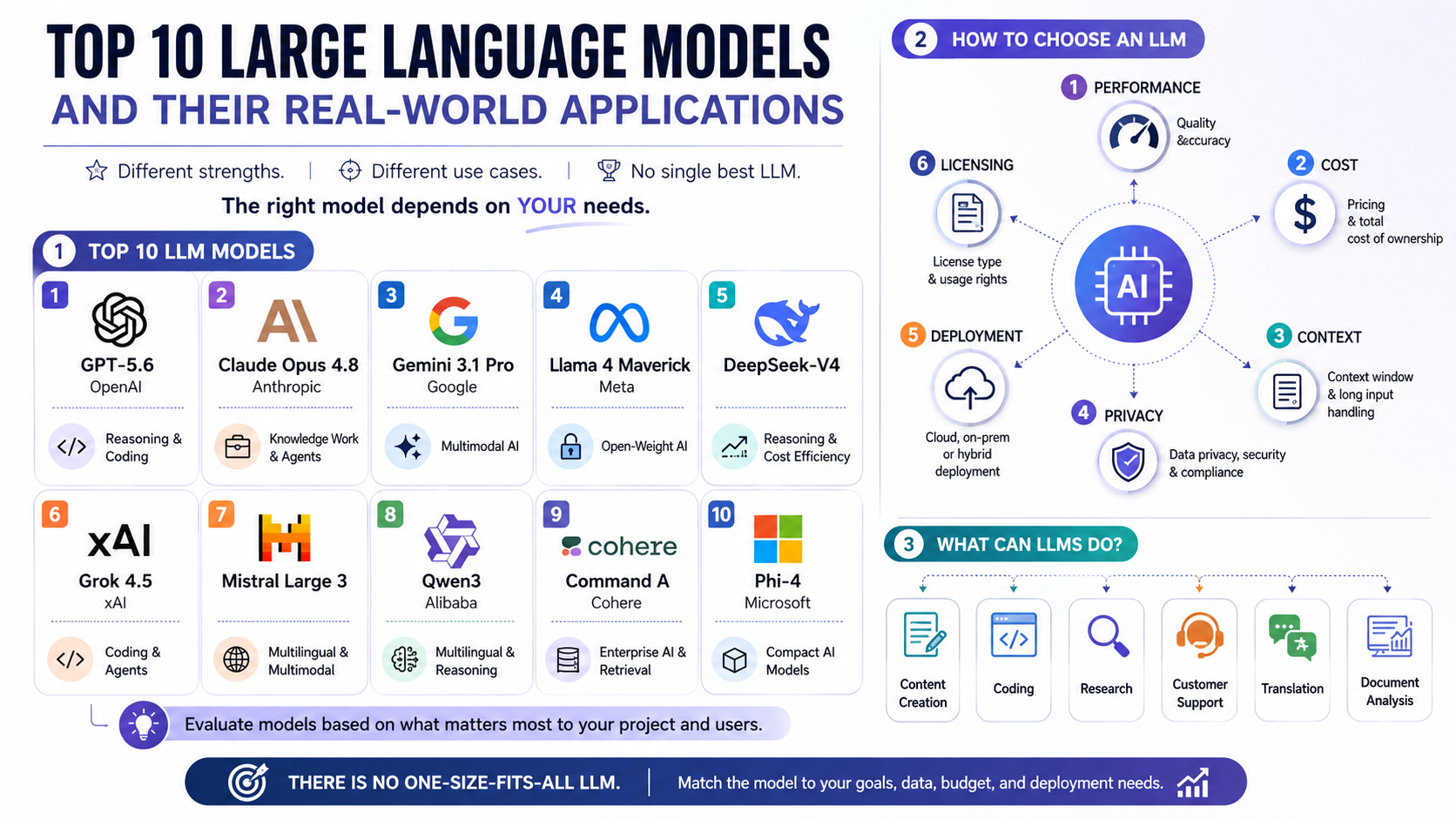
There is no universal ranking of the top LLM models. Instead, performance depends on the task, benchmark, cost, context length, deployment method, and licensing requirements.
Moreover, the LLM market changes quickly. For that reason, older lists can become outdated within months. Therefore, current examples worth evaluating include the following:
- GPT-5.6 from OpenAI for advanced reasoning and coding.
- Claude Opus 4.8 from Anthropic for complex knowledge work and agentic tasks.
- Gemini 3.1 Pro from Google for advanced multimodal workloads.
- Llama 4 Maverick from Meta for open-weight development.
- DeepSeek-V4 for reasoning and cost-conscious deployments.
- Grok 4.5 from xAI for coding, agents, and knowledge work.
- Mistral Large 3 for open-weight, multilingual, multimodal applications.
- Qwen3 from Alibaba for multilingual and reasoning workloads.
- Command A from Cohere for enterprise applications and retrieval.
- Phi-4 from Microsoft for compact language-model deployments.
Ultimately, these models serve different needs, so the “best” option depends on your specific use case.
Choosing the Right LLM
Choosing a language model requires more than comparing benchmark scores. Instead, start by identifying your application’s goals and technical requirements.
In particular, consider these factors:
- Performance: Does the model handle your most important tasks reliably?
- Cost: Can your budget support expected usage?
- Context: Can it process the documents or conversations you need?
- Privacy: Where will your data be processed and stored?
- Deployment: Do you need an API, cloud service, or local hosting?
- Licensing: Does the model’s license support your intended use?
Generally, proprietary models can offer managed infrastructure and strong general-purpose performance. On the other hand, open-weight models can provide greater control over deployment and customization, making the open-source AI vs. closed AI decision an important consideration.
Ultimately, the best choice is usually the model that fits your requirements. A larger model is not automatically better for every application.
What Are LLM Examples?
Large Language Models appear across modern software, search tools, productivity platforms, and business applications. For example, well-known examples include GPT models from OpenAI, Claude from Anthropic, Gemini from Google, and Llama from Meta. These applications are increasingly becoming part of AI-powered productivity tools.
In addition, other notable LLM families include Qwen, Mistral, DeepSeek, Cohere Command, and Microsoft’s Phi models. These systems vary in size, capabilities, licensing, context length, and deployment options.
As a result, LLMs can support many everyday and professional workflows. Common applications include AI chatbots for customer service:
- Content generation: Drafting articles, emails, summaries, and marketing copy.
- Coding: Generating, explaining, reviewing, and debugging software.
- Search and research: Summarizing information and answering questions.
- Customer support: Handling common requests through conversational systems.
- Translation: Producing multilingual content and assisting localization.
- Document analysis: Extracting information from large collections of files.
Furthermore, businesses can connect LLMs to internal knowledge bases. Retrieval-Augmented Generation can help models retrieve relevant information before generating an answer.
Enterprise and Specialized Applications
Organizations increasingly adapt LLMs for specific industries and workflows. For instance, legal teams may use them for document review. Financial teams can use them for research and structured analysis.
Similarly, healthcare organizations may apply language models to administrative and documentation tasks. However, these uses require careful validation because accuracy and compliance can be critical.
Although domain-specific data can improve performance for specialized tasks, customization does not automatically eliminate errors or hallucinations.
Therefore, organizations should combine model evaluation, access controls, monitoring, human review, and clear governance. This approach helps teams gain value while managing operational and security risks.
What’s the Difference Between LLM and AI?
Artificial Intelligence is a broad field that includes many technologies designed to perform tasks associated with human intelligence. These tasks can include perception, prediction, reasoning, planning, language processing, and decision-making.
By comparison, a Large Language Model is one type of AI system. Its primary purpose is to process and generate language. It can learn patterns from text and other training data, depending on its design.
However, AI includes many systems that are not LLMs. Computer vision models can analyze images. Robotics systems can control physical machines. Recommendation systems can predict user preferences. Likewise, traditional machine-learning systems can perform classification and forecasting.
This relationship is easier to understand as a hierarchy. In simple terms, AI is the broad category, while LLMs are a specialized part of that category.
As a result, understanding this distinction prevents common terminology mistakes. ChatGPT is an AI application that uses language models. GPT is a family of LLMs. Meanwhile, AI includes many technologies beyond language generation.
The Broader Scope of Artificial Intelligence
Artificial intelligence extends well beyond text generation. For example, modern AI can interpret images, recognize speech, recommend content, control robots, and support autonomous systems.
In addition, computer vision can support image analysis, while AI systems can assist with navigation. Chess engines also demonstrate AI capabilities without relying on conversational language models.
At the same time, some modern models are multimodal. They can process combinations of text, images, audio, or other inputs. Consequently, the boundaries between language systems and broader AI applications continue to evolve.
Nevertheless, the basic distinction remains useful. LLMs focus primarily on language, while artificial intelligence covers a much wider range of intelligent systems.
Ultimately, knowing this hierarchy makes technical discussions easier. It also helps users choose the right technology for a particular problem.
Frequently Asked Questions About Large Language Models
How are Large Language Models trained?
Large Language Models are trained using massive datasets containing books, articles, websites, and code repositories. During the initial pre-training phase, the neural network learns to predict the next word in a sentence across billions of examples. Following this unsupervised phase, developers use supervised fine-tuning and human feedback to align the model’s behavior, ensuring it provides helpful, safe, and accurate responses to user queries.
Can Large Language Models learn new information after training?
Traditional Large Language Models cannot permanently update their core internal knowledge weights after their training cutoff without retraining. However, developers overcome this limitation using techniques like Retrieval-Augmented Generation. This method connects the model to external databases or live web search tools, allowing it to retrieve up-to-date facts and incorporate current information directly into its conversational responses instantly.
What causes hallucinations in Large Language Models?
Hallucinations occur because these models operate on statistical probability rather than factual lookup databases. When prompted with ambiguous or unfamiliar topics, the system predicts words that sound plausible and grammatically correct based on its training patterns rather than verifying objective truth. Developers continuously work to minimize these errors through common AI mistakes and better practices, better training data curation, reasoning frameworks, and external verification mechanisms.
Are open-source Large Language Models secure for business use?
Open-source or open-weights models offer high security for businesses because companies can host the software on their own private servers. This ensures that sensitive corporate data never leaves the organization’s internal infrastructure, satisfying strict regulatory and privacy requirements. However, organizations must still manage model vulnerabilities, prompt injection risks, and ensure proper internal governance when deploying these systems.
Conclusion: Why Large Language Models Matter for Modern AI
Large Language Models have changed how people interact with digital information. They can generate text, summarize documents, assist with coding, translate languages, and support many other workflows.
Understanding these systems starts with a few important distinctions. An LLM is a type of AI technology focused on language. GPT is a specific family of LLMs. ChatGPT is a conversational application built around language models.
The LLM landscape continues to evolve quickly. New models introduce improvements in reasoning, coding, multimodal processing, context handling, efficiency, and agentic capabilities.
Choosing the right model therefore requires more than looking for a single “best” option. Consider performance, cost, privacy, deployment, context requirements, licensing, and your specific workflow.
It is equally important to understand limitations. LLMs can hallucinate, rely on outdated information, and require additional safeguards for sensitive applications.
With realistic expectations and responsible deployment, Large Language Models can become powerful tools for productivity, research, software development, and business innovation.