
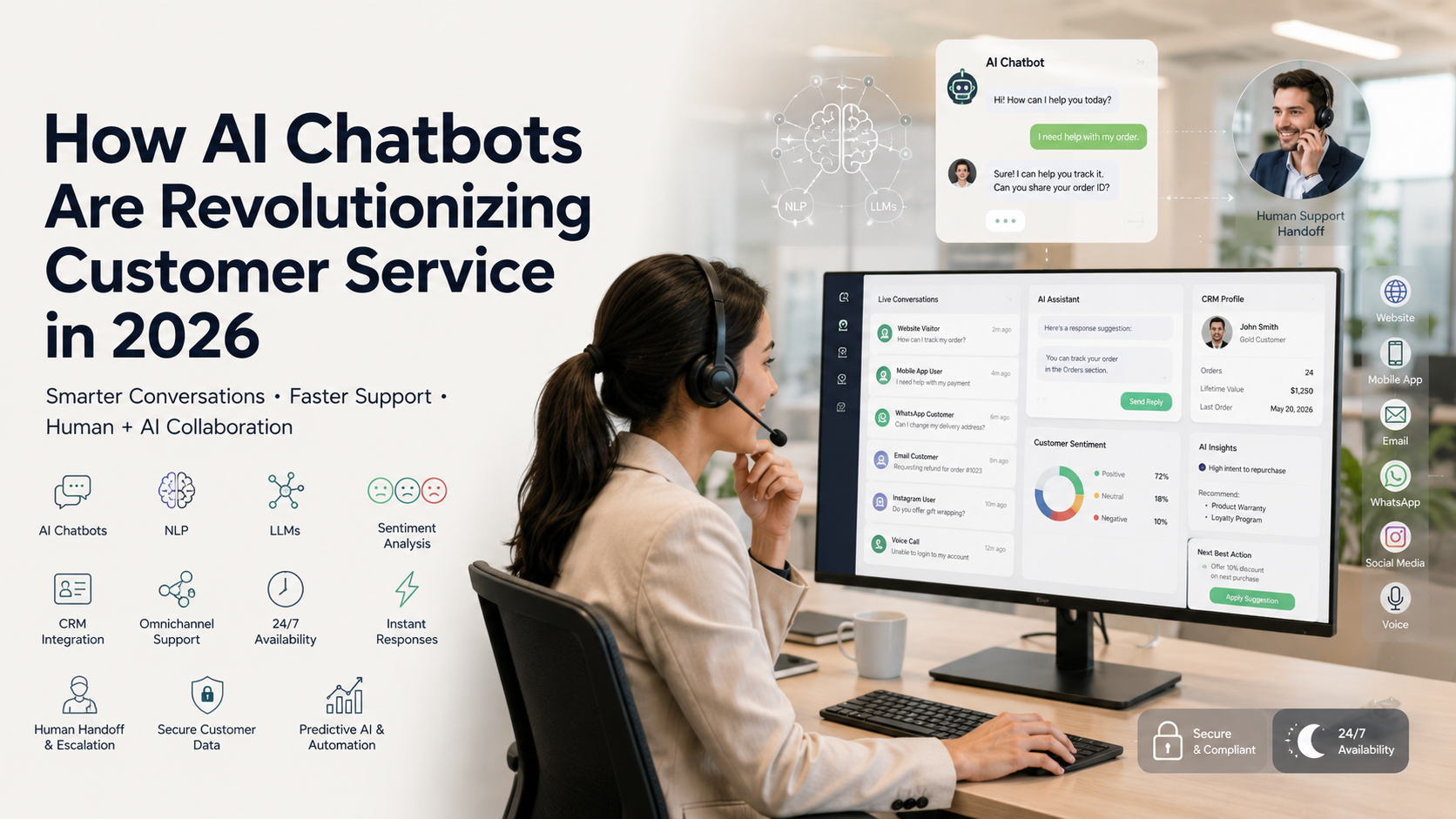
How AI Chatbots Are Revolutionizing Customer Service in 2026
The customer support industry has changed dramatically over the past few years. Today, AI chatbots are revolutionizing customer service by transforming how businesses communicate with their customers. Instead of relying on scripted responses, modern AI assistants understand context, recognize intent, and provide accurate answers within seconds.
Recent advances in generative AI and natural language processing (NLP) have made conversational systems far more capable than traditional chatbots. These advancements in artificial intelligence are helping businesses create more natural and intelligent customer interactions. For example, research and developments in generative AI from organizations like OpenAI have accelerated the adoption of advanced conversational systems.
Customer expectations have also evolved. Long wait times and repetitive automated menus no longer meet modern standards. People expect fast, personalized assistance regardless of the time or communication channel.
This article explains how AI-powered customer support works, why it outperforms older automation systems, and how organizations use conversational AI to improve customer satisfaction, reduce costs, and strengthen long-term loyalty.
Why AI Chatbots Are Revolutionizing Customer Service Today

The biggest reason AI chatbots are revolutionizing customer service is their ability to understand people instead of simply matching keywords. Traditional chatbots followed rigid decision trees and predefined scripts. Even a small change in wording could confuse the system and prevent it from providing a useful answer.
Modern conversational AI works differently. Using natural language processing, machine learning, and large language models, these systems understand context, intent, and conversational flow. They recognize different ways customers ask the same question and respond with relevant, personalized information.
Businesses also benefit from faster response times and greater operational efficiency. AI assistants can manage thousands of conversations simultaneously without delays. This allows support teams to focus on complex cases that require human judgment or empathy.
Additional benefits include:
- Instant responses to common customer questions.
- Personalized conversations based on previous interactions.
- Consistent service quality across every communication channel.
- Lower operational costs through intelligent automation.
- Improved customer satisfaction with faster issue resolution.
Rather than replacing human agents, modern AI works alongside them. It automates repetitive requests while escalating sensitive or complicated issues to experienced support staff. This balanced approach creates a faster, more efficient, and customer-focused support experience.
True 24/7 Availability Without Burnout
One of the greatest strengths of AI-powered customer support is continuous availability. Human agents require breaks, vacations, and shift changes. AI chatbots, however, provide reliable assistance every hour of the day without interruptions.
Customers no longer have to wait until business hours to receive help. Whether they need to track an order, reset a password, or find product information, an AI assistant can respond immediately. This constant availability improves customer confidence and reduces frustration.
During seasonal sales or unexpected traffic spikes, AI systems scale effortlessly. Instead of forcing customers into long queues, they handle thousands of conversations at once while maintaining consistent response quality. Businesses can therefore deliver dependable service even during their busiest periods.
Continuous support also helps global organizations serve customers across multiple time zones. Regardless of location, users receive quick and accurate assistance whenever they need it.
Drastic Reductions in Wait Times
Long wait times remain one of the biggest causes of customer dissatisfaction. Traditional support centers often struggle during busy periods, leaving customers waiting several minutes or even hours for assistance.
Modern AI chatbots eliminate much of this delay by responding instantly. They identify customer intent, retrieve relevant information, and deliver accurate answers within seconds. Even when an issue requires human involvement, AI gathers important details before transferring the conversation, allowing support agents to resolve problems more quickly.
Faster responses also improve key business metrics. Customers are less likely to abandon purchases, leave negative reviews, or contact support repeatedly for the same issue.
By reducing queues and accelerating issue resolution, AI-powered customer service creates a smoother experience for both customers and support teams. Organizations benefit from higher efficiency, while customers receive the fast, reliable assistance they increasingly expect.
Key Technologies Driving Modern Conversational Support
The rapid growth of AI chatbots comes from several technologies working together rather than a single innovation. Modern conversational systems combine natural language processing (NLP), machine learning, large language models (LLMs), sentiment analysis, and CRM integration to deliver fast and personalized support. Unlike older rule-based chatbots, today’s AI assistants understand context, remember previous interactions, and provide responses that match the customer’s intent.
These platforms also connect with internal business systems, allowing them to retrieve account details, order information, and product documentation in real time. As a result, customers receive accurate answers without switching between multiple support channels.
When implemented correctly, these technologies improve response accuracy, reduce support costs, and create a smoother customer experience. They also help businesses scale customer service while maintaining consistency across websites, mobile apps, email, social media, and messaging platforms.
Natural Language Processing and Sentiment Analysis
Natural language processing (NLP) enables AI chatbots to understand how people naturally communicate. Instead of relying on exact keywords, modern systems analyze sentence structure, intent, and conversational context. This allows them to answer questions accurately, even when customers use informal language, spelling mistakes, or different phrasing.
Sentiment analysis adds another layer of intelligence. The AI evaluates emotional cues within a conversation to determine whether a customer feels satisfied, confused, or frustrated. Based on that assessment, it adjusts its tone or recommends escalating the conversation to a human representative.
A typical workflow looks like this:
Customer Query
        │
        ▼
Sentiment Analysis Engine
        │
        ├── Positive or Neutral → AI Generates Helpful Response
        │
        └── Negative or Urgent → Escalate to Human Agent
This combination creates more natural conversations, improves customer satisfaction, and helps businesses resolve sensitive issues before they become larger problems.
Deep CRM Integration
Modern AI chatbots become significantly more powerful when connected to a Customer Relationship Management (CRM) platform. Instead of treating every interaction as a new conversation, the chatbot accesses customer history to provide faster and more personalized assistance.
When a customer starts a conversation, the AI can securely retrieve details such as previous purchases, support tickets, subscription status, warranties, and communication preferences. This eliminates repetitive questions and creates a seamless support experience.
CRM integration also enables chatbots to perform routine actions automatically. Depending on business permissions, they can update account information, check delivery status, schedule appointments, create support tickets, or initiate refund requests without requiring manual intervention.
For support teams, this integration reduces repetitive work and improves productivity. Customers benefit from quicker resolutions and personalized service, while businesses gain valuable insights into customer behavior and support performance. The result is a more efficient, data-driven customer service operation that strengthens long-term customer relationships.
Overcoming the Challenges of Automated Support
Although AI chatbots are revolutionizing customer service, successful implementation requires careful planning and ongoing management. Businesses cannot rely on automation alone. They must ensure their AI systems deliver accurate information, protect customer data, and know when human intervention is necessary. A poorly trained chatbot can frustrate customers just as quickly as outdated support systems.
Organizations overcome these challenges by building AI solutions on trusted knowledge sources, monitoring performance regularly, and continuously refining responses based on customer feedback. Clear escalation policies also ensure that complex or sensitive issues reach experienced support agents without unnecessary delays.
The most effective customer service strategies combine the speed of AI with the judgment and empathy of human representatives. This hybrid approach improves customer satisfaction, reduces operational costs, and builds trust while maintaining the consistency that modern customers expect from every interaction.
Eliminating Hallucinations and Errors
One challenge facing generative AI is the possibility of hallucinations, where a model generates incorrect or unsupported information. While these errors have become less common, businesses still need safeguards to maintain customer trust and ensure accurate support.
Many organizations address this challenge with Retrieval-Augmented Generation (RAG). Instead of relying solely on the AI model’s internal knowledge, RAG retrieves information from verified company resources, such as product manuals, knowledge bases, FAQs, and policy documents. The chatbot then uses those trusted sources to generate accurate, context-aware responses.
Additional best practices include:
- Using verified internal documentation as the primary knowledge source.
- Reviewing AI conversations regularly to identify inaccuracies.
- Updating knowledge bases whenever products or policies change.
- Monitoring performance metrics to improve response quality.
These safeguards significantly reduce misinformation and help businesses provide reliable, consistent customer support.
Knowing When to Escalate to Humans
Even the most advanced AI cannot solve every customer problem. Some situations require human judgment, emotional intelligence, or specialized expertise. For this reason, successful AI implementations include clear escalation rules that determine when a conversation should move to a live support agent.
Escalation may be necessary when customers express frustration, request exceptions to company policies, discuss billing disputes, or describe complex technical issues. AI can recognize these situations through sentiment analysis, conversation history, and confidence scoring before transferring the chat with all relevant details.
A smooth handoff is essential. Customers should not have to repeat their information after the transfer. Instead, the human representative receives the complete conversation history, allowing them to continue the discussion without interruption.
By combining intelligent automation with skilled human support, businesses deliver faster resolutions while preserving the empathy and personal attention that customers value during more challenging interactions.
Future Trends in Automated Client Relations
The future of AI chatbots extends far beyond answering customer questions. As technology advances, AI chatbots are revolutionizing customer service by becoming more proactive, predictive, and deeply integrated into business operations. Instead of waiting for customers to report problems, intelligent systems will identify potential issues early and recommend solutions before frustration develops.
Advances in generative AI, machine learning, and predictive analytics will also improve personalization. AI assistants will analyze customer preferences, previous interactions, and behavioral patterns to deliver more relevant recommendations and support. This approach creates faster resolutions while strengthening customer relationships.
Businesses will continue adopting conversational AI across websites, mobile apps, messaging platforms, and voice assistants. As these systems become more capable, organizations that combine automation with human expertise will be better positioned to improve customer satisfaction, increase operational efficiency, and build long-term customer loyalty.
Proactive Problem Solving
Traditional customer service reacts after a customer reports a problem. Modern AI is shifting toward a proactive approach by identifying issues before they become major concerns. This change helps businesses resolve problems earlier and creates a smoother customer experience.
For example, an AI assistant can detect a failed payment, delayed shipment, or repeated login error. Instead of waiting for the customer to seek help, it can automatically start a conversation with helpful guidance or recommend the next best action. Early intervention reduces frustration and often prevents additional support requests.
Proactive AI also benefits businesses by monitoring patterns across thousands of interactions. It can identify recurring issues, highlight product defects, and alert support teams before problems affect a larger group of customers. By preventing issues instead of simply responding to them, organizations improve customer satisfaction while reducing support costs and operational workload.
Omnichannel Fluidity
Today’s customers expect consistent support regardless of how they contact a business. They may begin a conversation on a website, continue it through WhatsApp, and finish it by email or live chat. Modern AI-powered customer service maintains context across these channels, creating a seamless experience.
An integrated AI platform stores conversation history, customer preferences, and previous interactions in real time. Customers no longer need to repeat the same information whenever they switch devices or communication channels. This continuity reduces frustration and helps support teams resolve issues more efficiently.
An effective omnichannel strategy typically includes:
- Website live chat
- Mobile applications
- Email support
- WhatsApp and other messaging apps
- Social media messaging
- Voice assistants and contact centers
By connecting every touchpoint, businesses deliver faster, more personalized support while creating a consistent brand experience across the entire customer journey.
Frequently Asked Questions
How are AI chatbots revolutionizing customer service compared to older automated systems?
Traditional chatbots relied on predefined rules and keyword matching. If customers used unexpected wording, the system often failed to provide a helpful response. Modern AI chatbots use natural language processing (NLP) and large language models (LLMs) to understand intent, context, and conversational flow. They recognize different ways people ask the same question and respond naturally.
These intelligent systems also learn from previous interactions and connect with business applications such as CRM platforms, order management systems, and knowledge bases. This allows them to complete tasks like tracking orders, processing refunds, updating account details, or answering product questions with greater accuracy. As a result, AI chatbots are revolutionizing customer service by delivering faster, more personalized, and more reliable customer support than traditional automation.
Will conversational AI completely replace human support agents?
No. Conversational AI is designed to support human agents rather than replace them. AI performs best when handling repetitive, high-volume tasks such as password resets, appointment scheduling, order tracking, and frequently asked questions. These automated interactions reduce workloads and allow support teams to focus on more valuable customer conversations.
Human representatives remain essential for situations involving emotional sensitivity, complex troubleshooting, policy exceptions, or strategic decision-making. Modern customer service works best as a hybrid model where AI manages routine requests while experienced agents resolve more challenging cases.
This collaboration improves efficiency without sacrificing empathy. Customers receive faster responses for simple questions and personalized attention whenever human expertise is required.
How do modern business chatbots protect customer data and privacy?
Security and privacy are essential components of enterprise AI solutions. Modern AI-powered customer service platforms protect customer information through encryption, secure authentication, and strict access controls. These safeguards help prevent unauthorized access to sensitive business and customer data.
Many organizations also comply with regulations such as GDPR, CCPA, and other regional privacy laws. Businesses can configure AI systems to automatically detect and redact sensitive information, including payment details and personal identifiers, before storing conversation records.
Regular security audits, permission controls, and monitored access further strengthen data protection. By combining advanced security practices with responsible AI governance, organizations build customer trust while maintaining compliance with industry standards.
Can small businesses afford to implement advanced AI support tools?
Yes. Modern AI customer support solutions are more affordable than ever. Many cloud-based providers offer flexible subscription plans based on conversation volume, allowing businesses to scale as they grow without large upfront investments.
No-code and low-code platforms have also reduced implementation costs. Small businesses can build intelligent chatbots, connect them with existing software, and automate common customer requests without hiring large development teams.
Beyond affordability, AI often delivers measurable returns through reduced support costs, faster response times, and improved customer satisfaction. Even small organizations can provide around-the-clock support that previously required much larger customer service departments.
What is the best way to train an AI assistant for accurate customer interactions?
An effective AI assistant depends on high-quality training data and continuous improvement. Businesses should build their knowledge base using verified sources, including product documentation, company policies, historical support conversations, and frequently asked questions. Accurate information leads to more reliable customer responses.
Training does not end after deployment. Organizations should regularly review AI conversations, monitor customer feedback, identify inaccurate responses, and update documentation whenever products or policies change. Performance metrics also help identify opportunities for improvement.
Many businesses combine these practices with Retrieval-Augmented Generation (RAG), enabling AI to retrieve answers from trusted internal resources instead of generating unsupported information. This approach improves accuracy while maintaining consistent customer experiences.
Conclusion
The evolution of customer support makes one thing clear: AI chatbots are revolutionizing customer service by setting new standards for speed, accuracy, and personalization. Modern conversational AI helps businesses respond instantly, automate repetitive tasks, and deliver consistent support across multiple channels. As customer expectations continue to rise, organizations that embrace intelligent automation will be better prepared to provide exceptional service at scale.
Businesses looking to understand the role of AI assistants can explore this detailed AI chatbots guide for businesses to learn how conversational tools improve customer interactions and operational efficiency.
At the same time, successful customer service is not about replacing people. The most effective strategies combine AI efficiency with human empathy and expertise. While chatbots handle routine inquiries, human agents focus on complex situations that require judgment, creativity, or emotional understanding. This balanced approach improves customer satisfaction while making support teams more productive.
Understanding the differences between automation and human expertise is essential. A detailed comparison of AI chatbots vs human customer support explains how businesses can create a hybrid support model that combines technology with human problem-solving.
Looking ahead, advances in natural language processing, predictive analytics, and generative AI will further enhance conversational support. Businesses that invest in secure, well-trained AI systems and maintain accurate knowledge bases will gain a competitive advantage. By integrating AI with existing workflows and continuously refining performance, organizations can build stronger customer relationships, reduce operational costs, and create support experiences that meet the demands of 2026 and beyond.